NEGOTIATION
SKILLS
BY: ANTHONY AJAYI
DATE: FRIDAY 6TH JANUARY,2017
Outline
• Introduction
• Explain What is Negotiation
• The Need for Negotiation
• Explain the Basic Principles of Negotiation
• The Art of Negotiation
• Describe the Benefits of Negotiation
• Types of Negotiation Strategies
• Conclusion
Globus Inc. is a
leading IT giant. Peter
Looney is a Project
Manager in Globus
Inc. He is responsible
for meeting the
clients for every new
software development
project that comes to
Globus.
INTRODUCTION
Introduction contd
Maxwell
Telecommunication
a leading Telecom
Service company
recently came to
Globus to have new
SAP based
database software
to be developed for
them.
Introduction contd
Peter carefully reviewed
and analyzed Maxwell’s
requirements and came
up with a Project Plan.
Introduction contd
Now, the only thing that
Peter needed to go ahead
with starting the project
and develop the software
was the client’s approval
of the Project Plan.
Introduction contd
Peter held a meeting with the
clients to discuss the Project
Plan and gain overall approval
for the terms and conditions of
the Project.
Introduction contd
The client was in a hurry to get
the software. Peter tried to
negotiate upon broader
deadlines but due to client’s
pressure, he ultimately agreed
to finish the project as per their
requested deadlines.
Introduction contd
When the project was
under progress, Peter and
his team realized that the
deadlines that he had
agreed upon are nearly
impossible to meet.
Introduction contd
Peter and his team were
not able to complete the
project as was promised to
the client due to which
Globus had to pay some
penalty for late delivery.
Introduction contd
Also, the client added new
requirements that had to be
incorporated in the software.
However, Peter had not negotiated
about the terms with the client for
any further enhancements or
features being added to the
software.
Introduction contd
Hence, Globus had to incur a loss
in the project because the scope of
work had increased but the terms
of the project had not been well
negotiated.
Introduction contd
Also, Peter’s team was
forced to work 7-days, even
from home to try to
complete the project.
Introduction contd
Introduction contd
Introduction contd
Introduction contd
Introduction contd
Thus, you can see
that ‘negotiation
skills’ are a must for
anyone to succeed
when dealing with
people.
What is negotiation?
• Negotiation is a discussion between two parties to find
out the solution and for the purpose of reaching a joint
agreement about differing needs or opinions.
• It involves using the art of ‘persuasion’ to get others to
understand and agree with your viewpoint. It works
best when an individual has a win-win attitude.
What is Negotiation?
• The key skills that are involved in a successful
negotiation are that of good communication skills,
sales and marketing skills, good psychological
analytical skills, sociology skills, assertiveness and
conflict resolution skills.
• Therefore, negotiations may take place between
various kinds of different people such as between a
customer and seller, a boss and employee, two
business partners, a diplomat or a civil servant and a
foreign diplomat, between spouses, between friends
and between parents and children.
Need for Negotiation
No two people are exactly same.
Therefore, each and every individual
thinks and behaves differently in different
situations and has different needs, wants,
beliefs and aims. It is this basic difference
between people that gives rise to
disagreement and conflict from time-to-
time.
Moreover, to mutually co-exist with each
other at personal, professional as well as
business level, it is important that these
conflicts and disagreements should be
resolved.
Need for Negotiation
This is because conflicts may lead to
argument and resentment which may result
in one or all of the involved parties feeling
unhappy.
Hence, negotiation helps everyone involved
to seek a common ground of agreement
between the disagreements and also meet
their individual objectives.
Basic Principles of Negotiation
There are a few common basic principles that apply to all types of negotiations and in all
situations. Some of the basic principles of negotiation are as follows:
Basic Principles of Negotiation
There are a few common basic principles that apply to all types of negotiations and in all
situations. Some of the basic principles of negotiation are as follows:
Basic Principles of Negotiation
Every negotiation
process involves
compromise or change
of opinion of one or
both parties in order to
reach an acceptable
final agreement.
The Art of Negotiation
Negotiation is an art; you can get better and
better with it.
If you feel that you don’t have an innate talent
for negotiations, don’t be disappointed
because these skills can be honed and
developed with the proper training and
practice.
People who always speak good things may feel
that they are good negotiators, but that is not
always the case. Negotiation is all about
understanding what you want and what the
other person wants, and then coming up with a
win-win scenario.
The Art of Negotiation
Negotiation happens everywhere – it’s omnipresent. You
may have to negotiate over anything – right from the
deadlines of a project to which person will do what
chores at home.
In the real world, it is sometimes difficult to ascertain
whether your negotiation is good or bad. You may think
that you are a good negotiator, but in reality, it may be
just the opposite.
Even before you negotiate, you will have to know what
can be negotiated and what cannot be negotiated.
BENEFIT OF NEGOTIATION
Good negotiations
help you to gain
better control in
business as well as
personal
situations.
They help you to identify
and understand you’re as
well as the other parties’
interests and also
understand the
differences between both.
It helps to reach a‘Win
Win’ Solution,which is
mutually beneficial to
all the parties involved
in a negotiation.
Good
negotiations
also help to
improve
interpersonal
relationships.
The following are some of the
benefits of negotiations
They help to
develop and
maintain an
overall
harmonious and
thriving
interpersonal
environment.
It is one of the
easiest and
quickest ways
to solve
conflicts and
disagreements.
Negotiations help to
reduces stress and
frustration among
two conflicting
individuals.
Negotiations help to reach an
agreement in cases where a
dead-end may be reached if a
consensus is not established
between two differing needs,
wants or opinions.
Types of Negotiation Strategies
Let’s look at each in detail
There are two main types of negotiation strategies
which are as follows:
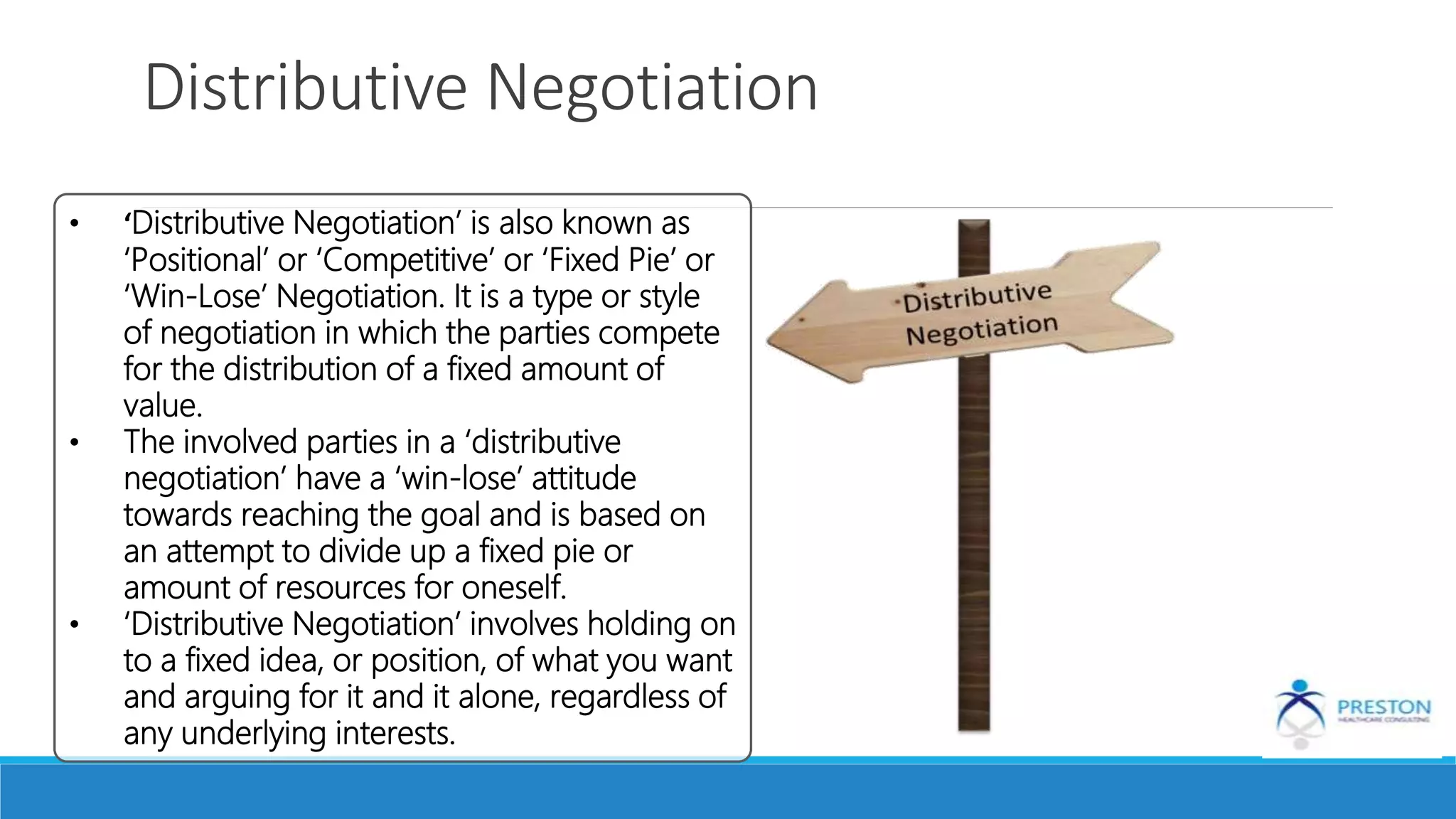
• ‘Distributive Negotiation’ is also known as
‘Positional’ or ‘Competitive’ or ‘Fixed Pie’ or
‘Win-Lose’ Negotiation. It is a type or style
of negotiation in which the parties compete
for the distribution of a fixed amount of
value.
• The involved parties in a ‘distributive
negotiation’ have a ‘win-lose’ attitude
towards reaching the goal and is based on
an attempt to divide up a fixed pie or
amount of resources for oneself.
• ‘Distributive Negotiation’ involves holding on
to a fixed idea, or position, of what you want
and arguing for it and it alone, regardless of
any underlying interests.
Distributive Negotiation
The main focus in such a type of negotiation strategy is on achieving immediate
goals, with little or no regard for building future relationships. Generally, no new
creative solution is reached in such negotiations as the parties spend least
possible time and energy in resolving the conflict. The outcome of the
negotiation is reached by presentation of fixed solutions and a decision or choice
is made quickly.
Integrative Negotiation
• ‘Integrative Negotiation’ is also known as
‘Interest-based’ or ‘Cooperative’ or ‘Win-Win’ or
‘Non-zero Sum’ Negotiation. It is a type or style of
negotiation in which the parties cooperate to
achieve a satisfactory result for both. The involved
parties in an ‘integrative negotiation’ have a ‘win-
win’ attitude towards reaching the goal and
attempt to strive not just for their own outcomes,
but for favorable outcomes for both sides.
• ‘Integrative Negotiation’ involves reaching an
agreement keeping into consideration both the
parties’ interests which includes the needs, desires,
concerns, and fears important to each side.
Integrative Negotiation
The main focus in such a type of negotiation strategy is on developing mutually beneficial
agreements based on the interests of the disputants.
Generally, new creative solutions are reached in such negotiations as the parties spend
maximum possible time and energy in resolving the conflict. The outcome of the negotiation is
reached by collaboration between the parties to find a “win-win" solution to their dispute.
CONCLUSION
RECOMMENDED TEXT
Recommended Texts
You Can Negotiate Anything By Herb Cohen
The Negotiator By Fredrick Forsyth
Recommended Movie
 The Negotiator Starring Samuel L. Jackson (1998)
Acknowledgement
 LinkIn Learning
THANK YOU

Negotiation Skills.

  • 1.
  • 3.
    Outline • Introduction • ExplainWhat is Negotiation • The Need for Negotiation • Explain the Basic Principles of Negotiation • The Art of Negotiation • Describe the Benefits of Negotiation • Types of Negotiation Strategies • Conclusion
  • 4.
    Globus Inc. isa leading IT giant. Peter Looney is a Project Manager in Globus Inc. He is responsible for meeting the clients for every new software development project that comes to Globus. INTRODUCTION
  • 5.
    Introduction contd Maxwell Telecommunication a leadingTelecom Service company recently came to Globus to have new SAP based database software to be developed for them.
  • 6.
    Introduction contd Peter carefullyreviewed and analyzed Maxwell’s requirements and came up with a Project Plan.
  • 7.
    Introduction contd Now, theonly thing that Peter needed to go ahead with starting the project and develop the software was the client’s approval of the Project Plan.
  • 8.
    Introduction contd Peter helda meeting with the clients to discuss the Project Plan and gain overall approval for the terms and conditions of the Project.
  • 9.
    Introduction contd The clientwas in a hurry to get the software. Peter tried to negotiate upon broader deadlines but due to client’s pressure, he ultimately agreed to finish the project as per their requested deadlines.
  • 10.
    Introduction contd When theproject was under progress, Peter and his team realized that the deadlines that he had agreed upon are nearly impossible to meet.
  • 11.
    Introduction contd Peter andhis team were not able to complete the project as was promised to the client due to which Globus had to pay some penalty for late delivery.
  • 12.
    Introduction contd Also, theclient added new requirements that had to be incorporated in the software. However, Peter had not negotiated about the terms with the client for any further enhancements or features being added to the software.
  • 13.
    Introduction contd Hence, Globushad to incur a loss in the project because the scope of work had increased but the terms of the project had not been well negotiated.
  • 14.
    Introduction contd Also, Peter’steam was forced to work 7-days, even from home to try to complete the project.
  • 15.
  • 16.
  • 17.
  • 18.
  • 19.
    Introduction contd Thus, youcan see that ‘negotiation skills’ are a must for anyone to succeed when dealing with people.
  • 20.
    What is negotiation? •Negotiation is a discussion between two parties to find out the solution and for the purpose of reaching a joint agreement about differing needs or opinions. • It involves using the art of ‘persuasion’ to get others to understand and agree with your viewpoint. It works best when an individual has a win-win attitude.
  • 21.
    What is Negotiation? •The key skills that are involved in a successful negotiation are that of good communication skills, sales and marketing skills, good psychological analytical skills, sociology skills, assertiveness and conflict resolution skills. • Therefore, negotiations may take place between various kinds of different people such as between a customer and seller, a boss and employee, two business partners, a diplomat or a civil servant and a foreign diplomat, between spouses, between friends and between parents and children.
  • 22.
    Need for Negotiation Notwo people are exactly same. Therefore, each and every individual thinks and behaves differently in different situations and has different needs, wants, beliefs and aims. It is this basic difference between people that gives rise to disagreement and conflict from time-to- time. Moreover, to mutually co-exist with each other at personal, professional as well as business level, it is important that these conflicts and disagreements should be resolved.
  • 23.
    Need for Negotiation Thisis because conflicts may lead to argument and resentment which may result in one or all of the involved parties feeling unhappy. Hence, negotiation helps everyone involved to seek a common ground of agreement between the disagreements and also meet their individual objectives.
  • 24.
    Basic Principles ofNegotiation There are a few common basic principles that apply to all types of negotiations and in all situations. Some of the basic principles of negotiation are as follows:
  • 25.
    Basic Principles ofNegotiation There are a few common basic principles that apply to all types of negotiations and in all situations. Some of the basic principles of negotiation are as follows:
  • 26.
    Basic Principles ofNegotiation Every negotiation process involves compromise or change of opinion of one or both parties in order to reach an acceptable final agreement.
  • 27.
    The Art ofNegotiation Negotiation is an art; you can get better and better with it. If you feel that you don’t have an innate talent for negotiations, don’t be disappointed because these skills can be honed and developed with the proper training and practice. People who always speak good things may feel that they are good negotiators, but that is not always the case. Negotiation is all about understanding what you want and what the other person wants, and then coming up with a win-win scenario.
  • 28.
    The Art ofNegotiation Negotiation happens everywhere – it’s omnipresent. You may have to negotiate over anything – right from the deadlines of a project to which person will do what chores at home. In the real world, it is sometimes difficult to ascertain whether your negotiation is good or bad. You may think that you are a good negotiator, but in reality, it may be just the opposite. Even before you negotiate, you will have to know what can be negotiated and what cannot be negotiated.
  • 29.
    BENEFIT OF NEGOTIATION Goodnegotiations help you to gain better control in business as well as personal situations. They help you to identify and understand you’re as well as the other parties’ interests and also understand the differences between both. It helps to reach a‘Win Win’ Solution,which is mutually beneficial to all the parties involved in a negotiation. Good negotiations also help to improve interpersonal relationships.
  • 30.
    The following aresome of the benefits of negotiations They help to develop and maintain an overall harmonious and thriving interpersonal environment. It is one of the easiest and quickest ways to solve conflicts and disagreements. Negotiations help to reduces stress and frustration among two conflicting individuals. Negotiations help to reach an agreement in cases where a dead-end may be reached if a consensus is not established between two differing needs, wants or opinions.
  • 31.
    Types of NegotiationStrategies Let’s look at each in detail There are two main types of negotiation strategies which are as follows:
  • 32.
    • ‘Distributive Negotiation’is also known as ‘Positional’ or ‘Competitive’ or ‘Fixed Pie’ or ‘Win-Lose’ Negotiation. It is a type or style of negotiation in which the parties compete for the distribution of a fixed amount of value. • The involved parties in a ‘distributive negotiation’ have a ‘win-lose’ attitude towards reaching the goal and is based on an attempt to divide up a fixed pie or amount of resources for oneself. • ‘Distributive Negotiation’ involves holding on to a fixed idea, or position, of what you want and arguing for it and it alone, regardless of any underlying interests. Distributive Negotiation
  • 33.
    Distributive Negotiation The mainfocus in such a type of negotiation strategy is on achieving immediate goals, with little or no regard for building future relationships. Generally, no new creative solution is reached in such negotiations as the parties spend least possible time and energy in resolving the conflict. The outcome of the negotiation is reached by presentation of fixed solutions and a decision or choice is made quickly.
  • 34.
    Integrative Negotiation • ‘IntegrativeNegotiation’ is also known as ‘Interest-based’ or ‘Cooperative’ or ‘Win-Win’ or ‘Non-zero Sum’ Negotiation. It is a type or style of negotiation in which the parties cooperate to achieve a satisfactory result for both. The involved parties in an ‘integrative negotiation’ have a ‘win- win’ attitude towards reaching the goal and attempt to strive not just for their own outcomes, but for favorable outcomes for both sides. • ‘Integrative Negotiation’ involves reaching an agreement keeping into consideration both the parties’ interests which includes the needs, desires, concerns, and fears important to each side.
  • 35.
    Integrative Negotiation The mainfocus in such a type of negotiation strategy is on developing mutually beneficial agreements based on the interests of the disputants. Generally, new creative solutions are reached in such negotiations as the parties spend maximum possible time and energy in resolving the conflict. The outcome of the negotiation is reached by collaboration between the parties to find a “win-win" solution to their dispute.
  • 36.
  • 37.
    RECOMMENDED TEXT Recommended Texts YouCan Negotiate Anything By Herb Cohen The Negotiator By Fredrick Forsyth Recommended Movie  The Negotiator Starring Samuel L. Jackson (1998) Acknowledgement  LinkIn Learning
  • 38.