Negotiation Skills & Conflict Handling by Ziaur Rahman CEO, IITM www.iitmbd.org Email: infoiitm@yahoo.com
Negotiation A process where mandated representatives  meet in order to resolve their differences  and reach agreement. The outcome is often  dependent on the power relationship  between the groups.
Types of negotiations 1. Positional Negotiation 2. Interest Based Negotiation 3. Competitive Negotiation 4. Co-operative Negotiation 5. Principled Negotiation
Barriers to negotiation 1. Poor communication skills 2. Overreacting & emotional responses 3. Misunderstandings 4. Conditioned or learned responses 5. Relationship dynamics
Rules for negotiation 1. Be strategic and deliberate with words 2. Be willing to prepare & prepare well 3. Have high expectations 4. Be patient in listening 5. Maintain your integrity
Negotiation essentials Communicate No clear lines of communication = no negotiation. “ problems" fall into three categories: - perception, - emotion, and - communication. "Facts, even if established, may do nothing to solve the problem."
Negotiation essentials Co-operate Be cooperative, but don't let your guard down. Statistics show that cooperative negotiators are more effective than competitive negotiators. However, in positional bargaining, a hard game dominates a soft one.
Negotiation essentials Listen THE POWER IS IN LISTENING •  Ask questions, test for understanding, summarize, and listen, listen, listen…... •  Get more by finding out what others wants than by clever arguments for what you need. •  The cheapest concession you can make is to let others know they have been heard.
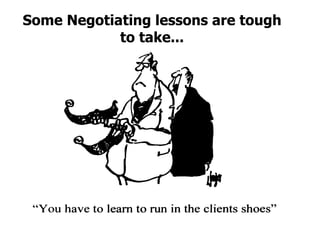
Some Negotiating lessons are tough to take...
Negotiation winners 1. Have a Game Plan 2. Focus on Your Goals 3. Identify the Issues 4. Have Powerful Justifications 5. Evaluate, Evaluate, Evaluate 6. Pay Attention to Closure
Negotiation gems Apply Power Negotiation Leverage Remember The Game Plan
"The truly gifted negotiator, then, is one whose initial position is exaggerated enough to allow for a series of concessions that will  yield a desirable final offer from the  opponent, yet is not so outlandish as to be  seen as illegitimate from the start." Gifted Negotiator
The Pre-Negotiation Planning Phase Decide if Subject Matter Expert involvement required Research options/issues and precedence's Understand the motivators of affected stakeholders Know impact of each option (time, cost, quality, scope) Risk/opportunity assessments Timing issues (urgency, best time to meet, etc) Summarize pros and cons
The Pre-Negotiation Planning Phase Cultural considerations (people and Enterprise) Formulate strategy based on knowledge of the   stakeholders Pre-meeting info dissemination Invite appropriate empowered representatives Set conducive agenda, facilities, timeslot, and  refreshments Plan for timely post negotiation action Plan for analysis of “lessons learned” after  negotiating
Understanding Key Motivators Think back to the last time you were blindsided by an unexpected motivator. What was it? Typical tangible motivators: Fiscal impacts (Enterprise  &  for their own or department) Workload/Overtime/training/vacation impact Contractual/Organizational issues, etc Less Tangible : Desire to be heard and have their needs acknowledged Desire to save face/look good in the eyes of others Resistance to change (fear of unknown/untried) Desire to satisfy their own or bosses hidden agenda Biases, dislikes, ethnic customs, political alliances, etc Emotional (and why should they trust you?) TIP: Learn to read body language
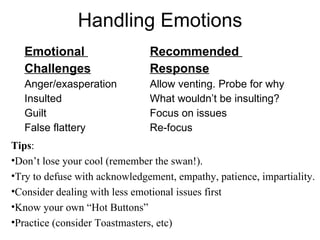
Handling Emotions Emotional  Challenges Anger/exasperation Insulted Guilt False flattery Recommended  Response Allow venting. Probe for why What wouldn’t be insulting? Focus on issues Re-focus Tips :  Don’t lose your cool (remember the swan!). Try to defuse with acknowledgement, empathy, patience, impartiality. Consider dealing with less emotional issues first Know your own “Hot Buttons” Practice (consider Toastmasters, etc)
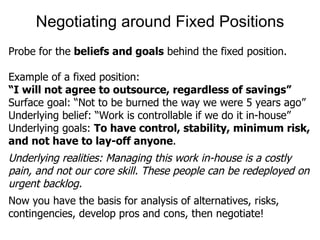
Negotiating around Fixed Positions Probe for the  beliefs and goals  behind the fixed position. Example of a fixed position:  “ I will not agree to outsource, regardless of savings” Surface goal: “Not to be burned the way we were 5 years ago” Underlying belief: “Work is controllable if we do it in-house” Underlying goals:  To have control, stability, minimum risk, and not have to lay-off anyone .  Underlying realities: Managing this work in-house is a costly pain, and not our core skill. These people can be redeployed on urgent backlog. Now you have the basis for analysis of alternatives, risks, contingencies, develop pros and cons, then negotiate!
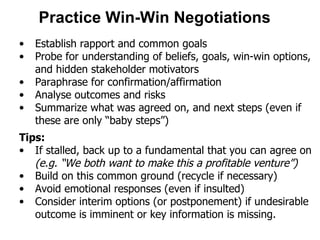
Practice Win-Win Negotiations   Establish rapport and common goals Probe for understanding of beliefs, goals, win-win options, and hidden stakeholder motivators  Paraphrase for confirmation/affirmation Analyse outcomes and risks Summarize what was agreed on, and next steps (even if these are only “baby steps”) Tips: If stalled, back up to a fundamental that you can agree on  (e.g. “We both want to make this a profitable venture”) Build on this common ground (recycle if necessary)  Avoid emotional responses (even if insulted) Consider interim options (or postponement) if undesirable outcome is imminent or key information is missing.
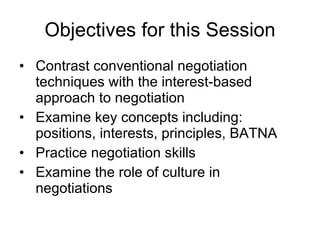
Objectives for this Session Contrast conventional negotiation techniques with the interest-based approach to negotiation Examine key concepts including: positions, interests, principles, BATNA Practice negotiation skills Examine the role of culture in negotiations
Everyone  Negotiates Buying a car, house or other object for which the price may not be fixed Establishing a salary, workplace tasks, office conditions, etc. Organizing team tasks or priorities Allocating household tasks Deciding how to spend a free evening
Conventional Negotiations Focus on winning Assert positions/personal preferences Concede stubbornly Seek compromises based on arbitrary divisions (e.g. split the difference) Engage in threats, bluffs or other negotiation tactics
Conventional Negotiation Tactics Good cop/bad cop Highball/lowball Bluff  Threats Nibble Appeals to ‘reason’
Exercise 1 ( To be participated in a group of three) Roles . Zerin, a 15 year old girl – Participant 1 Father – Participant 2, Mother – Participant 3  Background : Zerin (19 years) lived in Chittagong. Zerin is calling home from her mobile to tell her parents that she is hitch-hiking to Dallywood to be a movie star. She has taken only 2,000 takas with her. She sounds convincing that she is doing the right thing but you as her parents feel differently. Please act out your roles and try to Negotiate from your position. Please let the audience know what position you would like to take. The entire conversation is for a maximum of 5 minutes. Focus on a “win-win” approach before Zerin disconnects.
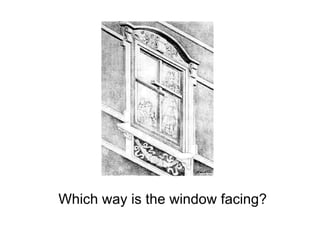
Which way is the window facing?
An Alternative: Interest-Based Negotiations* Separate the people from the problem Focus on interests, not positions Invent options for mutual gain Insist on objective criteria *Roger Fisher & William Ury. 1991.  Getting to Yes . 2 nd  ed. New York: Penguin.
Principle 1: Separate the People from the Problem Disentangle the people from the problem Deal with the people problem: acknowledge perceptions, emotions Listen actively Speak to be understood Speak about yourself, not them
Principle 2: Focus on Interests, Not Positions Positions : What disputants say they want in a negotiation: a particular price, job, work schedule, change in someone else’s behavior, revised contract provision, etc. Interests : Underlying desires or concerns that motivate people in particular situations (May sometimes be the same as their positions!)
Focusing on Interests Problem : barking dog My interpretation : my neighbor doesn’t care about my needs My position : quiet the dog My interest : I need sleep Issue : how to control the barking
Focusing on Interests Problem : reefs are dying My interpretation : inadequately controlled construction in near-shore areas results in runoff that smothers reefs. My position : stop or severely limit land disturbance Interest : reducing the rate of coral loss Issue : What’s the real source of reef degradation? How can runoff be reduced/ controlled?
Types of Interests Substantive : How people describe the issue: barking dogs, cars blocking driveway, dying reefs Relational : How people  they should be treated or acknowledged. Procedural : How people think issues should be addressed (e.g. courts, ho`oponopono)
Principle 3: Invent Options for Mutual Gain Focus on the variety of ways issues/ interests (yours/theirs) might be addressed? Avoid assuming there’s a single solution Separate brainstorming from evaluation of options Don’t assume zero-sum conditions Think creatively
Principle 4: Insist on Objective Criteria Fair standards : market value, precedent, blue book value, professional standards, “best practice,” industry average, equal treatment, etc. Fair procedures : e.g. last best offers, taking turns, drawing lots
When is the Interest-Based Approach Appropriate? Other party is willing to problem-solve There is sufficient trust and information—or a willingness to develop them On-going relationships are important Commitment to carry out the agreement is needed Quality agreement is more important than an expedient one
When is the Interest-Based Approach Unnecessary? On-going relationships are not important Negotiation is viewed as strictly distributive (e.g. buying a car) Lack of commitment to problem-solving on the part of one or more parties One or more parties see the negotiation as involving fundamental rights (but some contention about this)
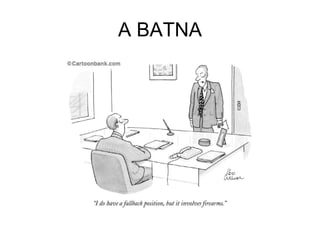
Prepping for Your Negotiation What are our interests? What are theirs? How can we find out? What’s our BATNA? What’s theirs? What’s our WATNA? Theirs? What do we know about their circumstances that might affect the negotiations? What’s their negotiation style? Etc.
A BATNA
Negotiating Steps Develop ground rules Jointly identify issues Explore interests Develop objective standards Brainstorm options Evaluate options using standards Try to reach consensus decision
Adapting General Principles to Specific Negotiations Pacing: fast or slow? Formality: high or low? Oral or written agreements: which are more binding and inclusive? Bluntness of communication: direct or indirect? Time-frame: short or long term? Who negotiates: Equals or most competent?
Sources of Negotiation Problems Perceptual errors Unrealistic expectations about likely outcomes Unwillingness or inability to engage in real negotiations Perceived non-negotiability of some disputes
Special issues in Negotiation Confidentiality Neutrality Authority Integrity Credibility Also applicable in conflict handling
Conflict Handling
The conflict within “We accuse others, we excuse ourselves” -Unknown
Workplace conflict “A condition between or among workers whose jobs are interdependent, who feel angry, who perceive the other (s) as being at fault, and who act in ways that cause a business problem” Daniel Dana
Signs of conflict Anger Disgruntled staff Low productivity High turnover Absenteeism Frequent ‘sick days’ Dysfunctional meetings Bullying
The cost of conflict Reputation Safety Loyalty Production Recruitment Replacement Litigation Time Money •  Wasted time •  Bad decisions •  Lost employees •  Restructuring •  Sabotage, theft, •  Damage •  Lowered motivation •  Lost work time •  Health costs
Culture & conflict Dominating organization : One in which power contests are the prevailing approach to resolving conflicts. Litigating organization : One in which right contests are the prevailing approach to resolving conflicts. Mediating organization : One in which interest reconciliation is the prevailing approach to resolving conflicts.  - Daniel Dana
Conflict is productive… When: Used to create and innovate The organization develops dispute resolving systems and procedures We see it as value neutral rather than negative We use the opportunity for growth We share new information
Conflict is productive… When: There are new solutions which include everyone’s perspective We separate the people from the problem We discover our “hot button” triggers and find effective ways to cool down our reactions We learn problem solving skills Attention is focused on the hidden costs
“Conflict involves struggles between two or more people over values, or competition for status, power and scarce resources.” - Moore 1986 Conflict handling and its Management
Conflict Handling and its Management • Conflict is inevitable. It need not be viewed as only a negative process. Has both productive and destructive potential. Conflict if mismanaged, however, can threaten relationships, systems and institutions.
Conflict handling and its Management Basic approaches to managing conflict: 1. Ignoring the conflict 2. Avoiding the conflict producing situation 3. Coercion and/or violence 4. Negotiation 5. Mediation 6. Adjudication or arbitration
Conflict handling and its Management Historically, all societies have resolved conflict by using: Negotiation Mediation Adjudication Globally, these are the three primary dispute resolving processes .
Conflict Inventory Who has experienced a conflict (problem, issue, scrape, misunderstanding, etc) in the last month? How did you respond? What was your “conflict strategy?”
Conflict Resolution Options Avoidance Capitulation Suppression Accommodation Problem solving (e.g. conciliation, negotiation, mediation, facilitation) Escalation Confrontation
Problem Solving Options Conciliation: neutral 3 rd  party assists disputants by acting as go-between Arbitration: neutral 3 rd  party acts as judge Negotiation: parties confer to arrive at mutually satisfactory solution Mediation: neutral 3 rd  party assists parties in their own negotiations Facilitation: neutral 3 rd  party assists in group discussions
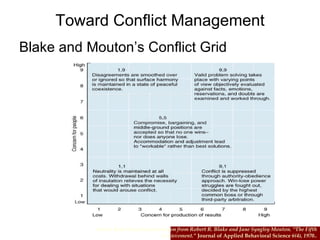
Toward Conflict Management Blake and Mouton’s Conflict Grid Source: Reproduced by permission from Robert R. Blake and Jane Syngley Mouton. “The Fifth Achievement.”  Journal of Applied Behavioral Science  6(4), 1970..
Toward Conflict Management—Practical Tips Walker and Harris (1995) offer the following practical tips for implementing the 9,9 style. Encouraging behavior occurs when a team member: 1. Avoids feelings or perceptions that imply the other person is wrong or needs to change. 2. Communicates a desire to work together to explore a problem or seek a solution. 3. Exhibits behavior that is spontaneous and destruction-free.
Toward Conflict Management—Practical Tips 4. Identifies with another team member’s problems, shares feelings, and accepts the team member’s reaction. 5. Treats other team members with respect and trust. 6. Investigates issues rather than taking sides on them. The same principles can be applied to negotiating with  others outside your team, or with a supplier or  customer.
Toward Conflict Management Blake and Mouton (1970) proposed a grid that shows various conflict approaches. The 1,1 style is the hands-off approach, also called  avoidance . The 1,9 position, also called  accommodation , is excessively person-oriented.
Toward Conflict Management The 5,5 position represents a willingness to compromise. The 9,1 is the bullheaded approach, also called  competing. The optimum style for reducing conflict is the 9,9 approach, also called  collaboration .
Game Theory Game theory puts people into the mixed-motive situation. Covey (1990) in  The Seven Habits of Highly Successful People  refers to the scarcity mentality versus the abundance mentality. The scarcity mentality leads us to resent the success of others. The abundance mentality allows us to think of situations in which everybody can win.
Toward Conflict Management Fisher, Ury, and Patton (1991) outline four principles that compose  principled negotiation . Separate the people from the problem. Focus on interests, not positions. Invent options for mutual gain. Seek objective criteria.
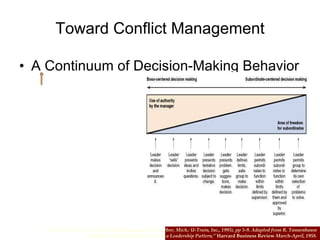
Toward Conflict Management The Continuum of Decision-Making Behavior has been described as including four styles of decision making: Tells Sells Consults Joins
Toward Conflict Management A Continuum of Decision-Making Behavior Source: From Stewart L. Tubbs.  Empowerment  (Ann Arbor, Mich.: U-Train, Inc., 1993), pp 5-9. Adapted from R. Tannenbaum and H.W. Schmidt. “How to Choose a Leadership Pattern,”  Harvard Business Review  March-April, 1958.
Managing people Leaders Managers Careers  Global Human Resource Systems (the process by which people are managed)
Leadership Theories Traits Those that don’t change readily, e.g., height, gender Those that change with difficulty, values Those that can be developed Leadership Styles Orientation to people Task orientation Contingency—leader’s style needs to adapt to the context “ New” leadership such as transformational or connective leaders
Steven Rhinesmith (2000) 1.  M anaging competitiveness by looking at the "big picture" 2.  M anaging complexity 3.  M anaging alignment 4.  M anaging change 5.  M anaging teams 6.  M anaging learning by being open and learning globally
Black, Morrison, and Gregersen (1999)   1.  I nquisitiveness 2.  A n ability to embrace duality 3.  C haracter to develop trust and goodwill among people from different cultural backgrounds 4. “ S avvy" that allows a leader to see what needs to be done and marshall resources for accomplishment
Rosen, Digh, Singer and Phillips (2000)   1.  P ersonal literacy including understanding self and one's own limitations and abilities 2.  S ocial literacy to assemble strong teams and unleash collective strength 3.  B usiness literacy including understanding the organization and its environment 4.  C ultural literacy includes knowing about and leveraging culture differences
McCall and Hollenbeck (2002)   1.  O pen-minded and flexible in thinking and tactics pursued 2.  C ultural interest and sensitivity 3.  A bility to deal with complexity 4.  R esilience, resourcefulness, optimism, and energy 5.  H onesty and integrity 6.  A  stable personal life 7.  T echnical or business skills
Global Leadership  Attributes and Theories A  g lobal  m indset—a way of thinking that looks beyond self and immediate circumstances — trait; new leader Know  t he  b usiness and  i ts  e nvironment—know the environment, savvy, big picture thinking, alignment—contingency Create and  c onvey a  c lear  v ision with  i ntegrity—clear sense of purpose; convey to others;character; honesty; integrity—trait, leadership style Develop  s elf- a wareness and  u nderstanding—personal literacy; self-knowledge; reflection—trait; new leader Manage  d iversity—diverse groups and structures; people from many backgrounds—leadership style, trait Continuously  l earn—inquisitiveness; being open to others and to new information; leader and learner—new leader
William Van Dusen Wishard (1995)   1.  T here is a need to discern what is permanent and immutable  2.  W e must learn to make interconnections between people, events, and different categories of life because interdependence is an emerging condition of life 3.  W e must learn to know ourselves 4.  W e each need some understanding of how change and technology are affecting people and institutions 5.  W e need to be open to dimensions of existence that are difficult to understand, value or control; within ourselves we need to value intuition 6.  T here is a need to interact with people in a manner that will bridge racial and cultural differences 7.  T here is a need to have a personal sense of creating something new for the future
The four agreements: Don Miguel Ruiz's Code for Life Don Miguel Ruiz's book,  The Four Agreements  was published in 1997.  The Four Agreements  is a life-changing book, whose ideas come from the ancient Toltec wisdom of the native people of Southern Mexico. The Toltec were 'people of knowledge' - scientists and artists who created a society to explore and conserve the traditional spiritual knowledge and practices of their ancestors.  The simple ideas of  The Four Agreements  provide an inspirational code for life; a personal development model, and a template for personal development, behavior, communications and relationships. Here is how Don Miguel Ruiz summarizes 'The Four Agreements‘….
Agreement 1 Be impeccable with your words “Speak with integrity. Say only what you mean. Avoid using the words to speak against yourself or to gossip about others. Use the power of your word in the direction of truth and love.”
Agreement 2 Don’t take anything personally   “Nothing others do is because of you. What others say and do is a projection of their own reality, their own dream. When you are immune to the opinions and actions of others, you won’t be the victim of needless suffering.”
Agreement 3 Don’t make assumptions “Find the courage to ask questions and to express what you really want. Communicate with others as clearly as you can to avoid misunderstandings, sadness and drama. With just this one agreement, you can completely transform your life.”
Agreement 4 Always do your best   “Your best is going to change from moment to moment; it will be different when you are healthy as opposed to sick. Under any circumstance, simply do your best, and you will avoid self-judgment, self-abuse and regret.”

Negotiation Skills and Conflict Handling

  • 1.
    Negotiation Skills &Conflict Handling by Ziaur Rahman CEO, IITM www.iitmbd.org Email: infoiitm@yahoo.com
  • 2.
    Negotiation A processwhere mandated representatives meet in order to resolve their differences and reach agreement. The outcome is often dependent on the power relationship between the groups.
  • 3.
    Types of negotiations1. Positional Negotiation 2. Interest Based Negotiation 3. Competitive Negotiation 4. Co-operative Negotiation 5. Principled Negotiation
  • 4.
    Barriers to negotiation1. Poor communication skills 2. Overreacting & emotional responses 3. Misunderstandings 4. Conditioned or learned responses 5. Relationship dynamics
  • 5.
    Rules for negotiation1. Be strategic and deliberate with words 2. Be willing to prepare & prepare well 3. Have high expectations 4. Be patient in listening 5. Maintain your integrity
  • 6.
    Negotiation essentials CommunicateNo clear lines of communication = no negotiation. “ problems" fall into three categories: - perception, - emotion, and - communication. "Facts, even if established, may do nothing to solve the problem."
  • 7.
    Negotiation essentials Co-operateBe cooperative, but don't let your guard down. Statistics show that cooperative negotiators are more effective than competitive negotiators. However, in positional bargaining, a hard game dominates a soft one.
  • 8.
    Negotiation essentials ListenTHE POWER IS IN LISTENING • Ask questions, test for understanding, summarize, and listen, listen, listen…... • Get more by finding out what others wants than by clever arguments for what you need. • The cheapest concession you can make is to let others know they have been heard.
  • 9.
    Some Negotiating lessonsare tough to take...
  • 10.
    Negotiation winners 1.Have a Game Plan 2. Focus on Your Goals 3. Identify the Issues 4. Have Powerful Justifications 5. Evaluate, Evaluate, Evaluate 6. Pay Attention to Closure
  • 11.
    Negotiation gems ApplyPower Negotiation Leverage Remember The Game Plan
  • 12.
    "The truly giftednegotiator, then, is one whose initial position is exaggerated enough to allow for a series of concessions that will yield a desirable final offer from the opponent, yet is not so outlandish as to be seen as illegitimate from the start." Gifted Negotiator
  • 13.
    The Pre-Negotiation PlanningPhase Decide if Subject Matter Expert involvement required Research options/issues and precedence's Understand the motivators of affected stakeholders Know impact of each option (time, cost, quality, scope) Risk/opportunity assessments Timing issues (urgency, best time to meet, etc) Summarize pros and cons
  • 14.
    The Pre-Negotiation PlanningPhase Cultural considerations (people and Enterprise) Formulate strategy based on knowledge of the stakeholders Pre-meeting info dissemination Invite appropriate empowered representatives Set conducive agenda, facilities, timeslot, and refreshments Plan for timely post negotiation action Plan for analysis of “lessons learned” after negotiating
  • 15.
    Understanding Key MotivatorsThink back to the last time you were blindsided by an unexpected motivator. What was it? Typical tangible motivators: Fiscal impacts (Enterprise & for their own or department) Workload/Overtime/training/vacation impact Contractual/Organizational issues, etc Less Tangible : Desire to be heard and have their needs acknowledged Desire to save face/look good in the eyes of others Resistance to change (fear of unknown/untried) Desire to satisfy their own or bosses hidden agenda Biases, dislikes, ethnic customs, political alliances, etc Emotional (and why should they trust you?) TIP: Learn to read body language
  • 16.
    Handling Emotions Emotional Challenges Anger/exasperation Insulted Guilt False flattery Recommended Response Allow venting. Probe for why What wouldn’t be insulting? Focus on issues Re-focus Tips : Don’t lose your cool (remember the swan!). Try to defuse with acknowledgement, empathy, patience, impartiality. Consider dealing with less emotional issues first Know your own “Hot Buttons” Practice (consider Toastmasters, etc)
  • 17.
    Negotiating around FixedPositions Probe for the beliefs and goals behind the fixed position. Example of a fixed position: “ I will not agree to outsource, regardless of savings” Surface goal: “Not to be burned the way we were 5 years ago” Underlying belief: “Work is controllable if we do it in-house” Underlying goals: To have control, stability, minimum risk, and not have to lay-off anyone . Underlying realities: Managing this work in-house is a costly pain, and not our core skill. These people can be redeployed on urgent backlog. Now you have the basis for analysis of alternatives, risks, contingencies, develop pros and cons, then negotiate!
  • 18.
    Practice Win-Win Negotiations Establish rapport and common goals Probe for understanding of beliefs, goals, win-win options, and hidden stakeholder motivators Paraphrase for confirmation/affirmation Analyse outcomes and risks Summarize what was agreed on, and next steps (even if these are only “baby steps”) Tips: If stalled, back up to a fundamental that you can agree on (e.g. “We both want to make this a profitable venture”) Build on this common ground (recycle if necessary) Avoid emotional responses (even if insulted) Consider interim options (or postponement) if undesirable outcome is imminent or key information is missing.
  • 19.
    Objectives for thisSession Contrast conventional negotiation techniques with the interest-based approach to negotiation Examine key concepts including: positions, interests, principles, BATNA Practice negotiation skills Examine the role of culture in negotiations
  • 20.
    Everyone NegotiatesBuying a car, house or other object for which the price may not be fixed Establishing a salary, workplace tasks, office conditions, etc. Organizing team tasks or priorities Allocating household tasks Deciding how to spend a free evening
  • 21.
    Conventional Negotiations Focuson winning Assert positions/personal preferences Concede stubbornly Seek compromises based on arbitrary divisions (e.g. split the difference) Engage in threats, bluffs or other negotiation tactics
  • 22.
    Conventional Negotiation TacticsGood cop/bad cop Highball/lowball Bluff Threats Nibble Appeals to ‘reason’
  • 23.
    Exercise 1 (To be participated in a group of three) Roles . Zerin, a 15 year old girl – Participant 1 Father – Participant 2, Mother – Participant 3 Background : Zerin (19 years) lived in Chittagong. Zerin is calling home from her mobile to tell her parents that she is hitch-hiking to Dallywood to be a movie star. She has taken only 2,000 takas with her. She sounds convincing that she is doing the right thing but you as her parents feel differently. Please act out your roles and try to Negotiate from your position. Please let the audience know what position you would like to take. The entire conversation is for a maximum of 5 minutes. Focus on a “win-win” approach before Zerin disconnects.
  • 24.
    Which way isthe window facing?
  • 25.
    An Alternative: Interest-BasedNegotiations* Separate the people from the problem Focus on interests, not positions Invent options for mutual gain Insist on objective criteria *Roger Fisher & William Ury. 1991. Getting to Yes . 2 nd ed. New York: Penguin.
  • 26.
    Principle 1: Separatethe People from the Problem Disentangle the people from the problem Deal with the people problem: acknowledge perceptions, emotions Listen actively Speak to be understood Speak about yourself, not them
  • 27.
    Principle 2: Focuson Interests, Not Positions Positions : What disputants say they want in a negotiation: a particular price, job, work schedule, change in someone else’s behavior, revised contract provision, etc. Interests : Underlying desires or concerns that motivate people in particular situations (May sometimes be the same as their positions!)
  • 28.
    Focusing on InterestsProblem : barking dog My interpretation : my neighbor doesn’t care about my needs My position : quiet the dog My interest : I need sleep Issue : how to control the barking
  • 29.
    Focusing on InterestsProblem : reefs are dying My interpretation : inadequately controlled construction in near-shore areas results in runoff that smothers reefs. My position : stop or severely limit land disturbance Interest : reducing the rate of coral loss Issue : What’s the real source of reef degradation? How can runoff be reduced/ controlled?
  • 30.
    Types of InterestsSubstantive : How people describe the issue: barking dogs, cars blocking driveway, dying reefs Relational : How people they should be treated or acknowledged. Procedural : How people think issues should be addressed (e.g. courts, ho`oponopono)
  • 31.
    Principle 3: InventOptions for Mutual Gain Focus on the variety of ways issues/ interests (yours/theirs) might be addressed? Avoid assuming there’s a single solution Separate brainstorming from evaluation of options Don’t assume zero-sum conditions Think creatively
  • 32.
    Principle 4: Insiston Objective Criteria Fair standards : market value, precedent, blue book value, professional standards, “best practice,” industry average, equal treatment, etc. Fair procedures : e.g. last best offers, taking turns, drawing lots
  • 33.
    When is theInterest-Based Approach Appropriate? Other party is willing to problem-solve There is sufficient trust and information—or a willingness to develop them On-going relationships are important Commitment to carry out the agreement is needed Quality agreement is more important than an expedient one
  • 34.
    When is theInterest-Based Approach Unnecessary? On-going relationships are not important Negotiation is viewed as strictly distributive (e.g. buying a car) Lack of commitment to problem-solving on the part of one or more parties One or more parties see the negotiation as involving fundamental rights (but some contention about this)
  • 35.
    Prepping for YourNegotiation What are our interests? What are theirs? How can we find out? What’s our BATNA? What’s theirs? What’s our WATNA? Theirs? What do we know about their circumstances that might affect the negotiations? What’s their negotiation style? Etc.
  • 36.
  • 37.
    Negotiating Steps Developground rules Jointly identify issues Explore interests Develop objective standards Brainstorm options Evaluate options using standards Try to reach consensus decision
  • 38.
    Adapting General Principlesto Specific Negotiations Pacing: fast or slow? Formality: high or low? Oral or written agreements: which are more binding and inclusive? Bluntness of communication: direct or indirect? Time-frame: short or long term? Who negotiates: Equals or most competent?
  • 39.
    Sources of NegotiationProblems Perceptual errors Unrealistic expectations about likely outcomes Unwillingness or inability to engage in real negotiations Perceived non-negotiability of some disputes
  • 40.
    Special issues inNegotiation Confidentiality Neutrality Authority Integrity Credibility Also applicable in conflict handling
  • 41.
  • 42.
    The conflict within“We accuse others, we excuse ourselves” -Unknown
  • 43.
    Workplace conflict “Acondition between or among workers whose jobs are interdependent, who feel angry, who perceive the other (s) as being at fault, and who act in ways that cause a business problem” Daniel Dana
  • 44.
    Signs of conflictAnger Disgruntled staff Low productivity High turnover Absenteeism Frequent ‘sick days’ Dysfunctional meetings Bullying
  • 45.
    The cost ofconflict Reputation Safety Loyalty Production Recruitment Replacement Litigation Time Money • Wasted time • Bad decisions • Lost employees • Restructuring • Sabotage, theft, • Damage • Lowered motivation • Lost work time • Health costs
  • 46.
    Culture & conflictDominating organization : One in which power contests are the prevailing approach to resolving conflicts. Litigating organization : One in which right contests are the prevailing approach to resolving conflicts. Mediating organization : One in which interest reconciliation is the prevailing approach to resolving conflicts. - Daniel Dana
  • 47.
    Conflict is productive…When: Used to create and innovate The organization develops dispute resolving systems and procedures We see it as value neutral rather than negative We use the opportunity for growth We share new information
  • 48.
    Conflict is productive…When: There are new solutions which include everyone’s perspective We separate the people from the problem We discover our “hot button” triggers and find effective ways to cool down our reactions We learn problem solving skills Attention is focused on the hidden costs
  • 49.
    “Conflict involves strugglesbetween two or more people over values, or competition for status, power and scarce resources.” - Moore 1986 Conflict handling and its Management
  • 50.
    Conflict Handling andits Management • Conflict is inevitable. It need not be viewed as only a negative process. Has both productive and destructive potential. Conflict if mismanaged, however, can threaten relationships, systems and institutions.
  • 51.
    Conflict handling andits Management Basic approaches to managing conflict: 1. Ignoring the conflict 2. Avoiding the conflict producing situation 3. Coercion and/or violence 4. Negotiation 5. Mediation 6. Adjudication or arbitration
  • 52.
    Conflict handling andits Management Historically, all societies have resolved conflict by using: Negotiation Mediation Adjudication Globally, these are the three primary dispute resolving processes .
  • 53.
    Conflict Inventory Whohas experienced a conflict (problem, issue, scrape, misunderstanding, etc) in the last month? How did you respond? What was your “conflict strategy?”
  • 54.
    Conflict Resolution OptionsAvoidance Capitulation Suppression Accommodation Problem solving (e.g. conciliation, negotiation, mediation, facilitation) Escalation Confrontation
  • 55.
    Problem Solving OptionsConciliation: neutral 3 rd party assists disputants by acting as go-between Arbitration: neutral 3 rd party acts as judge Negotiation: parties confer to arrive at mutually satisfactory solution Mediation: neutral 3 rd party assists parties in their own negotiations Facilitation: neutral 3 rd party assists in group discussions
  • 56.
    Toward Conflict ManagementBlake and Mouton’s Conflict Grid Source: Reproduced by permission from Robert R. Blake and Jane Syngley Mouton. “The Fifth Achievement.” Journal of Applied Behavioral Science 6(4), 1970..
  • 57.
    Toward Conflict Management—PracticalTips Walker and Harris (1995) offer the following practical tips for implementing the 9,9 style. Encouraging behavior occurs when a team member: 1. Avoids feelings or perceptions that imply the other person is wrong or needs to change. 2. Communicates a desire to work together to explore a problem or seek a solution. 3. Exhibits behavior that is spontaneous and destruction-free.
  • 58.
    Toward Conflict Management—PracticalTips 4. Identifies with another team member’s problems, shares feelings, and accepts the team member’s reaction. 5. Treats other team members with respect and trust. 6. Investigates issues rather than taking sides on them. The same principles can be applied to negotiating with others outside your team, or with a supplier or customer.
  • 59.
    Toward Conflict ManagementBlake and Mouton (1970) proposed a grid that shows various conflict approaches. The 1,1 style is the hands-off approach, also called avoidance . The 1,9 position, also called accommodation , is excessively person-oriented.
  • 60.
    Toward Conflict ManagementThe 5,5 position represents a willingness to compromise. The 9,1 is the bullheaded approach, also called competing. The optimum style for reducing conflict is the 9,9 approach, also called collaboration .
  • 61.
    Game Theory Gametheory puts people into the mixed-motive situation. Covey (1990) in The Seven Habits of Highly Successful People refers to the scarcity mentality versus the abundance mentality. The scarcity mentality leads us to resent the success of others. The abundance mentality allows us to think of situations in which everybody can win.
  • 62.
    Toward Conflict ManagementFisher, Ury, and Patton (1991) outline four principles that compose principled negotiation . Separate the people from the problem. Focus on interests, not positions. Invent options for mutual gain. Seek objective criteria.
  • 63.
    Toward Conflict ManagementThe Continuum of Decision-Making Behavior has been described as including four styles of decision making: Tells Sells Consults Joins
  • 64.
    Toward Conflict ManagementA Continuum of Decision-Making Behavior Source: From Stewart L. Tubbs. Empowerment (Ann Arbor, Mich.: U-Train, Inc., 1993), pp 5-9. Adapted from R. Tannenbaum and H.W. Schmidt. “How to Choose a Leadership Pattern,” Harvard Business Review March-April, 1958.
  • 65.
    Managing people LeadersManagers Careers Global Human Resource Systems (the process by which people are managed)
  • 66.
    Leadership Theories TraitsThose that don’t change readily, e.g., height, gender Those that change with difficulty, values Those that can be developed Leadership Styles Orientation to people Task orientation Contingency—leader’s style needs to adapt to the context “ New” leadership such as transformational or connective leaders
  • 67.
    Steven Rhinesmith (2000)1. M anaging competitiveness by looking at the "big picture" 2. M anaging complexity 3. M anaging alignment 4. M anaging change 5. M anaging teams 6. M anaging learning by being open and learning globally
  • 68.
    Black, Morrison, andGregersen (1999) 1. I nquisitiveness 2. A n ability to embrace duality 3. C haracter to develop trust and goodwill among people from different cultural backgrounds 4. “ S avvy" that allows a leader to see what needs to be done and marshall resources for accomplishment
  • 69.
    Rosen, Digh, Singerand Phillips (2000) 1. P ersonal literacy including understanding self and one's own limitations and abilities 2. S ocial literacy to assemble strong teams and unleash collective strength 3. B usiness literacy including understanding the organization and its environment 4. C ultural literacy includes knowing about and leveraging culture differences
  • 70.
    McCall and Hollenbeck(2002) 1. O pen-minded and flexible in thinking and tactics pursued 2. C ultural interest and sensitivity 3. A bility to deal with complexity 4. R esilience, resourcefulness, optimism, and energy 5. H onesty and integrity 6. A stable personal life 7. T echnical or business skills
  • 71.
    Global Leadership Attributes and Theories A g lobal m indset—a way of thinking that looks beyond self and immediate circumstances — trait; new leader Know t he b usiness and i ts e nvironment—know the environment, savvy, big picture thinking, alignment—contingency Create and c onvey a c lear v ision with i ntegrity—clear sense of purpose; convey to others;character; honesty; integrity—trait, leadership style Develop s elf- a wareness and u nderstanding—personal literacy; self-knowledge; reflection—trait; new leader Manage d iversity—diverse groups and structures; people from many backgrounds—leadership style, trait Continuously l earn—inquisitiveness; being open to others and to new information; leader and learner—new leader
  • 72.
    William Van DusenWishard (1995) 1. T here is a need to discern what is permanent and immutable 2. W e must learn to make interconnections between people, events, and different categories of life because interdependence is an emerging condition of life 3. W e must learn to know ourselves 4. W e each need some understanding of how change and technology are affecting people and institutions 5. W e need to be open to dimensions of existence that are difficult to understand, value or control; within ourselves we need to value intuition 6. T here is a need to interact with people in a manner that will bridge racial and cultural differences 7. T here is a need to have a personal sense of creating something new for the future
  • 73.
    The four agreements:Don Miguel Ruiz's Code for Life Don Miguel Ruiz's book, The Four Agreements was published in 1997. The Four Agreements is a life-changing book, whose ideas come from the ancient Toltec wisdom of the native people of Southern Mexico. The Toltec were 'people of knowledge' - scientists and artists who created a society to explore and conserve the traditional spiritual knowledge and practices of their ancestors. The simple ideas of The Four Agreements provide an inspirational code for life; a personal development model, and a template for personal development, behavior, communications and relationships. Here is how Don Miguel Ruiz summarizes 'The Four Agreements‘….
  • 74.
    Agreement 1 Beimpeccable with your words “Speak with integrity. Say only what you mean. Avoid using the words to speak against yourself or to gossip about others. Use the power of your word in the direction of truth and love.”
  • 75.
    Agreement 2 Don’ttake anything personally “Nothing others do is because of you. What others say and do is a projection of their own reality, their own dream. When you are immune to the opinions and actions of others, you won’t be the victim of needless suffering.”
  • 76.
    Agreement 3 Don’tmake assumptions “Find the courage to ask questions and to express what you really want. Communicate with others as clearly as you can to avoid misunderstandings, sadness and drama. With just this one agreement, you can completely transform your life.”
  • 77.
    Agreement 4 Alwaysdo your best “Your best is going to change from moment to moment; it will be different when you are healthy as opposed to sick. Under any circumstance, simply do your best, and you will avoid self-judgment, self-abuse and regret.”

Editor's Notes

  • #67 Studies of leadership fall into four categories: Trait theories look at three categories of traits: Those that do not change, e.g., height, nationality Those that change with difficulty, e.g., values Those that can be developed, e.g., interpersonal skills Leadership styles such as consideration for others versus task orientation Contingency theory: leaders need to fit their environment New l eadership such as transformative or connective leaders Transformational leadership is believed to have four dimensions (Bass, 1985): The transformational leader stimulates followers by questioning assumptions and encouraging new approaches to thinking and working The transformational leader focuses on developing followers, using empathy, showing consideration, or demonstrating support for employees The transformational leader has charisma—people want to follow this leader because he/she demonstrates an ideal of leadership The transformational leader has a vision that energizes and inspires followers
  • #68 Several leadership studies
  • #69 senior executives for Fortune 500 firms
  • #70 S urveyed over 1,000 CEOs
  • #71 I nterviews with 101 executives who their firms deemed to be extremely successful .
  • #72 Each of these theories has been used to study global leaders . Global m indset: managers with a global mindset are able to sustain a broad view of the organization and keep the details in mind. A global mindset helps this leader balance contradictions the organization faces, encourages reliance on processes to achieve success, helps the leader accomplishes work . G lobal mindset is a leadership trait, but it also reflects new leadership because a global mindset assists in managing the meaning of events.