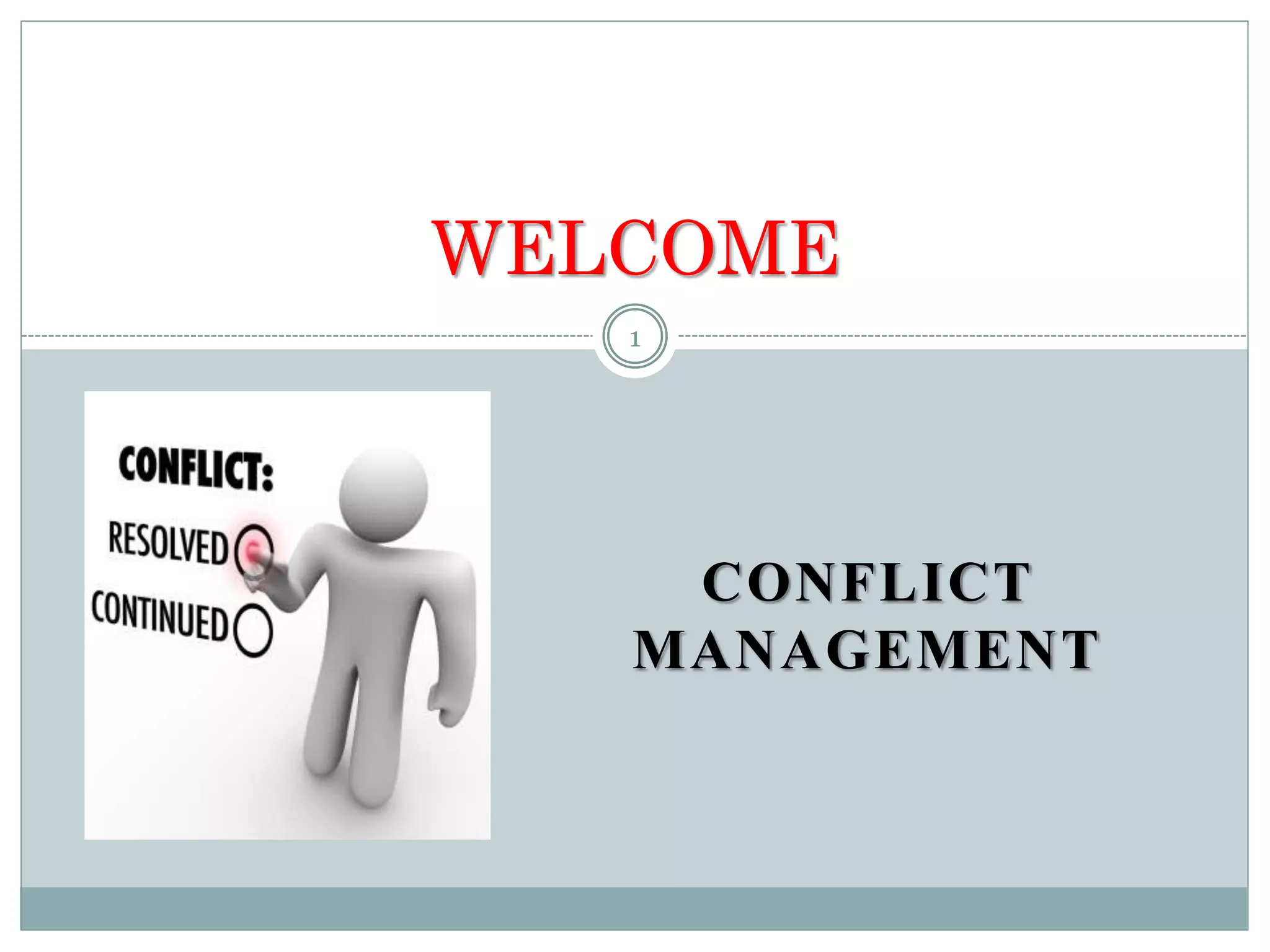
CONFLICT
MANAGEMENT
1
WELCOME
Outcome Objectives
2
At the close of this session, you will be able to:
Identify the causes of workplace conflict.
State why it is important to resolve conflict in the
workplace.
Describe the methods of resolving conflict.
List the Do’s and Don’ts of workplace conflict.
Describe the steps in the conflict resolution process.
In a Nutshell…..
3
With respect to conflict managers
must be know the “Three R’s”:
Recognize
Respond
Resolve
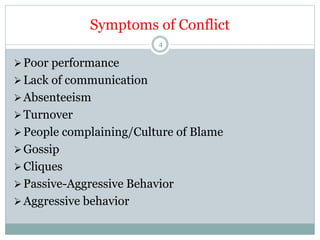
Symptoms of Conflict
4
Poor performance
Lack of communication
Absenteeism
Turnover
People complaining/Culture of Blame
Gossip
Cliques
Passive-Aggressive Behavior
Aggressive behavior
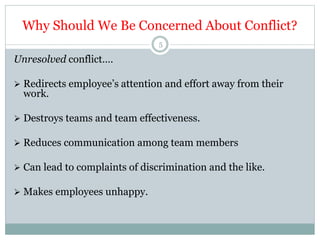
Why Should We Be Concerned About Conflict?
5
Unresolved conflict….
 Redirects employee’s attention and effort away from their
work.
 Destroys teams and team effectiveness.
 Reduces communication among team members
 Can lead to complaints of discrimination and the like.
 Makes employees unhappy.
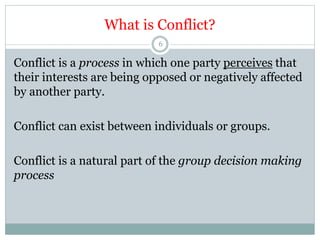
What is Conflict?
6
Conflict is a process in which one party perceives that
their interests are being opposed or negatively affected
by another party.
Conflict can exist between individuals or groups.
Conflict is a natural part of the group decision making
process
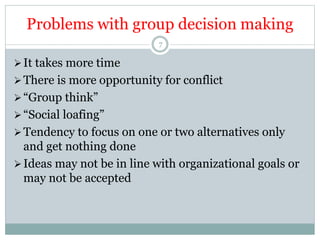
Problems with group decision making
7
It takes more time
There is more opportunity for conflict
“Group think”
“Social loafing”
Tendency to focus on one or two alternatives only
and get nothing done
Ideas may not be in line with organizational goals or
may not be accepted
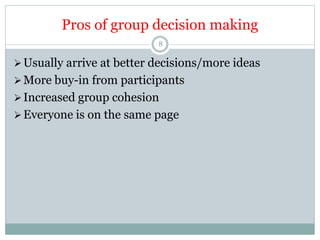
Pros of group decision making
8
Usually arrive at better decisions/more ideas
More buy-in from participants
Increased group cohesion
Everyone is on the same page
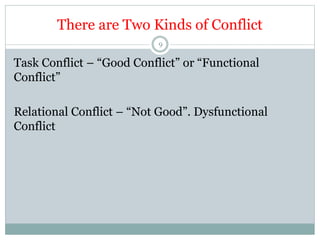
There are Two Kinds of Conflict
9
Task Conflict – “Good Conflict” or “Functional
Conflict”
Relational Conflict – “Not Good”. Dysfunctional
Conflict
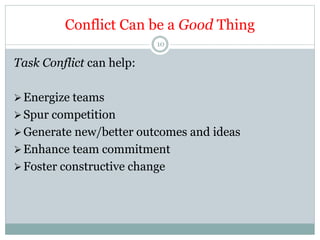
Conflict Can be a Good Thing
10
Task Conflict can help:
Energize teams
Spur competition
Generate new/better outcomes and ideas
Enhance team commitment
Foster constructive change
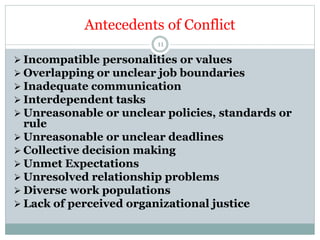
Antecedents of Conflict
11
 Incompatible personalities or values
 Overlapping or unclear job boundaries
 Inadequate communication
 Interdependent tasks
 Unreasonable or unclear policies, standards or
rule
 Unreasonable or unclear deadlines
 Collective decision making
 Unmet Expectations
 Unresolved relationship problems
 Diverse work populations
 Lack of perceived organizational justice
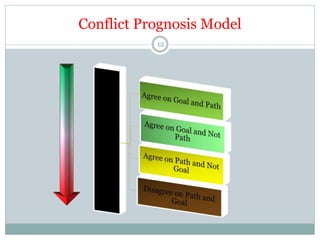
Conflict Prognosis Model
12
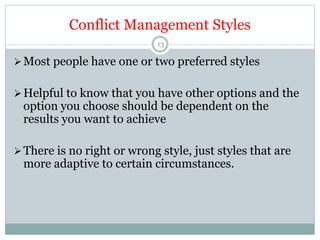
Conflict Management Styles
13
Most people have one or two preferred styles
Helpful to know that you have other options and the
option you choose should be dependent on the
results you want to achieve
There is no right or wrong style, just styles that are
more adaptive to certain circumstances.
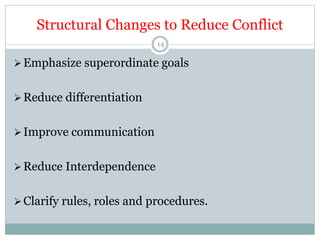
Structural Changes to Reduce Conflict
14
Emphasize superordinate goals
Reduce differentiation
Improve communication
Reduce Interdependence
Clarify rules, roles and procedures.
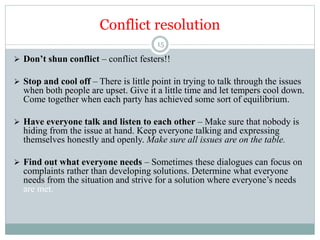
Conflict resolution
15
 Don’t shun conflict – conflict festers!!
 Stop and cool off – There is little point in trying to talk through the issues
when both people are upset. Give it a little time and let tempers cool down.
Come together when each party has achieved some sort of equilibrium.
 Have everyone talk and listen to each other – Make sure that nobody is
hiding from the issue at hand. Keep everyone talking and expressing
themselves honestly and openly. Make sure all issues are on the table.
 Find out what everyone needs – Sometimes these dialogues can focus on
complaints rather than developing solutions. Determine what everyone
needs from the situation and strive for a solution where everyone’s needs
are met.
Conflict Resolution – part 2
16
 Brainstorm solutions – Everyone will have their own vision of an
ideal outcome for themselves. The challenge will be to avoid forcing
our solutions on the conflict situation and allow solutions to emerge
out of creative thinking on everyone’s part.
 Choose the idea that everyone can live with – One of the ways to
break from a negative conflict cycle is to find solutions that you all
feel are fair under the circumstances
 Create a plan and implement it – To make sure that the conflict
does not re-emerge, you must make a blueprint. Plan ways of
working together that will keep emotional outbursts to a minimum.
Conflict Mediation
17
 Meet with each party individually to identify the issues and ascertain
how amenable parties are to mediation.
 Meet in a private, quiet space.
 Lay out ground rules.
 Each party takes turning putting all their cards on the table.
 Identify areas of agreement.
 Clarify points, terms used and areas of disagreement.
 Parties take turns going back and forth. Takes breaks as need be.
 Identify areas where the parties can “agree to disagree”.
 Keep issues focused on work and behavior and not personalities.
 Take sides where necessary and appropriate.
 When parties begin to repeat themselves the discussion has gone full
circle.

Recognizing, Responding and Resolving Conflict

  • 1.
  • 2.
    Outcome Objectives 2 At theclose of this session, you will be able to: Identify the causes of workplace conflict. State why it is important to resolve conflict in the workplace. Describe the methods of resolving conflict. List the Do’s and Don’ts of workplace conflict. Describe the steps in the conflict resolution process.
  • 3.
    In a Nutshell….. 3 Withrespect to conflict managers must be know the “Three R’s”: Recognize Respond Resolve
  • 4.
    Symptoms of Conflict 4 Poorperformance Lack of communication Absenteeism Turnover People complaining/Culture of Blame Gossip Cliques Passive-Aggressive Behavior Aggressive behavior
  • 5.
    Why Should WeBe Concerned About Conflict? 5 Unresolved conflict….  Redirects employee’s attention and effort away from their work.  Destroys teams and team effectiveness.  Reduces communication among team members  Can lead to complaints of discrimination and the like.  Makes employees unhappy.
  • 6.
    What is Conflict? 6 Conflictis a process in which one party perceives that their interests are being opposed or negatively affected by another party. Conflict can exist between individuals or groups. Conflict is a natural part of the group decision making process
  • 7.
    Problems with groupdecision making 7 It takes more time There is more opportunity for conflict “Group think” “Social loafing” Tendency to focus on one or two alternatives only and get nothing done Ideas may not be in line with organizational goals or may not be accepted
  • 8.
    Pros of groupdecision making 8 Usually arrive at better decisions/more ideas More buy-in from participants Increased group cohesion Everyone is on the same page
  • 9.
    There are TwoKinds of Conflict 9 Task Conflict – “Good Conflict” or “Functional Conflict” Relational Conflict – “Not Good”. Dysfunctional Conflict
  • 10.
    Conflict Can bea Good Thing 10 Task Conflict can help: Energize teams Spur competition Generate new/better outcomes and ideas Enhance team commitment Foster constructive change
  • 11.
    Antecedents of Conflict 11 Incompatible personalities or values  Overlapping or unclear job boundaries  Inadequate communication  Interdependent tasks  Unreasonable or unclear policies, standards or rule  Unreasonable or unclear deadlines  Collective decision making  Unmet Expectations  Unresolved relationship problems  Diverse work populations  Lack of perceived organizational justice
  • 12.
  • 13.
    Conflict Management Styles 13 Mostpeople have one or two preferred styles Helpful to know that you have other options and the option you choose should be dependent on the results you want to achieve There is no right or wrong style, just styles that are more adaptive to certain circumstances.
  • 14.
    Structural Changes toReduce Conflict 14 Emphasize superordinate goals Reduce differentiation Improve communication Reduce Interdependence Clarify rules, roles and procedures.
  • 15.
    Conflict resolution 15  Don’tshun conflict – conflict festers!!  Stop and cool off – There is little point in trying to talk through the issues when both people are upset. Give it a little time and let tempers cool down. Come together when each party has achieved some sort of equilibrium.  Have everyone talk and listen to each other – Make sure that nobody is hiding from the issue at hand. Keep everyone talking and expressing themselves honestly and openly. Make sure all issues are on the table.  Find out what everyone needs – Sometimes these dialogues can focus on complaints rather than developing solutions. Determine what everyone needs from the situation and strive for a solution where everyone’s needs are met.
  • 16.
    Conflict Resolution –part 2 16  Brainstorm solutions – Everyone will have their own vision of an ideal outcome for themselves. The challenge will be to avoid forcing our solutions on the conflict situation and allow solutions to emerge out of creative thinking on everyone’s part.  Choose the idea that everyone can live with – One of the ways to break from a negative conflict cycle is to find solutions that you all feel are fair under the circumstances  Create a plan and implement it – To make sure that the conflict does not re-emerge, you must make a blueprint. Plan ways of working together that will keep emotional outbursts to a minimum.
  • 17.
    Conflict Mediation 17  Meetwith each party individually to identify the issues and ascertain how amenable parties are to mediation.  Meet in a private, quiet space.  Lay out ground rules.  Each party takes turning putting all their cards on the table.  Identify areas of agreement.  Clarify points, terms used and areas of disagreement.  Parties take turns going back and forth. Takes breaks as need be.  Identify areas where the parties can “agree to disagree”.  Keep issues focused on work and behavior and not personalities.  Take sides where necessary and appropriate.  When parties begin to repeat themselves the discussion has gone full circle.