SCHOOL-TO-PRISON
PIPELINE
HOW PERCEIVED EXPERIENCES WITH TEACHERS LEAD
STUDENTS TO STREET BEHAVIOR INSIDE SCHOOLS

Presenter: Ashlee Johnson
University of Delaware
DEMOGRAPHIC PROFILE
TEACHERS

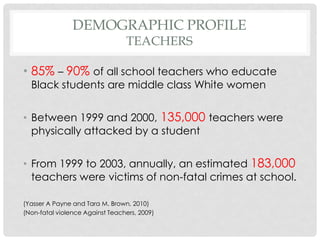
• 85% – 90% of all school teachers who educate
Black students are middle class White women

• Between 1999 and 2000, 135,000 teachers were
physically attacked by a student
• From 1999 to 2003, annually, an estimated 183,000
teachers were victims of non-fatal crimes at school.
(Yasser A Payne and Tara M. Brown, 2010)
(Non-fatal violence Against Teachers, 2009)
DEMOGRAPHIC PROFILE
SCHOOLS

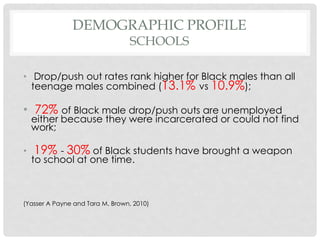
• Drop/push out rates rank higher for Black males than all
teenage males combined (13.1% vs 10.9%);

• 72% of Black male drop/push outs are unemployed

either because they were incarcerated or could not find
work;

•

19% - 30% of Black students have brought a weapon

to school at one time.

(Yasser A Payne and Tara M. Brown, 2010)
DEMOGRAPHIC PROFILE
SOCIETY
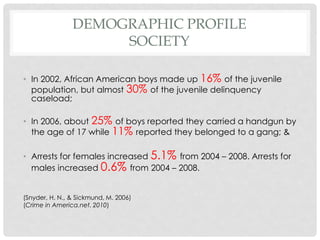
• In 2002, African American boys made up 16% of the juvenile
population, but almost 30% of the juvenile delinquency
caseload;
• In 2006, about 25% of boys reported they carried a handgun by
the age of 17 while 11% reported they belonged to a gang; &

• Arrests for females increased 5.1% from 2004 – 2008. Arrests for
males increased 0.6% from 2004 – 2008.
(Snyder, H. N., & Sickmund, M. 2006)
(Crime in America.net. 2010)
LITERATURE REVIEW
• Student-Teacher relationship

• Teacher Expectation Theory
• “Acting White” thesis

(Debra Hooks and Maja Miskovic, 2012)
(Yasser A Payne and Tara M. Brown, 2010)
(Carol A Mullen and R Lynne Patrick, 2012)
RESEARCH QUESTIONS

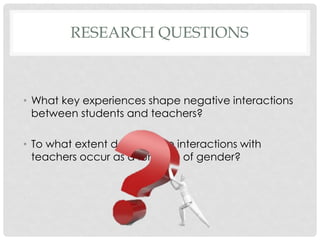
• What key experiences shape negative interactions
between students and teachers?
• To what extent do negative interactions with
teachers occur as a function of gender?
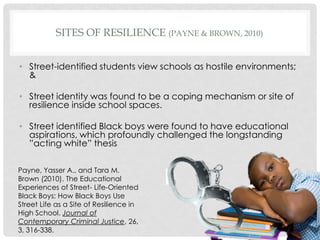
SITES OF RESILIENCE (PAYNE & BROWN, 2010)
• Street-identified students view schools as hostile environments;
&
• Street identity was found to be a coping mechanism or site of
resilience inside school spaces.
• Street identified Black boys were found to have educational
aspirations, which profoundly challenged the longstanding
”acting white” thesis
Payne, Yasser A., and Tara M.
Brown (2010). The Educational
Experiences of Street- Life-Oriented
Black Boys: How Black Boys Use
Street Life as a Site of Resilience in
High School. Journal of
Contemporary Criminal Justice, 26,
3, 316-338.
WHAT DOES STREET LIFE MEAN?
• Street Ideology – centered on personal & economic survival.
• Set of Activities
• Bonding activities extends to joking,“playing the dozens”, hanging
on the “corner” or “block”, rhyming (or rapping), playing
basketball amongst each other to name a few activities; and

• Illegal activities (e. g. armed robbery, selling drugs,
engaging in physical violence, etc.) generally employed
to confront the effects of economic poverty.
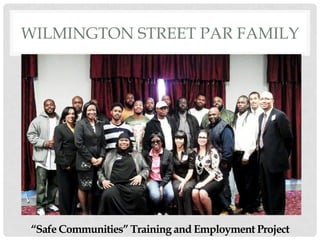
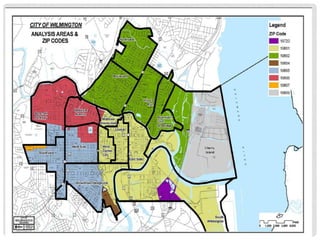
WILMINGTON STREET PAR FAMILY
WHAT IS
PARTICIPATORY ACTION RESEARCH?
• Participatory Action Research (PAR) projects includes on the
research team, members of the population under study. Once such
members are identified, they then are offered the opportunity to
participate in all phases of the research project (e. g. theoretical
framing, literature review, analysis, publication, presentation,
monetary compensation, etc.); &

• PAR projects require an social justice based response to be
organized in response to the data collected by the study.

Research + Social Activism = PAR
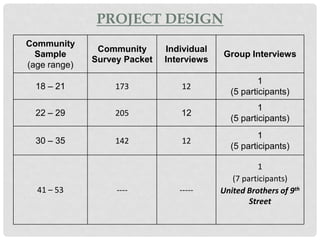
PROJECT DESIGN
Community
Sample
(age range)

Community
Survey Packet

Individual
Interviews

Group Interviews

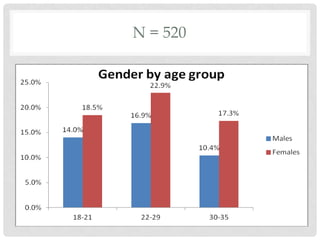
18 – 21

173

12

1
(5 participants)

22 – 29

205

12

1
(5 participants)

30 – 35

142

12

1
(5 participants)

41 – 53

----

-----

1
(7 participants)
United Brothers of 9th
Street
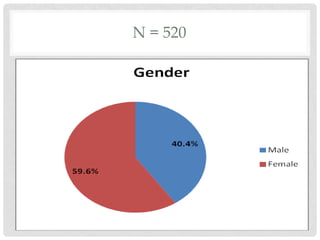
N = 520
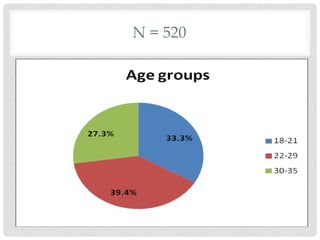
N = 520
N = 520
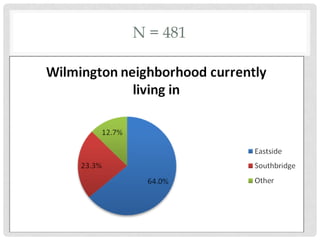
N = 481
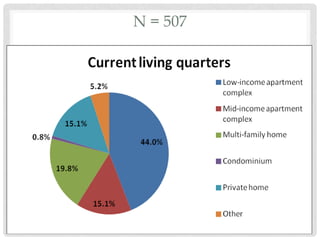
N = 507
N = 503
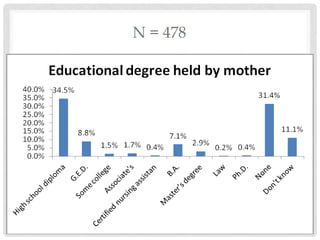
N = 478
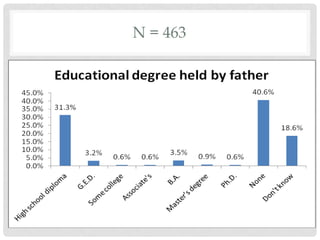
N = 463
PROJECT DESIGN

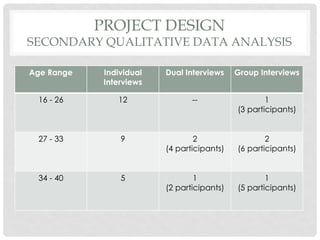
SECONDARY QUALITATIVE DATA ANALYSIS
Age Range

Individual
Interviews

Dual Interviews

Group Interviews

16 - 26

12

--

1
(3 participants)

27 - 33

9

2
(4 participants)

2
(6 participants)

34 - 40

5

1
(2 participants)

1
(5 participants)
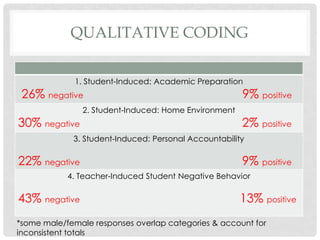
QUALITATIVE CODING
1. Student-Induced: Academic Preparation

26% negative
30% negative

2. Student-Induced: Home Environment

9% positive

2% positive

3. Student-Induced: Personal Accountability

22% negative

9% positive

4. Teacher-Induced Student Negative Behavior

43% negative

13% positive

*some male/female responses overlap categories & account for
inconsistent totals
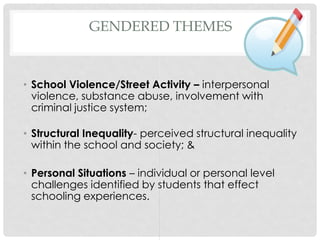
GENDERED THEMES

• School Violence/Street Activity – interpersonal
violence, substance abuse, involvement with
criminal justice system;
• Structural Inequality- perceived structural inequality
within the school and society; &
• Personal Situations – individual or personal level
challenges identified by students that effect
schooling experiences.
MALES

• School violence/Street activity – 10/29 (34%)
• Structural Inequality – 22/29 (76%)
• Personal Situations – 10/29 (34%)
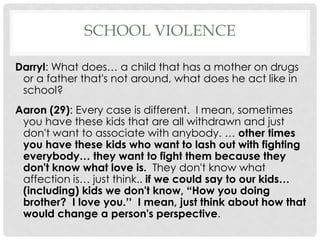
SCHOOL VIOLENCE
Darryl: What does… a child that has a mother on drugs
or a father that's not around, what does he act like in
school?
Aaron (29): Every case is different. I mean, sometimes
you have these kids that are all withdrawn and just
don't want to associate with anybody. … other times
you have these kids who want to lash out with fighting
everybody… they want to fight them because they
don't know what love is. They don't know what
affection is… just think.. if we could say to our kids…
(including) kids we don't know, “How you doing
brother? I love you.’’ I mean, just think about how that
would change a person's perspective.
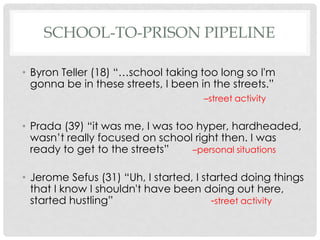
SCHOOL-TO-PRISON PIPELINE
• Byron Teller (18) “…school taking too long so I'm
gonna be in these streets, I been in the streets.”
–street activity

• Prada (39) “it was me, I was too hyper, hardheaded,
wasn’t really focused on school right then. I was
ready to get to the streets”
–personal situations

• Jerome Sefus (31) “Uh, I started, I started doing things
that I know I shouldn't have been doing out here,
started hustling”
-street activity
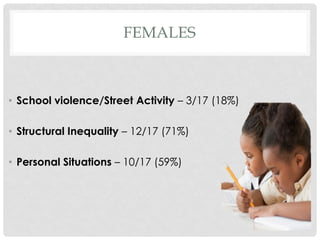
FEMALES

• School violence/Street Activity – 3/17 (18%)
• Structural Inequality – 12/17 (71%)
• Personal Situations – 10/17 (59%)
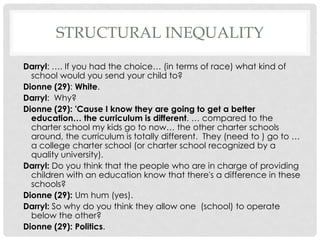
STRUCTURAL INEQUALITY
Darryl: …. If you had the choice… (in terms of race) what kind of
school would you send your child to?
Dionne (29): White.
Darryl: Why?
Dionne (29): 'Cause I know they are going to get a better
education… the curriculum is different. … compared to the
charter school my kids go to now… the other charter schools
around, the curriculum is totally different. They (need to ) go to …
a college charter school (or charter school recognized by a
quality university).
Darryl: Do you think that the people who are in charge of providing
children with an education know that there's a difference in these
schools?
Dionne (29): Um hum (yes).
Darryl: So why do you think they allow one (school) to operate
below the other?
Dionne (29): Politics.
WHAT HAVE WE LEARNED?

• Gender differences
• Structural inequality
• Most participants spoke about a negative
relationship with teachers
THANK YOU!
• Dr. Yasser Payne, Black American Studies
Department, University of Delaware
• University of Delaware Undergraduate Research
Program
• Ms. Meg Meiman & Dr. Lynnette Overby
• 2012 Summer Scholars Research Group

• University of Delaware N.U.C.L.E.U.S. Program

School-to-Prison Pipeline: How perceived experiences with teachers lead students to street behavior inside schools 

  • 1.
    SCHOOL-TO-PRISON PIPELINE HOW PERCEIVED EXPERIENCESWITH TEACHERS LEAD STUDENTS TO STREET BEHAVIOR INSIDE SCHOOLS Presenter: Ashlee Johnson University of Delaware
  • 2.
    DEMOGRAPHIC PROFILE TEACHERS • 85%– 90% of all school teachers who educate Black students are middle class White women • Between 1999 and 2000, 135,000 teachers were physically attacked by a student • From 1999 to 2003, annually, an estimated 183,000 teachers were victims of non-fatal crimes at school. (Yasser A Payne and Tara M. Brown, 2010) (Non-fatal violence Against Teachers, 2009)
  • 3.
    DEMOGRAPHIC PROFILE SCHOOLS • Drop/pushout rates rank higher for Black males than all teenage males combined (13.1% vs 10.9%); • 72% of Black male drop/push outs are unemployed either because they were incarcerated or could not find work; • 19% - 30% of Black students have brought a weapon to school at one time. (Yasser A Payne and Tara M. Brown, 2010)
  • 4.
    DEMOGRAPHIC PROFILE SOCIETY • In2002, African American boys made up 16% of the juvenile population, but almost 30% of the juvenile delinquency caseload; • In 2006, about 25% of boys reported they carried a handgun by the age of 17 while 11% reported they belonged to a gang; & • Arrests for females increased 5.1% from 2004 – 2008. Arrests for males increased 0.6% from 2004 – 2008. (Snyder, H. N., & Sickmund, M. 2006) (Crime in America.net. 2010)
  • 5.
    LITERATURE REVIEW • Student-Teacherrelationship • Teacher Expectation Theory • “Acting White” thesis (Debra Hooks and Maja Miskovic, 2012) (Yasser A Payne and Tara M. Brown, 2010) (Carol A Mullen and R Lynne Patrick, 2012)
  • 6.
    RESEARCH QUESTIONS • Whatkey experiences shape negative interactions between students and teachers? • To what extent do negative interactions with teachers occur as a function of gender?
  • 7.
    SITES OF RESILIENCE(PAYNE & BROWN, 2010) • Street-identified students view schools as hostile environments; & • Street identity was found to be a coping mechanism or site of resilience inside school spaces. • Street identified Black boys were found to have educational aspirations, which profoundly challenged the longstanding ”acting white” thesis Payne, Yasser A., and Tara M. Brown (2010). The Educational Experiences of Street- Life-Oriented Black Boys: How Black Boys Use Street Life as a Site of Resilience in High School. Journal of Contemporary Criminal Justice, 26, 3, 316-338.
  • 8.
    WHAT DOES STREETLIFE MEAN? • Street Ideology – centered on personal & economic survival. • Set of Activities • Bonding activities extends to joking,“playing the dozens”, hanging on the “corner” or “block”, rhyming (or rapping), playing basketball amongst each other to name a few activities; and • Illegal activities (e. g. armed robbery, selling drugs, engaging in physical violence, etc.) generally employed to confront the effects of economic poverty.
  • 9.
  • 10.
    WHAT IS PARTICIPATORY ACTIONRESEARCH? • Participatory Action Research (PAR) projects includes on the research team, members of the population under study. Once such members are identified, they then are offered the opportunity to participate in all phases of the research project (e. g. theoretical framing, literature review, analysis, publication, presentation, monetary compensation, etc.); & • PAR projects require an social justice based response to be organized in response to the data collected by the study. Research + Social Activism = PAR
  • 11.
    PROJECT DESIGN Community Sample (age range) Community SurveyPacket Individual Interviews Group Interviews 18 – 21 173 12 1 (5 participants) 22 – 29 205 12 1 (5 participants) 30 – 35 142 12 1 (5 participants) 41 – 53 ---- ----- 1 (7 participants) United Brothers of 9th Street
  • 13.
  • 14.
  • 15.
  • 16.
  • 17.
  • 18.
  • 19.
  • 20.
  • 21.
    PROJECT DESIGN SECONDARY QUALITATIVEDATA ANALYSIS Age Range Individual Interviews Dual Interviews Group Interviews 16 - 26 12 -- 1 (3 participants) 27 - 33 9 2 (4 participants) 2 (6 participants) 34 - 40 5 1 (2 participants) 1 (5 participants)
  • 22.
    QUALITATIVE CODING 1. Student-Induced:Academic Preparation 26% negative 30% negative 2. Student-Induced: Home Environment 9% positive 2% positive 3. Student-Induced: Personal Accountability 22% negative 9% positive 4. Teacher-Induced Student Negative Behavior 43% negative 13% positive *some male/female responses overlap categories & account for inconsistent totals
  • 23.
    GENDERED THEMES • SchoolViolence/Street Activity – interpersonal violence, substance abuse, involvement with criminal justice system; • Structural Inequality- perceived structural inequality within the school and society; & • Personal Situations – individual or personal level challenges identified by students that effect schooling experiences.
  • 24.
    MALES • School violence/Streetactivity – 10/29 (34%) • Structural Inequality – 22/29 (76%) • Personal Situations – 10/29 (34%)
  • 25.
    SCHOOL VIOLENCE Darryl: Whatdoes… a child that has a mother on drugs or a father that's not around, what does he act like in school? Aaron (29): Every case is different. I mean, sometimes you have these kids that are all withdrawn and just don't want to associate with anybody. … other times you have these kids who want to lash out with fighting everybody… they want to fight them because they don't know what love is. They don't know what affection is… just think.. if we could say to our kids… (including) kids we don't know, “How you doing brother? I love you.’’ I mean, just think about how that would change a person's perspective.
  • 26.
    SCHOOL-TO-PRISON PIPELINE • ByronTeller (18) “…school taking too long so I'm gonna be in these streets, I been in the streets.” –street activity • Prada (39) “it was me, I was too hyper, hardheaded, wasn’t really focused on school right then. I was ready to get to the streets” –personal situations • Jerome Sefus (31) “Uh, I started, I started doing things that I know I shouldn't have been doing out here, started hustling” -street activity
  • 27.
    FEMALES • School violence/StreetActivity – 3/17 (18%) • Structural Inequality – 12/17 (71%) • Personal Situations – 10/17 (59%)
  • 28.
    STRUCTURAL INEQUALITY Darryl: ….If you had the choice… (in terms of race) what kind of school would you send your child to? Dionne (29): White. Darryl: Why? Dionne (29): 'Cause I know they are going to get a better education… the curriculum is different. … compared to the charter school my kids go to now… the other charter schools around, the curriculum is totally different. They (need to ) go to … a college charter school (or charter school recognized by a quality university). Darryl: Do you think that the people who are in charge of providing children with an education know that there's a difference in these schools? Dionne (29): Um hum (yes). Darryl: So why do you think they allow one (school) to operate below the other? Dionne (29): Politics.
  • 29.
    WHAT HAVE WELEARNED? • Gender differences • Structural inequality • Most participants spoke about a negative relationship with teachers
  • 30.
    THANK YOU! • Dr.Yasser Payne, Black American Studies Department, University of Delaware • University of Delaware Undergraduate Research Program • Ms. Meg Meiman & Dr. Lynnette Overby • 2012 Summer Scholars Research Group • University of Delaware N.U.C.L.E.U.S. Program