Database Management
Why Study Data Resource Management?

• Today’s business enterprises cannot survive or
  succeed without quality data about their internal
  operations and external environment.

Definition:
• A managerial activity that applies information
  systems technologies to the task of managing an
  organization’s data resources to meet the
  information needs of their business stakeholders
Foundation Data Concepts
• Character – single alphabetic, numeric or
  other symbol
• Field – group of related characters
• Entity – person, place, object or event
• Attribute – characteristic of an entity
Foundation Data Concepts
• Record – collection of attributes that describe
  an entity
• File – group of related records
• Database – integrated collection of logically
  related data elements
Traditional File Processing vs DBMS

Definition: Traditional File Processing
• Data are organized, stored, and processed in
  independent files of data records

Definition: Database Management Systems
• Software that controls the creation,
  maintenance, and use of databases
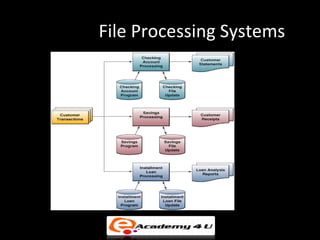
File Processing Systems
Problems of File Processing
• Data Redundancy – duplicate data requires an update to
  be made to all files storing that data

• Lack of Data Integration – data stored in separate files
  require special programs for output making ad hoc
  reporting difficult

• Data Dependence – programs must include information
  about how the data is stored so a change in storage
  format requires a change in programs
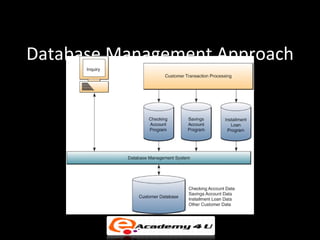
Database Management Approach
Definition:
• Consolidates data records into one database
  that can be accessed by many different
  application programs.

• Software interface between users and
  databases

• Data definition is stored once, separately from
  application programs
Database Management Approach
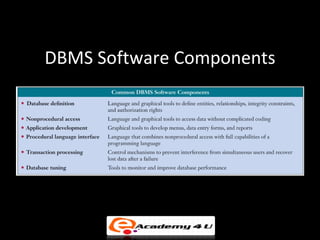
DBMS Software Components
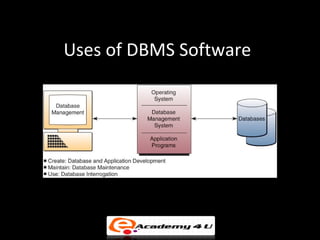
Uses of DBMS Software
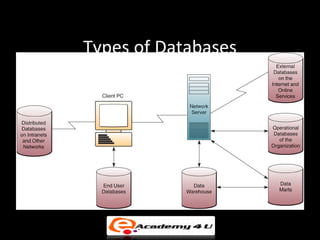
Types of Databases
Types of Databases
• Operational – store detailed data needed to
  support the business processes and
  operations of a company
• Distributed – databases that are replicated
  and distributed in whole or in part to network
  servers at a variety of sites
Types of Databases
• External – contain a wealth of information
  available from commercial online services and
  from many sources on the World Wide Web
• Hypermedia – consist of hyperlinked pages of
  multimedia
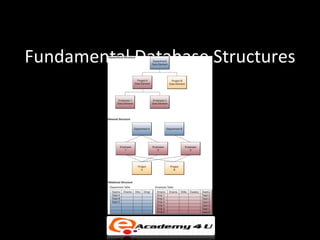
Fundamental Database Structures
Database Structures
•   Hierarchical – relationships between records form a hierarchy or treelike
    structure. A record is subdivided into segments that are connected to
    each other in one to many parent – child relationship. Relationships
    among the records are one-to-many.

•   Network – data can be accessed by one of several paths because any data
    element or record can be related to any number of other data elements.
    An older logical database model that is useful for depicting many-to-many
    relationships. The network structure can represent more complex logical
    relationships, and is still used by many mainframe DBMS packages.
Relational Database Structure
Definition:
• All data elements within the database are
  viewed as being stored in the form of simple
  tables
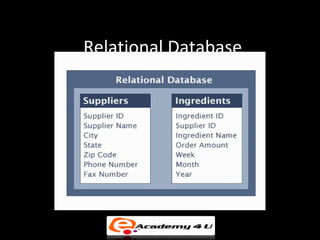
Relational Database
Multidimensional Database Structure
Definition:
• Variation of the relational model that uses
  multidimensional structures to organize data
  and express the relationships between data
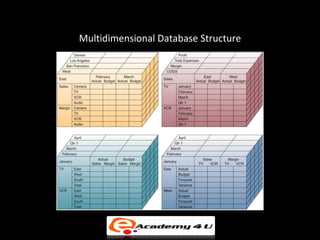
Multidimensional Database Structure
Object-Oriented Database
                   Structure
Definition:
• Can accommodate more complex data types including
  graphics, pictures, voice and text

• Encapsulation – data values and operations that can be
  performed on them are stored as a unit

• Inheritance – automatically creating new objects by
  replicating some or all of the characteristics of one or
  more existing objects
Evaluation of Database Structures
• Hierarchical data structure is best for
  structured, routine types of transaction
  processing.
• Network data structure is best when many-to-
  many relationships are needed.
• Relational data structure is best when ad hoc
  reporting is required.
Database Development
• Enterprise-wide database development is
  usually controlled by database administrators
  (DBA)
• Data dictionary – catalog or directory
  containing metadata
• Metadata – data about data
Database Development Process
• First, develop a Conceptual design
   – - an abstract model of the database from the user or
     business perspective .
   – - Create physical and logical view
• Second, organize with Entity-Relationship (ER)
  modeling
   – process of planning the database design
   – Entity classes  Instance  Identifiers  Relationships
Database Development Process
• Third, analyze the data structure by applying the
  Normalization process
   – method that reduces a relational database to its most
     streamlined form
   – Helps achieve
       • minimum redundancy
       • maximum data integrity
       • best processing performance
Database Development Process
• Fourth, physically implement the data structure in
  the database management system software (
   –   Create tables
   –   Define fields and field properties
   –   Establish primary keys
   –   Define table relationships
   –   Add actual data (records) to tables
Logical vs. Physical Views
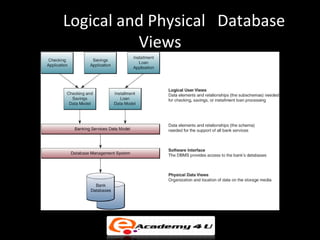
• Logical – logical consist of conceptual design
  within an abstract model which data
  elements and relationships (subschemas) are
  used in the model.

• Physical – the design shows how the database
  is arranged, physically stored and accessed on
  the storage devices of a computer system.
Logical and Physical Database
          Views
Database Maintenance
• Updating a database continually to reflect
  new business transactions and other events
• Updating a database to correct data and
  ensure accuracy of the data
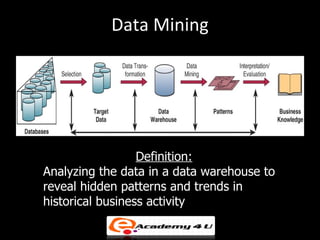
Data Mining


                  Definition:
Analyzing the data in a data warehouse to
reveal hidden patterns and trends in
historical business activity
Data Mining Uses
• Perform “market-basket analysis” to identify new
  product bundles.

• Find root causes to quality or manufacturing
  problems.

• Prevent customer attrition and acquire new
  customers.

• Cross-sell to existing customers.

• Profile customers with more accuracy.
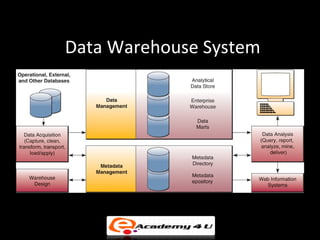
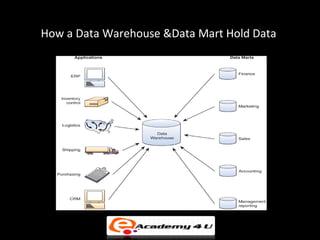
Data Warehouse vs Data Mart
Definition:Data Warehouse
• Large database that stores data that have been
  extracted from the various operational, external, and
  other databases of an organization
Definition: Data Mart
• Databases that hold subsets of data from a data
  warehouse that focus on specific aspects of a
  company, such as a department or a business
  process
Data Warehouse System
Basic Characteristics of
                  Data Warehouse
Organized by business dimension or subject
• Data are organized by subject (by customer, supplier, vendor, product,
   region etc) and contain information relevant for decision and data
   analysis.
Consistent
• Data in different databases may encoded differently. E.g, gender data may
   be encoded 0 and 1 in one operational system and or M and F in another.
   In data warehouse , it must be coded in a consistent manner
Nonvolatile
• Data are not updated after they are entered into the warehouse
Basic Characteristics of
              Data Warehouse (cont’)
Historical
• The data are kept for many years so that they can be used for trends,
   forecasting and comparison over time.
Use online analytical processing
• Online Analytical Processing (OLAP) involves the analysis of accumulated
   data by end users which are designed to support decision makers.
Multidimensional Structure
• Data warehouse use multidimensional data structure so it allow users to
   view and analyze data from the various perspective of the various
   business dimensions.
How a Data Warehouse &Data Mart Hold Data

Management information system database management

  • 1.
  • 2.
    Why Study DataResource Management? • Today’s business enterprises cannot survive or succeed without quality data about their internal operations and external environment. Definition: • A managerial activity that applies information systems technologies to the task of managing an organization’s data resources to meet the information needs of their business stakeholders
  • 3.
    Foundation Data Concepts •Character – single alphabetic, numeric or other symbol • Field – group of related characters • Entity – person, place, object or event • Attribute – characteristic of an entity
  • 4.
    Foundation Data Concepts •Record – collection of attributes that describe an entity • File – group of related records • Database – integrated collection of logically related data elements
  • 5.
    Traditional File Processingvs DBMS Definition: Traditional File Processing • Data are organized, stored, and processed in independent files of data records Definition: Database Management Systems • Software that controls the creation, maintenance, and use of databases
  • 6.
  • 7.
    Problems of FileProcessing • Data Redundancy – duplicate data requires an update to be made to all files storing that data • Lack of Data Integration – data stored in separate files require special programs for output making ad hoc reporting difficult • Data Dependence – programs must include information about how the data is stored so a change in storage format requires a change in programs
  • 8.
    Database Management Approach Definition: •Consolidates data records into one database that can be accessed by many different application programs. • Software interface between users and databases • Data definition is stored once, separately from application programs
  • 9.
  • 10.
  • 11.
    Uses of DBMSSoftware
  • 12.
  • 13.
    Types of Databases •Operational – store detailed data needed to support the business processes and operations of a company • Distributed – databases that are replicated and distributed in whole or in part to network servers at a variety of sites
  • 14.
    Types of Databases •External – contain a wealth of information available from commercial online services and from many sources on the World Wide Web • Hypermedia – consist of hyperlinked pages of multimedia
  • 15.
  • 16.
    Database Structures • Hierarchical – relationships between records form a hierarchy or treelike structure. A record is subdivided into segments that are connected to each other in one to many parent – child relationship. Relationships among the records are one-to-many. • Network – data can be accessed by one of several paths because any data element or record can be related to any number of other data elements. An older logical database model that is useful for depicting many-to-many relationships. The network structure can represent more complex logical relationships, and is still used by many mainframe DBMS packages.
  • 17.
    Relational Database Structure Definition: •All data elements within the database are viewed as being stored in the form of simple tables
  • 18.
  • 19.
    Multidimensional Database Structure Definition: •Variation of the relational model that uses multidimensional structures to organize data and express the relationships between data
  • 20.
  • 21.
    Object-Oriented Database Structure Definition: • Can accommodate more complex data types including graphics, pictures, voice and text • Encapsulation – data values and operations that can be performed on them are stored as a unit • Inheritance – automatically creating new objects by replicating some or all of the characteristics of one or more existing objects
  • 22.
    Evaluation of DatabaseStructures • Hierarchical data structure is best for structured, routine types of transaction processing. • Network data structure is best when many-to- many relationships are needed. • Relational data structure is best when ad hoc reporting is required.
  • 23.
    Database Development • Enterprise-widedatabase development is usually controlled by database administrators (DBA) • Data dictionary – catalog or directory containing metadata • Metadata – data about data
  • 24.
    Database Development Process •First, develop a Conceptual design – - an abstract model of the database from the user or business perspective . – - Create physical and logical view • Second, organize with Entity-Relationship (ER) modeling – process of planning the database design – Entity classes  Instance  Identifiers  Relationships
  • 25.
    Database Development Process •Third, analyze the data structure by applying the Normalization process – method that reduces a relational database to its most streamlined form – Helps achieve • minimum redundancy • maximum data integrity • best processing performance
  • 26.
    Database Development Process •Fourth, physically implement the data structure in the database management system software ( – Create tables – Define fields and field properties – Establish primary keys – Define table relationships – Add actual data (records) to tables
  • 27.
    Logical vs. PhysicalViews • Logical – logical consist of conceptual design within an abstract model which data elements and relationships (subschemas) are used in the model. • Physical – the design shows how the database is arranged, physically stored and accessed on the storage devices of a computer system.
  • 28.
    Logical and PhysicalDatabase Views
  • 29.
    Database Maintenance • Updatinga database continually to reflect new business transactions and other events • Updating a database to correct data and ensure accuracy of the data
  • 30.
    Data Mining Definition: Analyzing the data in a data warehouse to reveal hidden patterns and trends in historical business activity
  • 31.
    Data Mining Uses •Perform “market-basket analysis” to identify new product bundles. • Find root causes to quality or manufacturing problems. • Prevent customer attrition and acquire new customers. • Cross-sell to existing customers. • Profile customers with more accuracy.
  • 32.
    Data Warehouse vsData Mart Definition:Data Warehouse • Large database that stores data that have been extracted from the various operational, external, and other databases of an organization Definition: Data Mart • Databases that hold subsets of data from a data warehouse that focus on specific aspects of a company, such as a department or a business process
  • 33.
  • 34.
    Basic Characteristics of Data Warehouse Organized by business dimension or subject • Data are organized by subject (by customer, supplier, vendor, product, region etc) and contain information relevant for decision and data analysis. Consistent • Data in different databases may encoded differently. E.g, gender data may be encoded 0 and 1 in one operational system and or M and F in another. In data warehouse , it must be coded in a consistent manner Nonvolatile • Data are not updated after they are entered into the warehouse
  • 35.
    Basic Characteristics of Data Warehouse (cont’) Historical • The data are kept for many years so that they can be used for trends, forecasting and comparison over time. Use online analytical processing • Online Analytical Processing (OLAP) involves the analysis of accumulated data by end users which are designed to support decision makers. Multidimensional Structure • Data warehouse use multidimensional data structure so it allow users to view and analyze data from the various perspective of the various business dimensions.
  • 36.
    How a DataWarehouse &Data Mart Hold Data