Management Information System System Concepts
System A SYSTEM IS AN ORDERLY GROUPING OF INTERDEPENDENT COMPONENTS LINKED  TOGETHER ACCORDING TO A PLAN TO  ACHIEVE A SPECIFIC OBJECTIVE.
Basic Implications A System must be designed to achieve a predetermined objective. Interrelationships & Interdependence must exist among the components. The objectives of the organization as a whole have a higher priority than the objectives of its subsystems.
Examples of Systems Transportation System Telephone System Accounting System Production System Computer System  Business System etc.
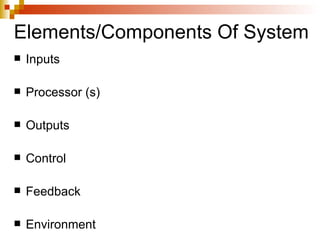
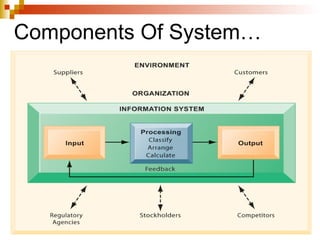
Elements/Components Of System Inputs Processor (s) Outputs Control Feedback Environment
Components Of System…
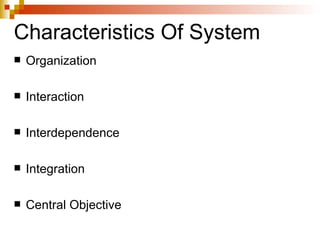
Characteristics Of System Organization Interaction Interdependence Integration Central Objective
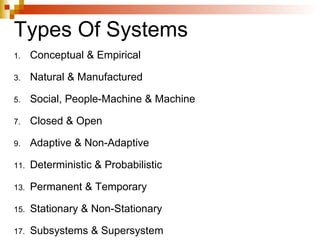
Types Of Systems Conceptual & Empirical Natural & Manufactured Social, People-Machine & Machine Closed & Open Adaptive & Non-Adaptive Deterministic & Probabilistic Permanent & Temporary Stationary & Non-Stationary Subsystems & Supersystem
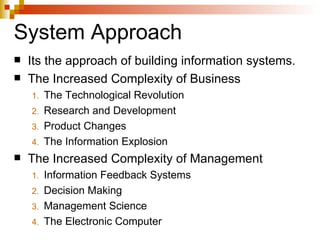
System Approach Its the approach of building information systems. The Increased Complexity of Business The Technological Revolution Research and Development Product Changes The Information Explosion The Increased Complexity of Management Information Feedback Systems Decision Making Management Science The Electronic Computer
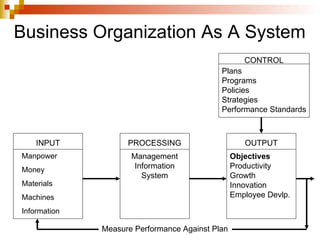
Business Organization As A System CONTROL Plans  Programs  Policies  Strategies  Performance Standards Measure Performance Against Plan INPUT Manpower Money Materials Machines Information PROCESSING Management Information System OUTPUT Objectives  Productivity Growth Innovation Employee Devlp.

System concepts

  • 1.
  • 2.
    System A SYSTEMIS AN ORDERLY GROUPING OF INTERDEPENDENT COMPONENTS LINKED TOGETHER ACCORDING TO A PLAN TO ACHIEVE A SPECIFIC OBJECTIVE.
  • 3.
    Basic Implications ASystem must be designed to achieve a predetermined objective. Interrelationships & Interdependence must exist among the components. The objectives of the organization as a whole have a higher priority than the objectives of its subsystems.
  • 4.
    Examples of SystemsTransportation System Telephone System Accounting System Production System Computer System Business System etc.
  • 5.
    Elements/Components Of SystemInputs Processor (s) Outputs Control Feedback Environment
  • 6.
  • 7.
    Characteristics Of SystemOrganization Interaction Interdependence Integration Central Objective
  • 8.
    Types Of SystemsConceptual & Empirical Natural & Manufactured Social, People-Machine & Machine Closed & Open Adaptive & Non-Adaptive Deterministic & Probabilistic Permanent & Temporary Stationary & Non-Stationary Subsystems & Supersystem
  • 9.
    System Approach Itsthe approach of building information systems. The Increased Complexity of Business The Technological Revolution Research and Development Product Changes The Information Explosion The Increased Complexity of Management Information Feedback Systems Decision Making Management Science The Electronic Computer
  • 10.
    Business Organization AsA System CONTROL Plans Programs Policies Strategies Performance Standards Measure Performance Against Plan INPUT Manpower Money Materials Machines Information PROCESSING Management Information System OUTPUT Objectives Productivity Growth Innovation Employee Devlp.