Group members :
Raja Muhammad noman
Muhammad aqib
Haider abbas
Farhad abbas
CONTENTS
 DATABASES, DATA and information
 THE HIERARCHY OF DATA
 MAINTAINING DATA
 FILE PROCESSING VERSUS DATABASES
 DATABASE MANAGEMENT SYSTEMS
 RELATIONAL, OBJECT-ORIENTED, AND MULTIDIMENSIONAL
DATABASE
 WEB DATABASES DATABASE ADMINISTRATION
DATABASE ,DATA ,AND INFORMATION:
 Data is a collection of unprocessed item.
 Information is processed data.
 Database is a collection of data organized in a manner that allows access,
retrieval, and use of that data. Computers process data in a database into
information. Mostly data represents recordable facts. Data aids in
producing information, which is based on facts. For example, if we have
data about marks obtained by all students, we can then conclude about
toppers and average marks. A database management system stores data in
such a way that it becomes easier to retrieve, manipulate, and produce
information
Most companies realize that data is one of their more valuable assets —
because data is used to generate information. Many business transactions take
less time when employees have instant access to information. To ensure that
data is accessible on demand, a company must manage and protect its data
just as it would any other resource. Thus, it is vital that the data has integrity
and is kept secure. For a computer to produce correct information, the data
that is entered into a database must have integrity. Data integrity identifies the
quality of the data. An erroneous member address in a member database is an
example of incorrect data. When a database contains this type of error, it loses
integrity. Data integrity is very important because computers and people use
information to make decisions and take actions. Garbage in, garbage out
(GIGO) is a computing phrase that points out the accuracy of a computer’s
output depends on the accuracy of the input. If you enter incorrect data into a
computer (garbage in), the computer will produce incorrect information
(garbage out).
The hierarchy of data
 In the computer profession, data is classified in a hierarchy. Each higher
level of data consists of one or more items from the lower level.
Maintaining data
 File maintenance refers to the procedures that keep data current. File
maintenance procedures include:
 Adding records
Users add new records to a file when they obtain new data.
 Changing records
(1) to correct inaccurate data.
(2) to update old data with new data.
 Deleting records
When a record no longer is needed, a user deletes it from a file.
Validating data
Validation is the process of comparing data with a set of rules or values
to find out if the data is correct. Many programs perform a validity
check that analyzes entered data to help ensure that it is correct. For
instance, when a membership services associate adds or changes data in
a member record, the DBMS tests the entered data.
 ALPHABETIC/NUMBERIC CHECK
 RANGE CHECK
 CONSISTENCY CHECK
 COMPLETENESS CHECK
 CHECK DIGIT
File processing versus data base
Almost all application programs use the file processing approach, the
database approach, or a combination of both approaches to store and
manage data.
File processing system
many organizations exclusively used file processing systems to store
and manage data. In a typical file processing system, each department or
area within an organization has its own set of file.
The Database approach
When a company uses the database approach, many programs and
users share the data in the database.
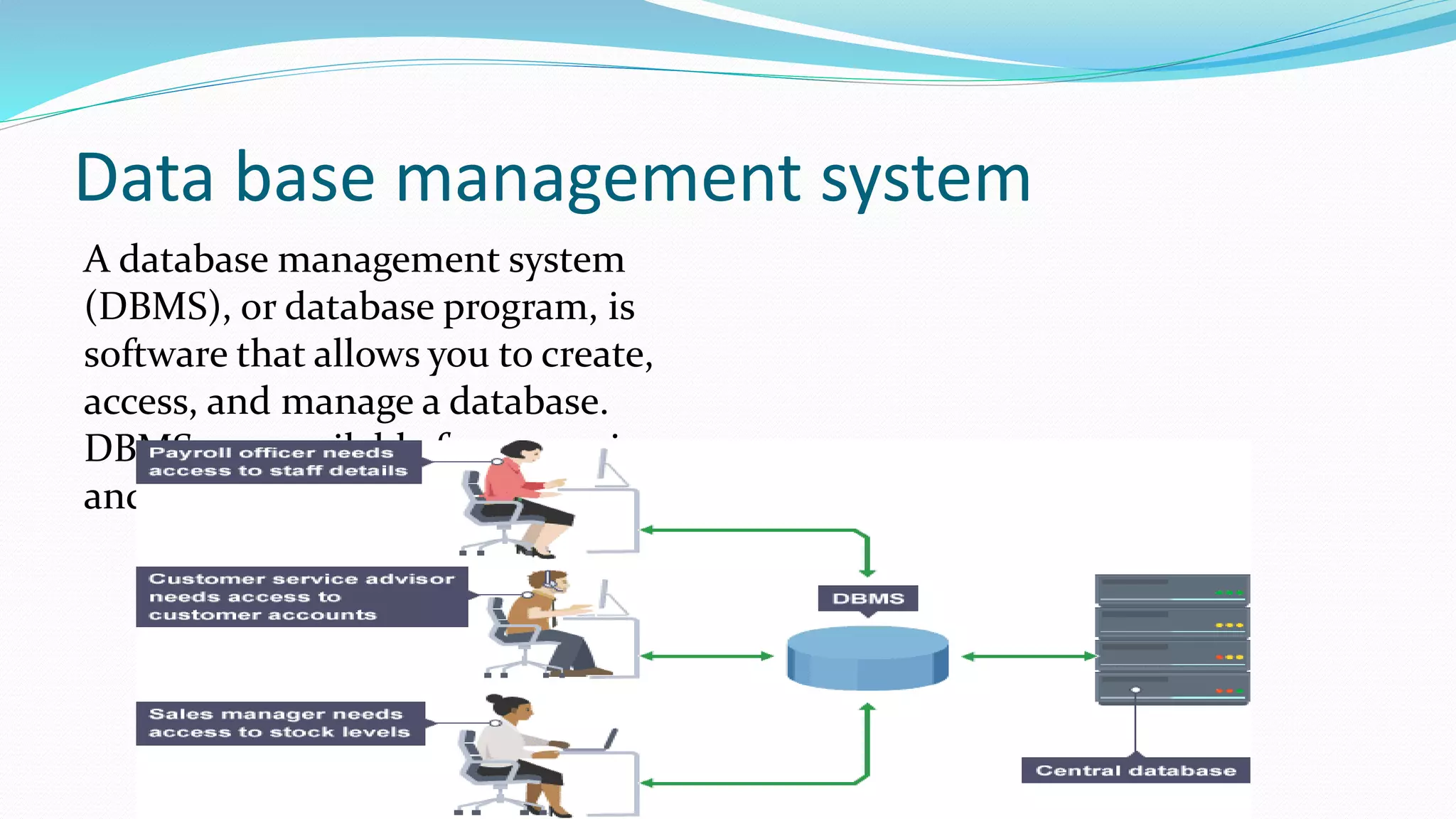
Data base management system
A database management system
(DBMS), or database program, is
software that allows you to create,
access, and manage a database.
DBMSs are available for many sizes
and types of computer
A DBMS provides means to ensure that only authorized users
access data at permitted times. In addition, most DBMSs allow
different levels of access privileges to be identified for each field in
the database. These access privileges define the actions that a
specific user or group of users can perform. Access privileges for
data involve establishing who can enter new data, change existing
data, delete unwanted data, and view data.
RELATIONAL, OBJECT-ORIENTED, AND
MULTIDIMENSIONAL DATABASE
 Every database and DBMS is based on a specific data model. A data
model consists of rules and standards that define how the database
organizes data. A data model defines how users view the
organization of the data. It does not define how the operating system
actually arranges the data on the disk. Three popular data models in
use today are relational, object-oriented, and multidimensional. A
database typically is based on one data model. Some databases,
however, combine features of the relational and object-oriented data
models.
Today, a relational database is a widely used type of database. A
relational database is a database that stores data in tables that
consist of rows and columns. Each row has a primary key and each
column has a unique name. a file processing environment uses the
terms file, record, and field to represent data. A relational database
uses terms different from a file processing system. A developer of a
relational database refers to a file as a relation, a record as a tuple,
and a field as an attribute. A user of a relational database, by
contrast, refers to a file as a table, a record as a row, and a field as a
column
An object-oriented database (OODB) stores data in objects. An object is an
item that contains data, as well as the actions that read or process the data. A
Member object, for example, might contain data about a member such as
Member ID, First Name, Last Name, Address, and so on. It also could contain
instructions about how to print the member record or the formula required to
calculate a member’s balance due. Object-oriented databases have several
advantages compared with relational databases: they can store more types of
data, access this data faster, and allow programmers to reuse objects. An
object-oriented database stores unstructured data more efficiently than a
relational database. Unstructured data includes photographs, video clips,
audio clips, and documents. When users query an object-oriented database,
the results often are displayed more quickly than the same query of a relational
database
A multidimensional database stores data in dimensions. Whereas a relational
database is a two-dimensional table, a multidimensional database can store
more than two dimensions of data. These multiple dimensions allow users to
access and analyze any view of the database data.
DATA WAREHOUSES
One application that typically uses multidimensional databases is a data
warehouse. A data warehouse is a huge database that stores and manages the
data required to analyze historical and current transactions. Through a data
warehouse, managers and other users access transactions and summaries of
transactions quickly and efficiently.
One of the more profound features of the Web is the vast amount of
information it provides. The Web offers information about jobs, travel
destinations, television programming, pictures, movies, videos, local and
national weather, sporting events, and legislative information. You can shop
for just about any product or service, buy or sell stocks, search for a job, and
make airline reservations. Much of this and other information on the Web
exists in databases. Some Web databases are collaborative databases, where
users store and share photos, videos, recordings, and other personal media
with other registered users. To access data in a Web database, you fill in a form
or enter search text on a Web page. Many search engines such as Yahoo! use
databases to store Web site descriptions. To access the database, you enter
search text into the search engine. A Web database usually resides on a
database server. A database server is a computer that stores and provides
access to a database.
Managing a company’s database requires a great deal of coordination. The role of
coordinating the use of the database belongs to the database analysts and
administrators. To carry out their responsibilities, these IT (information technology)
professionals follow database design guidelines and need cooperation from all
database users.
Database Design Guidelines
A carefully designed database makes it easier for a user to query the database, modify
the data, and create report
The database analysts and administrators are responsible for managing and
coordinating all database activities. The database analyst (DA) decides on the
proper placement of fields, defines the relationships among data, and
identifies users’ access privileges. The database administrator (DBA) requires a
more technical inside view of the data. The DBA creates and maintains the
data dictionary, manages security of the database, monitors the performance
of the database, and checks backup and recovery procedures. In small
companies, one person often is both the DA and DBA. In larger companies,
the responsibilities of the DA and DBA are split among two or more people
Employees should learn how to use the data in the
database effectively. The amount of information available
often amazes first-time database users. Instant access to
information helps employees perform their jobs more
effectively. Today, employees access databases from their
office desktop computers, notebook computers, or even
smart phones, PDAs, and other mobile devices. The
maintenance of a database is an ongoing task that
companies measure constantly against their overall goals.
DATABASE MANAGEMENT

DATABASE MANAGEMENT

  • 2.
    Group members : RajaMuhammad noman Muhammad aqib Haider abbas Farhad abbas
  • 3.
    CONTENTS  DATABASES, DATAand information  THE HIERARCHY OF DATA  MAINTAINING DATA  FILE PROCESSING VERSUS DATABASES  DATABASE MANAGEMENT SYSTEMS  RELATIONAL, OBJECT-ORIENTED, AND MULTIDIMENSIONAL DATABASE  WEB DATABASES DATABASE ADMINISTRATION
  • 4.
    DATABASE ,DATA ,ANDINFORMATION:  Data is a collection of unprocessed item.  Information is processed data.  Database is a collection of data organized in a manner that allows access, retrieval, and use of that data. Computers process data in a database into information. Mostly data represents recordable facts. Data aids in producing information, which is based on facts. For example, if we have data about marks obtained by all students, we can then conclude about toppers and average marks. A database management system stores data in such a way that it becomes easier to retrieve, manipulate, and produce information
  • 5.
    Most companies realizethat data is one of their more valuable assets — because data is used to generate information. Many business transactions take less time when employees have instant access to information. To ensure that data is accessible on demand, a company must manage and protect its data just as it would any other resource. Thus, it is vital that the data has integrity and is kept secure. For a computer to produce correct information, the data that is entered into a database must have integrity. Data integrity identifies the quality of the data. An erroneous member address in a member database is an example of incorrect data. When a database contains this type of error, it loses integrity. Data integrity is very important because computers and people use information to make decisions and take actions. Garbage in, garbage out (GIGO) is a computing phrase that points out the accuracy of a computer’s output depends on the accuracy of the input. If you enter incorrect data into a computer (garbage in), the computer will produce incorrect information (garbage out).
  • 6.
    The hierarchy ofdata  In the computer profession, data is classified in a hierarchy. Each higher level of data consists of one or more items from the lower level.
  • 7.
    Maintaining data  Filemaintenance refers to the procedures that keep data current. File maintenance procedures include:  Adding records Users add new records to a file when they obtain new data.  Changing records (1) to correct inaccurate data. (2) to update old data with new data.  Deleting records When a record no longer is needed, a user deletes it from a file.
  • 8.
    Validating data Validation isthe process of comparing data with a set of rules or values to find out if the data is correct. Many programs perform a validity check that analyzes entered data to help ensure that it is correct. For instance, when a membership services associate adds or changes data in a member record, the DBMS tests the entered data.  ALPHABETIC/NUMBERIC CHECK  RANGE CHECK  CONSISTENCY CHECK  COMPLETENESS CHECK  CHECK DIGIT
  • 9.
    File processing versusdata base Almost all application programs use the file processing approach, the database approach, or a combination of both approaches to store and manage data. File processing system many organizations exclusively used file processing systems to store and manage data. In a typical file processing system, each department or area within an organization has its own set of file. The Database approach When a company uses the database approach, many programs and users share the data in the database.
  • 10.
    Data base managementsystem A database management system (DBMS), or database program, is software that allows you to create, access, and manage a database. DBMSs are available for many sizes and types of computer
  • 11.
    A DBMS providesmeans to ensure that only authorized users access data at permitted times. In addition, most DBMSs allow different levels of access privileges to be identified for each field in the database. These access privileges define the actions that a specific user or group of users can perform. Access privileges for data involve establishing who can enter new data, change existing data, delete unwanted data, and view data.
  • 12.
    RELATIONAL, OBJECT-ORIENTED, AND MULTIDIMENSIONALDATABASE  Every database and DBMS is based on a specific data model. A data model consists of rules and standards that define how the database organizes data. A data model defines how users view the organization of the data. It does not define how the operating system actually arranges the data on the disk. Three popular data models in use today are relational, object-oriented, and multidimensional. A database typically is based on one data model. Some databases, however, combine features of the relational and object-oriented data models.
  • 13.
    Today, a relationaldatabase is a widely used type of database. A relational database is a database that stores data in tables that consist of rows and columns. Each row has a primary key and each column has a unique name. a file processing environment uses the terms file, record, and field to represent data. A relational database uses terms different from a file processing system. A developer of a relational database refers to a file as a relation, a record as a tuple, and a field as an attribute. A user of a relational database, by contrast, refers to a file as a table, a record as a row, and a field as a column
  • 14.
    An object-oriented database(OODB) stores data in objects. An object is an item that contains data, as well as the actions that read or process the data. A Member object, for example, might contain data about a member such as Member ID, First Name, Last Name, Address, and so on. It also could contain instructions about how to print the member record or the formula required to calculate a member’s balance due. Object-oriented databases have several advantages compared with relational databases: they can store more types of data, access this data faster, and allow programmers to reuse objects. An object-oriented database stores unstructured data more efficiently than a relational database. Unstructured data includes photographs, video clips, audio clips, and documents. When users query an object-oriented database, the results often are displayed more quickly than the same query of a relational database
  • 15.
    A multidimensional databasestores data in dimensions. Whereas a relational database is a two-dimensional table, a multidimensional database can store more than two dimensions of data. These multiple dimensions allow users to access and analyze any view of the database data. DATA WAREHOUSES One application that typically uses multidimensional databases is a data warehouse. A data warehouse is a huge database that stores and manages the data required to analyze historical and current transactions. Through a data warehouse, managers and other users access transactions and summaries of transactions quickly and efficiently.
  • 16.
    One of themore profound features of the Web is the vast amount of information it provides. The Web offers information about jobs, travel destinations, television programming, pictures, movies, videos, local and national weather, sporting events, and legislative information. You can shop for just about any product or service, buy or sell stocks, search for a job, and make airline reservations. Much of this and other information on the Web exists in databases. Some Web databases are collaborative databases, where users store and share photos, videos, recordings, and other personal media with other registered users. To access data in a Web database, you fill in a form or enter search text on a Web page. Many search engines such as Yahoo! use databases to store Web site descriptions. To access the database, you enter search text into the search engine. A Web database usually resides on a database server. A database server is a computer that stores and provides access to a database.
  • 17.
    Managing a company’sdatabase requires a great deal of coordination. The role of coordinating the use of the database belongs to the database analysts and administrators. To carry out their responsibilities, these IT (information technology) professionals follow database design guidelines and need cooperation from all database users. Database Design Guidelines A carefully designed database makes it easier for a user to query the database, modify the data, and create report
  • 18.
    The database analystsand administrators are responsible for managing and coordinating all database activities. The database analyst (DA) decides on the proper placement of fields, defines the relationships among data, and identifies users’ access privileges. The database administrator (DBA) requires a more technical inside view of the data. The DBA creates and maintains the data dictionary, manages security of the database, monitors the performance of the database, and checks backup and recovery procedures. In small companies, one person often is both the DA and DBA. In larger companies, the responsibilities of the DA and DBA are split among two or more people
  • 19.
    Employees should learnhow to use the data in the database effectively. The amount of information available often amazes first-time database users. Instant access to information helps employees perform their jobs more effectively. Today, employees access databases from their office desktop computers, notebook computers, or even smart phones, PDAs, and other mobile devices. The maintenance of a database is an ongoing task that companies measure constantly against their overall goals.