Data Resource Management
Chapter 5
Copyright © 2010 by the McGraw-Hill Companies, Inc. All rights reserved.McGraw-Hill/Irwin
5-2
Learning Objectives
Explain the business value of implementing
data resource management processes and
technologies in an organization
Outline the advantages of a database
management approach to managing the data
resources of a business, compared with a file
processing approach
Explain how database management software
helps business professionals and supports the
operations and management of a business
5-3
Learning Objectives
Provide examples to illustrate the following
concepts
– Major types of databases
– Data warehouses and data mining
– Logical data elements
– Fundamental database structures
– Database development
5-4
Fundamental Data
Concepts
5-5
Database Management
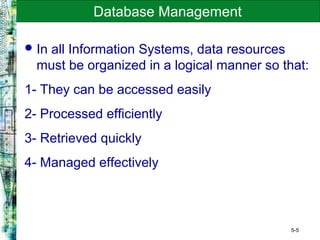
In all Information Systems, data resources
must be organized in a logical manner so that:
1- They can be accessed easily
2- Processed efficiently
3- Retrieved quickly
4- Managed effectively
5-6
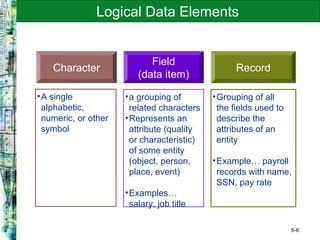
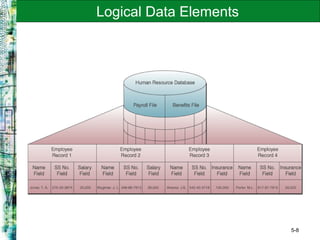
Logical Data Elements
Field
(data item)
RecordCharacter
•a grouping of
related characters
•Represents an
attribute (quality
or characteristic)
of some entity
(object, person,
place, event)
•Examples…
salary, job title
•Grouping of all
the fields used to
describe the
attributes of an
entity
•Example… payroll
records with name,
SSN, pay rate
•A single
alphabetic,
numeric, or other
symbol
5-7
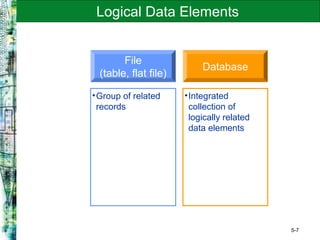
Logical Data Elements
File
(table, flat file)
Database
•Group of related
records
•Integrated
collection of
logically related
data elements
5-8
Logical Data Elements
5-9
Database Structure
5-105-10
Database Structures
1. Hierarchical
2. Network
3. Relational
4. Object-oriented
5. Multidimensional
5-11
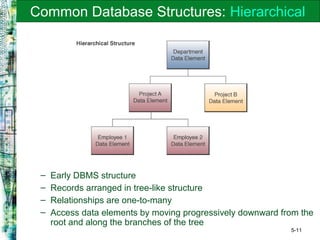
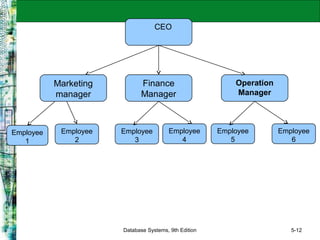
Common Database Structures: Hierarchical
– Early DBMS structure
– Records arranged in tree-like structure
– Relationships are one-to-many
– Access data elements by moving progressively downward from the
root and along the branches of the tree
5-12Database Systems, 9th Edition
CEO
Marketing
manager
Operation
Manager
Finance
Manager
Employee
1
Employee
2
Employee
3
Employee
5
Employee
4
Employee
6
5-13
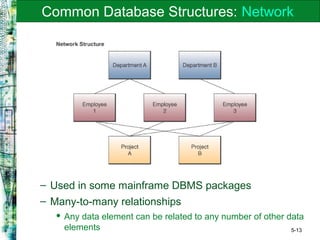
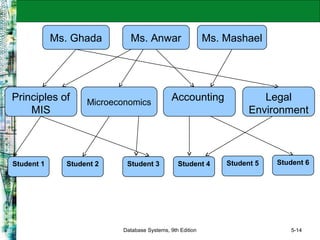
Common Database Structures: Network
– Used in some mainframe DBMS packages
– Many-to-many relationships
 Any data element can be related to any number of other data
elements
5-14Database Systems, 9th Edition
Ms. Ghada Ms. Anwar Ms. Mashael
Principles of
MIS
Microeconomics
Accounting Legal
Environment
Student 1 Student 2 Student 3 Student 4 Student 5 Student 6
5-15
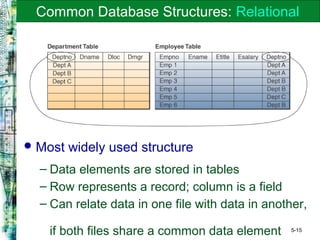
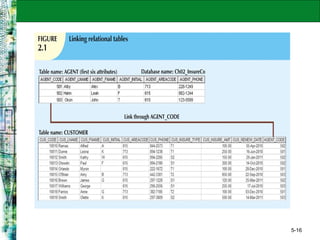
Common Database Structures: Relational
Most widely used structure
– Data elements are stored in tables
– Row represents a record; column is a field
– Can relate data in one file with data in another,
if both files share a common data element
5-16
5-17
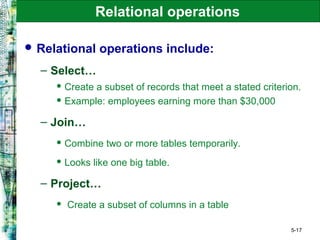
Relational operations
 Relational operations include:
– Select…
 Create a subset of records that meet a stated criterion.
 Example: employees earning more than $30,000
– Join…
 Combine two or more tables temporarily.
 Looks like one big table.
– Project…
 Create a subset of columns in a table
5-18
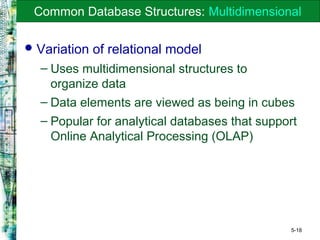
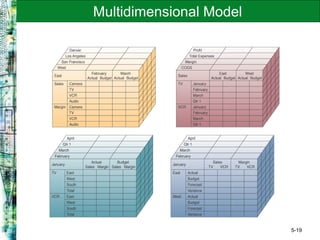
Common Database Structures: Multidimensional
Variation of relational model
– Uses multidimensional structures to
organize data
– Data elements are viewed as being in cubes
– Popular for analytical databases that support
Online Analytical Processing (OLAP)
5-19
Multidimensional Model
5-20
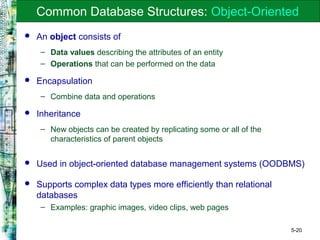
Common Database Structures: Object-Oriented
 An object consists of
– Data values describing the attributes of an entity
– Operations that can be performed on the data
 Encapsulation
– Combine data and operations
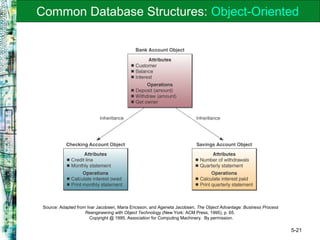
 Inheritance
– New objects can be created by replicating some or all of the
characteristics of parent objects
 Used in object-oriented database management systems (OODBMS)
 Supports complex data types more efficiently than relational
databases
– Examples: graphic images, video clips, web pages
5-21
Common Database Structures: Object-Oriented
Source: Adapted from Ivar Jacobsen, Maria Ericsson, and Ageneta Jacobsen, The Object Advantage: Business Process
Reengineering with Object Technology (New York: ACM Press, 1995), p. 65.
Copyright @ 1995, Association for Computing Machinery. By permission.
5-22
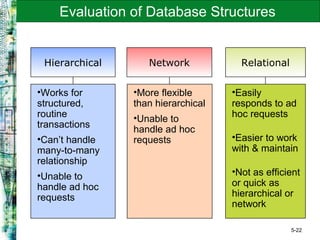
Evaluation of Database Structures
Hierarchical
•Works for
structured,
routine
transactions
•Can’t handle
many-to-many
relationship
•Unable to
handle ad hoc
requests
Network
•More flexible
than hierarchical
•Unable to
handle ad hoc
requests
Relational
•Easily
responds to ad
hoc requests
•Easier to work
with & maintain
•Not as efficient
or quick as
hierarchical or
network
5-23
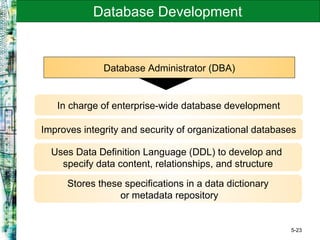
Database Development
Database Administrator (DBA)
In charge of enterprise-wide database development
Improves integrity and security of organizational databases
Uses Data Definition Language (DDL) to develop and
specify data content, relationships, and structure
Stores these specifications in a data dictionary
or metadata repository
5-24
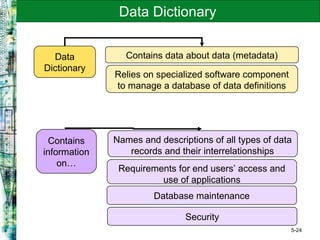
Data Dictionary
Data
Dictionary
Contains data about data (metadata)
Relies on specialized software component
to manage a database of data definitions
Contains
information
on…
Security
Database maintenance
Requirements for end users’ access and
use of applications
Names and descriptions of all types of data
records and their interrelationships
5-25
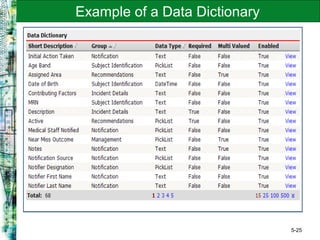
Example of a Data Dictionary
5-26
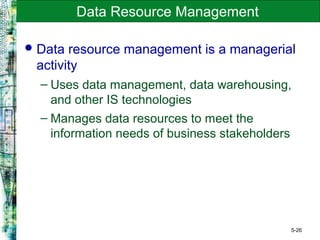
Data Resource Management
Data resource management is a managerial
activity
– Uses data management, data warehousing,
and other IS technologies
– Manages data resources to meet the
information needs of business stakeholders
5-27
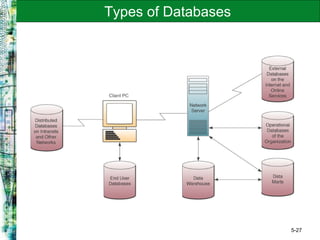
Types of Databases
5-28
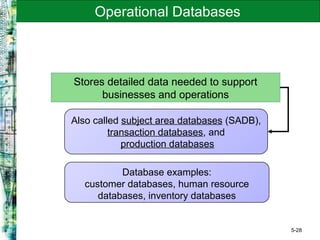
Operational Databases
Stores detailed data needed to support
businesses and operations
Also called subject area databases (SADB),
transaction databases, and
production databases
Database examples:
customer databases, human resource
databases, inventory databases
5-29
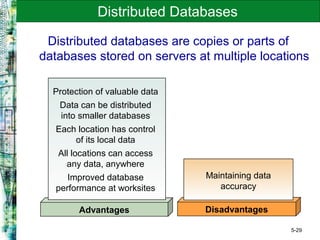
Distributed Databases
Distributed databases are copies or parts of
databases stored on servers at multiple locations
Advantages Disadvantages
Protection of valuable data
Data can be distributed
into smaller databases
Each location has control
of its local data
All locations can access
any data, anywhere
Improved database
performance at worksites
Maintaining data
accuracy
5-30
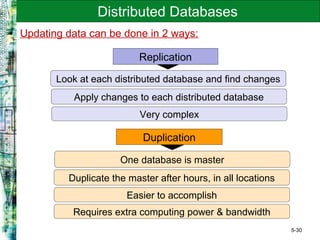
Distributed Databases
Look at each distributed database and find changes
Apply changes to each distributed database
Very complex
One database is master
Duplicate the master after hours, in all locations
Easier to accomplish
Requires extra computing power & bandwidth
Duplication
Replication
Updating data can be done in 2 ways:
5-31
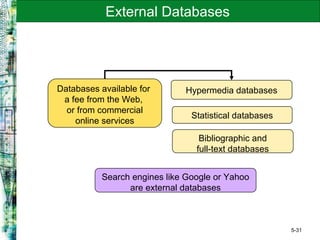
External Databases
Databases available for
a fee from the Web,
or from commercial
online services
Search engines like Google or Yahoo
are external databases
Hypermedia databases
Statistical databases
Bibliographic and
full-text databases
5-32
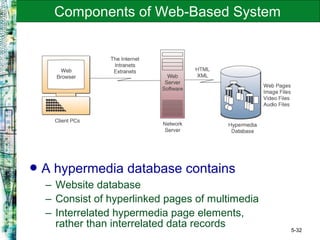
Components of Web-Based System
A hypermedia database contains
– Website database
– Consist of hyperlinked pages of multimedia
– Interrelated hypermedia page elements,
rather than interrelated data records
5-33
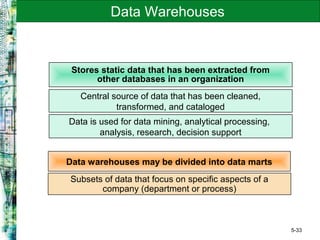
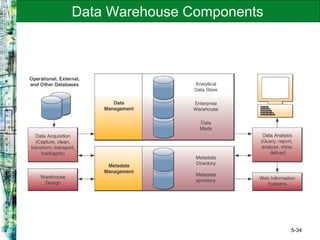
Data Warehouses
Central source of data that has been cleaned,
transformed, and cataloged
Stores static data that has been extracted from
other databases in an organization
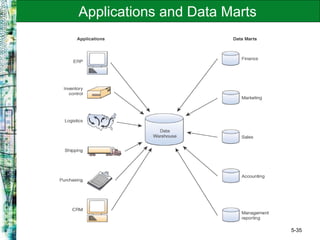
Subsets of data that focus on specific aspects of a
company (department or process)
Data warehouses may be divided into data marts
Data is used for data mining, analytical processing,
analysis, research, decision support
5-34
Data Warehouse Components
5-35
Applications and Data Marts
5-365-36
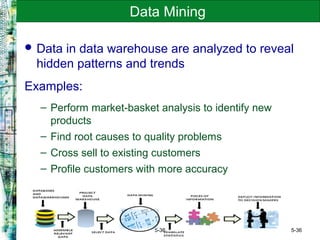
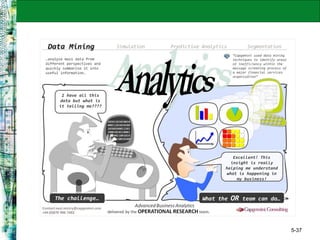
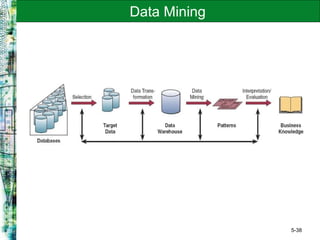
Data Mining
 Data in data warehouse are analyzed to reveal
hidden patterns and trends
Examples:
– Perform market-basket analysis to identify new
products
– Find root causes to quality problems
– Cross sell to existing customers
– Profile customers with more accuracy
5-37
5-38
Data Mining

CH005

  • 1.
    Data Resource Management Chapter5 Copyright © 2010 by the McGraw-Hill Companies, Inc. All rights reserved.McGraw-Hill/Irwin
  • 2.
    5-2 Learning Objectives Explain thebusiness value of implementing data resource management processes and technologies in an organization Outline the advantages of a database management approach to managing the data resources of a business, compared with a file processing approach Explain how database management software helps business professionals and supports the operations and management of a business
  • 3.
    5-3 Learning Objectives Provide examplesto illustrate the following concepts – Major types of databases – Data warehouses and data mining – Logical data elements – Fundamental database structures – Database development
  • 4.
  • 5.
    5-5 Database Management In allInformation Systems, data resources must be organized in a logical manner so that: 1- They can be accessed easily 2- Processed efficiently 3- Retrieved quickly 4- Managed effectively
  • 6.
    5-6 Logical Data Elements Field (dataitem) RecordCharacter •a grouping of related characters •Represents an attribute (quality or characteristic) of some entity (object, person, place, event) •Examples… salary, job title •Grouping of all the fields used to describe the attributes of an entity •Example… payroll records with name, SSN, pay rate •A single alphabetic, numeric, or other symbol
  • 7.
    5-7 Logical Data Elements File (table,flat file) Database •Group of related records •Integrated collection of logically related data elements
  • 8.
  • 9.
  • 10.
    5-105-10 Database Structures 1. Hierarchical 2.Network 3. Relational 4. Object-oriented 5. Multidimensional
  • 11.
    5-11 Common Database Structures:Hierarchical – Early DBMS structure – Records arranged in tree-like structure – Relationships are one-to-many – Access data elements by moving progressively downward from the root and along the branches of the tree
  • 12.
    5-12Database Systems, 9thEdition CEO Marketing manager Operation Manager Finance Manager Employee 1 Employee 2 Employee 3 Employee 5 Employee 4 Employee 6
  • 13.
    5-13 Common Database Structures:Network – Used in some mainframe DBMS packages – Many-to-many relationships  Any data element can be related to any number of other data elements
  • 14.
    5-14Database Systems, 9thEdition Ms. Ghada Ms. Anwar Ms. Mashael Principles of MIS Microeconomics Accounting Legal Environment Student 1 Student 2 Student 3 Student 4 Student 5 Student 6
  • 15.
    5-15 Common Database Structures:Relational Most widely used structure – Data elements are stored in tables – Row represents a record; column is a field – Can relate data in one file with data in another, if both files share a common data element
  • 16.
  • 17.
    5-17 Relational operations  Relationaloperations include: – Select…  Create a subset of records that meet a stated criterion.  Example: employees earning more than $30,000 – Join…  Combine two or more tables temporarily.  Looks like one big table. – Project…  Create a subset of columns in a table
  • 18.
    5-18 Common Database Structures:Multidimensional Variation of relational model – Uses multidimensional structures to organize data – Data elements are viewed as being in cubes – Popular for analytical databases that support Online Analytical Processing (OLAP)
  • 19.
  • 20.
    5-20 Common Database Structures:Object-Oriented  An object consists of – Data values describing the attributes of an entity – Operations that can be performed on the data  Encapsulation – Combine data and operations  Inheritance – New objects can be created by replicating some or all of the characteristics of parent objects  Used in object-oriented database management systems (OODBMS)  Supports complex data types more efficiently than relational databases – Examples: graphic images, video clips, web pages
  • 21.
    5-21 Common Database Structures:Object-Oriented Source: Adapted from Ivar Jacobsen, Maria Ericsson, and Ageneta Jacobsen, The Object Advantage: Business Process Reengineering with Object Technology (New York: ACM Press, 1995), p. 65. Copyright @ 1995, Association for Computing Machinery. By permission.
  • 22.
    5-22 Evaluation of DatabaseStructures Hierarchical •Works for structured, routine transactions •Can’t handle many-to-many relationship •Unable to handle ad hoc requests Network •More flexible than hierarchical •Unable to handle ad hoc requests Relational •Easily responds to ad hoc requests •Easier to work with & maintain •Not as efficient or quick as hierarchical or network
  • 23.
    5-23 Database Development Database Administrator(DBA) In charge of enterprise-wide database development Improves integrity and security of organizational databases Uses Data Definition Language (DDL) to develop and specify data content, relationships, and structure Stores these specifications in a data dictionary or metadata repository
  • 24.
    5-24 Data Dictionary Data Dictionary Contains dataabout data (metadata) Relies on specialized software component to manage a database of data definitions Contains information on… Security Database maintenance Requirements for end users’ access and use of applications Names and descriptions of all types of data records and their interrelationships
  • 25.
    5-25 Example of aData Dictionary
  • 26.
    5-26 Data Resource Management Dataresource management is a managerial activity – Uses data management, data warehousing, and other IS technologies – Manages data resources to meet the information needs of business stakeholders
  • 27.
  • 28.
    5-28 Operational Databases Stores detaileddata needed to support businesses and operations Also called subject area databases (SADB), transaction databases, and production databases Database examples: customer databases, human resource databases, inventory databases
  • 29.
    5-29 Distributed Databases Distributed databasesare copies or parts of databases stored on servers at multiple locations Advantages Disadvantages Protection of valuable data Data can be distributed into smaller databases Each location has control of its local data All locations can access any data, anywhere Improved database performance at worksites Maintaining data accuracy
  • 30.
    5-30 Distributed Databases Look ateach distributed database and find changes Apply changes to each distributed database Very complex One database is master Duplicate the master after hours, in all locations Easier to accomplish Requires extra computing power & bandwidth Duplication Replication Updating data can be done in 2 ways:
  • 31.
    5-31 External Databases Databases availablefor a fee from the Web, or from commercial online services Search engines like Google or Yahoo are external databases Hypermedia databases Statistical databases Bibliographic and full-text databases
  • 32.
    5-32 Components of Web-BasedSystem A hypermedia database contains – Website database – Consist of hyperlinked pages of multimedia – Interrelated hypermedia page elements, rather than interrelated data records
  • 33.
    5-33 Data Warehouses Central sourceof data that has been cleaned, transformed, and cataloged Stores static data that has been extracted from other databases in an organization Subsets of data that focus on specific aspects of a company (department or process) Data warehouses may be divided into data marts Data is used for data mining, analytical processing, analysis, research, decision support
  • 34.
  • 35.
  • 36.
    5-365-36 Data Mining  Datain data warehouse are analyzed to reveal hidden patterns and trends Examples: – Perform market-basket analysis to identify new products – Find root causes to quality problems – Cross sell to existing customers – Profile customers with more accuracy
  • 37.
  • 38.

Editor's Notes

  • #16 Relational operations include: Select… Create a subset of records that meet a stated criterion. Example: employees earning more than $30,000 Join… Combine two or more tables temporarily. Looks like one big table. Project… Create a subset of columns in a table
  • #18 Three basic operations on relational databases
  • #19 OLAP is used for answers to complex business queries
  • #23 Gap in performance between relational and hierarchical and network is rapidly narrowing
  • #24 Data dictionary Data base catalog containing metadata Metadata – data about data
  • #25 Database development is a top-down process Develop an enterprise model that defines the basic business process of the enterprise Define the information needs of end users in a business process Identify the key data elements that are needed to perform specific business activities (entity relationship diagrams)
  • #34 Stores data that has been extracted from the operational, external and other databases Data has been cleaned, transformed and cataloged Used by managers and professionals for Data mining, Online analytical processing, Business analysis, Market research, Decision support Data mart is subset of warehouse for specific use of department Static data?
  • #37 Discussed in more detail in chapter 9
  • #39 Data in data warehouses are analyzed to reveal hidden patterns and trends Market-basket analysis to identify new product bundles Find root cause of qualify or manufacturing problems Prevent customer attrition Acquire new customers Cross-sell to existing customers Profile customers with more accuracy