Oleh:
Daniel Gunawan - 10110310005
Yonathan Hadiputra - 10110310011
Benyamin Reggy Sianipar - 10110310025
David - 10110310035
Adrian Stefan - 10110310065
Yoel Dennis Salim - 10110310069
Andrey Raharja - 10110310076
Systems analysis and design – the process of designing,
building, and maintaining information systems
The individual who performs this task is called
Systems analyst
Organization wants to hire System analyst because
they have both technical and managerial expertise.
Evolution of IS development
From “art” to a “discipline”: In the early days of
computing it was considered an art that a very few
people could master
Standardized development methods: The techniques
used to build an IS varies greatly from individual to
individual. It was very difficult to integrate and
maintain. To address this problem, info. Sys.
professionals decided to use a disciplined approach of
introducing common methods, techniques, and tools for
building information systems
Software engineering: This evolution led to the use of the
term software engineering to define what system analyst
& programmer do.
Options for Obtaining Information Systems
1. Build your own
2. Buy a prepackaged system from a software
development company or consulting firm.
Example: Payroll system.
3. Outsource development to a 3rd
party: outside
organization custom build a system to an
organization’s specifications. Good option when
an organization does not have adequate
resources or expertise.
4. End user development: Individual users and
departments build their own custom systems to
support their individuals. Example MS. Excel.
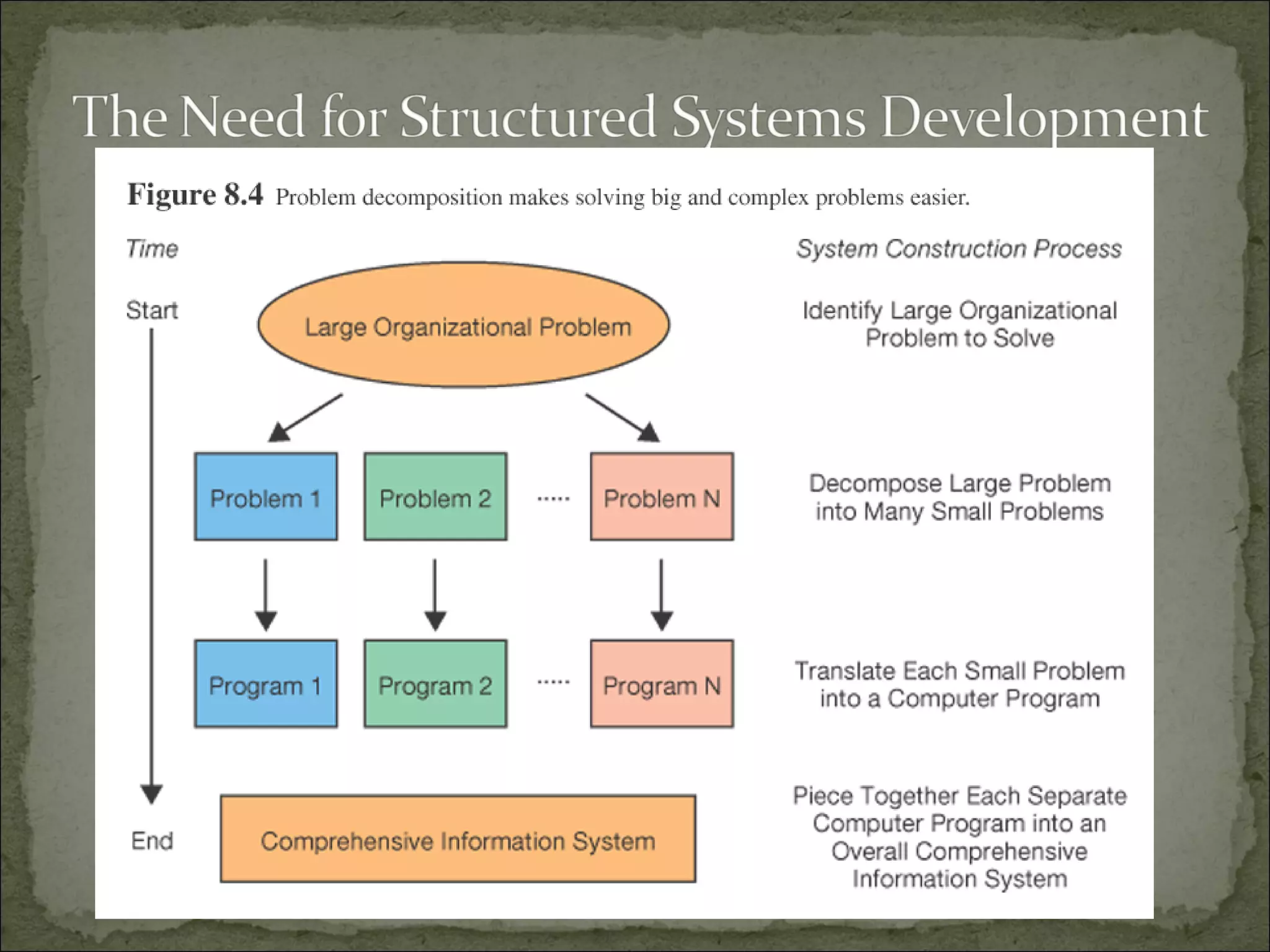
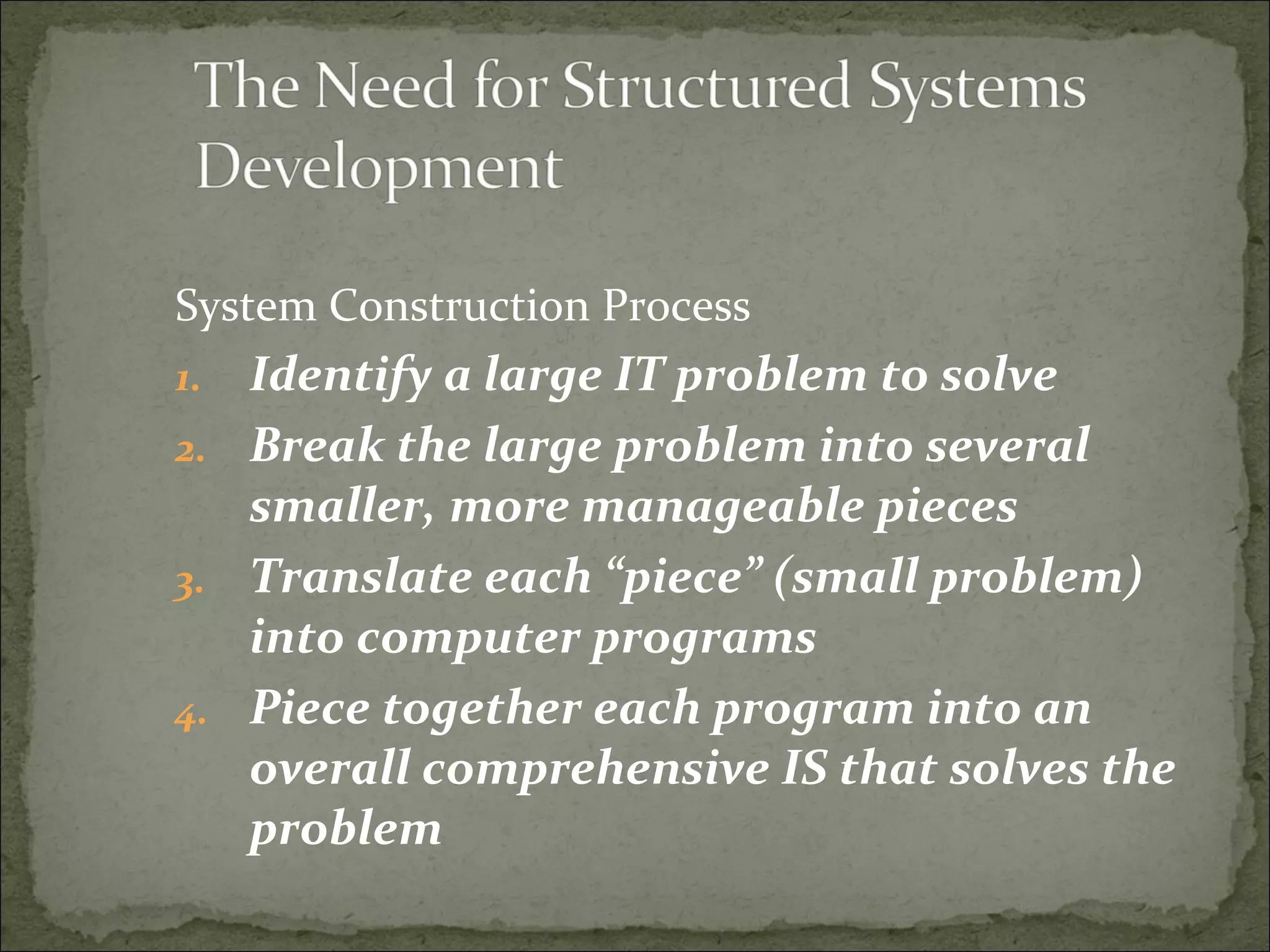
System Construction Process
1. Identify a large IT problem to solve
2. Break the large problem into several
smaller, more manageable pieces
3. Translate each “piece” (small problem)
into computer programs
4. Piece together each program into an
overall comprehensive IS that solves the
problem
The Role of Users in the Systems Development
Process
It is important for all members of the organization
to understand what is meant by system
development and what activities occur.
Effective partnership: A close and mutually
respectful working relationship between analysts
and users is a key to project success.
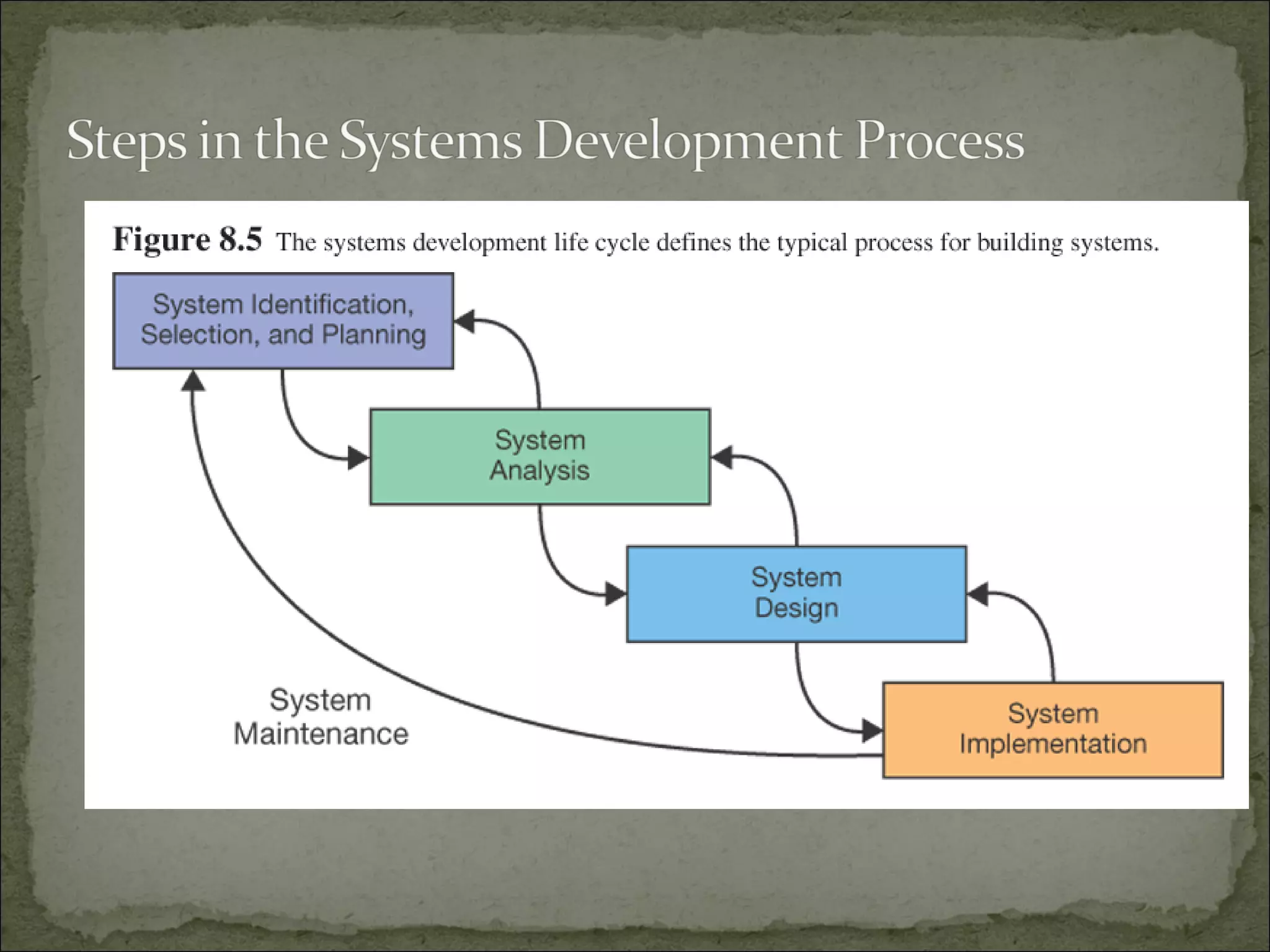
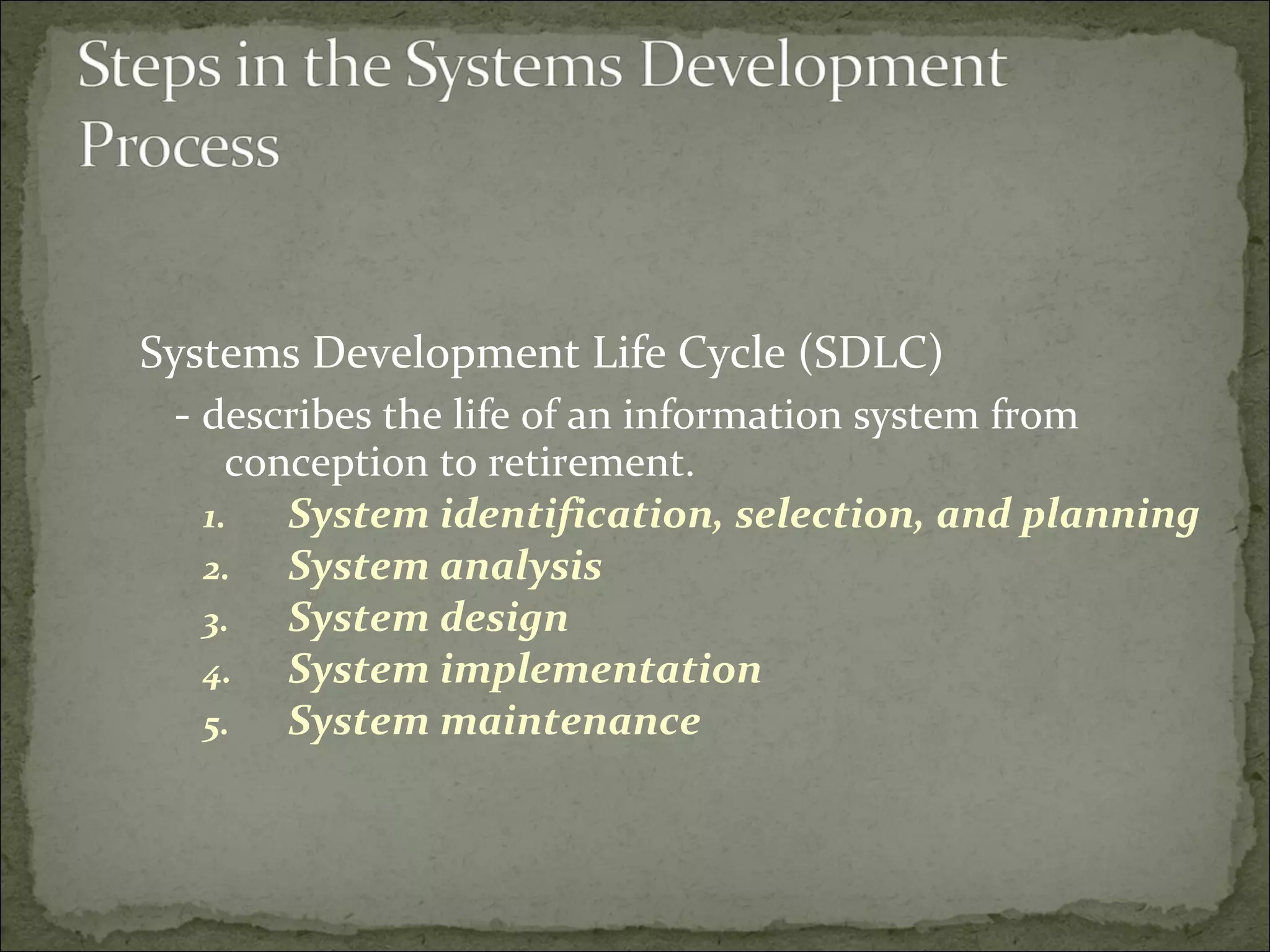
Systems Development Life Cycle (SDLC)
- describes the life of an information system from
conception to retirement.
1. System identification, selection, and planning
2. System analysis
3. System design
4. System implementation
5. System maintenance
Phase 1: System Identification, Selection, and
Planning
Undertake only those projects critical to mission,
goals, and objectives
Select a development project from all possible
projects that could be performed
Different evaluation criteria used to rank potential
projects
Steps in the Systems
Development Process
Phase 1: System Identification, Selection, and
Planning
Evaluation criteria
 Strategic alignment: The extent to which the project is viewed as
helping the organization achieve its strategic objectives an d long-
term goal.
 Potential benefits: The extent to which the project is viewed as
improving profits, customer service, and the duration of the
benefits
 Potential costs and resource availability: The number and types of
resources the project requires and their availability
 Project size / duration: The number of individuals and the length
of time needed to complete the project
 Technical difficulty / risks: The level of technical difficulty
involved to complete the project within a given time and resources
Steps in the Systems
Development Process
Phase 2: System Analysis
 Collecting System Requirements: Requirement collection is
process of gathering and organizing information from users,
managers, business processes, an documents to understand how
a proposed system should work
System analysts use a variety of techniques to collect system
requirements
 Interviews: analysts interview people
 Questionnaires: analysts design and administer surveys.
 Observations: analysts observe workers at selected times
 Document analysis: analysts study business documents
Critical Success Factors (CSF): analysts ask each person to
define her own personal CSFs.
Joint Application Design (JAD): Special type of a group
meeting where all users and analysts meet at the same time
Steps in the Systems
Development Process
Phase 2: System Analysis
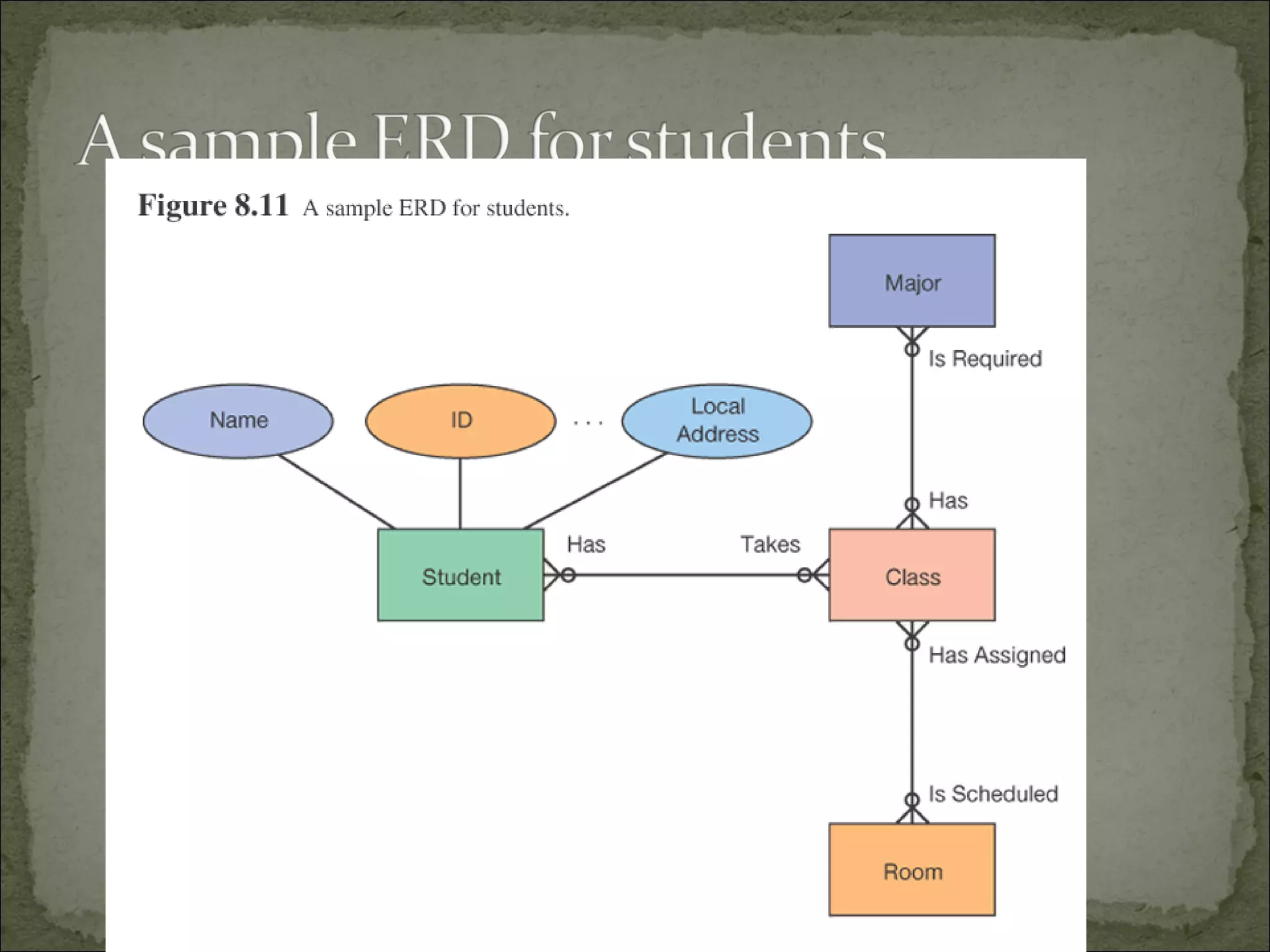
Modeling Organizational Data: To construct an
information system, systems analysts must
understand what data the information system
needs in order to accomplish the intended tasks. To
do this they use data modeling tools to collect and
describe data to users.
 Entity Relationship Diagram (ERD)
Modeling Organizational Processes and Logic
 Data flows
 Processing logic
Steps in the Systems
Development Process
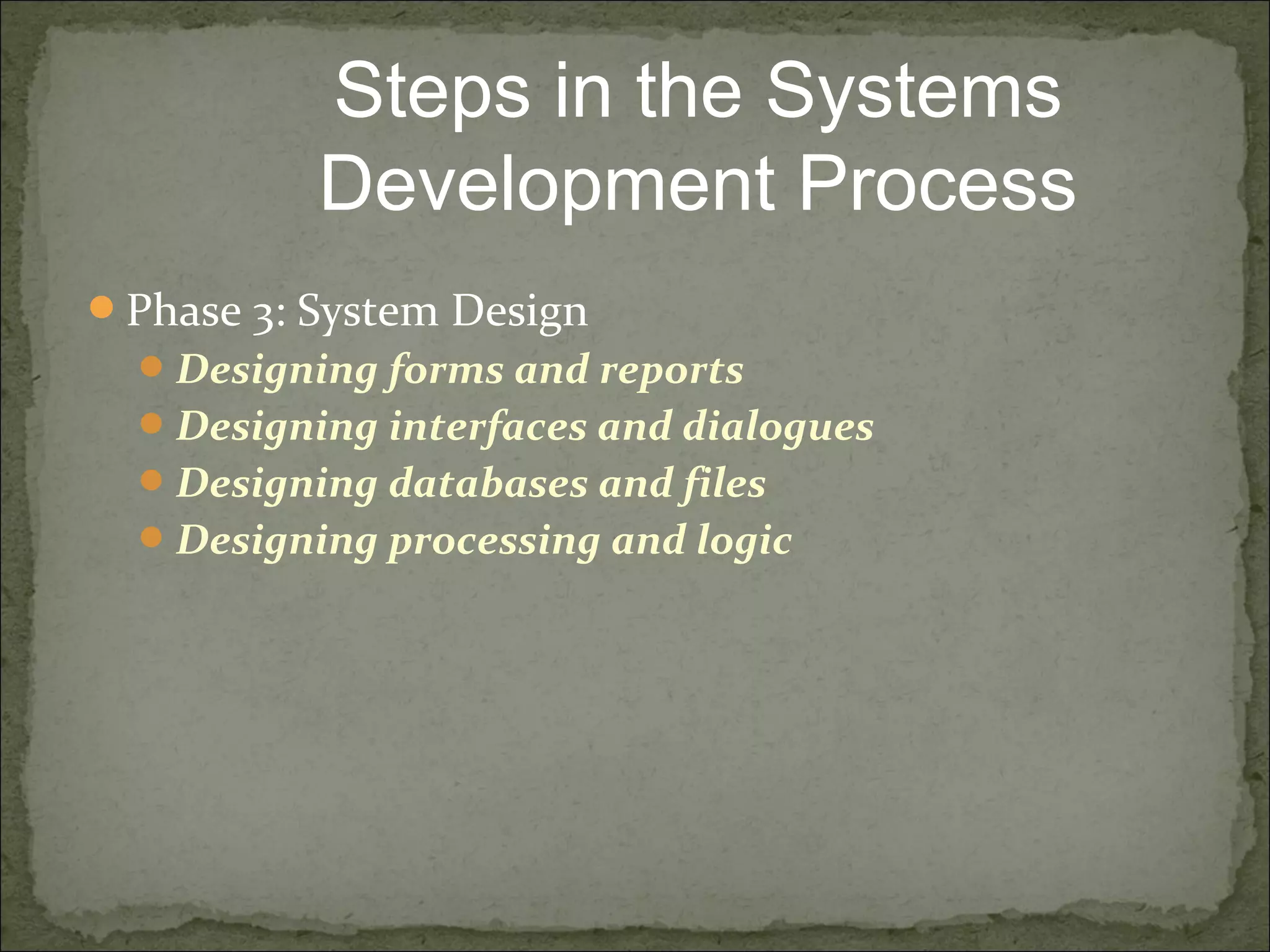
Phase 3: System Design
Designing forms and reports
Designing interfaces and dialogues
Designing databases and files
Designing processing and logic
Steps in the Systems
Development Process
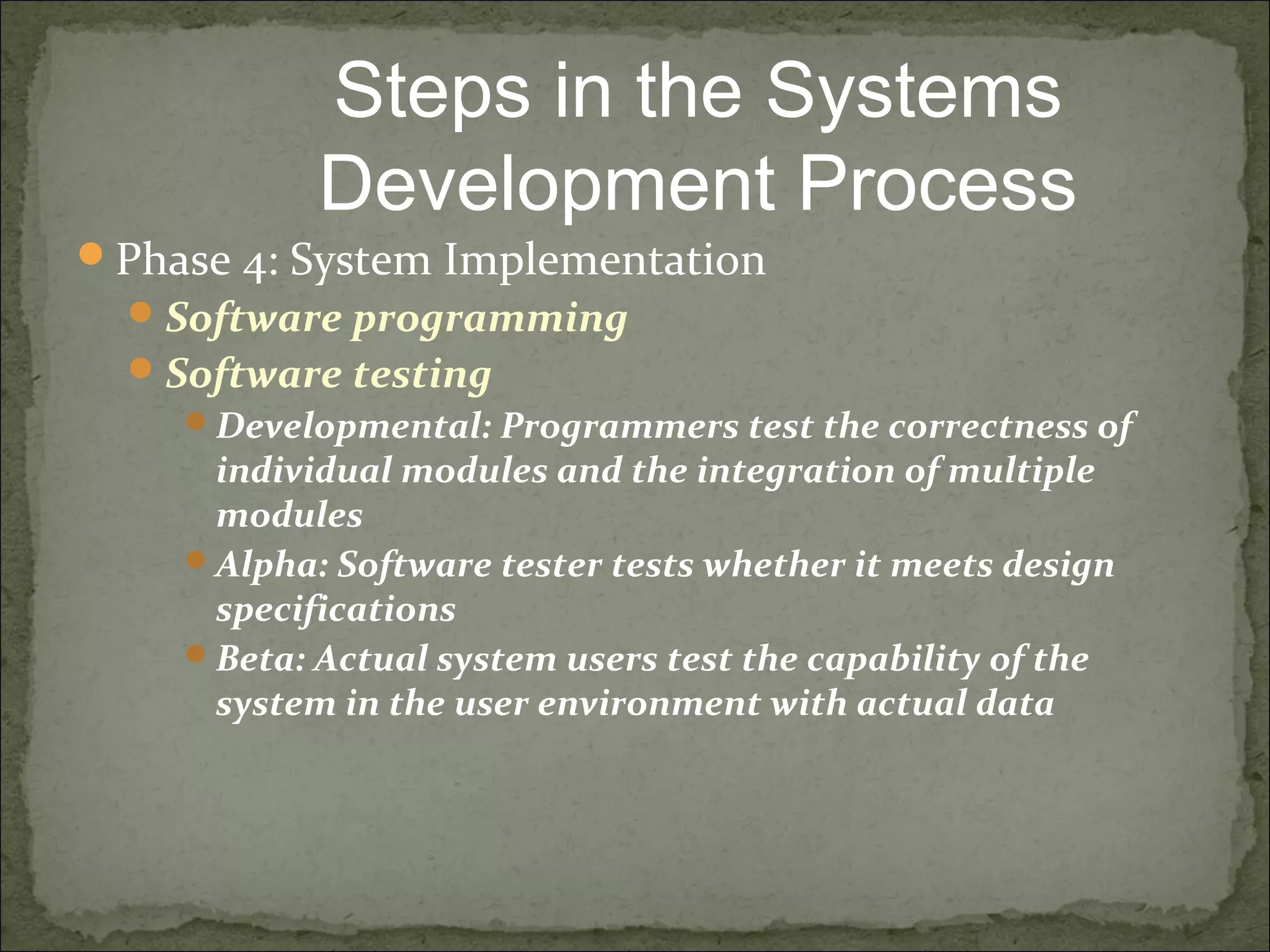
Phase 4: System Implementation
Software programming
Software testing
Developmental: Programmers test the correctness of
individual modules and the integration of multiple
modules
Alpha: Software tester tests whether it meets design
specifications
Beta: Actual system users test the capability of the
system in the user environment with actual data
Steps in the Systems
Development Process
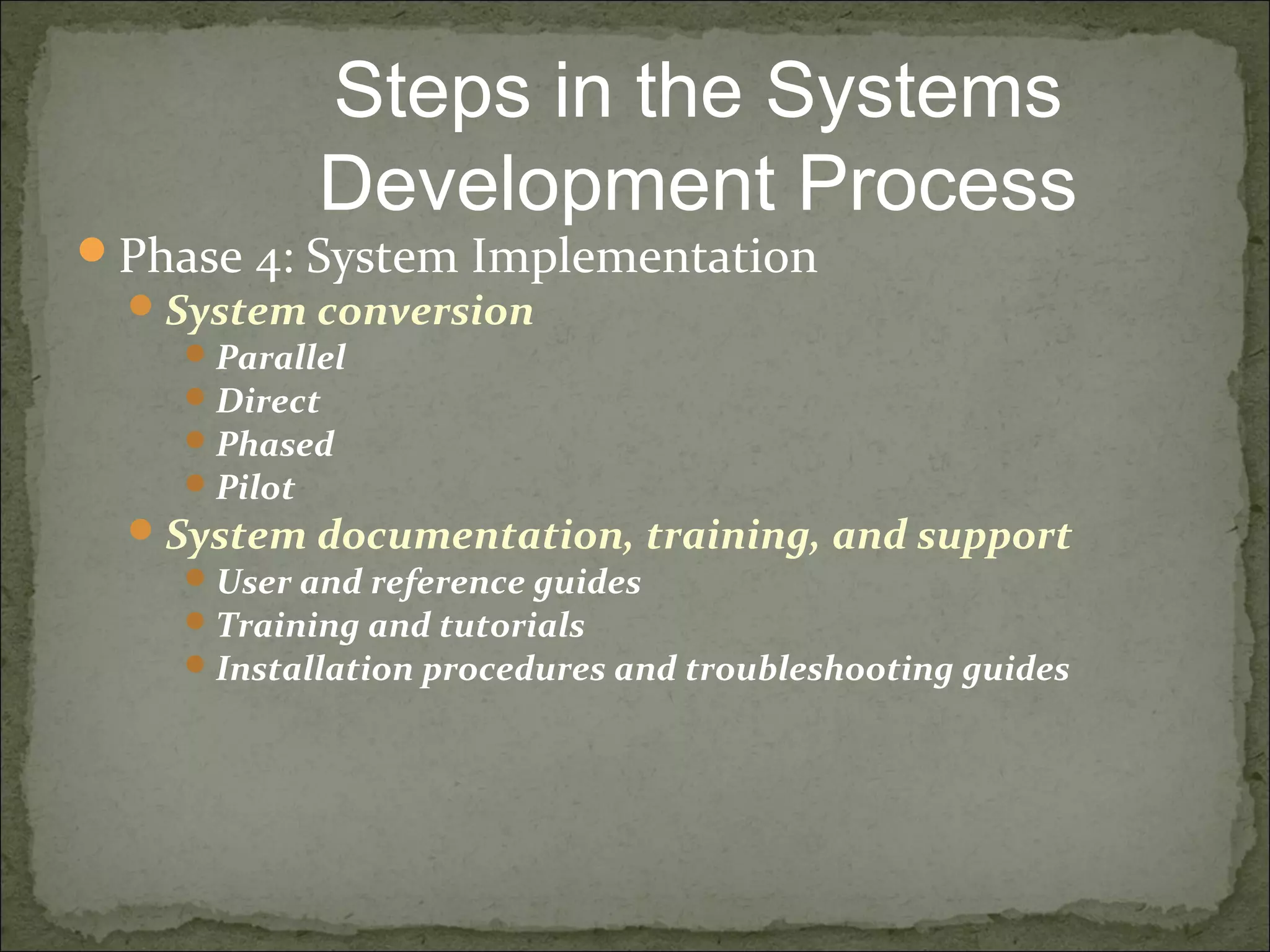
Phase 4: System Implementation
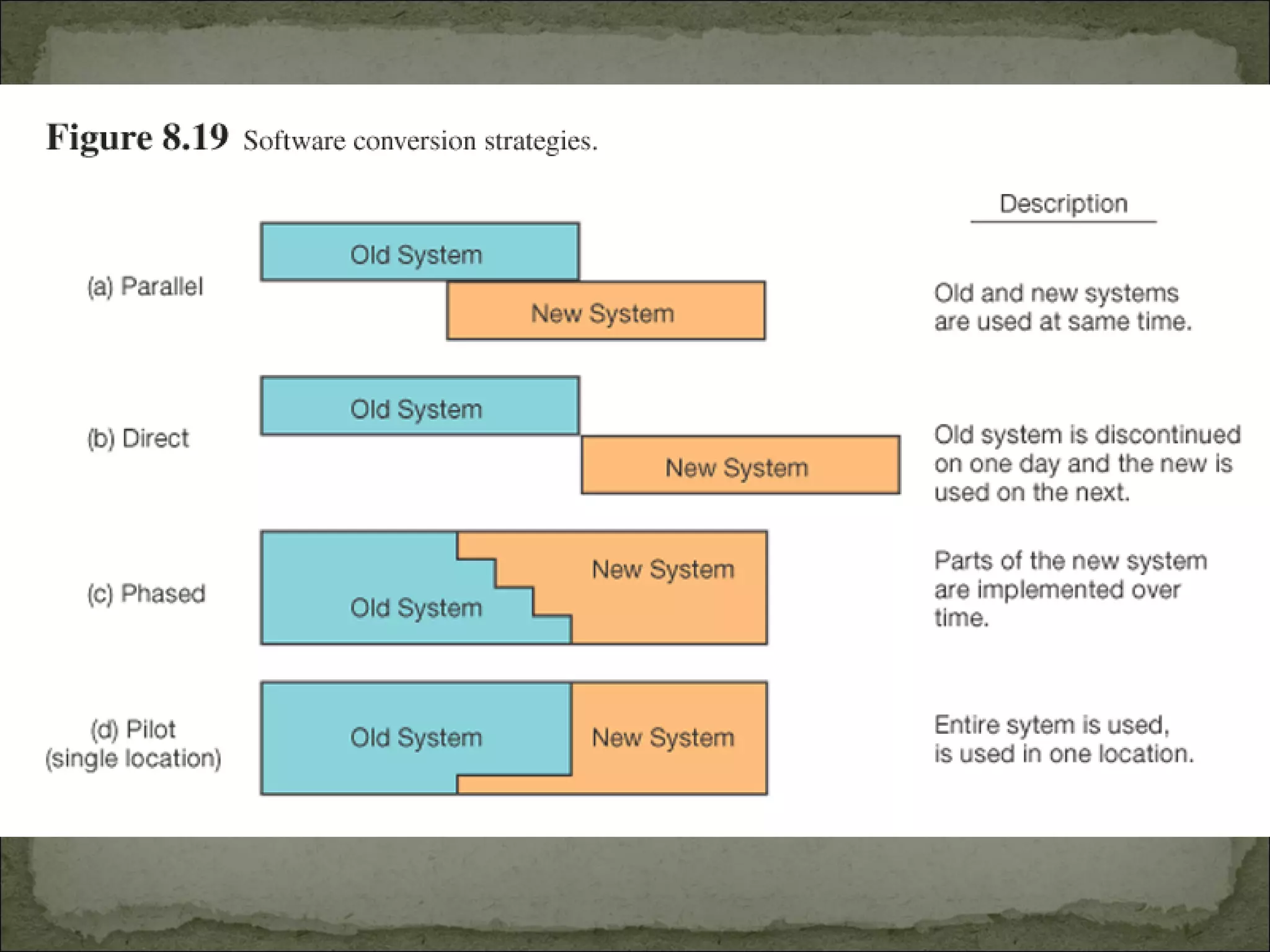
System conversion
Parallel
Direct
Phased
Pilot
System documentation, training, and support
User and reference guides
Training and tutorials
Installation procedures and troubleshooting guides
Steps in the Systems
Development Process
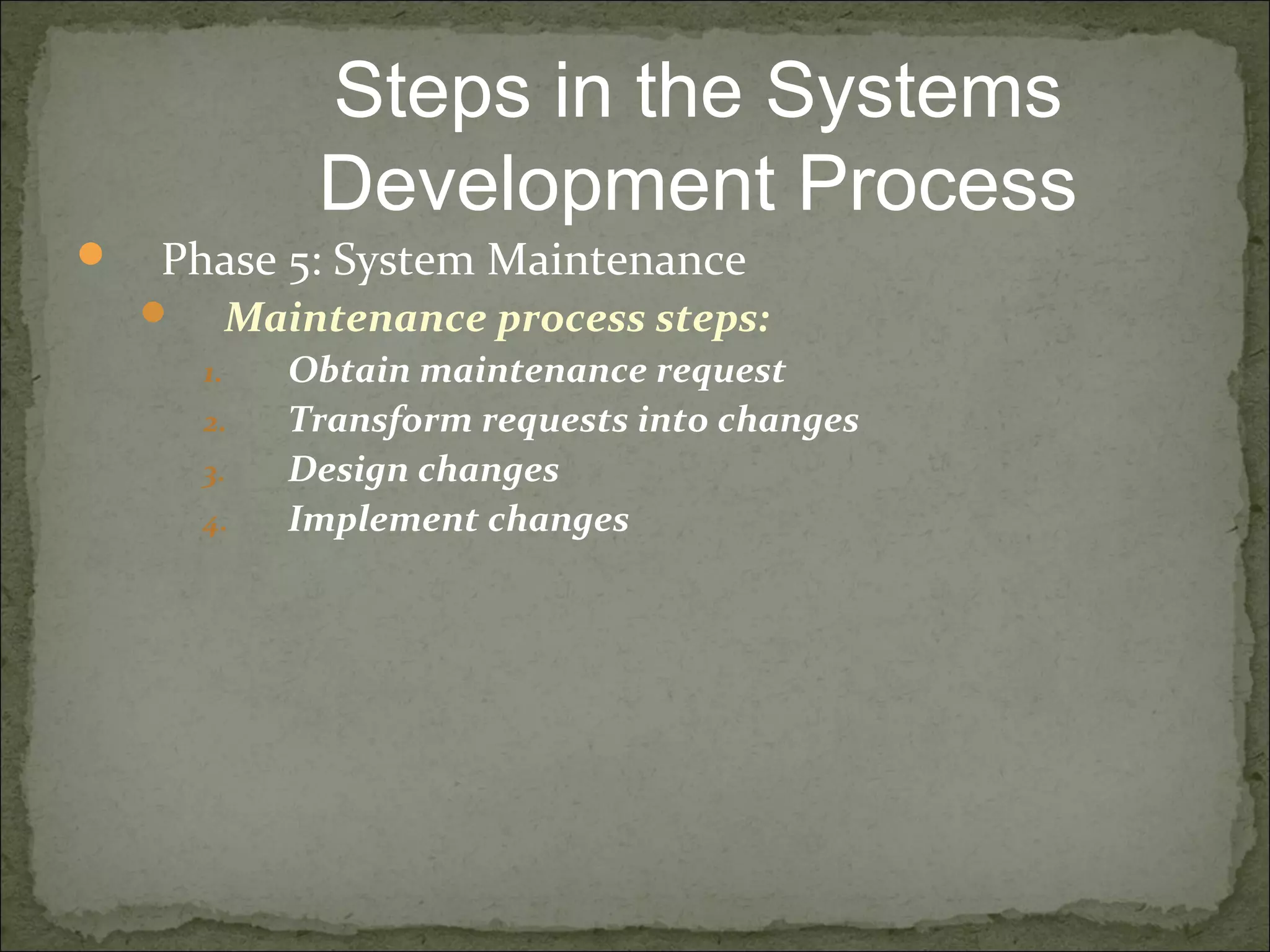
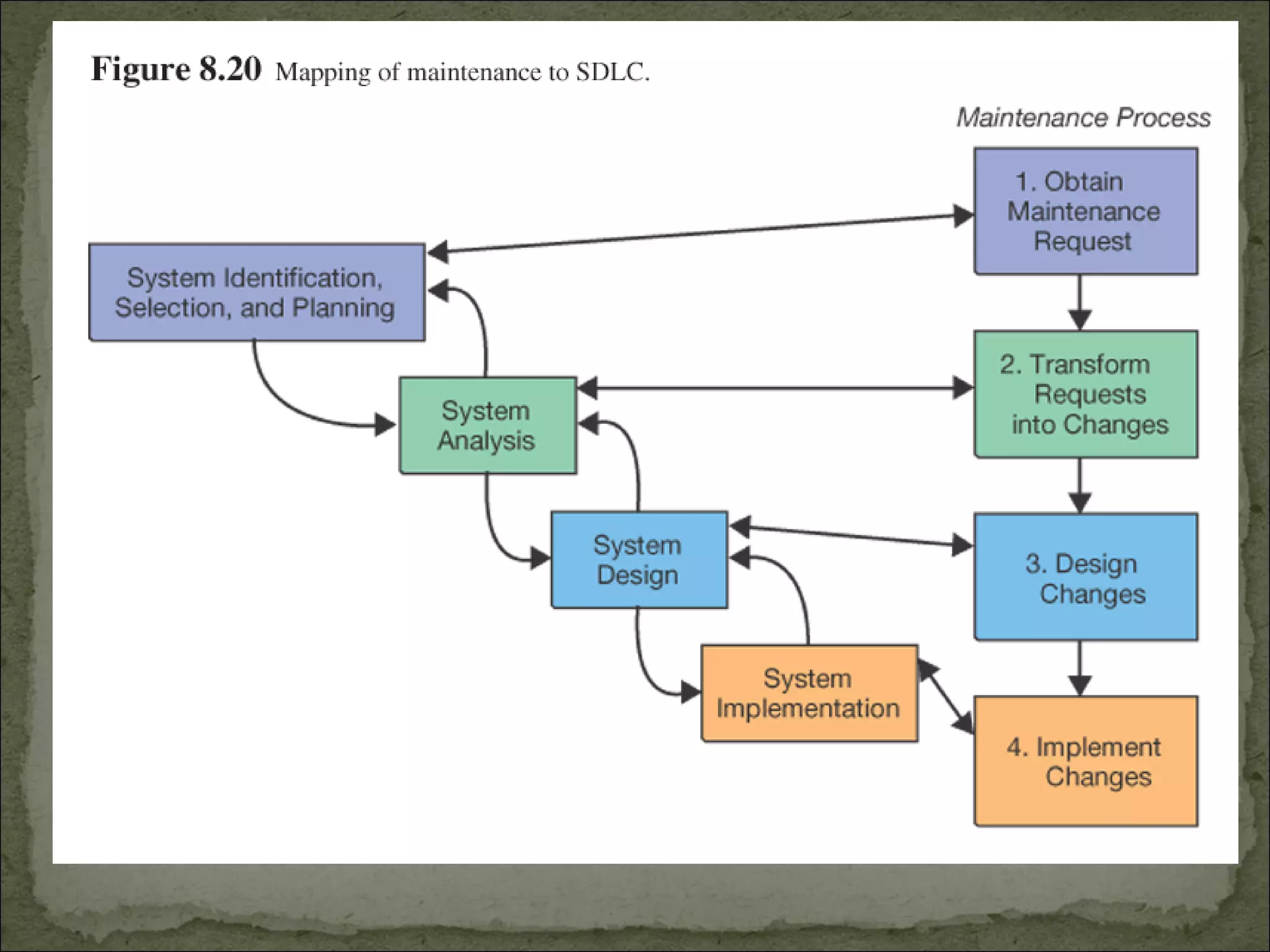
 Phase 5: System Maintenance
 Maintenance process steps:
1. Obtain maintenance request
2. Transform requests into changes
3. Design changes
4. Implement changes
Steps in the Systems
Development Process
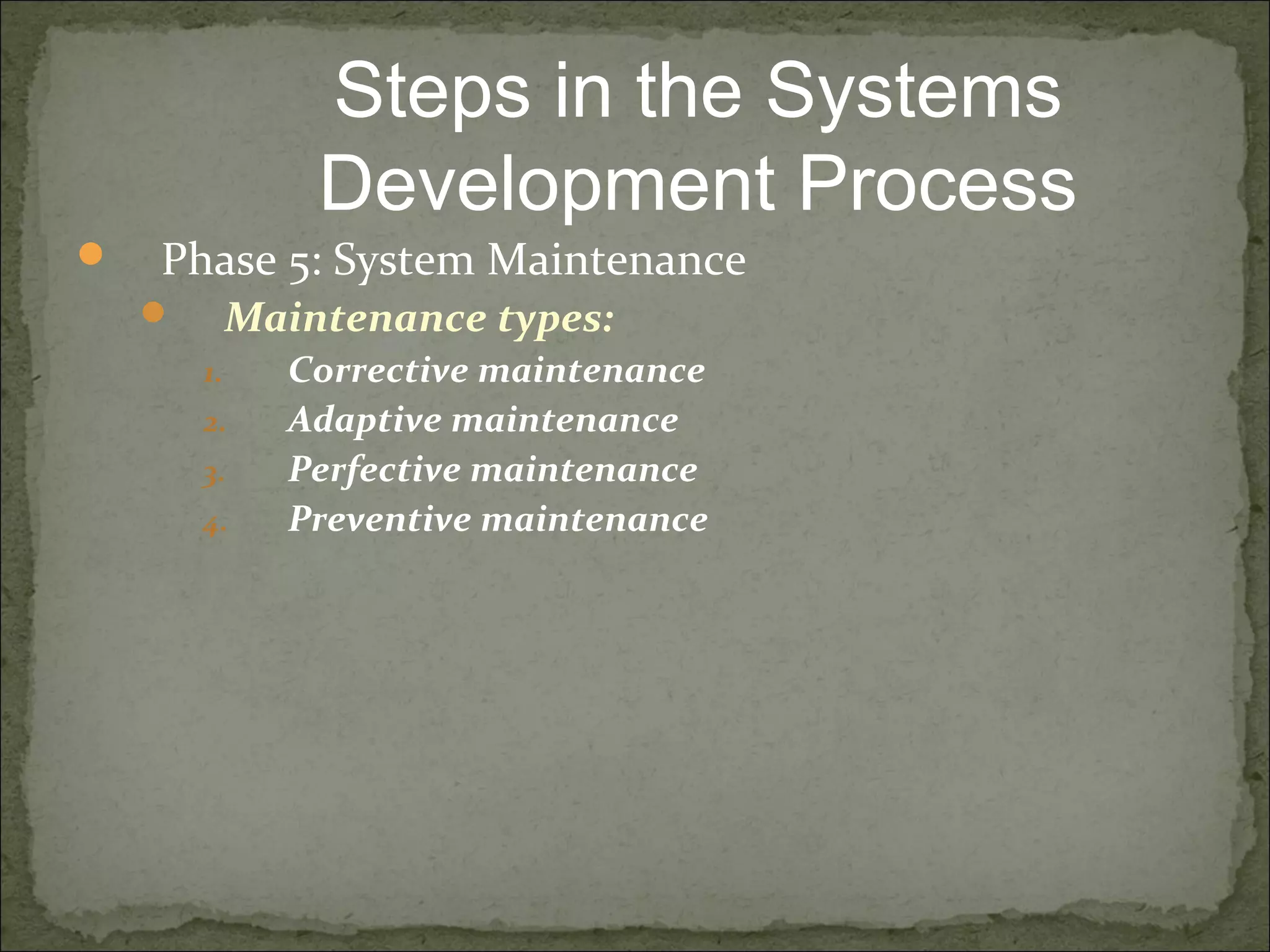
 Phase 5: System Maintenance
 Maintenance types:
1. Corrective maintenance
2. Adaptive maintenance
3. Perfective maintenance
4. Preventive maintenance
Steps in the Systems
Development Process
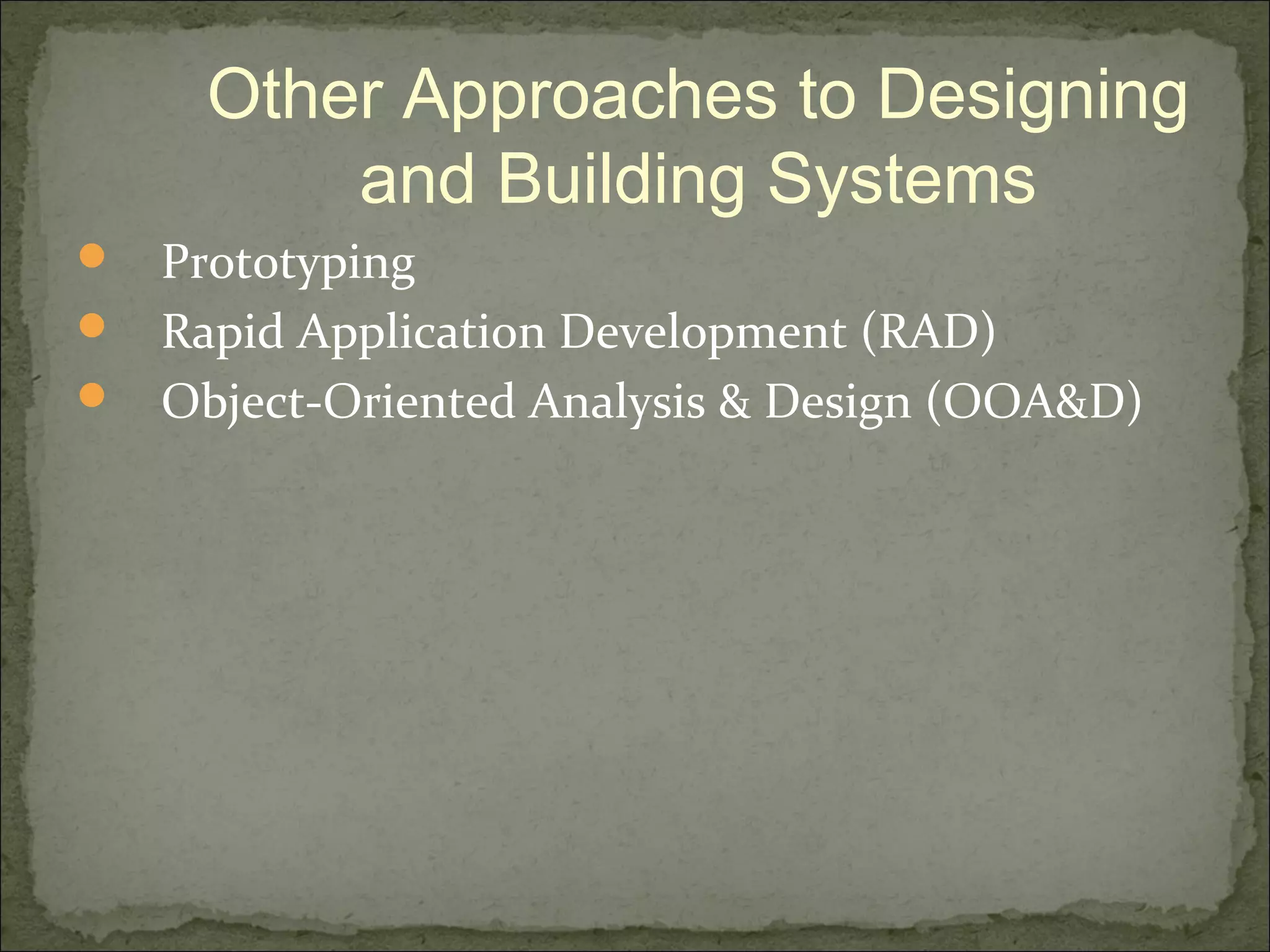
 Prototyping
 Rapid Application Development (RAD)
 Object-Oriented Analysis & Design (OOA&D)
Other Approaches to Designing
and Building Systems
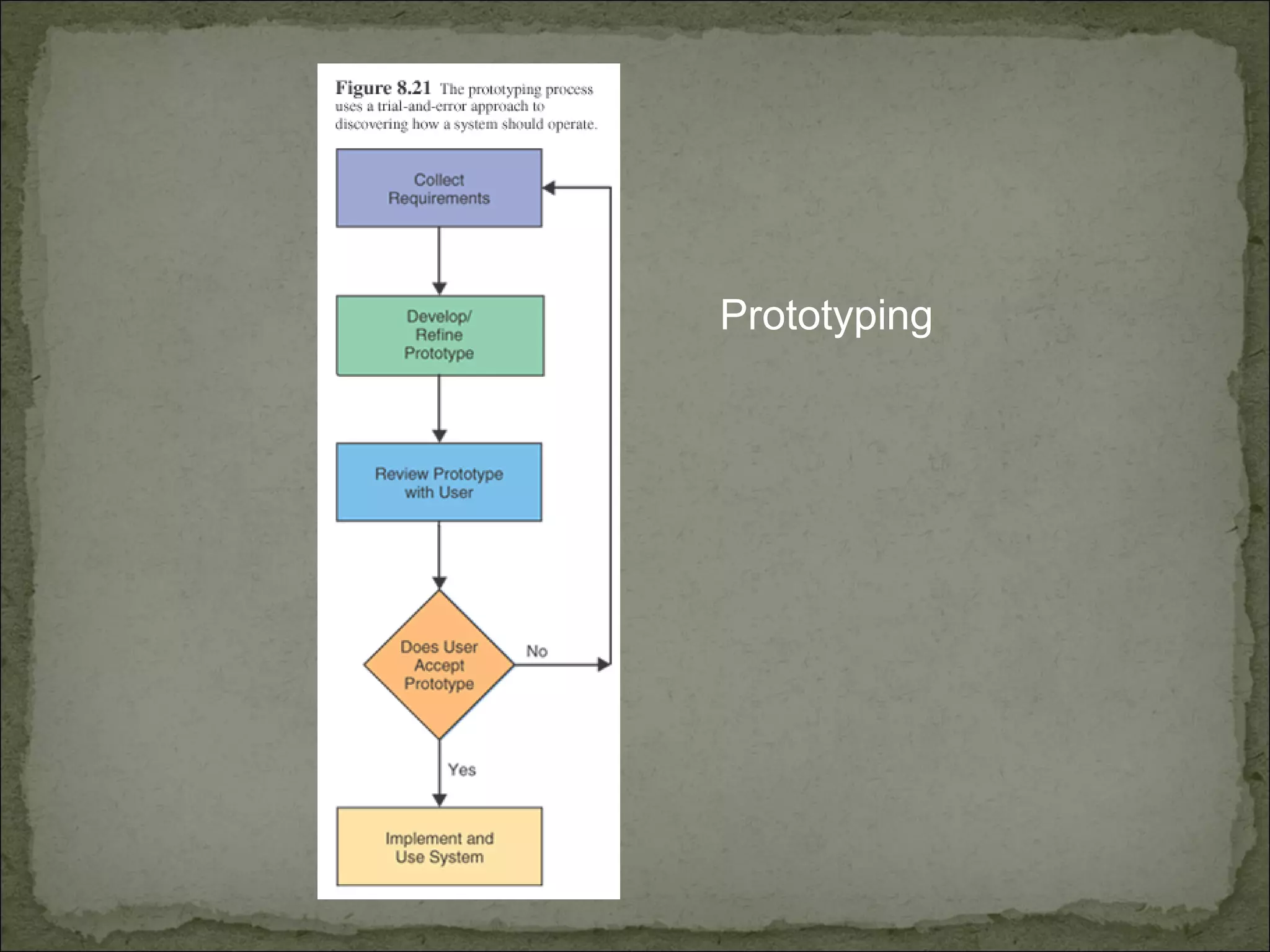
Prototyping
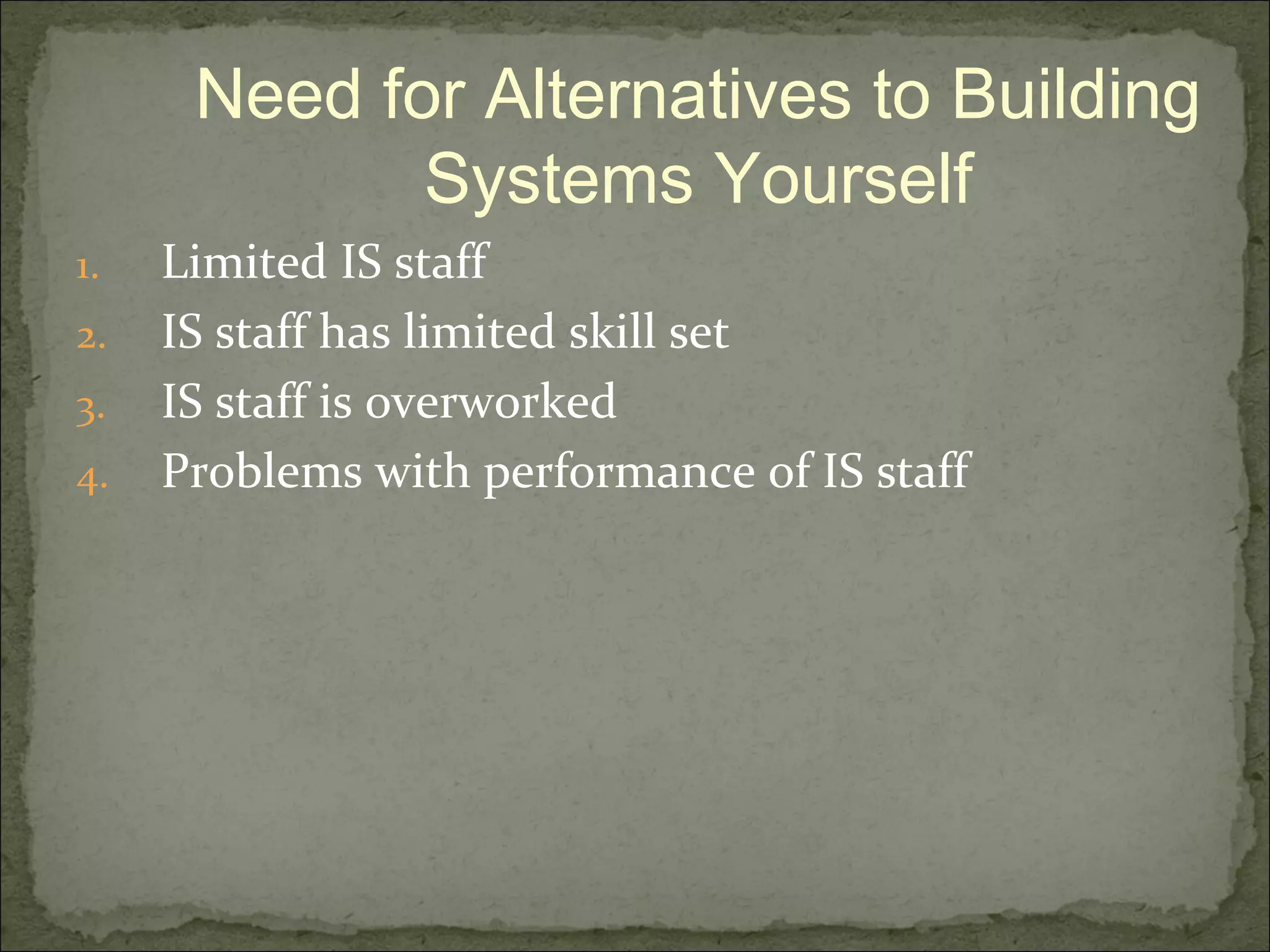
1. Limited IS staff
2. IS staff has limited skill set
3. IS staff is overworked
4. Problems with performance of IS staff
Need for Alternatives to Building
Systems Yourself
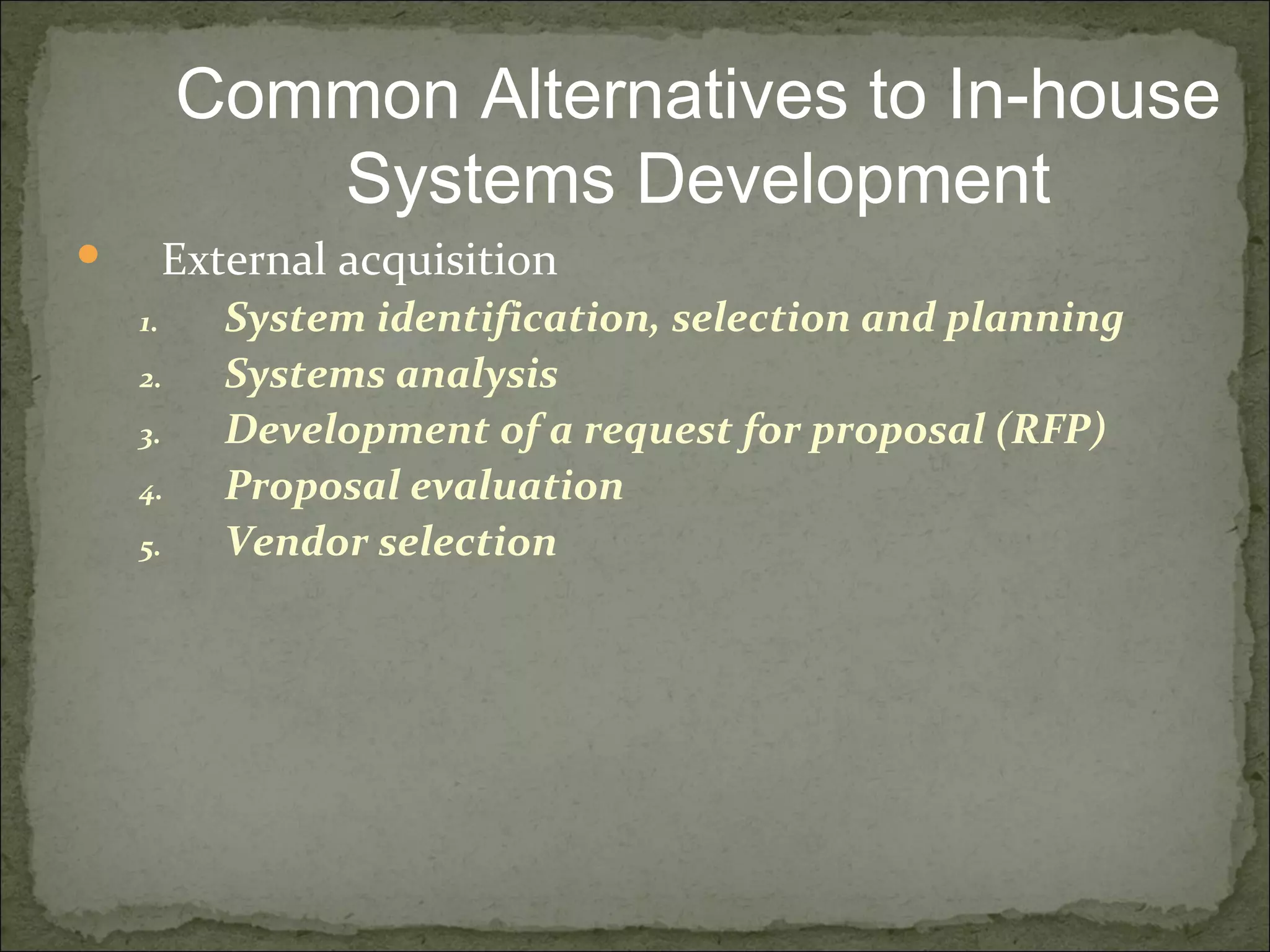
 External acquisition
1. System identification, selection and planning
2. Systems analysis
3. Development of a request for proposal (RFP)
4. Proposal evaluation
5. Vendor selection
Common Alternatives to In-house
Systems Development
 Outsourcing – the practice of turning over
responsibility of some to all of an
organization’s information systems
development and operations to an outside
firm
Common Alternatives to In-house
Systems Development
 Why Outsource?
 Cost and quality concerns
 Problems in IS performance
 Supplier pressures
 Simplifying, downsizing, and reengineering
 Financial factors
 Organizational culture
 Internal irritants
Common Alternatives to In-house
Systems Development
 Managing the IS outsourcing relationship
 Strong CIO oversight
 Measurement of milestones, costs, and benefits
 Customer relationship management
 Not all outsourcing relationships are the
same
 Basic relationship
 Preferred relationship
 Strategic relationship
Common Alternatives to In-house
Systems Development
 End-user development
 Benefits of end-user development
 Encouraging end-user development
 End-user development pitfalls
Common Alternatives to In-house
Systems Development

Information Systems Development and Acquisition

  • 1.
    Oleh: Daniel Gunawan -10110310005 Yonathan Hadiputra - 10110310011 Benyamin Reggy Sianipar - 10110310025 David - 10110310035 Adrian Stefan - 10110310065 Yoel Dennis Salim - 10110310069 Andrey Raharja - 10110310076
  • 2.
    Systems analysis anddesign – the process of designing, building, and maintaining information systems The individual who performs this task is called Systems analyst Organization wants to hire System analyst because they have both technical and managerial expertise.
  • 3.
    Evolution of ISdevelopment From “art” to a “discipline”: In the early days of computing it was considered an art that a very few people could master Standardized development methods: The techniques used to build an IS varies greatly from individual to individual. It was very difficult to integrate and maintain. To address this problem, info. Sys. professionals decided to use a disciplined approach of introducing common methods, techniques, and tools for building information systems Software engineering: This evolution led to the use of the term software engineering to define what system analyst & programmer do.
  • 4.
    Options for ObtainingInformation Systems 1. Build your own 2. Buy a prepackaged system from a software development company or consulting firm. Example: Payroll system. 3. Outsource development to a 3rd party: outside organization custom build a system to an organization’s specifications. Good option when an organization does not have adequate resources or expertise. 4. End user development: Individual users and departments build their own custom systems to support their individuals. Example MS. Excel.
  • 6.
    System Construction Process 1.Identify a large IT problem to solve 2. Break the large problem into several smaller, more manageable pieces 3. Translate each “piece” (small problem) into computer programs 4. Piece together each program into an overall comprehensive IS that solves the problem
  • 7.
    The Role ofUsers in the Systems Development Process It is important for all members of the organization to understand what is meant by system development and what activities occur. Effective partnership: A close and mutually respectful working relationship between analysts and users is a key to project success.
  • 9.
    Systems Development LifeCycle (SDLC) - describes the life of an information system from conception to retirement. 1. System identification, selection, and planning 2. System analysis 3. System design 4. System implementation 5. System maintenance
  • 10.
    Phase 1: SystemIdentification, Selection, and Planning Undertake only those projects critical to mission, goals, and objectives Select a development project from all possible projects that could be performed Different evaluation criteria used to rank potential projects Steps in the Systems Development Process
  • 11.
    Phase 1: SystemIdentification, Selection, and Planning Evaluation criteria  Strategic alignment: The extent to which the project is viewed as helping the organization achieve its strategic objectives an d long- term goal.  Potential benefits: The extent to which the project is viewed as improving profits, customer service, and the duration of the benefits  Potential costs and resource availability: The number and types of resources the project requires and their availability  Project size / duration: The number of individuals and the length of time needed to complete the project  Technical difficulty / risks: The level of technical difficulty involved to complete the project within a given time and resources Steps in the Systems Development Process
  • 12.
    Phase 2: SystemAnalysis  Collecting System Requirements: Requirement collection is process of gathering and organizing information from users, managers, business processes, an documents to understand how a proposed system should work System analysts use a variety of techniques to collect system requirements  Interviews: analysts interview people  Questionnaires: analysts design and administer surveys.  Observations: analysts observe workers at selected times  Document analysis: analysts study business documents Critical Success Factors (CSF): analysts ask each person to define her own personal CSFs. Joint Application Design (JAD): Special type of a group meeting where all users and analysts meet at the same time Steps in the Systems Development Process
  • 13.
    Phase 2: SystemAnalysis Modeling Organizational Data: To construct an information system, systems analysts must understand what data the information system needs in order to accomplish the intended tasks. To do this they use data modeling tools to collect and describe data to users.  Entity Relationship Diagram (ERD) Modeling Organizational Processes and Logic  Data flows  Processing logic Steps in the Systems Development Process
  • 15.
    Phase 3: SystemDesign Designing forms and reports Designing interfaces and dialogues Designing databases and files Designing processing and logic Steps in the Systems Development Process
  • 16.
    Phase 4: SystemImplementation Software programming Software testing Developmental: Programmers test the correctness of individual modules and the integration of multiple modules Alpha: Software tester tests whether it meets design specifications Beta: Actual system users test the capability of the system in the user environment with actual data Steps in the Systems Development Process
  • 17.
    Phase 4: SystemImplementation System conversion Parallel Direct Phased Pilot System documentation, training, and support User and reference guides Training and tutorials Installation procedures and troubleshooting guides Steps in the Systems Development Process
  • 19.
     Phase 5:System Maintenance  Maintenance process steps: 1. Obtain maintenance request 2. Transform requests into changes 3. Design changes 4. Implement changes Steps in the Systems Development Process
  • 20.
     Phase 5:System Maintenance  Maintenance types: 1. Corrective maintenance 2. Adaptive maintenance 3. Perfective maintenance 4. Preventive maintenance Steps in the Systems Development Process
  • 22.
     Prototyping  RapidApplication Development (RAD)  Object-Oriented Analysis & Design (OOA&D) Other Approaches to Designing and Building Systems
  • 23.
  • 24.
    1. Limited ISstaff 2. IS staff has limited skill set 3. IS staff is overworked 4. Problems with performance of IS staff Need for Alternatives to Building Systems Yourself
  • 25.
     External acquisition 1.System identification, selection and planning 2. Systems analysis 3. Development of a request for proposal (RFP) 4. Proposal evaluation 5. Vendor selection Common Alternatives to In-house Systems Development
  • 26.
     Outsourcing –the practice of turning over responsibility of some to all of an organization’s information systems development and operations to an outside firm Common Alternatives to In-house Systems Development
  • 27.
     Why Outsource? Cost and quality concerns  Problems in IS performance  Supplier pressures  Simplifying, downsizing, and reengineering  Financial factors  Organizational culture  Internal irritants Common Alternatives to In-house Systems Development
  • 28.
     Managing theIS outsourcing relationship  Strong CIO oversight  Measurement of milestones, costs, and benefits  Customer relationship management  Not all outsourcing relationships are the same  Basic relationship  Preferred relationship  Strategic relationship Common Alternatives to In-house Systems Development
  • 29.
     End-user development Benefits of end-user development  Encouraging end-user development  End-user development pitfalls Common Alternatives to In-house Systems Development

Editor's Notes

  • #11 An organization can only work on only a limited number of projects at a given time due to limited resources so care must be taken when selecting the projects to build. After all possible projects are identified, those deemed most likely to yield significant organizational benefits, given available resources, are selected for subsequent development. Some possible evaluation criteria for ranking potential projects are: strategic alignment, potential benefits, potential costs and resource availability, project size and duration, and technical difficulty.
  • #12 An organization can only work on only a limited number of projects at a given time due to limited resources so care must be taken when selecting the projects to build. After all possible projects are identified, those deemed most likely to yield significant organizational benefits, given available resources, are selected for subsequent development. Some possible evaluation criteria for ranking potential projects are: strategic alignment, potential benefits, potential costs and resource availability, project size and duration, and technical difficulty.
  • #13 An organization can only work on only a limited number of projects at a given time due to limited resources so care must be taken when selecting the projects to build. After all possible projects are identified, those deemed most likely to yield significant organizational benefits, given available resources, are selected for subsequent development. Some possible evaluation criteria for ranking potential projects are: strategic alignment, potential benefits, potential costs and resource availability, project size and duration, and technical difficulty.
  • #14 An organization can only work on only a limited number of projects at a given time due to limited resources so care must be taken when selecting the projects to build. After all possible projects are identified, those deemed most likely to yield significant organizational benefits, given available resources, are selected for subsequent development. Some possible evaluation criteria for ranking potential projects are: strategic alignment, potential benefits, potential costs and resource availability, project size and duration, and technical difficulty.
  • #16 An organization can only work on only a limited number of projects at a given time due to limited resources so care must be taken when selecting the projects to build. After all possible projects are identified, those deemed most likely to yield significant organizational benefits, given available resources, are selected for subsequent development. Some possible evaluation criteria for ranking potential projects are: strategic alignment, potential benefits, potential costs and resource availability, project size and duration, and technical difficulty.
  • #17 An organization can only work on only a limited number of projects at a given time due to limited resources so care must be taken when selecting the projects to build. After all possible projects are identified, those deemed most likely to yield significant organizational benefits, given available resources, are selected for subsequent development. Some possible evaluation criteria for ranking potential projects are: strategic alignment, potential benefits, potential costs and resource availability, project size and duration, and technical difficulty.
  • #18 An organization can only work on only a limited number of projects at a given time due to limited resources so care must be taken when selecting the projects to build. After all possible projects are identified, those deemed most likely to yield significant organizational benefits, given available resources, are selected for subsequent development. Some possible evaluation criteria for ranking potential projects are: strategic alignment, potential benefits, potential costs and resource availability, project size and duration, and technical difficulty.
  • #20 An organization can only work on only a limited number of projects at a given time due to limited resources so care must be taken when selecting the projects to build. After all possible projects are identified, those deemed most likely to yield significant organizational benefits, given available resources, are selected for subsequent development. Some possible evaluation criteria for ranking potential projects are: strategic alignment, potential benefits, potential costs and resource availability, project size and duration, and technical difficulty.
  • #21 An organization can only work on only a limited number of projects at a given time due to limited resources so care must be taken when selecting the projects to build. After all possible projects are identified, those deemed most likely to yield significant organizational benefits, given available resources, are selected for subsequent development. Some possible evaluation criteria for ranking potential projects are: strategic alignment, potential benefits, potential costs and resource availability, project size and duration, and technical difficulty.
  • #23 An organization can only work on only a limited number of projects at a given time due to limited resources so care must be taken when selecting the projects to build. After all possible projects are identified, those deemed most likely to yield significant organizational benefits, given available resources, are selected for subsequent development. Some possible evaluation criteria for ranking potential projects are: strategic alignment, potential benefits, potential costs and resource availability, project size and duration, and technical difficulty.
  • #25 An organization can only work on only a limited number of projects at a given time due to limited resources so care must be taken when selecting the projects to build. After all possible projects are identified, those deemed most likely to yield significant organizational benefits, given available resources, are selected for subsequent development. Some possible evaluation criteria for ranking potential projects are: strategic alignment, potential benefits, potential costs and resource availability, project size and duration, and technical difficulty.
  • #26 An organization can only work on only a limited number of projects at a given time due to limited resources so care must be taken when selecting the projects to build. After all possible projects are identified, those deemed most likely to yield significant organizational benefits, given available resources, are selected for subsequent development. Some possible evaluation criteria for ranking potential projects are: strategic alignment, potential benefits, potential costs and resource availability, project size and duration, and technical difficulty.
  • #27 An organization can only work on only a limited number of projects at a given time due to limited resources so care must be taken when selecting the projects to build. After all possible projects are identified, those deemed most likely to yield significant organizational benefits, given available resources, are selected for subsequent development. Some possible evaluation criteria for ranking potential projects are: strategic alignment, potential benefits, potential costs and resource availability, project size and duration, and technical difficulty.
  • #28 An organization can only work on only a limited number of projects at a given time due to limited resources so care must be taken when selecting the projects to build. After all possible projects are identified, those deemed most likely to yield significant organizational benefits, given available resources, are selected for subsequent development. Some possible evaluation criteria for ranking potential projects are: strategic alignment, potential benefits, potential costs and resource availability, project size and duration, and technical difficulty.
  • #29 An organization can only work on only a limited number of projects at a given time due to limited resources so care must be taken when selecting the projects to build. After all possible projects are identified, those deemed most likely to yield significant organizational benefits, given available resources, are selected for subsequent development. Some possible evaluation criteria for ranking potential projects are: strategic alignment, potential benefits, potential costs and resource availability, project size and duration, and technical difficulty.
  • #30 An organization can only work on only a limited number of projects at a given time due to limited resources so care must be taken when selecting the projects to build. After all possible projects are identified, those deemed most likely to yield significant organizational benefits, given available resources, are selected for subsequent development. Some possible evaluation criteria for ranking potential projects are: strategic alignment, potential benefits, potential costs and resource availability, project size and duration, and technical difficulty.