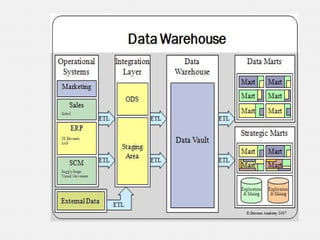

DATA
WAREHOUSING
Presented By:
Monika Kesarwani
CONTENTS
Introduction of Data warehouse
Defination of Data warehousing
Overview of Data warehouse
Characteristics of Data warehouse
Data warehouse VS Database
Multidimension schemas
 Star schema
 Snowflake schema
 Fact constellation galaxy
OLAP operations
Overview of an OLAP services
Building a data warehouse
Applications of Data warehouse
The datawarehouse is an informational environment
which does the following:
 Provides an integrated view of an enterprise.
 Renders the enterprise’s current as well as historical
data.
 Decision making is possible without hindering
operational systems.
 Makes information consistent and easily accessible.
 Provides a flexible,conductive and interactive source of
strategic information.
INTRODUCTION
DEFINITION
W.H. Inmon defined data warehouse as “subject-oriented,
integrated , non-volatile , time-variant collection of data in
support of management’s decisions.”
 Data warehouse provide access to the data for complex
analysis, knowledge discovery, and decision making.
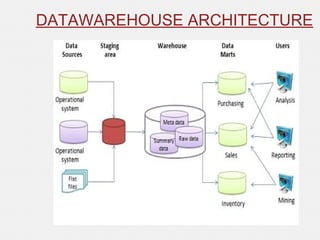
DATAWAREHOUSE ARCHITECTURE
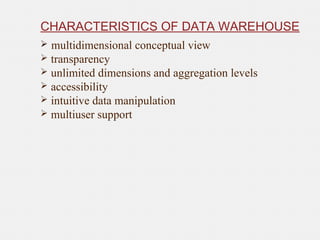
CHARACTERISTICS OF DATA WAREHOUSE
 multidimensional conceptual view
 transparency
 unlimited dimensions and aggregation levels
 accessibility
 intuitive data manipulation
 multiuser support
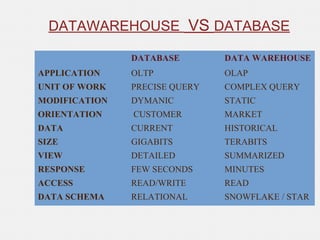
DATAWAREHOUSE VS DATABASE
DATABASE DATA WAREHOUSE
APPLICATION OLTP OLAP
UNIT OF WORK PRECISE QUERY COMPLEX QUERY
MODIFICATION DYMANIC STATIC
ORIENTATION CUSTOMER MARKET
DATA CURRENT HISTORICAL
SIZE GIGABITS TERABITS
VIEW DETAILED SUMMARIZED
RESPONSE FEW SECONDS MINUTES
ACCESS READ/WRITE READ
DATA SCHEMA RELATIONAL SNOWFLAKE / STAR
MULTIDIMENSIONAL SCHEMAS
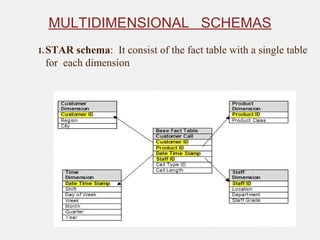
1.STAR schema: It consist of the fact table with a single table
for each dimension
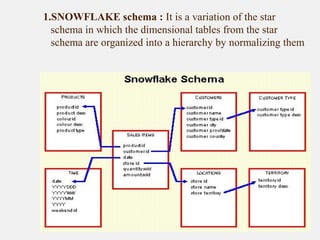
1.SNOWFLAKE schema : It is a variation of the star
schema in which the dimensional tables from the star
schema are organized into a hierarchy by normalizing them
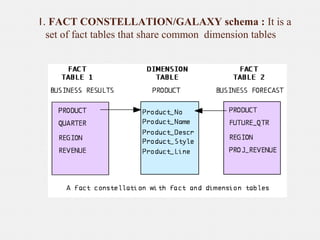
1. FACT CONSTELLATION/GALAXY schema : It is a
set of fact tables that share common dimension tables
OLAP OPERATIONS
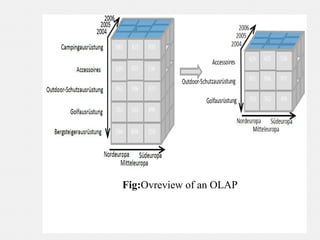
• Online Analytical Processing is a computer based
technique for analyzing business data in the search for
business intelligence.
• Its aim is to provide multidimensional analysis to the
underlying data.
• It help analyst for gaining data through fast,consistent,
interactive access in a wide variety of possible views of
information.
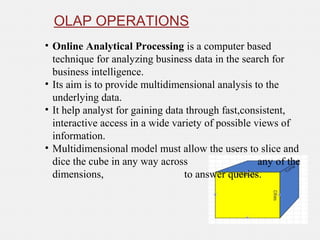
• Multidimensional model must allow the users to slice and
dice the cube in any way across any of the
dimensions, to answer queries.
Fig:Ovreview of an OLAP
BUILDING A DATA WAREHOUSE
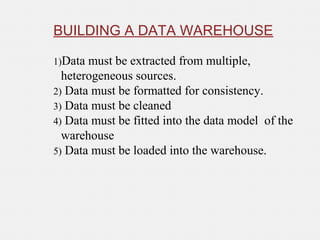
1)Data must be extracted from multiple,
heterogeneous sources.
2) Data must be formatted for consistency.
3) Data must be cleaned
4) Data must be fitted into the data model of the
warehouse
5) Data must be loaded into the warehouse.
Applications
1) Query and Reporting tools
2) OLAP
3) Analysis
4) Data Mining
CONCLUSION
As data warehouses were developed to meet the growing
demand for information analysis that could not met by
operational systems for a range of reasons:
 The processing load of reporting affected the response
time of the operational systems.
 The database designs of operational systems were not
optimized for information analysis and strategic
decision making.
 Generally all big organizations had a number of
opertaional systems so enterprise-wide reporting could
not be supported from a single system.
QUESTIONS?

Data warehouse

  • 1.
  • 2.
    CONTENTS Introduction of Datawarehouse Defination of Data warehousing Overview of Data warehouse Characteristics of Data warehouse Data warehouse VS Database Multidimension schemas  Star schema  Snowflake schema  Fact constellation galaxy OLAP operations Overview of an OLAP services Building a data warehouse Applications of Data warehouse
  • 3.
    The datawarehouse isan informational environment which does the following:  Provides an integrated view of an enterprise.  Renders the enterprise’s current as well as historical data.  Decision making is possible without hindering operational systems.  Makes information consistent and easily accessible.  Provides a flexible,conductive and interactive source of strategic information. INTRODUCTION
  • 4.
    DEFINITION W.H. Inmon defineddata warehouse as “subject-oriented, integrated , non-volatile , time-variant collection of data in support of management’s decisions.”  Data warehouse provide access to the data for complex analysis, knowledge discovery, and decision making.
  • 6.
  • 7.
    CHARACTERISTICS OF DATAWAREHOUSE  multidimensional conceptual view  transparency  unlimited dimensions and aggregation levels  accessibility  intuitive data manipulation  multiuser support
  • 8.
    DATAWAREHOUSE VS DATABASE DATABASEDATA WAREHOUSE APPLICATION OLTP OLAP UNIT OF WORK PRECISE QUERY COMPLEX QUERY MODIFICATION DYMANIC STATIC ORIENTATION CUSTOMER MARKET DATA CURRENT HISTORICAL SIZE GIGABITS TERABITS VIEW DETAILED SUMMARIZED RESPONSE FEW SECONDS MINUTES ACCESS READ/WRITE READ DATA SCHEMA RELATIONAL SNOWFLAKE / STAR
  • 9.
    MULTIDIMENSIONAL SCHEMAS 1.STAR schema:It consist of the fact table with a single table for each dimension
  • 10.
    1.SNOWFLAKE schema :It is a variation of the star schema in which the dimensional tables from the star schema are organized into a hierarchy by normalizing them
  • 11.
    1. FACT CONSTELLATION/GALAXYschema : It is a set of fact tables that share common dimension tables
  • 12.
    OLAP OPERATIONS • OnlineAnalytical Processing is a computer based technique for analyzing business data in the search for business intelligence. • Its aim is to provide multidimensional analysis to the underlying data. • It help analyst for gaining data through fast,consistent, interactive access in a wide variety of possible views of information. • Multidimensional model must allow the users to slice and dice the cube in any way across any of the dimensions, to answer queries.
  • 13.
  • 14.
    BUILDING A DATAWAREHOUSE 1)Data must be extracted from multiple, heterogeneous sources. 2) Data must be formatted for consistency. 3) Data must be cleaned 4) Data must be fitted into the data model of the warehouse 5) Data must be loaded into the warehouse.
  • 15.
    Applications 1) Query andReporting tools 2) OLAP 3) Analysis 4) Data Mining
  • 16.
    CONCLUSION As data warehouseswere developed to meet the growing demand for information analysis that could not met by operational systems for a range of reasons:  The processing load of reporting affected the response time of the operational systems.  The database designs of operational systems were not optimized for information analysis and strategic decision making.  Generally all big organizations had a number of opertaional systems so enterprise-wide reporting could not be supported from a single system.
  • 17.