What is Infrastructure? 
 In information technology and on the Internet, infrastructure is the 
physical hardware used to interconnect computers and users. 
Infrastructure includes the transmission media, including telephone 
lines, cable television lines, satellites antennas, routers, and other 
devices that control transmission paths. Infrastructure also includes 
the software used to send, receive, and manage the signals that are 
transmitted. 
Information technology infrastructure is the integrated framework 
upon which digital networks operate. This infrastructure includes data 
centers,computers, computer networks, Database 
Management devices, and a regulatory system.
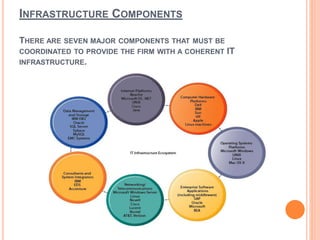
INFRASTRUCTURE COMPONENTS 
THERE ARE SEVEN MAJOR COMPONENTS THAT MUST BE 
COORDINATED TO PROVIDE THE FIRM WITH A COHERENT IT 
INFRASTRUCTURE.
1. COMPUTER HARDWARE PLATFORMS 
COMPUTER HARDWARE PLATFORMS INCLUDE CLIENT MACHINES AND SERVER 
MACHINES, AS WELL AS MODERN MAINFRAMES PRODUCED BY IBM. US FIRMS SPENT 
ABOUT $145 BILLION ON COMPUTER HARDWARE. 
2. OPERATING SYSTEM PLATFORMS 
OPERATING SYSTEM PLATFORMS INCLUDE PLATFORMS FOR CLIENT COMPUTERS, 
DOMINATED BY WINDOWS OPERATING SYSTEMS, AND SERVERS, DOMINATED BY THE 
VARIOUS FORMS OF THE UNIX OPERATING SYSTEM OR LINUX. OPERATING 
SYSTEMS ARE SOFTWARE THAT MANAGE THE RESOURCES AND ACTIVITIES OF THE 
COMPUTER AND ACT AS AN INTERFACE FOR THE USER. 
3. ENTERPRISE SOFTWARE APPLICATIONS 
ENTERPRISE SOFTWARE APPLICATIONS INCLUDE SAP, ORACLE, AND PEOPLESOFT, 
AND MIDDLEWARE SOFTWARE THAT ARE USED TO LINK A FIRM'S EXISTING 
APPLICATION SYSTEMS.
4. DATA MANAGEMENT AND STORAGE 
DATA MANAGEMENT AND STORAGE IS HANDLED BY DATABASE 
MANAGEMENT SOFTWARE AND STORAGE DEVICES INCLUDE 
TRADITIONAL STORAGE METHODS, SUCH AS DISK ARRAYS AND TAPE 
LIBRARIES, AND NEWER NETWORK-BASED STORAGE TECHNOLOGIES 
SUCH AS STORAGE AREA NETWORKS (SANS). SANS CONNECT 
MULTIPLE STORAGE DEVICES ON DEDICATED HIGH-SPEED 
NETWORKS. 
5. NETWORKING AND TELECOMMUNICATIONS 
PLATFORMS 
NETWORKING AND TELECOMMUNICATIONS PLATFORMS INCLUDE 
WINDOWS SERVER OPERATING SYSTEMS, NOVELL, LINUX, AND 
UNIX. NEARLY ALL LAN AND MANY WIDE AREA NETWORKS 
(WANS) USE THE TCP/IP STANDARDS FOR NETWORKING.
6. INTERNET PLATFORMS 
INTERNET PLATFORMS OVERLAP WITH, AND MUST RELATE TO, THE 
FIRM'S GENERAL NETWORKING INFRASTRUCTURE AND HARDWARE 
AND SOFTWARE PLATFORMS. INTERNET-RELATED INFRASTRUCTURE 
INCLUDES THE HARDWARE, SOFTWARE AND SERVICES TO MAINTAIN 
CORPORATE WEB SITES, INTRANETS, AND EXTRANETS, INCLUDING 
WEB HOSTING SERVICES AND WEB SOFTWARE APPLICATION 
DEVELOPMENT TOOLS. 
7. CONSULTING AND SYSTEM INTEGRATION SERVICES 
CONSULTING AND SYSTEM INTEGRATION SERVICES ARE RELIED ON 
FOR INTEGRATING A FIRM'S LEGACY SYSTEMS WITH NEW 
TECHNOLOGY AND INFRASTRUCTURE AND PROVIDING EXPERTISE IN 
IMPLEMENTING NEW INFRASTRUCTURE ALONG WITH RELEVANT 
CHANGES IN BUSINESS PROCESSES, TRAINING, AND SOFTWARE 
INTEGRATION.
MAKING WISE INFRASTRUCTURE 
INVESTMENT 
IT Infrastructure is a major capital 
investment for the firm. If too much is spent 
on infrastructure, it lies idle and constitutes 
a drag on firm financial performance. If too 
little is spent, important business services 
cannot be delivered and firms competitors 
will outperform in the under investing firm.
DATABASE MANAGEMENT SYSTEMS 
A DATABASE IS A COLLECTION OF RECORDS. DATABASE 
MANAGEMENT SYSTEMS ARE DESIGNED AS THE MEANS OF 
MANAGING ALL THE RECORDS. DATABASE MANAGEMENT IS A 
SOFTWARE SYSTEM THAT USES A STANDARD METHOD AND RUNNING 
QUERIES WITH SOME OF THEM DESIGNED FOR THE OVERSIGHT AND 
PROPER CONTROL OF DATABASES. 
Types of Database Management Systems: 
There are four structural types of database 
management systems: 
 Hierarchical databases. 
 Network databases. 
 Relational databases. 
 Object-oriented databases
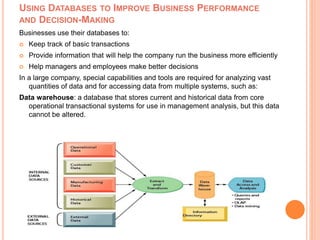
USING DATABASES TO IMPROVE BUSINESS PERFORMANCE 
AND DECISION-MAKING 
Businesses use their databases to: 
 Keep track of basic transactions 
 Provide information that will help the company run the business more efficiently 
 Help managers and employees make better decisions 
In a large company, special capabilities and tools are required for analyzing vast 
quantities of data and for accessing data from multiple systems, such as: 
Data warehouse: a database that stores current and historical data from core 
operational transactional systems for use in management analysis, but this data 
cannot be altered.
Data mart: A subset of a data warehouse in which a summarized or highly focused 
portion of the organization's data is placed in a separate database for a specific 
population of users. 
Business intelligence (BI) tools: Data analysis tools used for consolidating, 
analyzing, and accessing vast stores of data to help in decision making, such as 
software for database query and reporting, tools for multidimensional data analysis 
(online analytical processing), and data mining.
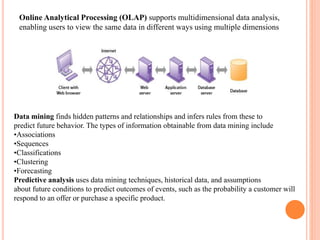
Online Analytical Processing (OLAP) supports multidimensional data analysis, 
enabling users to view the same data in different ways using multiple dimensions 
Data mining finds hidden patterns and relationships and infers rules from these to 
predict future behavior. The types of information obtainable from data mining include 
•Associations 
•Sequences 
•Classifications 
•Clustering 
•Forecasting 
Predictive analysis uses data mining techniques, historical data, and assumptions 
about future conditions to predict outcomes of events, such as the probability a customer will 
respond to an offer or purchase a specific product.
TYPES OF NETWORK 
Common examples of area 
network types are: 
 LAN - Local Area Network 
 WLAN - Wireless Local Area 
Network 
 WAN - Wide Area Network 
 MAN - Metropolitan Area 
Network 
 SAN - Storage Area Network, 
System Area Network, Server 
Area Network, or sometimes 
Small Area Network 
 CAN - Campus Area Network, 
Controller Area Network, or 
sometimes Cluster Area 
Network 
 PAN - Personal Area Network 
 DAN - Desk Area Network
WHAT IS TRANSMISSION MEDIA ? 
TRANSMISSION MEDIA IS A PATHWAY THAT CARRIES THE 
INFORMATION FROM SENDER TO RECEIVER.WE USE DIFFERENT 
TYPES OF CABLES OR WAVES TO TRANSMIT DATA. DATA IS 
TRANSMITTED NORMALLY THROUGH ELECTRICAL OR 
ELECTROMAGNETIC SIGNALS. 
Types of transmission media: 
Transmission media is broadly classified into two groups. 
 1. Wired or Guided Media or Bound Transmission Media 
 2. Wireless or Unguided Media or Unbound Transmission Media
Wireless or Unguided Media or Unbound Transmission 
Media: Unbound transmission media are the ways of 
transmitting data without using any cables. These media are 
not bounded by physical geography. This type of transmission 
is called Wireless communication. 
Wired or Guided Media or Bound Transmission 
Media: Bound transmission media are the cables that are 
tangible or have physical existence and are limited by the 
physical geography. Popular bound transmission media in 
use are twisted pair cable, co-axial cable and fiber optical 
cable.
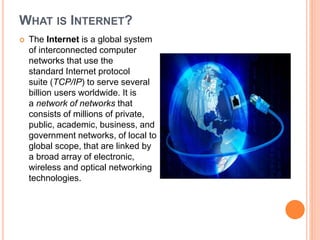
WHAT IS INTERNET? 
 The Internet is a global system 
of interconnected computer 
networks that use the 
standard Internet protocol 
suite (TCP/IP) to serve several 
billion users worldwide. It is 
a network of networks that 
consists of millions of private, 
public, academic, business, and 
government networks, of local to 
global scope, that are linked by 
a broad array of electronic, 
wireless and optical networking 
technologies.
INTERNET BASED COMMUNICATION TOOLS 
 There are many different kinds of Internet 
communications tool, such as email, VoIP, forums, 
online chat and social networking among others. 
Using the latest tools and methods of 
communicating over the Internet is essential for 
bringing your business into the modern age of 
communication and marketing.
WIRELESS REVOLUTION 
 The revolution is expected to dramatically affect the way we 
communicate and use computer technology. Wireless will 
change the significance of location. Time-zone and cost now 
matter more than mere distance. Indeed, in some ways, the 
mobile telephone dispenses with physical geography even 
more effectively than does the Internet. To tap into their e-mail, 
most folk still have to plug in somewhere in the world 
(although that too will change as new mobile gadgets
Thank you very 
much 
for being with us & 
support us….

It infrastructure

  • 1.
    What is Infrastructure?  In information technology and on the Internet, infrastructure is the physical hardware used to interconnect computers and users. Infrastructure includes the transmission media, including telephone lines, cable television lines, satellites antennas, routers, and other devices that control transmission paths. Infrastructure also includes the software used to send, receive, and manage the signals that are transmitted. Information technology infrastructure is the integrated framework upon which digital networks operate. This infrastructure includes data centers,computers, computer networks, Database Management devices, and a regulatory system.
  • 2.
    INFRASTRUCTURE COMPONENTS THEREARE SEVEN MAJOR COMPONENTS THAT MUST BE COORDINATED TO PROVIDE THE FIRM WITH A COHERENT IT INFRASTRUCTURE.
  • 3.
    1. COMPUTER HARDWAREPLATFORMS COMPUTER HARDWARE PLATFORMS INCLUDE CLIENT MACHINES AND SERVER MACHINES, AS WELL AS MODERN MAINFRAMES PRODUCED BY IBM. US FIRMS SPENT ABOUT $145 BILLION ON COMPUTER HARDWARE. 2. OPERATING SYSTEM PLATFORMS OPERATING SYSTEM PLATFORMS INCLUDE PLATFORMS FOR CLIENT COMPUTERS, DOMINATED BY WINDOWS OPERATING SYSTEMS, AND SERVERS, DOMINATED BY THE VARIOUS FORMS OF THE UNIX OPERATING SYSTEM OR LINUX. OPERATING SYSTEMS ARE SOFTWARE THAT MANAGE THE RESOURCES AND ACTIVITIES OF THE COMPUTER AND ACT AS AN INTERFACE FOR THE USER. 3. ENTERPRISE SOFTWARE APPLICATIONS ENTERPRISE SOFTWARE APPLICATIONS INCLUDE SAP, ORACLE, AND PEOPLESOFT, AND MIDDLEWARE SOFTWARE THAT ARE USED TO LINK A FIRM'S EXISTING APPLICATION SYSTEMS.
  • 4.
    4. DATA MANAGEMENTAND STORAGE DATA MANAGEMENT AND STORAGE IS HANDLED BY DATABASE MANAGEMENT SOFTWARE AND STORAGE DEVICES INCLUDE TRADITIONAL STORAGE METHODS, SUCH AS DISK ARRAYS AND TAPE LIBRARIES, AND NEWER NETWORK-BASED STORAGE TECHNOLOGIES SUCH AS STORAGE AREA NETWORKS (SANS). SANS CONNECT MULTIPLE STORAGE DEVICES ON DEDICATED HIGH-SPEED NETWORKS. 5. NETWORKING AND TELECOMMUNICATIONS PLATFORMS NETWORKING AND TELECOMMUNICATIONS PLATFORMS INCLUDE WINDOWS SERVER OPERATING SYSTEMS, NOVELL, LINUX, AND UNIX. NEARLY ALL LAN AND MANY WIDE AREA NETWORKS (WANS) USE THE TCP/IP STANDARDS FOR NETWORKING.
  • 5.
    6. INTERNET PLATFORMS INTERNET PLATFORMS OVERLAP WITH, AND MUST RELATE TO, THE FIRM'S GENERAL NETWORKING INFRASTRUCTURE AND HARDWARE AND SOFTWARE PLATFORMS. INTERNET-RELATED INFRASTRUCTURE INCLUDES THE HARDWARE, SOFTWARE AND SERVICES TO MAINTAIN CORPORATE WEB SITES, INTRANETS, AND EXTRANETS, INCLUDING WEB HOSTING SERVICES AND WEB SOFTWARE APPLICATION DEVELOPMENT TOOLS. 7. CONSULTING AND SYSTEM INTEGRATION SERVICES CONSULTING AND SYSTEM INTEGRATION SERVICES ARE RELIED ON FOR INTEGRATING A FIRM'S LEGACY SYSTEMS WITH NEW TECHNOLOGY AND INFRASTRUCTURE AND PROVIDING EXPERTISE IN IMPLEMENTING NEW INFRASTRUCTURE ALONG WITH RELEVANT CHANGES IN BUSINESS PROCESSES, TRAINING, AND SOFTWARE INTEGRATION.
  • 6.
    MAKING WISE INFRASTRUCTURE INVESTMENT IT Infrastructure is a major capital investment for the firm. If too much is spent on infrastructure, it lies idle and constitutes a drag on firm financial performance. If too little is spent, important business services cannot be delivered and firms competitors will outperform in the under investing firm.
  • 7.
    DATABASE MANAGEMENT SYSTEMS A DATABASE IS A COLLECTION OF RECORDS. DATABASE MANAGEMENT SYSTEMS ARE DESIGNED AS THE MEANS OF MANAGING ALL THE RECORDS. DATABASE MANAGEMENT IS A SOFTWARE SYSTEM THAT USES A STANDARD METHOD AND RUNNING QUERIES WITH SOME OF THEM DESIGNED FOR THE OVERSIGHT AND PROPER CONTROL OF DATABASES. Types of Database Management Systems: There are four structural types of database management systems:  Hierarchical databases.  Network databases.  Relational databases.  Object-oriented databases
  • 8.
    USING DATABASES TOIMPROVE BUSINESS PERFORMANCE AND DECISION-MAKING Businesses use their databases to:  Keep track of basic transactions  Provide information that will help the company run the business more efficiently  Help managers and employees make better decisions In a large company, special capabilities and tools are required for analyzing vast quantities of data and for accessing data from multiple systems, such as: Data warehouse: a database that stores current and historical data from core operational transactional systems for use in management analysis, but this data cannot be altered.
  • 9.
    Data mart: Asubset of a data warehouse in which a summarized or highly focused portion of the organization's data is placed in a separate database for a specific population of users. Business intelligence (BI) tools: Data analysis tools used for consolidating, analyzing, and accessing vast stores of data to help in decision making, such as software for database query and reporting, tools for multidimensional data analysis (online analytical processing), and data mining.
  • 10.
    Online Analytical Processing(OLAP) supports multidimensional data analysis, enabling users to view the same data in different ways using multiple dimensions Data mining finds hidden patterns and relationships and infers rules from these to predict future behavior. The types of information obtainable from data mining include •Associations •Sequences •Classifications •Clustering •Forecasting Predictive analysis uses data mining techniques, historical data, and assumptions about future conditions to predict outcomes of events, such as the probability a customer will respond to an offer or purchase a specific product.
  • 11.
    TYPES OF NETWORK Common examples of area network types are:  LAN - Local Area Network  WLAN - Wireless Local Area Network  WAN - Wide Area Network  MAN - Metropolitan Area Network  SAN - Storage Area Network, System Area Network, Server Area Network, or sometimes Small Area Network  CAN - Campus Area Network, Controller Area Network, or sometimes Cluster Area Network  PAN - Personal Area Network  DAN - Desk Area Network
  • 12.
    WHAT IS TRANSMISSIONMEDIA ? TRANSMISSION MEDIA IS A PATHWAY THAT CARRIES THE INFORMATION FROM SENDER TO RECEIVER.WE USE DIFFERENT TYPES OF CABLES OR WAVES TO TRANSMIT DATA. DATA IS TRANSMITTED NORMALLY THROUGH ELECTRICAL OR ELECTROMAGNETIC SIGNALS. Types of transmission media: Transmission media is broadly classified into two groups.  1. Wired or Guided Media or Bound Transmission Media  2. Wireless or Unguided Media or Unbound Transmission Media
  • 13.
    Wireless or UnguidedMedia or Unbound Transmission Media: Unbound transmission media are the ways of transmitting data without using any cables. These media are not bounded by physical geography. This type of transmission is called Wireless communication. Wired or Guided Media or Bound Transmission Media: Bound transmission media are the cables that are tangible or have physical existence and are limited by the physical geography. Popular bound transmission media in use are twisted pair cable, co-axial cable and fiber optical cable.
  • 14.
    WHAT IS INTERNET?  The Internet is a global system of interconnected computer networks that use the standard Internet protocol suite (TCP/IP) to serve several billion users worldwide. It is a network of networks that consists of millions of private, public, academic, business, and government networks, of local to global scope, that are linked by a broad array of electronic, wireless and optical networking technologies.
  • 15.
    INTERNET BASED COMMUNICATIONTOOLS  There are many different kinds of Internet communications tool, such as email, VoIP, forums, online chat and social networking among others. Using the latest tools and methods of communicating over the Internet is essential for bringing your business into the modern age of communication and marketing.
  • 16.
    WIRELESS REVOLUTION The revolution is expected to dramatically affect the way we communicate and use computer technology. Wireless will change the significance of location. Time-zone and cost now matter more than mere distance. Indeed, in some ways, the mobile telephone dispenses with physical geography even more effectively than does the Internet. To tap into their e-mail, most folk still have to plug in somewhere in the world (although that too will change as new mobile gadgets
  • 17.
    Thank you very much for being with us & support us….