Database Management System (DBMS) an Introduction
Intro to DBMS Understand why databases are important to modern organizations Understand how databases work Understand how organizations can maximize their strategic potential with databases Objectives
Intro to DBMS Data is a vital part of any organization. It needs to be stored, organized, managed, accessed, protected and manipulated. Operational  Use databases to: Create a book Track book sales Set salaries and wages Pay employees
Purpose of DBMS The purpose of a database is to keep track of things Unlike a list or spreadsheet, a database may store information that is more complicated than a simple list Intro to DBMS
Database Management for Strategic Advantage The Database Approach: Foundational Concepts DBMS – Database Management Systems Use a DBMS software to create, store, organize, and retrieve data from a single database or several databases Example: Microsoft Access Intro to DBMS
Database Management for Strategic Advantage Advantages of the Database Approach  Program-data independence Minimal data redundancy Improved data consistency Improved data sharing Increased productivity of application development Enforcement of standards Improved data quality Improved data accessibility Reduced program maintenance Intro to DBMS
Database Management for Strategic Advantage Effective Management of Databases The database administrator (DBA) : Works with programmers and analysts to design and implement the database Works with users and managers to establish database policies Implements security features and establishes database permissions Intro to DBMS
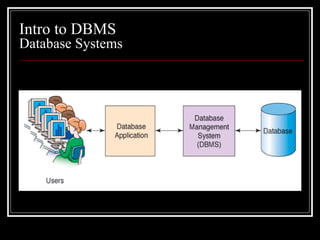
Intro to DBMS The four components of a  database system  are: Users Database Application Database Management System (DBMS) Database Database Systems
Intro to DBMS Database Systems
A user of a database system will Use a database application to track things Use forms to enter, read, delete and query data Produce reports Database Systems - Users Intro to DBMS
A set of one or more computer programs that serves as an intermediary between the users and the DBMS Application program that read or modify database data by sending SQL statements to DBMS. Application program to present data to users in the format of forms and reports. Intro to DBMS Database Systems – Database Application
Create and process forms Process user queries Create and process reports Execute application logic Control database applications Database Systems – Database Application : Functions Intro to DBMS
Intro to DBMS Database Systems – DBMS A computer program used to create, process and administer the database DBMS receives request encoded in SQL and translates these requests into actions on the database DBMS is a large, complicated program that is licensed software. Almost majority of the companies never write their own DBMS program.
Intro to DBMS Database Systems – Database The database is a collection of related tables and other structures. A database is a  self-describing  collection of  related  records
Create databases Create tables Create supporting structures Read database data Modify database data (insert, update, delete) Maintain database structures Enforce rules Control concurrency Provide security Perform backup and recovery Intro to DBMS Functions of DBMS
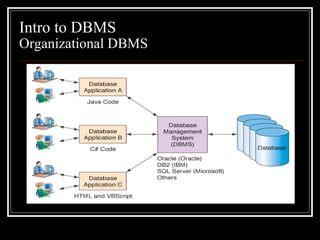
Intro to DBMS Organizational DBMS
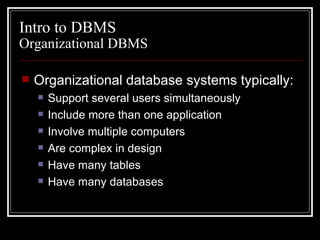
Organizational database systems typically: Support several users simultaneously Include more than one application Involve multiple computers Are complex in design Have many tables Have many databases Intro to DBMS Organizational DBMS

Data Base Management System

  • 1.
    Database Management System(DBMS) an Introduction
  • 2.
    Intro to DBMSUnderstand why databases are important to modern organizations Understand how databases work Understand how organizations can maximize their strategic potential with databases Objectives
  • 3.
    Intro to DBMSData is a vital part of any organization. It needs to be stored, organized, managed, accessed, protected and manipulated. Operational Use databases to: Create a book Track book sales Set salaries and wages Pay employees
  • 4.
    Purpose of DBMSThe purpose of a database is to keep track of things Unlike a list or spreadsheet, a database may store information that is more complicated than a simple list Intro to DBMS
  • 5.
    Database Management forStrategic Advantage The Database Approach: Foundational Concepts DBMS – Database Management Systems Use a DBMS software to create, store, organize, and retrieve data from a single database or several databases Example: Microsoft Access Intro to DBMS
  • 6.
    Database Management forStrategic Advantage Advantages of the Database Approach Program-data independence Minimal data redundancy Improved data consistency Improved data sharing Increased productivity of application development Enforcement of standards Improved data quality Improved data accessibility Reduced program maintenance Intro to DBMS
  • 7.
    Database Management forStrategic Advantage Effective Management of Databases The database administrator (DBA) : Works with programmers and analysts to design and implement the database Works with users and managers to establish database policies Implements security features and establishes database permissions Intro to DBMS
  • 8.
    Intro to DBMSThe four components of a database system are: Users Database Application Database Management System (DBMS) Database Database Systems
  • 9.
    Intro to DBMSDatabase Systems
  • 10.
    A user ofa database system will Use a database application to track things Use forms to enter, read, delete and query data Produce reports Database Systems - Users Intro to DBMS
  • 11.
    A set ofone or more computer programs that serves as an intermediary between the users and the DBMS Application program that read or modify database data by sending SQL statements to DBMS. Application program to present data to users in the format of forms and reports. Intro to DBMS Database Systems – Database Application
  • 12.
    Create and processforms Process user queries Create and process reports Execute application logic Control database applications Database Systems – Database Application : Functions Intro to DBMS
  • 13.
    Intro to DBMSDatabase Systems – DBMS A computer program used to create, process and administer the database DBMS receives request encoded in SQL and translates these requests into actions on the database DBMS is a large, complicated program that is licensed software. Almost majority of the companies never write their own DBMS program.
  • 14.
    Intro to DBMSDatabase Systems – Database The database is a collection of related tables and other structures. A database is a self-describing collection of related records
  • 15.
    Create databases Createtables Create supporting structures Read database data Modify database data (insert, update, delete) Maintain database structures Enforce rules Control concurrency Provide security Perform backup and recovery Intro to DBMS Functions of DBMS
  • 16.
    Intro to DBMSOrganizational DBMS
  • 17.
    Organizational database systemstypically: Support several users simultaneously Include more than one application Involve multiple computers Are complex in design Have many tables Have many databases Intro to DBMS Organizational DBMS