MEMBER IN INTERNATIONAL NETWORK FOR POULTRY DEVELOPMENTFAO
FAO IRAQ
Prevalence of Mycoplasma gallisepticum
Infection in Poultry Farms
Dr. Majed H. Mohammed Ph.D.
Virology and Moleculat Cell Biology
majed.mohammed@uod.ac
Background
• Mycoplasmas are highly versatile and successful
pathogen
• Chronic Respiratory Disease: Once infected,
infection remains for life
• Mycoplasma lack a cell wall: resistant to
penicillin group of antibiotics
• Antimicoplasmal drugs are bacteriostatic
• Antibodies can not eliminate infection
• Field infection (MG/MS) level is high due to
vertical transmission and low level of biosecurity
• Raising mycoplasma clean flocks is not
practicable
Major pathogenic species
M. gallisepticum - Chickens, Turkeys
M. synoviae - Chickens, Turkeys
M. meliagridis - Turkeys
M. iowae - Turkeys
Smallest self replicating prokaryotes
Lack of cell wall, bounded by cell membrane
Fragile – easily killed out side its host by
disinfectants
• Costliest Disease in Poultry
• Mortality
• Reduced feed conversion
• Loss of weight
• Complications with – IB, ND, E coli
• Drop in egg production
• Reduced hatchability & chick viability
• Cost of eradication and control programs
Economic significance
Transmission
• Horizontal
– Within a flock - contact or aerosols
– Between flocks - windborne
• Vertical
– Parent to the chick through egg
Some possible egg-borne infections
Target organs:
– Respiratory system
– Synovial membranes
– Reproductive system
Incubation period:
– Chronic slow spreading
– Varies from 6-21 days
Clinical Signs
• Coughing, sneezing, Nasal discharge
• Foamy secretions in the eye
• Open mouthed breathing
• Tracheal rales
• Reduced feed consumption
• Loss of weight – more stunted chicks
• Drop in egg production – layer, breeder
• Reduced hatchability, chick viability
• Lameness
• Morbidity – up to 100%
• Mortality – up to 30%
Gross Lesions
• Sinusitis and conjunctivitis
• Tracheitis with excessive
mucus
• Airsacculitis
• Pneumonia
• Synovitis
• Osteomyelitis
• Salpingitis
The most characteristic signs in adult flocks
are tracheal rales, nasal discharge, coughing
Frothy exudate
in Air sac
Accumulation of
Cheesy mass in thoracic air sac
Foamy lesions
develop on air sacs
Within one weak later become 8-10 folds
thicker than normal
Secondary E.coli infection leads to severe
fibrinopurelent or Caseous exudates on
pericardium and liver capsule (fibrinous
pericarditis and fibrinous perihepatitis)
Complicated Chronic Respiratory Disease
Air-saculitis, Pericarditis, perihepatitis
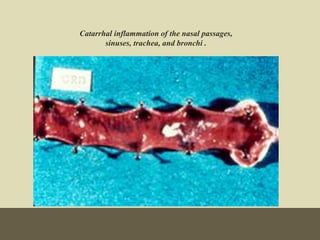
Catarrhal inflammation of the nasal passages,
sinuses, trachea, and bronchi .
Diagnosis of maycoplasma
• Isolation: Laborious process (slow growth – complex
nutritional requirement) tubes should be incubated at 37 C
for at least 14 days before being discarded as negative.
• Identification: Biochemical & Serological (growth
inhibition test, agar gel precipitation test, ELISA, FAT, HI,
Agglutination test).
• Routine monitoring of flocks for MG and MS infection is usually
by the RSA, (Rapid Sera Agglutination also known as the Plate
test, SPA) or ELISA test. Testing is usually recommended to be
every 3 weeks in high risk areas
• Yolk samples from eggs can be tested in ELISA format tests and
may be useful, especially if access to the parent flock is not
possible or is a problem from a biosecurity point of view
Monitoring by serology
Serum separation for ELISA
Collection of choanal swab
• In the field, many cases of M. gallisepticum infection are complicated by
other diseaseproducing bacteria. Therefore, effective treatment must also
attack the secondary invaders.
• Most strains of mycoplasma M. gallisepticum are sensitive to a number of
antibiotics, but are resistant to penicillins or other antibiotics which act by
inhibiting cell wall
• A combination of colistin and tylosin with other anti-bacterials generally
helps and effect will be better if bronchodilators are also used in drinking
water for 3-5
• tetracyclines, tylosin, tiamulin, quinolones (enrofloxacin) and tilmicosin
but most of these are bacteriostatic rather than bacteriosidal.
tetracyclines, tylosin, tiamulin, quinolones (enrofloxacin) and tilmicosin
but most of these are bacteriostatic rather than bacteriosidal.
Treatment
The avian respiratory system is
involved in the following
functions:
absorption of oxygen (O2)
release of carbon dioxide (CO2)
release of heat (temperature
regulation)
detoxification of certain chemicals
rapid adjustments of acid/base
balance
Use of vaccines:
(a) Killed vaccines:
(b) Live vaccines: These are of three types: F strain vaccine, 6/85
strain vaccine, and ts-11 vaccine
Management: Because M. gallisepticum can be transmitted by
egg, maintaining chicken flocks free of M. gallisepticum is
possible only by starting with breeding stocks that are free of the
infection.
Prevention and Control
biosecurity is extremely important in the control of disease
Suggestions and Comments
Biosecurity – Preventing disease in poultry
The use of anolyte in poultry
The addition of neutral anolyte into the drinking
water ...
improves feed conversion
promote immunity
increases the resistance to disease
permits an increase in the vitality
reduces mortality by 50 to 70%
allows a higher life weight at lower feed consumption
reduced the use of antibiotics
eliminates E-coli, salmonella, coccidiosis
improving the quality of the feed of the animals
Minimizes the impact of mortality during epidemics
reduced the amount of small eggs increases the
quality and the uniformity of the calibration of eggs
Crd
Crd
Crd

Crd

  • 1.
    MEMBER IN INTERNATIONALNETWORK FOR POULTRY DEVELOPMENTFAO FAO IRAQ Prevalence of Mycoplasma gallisepticum Infection in Poultry Farms Dr. Majed H. Mohammed Ph.D. Virology and Moleculat Cell Biology majed.mohammed@uod.ac
  • 2.
    Background • Mycoplasmas arehighly versatile and successful pathogen • Chronic Respiratory Disease: Once infected, infection remains for life • Mycoplasma lack a cell wall: resistant to penicillin group of antibiotics • Antimicoplasmal drugs are bacteriostatic • Antibodies can not eliminate infection • Field infection (MG/MS) level is high due to vertical transmission and low level of biosecurity • Raising mycoplasma clean flocks is not practicable
  • 3.
    Major pathogenic species M.gallisepticum - Chickens, Turkeys M. synoviae - Chickens, Turkeys M. meliagridis - Turkeys M. iowae - Turkeys Smallest self replicating prokaryotes Lack of cell wall, bounded by cell membrane Fragile – easily killed out side its host by disinfectants
  • 4.
    • Costliest Diseasein Poultry • Mortality • Reduced feed conversion • Loss of weight • Complications with – IB, ND, E coli • Drop in egg production • Reduced hatchability & chick viability • Cost of eradication and control programs Economic significance
  • 5.
    Transmission • Horizontal – Withina flock - contact or aerosols – Between flocks - windborne • Vertical – Parent to the chick through egg
  • 6.
  • 7.
    Target organs: – Respiratorysystem – Synovial membranes – Reproductive system Incubation period: – Chronic slow spreading – Varies from 6-21 days
  • 8.
    Clinical Signs • Coughing,sneezing, Nasal discharge • Foamy secretions in the eye • Open mouthed breathing • Tracheal rales • Reduced feed consumption • Loss of weight – more stunted chicks • Drop in egg production – layer, breeder • Reduced hatchability, chick viability • Lameness • Morbidity – up to 100% • Mortality – up to 30%
  • 9.
    Gross Lesions • Sinusitisand conjunctivitis • Tracheitis with excessive mucus • Airsacculitis • Pneumonia • Synovitis • Osteomyelitis • Salpingitis
  • 10.
    The most characteristicsigns in adult flocks are tracheal rales, nasal discharge, coughing
  • 11.
    Frothy exudate in Airsac Accumulation of Cheesy mass in thoracic air sac
  • 12.
    Foamy lesions develop onair sacs Within one weak later become 8-10 folds thicker than normal
  • 13.
    Secondary E.coli infectionleads to severe fibrinopurelent or Caseous exudates on pericardium and liver capsule (fibrinous pericarditis and fibrinous perihepatitis)
  • 14.
    Complicated Chronic RespiratoryDisease Air-saculitis, Pericarditis, perihepatitis
  • 15.
    Catarrhal inflammation ofthe nasal passages, sinuses, trachea, and bronchi .
  • 16.
    Diagnosis of maycoplasma •Isolation: Laborious process (slow growth – complex nutritional requirement) tubes should be incubated at 37 C for at least 14 days before being discarded as negative. • Identification: Biochemical & Serological (growth inhibition test, agar gel precipitation test, ELISA, FAT, HI, Agglutination test).
  • 17.
    • Routine monitoringof flocks for MG and MS infection is usually by the RSA, (Rapid Sera Agglutination also known as the Plate test, SPA) or ELISA test. Testing is usually recommended to be every 3 weeks in high risk areas • Yolk samples from eggs can be tested in ELISA format tests and may be useful, especially if access to the parent flock is not possible or is a problem from a biosecurity point of view Monitoring by serology
  • 18.
    Serum separation forELISA Collection of choanal swab
  • 19.
    • In thefield, many cases of M. gallisepticum infection are complicated by other diseaseproducing bacteria. Therefore, effective treatment must also attack the secondary invaders. • Most strains of mycoplasma M. gallisepticum are sensitive to a number of antibiotics, but are resistant to penicillins or other antibiotics which act by inhibiting cell wall • A combination of colistin and tylosin with other anti-bacterials generally helps and effect will be better if bronchodilators are also used in drinking water for 3-5 • tetracyclines, tylosin, tiamulin, quinolones (enrofloxacin) and tilmicosin but most of these are bacteriostatic rather than bacteriosidal. tetracyclines, tylosin, tiamulin, quinolones (enrofloxacin) and tilmicosin but most of these are bacteriostatic rather than bacteriosidal. Treatment
  • 20.
    The avian respiratorysystem is involved in the following functions: absorption of oxygen (O2) release of carbon dioxide (CO2) release of heat (temperature regulation) detoxification of certain chemicals rapid adjustments of acid/base balance
  • 21.
    Use of vaccines: (a)Killed vaccines: (b) Live vaccines: These are of three types: F strain vaccine, 6/85 strain vaccine, and ts-11 vaccine Management: Because M. gallisepticum can be transmitted by egg, maintaining chicken flocks free of M. gallisepticum is possible only by starting with breeding stocks that are free of the infection. Prevention and Control
  • 22.
    biosecurity is extremelyimportant in the control of disease Suggestions and Comments Biosecurity – Preventing disease in poultry
  • 30.
    The use ofanolyte in poultry The addition of neutral anolyte into the drinking water ... improves feed conversion promote immunity increases the resistance to disease permits an increase in the vitality reduces mortality by 50 to 70% allows a higher life weight at lower feed consumption reduced the use of antibiotics eliminates E-coli, salmonella, coccidiosis improving the quality of the feed of the animals Minimizes the impact of mortality during epidemics reduced the amount of small eggs increases the quality and the uniformity of the calibration of eggs