Male sterility in vegetables crop
Submitted by:-
Mamta Choudhary
M.sc. Genetics & Plant Breeding
Lovely Professional University,
Phagwara, Punjab.
Male sterility was 1st time reported by J.K. Kaulreuter (1763).
Sterility:-
Sterility in a plant means that the pollen or ova it produces are not viable
and cannot result in the formation of an embryo.
Male sterility:-
Male sterility refers to a condition in which the pollen is either absent or
non-functional in flowering plants .
Male sterility is agronomically important for the hybrid seed production.
Introduction
1. Mitochondrial mutation
2. Barrier of tapetal layer
3. Improper timing of callase activity
4. Role of Esterase
5. Absence or malformation of male organs in bisexual flowers.
6. Abnormal microsporogenesis
Significance of male sterility
• Genetic emasculation of plants.
• Economic & quality hybrid seed production.
• Larger quantity of hybrid seeds.
• As tester genotypes for assessing the combining ability
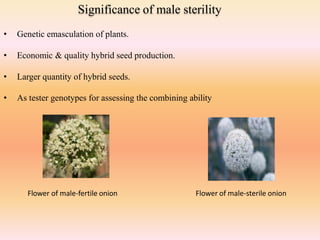
Flower of male-fertile onion Flower of male-sterile onion
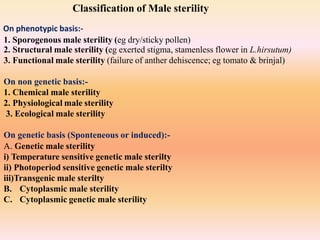
Classification of Male sterility
On phenotypic basis:-
1. Sporogenous male sterility (eg dry/sticky pollen)
2. Structural male sterility (eg exerted stigma, stamenless flower in L.hirsutum)
3. Functional male sterility (failure of anther dehiscence; eg tomato & brinjal)
On non genetic basis:-
1. Chemical male sterility
2. Physiological male sterility
3. Ecological male sterility
On genetic basis (Sponteneous or induced):-
A. Genetic male sterility
i) Temperature sensitive genetic male sterilty
ii) Photoperiod sensitive genetic male sterilty
iii)Transgenic male sterilty
B. Cytoplasmic male sterility
C. Cytoplasmic genetic male sterility
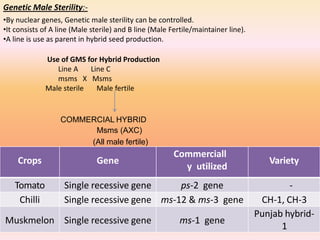
Genetic Male Sterility:-
•By nuclear genes, Genetic male sterility can be controlled.
•It consists of A line (Male sterile) and B line (Male Fertile/maintainer line).
•A line is use as parent in hybrid seed production.
Use of GMS for Hybrid Production
Line A Line C
msms X Msms
Male sterile Male fertile
COMMERCIAL HYBRID
Msms (AXC)
(All male fertile)
Crops Gene
Commerciall
y utilized
Variety
Tomato Single recessive gene ps-2 gene -
Chilli Single recessive gene ms-12 & ms-3 gene CH-1, CH-3
Muskmelon Single recessive gene ms-1 gene
Punjab hybrid-
1
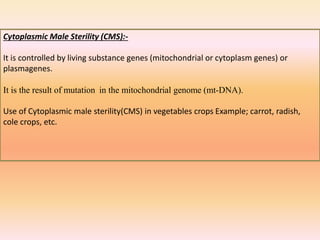
Cytoplasmic Male Sterility (CMS):-
It is controlled by living substance genes (mitochondrial or cytoplasm genes) or
plasmagenes.
It is the result of mutation in the mitochondrial genome (mt-DNA).
Use of Cytoplasmic male sterility(CMS) in vegetables crops Example; carrot, radish,
cole crops, etc.
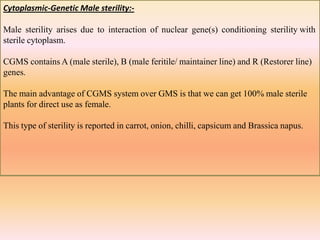
Cytoplasmic-Genetic Male sterility:-
Male sterility arises due to interaction of nuclear gene(s) conditioning sterility with
sterile cytoplasm.
CGMS contains A (male sterile), B (male feritile/ maintainer line) and R (Restorer line)
genes.
The main advantage of CGMS system over GMS is that we can get 100% male sterile
plants for direct use as female.
This type of sterility is reported in carrot, onion, chilli, capsicum and Brassica napus.
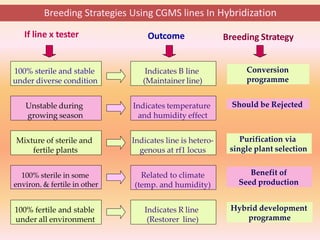
Breeding Strategies Using CGMS lines In Hybridization
100% sterile and stable
under diverse condition
Unstable during
growing season
Mixture of sterile and
fertile plants
100% sterile in some
environ. & fertile in other
100% fertile and stable
under all environment
If line x tester
Indicates B line
(Maintainer line)
Indicates temperature
and humidity effect
Indicates R line
(Restorer line)
Related to climate
(temp. and humidity)
Indicates line is hetero-
genous at rf1 locus
Outcome
Conversion
programme
Benefit of
Seed production
Purification via
single plant selection
Hybrid development
programme
Should be Rejected
Breeding Strategy
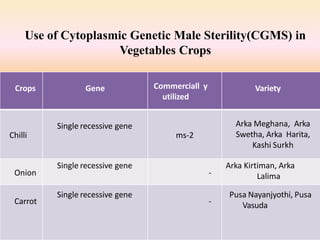
Crops Gene Commerciall y
utilized
Variety
Chilli
Single recessive gene
ms-2
Arka Meghana, Arka
Swetha, Arka Harita,
Kashi Surkh
Onion
Single recessive gene
-
Arka Kirtiman, Arka
Lalima
Carrot
Single recessive gene
-
Pusa Nayanjyothi, Pusa
Vasuda
Use of Cytoplasmic Genetic Male Sterility(CGMS) in
Vegetables Crops
Case study
Using Genic Male Sterility in Improving Hybrid Seed Production in
Tomato (Lycopersicon esculentum Mill.)
B. Atanassova and H. Georgiev
Department of Heterosis, Institute of Genetics
Bulgarian Academy of Sciences, Sofia 1113
Bulgaria
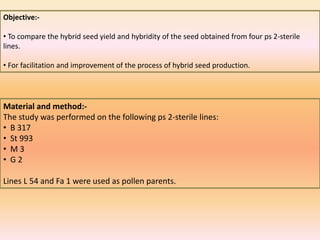
Material and method:-
The study was performed on the following ps 2-sterile lines:
• B 317
• St 993
• M 3
• G 2
Lines L 54 and Fa 1 were used as pollen parents.
Objective:-
• To compare the hybrid seed yield and hybridity of the seed obtained from four ps 2-sterile
lines.
• For facilitation and improvement of the process of hybrid seed production.
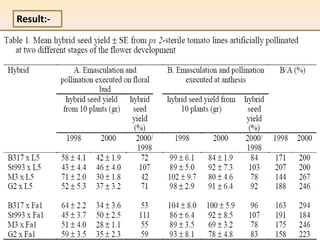
Result:-
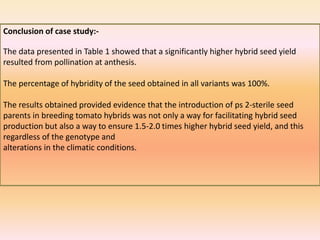
Conclusion of case study:-
The data presented in Table 1 showed that a significantly higher hybrid seed yield
resulted from pollination at anthesis.
The percentage of hybridity of the seed obtained in all variants was 100%.
The results obtained provided evidence that the introduction of ps 2-sterile seed
parents in breeding tomato hybrids was not only a way for facilitating hybrid seed
production but also a way to ensure 1.5-2.0 times higher hybrid seed yield, and this
regardless of the genotype and
alterations in the climatic conditions.
• Despite the complex maintenance process and additional labour requirement
to remove fertile segregants in hybrid seed production field, production of
male sterile based hybrid seeds is more economical than the seeds produced
by manual emasculation
• The research on male sterility in vegetables is a never ending process due to
rapid advancement of molecular advancements
• Substantial progress has been made in understanding the mechanism of male
sterility in selected vegetable crops techniques and their implementation.
• In fruit bearing vegetables like tomato, brinjal, chilli, muskmelon etc., identification
and utilization of functional male sterility are more attractive.
• In India, research on transgenic male sterility system was initiated in selected
vegetables
• Our first priority should be utilization of existing and established but unexploited
male sterility systems especially in chilli, onion, tomato,
References:-
• Atanassova, B. and Georgiev, H. (2002). Using Genic male sterility in improving hybrid seed
production in tomato (Lycopersicon esculentum Mill.). Acta Hortic. 579, 185-188
• Atanassova, B. 1999. Functional male sterility (ps 2) in tomato (Lycopersicon esculentum Mill.)
and its application in breeding and hybrid seed production. Euphytica 107(1):13-21.
• Atanassova, B. 2000. Functional male sterility in tomato (Lycopersicon esculentum Mill) and its
application in hybrid seed production. Acta Physiologiae Plantarum 22(3):221-225
• Daskaloff, Chr. 1937. Beitrag zum studium der heterosis bei den tomaten in bezug auf die
herstellung von heterosis sorten fur die praxis. Die Gartenbauwiss XI: 2.
• Georgiev, Hr. 1991. Heterosis in tomato breeding. In: Kalloo (ed.), “Genetic improvement of
tomato”, Springer-Verlag, pp.83-98.
• Mopidevi M. Nagaraju, T. Thomson, G. Koteswara Rao and Siva, M. 2017. Role of Male Sterility
in Vegetable Hybrid Seed Production. Int.J.Curr.Microbiol.App.Sci. 6(7): 134-141.
Male sterility in vegetable crops

Male sterility in vegetable crops

  • 1.
    Male sterility invegetables crop Submitted by:- Mamta Choudhary M.sc. Genetics & Plant Breeding Lovely Professional University, Phagwara, Punjab.
  • 2.
    Male sterility was1st time reported by J.K. Kaulreuter (1763). Sterility:- Sterility in a plant means that the pollen or ova it produces are not viable and cannot result in the formation of an embryo. Male sterility:- Male sterility refers to a condition in which the pollen is either absent or non-functional in flowering plants . Male sterility is agronomically important for the hybrid seed production. Introduction
  • 3.
    1. Mitochondrial mutation 2.Barrier of tapetal layer 3. Improper timing of callase activity 4. Role of Esterase 5. Absence or malformation of male organs in bisexual flowers. 6. Abnormal microsporogenesis
  • 4.
    Significance of malesterility • Genetic emasculation of plants. • Economic & quality hybrid seed production. • Larger quantity of hybrid seeds. • As tester genotypes for assessing the combining ability Flower of male-fertile onion Flower of male-sterile onion
  • 5.
    Classification of Malesterility On phenotypic basis:- 1. Sporogenous male sterility (eg dry/sticky pollen) 2. Structural male sterility (eg exerted stigma, stamenless flower in L.hirsutum) 3. Functional male sterility (failure of anther dehiscence; eg tomato & brinjal) On non genetic basis:- 1. Chemical male sterility 2. Physiological male sterility 3. Ecological male sterility On genetic basis (Sponteneous or induced):- A. Genetic male sterility i) Temperature sensitive genetic male sterilty ii) Photoperiod sensitive genetic male sterilty iii)Transgenic male sterilty B. Cytoplasmic male sterility C. Cytoplasmic genetic male sterility
  • 6.
    Genetic Male Sterility:- •Bynuclear genes, Genetic male sterility can be controlled. •It consists of A line (Male sterile) and B line (Male Fertile/maintainer line). •A line is use as parent in hybrid seed production. Use of GMS for Hybrid Production Line A Line C msms X Msms Male sterile Male fertile COMMERCIAL HYBRID Msms (AXC) (All male fertile) Crops Gene Commerciall y utilized Variety Tomato Single recessive gene ps-2 gene - Chilli Single recessive gene ms-12 & ms-3 gene CH-1, CH-3 Muskmelon Single recessive gene ms-1 gene Punjab hybrid- 1
  • 7.
    Cytoplasmic Male Sterility(CMS):- It is controlled by living substance genes (mitochondrial or cytoplasm genes) or plasmagenes. It is the result of mutation in the mitochondrial genome (mt-DNA). Use of Cytoplasmic male sterility(CMS) in vegetables crops Example; carrot, radish, cole crops, etc.
  • 9.
    Cytoplasmic-Genetic Male sterility:- Malesterility arises due to interaction of nuclear gene(s) conditioning sterility with sterile cytoplasm. CGMS contains A (male sterile), B (male feritile/ maintainer line) and R (Restorer line) genes. The main advantage of CGMS system over GMS is that we can get 100% male sterile plants for direct use as female. This type of sterility is reported in carrot, onion, chilli, capsicum and Brassica napus.
  • 10.
    Breeding Strategies UsingCGMS lines In Hybridization 100% sterile and stable under diverse condition Unstable during growing season Mixture of sterile and fertile plants 100% sterile in some environ. & fertile in other 100% fertile and stable under all environment If line x tester Indicates B line (Maintainer line) Indicates temperature and humidity effect Indicates R line (Restorer line) Related to climate (temp. and humidity) Indicates line is hetero- genous at rf1 locus Outcome Conversion programme Benefit of Seed production Purification via single plant selection Hybrid development programme Should be Rejected Breeding Strategy
  • 11.
    Crops Gene Commercially utilized Variety Chilli Single recessive gene ms-2 Arka Meghana, Arka Swetha, Arka Harita, Kashi Surkh Onion Single recessive gene - Arka Kirtiman, Arka Lalima Carrot Single recessive gene - Pusa Nayanjyothi, Pusa Vasuda Use of Cytoplasmic Genetic Male Sterility(CGMS) in Vegetables Crops
  • 12.
    Case study Using GenicMale Sterility in Improving Hybrid Seed Production in Tomato (Lycopersicon esculentum Mill.) B. Atanassova and H. Georgiev Department of Heterosis, Institute of Genetics Bulgarian Academy of Sciences, Sofia 1113 Bulgaria
  • 13.
    Material and method:- Thestudy was performed on the following ps 2-sterile lines: • B 317 • St 993 • M 3 • G 2 Lines L 54 and Fa 1 were used as pollen parents. Objective:- • To compare the hybrid seed yield and hybridity of the seed obtained from four ps 2-sterile lines. • For facilitation and improvement of the process of hybrid seed production.
  • 14.
  • 15.
    Conclusion of casestudy:- The data presented in Table 1 showed that a significantly higher hybrid seed yield resulted from pollination at anthesis. The percentage of hybridity of the seed obtained in all variants was 100%. The results obtained provided evidence that the introduction of ps 2-sterile seed parents in breeding tomato hybrids was not only a way for facilitating hybrid seed production but also a way to ensure 1.5-2.0 times higher hybrid seed yield, and this regardless of the genotype and alterations in the climatic conditions.
  • 16.
    • Despite thecomplex maintenance process and additional labour requirement to remove fertile segregants in hybrid seed production field, production of male sterile based hybrid seeds is more economical than the seeds produced by manual emasculation • The research on male sterility in vegetables is a never ending process due to rapid advancement of molecular advancements • Substantial progress has been made in understanding the mechanism of male sterility in selected vegetable crops techniques and their implementation. • In fruit bearing vegetables like tomato, brinjal, chilli, muskmelon etc., identification and utilization of functional male sterility are more attractive. • In India, research on transgenic male sterility system was initiated in selected vegetables • Our first priority should be utilization of existing and established but unexploited male sterility systems especially in chilli, onion, tomato,
  • 17.
    References:- • Atanassova, B.and Georgiev, H. (2002). Using Genic male sterility in improving hybrid seed production in tomato (Lycopersicon esculentum Mill.). Acta Hortic. 579, 185-188 • Atanassova, B. 1999. Functional male sterility (ps 2) in tomato (Lycopersicon esculentum Mill.) and its application in breeding and hybrid seed production. Euphytica 107(1):13-21. • Atanassova, B. 2000. Functional male sterility in tomato (Lycopersicon esculentum Mill) and its application in hybrid seed production. Acta Physiologiae Plantarum 22(3):221-225 • Daskaloff, Chr. 1937. Beitrag zum studium der heterosis bei den tomaten in bezug auf die herstellung von heterosis sorten fur die praxis. Die Gartenbauwiss XI: 2. • Georgiev, Hr. 1991. Heterosis in tomato breeding. In: Kalloo (ed.), “Genetic improvement of tomato”, Springer-Verlag, pp.83-98. • Mopidevi M. Nagaraju, T. Thomson, G. Koteswara Rao and Siva, M. 2017. Role of Male Sterility in Vegetable Hybrid Seed Production. Int.J.Curr.Microbiol.App.Sci. 6(7): 134-141.