HYBRIDSEEDPRODUCTION IN
VEGETABLES
Seed…………………..?
 An embryo, aliving organism embedded in the
supporting or thefood storagetissue.
 A carrier of new technologies
 A basic tool for secured food supply
 Theprincipal meansto securecrop yieldsin less
favorableproduction areas
 A medium for rapid rehabilitation of agriculturein
casesof natural disaster
2
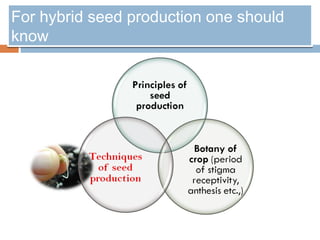
For hybrid seed production one should
know
For hybrid seed production one should
know
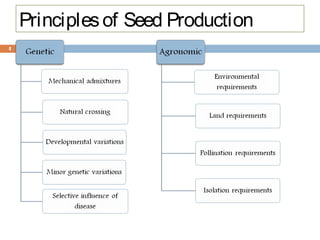
Principlesof Seed Production
4
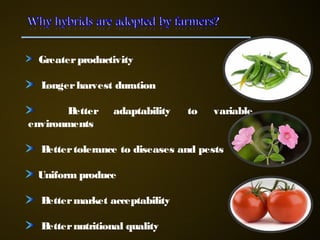
Greaterproductivity
Longerharvest duration
Better adaptability to variable
environments
Bettertolerance to diseases and pests
Uniform produce
Bettermarket acceptability
Betternutritional quality
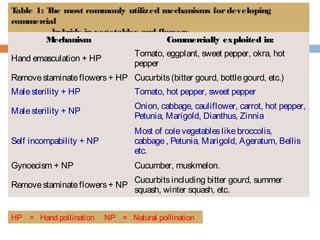
Table 1: The most commonly utilized mechanisms fordeveloping
commercial
hybrids in vegetables and flowers.
Mechanism Commercially exploited in:
Hand emasculation + HP
Tomato, eggplant, sweet pepper, okra, hot
pepper
Removestaminateflowers+ HP Cucurbits(bitter gourd, bottlegourd, etc.)
Malesterility + HP Tomato, hot pepper, sweet pepper
Malesterility + NP
Onion, cabbage, cauliflower, carrot, hot pepper,
Petunia, Marigold, Dianthus, Zinnia
Self incompability + NP
Most of colevegetableslikebroccolis,
cabbage, Petunia, Marigold, Ageratum, Bellis
etc.
Gynoecism + NP Cucumber, muskmelon.
Removestaminateflowers+ NP
Cucurbitsincluding bitter gourd, summer
squash, winter squash, etc.
HP = Hand pollination NP = Natural pollination
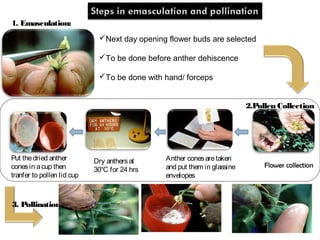
Next day opening flower buds are selected
To be done before anther dehiscence
To be done with hand/ forceps
2.Pollen Collection
1. Emasculation:
Flower collection
Anther conesaretaken
and put them in glassine
envelopes
Dry anthersat
30℃ for 24 hrs
Put thedried anther
conesin acup then
tranfer to pollen lid cup
3. Pollination
Limitations of Emasculation and
Pollination
Limitations of Emasculation and
Pollination
 Time consuming
 Labour intensive (Skill is necessary for commercial
seed production)
 Increased cost of production
 Production of large scale of F1 seeds.
 Reduced cost of hybrid seed production.
 Speedup the hybridization programme.
 Commercial exploitation of hybrid vigour.
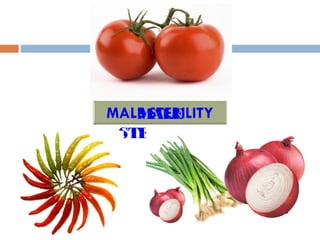
MALE
STERILITY
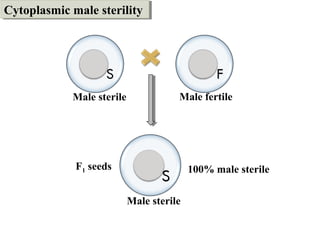
Male sterile
Male sterile
Male fertile
F1 seeds 100% male sterile
Cytoplasmic male sterilityCytoplasmic male sterility
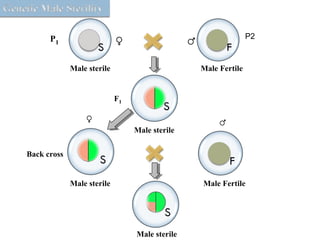
P1
P2
Male sterile Male Fertile
Male sterile
F1
Male sterile Male Fertile
Male sterile
Back cross
♀ ♂
♂♀
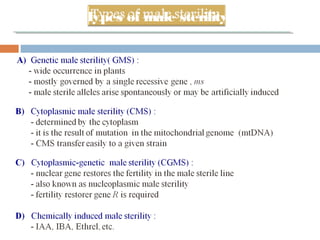
Types of male sterility
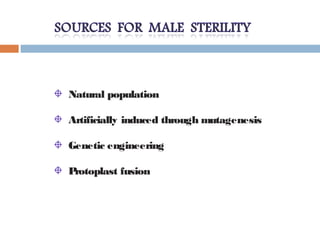
Natural population
Artificially induced through mutagenesis
Genetic engineering
Protoplast fusion
17
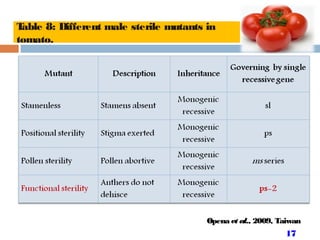
Table 8: Different male sterile mutants in
tomato.
Opena et al., 2009, Taiwan
18
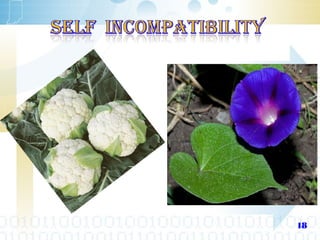
 Inability to set seed from application of pollen produced on
sameplant or it refersto failureof viablepollen of agiven
plant to fertilisetheovulesof thesameplant, but it capableof
fertilising effectively theovulesof themost other plant of the
samevariety.
 Self incompatibility occursin morethan 3000 sp belonging to
250 genera, spread in about 70 families.
Self incompatibility:Self incompatibility:
1.Gametophytic.
SIreaction of a pollen is determined by its own
genotype not by the genotype of the plant on which the
pollen is produced
2.Sporophytic.
SIreaction of pollen is governed by the genotype of
the plant on which the pollen is produced and not by the
genotype of the pollen.
20
 Stableself incompatibility.
 High seed set of self pollination at bud stage.
 Favorableand uniform economic characters.
 Desirablecombination ability.
21
Conclusion
 Hand emasculation and pollination is time consuming method
but can be practiced if skilled labour available.
 Tomato, Chilli, Bhendi, etc.,
 Male sterility and self incompatibility are two best methods of
hybrid seed production.
 GMS: Chilli
 CMS: Onion, Potato, etc.,
 CGMS: Chilli, etc.,
 Colecrops, Petunia, etc.,
Hybrid seed production-
Introduction
 Hybrid varieties have been evolved in those high
valued vegetable crops that exhibit marked heterosis
 Solanaceous vegetables (tomato, eggplant, sweet
pepper)
 Cucurbits (melons, cucumber, pumpkin and gourds)
 Root and bulb crops (onion, radish, carrot)
Techniques of hybrid seed
production
 SOLANACEOUS CROPS
 Tomato
Techniques of hybrid seed
production- Tomato
 Hybridization techniques:
 Indeterminate tomato varieties staked and trained with
either single stem or double stem, while determinate
varieties are trained with 3 stems
 Usually1st to 4th cluster on each branch selected
 The emasculation involves in holding the corolla at the
base and with a single upward pull pick off the corolla
along with all the stamens
 Usually the anthers are picked off a day before anthesis
with the help of forceps leaving the petals intact
Techniques of hybrid seed
production- Tomato
 Fresh pollen collection on the day of anthesis
by a vibrator are shed by vibrating the
flowers
 Pollens are collected in a glass tube or on a
glass plate from the male line and are
transferred to the stigma by finger or by
inserting the stigma into a glass tube
containing the pollen grains. Left over pollen
grains in the glass tube are not used on the
next day because its viability is reduced
considerably
Techniques of hybrid seed
production- Tomato
 Physiological Parameters Affecting Tomato
Seed Yield and Vigor
 Prolonged high temperature affect pollen
fertility and physiology of fertilization leading to
poor seed set
 Age of pollen and stigma, abundant or scarce
pollination, height of inflorescence and
fertilizer application exert an influence on vigor
of plant
Techniques of hybrid seed
production- Tomato
 Seed extraction and Drying
 By fermentation method
 By acid or alkali treatment: 10cc or 36% NaOH
added in 4kg tomato pulp for 15 minutes.
 Seed Yield
 1kg tomato produce 3-4g of seed yield. Av. Seed
yield: 60-70kg/ha
Techniques of hybrid seed
production-Eggplant and Pepper
 Manifestation of Heterosis:
 Heterosis in sweet pepper ranged 35-40%
 Eggplant 50-150%
 In eggplant it is manifested by earliness, fruit
number per plant & fruit weight
 Sweet pepper: plant height, days to flower,
fruit weight, early and total yield
Techniques of hybrid seed
production-Eggplant and Pepper
 Hybridization techniques:
 Stigma is receptive a day prior to anthesis in eggplant
 Bud pollination possible giving good fruit set and seed
yield
 In sweet pepper, emasculation done a day prior to
anthesis, whereas, pollination done in the morning on
the day of anthesis
 Natural cross pollination ranged from 0.2-46.8% in
eggplant flowers
 Pepper flowers are visited by honey bees occasionally.
Fresh pollen grains are collected on the day of anthesis
by a vibrator and can be stored for a period of 1 to 2
months at O°C using silica gel for proper drying of the
Techniques of hybrid seed
production-Eggplant and Pepper
 Use of Male Sterility in Hybrid Seed
Production in Eggplant and Sweet Pepper
 Male sterile lines available in eggplant (genic
male sterility) & sweet pepper (genic and ems)
but not successful at commercial seed
production
 Seed set on male sterile lines ranged from
46-67% in capsicum
 Cytoplasmic male sterility used now in chilli
pepper to produce F1 hybrid commercially by
several seed companies
Techniques of hybrid seed
production-Eggplant and Pepper
 Seed Extraction
 Eggplant harvested 50-55 days after anthesis and
stored for 10 days for post harvest ripening
 Sweet pepper: 60-65 days after anthesis
 Ripe fruits crushed and seeds separated by
washing. Dry air at 28-30ºC
 Seed Yield
 Eggplant: 150-200kg/ha
 Peppers: 100-200kg/ha. 1kg yields 5-7g of seed.
Techniques of hybrid seed
production- Cucurbits
 Steps of Hybrid Seed Production in
Cucurbitaceous Vegetables
 Production of inbred lines by inbreeding for 3 to 5
generations.
 Selection of inbred parents through combining
ability tests and potential hybrid production ability.
  Production of hybrid seeds (preferably single
cross hybrids and pistilate parent preparation is
relatively easy, and single fruit produces quite a
large number of seeds) 
 Maintenance of inbred parents
Techniques of hybrid seed
production- Watermelon
 Technique of Hybrid Seed Production
 Hybrid seeds of watermelon can be produced
by two ways
1. Through artificial pollination.
2. Removal of maleflower and use of insect
pollination.
Techniques of hybrid seed
production- Watermelon
1. Artificial pollination:
 Field lay-out
 Selection of female flowers
 Bagging of female & male flowers
 Collection of male flowers
 Period of pollination
 Seed fruit management
 Harvesting
 Extraction, washing and drying of seeds
 Seed yield 150-300kg/ha based on varieties, extent of
pollination & field condition
Techniques of hybrid seed
production- Watermelon
2. Removal of male flowers & Use of Insect
Pollination
 In this technique, male flowers of female
plant completely removed before opening
 Fruits from female parent harvested as
crossed fruits and other variety as srlf fruit of
male variety
 Used in commercial hybrid seed production
 Also referred as crossing block method
Techniques of hybrid seed
production- Pumpkin
 Production of inbred lines
 Seed sowing of diversified genotypes in Nov-
Jan for winter ecotypes. For summer
ecotypes, seed sowing after the1st monsoon
 Bagging of male and female flowers one day
before anthesis
 Select the vigorous inbreds after 4-5
generations of inbreeding
Techniques of hybrid seed
production- Pumpkin
 Production of Hybrid Seeds
 Planting of female and male inbred parents in 4:1 ratio
 Spray 50-100 ml of ethephon per litre of water on
pistilate parent to increase female flowers
 Bagging of flowers before anthesis. Rebag the female
flowers after pollination for another two days
 Harvest fruits after 60 days of pollination
 Remove seeds from the fruits, wash and dry for 3-4
days and sun dry for another 3-4 days.
 Preserve the seeds in sealed polyethylene bags at
low temperature (4-5°C)
Techniques of hybrid seed
production- Bottle gourd
 Production of Inbred Lines of Diverse
Genetic Background
 Bagging of male & female flowers
 Inbreeding at anthesis through following morning
and rebagging of the female flowers for another 2
to 3 days.
 Inbreeding done for 4-5 generations and select
better types by discarding the poor performers.
Techniques of hybrid seed
production- Bottle gourd
 Production of Hybrid Seeds
 Planting of female and pollinator inbreds in 4:1 ratio.
 Bagging of female and male flowers before anthesis
 Harvesting of mature fruits after senescence of the
plant, remove seeds, wash and dry. Store in sealed
polyethylene bags at low temperature
 
 Maintenance of Inbred Parents
 Inbreeding of parents to produce seeds should
be done when the parental stock is depleted.
Produce large quantity of seeds to maintain
genotypic & phenotypic integrity of the hybrid.
Techniques of hybrid seed
production- Bulbous crops
 Heterosis in Onion:
 Ranged from 14-67%. It is manifested in
uniform bulb size, bulb weight & efficient
source sink ratio
 Male Sterility in Onion:
 Controlled by combination of cytoplasmic
factor ‘5’ together with recessive nucleus gene
in its homozygous form
Techniques of hybrid seed
production- Bulbous crop: Onion
 Hybrid Seed Production Techniques
 For the production of hybrid seed in onion,
male and cytoplasmic female lines planted in
the ratio of 2:8
 Success of hybrid seed production depends
upon the pollen distribution pattern from fertile
to sterile plants in the crossing block
Techniques of hybrid seed
production- Onion
 Factors Affecting Hybrid Seeds in Onion
 Weak inbred lines
 Abnormal florets where ovary started to develop
but failed to produce seed
 Aborted ovule
 Excessive heat damaging the flowers
 Seed Yield
 Hybrid seed yield in onion ranges from 300-350 kg/ha
Techniques of hybrid seed
production- Cole crops
 Manifestaion of heterosis:
 Heterosis in cabbage: 25-61%
 Cauliflower: 20-60%
 Broccoli: 26-58%
 Manifested by head/curd size, early maturity,
head/curd weight and plant weight
Techniques of hybrid seed
production- Cole crops
 Male Sterility and Hybrid Seed Production
 Cytoplasmic male sterile lines and their
maintainers have been developed in cauliflower,
cabbage and broccoli using radish cytoplasm for
male sterility
 Cytosterile plants of broccoli, cabbage and
cauliflower are petaloid with large nectarines
responsible for bee attraction and good female
fertility 
 Seed Yield
 It varies from 500 - 800 kg/ha
Hybrid seed-production-in-vegetables

Hybrid seed-production-in-vegetables

  • 1.
  • 2.
    Seed…………………..?  An embryo,aliving organism embedded in the supporting or thefood storagetissue.  A carrier of new technologies  A basic tool for secured food supply  Theprincipal meansto securecrop yieldsin less favorableproduction areas  A medium for rapid rehabilitation of agriculturein casesof natural disaster 2
  • 3.
    For hybrid seedproduction one should know For hybrid seed production one should know
  • 4.
  • 6.
    Greaterproductivity Longerharvest duration Better adaptabilityto variable environments Bettertolerance to diseases and pests Uniform produce Bettermarket acceptability Betternutritional quality
  • 7.
    Table 1: Themost commonly utilized mechanisms fordeveloping commercial hybrids in vegetables and flowers. Mechanism Commercially exploited in: Hand emasculation + HP Tomato, eggplant, sweet pepper, okra, hot pepper Removestaminateflowers+ HP Cucurbits(bitter gourd, bottlegourd, etc.) Malesterility + HP Tomato, hot pepper, sweet pepper Malesterility + NP Onion, cabbage, cauliflower, carrot, hot pepper, Petunia, Marigold, Dianthus, Zinnia Self incompability + NP Most of colevegetableslikebroccolis, cabbage, Petunia, Marigold, Ageratum, Bellis etc. Gynoecism + NP Cucumber, muskmelon. Removestaminateflowers+ NP Cucurbitsincluding bitter gourd, summer squash, winter squash, etc. HP = Hand pollination NP = Natural pollination
  • 9.
    Next day openingflower buds are selected To be done before anther dehiscence To be done with hand/ forceps 2.Pollen Collection 1. Emasculation: Flower collection Anther conesaretaken and put them in glassine envelopes Dry anthersat 30℃ for 24 hrs Put thedried anther conesin acup then tranfer to pollen lid cup 3. Pollination
  • 10.
    Limitations of Emasculationand Pollination Limitations of Emasculation and Pollination  Time consuming  Labour intensive (Skill is necessary for commercial seed production)  Increased cost of production
  • 11.
     Production oflarge scale of F1 seeds.  Reduced cost of hybrid seed production.  Speedup the hybridization programme.  Commercial exploitation of hybrid vigour.
  • 12.
  • 13.
    Male sterile Male sterile Malefertile F1 seeds 100% male sterile Cytoplasmic male sterilityCytoplasmic male sterility
  • 14.
    P1 P2 Male sterile MaleFertile Male sterile F1 Male sterile Male Fertile Male sterile Back cross ♀ ♂ ♂♀
  • 15.
    Types of malesterility
  • 16.
    Natural population Artificially inducedthrough mutagenesis Genetic engineering Protoplast fusion
  • 17.
    17 Table 8: Differentmale sterile mutants in tomato. Opena et al., 2009, Taiwan
  • 18.
  • 19.
     Inability toset seed from application of pollen produced on sameplant or it refersto failureof viablepollen of agiven plant to fertilisetheovulesof thesameplant, but it capableof fertilising effectively theovulesof themost other plant of the samevariety.  Self incompatibility occursin morethan 3000 sp belonging to 250 genera, spread in about 70 families. Self incompatibility:Self incompatibility:
  • 20.
    1.Gametophytic. SIreaction of apollen is determined by its own genotype not by the genotype of the plant on which the pollen is produced 2.Sporophytic. SIreaction of pollen is governed by the genotype of the plant on which the pollen is produced and not by the genotype of the pollen. 20
  • 21.
     Stableself incompatibility. High seed set of self pollination at bud stage.  Favorableand uniform economic characters.  Desirablecombination ability. 21
  • 22.
    Conclusion  Hand emasculationand pollination is time consuming method but can be practiced if skilled labour available.  Tomato, Chilli, Bhendi, etc.,  Male sterility and self incompatibility are two best methods of hybrid seed production.  GMS: Chilli  CMS: Onion, Potato, etc.,  CGMS: Chilli, etc.,  Colecrops, Petunia, etc.,
  • 23.
    Hybrid seed production- Introduction Hybrid varieties have been evolved in those high valued vegetable crops that exhibit marked heterosis  Solanaceous vegetables (tomato, eggplant, sweet pepper)  Cucurbits (melons, cucumber, pumpkin and gourds)  Root and bulb crops (onion, radish, carrot)
  • 24.
    Techniques of hybridseed production  SOLANACEOUS CROPS  Tomato
  • 25.
    Techniques of hybridseed production- Tomato  Hybridization techniques:  Indeterminate tomato varieties staked and trained with either single stem or double stem, while determinate varieties are trained with 3 stems  Usually1st to 4th cluster on each branch selected  The emasculation involves in holding the corolla at the base and with a single upward pull pick off the corolla along with all the stamens  Usually the anthers are picked off a day before anthesis with the help of forceps leaving the petals intact
  • 26.
    Techniques of hybridseed production- Tomato  Fresh pollen collection on the day of anthesis by a vibrator are shed by vibrating the flowers  Pollens are collected in a glass tube or on a glass plate from the male line and are transferred to the stigma by finger or by inserting the stigma into a glass tube containing the pollen grains. Left over pollen grains in the glass tube are not used on the next day because its viability is reduced considerably
  • 27.
    Techniques of hybridseed production- Tomato  Physiological Parameters Affecting Tomato Seed Yield and Vigor  Prolonged high temperature affect pollen fertility and physiology of fertilization leading to poor seed set  Age of pollen and stigma, abundant or scarce pollination, height of inflorescence and fertilizer application exert an influence on vigor of plant
  • 28.
    Techniques of hybridseed production- Tomato  Seed extraction and Drying  By fermentation method  By acid or alkali treatment: 10cc or 36% NaOH added in 4kg tomato pulp for 15 minutes.  Seed Yield  1kg tomato produce 3-4g of seed yield. Av. Seed yield: 60-70kg/ha
  • 29.
    Techniques of hybridseed production-Eggplant and Pepper  Manifestation of Heterosis:  Heterosis in sweet pepper ranged 35-40%  Eggplant 50-150%  In eggplant it is manifested by earliness, fruit number per plant & fruit weight  Sweet pepper: plant height, days to flower, fruit weight, early and total yield
  • 30.
    Techniques of hybridseed production-Eggplant and Pepper  Hybridization techniques:  Stigma is receptive a day prior to anthesis in eggplant  Bud pollination possible giving good fruit set and seed yield  In sweet pepper, emasculation done a day prior to anthesis, whereas, pollination done in the morning on the day of anthesis  Natural cross pollination ranged from 0.2-46.8% in eggplant flowers  Pepper flowers are visited by honey bees occasionally. Fresh pollen grains are collected on the day of anthesis by a vibrator and can be stored for a period of 1 to 2 months at O°C using silica gel for proper drying of the
  • 31.
    Techniques of hybridseed production-Eggplant and Pepper  Use of Male Sterility in Hybrid Seed Production in Eggplant and Sweet Pepper  Male sterile lines available in eggplant (genic male sterility) & sweet pepper (genic and ems) but not successful at commercial seed production  Seed set on male sterile lines ranged from 46-67% in capsicum  Cytoplasmic male sterility used now in chilli pepper to produce F1 hybrid commercially by several seed companies
  • 32.
    Techniques of hybridseed production-Eggplant and Pepper  Seed Extraction  Eggplant harvested 50-55 days after anthesis and stored for 10 days for post harvest ripening  Sweet pepper: 60-65 days after anthesis  Ripe fruits crushed and seeds separated by washing. Dry air at 28-30ºC  Seed Yield  Eggplant: 150-200kg/ha  Peppers: 100-200kg/ha. 1kg yields 5-7g of seed.
  • 33.
    Techniques of hybridseed production- Cucurbits  Steps of Hybrid Seed Production in Cucurbitaceous Vegetables  Production of inbred lines by inbreeding for 3 to 5 generations.  Selection of inbred parents through combining ability tests and potential hybrid production ability.   Production of hybrid seeds (preferably single cross hybrids and pistilate parent preparation is relatively easy, and single fruit produces quite a large number of seeds)   Maintenance of inbred parents
  • 34.
    Techniques of hybridseed production- Watermelon  Technique of Hybrid Seed Production  Hybrid seeds of watermelon can be produced by two ways 1. Through artificial pollination. 2. Removal of maleflower and use of insect pollination.
  • 35.
    Techniques of hybridseed production- Watermelon 1. Artificial pollination:  Field lay-out  Selection of female flowers  Bagging of female & male flowers  Collection of male flowers  Period of pollination  Seed fruit management  Harvesting  Extraction, washing and drying of seeds  Seed yield 150-300kg/ha based on varieties, extent of pollination & field condition
  • 36.
    Techniques of hybridseed production- Watermelon 2. Removal of male flowers & Use of Insect Pollination  In this technique, male flowers of female plant completely removed before opening  Fruits from female parent harvested as crossed fruits and other variety as srlf fruit of male variety  Used in commercial hybrid seed production  Also referred as crossing block method
  • 37.
    Techniques of hybridseed production- Pumpkin  Production of inbred lines  Seed sowing of diversified genotypes in Nov- Jan for winter ecotypes. For summer ecotypes, seed sowing after the1st monsoon  Bagging of male and female flowers one day before anthesis  Select the vigorous inbreds after 4-5 generations of inbreeding
  • 38.
    Techniques of hybridseed production- Pumpkin  Production of Hybrid Seeds  Planting of female and male inbred parents in 4:1 ratio  Spray 50-100 ml of ethephon per litre of water on pistilate parent to increase female flowers  Bagging of flowers before anthesis. Rebag the female flowers after pollination for another two days  Harvest fruits after 60 days of pollination  Remove seeds from the fruits, wash and dry for 3-4 days and sun dry for another 3-4 days.  Preserve the seeds in sealed polyethylene bags at low temperature (4-5°C)
  • 39.
    Techniques of hybridseed production- Bottle gourd  Production of Inbred Lines of Diverse Genetic Background  Bagging of male & female flowers  Inbreeding at anthesis through following morning and rebagging of the female flowers for another 2 to 3 days.  Inbreeding done for 4-5 generations and select better types by discarding the poor performers.
  • 40.
    Techniques of hybridseed production- Bottle gourd  Production of Hybrid Seeds  Planting of female and pollinator inbreds in 4:1 ratio.  Bagging of female and male flowers before anthesis  Harvesting of mature fruits after senescence of the plant, remove seeds, wash and dry. Store in sealed polyethylene bags at low temperature    Maintenance of Inbred Parents  Inbreeding of parents to produce seeds should be done when the parental stock is depleted. Produce large quantity of seeds to maintain genotypic & phenotypic integrity of the hybrid.
  • 41.
    Techniques of hybridseed production- Bulbous crops  Heterosis in Onion:  Ranged from 14-67%. It is manifested in uniform bulb size, bulb weight & efficient source sink ratio  Male Sterility in Onion:  Controlled by combination of cytoplasmic factor ‘5’ together with recessive nucleus gene in its homozygous form
  • 42.
    Techniques of hybridseed production- Bulbous crop: Onion  Hybrid Seed Production Techniques  For the production of hybrid seed in onion, male and cytoplasmic female lines planted in the ratio of 2:8  Success of hybrid seed production depends upon the pollen distribution pattern from fertile to sterile plants in the crossing block
  • 43.
    Techniques of hybridseed production- Onion  Factors Affecting Hybrid Seeds in Onion  Weak inbred lines  Abnormal florets where ovary started to develop but failed to produce seed  Aborted ovule  Excessive heat damaging the flowers  Seed Yield  Hybrid seed yield in onion ranges from 300-350 kg/ha
  • 44.
    Techniques of hybridseed production- Cole crops  Manifestaion of heterosis:  Heterosis in cabbage: 25-61%  Cauliflower: 20-60%  Broccoli: 26-58%  Manifested by head/curd size, early maturity, head/curd weight and plant weight
  • 45.
    Techniques of hybridseed production- Cole crops  Male Sterility and Hybrid Seed Production  Cytoplasmic male sterile lines and their maintainers have been developed in cauliflower, cabbage and broccoli using radish cytoplasm for male sterility  Cytosterile plants of broccoli, cabbage and cauliflower are petaloid with large nectarines responsible for bee attraction and good female fertility   Seed Yield  It varies from 500 - 800 kg/ha