MALE STERILITY
IN PLANTS
BY: AKSHIT KUKRETI
Ph.D. Scholar
Forest Research Institute, Dehradun,
Uttarakhand, India
Introduction
 Male sterility is the inability of plants
to produce or to release functional
pollens (microspores) or gametes to
produce offspring.
OR
 Absence or malformation of male
organs (stamens) in bisexual plants or
no male flowers in dioecious plants
 Anther abortion in intragenic and
between hybrids first observed by
Koelreuter in 1763.
Phenotypical Classification of Male
Sterility
 Sporogenous Male Sterility: Due to breakdown of
Microsporogenesis, before, during, or after meiosis generally
caused by an abnormal and malfunctioning tapetum layer.
(Tapetum is innermost wall of microsporangium–provides
enzymes, hormones, food for developing PMCs and
microspores)
 Structural Male Sterility: Anomalies in male sex organs, Male
flowers or stamens are malformed and non-functional or
completely absent.
 Functional Male Sterility: Viable pollens are formed but
trapped in indehiscent anther lobe (e.g.: extended style, pollen is
glued together so can’t be released:soybean, peas).
Types of male sterility based on its
inheritance
 Genetic/Nuclear male sterility
 Cytoplasmic male sterility
 Cytoplasmic genetic male sterility
 Chemically induced male sterility
Genetic/Nuclear male sterility:
Governed by nuclear gene without
any influence of cytoplasm.
• GMS is mainly originates
through Spontaneous
mutation. Mutation results in
nuclear MS.
• Spontaneous nuclear male
sterility is usually controlled
by a single recessive gene
(ms gene).
Fig.1: Inheritance of Genetic Male
Sterility
Genetic/Nuclear male sterility
Types of Genetic Male Sterility
1. Temperature Sensitive GMS: In Rice complete MS is produced by ms gene at
higher temperature (˃ 30° C) but below at that temperature it exhibits normal
fertility (˂28° C).
2. Photoperiod Sensitive GMS: Complete sterility is obtained when Rice plant
grown under long day condition (day length more than 13 hr. 45 min.) but under
short day condition almost normal fertility is obtained.
3. Transgenic GMS: A new gene introduce into the genome of an organism by
recombinant DNA technology and genetic engineering.
Barnase/barstar system for engineered male sterility
Bacillus amyloliquifaciens contains two types of gene Barnase and Barstar. Barnase
is extracellular RNase; barstar (code for protein) is inhibitor of barnase.
Barnase is for protection from microbial predators and barstar to protect itself from
barnase.
Cytoplasmic Male sterility
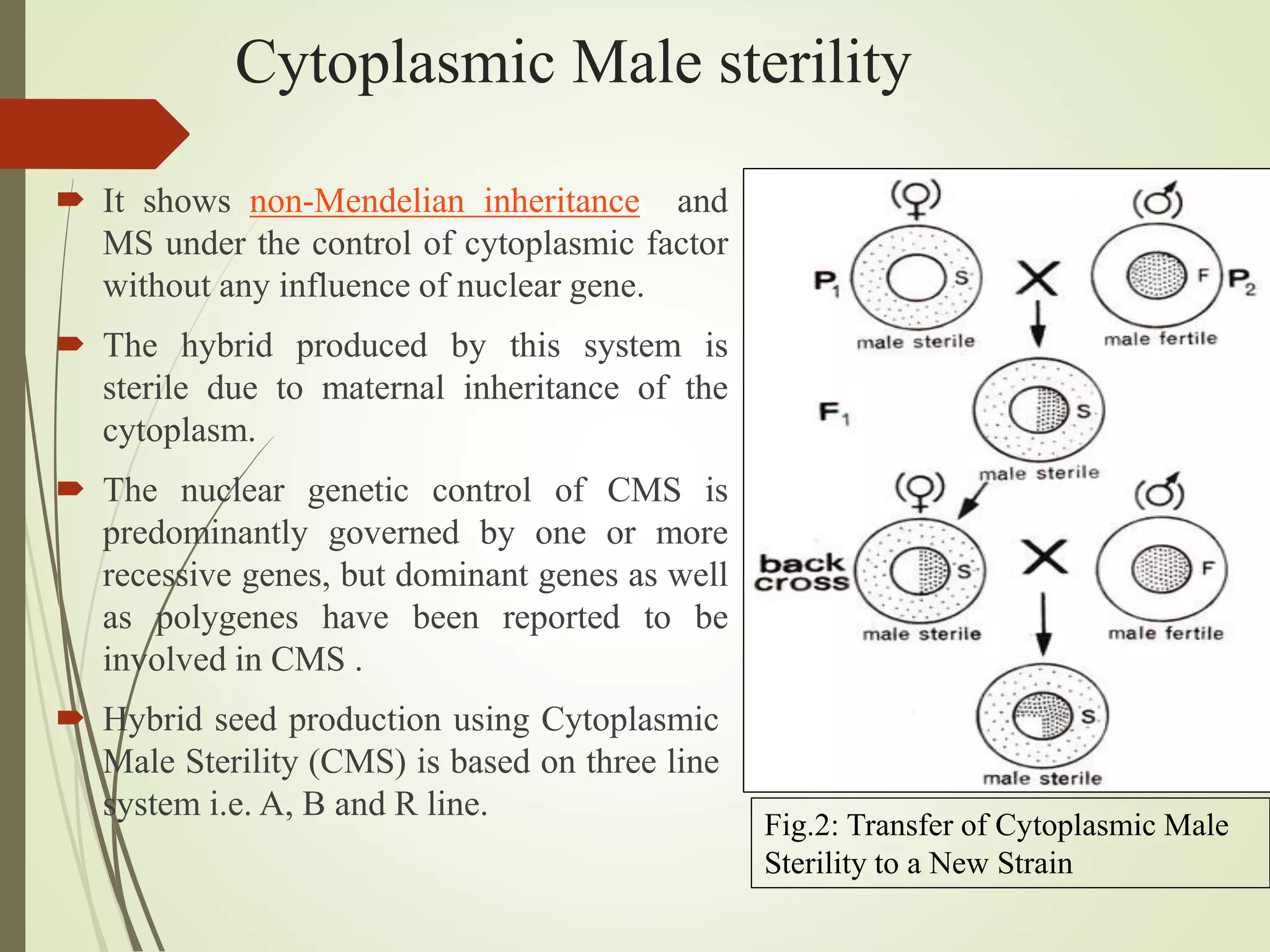
 It shows non-Mendelian inheritance and
MS under the control of cytoplasmic factor
without any influence of nuclear gene.
 The hybrid produced by this system is
sterile due to maternal inheritance of the
cytoplasm.
 The nuclear genetic control of CMS is
predominantly governed by one or more
recessive genes, but dominant genes as well
as polygenes have been reported to be
involved in CMS .
 Hybrid seed production using Cytoplasmic
Male Sterility (CMS) is based on three line
system i.e. A, B and R line.
Fig.2: Transfer of Cytoplasmic Male
Sterility to a New Strain
A-line: CMS line is called as A line.
This is sterile due to the genes in
cytoplasm (mitochondrial DNA).
B-line: This is isogenic (genotypically
identical except one gene) to CMS line
except fertility. It maintains A line. It
means if you want seed of A line, you
have to cross it with B line otherwise A
line will be no more as it has no active
male parts.
R line: This line has restorer genes in
nucleus to restore fertility of A line. R
line is entirely different to that A and B
line. R line has very high SCA (Specific
Combining Ability) effects. It is used to
produce hybrid seeds
Fig. 3: Transfer of CMS from one line into another one (B) through repeated backcrossing. After 6-8
back crosses the CMS line will contain the same nuclear genes as the male fertile line B. The male
fertile line B is used to maintain this new CMS line , therefore it is called the maintainer line. (MS-
Male sterile, MF- Male fertile)
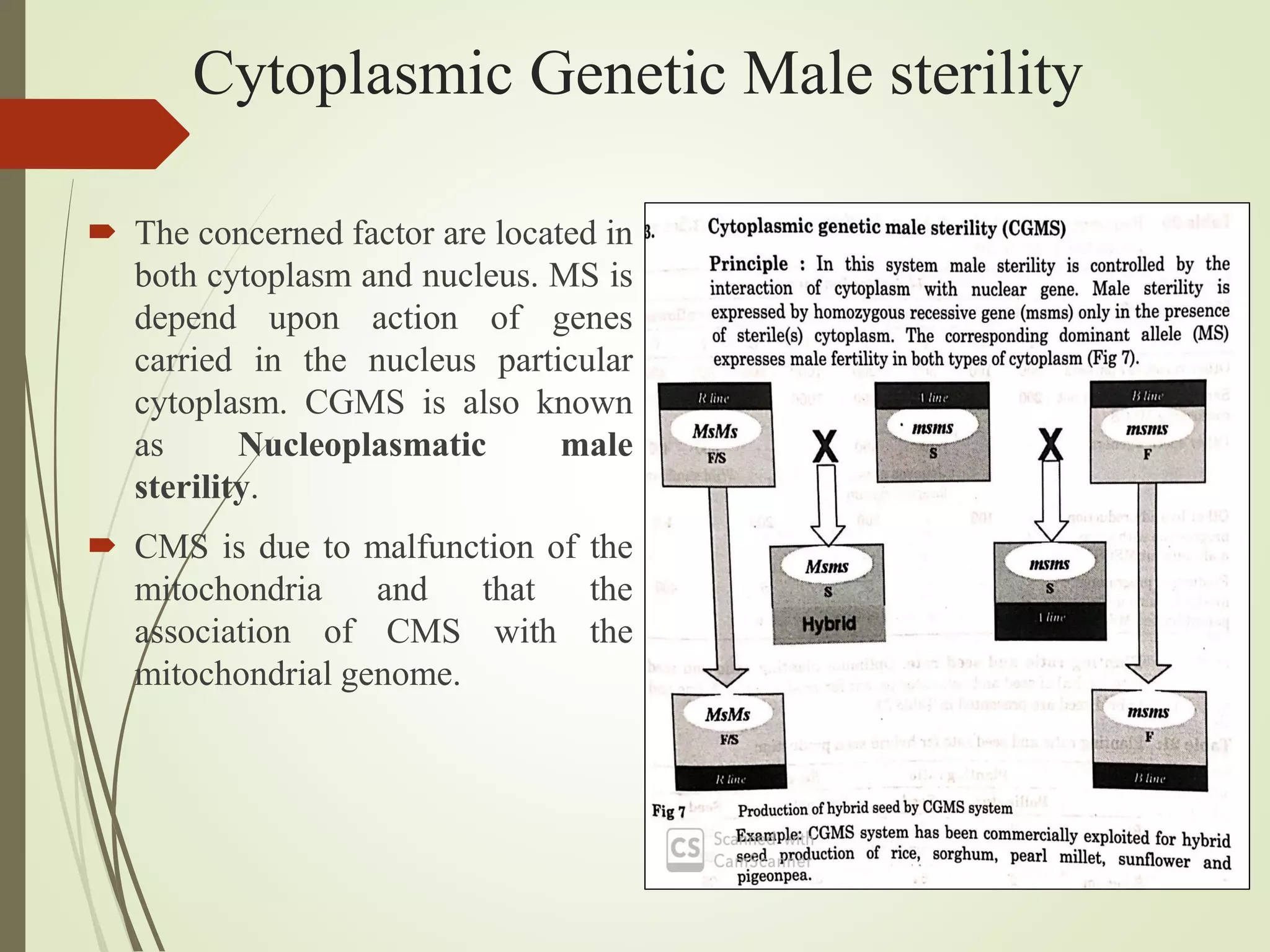
Cytoplasmic Genetic Male sterility
 The concerned factor are located in
both cytoplasm and nucleus. MS is
depend upon action of genes
carried in the nucleus particular
cytoplasm. CGMS is also known
as Nucleoplasmatic male
sterility.
 CMS is due to malfunction of the
mitochondria and that the
association of CMS with the
mitochondrial genome.
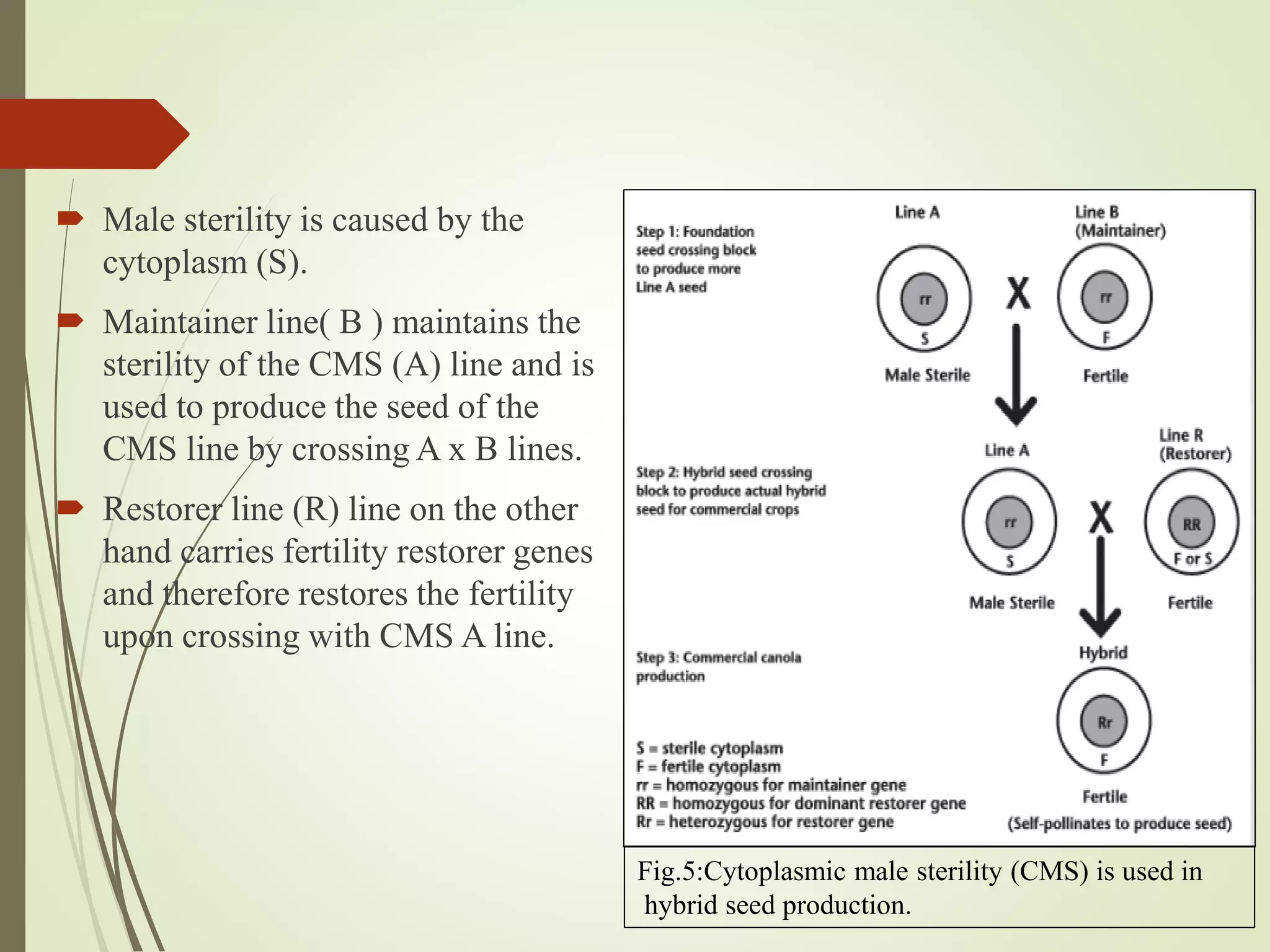
 Male sterility is caused by the
cytoplasm (S).
 Maintainer line( B ) maintains the
sterility of the CMS (A) line and is
used to produce the seed of the
CMS line by crossing A x B lines.
 Restorer line (R) line on the other
hand carries fertility restorer genes
and therefore restores the fertility
upon crossing with CMS A line.
Fig.5:Cytoplasmic male sterility (CMS) is used in
hybrid seed production.
Chemically Induced Male Sterility
 Several chemicals disrupt the function of male reproductive
organs in plants. These compound has been called as
gametocides, male steriliants, pollenocides, etc. McRae
(1985) suggested the use of a single term chemical
hybridising agent (CHA) to avoid confusion of terms.
 CHA (Gametocides) which or when sprayed on plants at a
certain stage before flowering render the plant male
sterility. First time it was reported by Moore (1950) and by
Naylor (1950), induced MS in Maize using Maleic
hydrazide. e.g. FW450, Ethrel, RH 531, DPX3778, Zinc
methyl arsenate, RH0007
Hybrid Seed production based on CHAs
 Effective chemical emasculation and cross pollination
 Proper environmental condition ( 26-28° C + 80 % RH)
 Synchronization of flowering of male and female parents
Advantages of CHAs
 Any line can be used as the female parent
 The hybrid seed production is based on only two lines
 CHA based F2 hybrids are fully fertile.
Limitations of CHAs
 Lack of effective male sterilization, partial female sterility and
phytotoxicity of CHAs
 Less likely to be effective in crops with a long flowering
period coupled with substantial vegetative growth such as
sugar beet and forages.
USE OF MALE STERILITY IN
PLANT BREEDING
 Male sterility plays an important role in plant
breeding, firstly in the production of hybrid seed.
 As a plant breeding tool facilitating population
improvement.
 Interspecific hybridization and other intermediate
breeding procedures
Questions
 Breeding method for transferring monogenic disease resistance from wild species
to improved variety- Back cross
 In Back cross breeding repeated crossing with recurrent parent is done to-
Completely recover the genotype of recurrent parent
 The factors responsible for cytoplasmic male sterility in plants are located in the:
Mitochondrial DNA
 Cell organelles causes male sterility in mustard- Mitochondria only
 Inbred lines that have same genetic constitution but differ for only locus are called-
B line
 Presence of B line (male fertile) in a male sterile line (A) termed as- Pollen
Shadders
 Male sterility system where fertility restorer gene is not known is called-
Cytoplasmic Male Sterility
References:
 Kantwa, S.R. (2005). Objective Agriculture, New Vishal
Publications, New Delhi.
 Kaul, M.L.H. (1988). Male Sterility in Higher Plants, Monogr.
Theor. Appl. Genet., No. 10, SpringerVerlag, Berlin,
Heidelberg, New York.
 Lasa, J.M. and Bosemarkh, N.O. (1993). Male Sterility. Plant
Breeding: Principles and prospects. 213-228
 Ramage, R.T. (1965). Balanced tertiary trisomics for use in
hybrid seed production. Crop Sci., 5, 177-178
 Singh, B.D. (1998): Biotechnology, Kalyani Publishers, New
Delhi.
Thank You

Male sterility in plants

  • 1.
    MALE STERILITY IN PLANTS BY:AKSHIT KUKRETI Ph.D. Scholar Forest Research Institute, Dehradun, Uttarakhand, India
  • 2.
    Introduction  Male sterilityis the inability of plants to produce or to release functional pollens (microspores) or gametes to produce offspring. OR  Absence or malformation of male organs (stamens) in bisexual plants or no male flowers in dioecious plants  Anther abortion in intragenic and between hybrids first observed by Koelreuter in 1763.
  • 3.
    Phenotypical Classification ofMale Sterility  Sporogenous Male Sterility: Due to breakdown of Microsporogenesis, before, during, or after meiosis generally caused by an abnormal and malfunctioning tapetum layer. (Tapetum is innermost wall of microsporangium–provides enzymes, hormones, food for developing PMCs and microspores)  Structural Male Sterility: Anomalies in male sex organs, Male flowers or stamens are malformed and non-functional or completely absent.  Functional Male Sterility: Viable pollens are formed but trapped in indehiscent anther lobe (e.g.: extended style, pollen is glued together so can’t be released:soybean, peas).
  • 4.
    Types of malesterility based on its inheritance  Genetic/Nuclear male sterility  Cytoplasmic male sterility  Cytoplasmic genetic male sterility  Chemically induced male sterility
  • 5.
    Genetic/Nuclear male sterility: Governedby nuclear gene without any influence of cytoplasm. • GMS is mainly originates through Spontaneous mutation. Mutation results in nuclear MS. • Spontaneous nuclear male sterility is usually controlled by a single recessive gene (ms gene). Fig.1: Inheritance of Genetic Male Sterility Genetic/Nuclear male sterility
  • 6.
    Types of GeneticMale Sterility 1. Temperature Sensitive GMS: In Rice complete MS is produced by ms gene at higher temperature (˃ 30° C) but below at that temperature it exhibits normal fertility (˂28° C). 2. Photoperiod Sensitive GMS: Complete sterility is obtained when Rice plant grown under long day condition (day length more than 13 hr. 45 min.) but under short day condition almost normal fertility is obtained. 3. Transgenic GMS: A new gene introduce into the genome of an organism by recombinant DNA technology and genetic engineering. Barnase/barstar system for engineered male sterility Bacillus amyloliquifaciens contains two types of gene Barnase and Barstar. Barnase is extracellular RNase; barstar (code for protein) is inhibitor of barnase. Barnase is for protection from microbial predators and barstar to protect itself from barnase.
  • 7.
    Cytoplasmic Male sterility It shows non-Mendelian inheritance and MS under the control of cytoplasmic factor without any influence of nuclear gene.  The hybrid produced by this system is sterile due to maternal inheritance of the cytoplasm.  The nuclear genetic control of CMS is predominantly governed by one or more recessive genes, but dominant genes as well as polygenes have been reported to be involved in CMS .  Hybrid seed production using Cytoplasmic Male Sterility (CMS) is based on three line system i.e. A, B and R line. Fig.2: Transfer of Cytoplasmic Male Sterility to a New Strain
  • 8.
    A-line: CMS lineis called as A line. This is sterile due to the genes in cytoplasm (mitochondrial DNA). B-line: This is isogenic (genotypically identical except one gene) to CMS line except fertility. It maintains A line. It means if you want seed of A line, you have to cross it with B line otherwise A line will be no more as it has no active male parts. R line: This line has restorer genes in nucleus to restore fertility of A line. R line is entirely different to that A and B line. R line has very high SCA (Specific Combining Ability) effects. It is used to produce hybrid seeds Fig. 3: Transfer of CMS from one line into another one (B) through repeated backcrossing. After 6-8 back crosses the CMS line will contain the same nuclear genes as the male fertile line B. The male fertile line B is used to maintain this new CMS line , therefore it is called the maintainer line. (MS- Male sterile, MF- Male fertile)
  • 9.
    Cytoplasmic Genetic Malesterility  The concerned factor are located in both cytoplasm and nucleus. MS is depend upon action of genes carried in the nucleus particular cytoplasm. CGMS is also known as Nucleoplasmatic male sterility.  CMS is due to malfunction of the mitochondria and that the association of CMS with the mitochondrial genome.
  • 10.
     Male sterilityis caused by the cytoplasm (S).  Maintainer line( B ) maintains the sterility of the CMS (A) line and is used to produce the seed of the CMS line by crossing A x B lines.  Restorer line (R) line on the other hand carries fertility restorer genes and therefore restores the fertility upon crossing with CMS A line. Fig.5:Cytoplasmic male sterility (CMS) is used in hybrid seed production.
  • 11.
    Chemically Induced MaleSterility  Several chemicals disrupt the function of male reproductive organs in plants. These compound has been called as gametocides, male steriliants, pollenocides, etc. McRae (1985) suggested the use of a single term chemical hybridising agent (CHA) to avoid confusion of terms.  CHA (Gametocides) which or when sprayed on plants at a certain stage before flowering render the plant male sterility. First time it was reported by Moore (1950) and by Naylor (1950), induced MS in Maize using Maleic hydrazide. e.g. FW450, Ethrel, RH 531, DPX3778, Zinc methyl arsenate, RH0007
  • 12.
    Hybrid Seed productionbased on CHAs  Effective chemical emasculation and cross pollination  Proper environmental condition ( 26-28° C + 80 % RH)  Synchronization of flowering of male and female parents Advantages of CHAs  Any line can be used as the female parent  The hybrid seed production is based on only two lines  CHA based F2 hybrids are fully fertile. Limitations of CHAs  Lack of effective male sterilization, partial female sterility and phytotoxicity of CHAs  Less likely to be effective in crops with a long flowering period coupled with substantial vegetative growth such as sugar beet and forages.
  • 13.
    USE OF MALESTERILITY IN PLANT BREEDING  Male sterility plays an important role in plant breeding, firstly in the production of hybrid seed.  As a plant breeding tool facilitating population improvement.  Interspecific hybridization and other intermediate breeding procedures
  • 14.
    Questions  Breeding methodfor transferring monogenic disease resistance from wild species to improved variety- Back cross  In Back cross breeding repeated crossing with recurrent parent is done to- Completely recover the genotype of recurrent parent  The factors responsible for cytoplasmic male sterility in plants are located in the: Mitochondrial DNA  Cell organelles causes male sterility in mustard- Mitochondria only  Inbred lines that have same genetic constitution but differ for only locus are called- B line  Presence of B line (male fertile) in a male sterile line (A) termed as- Pollen Shadders  Male sterility system where fertility restorer gene is not known is called- Cytoplasmic Male Sterility
  • 15.
    References:  Kantwa, S.R.(2005). Objective Agriculture, New Vishal Publications, New Delhi.  Kaul, M.L.H. (1988). Male Sterility in Higher Plants, Monogr. Theor. Appl. Genet., No. 10, SpringerVerlag, Berlin, Heidelberg, New York.  Lasa, J.M. and Bosemarkh, N.O. (1993). Male Sterility. Plant Breeding: Principles and prospects. 213-228  Ramage, R.T. (1965). Balanced tertiary trisomics for use in hybrid seed production. Crop Sci., 5, 177-178  Singh, B.D. (1998): Biotechnology, Kalyani Publishers, New Delhi.
  • 16.