IJRET: International Journal of Research in Engineering and Technology eISSN: 2319-1163 | pISSN: 2321-7308
_______________________________________________________________________________________
Volume: 03 Issue: 05 | May-2014, Available @ http://www.ijret.org 50
MAGLEV WINDMILL
Minu John1
, Rohit John2
, Syamily P.S3
, Vyshak P.A4
1
Student, Dept. of EEE, Mar Athanasius College of Engineering, Kothamangalam, India
2
Student, Dept. of EEE, Mar Athanasius College of Engineering, Kothamangalam, India
3
Student, Dept. of EEE, Mar Athanasius College of Engineering, Kothamangalam, India
4
Student, Dept. of EEE, Mar Athanasius College of Engineering, Kothamangalam, India
Abstract
Magnetic levitation, maglev, or magnetic suspension is a method by which an object is suspended with no support other than magnetic
fields. Magnetic pressure is used to counteract the effects of the gravitational and any other accelerations. The principal advantage of
a maglev windmill from a conventional one is, as the rotor is floating in the air due to levitation, mechanical friction is totally elimi-
nated. That makes the rotation possible in very low wind speeds. Maglev wind turbines have several advantages over conventional
wind turbines. For instance, they’re able to use winds with starting speeds as low as 1.5 meters per second (m/s). Also, they could
operate in winds exceeding 40 m/s.
Keywords: Wind Energy, Magnetic Levitation, Power Generation, Magnets
-----------------------------------------------------------------------***-----------------------------------------------------------------------
1. INTRODUCTION
Wind is a form of solar energy. It is a natural power source that
can be economically used to generate electricity. The way in
which wind is created is from the atmosphere of the sun causing
areas of uneven heating. In conjunction with the uneven heating
of the sun, rotation of the earth and the rockiness of the earth’s
surface winds are formed. The terms wind energy or wind power
describes the process by which the wind is used to generate me-
chanical power or electricity. Wind turbines convert the kinetic
energy in the wind into mechanical power. This mechanical
power can be used for specific tasks (such as grinding grain or
pumping water) or a generator can convert this mechanical pow-
er into electricity. The wind turbine is used for conversion of
kinetic energy of wind into electrical energy. The wind turns the
blades, which spin a shaft, which connects to a generator and
makes electricity.
The Maglev wind turbine design is a vast departure from con-
ventional propeller designs. Its main advantages are that it uses
frictionless bearings and a magnetic levitation design and it does
not need to vast spaces required by more conventional wind tur-
bines. It also requires little if any maintenance. The Maglev wind
turbine was first unveiled at the Wind Power Asia exhibition in
Beijing 2007. The unique operating principle behind this design
is through magnetic levitation. Magnetic levitation is supposedly
an extremely efficient system for wind energy. The vertically
oriented blades of the wind turbine are suspended in the air re-
placing any need for ball bearings.
1.1 Need for Wind Power Technology
Renewable energy is generally electricity supplied from
sources, such as wind power, solar power, geothermal
energy, hydropower and various forms of biomass. These
sources have been coined renewable due to their conti-
nuous replenishment and availability for use over and
over again. The popularity of renewable energy has expe-
rienced a significant upsurge in recent times due to the
exhaustion of conventional power generation methods
and increasing realization of its adverse effects on the
environment. It is estimated that renewable sources might
contribute about 20%-50% to energy consumption in the
later part of the 21st century. Facts from the World Wind
Energy Association estimates that by 2010, 160GW of
wind power capacity is expected to be installed world-
wide which implies an anticipated net growth rate of
more than 21% per year. Maglev wind turbines have sev-
eral advantages over conventional wind turbines. For
instance, they’re able to use winds with starting speeds as
low as 1.5 meters per second (m/s). Also, they could op-
erate in winds exceeding 40 m/s. It would also increase
generation capacity by 20% over conventional wind tur-
bines and decrease operational costs by 50%. This makes
the efficiency of the system higher than conventional
wind turbine. Currently, the largest conventional wind
turbines in the world produce only five megawatts of
power. However, one large maglev wind turbine could
generate one GW of clean power, enough to supply ener-
gy to 75,000 homes [1]
. The turbine uses permanent type
of rare earth magnets (neodymium) instead of electro-
magnets and therefore it doesn’t require electricity to run.
The friction between the turbine blades and the base can
maximum power output.
IJRET: International Journal of Research in Engineering and Technology eISSN: 2319-1163 | pISSN: 2321-7308
_______________________________________________________________________________________
Volume: 03 Issue: 05 | May-2014, Available @ http://www.ijret.org 51
2. WIND POWER & WIND TURBINES
2.1 Wind Power Technology
Wind power technology is the various infrastructure and process
that promote the harnessing of wind generation for mechanical
power and electricity. This basically entails the wind and charac-
teristics related to its strength and direction, as well as the func-
tioning of both internal and external components of a wind tur-
bine with respect to wind behavior. Wind power, as an alterna-
tive to fossil fuels, is plentiful, renewable, widely distributed,
clean, produces no greenhouse gas emissions during operation
and uses little land. Any effects on the environment are generally
less problematic than those from other power sources. 83 coun-
tries around the world are using wind power on a commercial
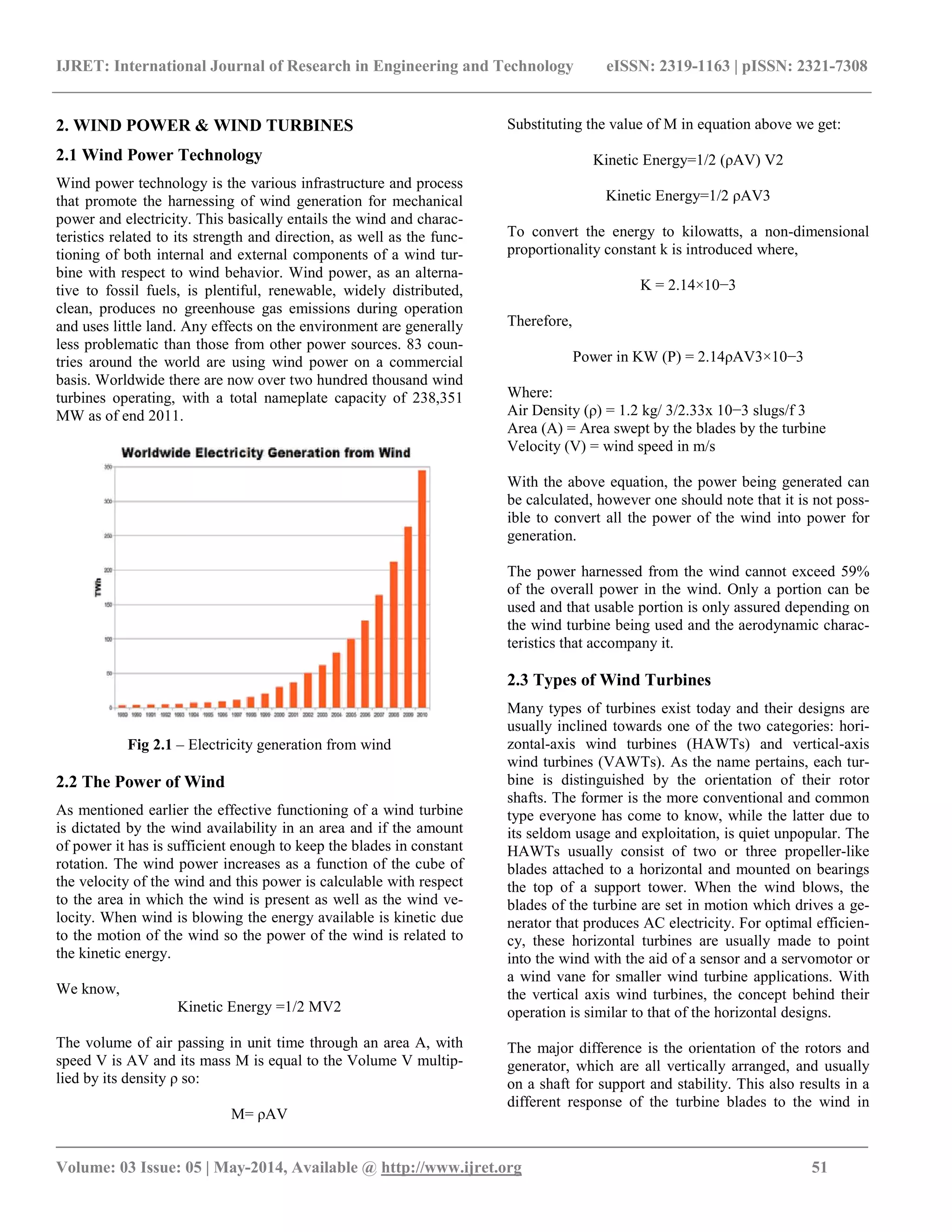
basis. Worldwide there are now over two hundred thousand wind
turbines operating, with a total nameplate capacity of 238,351
MW as of end 2011.
Fig 2.1 – Electricity generation from wind
2.2 The Power of Wind
As mentioned earlier the effective functioning of a wind turbine
is dictated by the wind availability in an area and if the amount
of power it has is sufficient enough to keep the blades in constant
rotation. The wind power increases as a function of the cube of
the velocity of the wind and this power is calculable with respect
to the area in which the wind is present as well as the wind ve-
locity. When wind is blowing the energy available is kinetic due
to the motion of the wind so the power of the wind is related to
the kinetic energy.
We know,
Kinetic Energy =1/2 MV2
The volume of air passing in unit time through an area A, with
speed V is AV and its mass M is equal to the Volume V multip-
lied by its density ρ so:
M= ρAV
Substituting the value of M in equation above we get:
Kinetic Energy=1/2 (ρAV) V2
Kinetic Energy=1/2 ρAV3
To convert the energy to kilowatts, a non-dimensional
proportionality constant k is introduced where,
K = 2.14×10⁻³
Therefore,
Power in KW (P) = 2.14ρAV3×10−3
Where:
Air Density (ρ) = 1.2 kg/ 3/2.33x 10−3 slugs/f 3
Area (A) = Area swept by the blades by the turbine
Velocity (V) = wind speed in m/s
With the above equation, the power being generated can
be calculated, however one should note that it is not poss-
ible to convert all the power of the wind into power for
generation.
The power harnessed from the wind cannot exceed 59%
of the overall power in the wind. Only a portion can be
used and that usable portion is only assured depending on
the wind turbine being used and the aerodynamic charac-
teristics that accompany it.
2.3 Types of Wind Turbines
Many types of turbines exist today and their designs are
usually inclined towards one of the two categories: hori-
zontal-axis wind turbines (HAWTs) and vertical-axis
wind turbines (VAWTs). As the name pertains, each tur-
bine is distinguished by the orientation of their rotor
shafts. The former is the more conventional and common
type everyone has come to know, while the latter due to
its seldom usage and exploitation, is quiet unpopular. The
HAWTs usually consist of two or three propeller-like
blades attached to a horizontal and mounted on bearings
the top of a support tower. When the wind blows, the
blades of the turbine are set in motion which drives a ge-
nerator that produces AC electricity. For optimal efficien-
cy, these horizontal turbines are usually made to point
into the wind with the aid of a sensor and a servomotor or
a wind vane for smaller wind turbine applications. With
the vertical axis wind turbines, the concept behind their
operation is similar to that of the horizontal designs.
The major difference is the orientation of the rotors and
generator, which are all vertically arranged, and usually
on a shaft for support and stability. This also results in a
different response of the turbine blades to the wind in
IJRET: International Journal of Research in Engineering and Technology eISSN: 2319-1163 | pISSN: 2321-7308
_______________________________________________________________________________________
Volume: 03 Issue: 05 | May-2014, Available @ http://www.ijret.org 52
relation to that of the horizontal configurations. Their design
makes it possible for them to utilize the wind power from every
direction unlike the HAWTs that depend on lift forces from the
wind similar to the lift off concept of an airplane. Vertical axis
wind turbines are further subdivided into two major types name-
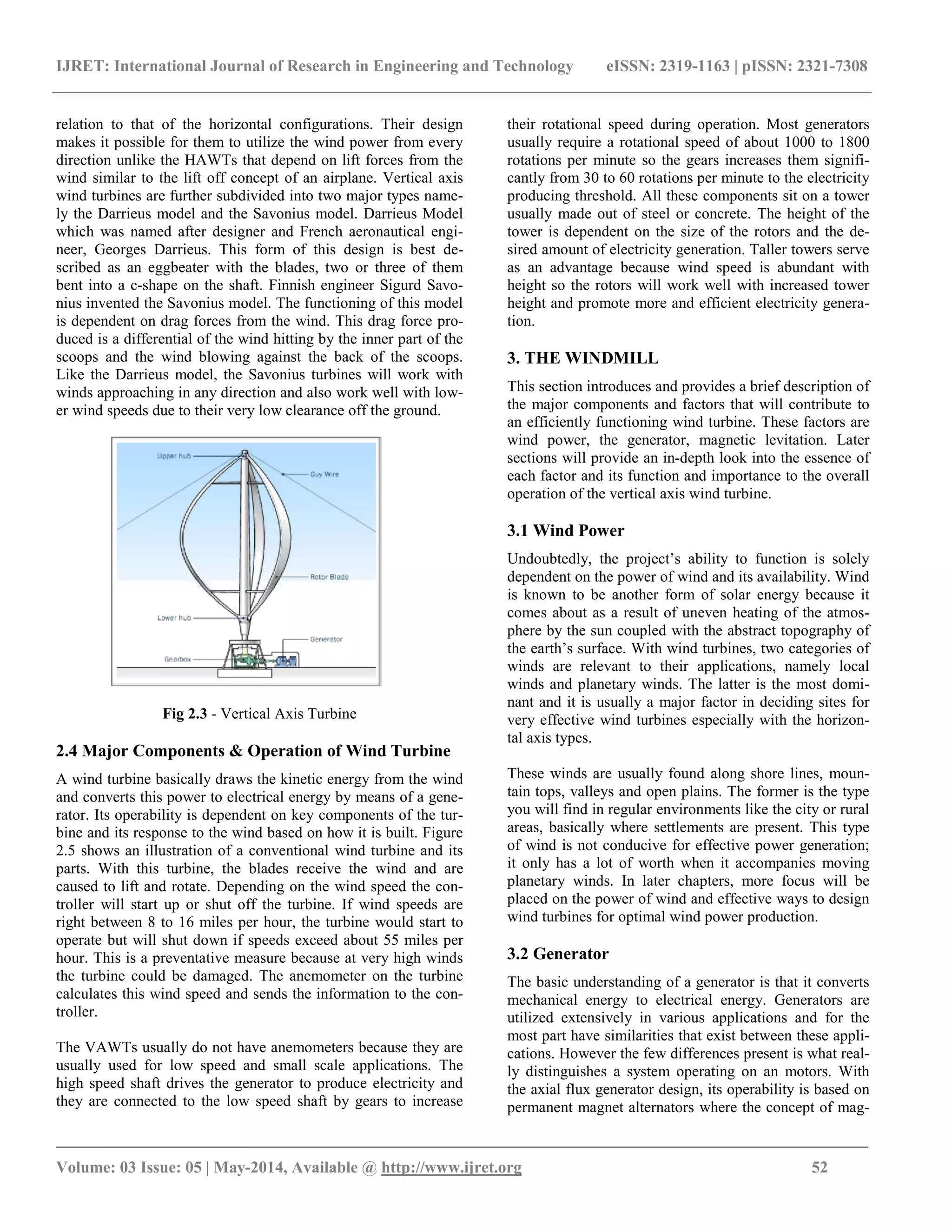
ly the Darrieus model and the Savonius model. Darrieus Model
which was named after designer and French aeronautical engi-
neer, Georges Darrieus. This form of this design is best de-
scribed as an eggbeater with the blades, two or three of them
bent into a c-shape on the shaft. Finnish engineer Sigurd Savo-
nius invented the Savonius model. The functioning of this model
is dependent on drag forces from the wind. This drag force pro-
duced is a differential of the wind hitting by the inner part of the
scoops and the wind blowing against the back of the scoops.
Like the Darrieus model, the Savonius turbines will work with
winds approaching in any direction and also work well with low-
er wind speeds due to their very low clearance off the ground.
Fig 2.3 - Vertical Axis Turbine
2.4 Major Components & Operation of Wind Turbine
A wind turbine basically draws the kinetic energy from the wind
and converts this power to electrical energy by means of a gene-
rator. Its operability is dependent on key components of the tur-
bine and its response to the wind based on how it is built. Figure
2.5 shows an illustration of a conventional wind turbine and its
parts. With this turbine, the blades receive the wind and are
caused to lift and rotate. Depending on the wind speed the con-
troller will start up or shut off the turbine. If wind speeds are
right between 8 to 16 miles per hour, the turbine would start to
operate but will shut down if speeds exceed about 55 miles per
hour. This is a preventative measure because at very high winds
the turbine could be damaged. The anemometer on the turbine
calculates this wind speed and sends the information to the con-
troller.
The VAWTs usually do not have anemometers because they are
usually used for low speed and small scale applications. The
high speed shaft drives the generator to produce electricity and
they are connected to the low speed shaft by gears to increase
their rotational speed during operation. Most generators
usually require a rotational speed of about 1000 to 1800
rotations per minute so the gears increases them signifi-
cantly from 30 to 60 rotations per minute to the electricity
producing threshold. All these components sit on a tower
usually made out of steel or concrete. The height of the
tower is dependent on the size of the rotors and the de-
sired amount of electricity generation. Taller towers serve
as an advantage because wind speed is abundant with
height so the rotors will work well with increased tower
height and promote more and efficient electricity genera-
tion.
3. THE WINDMILL
This section introduces and provides a brief description of
the major components and factors that will contribute to
an efficiently functioning wind turbine. These factors are
wind power, the generator, magnetic levitation. Later
sections will provide an in-depth look into the essence of
each factor and its function and importance to the overall
operation of the vertical axis wind turbine.
3.1 Wind Power
Undoubtedly, the project’s ability to function is solely
dependent on the power of wind and its availability. Wind
is known to be another form of solar energy because it
comes about as a result of uneven heating of the atmos-
phere by the sun coupled with the abstract topography of
the earth’s surface. With wind turbines, two categories of
winds are relevant to their applications, namely local
winds and planetary winds. The latter is the most domi-
nant and it is usually a major factor in deciding sites for
very effective wind turbines especially with the horizon-
tal axis types.
These winds are usually found along shore lines, moun-
tain tops, valleys and open plains. The former is the type
you will find in regular environments like the city or rural
areas, basically where settlements are present. This type
of wind is not conducive for effective power generation;
it only has a lot of worth when it accompanies moving
planetary winds. In later chapters, more focus will be
placed on the power of wind and effective ways to design
wind turbines for optimal wind power production.
3.2 Generator
The basic understanding of a generator is that it converts
mechanical energy to electrical energy. Generators are
utilized extensively in various applications and for the
most part have similarities that exist between these appli-
cations. However the few differences present is what real-
ly distinguishes a system operating on an motors. With
the axial flux generator design, its operability is based on
permanent magnet alternators where the concept of mag-
IJRET: International Journal of Research in Engineering and Technology eISSN: 2319-1163 | pISSN: 2321-7308
_______________________________________________________________________________________
Volume: 03 Issue: 05 | May-2014, Available @ http://www.ijret.org 53
nets and magnetic fields are the dominant factors in this form of
generator functioning. These generators have air gap surface
perpendicular to the rotating axis and the air gap generates mag-
netic fluxes parallel to the axis. In further chapters we will take a
detailed look into their basic operation and the configuration of
our design.
3.3 Magnetic Levitation
Also known as maglev, this phenomenon operates on the repul-
sion characteristics of permanent magnets. This technology has
been predominantly utilized in the rail industry in the Far East to
provide very fast and reliable transportation on maglev trains and
with on-going research its popularity is increasingly attaining
new heights. Using a pair of permanent magnets like neodymium
magnets and substantial support magnetic levitation can easily be
experienced. By placing these two magnets on top of each other
with like polarities facing each other, the magnetic repulsion will
be strong enough to keep both magnets at a distance away from
each other. The force created as a result of this repulsion can be
used for suspension purposes and is strong enough to balance the
weight of an object depending on the threshold of the magnets.
In this project, we expect to implement this technology form the
purpose of achieving vertical orientation with our rotors as well
as the axial flux generator.
3.4 Power Generation
When designing a generator it is important to have a firm grasp
of the basic laws that govern its performance. In order to induce
a voltage in a wire a nearby changing magnetic field must exist.
The voltage induced not only depends on the magnitude of the
field density but also on the coil area. The relationship between
the area and field density is known as flux (Φ). The way in
which this flux varies in time depends on the generator design.
The axial flux generator uses the changing magnetic flux to pro-
duce a voltage. The voltage produced by each coil can be calcu-
lated using Faraday's law of induction,
V= -N(dO/dt)
3.4.1 Induced EMF
In order to explain how an axial flux generator is designed the
elements that produce an electromotive force or voltage must be
described. An induced EMF is produced by a time varying mag-
netic field. Michael Faraday performed experiments with steady
currents and a simple transformer in hopes of producing a vol-
tage from a magnetic field. He discovered that a constant mag-
netic field would not induce a voltage but a time varying field
could. This was an important discovery in what is known as elec-
tromagnetic induction, a discovery that is fundamental in the
design of a generator. It is this relative motion of a magnetic
field producing a voltage that allows us to be creative in the
ways we produce electricity.
3.4.2 Magnetic Flux
The magnitude of the magnetic flux is greatest when the
coil in a magnetic field is perpendicular to the field. In the
design of an axial flux generator it is best to keep the
coils perpendicular to the field produced by the perma-
nent magnets. In many conventional motors a winding
rotates inside a magnetic field. The number of windings is
increased so that each winding is positioned close to 90
degrees to the field. Figure 4.1 illustrates this concept. In
our design the angle between the coils and the field does
not change, instead the field itself varies with time.
Faraday's law of induction states that the induced elec-
tromotive force is equal to the change in magnetic flux
over the change in time.
V = −d∅/dt
4. MAGNETIC LEVITATION
In selecting the vertical axis concept for the wind turbine
that is implemented as the power generation portion of
this project, certain uniqueness corresponded to it that did
not pertain to the other wind turbine designs. The charac-
teristic that set this wind generator apart from the others
is that it is fully supported and rotates about a vertical
axis. This axis is vertically oriented through the center of
the wind sails, which allows for a different type of rota-
tional support rather than the conventional ball bearing
system found in horizontal wind turbines.
This support is called maglev, which is based on magnet-
ic levitation. Maglev offers a near frictionless substitute
for ball bearings with little to no maintenance. The four
different classes are Alnico, Ceramic, Samarium Cobalt
and Neodymium Iron Boron also known Nd- Fe-B. Nd-
Fe-B is the most recent addition to this commercial list of
materials and at room temperature exhibits the highest
properties of all of the magnetic materials. It can be seen
in the B-H graph shown in Figure 5.1 that Nd-Fe-B has a
very attractive magnetic characteristic, which offers high
flux density operation and the ability to resist demagneti-
zation.
This attribute will be very important because the load that
will be levitated will be heavy and rotating high speeds,
which will exhibit a large downward force on the axis[3]
.
The next factor that needs to be considered is the shape
and size of the magnet which is directly related to the
placement of the magnets. It seems that levitation would
be most effective directly on the central axis line where,
under an evenly distributed load, the wind turbine center
of mass will be found as seen in Figure 5.2. This figure
shows a basic rendition of how the maglev will be inte-
grated into the design.
IJRET: International Journal of Research in Engineering and Technology eISSN: 2319-1163 | pISSN: 2321-7308
_______________________________________________________________________________________
Volume: 03 Issue: 05 | May-2014, Available @ http://www.ijret.org 54
If the magnets where ring shaped then they could easily be slid
tandem down the shaft with the like poles facing toward each
other. This would enable the repelling force required to support
the weight and force of the wind turbine and minimize the
amount of magnets needed to complete the concept. The perma-
nent magnets that were chosen for this application were the N42
magnets. These are Nd-Fe-B ring shaped permanent magnets
that are nickel plated to strengthen and protect the magnet itself.
The dimensions for the magnets are reasonable with an outside
diameter of 40mm, inside diameter of 20mm and height of
10mm.
4.1 Magnetic Selection
Some factors need to be assessed in choosing the permanent
magnet selection that would be best to implement the maglev
portion of the design. Understanding the characteristics of mag-
net materials and the different assortment of sizes, shapes and
materials is critical. There are four classes of commercialized
magnets used today which are based on their material composi-
tion each having their own magnetic properties.
The four different classes are Alnico, Ceramic, Samarium Cobalt
and Neodymium Iron Boron also known Nd- Fe-B. Nd-Fe-B is
the most recent addition to this commercial list of materials and
at room temperature exhibits the highest properties of all of the
magnetic materials. It can be seen in the B-H graph shown in
Figure 5.1 that Nd-Fe-B has a very attractive magnetic characte-
ristic which offers high flux density operation and the ability to
resist demagnetization. This attribute will be very important be-
cause the load that will be levitated will be heavy and rotating a
high speeds which will exhibit a large downward force on the
axis.
The next factor that needs to be considered is the shape and size
of the magnet which is directly related to the placement of the
magnets. It seems that levitation would be most effective directly
on the central axis line where, under an evenly distributed load,
the wind turbine center of mass will be found as seen in Figure
5.2. This figure shows a basic rendition of how the maglev will
be integrated into the design. If the magnets where ring shaped
then they could easily be slid tandem down the shaft with the
like poles facing toward each other. This would enable the repel-
ling force required to support the weight and force of the wind
turbine and minimize the amount of magnets needed to complete
the concept.
The permanent magnets that were chosen for this application
were the N42 magnets. These are Nd-Fe-B ring shaped perma-
nent magnets that are nickel plated to strengthen and protect the
magnet itself. The dimensions for the magnets are reasonable
with an outside diameter of 40mm, inside diameter of 20mm and
height of 10mm.
5. PROTOTYPE
Some modifications are made in order to overcome the
limitations of theoretical design of magnetically levitated
vertical axis wind turbine and a prototype is constructed.
This section includes details of modifications made.
5.1 Magnet Placement
Two ring type neodymium (NdFeB) magnets of grade N-
42 of outer diameter 40 mm, inner diameter 20 mm and
thickness 10 mm are placed at the center of the shaft by
which the required levitation between the stator and the
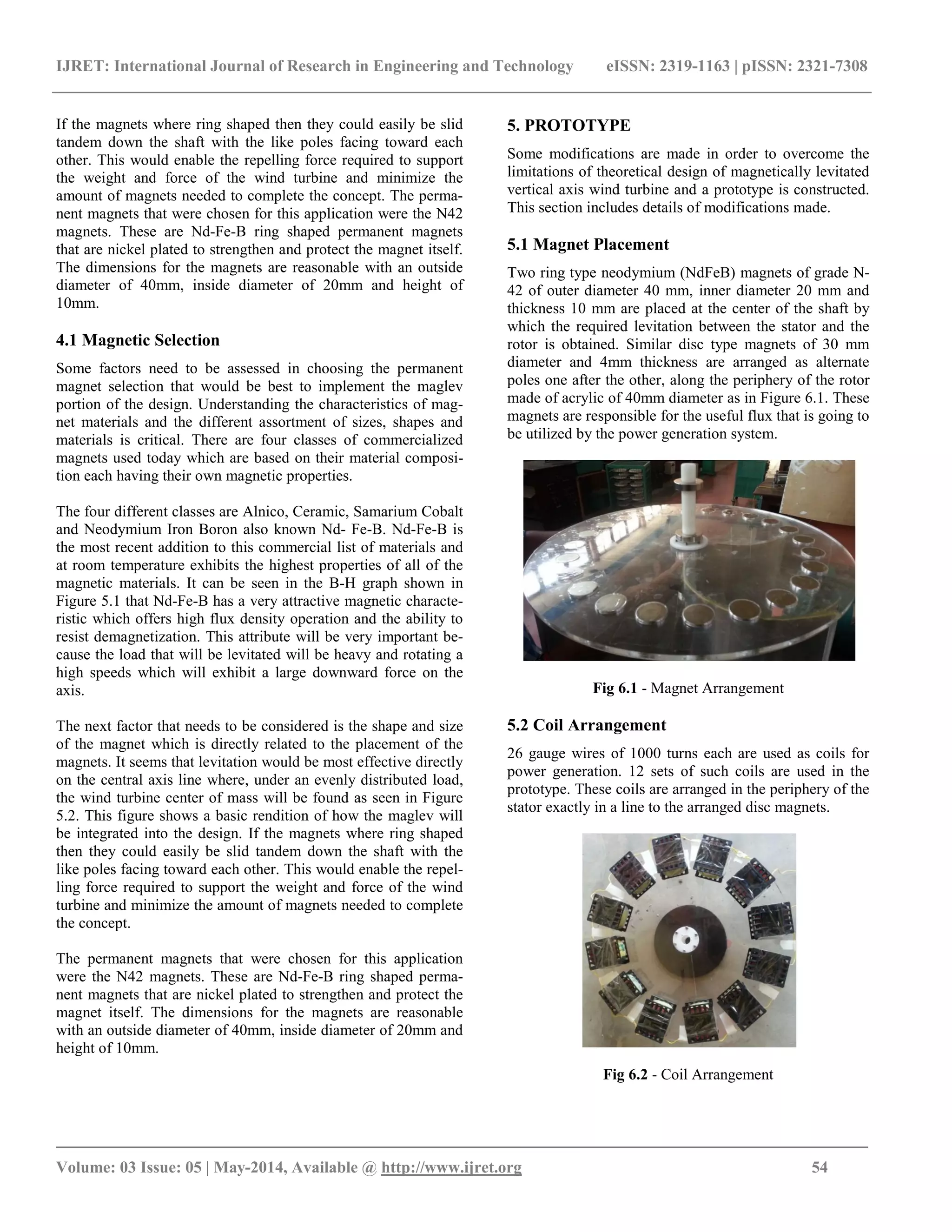
rotor is obtained. Similar disc type magnets of 30 mm
diameter and 4mm thickness are arranged as alternate
poles one after the other, along the periphery of the rotor
made of acrylic of 40mm diameter as in Figure 6.1. These
magnets are responsible for the useful flux that is going to
be utilized by the power generation system.
Fig 6.1 - Magnet Arrangement
5.2 Coil Arrangement
26 gauge wires of 1000 turns each are used as coils for
power generation. 12 sets of such coils are used in the
prototype. These coils are arranged in the periphery of the
stator exactly in a line to the arranged disc magnets.
Fig 6.2 - Coil Arrangement
IJRET: International Journal of Research in Engineering and Technology eISSN: 2319-1163 | pISSN: 2321-7308
_______________________________________________________________________________________
Volume: 03 Issue: 05 | May-2014, Available @ http://www.ijret.org 55
The coils are raised to a certain height for maximum utilization
of the magnetic flux. Each set of such coils are connected in se-
ries aiding to obtain maximum output voltage[4]
. The series con-
nections of the coils are preferred over the parallel connection
for optimizing a level between the output current and voltage.
The coil arrangement is shown in figure 6.2.
5.3 Levitation between Stator & Rotor
In the designed prototype, the stator and rotor are separated in
the air using the principle of magnetic levitation. The rotor is
lifted by a certain centimeters in the air by the magnetic pull
forces created by the ring type Neodymium magnets. This is the
principal advantage of a maglev windmill from a conventional
one. That is, as the rotor is floating in the air due to levitation,
mechanical friction is totally eliminated. That makes the rotation
possible in very low wind speeds. Figure 6.3 illustrates the mag-
netic levitation in our prototype.
Fig 6.3 - Magnetic Levitation
5.4 Blade Design
The blades used in this prototype are not of the conventional
type. In this prototype, As compared to the standard design mod-
el of the Savonius, we took a bit of a different approach in our
design by modifying it with a curvature design from the top of
the sails to the bottom[2]
. This design was attained with four tri-
angular shapes cut out from aluminum sheet metal and due to the
flexibility of the sheet metal, we were able to spiral the sail from
the top of the shaft to the base[6]
. The height of the blades were
400mm.
5.5 Final Model
The overall structure of the prototype designed is shown in the
figure 6.6. The output voltage obtained from this prototype is
measured using a multimeter and a maximum of 45 volts DC
were obtained.
A Led load of 3W is connected to the turbine and current is
measured to be 0.4 Amps.
6. CONCLUSIONS
At the end of the project, the magnetically levitated ver-
tical axis wind turbine was a success. The rotors that were
designed harnessed enough air to rotate at low and high
wind speeds while keeping the centre of mass closer to
the base yielding stability. The wind turbine rotor levi-
tated properly using permanent magnets, which allowed
for a smooth rotation with negligible friction.
Generator satisfied the specifications needed to supply
the LED load. An output ranging from 40V to 45V was
obtained from the magnetic levitated vertical axis wind
turbine prototype. A modified design of savonius model
wind turbine blade was used in the construction of the
model. An aluminium shaft was used to avoid the wob-
bling movement of the rotor. Overall, the magnetic levita-
tion wind turbine was a successful model.
Fig. 6.6 - Output waveform before & after rectification.
6.1 Limitations
In terms of large scale power production, vertical axis
wind turbines have not been known to be suitable for
these applications. Due to the overall structure and com-
plexity of the of the vertical axis wind turbine, to scale it
up to a size where it could provide the amount of power
to satisfy a commercial park or feed into the grid would
not be practical. The size of the rotors would have to be
immense and would cost too much to make. Aside from
the cost, this type of consumer would not desire the area
that it would consume and the aesthetics of the product.
Horizontal axis wind turbines are good for these applica-
tions because they do not take up as much space and are
positioned high up where they can obtain higher wind
speeds to provide an optimum power output.
6.2 Future Scope
The home for the magnetically levitated vertical axis
wind turbine would be in residential areas. Here it can be
mounted to a roof and be very efficient and practical. A
home owner would be able to extract free clean energy
thus experiencing a reduction in their utility cost and also
contribute to the “Green Energy” awareness that is in-
creasingly gaining popularity. The maglev windmill can
IJRET: International Journal of Research in Engineering and Technology eISSN: 2319-1163 | pISSN: 2321-7308
_______________________________________________________________________________________
Volume: 03 Issue: 05 | May-2014, Available @ http://www.ijret.org 56
be designed for using in a moderate scale power generation rang-
ing from 400 Watts to 1 KW. Also it is suitable for integrating
with the hybrid power generation units consisting of solar and
other natural resources.
Fig 7.1 - The finished model generating a voltage of 40V.
ACKNOWLEDGEMENTS
I thank almighty for bestowing upon us all his blessings for the
compilation of this project. I would like to express our gratitude
to Dr. George Isaac, Principal, Mar Athanasius College of Engi-
neering, Kothamangalam and Prof. K. Radhakrishnan, Head of
the Department, Electrical and Electronics, for providing us with
the guidance and facilities for the project. A deep sense of grati-
tude to project guide Prof. Rajan P Thomas, whose overall direc-
tion and guidance has been responsible for the successful com-
pletion of this project. I express our sincere gratitude to Project
coordinator Prof. Elizabeth Sebastian, for her cooperation and
guidance for preparing Project. I also extend our sincere thanks
to all other faculty members of Electrical and Electronics De-
partment and our friends for their support and encouragement.
REFERENCES
[1] Dinesh N Nagarkarand Dr. Z. J. Khan,”Wind Power Plant
Using Magnetic Levitation Wind Turbine”, International-
Journal of Engineering and Innovative Technology
(IJEIT) Volume 3, Issue1, July 2013.
[2] Liu Shuqin,”Magnetic Suspension and Self-pitch for Ver-
tical-axis Wind Turbines”,
ISBN:http://www.intechopen.com/books/fundamental-
and-advanced-topics-in-wind-power/magnetic-
suspensionand-self-pitch-for-vertical-axis-wind-
turbines.2011.
[3] MagLev Wind Turbine Technologies, Inc.
(MWTT) & Off Grid Technologies, Inc. (OGT),”
Vertical Axis Wind Turbine 200 Mega Watt off
Shore Wind Farm (VAWT Off Shore JV)-City of
Evanston, Illinois Lake Michigan Project”.
[4] M. A. Mueller and A. S. McDonald,”A
lightweight low speed permanent magnet electrical
generator for direct-drive wind turbines”, Institute
for Energy Systems, Institute for Energy Systems,
Edinburgh University, Edinburgh University,
Edinburgh, UK.
[5] Vishal D Dhareppgoaland MaheshwariM Kona-
gutti,” REGENEDYNE Maglev Wind Power Gen-
eration”, SARC-IRAJ International Conference,
16th June 2013, Pune, India, ISBN: 978-81-
92747-8-3.

Maglev windmill

  • 1.
    IJRET: International Journalof Research in Engineering and Technology eISSN: 2319-1163 | pISSN: 2321-7308 _______________________________________________________________________________________ Volume: 03 Issue: 05 | May-2014, Available @ http://www.ijret.org 50 MAGLEV WINDMILL Minu John1 , Rohit John2 , Syamily P.S3 , Vyshak P.A4 1 Student, Dept. of EEE, Mar Athanasius College of Engineering, Kothamangalam, India 2 Student, Dept. of EEE, Mar Athanasius College of Engineering, Kothamangalam, India 3 Student, Dept. of EEE, Mar Athanasius College of Engineering, Kothamangalam, India 4 Student, Dept. of EEE, Mar Athanasius College of Engineering, Kothamangalam, India Abstract Magnetic levitation, maglev, or magnetic suspension is a method by which an object is suspended with no support other than magnetic fields. Magnetic pressure is used to counteract the effects of the gravitational and any other accelerations. The principal advantage of a maglev windmill from a conventional one is, as the rotor is floating in the air due to levitation, mechanical friction is totally elimi- nated. That makes the rotation possible in very low wind speeds. Maglev wind turbines have several advantages over conventional wind turbines. For instance, they’re able to use winds with starting speeds as low as 1.5 meters per second (m/s). Also, they could operate in winds exceeding 40 m/s. Keywords: Wind Energy, Magnetic Levitation, Power Generation, Magnets -----------------------------------------------------------------------***----------------------------------------------------------------------- 1. INTRODUCTION Wind is a form of solar energy. It is a natural power source that can be economically used to generate electricity. The way in which wind is created is from the atmosphere of the sun causing areas of uneven heating. In conjunction with the uneven heating of the sun, rotation of the earth and the rockiness of the earth’s surface winds are formed. The terms wind energy or wind power describes the process by which the wind is used to generate me- chanical power or electricity. Wind turbines convert the kinetic energy in the wind into mechanical power. This mechanical power can be used for specific tasks (such as grinding grain or pumping water) or a generator can convert this mechanical pow- er into electricity. The wind turbine is used for conversion of kinetic energy of wind into electrical energy. The wind turns the blades, which spin a shaft, which connects to a generator and makes electricity. The Maglev wind turbine design is a vast departure from con- ventional propeller designs. Its main advantages are that it uses frictionless bearings and a magnetic levitation design and it does not need to vast spaces required by more conventional wind tur- bines. It also requires little if any maintenance. The Maglev wind turbine was first unveiled at the Wind Power Asia exhibition in Beijing 2007. The unique operating principle behind this design is through magnetic levitation. Magnetic levitation is supposedly an extremely efficient system for wind energy. The vertically oriented blades of the wind turbine are suspended in the air re- placing any need for ball bearings. 1.1 Need for Wind Power Technology Renewable energy is generally electricity supplied from sources, such as wind power, solar power, geothermal energy, hydropower and various forms of biomass. These sources have been coined renewable due to their conti- nuous replenishment and availability for use over and over again. The popularity of renewable energy has expe- rienced a significant upsurge in recent times due to the exhaustion of conventional power generation methods and increasing realization of its adverse effects on the environment. It is estimated that renewable sources might contribute about 20%-50% to energy consumption in the later part of the 21st century. Facts from the World Wind Energy Association estimates that by 2010, 160GW of wind power capacity is expected to be installed world- wide which implies an anticipated net growth rate of more than 21% per year. Maglev wind turbines have sev- eral advantages over conventional wind turbines. For instance, they’re able to use winds with starting speeds as low as 1.5 meters per second (m/s). Also, they could op- erate in winds exceeding 40 m/s. It would also increase generation capacity by 20% over conventional wind tur- bines and decrease operational costs by 50%. This makes the efficiency of the system higher than conventional wind turbine. Currently, the largest conventional wind turbines in the world produce only five megawatts of power. However, one large maglev wind turbine could generate one GW of clean power, enough to supply ener- gy to 75,000 homes [1] . The turbine uses permanent type of rare earth magnets (neodymium) instead of electro- magnets and therefore it doesn’t require electricity to run. The friction between the turbine blades and the base can maximum power output.
  • 2.
    IJRET: International Journalof Research in Engineering and Technology eISSN: 2319-1163 | pISSN: 2321-7308 _______________________________________________________________________________________ Volume: 03 Issue: 05 | May-2014, Available @ http://www.ijret.org 51 2. WIND POWER & WIND TURBINES 2.1 Wind Power Technology Wind power technology is the various infrastructure and process that promote the harnessing of wind generation for mechanical power and electricity. This basically entails the wind and charac- teristics related to its strength and direction, as well as the func- tioning of both internal and external components of a wind tur- bine with respect to wind behavior. Wind power, as an alterna- tive to fossil fuels, is plentiful, renewable, widely distributed, clean, produces no greenhouse gas emissions during operation and uses little land. Any effects on the environment are generally less problematic than those from other power sources. 83 coun- tries around the world are using wind power on a commercial basis. Worldwide there are now over two hundred thousand wind turbines operating, with a total nameplate capacity of 238,351 MW as of end 2011. Fig 2.1 – Electricity generation from wind 2.2 The Power of Wind As mentioned earlier the effective functioning of a wind turbine is dictated by the wind availability in an area and if the amount of power it has is sufficient enough to keep the blades in constant rotation. The wind power increases as a function of the cube of the velocity of the wind and this power is calculable with respect to the area in which the wind is present as well as the wind ve- locity. When wind is blowing the energy available is kinetic due to the motion of the wind so the power of the wind is related to the kinetic energy. We know, Kinetic Energy =1/2 MV2 The volume of air passing in unit time through an area A, with speed V is AV and its mass M is equal to the Volume V multip- lied by its density ρ so: M= ρAV Substituting the value of M in equation above we get: Kinetic Energy=1/2 (ρAV) V2 Kinetic Energy=1/2 ρAV3 To convert the energy to kilowatts, a non-dimensional proportionality constant k is introduced where, K = 2.14×10⁻³ Therefore, Power in KW (P) = 2.14ρAV3×10−3 Where: Air Density (ρ) = 1.2 kg/ 3/2.33x 10−3 slugs/f 3 Area (A) = Area swept by the blades by the turbine Velocity (V) = wind speed in m/s With the above equation, the power being generated can be calculated, however one should note that it is not poss- ible to convert all the power of the wind into power for generation. The power harnessed from the wind cannot exceed 59% of the overall power in the wind. Only a portion can be used and that usable portion is only assured depending on the wind turbine being used and the aerodynamic charac- teristics that accompany it. 2.3 Types of Wind Turbines Many types of turbines exist today and their designs are usually inclined towards one of the two categories: hori- zontal-axis wind turbines (HAWTs) and vertical-axis wind turbines (VAWTs). As the name pertains, each tur- bine is distinguished by the orientation of their rotor shafts. The former is the more conventional and common type everyone has come to know, while the latter due to its seldom usage and exploitation, is quiet unpopular. The HAWTs usually consist of two or three propeller-like blades attached to a horizontal and mounted on bearings the top of a support tower. When the wind blows, the blades of the turbine are set in motion which drives a ge- nerator that produces AC electricity. For optimal efficien- cy, these horizontal turbines are usually made to point into the wind with the aid of a sensor and a servomotor or a wind vane for smaller wind turbine applications. With the vertical axis wind turbines, the concept behind their operation is similar to that of the horizontal designs. The major difference is the orientation of the rotors and generator, which are all vertically arranged, and usually on a shaft for support and stability. This also results in a different response of the turbine blades to the wind in
  • 3.
    IJRET: International Journalof Research in Engineering and Technology eISSN: 2319-1163 | pISSN: 2321-7308 _______________________________________________________________________________________ Volume: 03 Issue: 05 | May-2014, Available @ http://www.ijret.org 52 relation to that of the horizontal configurations. Their design makes it possible for them to utilize the wind power from every direction unlike the HAWTs that depend on lift forces from the wind similar to the lift off concept of an airplane. Vertical axis wind turbines are further subdivided into two major types name- ly the Darrieus model and the Savonius model. Darrieus Model which was named after designer and French aeronautical engi- neer, Georges Darrieus. This form of this design is best de- scribed as an eggbeater with the blades, two or three of them bent into a c-shape on the shaft. Finnish engineer Sigurd Savo- nius invented the Savonius model. The functioning of this model is dependent on drag forces from the wind. This drag force pro- duced is a differential of the wind hitting by the inner part of the scoops and the wind blowing against the back of the scoops. Like the Darrieus model, the Savonius turbines will work with winds approaching in any direction and also work well with low- er wind speeds due to their very low clearance off the ground. Fig 2.3 - Vertical Axis Turbine 2.4 Major Components & Operation of Wind Turbine A wind turbine basically draws the kinetic energy from the wind and converts this power to electrical energy by means of a gene- rator. Its operability is dependent on key components of the tur- bine and its response to the wind based on how it is built. Figure 2.5 shows an illustration of a conventional wind turbine and its parts. With this turbine, the blades receive the wind and are caused to lift and rotate. Depending on the wind speed the con- troller will start up or shut off the turbine. If wind speeds are right between 8 to 16 miles per hour, the turbine would start to operate but will shut down if speeds exceed about 55 miles per hour. This is a preventative measure because at very high winds the turbine could be damaged. The anemometer on the turbine calculates this wind speed and sends the information to the con- troller. The VAWTs usually do not have anemometers because they are usually used for low speed and small scale applications. The high speed shaft drives the generator to produce electricity and they are connected to the low speed shaft by gears to increase their rotational speed during operation. Most generators usually require a rotational speed of about 1000 to 1800 rotations per minute so the gears increases them signifi- cantly from 30 to 60 rotations per minute to the electricity producing threshold. All these components sit on a tower usually made out of steel or concrete. The height of the tower is dependent on the size of the rotors and the de- sired amount of electricity generation. Taller towers serve as an advantage because wind speed is abundant with height so the rotors will work well with increased tower height and promote more and efficient electricity genera- tion. 3. THE WINDMILL This section introduces and provides a brief description of the major components and factors that will contribute to an efficiently functioning wind turbine. These factors are wind power, the generator, magnetic levitation. Later sections will provide an in-depth look into the essence of each factor and its function and importance to the overall operation of the vertical axis wind turbine. 3.1 Wind Power Undoubtedly, the project’s ability to function is solely dependent on the power of wind and its availability. Wind is known to be another form of solar energy because it comes about as a result of uneven heating of the atmos- phere by the sun coupled with the abstract topography of the earth’s surface. With wind turbines, two categories of winds are relevant to their applications, namely local winds and planetary winds. The latter is the most domi- nant and it is usually a major factor in deciding sites for very effective wind turbines especially with the horizon- tal axis types. These winds are usually found along shore lines, moun- tain tops, valleys and open plains. The former is the type you will find in regular environments like the city or rural areas, basically where settlements are present. This type of wind is not conducive for effective power generation; it only has a lot of worth when it accompanies moving planetary winds. In later chapters, more focus will be placed on the power of wind and effective ways to design wind turbines for optimal wind power production. 3.2 Generator The basic understanding of a generator is that it converts mechanical energy to electrical energy. Generators are utilized extensively in various applications and for the most part have similarities that exist between these appli- cations. However the few differences present is what real- ly distinguishes a system operating on an motors. With the axial flux generator design, its operability is based on permanent magnet alternators where the concept of mag-
  • 4.
    IJRET: International Journalof Research in Engineering and Technology eISSN: 2319-1163 | pISSN: 2321-7308 _______________________________________________________________________________________ Volume: 03 Issue: 05 | May-2014, Available @ http://www.ijret.org 53 nets and magnetic fields are the dominant factors in this form of generator functioning. These generators have air gap surface perpendicular to the rotating axis and the air gap generates mag- netic fluxes parallel to the axis. In further chapters we will take a detailed look into their basic operation and the configuration of our design. 3.3 Magnetic Levitation Also known as maglev, this phenomenon operates on the repul- sion characteristics of permanent magnets. This technology has been predominantly utilized in the rail industry in the Far East to provide very fast and reliable transportation on maglev trains and with on-going research its popularity is increasingly attaining new heights. Using a pair of permanent magnets like neodymium magnets and substantial support magnetic levitation can easily be experienced. By placing these two magnets on top of each other with like polarities facing each other, the magnetic repulsion will be strong enough to keep both magnets at a distance away from each other. The force created as a result of this repulsion can be used for suspension purposes and is strong enough to balance the weight of an object depending on the threshold of the magnets. In this project, we expect to implement this technology form the purpose of achieving vertical orientation with our rotors as well as the axial flux generator. 3.4 Power Generation When designing a generator it is important to have a firm grasp of the basic laws that govern its performance. In order to induce a voltage in a wire a nearby changing magnetic field must exist. The voltage induced not only depends on the magnitude of the field density but also on the coil area. The relationship between the area and field density is known as flux (Φ). The way in which this flux varies in time depends on the generator design. The axial flux generator uses the changing magnetic flux to pro- duce a voltage. The voltage produced by each coil can be calcu- lated using Faraday's law of induction, V= -N(dO/dt) 3.4.1 Induced EMF In order to explain how an axial flux generator is designed the elements that produce an electromotive force or voltage must be described. An induced EMF is produced by a time varying mag- netic field. Michael Faraday performed experiments with steady currents and a simple transformer in hopes of producing a vol- tage from a magnetic field. He discovered that a constant mag- netic field would not induce a voltage but a time varying field could. This was an important discovery in what is known as elec- tromagnetic induction, a discovery that is fundamental in the design of a generator. It is this relative motion of a magnetic field producing a voltage that allows us to be creative in the ways we produce electricity. 3.4.2 Magnetic Flux The magnitude of the magnetic flux is greatest when the coil in a magnetic field is perpendicular to the field. In the design of an axial flux generator it is best to keep the coils perpendicular to the field produced by the perma- nent magnets. In many conventional motors a winding rotates inside a magnetic field. The number of windings is increased so that each winding is positioned close to 90 degrees to the field. Figure 4.1 illustrates this concept. In our design the angle between the coils and the field does not change, instead the field itself varies with time. Faraday's law of induction states that the induced elec- tromotive force is equal to the change in magnetic flux over the change in time. V = −d∅/dt 4. MAGNETIC LEVITATION In selecting the vertical axis concept for the wind turbine that is implemented as the power generation portion of this project, certain uniqueness corresponded to it that did not pertain to the other wind turbine designs. The charac- teristic that set this wind generator apart from the others is that it is fully supported and rotates about a vertical axis. This axis is vertically oriented through the center of the wind sails, which allows for a different type of rota- tional support rather than the conventional ball bearing system found in horizontal wind turbines. This support is called maglev, which is based on magnet- ic levitation. Maglev offers a near frictionless substitute for ball bearings with little to no maintenance. The four different classes are Alnico, Ceramic, Samarium Cobalt and Neodymium Iron Boron also known Nd- Fe-B. Nd- Fe-B is the most recent addition to this commercial list of materials and at room temperature exhibits the highest properties of all of the magnetic materials. It can be seen in the B-H graph shown in Figure 5.1 that Nd-Fe-B has a very attractive magnetic characteristic, which offers high flux density operation and the ability to resist demagneti- zation. This attribute will be very important because the load that will be levitated will be heavy and rotating high speeds, which will exhibit a large downward force on the axis[3] . The next factor that needs to be considered is the shape and size of the magnet which is directly related to the placement of the magnets. It seems that levitation would be most effective directly on the central axis line where, under an evenly distributed load, the wind turbine center of mass will be found as seen in Figure 5.2. This figure shows a basic rendition of how the maglev will be inte- grated into the design.
  • 5.
    IJRET: International Journalof Research in Engineering and Technology eISSN: 2319-1163 | pISSN: 2321-7308 _______________________________________________________________________________________ Volume: 03 Issue: 05 | May-2014, Available @ http://www.ijret.org 54 If the magnets where ring shaped then they could easily be slid tandem down the shaft with the like poles facing toward each other. This would enable the repelling force required to support the weight and force of the wind turbine and minimize the amount of magnets needed to complete the concept. The perma- nent magnets that were chosen for this application were the N42 magnets. These are Nd-Fe-B ring shaped permanent magnets that are nickel plated to strengthen and protect the magnet itself. The dimensions for the magnets are reasonable with an outside diameter of 40mm, inside diameter of 20mm and height of 10mm. 4.1 Magnetic Selection Some factors need to be assessed in choosing the permanent magnet selection that would be best to implement the maglev portion of the design. Understanding the characteristics of mag- net materials and the different assortment of sizes, shapes and materials is critical. There are four classes of commercialized magnets used today which are based on their material composi- tion each having their own magnetic properties. The four different classes are Alnico, Ceramic, Samarium Cobalt and Neodymium Iron Boron also known Nd- Fe-B. Nd-Fe-B is the most recent addition to this commercial list of materials and at room temperature exhibits the highest properties of all of the magnetic materials. It can be seen in the B-H graph shown in Figure 5.1 that Nd-Fe-B has a very attractive magnetic characte- ristic which offers high flux density operation and the ability to resist demagnetization. This attribute will be very important be- cause the load that will be levitated will be heavy and rotating a high speeds which will exhibit a large downward force on the axis. The next factor that needs to be considered is the shape and size of the magnet which is directly related to the placement of the magnets. It seems that levitation would be most effective directly on the central axis line where, under an evenly distributed load, the wind turbine center of mass will be found as seen in Figure 5.2. This figure shows a basic rendition of how the maglev will be integrated into the design. If the magnets where ring shaped then they could easily be slid tandem down the shaft with the like poles facing toward each other. This would enable the repel- ling force required to support the weight and force of the wind turbine and minimize the amount of magnets needed to complete the concept. The permanent magnets that were chosen for this application were the N42 magnets. These are Nd-Fe-B ring shaped perma- nent magnets that are nickel plated to strengthen and protect the magnet itself. The dimensions for the magnets are reasonable with an outside diameter of 40mm, inside diameter of 20mm and height of 10mm. 5. PROTOTYPE Some modifications are made in order to overcome the limitations of theoretical design of magnetically levitated vertical axis wind turbine and a prototype is constructed. This section includes details of modifications made. 5.1 Magnet Placement Two ring type neodymium (NdFeB) magnets of grade N- 42 of outer diameter 40 mm, inner diameter 20 mm and thickness 10 mm are placed at the center of the shaft by which the required levitation between the stator and the rotor is obtained. Similar disc type magnets of 30 mm diameter and 4mm thickness are arranged as alternate poles one after the other, along the periphery of the rotor made of acrylic of 40mm diameter as in Figure 6.1. These magnets are responsible for the useful flux that is going to be utilized by the power generation system. Fig 6.1 - Magnet Arrangement 5.2 Coil Arrangement 26 gauge wires of 1000 turns each are used as coils for power generation. 12 sets of such coils are used in the prototype. These coils are arranged in the periphery of the stator exactly in a line to the arranged disc magnets. Fig 6.2 - Coil Arrangement
  • 6.
    IJRET: International Journalof Research in Engineering and Technology eISSN: 2319-1163 | pISSN: 2321-7308 _______________________________________________________________________________________ Volume: 03 Issue: 05 | May-2014, Available @ http://www.ijret.org 55 The coils are raised to a certain height for maximum utilization of the magnetic flux. Each set of such coils are connected in se- ries aiding to obtain maximum output voltage[4] . The series con- nections of the coils are preferred over the parallel connection for optimizing a level between the output current and voltage. The coil arrangement is shown in figure 6.2. 5.3 Levitation between Stator & Rotor In the designed prototype, the stator and rotor are separated in the air using the principle of magnetic levitation. The rotor is lifted by a certain centimeters in the air by the magnetic pull forces created by the ring type Neodymium magnets. This is the principal advantage of a maglev windmill from a conventional one. That is, as the rotor is floating in the air due to levitation, mechanical friction is totally eliminated. That makes the rotation possible in very low wind speeds. Figure 6.3 illustrates the mag- netic levitation in our prototype. Fig 6.3 - Magnetic Levitation 5.4 Blade Design The blades used in this prototype are not of the conventional type. In this prototype, As compared to the standard design mod- el of the Savonius, we took a bit of a different approach in our design by modifying it with a curvature design from the top of the sails to the bottom[2] . This design was attained with four tri- angular shapes cut out from aluminum sheet metal and due to the flexibility of the sheet metal, we were able to spiral the sail from the top of the shaft to the base[6] . The height of the blades were 400mm. 5.5 Final Model The overall structure of the prototype designed is shown in the figure 6.6. The output voltage obtained from this prototype is measured using a multimeter and a maximum of 45 volts DC were obtained. A Led load of 3W is connected to the turbine and current is measured to be 0.4 Amps. 6. CONCLUSIONS At the end of the project, the magnetically levitated ver- tical axis wind turbine was a success. The rotors that were designed harnessed enough air to rotate at low and high wind speeds while keeping the centre of mass closer to the base yielding stability. The wind turbine rotor levi- tated properly using permanent magnets, which allowed for a smooth rotation with negligible friction. Generator satisfied the specifications needed to supply the LED load. An output ranging from 40V to 45V was obtained from the magnetic levitated vertical axis wind turbine prototype. A modified design of savonius model wind turbine blade was used in the construction of the model. An aluminium shaft was used to avoid the wob- bling movement of the rotor. Overall, the magnetic levita- tion wind turbine was a successful model. Fig. 6.6 - Output waveform before & after rectification. 6.1 Limitations In terms of large scale power production, vertical axis wind turbines have not been known to be suitable for these applications. Due to the overall structure and com- plexity of the of the vertical axis wind turbine, to scale it up to a size where it could provide the amount of power to satisfy a commercial park or feed into the grid would not be practical. The size of the rotors would have to be immense and would cost too much to make. Aside from the cost, this type of consumer would not desire the area that it would consume and the aesthetics of the product. Horizontal axis wind turbines are good for these applica- tions because they do not take up as much space and are positioned high up where they can obtain higher wind speeds to provide an optimum power output. 6.2 Future Scope The home for the magnetically levitated vertical axis wind turbine would be in residential areas. Here it can be mounted to a roof and be very efficient and practical. A home owner would be able to extract free clean energy thus experiencing a reduction in their utility cost and also contribute to the “Green Energy” awareness that is in- creasingly gaining popularity. The maglev windmill can
  • 7.
    IJRET: International Journalof Research in Engineering and Technology eISSN: 2319-1163 | pISSN: 2321-7308 _______________________________________________________________________________________ Volume: 03 Issue: 05 | May-2014, Available @ http://www.ijret.org 56 be designed for using in a moderate scale power generation rang- ing from 400 Watts to 1 KW. Also it is suitable for integrating with the hybrid power generation units consisting of solar and other natural resources. Fig 7.1 - The finished model generating a voltage of 40V. ACKNOWLEDGEMENTS I thank almighty for bestowing upon us all his blessings for the compilation of this project. I would like to express our gratitude to Dr. George Isaac, Principal, Mar Athanasius College of Engi- neering, Kothamangalam and Prof. K. Radhakrishnan, Head of the Department, Electrical and Electronics, for providing us with the guidance and facilities for the project. A deep sense of grati- tude to project guide Prof. Rajan P Thomas, whose overall direc- tion and guidance has been responsible for the successful com- pletion of this project. I express our sincere gratitude to Project coordinator Prof. Elizabeth Sebastian, for her cooperation and guidance for preparing Project. I also extend our sincere thanks to all other faculty members of Electrical and Electronics De- partment and our friends for their support and encouragement. REFERENCES [1] Dinesh N Nagarkarand Dr. Z. J. Khan,”Wind Power Plant Using Magnetic Levitation Wind Turbine”, International- Journal of Engineering and Innovative Technology (IJEIT) Volume 3, Issue1, July 2013. [2] Liu Shuqin,”Magnetic Suspension and Self-pitch for Ver- tical-axis Wind Turbines”, ISBN:http://www.intechopen.com/books/fundamental- and-advanced-topics-in-wind-power/magnetic- suspensionand-self-pitch-for-vertical-axis-wind- turbines.2011. [3] MagLev Wind Turbine Technologies, Inc. (MWTT) & Off Grid Technologies, Inc. (OGT),” Vertical Axis Wind Turbine 200 Mega Watt off Shore Wind Farm (VAWT Off Shore JV)-City of Evanston, Illinois Lake Michigan Project”. [4] M. A. Mueller and A. S. McDonald,”A lightweight low speed permanent magnet electrical generator for direct-drive wind turbines”, Institute for Energy Systems, Institute for Energy Systems, Edinburgh University, Edinburgh University, Edinburgh, UK. [5] Vishal D Dhareppgoaland MaheshwariM Kona- gutti,” REGENEDYNE Maglev Wind Power Gen- eration”, SARC-IRAJ International Conference, 16th June 2013, Pune, India, ISBN: 978-81- 92747-8-3.