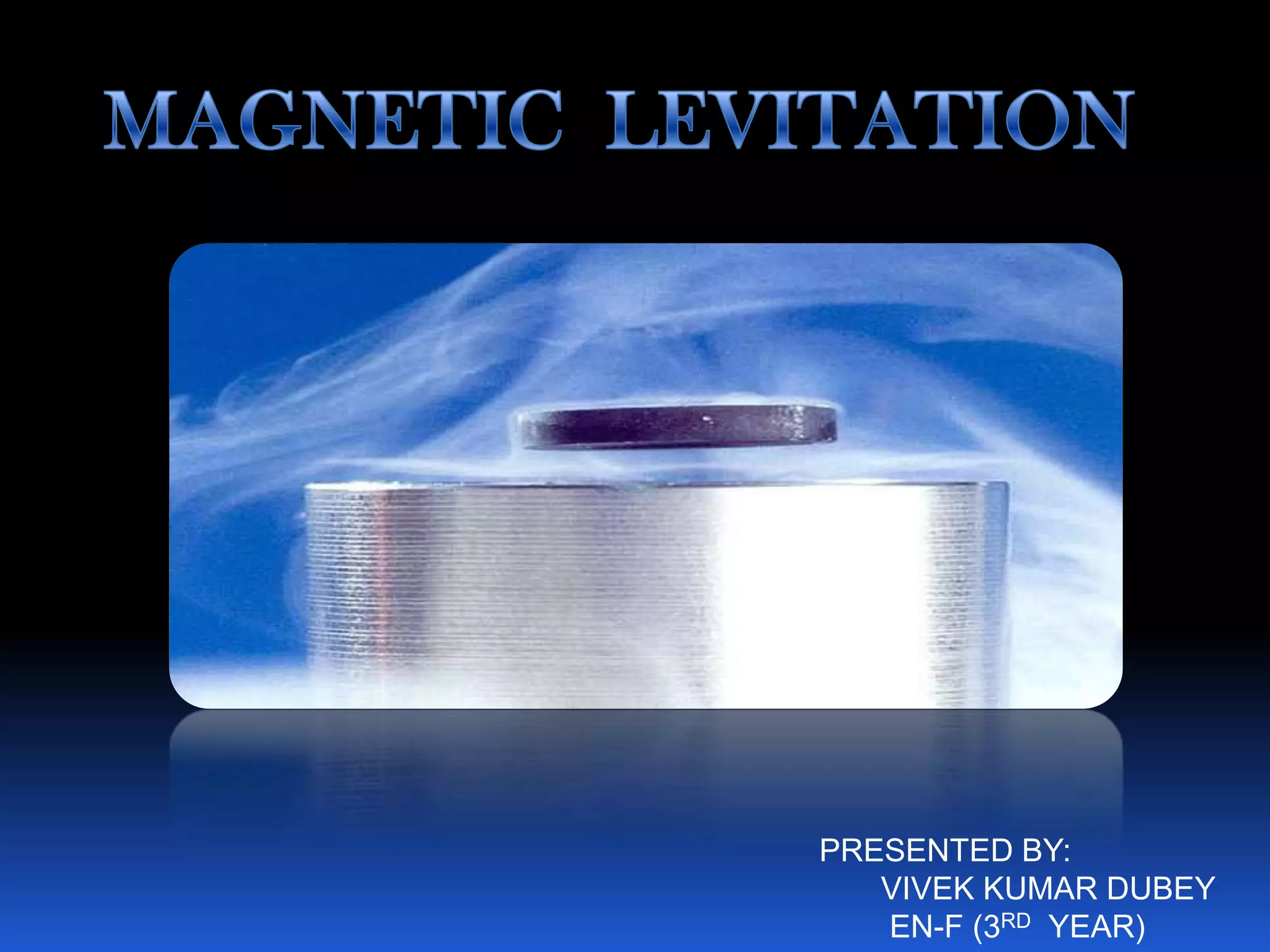
MAGNETIC  LEVITATIONPRESENTED BY:VIVEK KUMAR DUBEYEN-F (3RDYEAR)
Magnetic levitation, maglev, or magnetic suspension is a method by which an object is suspended above another objectwith no support other than magnetic field .The electromagnetic force is used to counteract the effects of the gravitational force.Direct Diamagnetic Levitation – How it WorksDiamagnetic materials repel a magnetic field All materials have diamagnetic properties, but the effect is very weak, and usually overcome by the object‘s paramagnetic or ferromagnetic properties, which act in the opposite mannerBy surrounding a diamagnetic material with a magnetic field, it can be held in a stationary position (the magnetic force is strong enough to counteract gravity)
Direct Diamagnetic Levitation – ApplicationsWater is primarily diamagnetic, so water droplets and objects that contain large amounts of water can be levitated
MAGLEV METHODS· Repulsion between like poles of permanent magnets orelectromagnets.· Repulsion between a magnet and a metallic conductorinduced by relative motion.· Repulsion between a metallic conductor and an ACelectromagnet.· Repulsion between a magnetic field and a diamagneticsubstance.· Repulsion between a magnet and a superconductor.· Attraction between unlike poles of permanent magnets orelectromagnets.· Attraction between the open core of an electromagneticsolenoid and a piece of iron or a magnet.· Attraction between a permanent magnet or electromagnetand a piece of iron.· Attraction between an electromagnet and a piece of iron ora magnet, with sensors and active control of the current tothe electromagnet used to maintain some distance betweenthem.· Repulsion between an electromagnet and a magnet, withsensors and active control of the current to theelectromagnet used to maintain some distance betweenthem.zMAGLEV METHODS· Repulsion between like poles of permanent magnets or electromagnets.
· Repulsion between a magnet and a metallic conductor induced by relative motion.
· Repulsion between a metallic conductor and an AC electromagnet.
· Repulsion between a magnetic field and a diamagnetic substance.
· Repulsion between a magnet and a superconductor.
· Attraction between unlike poles of      permanent magnets or electromagnets.· Attraction between the open core of an      electromagnetic solenoid and a piece of       iron or a magnet.· Attraction between a permanent magnet        or electromagnet and a piece of iron.
Super  LevitronTwo opposing neodymium-iron-boron permanent magnets.
 Invention by Roy Harrigan.
The rotation of a spinning object’s axis of spin creates a torroid of genuine stability.
The top remain levitating in a central point in space above the base where the forces acting on the top- gravitational, magnetic, and gyroscopic- are in equilibrium
Stops due to air resistanceWhy it works??? The principleTwo similar poles repel, and two different poles attract, with forces that are stronger when the poles are closer. There are four magnetic forces on the top. The north-north repulsion dominates, and the top is magnetically repelled. It hangs at the point of equilibrium where the total force is zero.”
The  FutureMagnetic Levitation
ApplicationsMaglev Trains- The magnetized coil running along the track, repels the large magnets on the train's undercarriage, allowing the train to levitateBiomagnetism- in MRI Particle accelerators to accelerate sub-atomic particles to nearly the speed of lightIn petaflop computers. A petaflop is a  thousand-trillion floating point operations per second.
NASAMaglev technology could give space vehicles a “running start” to break from Earth’s gravity
Maglev Space Propulsion Launching systems would use magnetic fields to levitate and accelerate a vehicle along a track .Reaching the end of the track,  the vehicle could switch to more conventional rocket engines.
The History Magnetic Levitation Vehicles

Magnetic levitation

  • 1.
    MAGNETIC LEVITATIONPRESENTEDBY:VIVEK KUMAR DUBEYEN-F (3RDYEAR)
  • 2.
    Magnetic levitation, maglev,or magnetic suspension is a method by which an object is suspended above another objectwith no support other than magnetic field .The electromagnetic force is used to counteract the effects of the gravitational force.Direct Diamagnetic Levitation – How it WorksDiamagnetic materials repel a magnetic field All materials have diamagnetic properties, but the effect is very weak, and usually overcome by the object‘s paramagnetic or ferromagnetic properties, which act in the opposite mannerBy surrounding a diamagnetic material with a magnetic field, it can be held in a stationary position (the magnetic force is strong enough to counteract gravity)
  • 4.
    Direct Diamagnetic Levitation– ApplicationsWater is primarily diamagnetic, so water droplets and objects that contain large amounts of water can be levitated
  • 5.
    MAGLEV METHODS· Repulsionbetween like poles of permanent magnets orelectromagnets.· Repulsion between a magnet and a metallic conductorinduced by relative motion.· Repulsion between a metallic conductor and an ACelectromagnet.· Repulsion between a magnetic field and a diamagneticsubstance.· Repulsion between a magnet and a superconductor.· Attraction between unlike poles of permanent magnets orelectromagnets.· Attraction between the open core of an electromagneticsolenoid and a piece of iron or a magnet.· Attraction between a permanent magnet or electromagnetand a piece of iron.· Attraction between an electromagnet and a piece of iron ora magnet, with sensors and active control of the current tothe electromagnet used to maintain some distance betweenthem.· Repulsion between an electromagnet and a magnet, withsensors and active control of the current to theelectromagnet used to maintain some distance betweenthem.zMAGLEV METHODS· Repulsion between like poles of permanent magnets or electromagnets.
  • 6.
    · Repulsion betweena magnet and a metallic conductor induced by relative motion.
  • 7.
    · Repulsion betweena metallic conductor and an AC electromagnet.
  • 8.
    · Repulsion betweena magnetic field and a diamagnetic substance.
  • 9.
    · Repulsion betweena magnet and a superconductor.
  • 10.
    · Attraction betweenunlike poles of permanent magnets or electromagnets.· Attraction between the open core of an electromagnetic solenoid and a piece of iron or a magnet.· Attraction between a permanent magnet or electromagnet and a piece of iron.
  • 11.
    Super LevitronTwoopposing neodymium-iron-boron permanent magnets.
  • 12.
    Invention byRoy Harrigan.
  • 13.
    The rotation ofa spinning object’s axis of spin creates a torroid of genuine stability.
  • 14.
    The top remainlevitating in a central point in space above the base where the forces acting on the top- gravitational, magnetic, and gyroscopic- are in equilibrium
  • 15.
    Stops due toair resistanceWhy it works??? The principleTwo similar poles repel, and two different poles attract, with forces that are stronger when the poles are closer. There are four magnetic forces on the top. The north-north repulsion dominates, and the top is magnetically repelled. It hangs at the point of equilibrium where the total force is zero.”
  • 16.
  • 17.
    ApplicationsMaglev Trains- Themagnetized coil running along the track, repels the large magnets on the train's undercarriage, allowing the train to levitateBiomagnetism- in MRI Particle accelerators to accelerate sub-atomic particles to nearly the speed of lightIn petaflop computers. A petaflop is a thousand-trillion floating point operations per second.
  • 18.
    NASAMaglev technology couldgive space vehicles a “running start” to break from Earth’s gravity
  • 19.
    Maglev Space PropulsionLaunching systems would use magnetic fields to levitate and accelerate a vehicle along a track .Reaching the end of the track, the vehicle could switch to more conventional rocket engines.
  • 20.
    The History MagneticLevitation Vehicles
  • 21.
    1750 – JohnMitchell conducted the first experiments measuring the magnetic forces between the poles of a magnet .
  • 22.
    1900 –Robert Goddard and Emile Bachelet conceive the concept of frictionless trains.
  • 23.
    1969 – Americanscientist James R. Powell and Gordan T. Danby patented the first design for Maglev trains.1990 – The initial phase of the Yamanashi Maglev Test Line commences.
  • 24.
    Magnetic Levitation WindTurbineMaximum overall efficiency of windmill is 30%.The remaining energy is mainly lost in friction. If the same windmill is operating at 50% of its maximum speed the efficiency becomes very low.
  • 25.
    Due towear and tear performance of the machine deteriorates.
  • 26.
    Normal windmill canstart its generation from wind speed of 3 m/s. But windmill using magnetic levitation can start generation from wind speed of 1.5m/s.
  • 27.
    ADVANTAGES OF MAGLEVtransportationNosurface contact or friction to slow them down. More speed = More passengers. Faster trips
  • 28.
  • 29.
    Petroleum independence withrespect to air and auto as a result of being electricallypowered..
  • 30.
  • 31.
    Potential for high capacities at 3-4 minutes headways. High safety.
  • 32.
    Convenient– due tohigh frequency of service, vibration free train rides and quieter. At speeds below 249.4 kmph the noise produced by Maglev trains is less than that by conventional trains. At speeds above 155 mph, most of the noise produced by vehicle is of aerodynamic origin, whether it is on rail or levitated.
  • 33.
    Thank you…..

Editor's Notes