
Presentation on
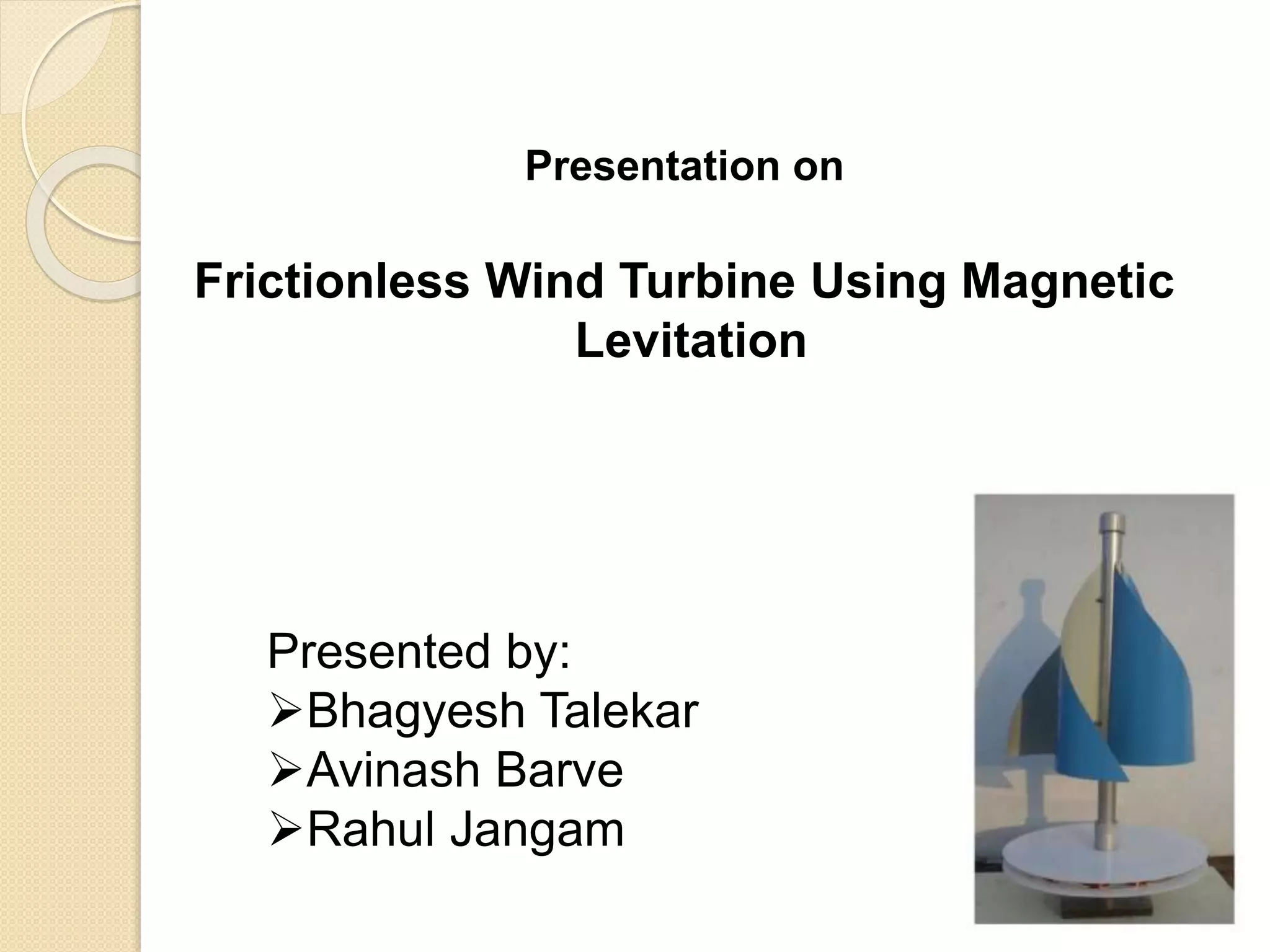
Frictionless Wind Turbine Using Magnetic
Levitation
Presented by:
Bhagyesh Talekar
Avinash Barve
Rahul Jangam
Introduction
 The project focuses on the utilization of wind
energy as renewable source which produces
clean and safe source of electricity.
 A Wind Turbine is a device that converts that
converts the wind’s kinetic energy into
mechanical power. Generators helps to convert
mechanical power into electrical energy.
 The project dwells on implementation of a
vertical axis wind turbine for the power
generation by using magnetic levitation.
 A vertical axis wind turbine (VAWT) is
introduced by magnetic levitation technology
to raise the performance.
 Maglev Wind Turbine was first presented at
the Wind Power Asia Exhibition in Beijing
2007.
Magnetic Levitation
 Magnetic levitation (Maglev) is a method by
which an object is suspended without any
support with the help of the strong magnetic
field.
 The repulsive force of magnets used for
reduction of effect of gravitational force
significantly.
 Magnetic force is used for reducing of
gravitational force and to lift up the objects in
air.
 By this technique implementation of this
vertical axis wind turbine is used for having
negligible friction.
Why we choose a vertical axis
turbine ?
 Works at lower wind speed.
 Wind direction does not
matter.
 VAWT is popular and
different unique concept can
be implemented at any size.
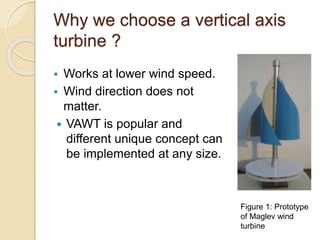
Figure 1: Prototype
of Maglev wind
turbine
Objective
The objectives of our experiment setup
are as follows:
• CAD design of various components
• Fabrication of individual components of
the setup obtained from local market
• Assembly of VAWT
• Testing of Experimental setup
• Result
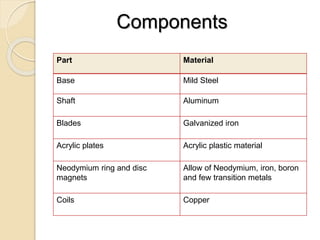
Part Material
Base Mild Steel
Shaft Aluminum
Blades Galvanized iron
Acrylic plates Acrylic plastic material
Neodymium ring and disc
magnets
Allow of Neodymium, iron, boron
and few transition metals
Coils Copper
Components
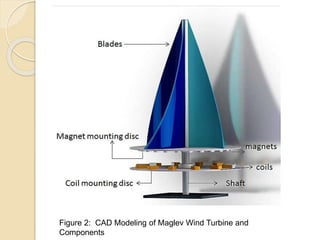
Figure 2: CAD Modeling of Maglev Wind Turbine and
Components
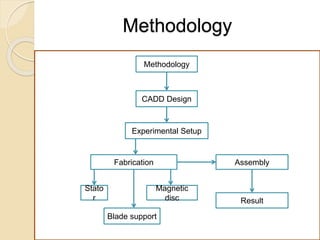
Methodology
Methodology
CADD Design
Experimental Setup
Fabrication
Stato
r
Blade support
Magnetic
disc
Assembly
Result
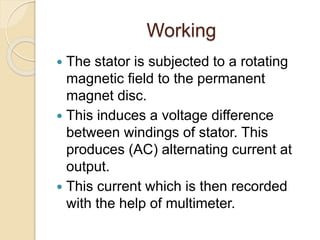
Working
 The stator is subjected to a rotating
magnetic field to the permanent
magnet disc.
 This induces a voltage difference
between windings of stator. This
produces (AC) alternating current at
output.
 This current which is then recorded
with the help of multimeter.
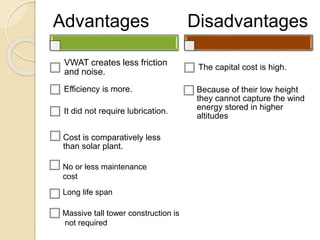
Advantages
VWAT creates less friction
and noise.
Efficiency is more.
It did not require lubrication.
Cost is comparatively less
than solar plant.
Disadvantages
The capital cost is high.
Because of their low height
they cannot capture the wind
energy stored in higher
altitudes
No or less maintenance
cost
Long life span
Massive tall tower construction is
not required
Result and Conclusion
0
5
10
15
20
25
30
25 50 75 100 120 150 200 250 300 350
O/PVOLTAGEINV
SPEED OF TURBINE IN RPM
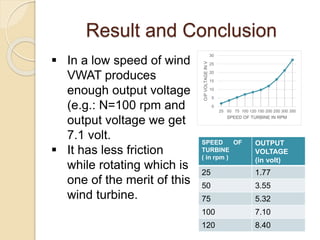
 In a low speed of wind
VWAT produces
enough output voltage
(e.g.: N=100 rpm and
output voltage we get
7.1 volt.
 It has less friction
while rotating which is
one of the merit of this
wind turbine.
SPEED OF
TURBINE
( in rpm )
OUTPUT
VOLTAGE
(in volt)
25 1.77
50 3.55
75 5.32
100 7.10
120 8.40
 We done our literature survey and market
survey on VAWT and also understood in the
future most of our energy source will be depend
on wind energy.
 We had made a prototype model and try to
mentioned it to look like a original model.
 Capital cost is high, in future by using other
reliable material its cost should be minimize.
Future scope for MVAWT
 It will well suited for green building.
 For power generation of electricity in
rural areas.
 It can be used in areas where wind
speed is low
Thank
you...

Friction Less Wind Turbine Using Magnetic Levitation

  • 1.
    Presentation on Frictionless WindTurbine Using Magnetic Levitation Presented by: Bhagyesh Talekar Avinash Barve Rahul Jangam
  • 2.
    Introduction  The projectfocuses on the utilization of wind energy as renewable source which produces clean and safe source of electricity.  A Wind Turbine is a device that converts that converts the wind’s kinetic energy into mechanical power. Generators helps to convert mechanical power into electrical energy.  The project dwells on implementation of a vertical axis wind turbine for the power generation by using magnetic levitation.
  • 3.
     A verticalaxis wind turbine (VAWT) is introduced by magnetic levitation technology to raise the performance.  Maglev Wind Turbine was first presented at the Wind Power Asia Exhibition in Beijing 2007.
  • 4.
    Magnetic Levitation  Magneticlevitation (Maglev) is a method by which an object is suspended without any support with the help of the strong magnetic field.  The repulsive force of magnets used for reduction of effect of gravitational force significantly.  Magnetic force is used for reducing of gravitational force and to lift up the objects in air.  By this technique implementation of this vertical axis wind turbine is used for having negligible friction.
  • 5.
    Why we choosea vertical axis turbine ?  Works at lower wind speed.  Wind direction does not matter.  VAWT is popular and different unique concept can be implemented at any size. Figure 1: Prototype of Maglev wind turbine
  • 6.
    Objective The objectives ofour experiment setup are as follows: • CAD design of various components • Fabrication of individual components of the setup obtained from local market • Assembly of VAWT • Testing of Experimental setup • Result
  • 7.
    Part Material Base MildSteel Shaft Aluminum Blades Galvanized iron Acrylic plates Acrylic plastic material Neodymium ring and disc magnets Allow of Neodymium, iron, boron and few transition metals Coils Copper Components
  • 8.
    Figure 2: CADModeling of Maglev Wind Turbine and Components
  • 9.
  • 10.
    Working  The statoris subjected to a rotating magnetic field to the permanent magnet disc.  This induces a voltage difference between windings of stator. This produces (AC) alternating current at output.  This current which is then recorded with the help of multimeter.
  • 11.
    Advantages VWAT creates lessfriction and noise. Efficiency is more. It did not require lubrication. Cost is comparatively less than solar plant. Disadvantages The capital cost is high. Because of their low height they cannot capture the wind energy stored in higher altitudes No or less maintenance cost Long life span Massive tall tower construction is not required
  • 12.
    Result and Conclusion 0 5 10 15 20 25 30 2550 75 100 120 150 200 250 300 350 O/PVOLTAGEINV SPEED OF TURBINE IN RPM  In a low speed of wind VWAT produces enough output voltage (e.g.: N=100 rpm and output voltage we get 7.1 volt.  It has less friction while rotating which is one of the merit of this wind turbine. SPEED OF TURBINE ( in rpm ) OUTPUT VOLTAGE (in volt) 25 1.77 50 3.55 75 5.32 100 7.10 120 8.40
  • 13.
     We doneour literature survey and market survey on VAWT and also understood in the future most of our energy source will be depend on wind energy.  We had made a prototype model and try to mentioned it to look like a original model.  Capital cost is high, in future by using other reliable material its cost should be minimize.
  • 14.
    Future scope forMVAWT  It will well suited for green building.  For power generation of electricity in rural areas.  It can be used in areas where wind speed is low
  • 15.