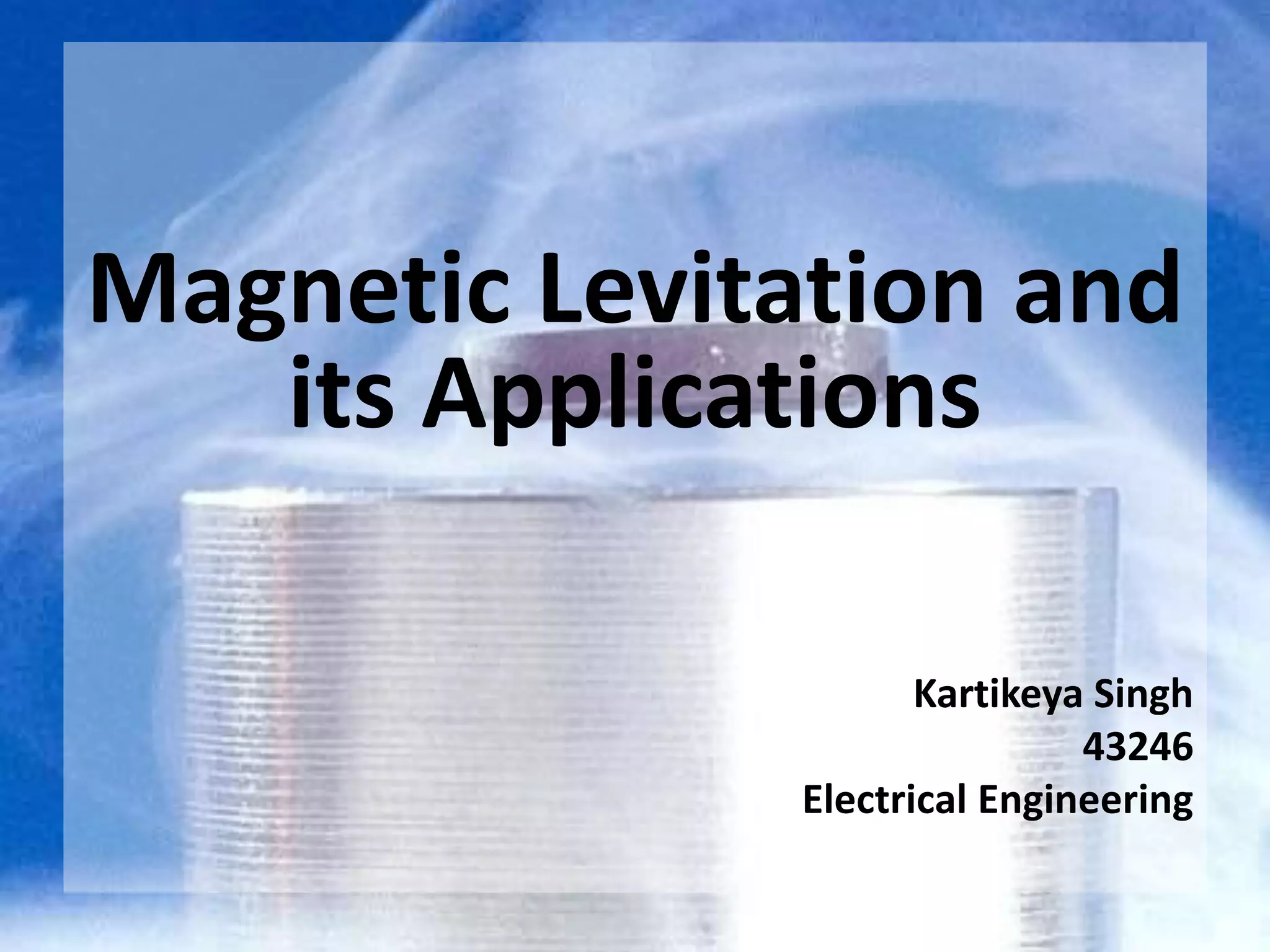
Magnetic Levitation and
its Applications
Kartikeya Singh
43246
Electrical Engineering
Contents
1. Introduction
2. Types of Levitation
3. Fundamental Principle
4. Maglev Applications
5. Maglev Trains
6. Wind Turbines
7. Maglev Space Propulsion
8. Maglev Bearing
9. Conclusion
10. References
Introduction
• Magnetic Levitation, or Maglev, is a method by
which an object is suspended above another object
without any support other than magnetic field.
• The electromagnetic force is used to counteract the
effects of the gravitational force.
Types of Levitation
• Mechanical constraint
• Direct Diamagnetic Levitation
• Superconductors
Fundamental Principle
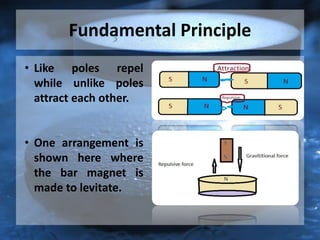
• Like poles repel
while unlike poles
attract each other.
• One arrangement is
shown here where
the bar magnet is
made to levitate.
Maglev Applications
1. Maglev Trains
2. Wind Turbines
3. Maglev Space Propulsion
4. Maglev Bearing
Maglev Trains
Technology Used
• Uses magnets to reach a really high velocity.
• Floats about 1-10cm above the Guideway on a
magnetic field.
• The Electro-magnets run the entire length of the
Guideway which propel the train in the forward
direction.
• Once the train is pulled into the next section, the
magnetism switches so that the train is pulled on
again.
Maglev Trains (Continued)
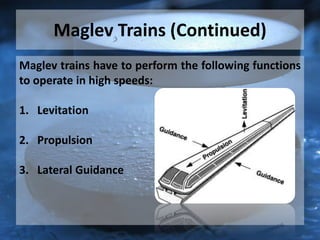
Maglev trains have to perform the following functions
to operate in high speeds:
1. Levitation
2. Propulsion
3. Lateral Guidance
Maglev Trains (Continued)
Types of Maglev Technology
There are mainly two types of Maglev technologies
used for the levitation purpose:
• Electromagnetic Suspension (EMS)
• Electrodynamic Suspension (EDS)
Maglev Trains (Continued)
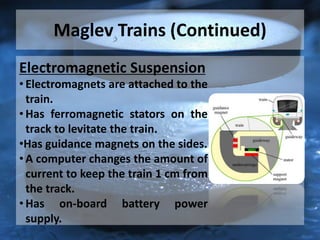
Electromagnetic Suspension
• Electromagnets are attached to the
train.
• Has ferromagnetic stators on the
track to levitate the train.
•Has guidance magnets on the sides.
• A computer changes the amount of
current to keep the train 1 cm from
the track.
• Has on-board battery power
supply.
Maglev Trains (Continued)
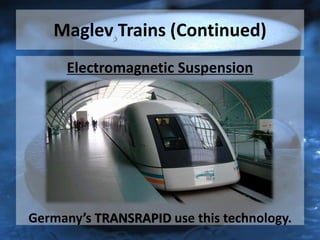
Electromagnetic Suspension
Germany’s TRANSRAPID use this technology.
Maglev Trains (Continued)
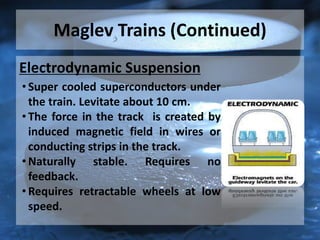
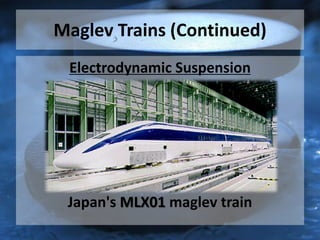
Electrodynamic Suspension
• Super cooled superconductors under
the train. Levitate about 10 cm.
• The force in the track is created by
induced magnetic field in wires or
conducting strips in the track.
• Naturally stable. Requires no
feedback.
• Requires retractable wheels at low
speed.
Maglev Trains (Continued)
Electrodynamic Suspension
Japan's MLX01 maglev train
Maglev Trains (Continued)
Propulsion
•The propulsion coils located on the sidewalls on both
sides of the guideway are energized by a three-phase
alternating current from a substation, creating a
shifting magnetic field on the guideway.
•The on-board superconducting magnets are attracted
and pushed by the shifting field, propelling the
Maglev vehicle.
Maglev Trains (Continued)
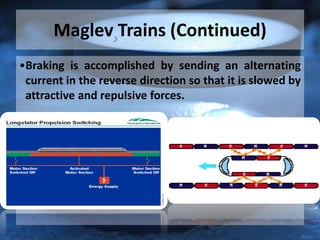
•Braking is accomplished by sending an alternating
current in the reverse direction so that it is slowed by
attractive and repulsive forces.
Maglev Trains (Continued)
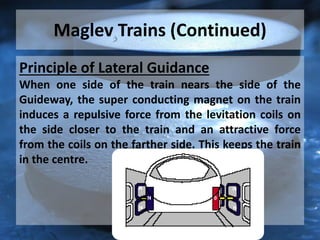
Principle of Lateral Guidance
When one side of the train nears the side of the
Guideway, the super conducting magnet on the train
induces a repulsive force from the levitation coils on
the side closer to the train and an attractive force
from the coils on the farther side. This keeps the train
in the centre.
Maglev Trains (Continued)
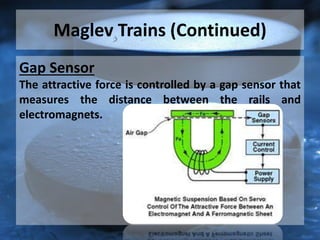
Gap Sensor
The attractive force is controlled by a gap sensor that
measures the distance between the rails and
electromagnets.
Maglev Trains (Continued)
Comparison with Ordinary Trains
• Less polluting.
• Maglev uses 30% less energy than a high-speed train
travelling at the same speed.
• Require no engine.
• Move faster than normal trains because they are not
affected by ground friction.
Maglev Trains (Continued)
• Incompatible with existing rail lines, unlike
traditional high-speed rail.
• Research has shown that the maglev is about 20
times safer than airplanes, 250 times safer than
conventional railroads and 700 times safer than
automobile travel.
• Maglev vehicle carries no fuel to increase fire hazard.
• Initial cost is very high ($20-$40 million per mile).
Wind Turbines
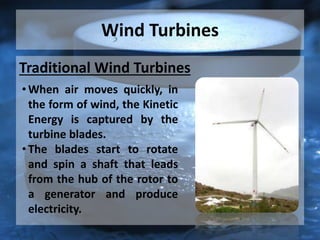
Traditional Wind Turbines
• When air moves quickly, in
the form of wind, the Kinetic
Energy is captured by the
turbine blades.
• The blades start to rotate
and spin a shaft that leads
from the hub of the rotor to
a generator and produce
electricity.
Wind Turbines (Continued)
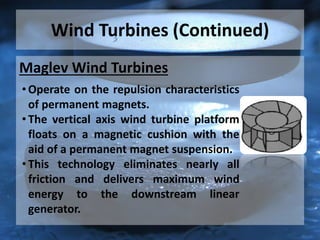
Maglev Wind Turbines
• Operate on the repulsion characteristics
of permanent magnets.
• The vertical axis wind turbine platform
floats on a magnetic cushion with the
aid of a permanent magnet suspension.
• This technology eliminates nearly all
friction and delivers maximum wind
energy to the downstream linear
generator.
Wind Turbines (Continued)
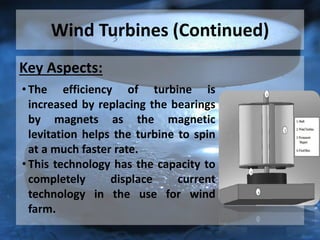
Key Aspects:
• The efficiency of turbine is
increased by replacing the bearings
by magnets as the magnetic
levitation helps the turbine to spin
at a much faster rate.
• This technology has the capacity to
completely displace current
technology in the use for wind
farm.
Wind Turbines (Continued)
Advantages of Maglev Wind Turbines:
• A massive tower structure is not required, as they
are mounted closer to the ground.
• They are located closer to the ground and hence
easier to maintain.
• Require no lubrication.
• Capable of generating power from wind speeds as
low as 1.5 m/s.
• Produce 20% more energy than a conventional
turbine in the same time, thus decreasing
operational costs by 50%.
Maglev Space Propulsion
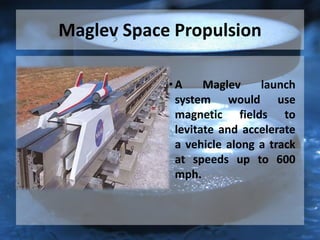
• A Maglev launch
system would use
magnetic fields to
levitate and accelerate
a vehicle along a track
at speeds up to 600
mph.
Maglev Space Propulsion (Continued)
• The vehicle would shift to rocket engines for
launching into orbit.
• Maglev systems could dramatically reduce the cost of
getting into space because they are powered by
electricity, an inexpensive energy source that stays
on the ground- unlike rocket fuel that adds weight
and cost to a launch vehicle.
Maglev Bearing
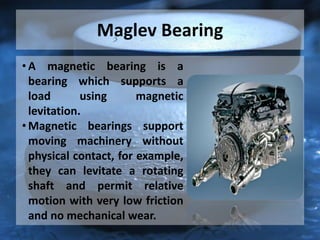
• A magnetic bearing is a
bearing which supports a
load using magnetic
levitation.
• Magnetic bearings support
moving machinery without
physical contact, for example,
they can levitate a rotating
shaft and permit relative
motion with very low friction
and no mechanical wear.
Conclusion
• Magnetic levitation is a very advantageous
technology with promising future scopes to be used
in almost every field.
• Although it is yet to be completely explored, even
the existing technology can significantly develop our
life to a great extent.
References
1. http://www.howstuffworks.com/
2. https://en.wikipedia.org/wiki/Magnetic_levitation
3. MAGLEV WIND TURBINE- Kiryan S.S. Scientific
supervisor– Associate Professor Gavrilina L.E.
Siberian Federal University.
4. Review of Maglev Train Technologies- Hyung-Woo
Lee , Ki-Chan Kim and Ju Lee
Thank You...!!!

Magnetic levitation

  • 1.
    Magnetic Levitation and itsApplications Kartikeya Singh 43246 Electrical Engineering
  • 2.
    Contents 1. Introduction 2. Typesof Levitation 3. Fundamental Principle 4. Maglev Applications 5. Maglev Trains 6. Wind Turbines 7. Maglev Space Propulsion 8. Maglev Bearing 9. Conclusion 10. References
  • 3.
    Introduction • Magnetic Levitation,or Maglev, is a method by which an object is suspended above another object without any support other than magnetic field. • The electromagnetic force is used to counteract the effects of the gravitational force.
  • 4.
    Types of Levitation •Mechanical constraint • Direct Diamagnetic Levitation • Superconductors
  • 5.
    Fundamental Principle • Likepoles repel while unlike poles attract each other. • One arrangement is shown here where the bar magnet is made to levitate.
  • 6.
    Maglev Applications 1. MaglevTrains 2. Wind Turbines 3. Maglev Space Propulsion 4. Maglev Bearing
  • 7.
    Maglev Trains Technology Used •Uses magnets to reach a really high velocity. • Floats about 1-10cm above the Guideway on a magnetic field. • The Electro-magnets run the entire length of the Guideway which propel the train in the forward direction. • Once the train is pulled into the next section, the magnetism switches so that the train is pulled on again.
  • 8.
    Maglev Trains (Continued) Maglevtrains have to perform the following functions to operate in high speeds: 1. Levitation 2. Propulsion 3. Lateral Guidance
  • 9.
    Maglev Trains (Continued) Typesof Maglev Technology There are mainly two types of Maglev technologies used for the levitation purpose: • Electromagnetic Suspension (EMS) • Electrodynamic Suspension (EDS)
  • 10.
    Maglev Trains (Continued) ElectromagneticSuspension • Electromagnets are attached to the train. • Has ferromagnetic stators on the track to levitate the train. •Has guidance magnets on the sides. • A computer changes the amount of current to keep the train 1 cm from the track. • Has on-board battery power supply.
  • 11.
    Maglev Trains (Continued) ElectromagneticSuspension Germany’s TRANSRAPID use this technology.
  • 12.
    Maglev Trains (Continued) ElectrodynamicSuspension • Super cooled superconductors under the train. Levitate about 10 cm. • The force in the track is created by induced magnetic field in wires or conducting strips in the track. • Naturally stable. Requires no feedback. • Requires retractable wheels at low speed.
  • 13.
    Maglev Trains (Continued) ElectrodynamicSuspension Japan's MLX01 maglev train
  • 14.
    Maglev Trains (Continued) Propulsion •Thepropulsion coils located on the sidewalls on both sides of the guideway are energized by a three-phase alternating current from a substation, creating a shifting magnetic field on the guideway. •The on-board superconducting magnets are attracted and pushed by the shifting field, propelling the Maglev vehicle.
  • 15.
    Maglev Trains (Continued) •Brakingis accomplished by sending an alternating current in the reverse direction so that it is slowed by attractive and repulsive forces.
  • 16.
    Maglev Trains (Continued) Principleof Lateral Guidance When one side of the train nears the side of the Guideway, the super conducting magnet on the train induces a repulsive force from the levitation coils on the side closer to the train and an attractive force from the coils on the farther side. This keeps the train in the centre.
  • 17.
    Maglev Trains (Continued) GapSensor The attractive force is controlled by a gap sensor that measures the distance between the rails and electromagnets.
  • 18.
    Maglev Trains (Continued) Comparisonwith Ordinary Trains • Less polluting. • Maglev uses 30% less energy than a high-speed train travelling at the same speed. • Require no engine. • Move faster than normal trains because they are not affected by ground friction.
  • 19.
    Maglev Trains (Continued) •Incompatible with existing rail lines, unlike traditional high-speed rail. • Research has shown that the maglev is about 20 times safer than airplanes, 250 times safer than conventional railroads and 700 times safer than automobile travel. • Maglev vehicle carries no fuel to increase fire hazard. • Initial cost is very high ($20-$40 million per mile).
  • 20.
    Wind Turbines Traditional WindTurbines • When air moves quickly, in the form of wind, the Kinetic Energy is captured by the turbine blades. • The blades start to rotate and spin a shaft that leads from the hub of the rotor to a generator and produce electricity.
  • 21.
    Wind Turbines (Continued) MaglevWind Turbines • Operate on the repulsion characteristics of permanent magnets. • The vertical axis wind turbine platform floats on a magnetic cushion with the aid of a permanent magnet suspension. • This technology eliminates nearly all friction and delivers maximum wind energy to the downstream linear generator.
  • 22.
    Wind Turbines (Continued) KeyAspects: • The efficiency of turbine is increased by replacing the bearings by magnets as the magnetic levitation helps the turbine to spin at a much faster rate. • This technology has the capacity to completely displace current technology in the use for wind farm.
  • 23.
    Wind Turbines (Continued) Advantagesof Maglev Wind Turbines: • A massive tower structure is not required, as they are mounted closer to the ground. • They are located closer to the ground and hence easier to maintain. • Require no lubrication. • Capable of generating power from wind speeds as low as 1.5 m/s. • Produce 20% more energy than a conventional turbine in the same time, thus decreasing operational costs by 50%.
  • 24.
    Maglev Space Propulsion •A Maglev launch system would use magnetic fields to levitate and accelerate a vehicle along a track at speeds up to 600 mph.
  • 25.
    Maglev Space Propulsion(Continued) • The vehicle would shift to rocket engines for launching into orbit. • Maglev systems could dramatically reduce the cost of getting into space because they are powered by electricity, an inexpensive energy source that stays on the ground- unlike rocket fuel that adds weight and cost to a launch vehicle.
  • 26.
    Maglev Bearing • Amagnetic bearing is a bearing which supports a load using magnetic levitation. • Magnetic bearings support moving machinery without physical contact, for example, they can levitate a rotating shaft and permit relative motion with very low friction and no mechanical wear.
  • 27.
    Conclusion • Magnetic levitationis a very advantageous technology with promising future scopes to be used in almost every field. • Although it is yet to be completely explored, even the existing technology can significantly develop our life to a great extent.
  • 28.
    References 1. http://www.howstuffworks.com/ 2. https://en.wikipedia.org/wiki/Magnetic_levitation 3.MAGLEV WIND TURBINE- Kiryan S.S. Scientific supervisor– Associate Professor Gavrilina L.E. Siberian Federal University. 4. Review of Maglev Train Technologies- Hyung-Woo Lee , Ki-Chan Kim and Ju Lee
  • 29.