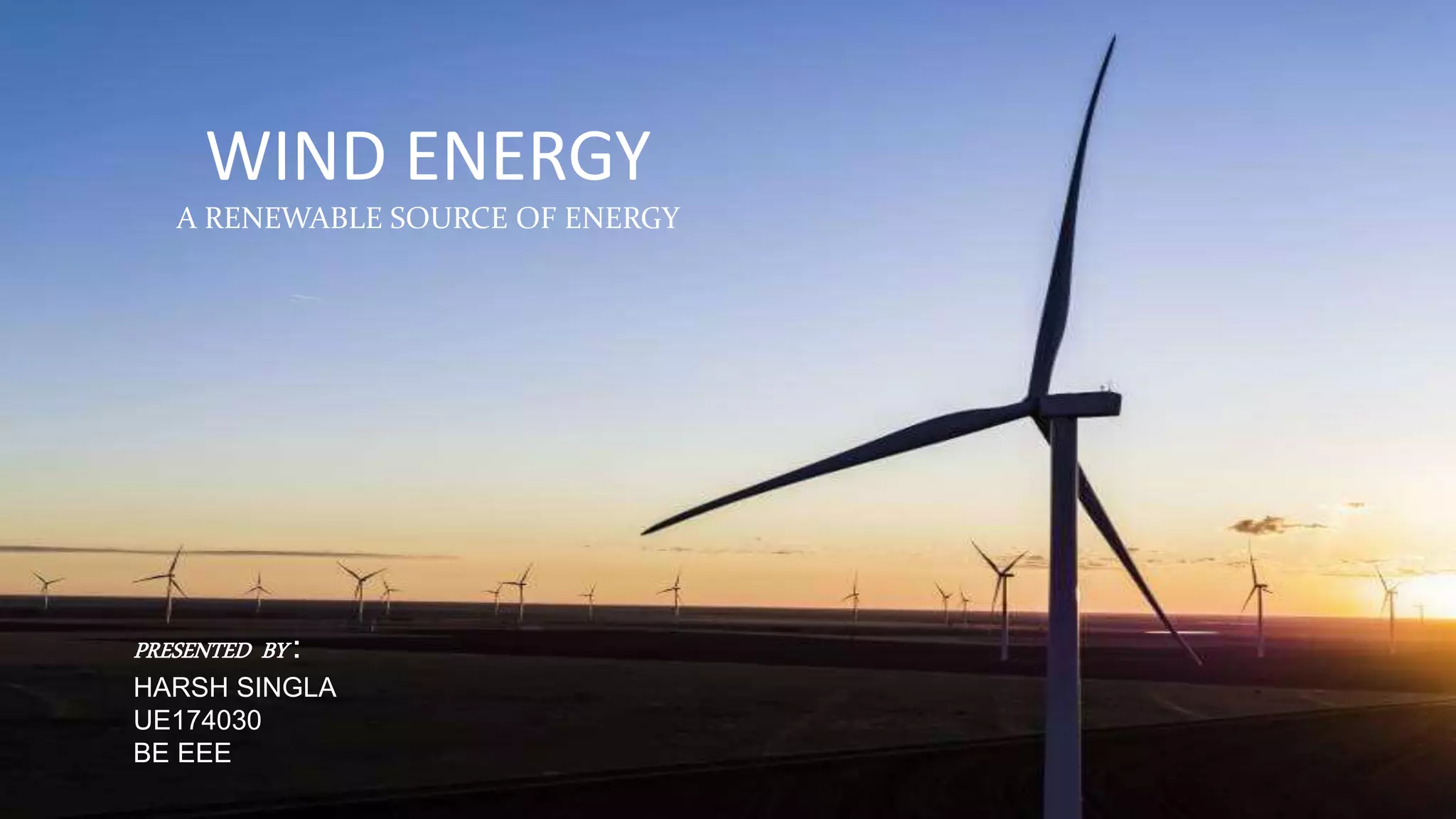
WIND ENERGY
A RENEWABLE SOURCE OF ENERGY
PRESENTED BY :
HARSH SINGLA
UE174030
BE EEE
INTRODUCTION
 Wind energy is a source of renewable energy. It does not contaminate, it is
inexhaustible and reduces the use of fossil fuels, which are the origin of
greenhouse gasses that cause global warming.
 In addition, wind energy is a “native” energy, because it is available practically
everywhere on the plant, which contributes to reducing energy imports and to
creating wealth and local employment.
 For these reasons, producing electricity through wind energy and its efficient
use contributes to sustainable development.
HISTORY
 Wind-powered machines used to grind grain and pump water. The windmill and wind
pump, were developed in what is now Iran, Afghanistan, India and Pakistan by the 9th
century.
 By 1000AD windmills are used for pumping seawater to make salt in China and Sicily.
 The First Windmill used for the production of electric power was built in Scotland in July
1887 by Prof James Blyth of Anderson’s College, Glasgow .
 By 2000 Global Wind Power Capacity reaches 17,400 MWs.
 2009 - The first floating off-shore wind turbine was installed outside Karmoy, Norway, by
Statoil. The 2.3 MW wind turbine was designed by Siemens and more of these wind
turbines were planned to be installed in the North Sea.
WIND TURBINES
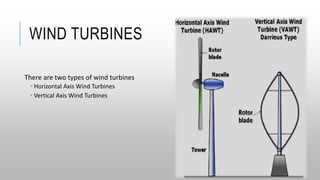
There are two types of wind turbines
 Horizontal Axis Wind Turbines
 Vertical Axis Wind Turbines
HORIZONTAL AXIS WIND
TURBINES (HAWTS)
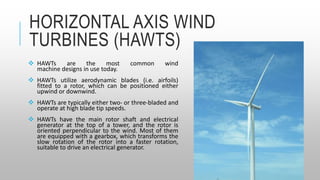
 HAWTs are the most common wind
machine designs in use today.
 HAWTs utilize aerodynamic blades (i.e. airfoils)
fitted to a rotor, which can be positioned either
upwind or downwind.
 HAWTs are typically either two- or three-bladed and
operate at high blade tip speeds.
 HAWTs have the main rotor shaft and electrical
generator at the top of a tower, and the rotor is
oriented perpendicular to the wind. Most of them
are equipped with a gearbox, which transforms the
slow rotation of the rotor into a faster rotation,
suitable to drive an electrical generator.
VERTICAL AXIS WIND TURBINES
(VAWTS)
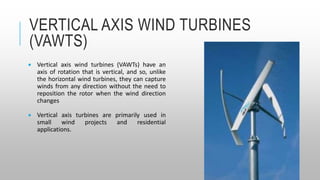
 Vertical axis wind turbines (VAWTs) have an
axis of rotation that is vertical, and so, unlike
the horizontal wind turbines, they can capture
winds from any direction without the need to
reposition the rotor when the wind direction
changes
 Vertical axis turbines are primarily used in
small wind projects and residential
applications.
Components of Wind Power
Plant
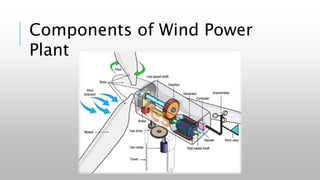
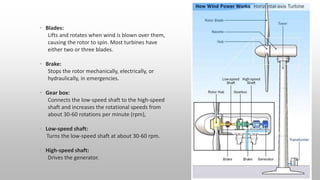
• Blades:
Lifts and rotates when wind is blown over them,
causing the rotor to spin. Most turbines have
either two or three blades.
• Brake:
Stops the rotor mechanically, electrically, or
hydraulically, in emergencies.
• Gear box:
Connects the low-speed shaft to the high-speed
shaft and increases the rotational speeds from
about 30-60 rotations per minute (rpm),
• Low-speed shaft:
Turns the low-speed shaft at about 30-60 rpm.
• High-speed shaft:
Drives the generator.
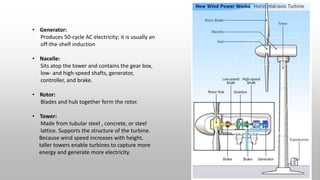
• Generator:
Produces 50-cycle AC electricity; it is usually an
off-the-shelf induction
• Nacelle:
Sits atop the tower and contains the gear box,
low- and high-speed shafts, generator,
controller, and brake.
• Rotor:
Blades and hub together form the rotor.
• Tower:
Made from tubular steel , concrete, or steel
lattice. Supports the structure of the turbine.
Because wind speed increases with height,
taller towers enable turbines to capture more
energy and generate more electricity.
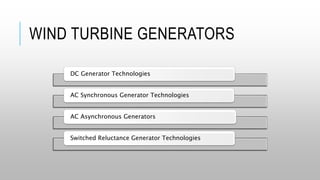
WIND TURBINE GENERATORS
DC Generator Technologies
AC Synchronous Generator Technologies
AC Asynchronous Generators
Switched Reluctance Generator Technologies
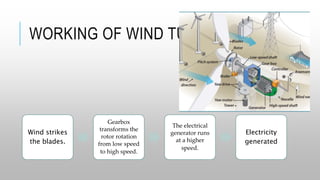
WORKING OF WIND TURBINE
Wind strikes
the blades.
Gearbox
transforms the
rotor rotation
from low speed
to high speed.
The electrical
generator runs
at a higher
speed.
Electricity
generated
CHARACTERISTIC OF SUITABLE
WIND POWER SITE
A high average wind speed.
Sufficient separation from noise-sensitive neighbours.
Good grid connection.
Good site access.
No special environmental or landscape designations.
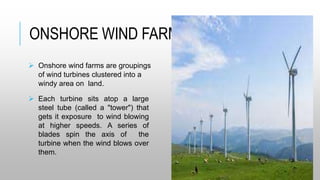
ONSHORE WIND FARMS:
 Onshore wind farms are groupings
of wind turbines clustered into a
windy area on land.
 Each turbine sits atop a large
steel tube (called a "tower") that
gets it exposure to wind blowing
at higher speeds. A series of
blades spin the axis of the
turbine when the wind blows over
them.
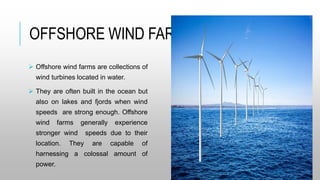
OFFSHORE WIND FARMS
 Offshore wind farms are collections of
wind turbines located in water.
 They are often built in the ocean but
also on lakes and fjords when wind
speeds are strong enough. Offshore
wind farms generally experience
stronger wind speeds due to their
location. They are capable of
harnessing a colossal amount of
power.
POWER
The power available from the wind is proportional to the cube of the wind speed. This means:
If the wind speed were 2 times greater, the power available from the wind would be 8 times greater.
FACTORS AFFECTING
POWER
The number of blades
The length of the blades
The shape of the blades
The mass (weight) of the blades
The pitch (angle) of the blades to the wind
The height of the tower
The gears used
The type of generator used
The computer system that controls the operation of the turbine and its power output
EFFICIENCY
Wind turbines do not produce electricity all the time. Although the wind might be available
for as much as 70 % of the time, it is often not strong enough to operate the wind turbine at
full capacity. The combination of absence of wind and inadequate wind strength means that
even in a good location the wind turbine, over the course of a year, will generate only about
30 % of the amount it could generate in a constant strong wind.
A good site might have a 35 % capacity factor. This means that the turbines will produce 35%
of their capacity on average over a year.
POWER PRODUCTION IN INDIA
 India’s wind energy sector is led by indigenous wind power industry.
 The country currently has the fourth highest wind installed capacity in the world with
total installed capacity of 35.6 GW (as on 31st March 2019) and has generated around
52.66 Billion Units during 2017-18.
 The Government is promoting wind power projects in entire country through private
sector investment.
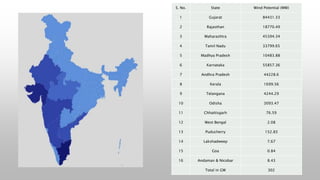
S. No. State Wind Potential (MW)
1 Gujarat 84431.33
2 Rajasthan 18770.49
3 Maharashtra 45394.34
4 Tamil Nadu 33799.65
5 Madhya Pradesh 10483.88
6 Karnataka 55857.36
7 Andhra Pradesh 44228.6
8 Kerala 1699.56
9 Telangana 4244.29
10 Odisha 3093.47
11 Chhattisgarh 76.59
12 West Bengal 2.08
13 Puducherry 152.83
14 Lakshadweep 7.67
15 Goa 0.84
16 Andaman & Nicobar 8.43
Total in GW 302
ADVANTAGES OF WIND
TURBINES
 They are a renewable energy resource.
 They do not emit greenhouse gases or any other pollution.
 They are more energy efficient than most power stations that burn fossil fuels.
 They are less costly to run than many other energy resources.
 They can be established in remote areas where other energy resources are not practical, even in
places like Antarctica and on ocean-going yachts.
DISADVANTAGES OF WIND
TURBINES
 The electrical power delivered varies because wind speed and direction vary. Sometimes the
wind speed is too low to even start rotation. Therefore they can only be used to provide some
of the electrical power people need.
 They can be damaged by very strong winds and also corroded by salt in the air when near the
sea.
 It can be costly to connect them to the electricity grid, due to the distances involved.
 They need to have flashing lights on the top to warn the pilots of any aircraft that fly overhead
of their presence. People who live close by sometimes complain the flashing lights disturb
their sleep.
 In many countries, most wind turbines are constructed off-shore, usually because people do
not want them across the land. This is a much more expensive location, because the turbines
are more costly to install and to maintain, because of problems such as corrosion of metal
parts by sea water and damage from the constant movement of waves and sand. This means
the electricity they generate is more expensive than that generated by coal-fired power
stations.
 There may be an impact on local bird populations.
THANK YOU

Wind Energy

  • 1.
    WIND ENERGY A RENEWABLESOURCE OF ENERGY PRESENTED BY : HARSH SINGLA UE174030 BE EEE
  • 2.
    INTRODUCTION  Wind energyis a source of renewable energy. It does not contaminate, it is inexhaustible and reduces the use of fossil fuels, which are the origin of greenhouse gasses that cause global warming.  In addition, wind energy is a “native” energy, because it is available practically everywhere on the plant, which contributes to reducing energy imports and to creating wealth and local employment.  For these reasons, producing electricity through wind energy and its efficient use contributes to sustainable development.
  • 3.
    HISTORY  Wind-powered machinesused to grind grain and pump water. The windmill and wind pump, were developed in what is now Iran, Afghanistan, India and Pakistan by the 9th century.  By 1000AD windmills are used for pumping seawater to make salt in China and Sicily.  The First Windmill used for the production of electric power was built in Scotland in July 1887 by Prof James Blyth of Anderson’s College, Glasgow .  By 2000 Global Wind Power Capacity reaches 17,400 MWs.  2009 - The first floating off-shore wind turbine was installed outside Karmoy, Norway, by Statoil. The 2.3 MW wind turbine was designed by Siemens and more of these wind turbines were planned to be installed in the North Sea.
  • 4.
    WIND TURBINES There aretwo types of wind turbines  Horizontal Axis Wind Turbines  Vertical Axis Wind Turbines
  • 5.
    HORIZONTAL AXIS WIND TURBINES(HAWTS)  HAWTs are the most common wind machine designs in use today.  HAWTs utilize aerodynamic blades (i.e. airfoils) fitted to a rotor, which can be positioned either upwind or downwind.  HAWTs are typically either two- or three-bladed and operate at high blade tip speeds.  HAWTs have the main rotor shaft and electrical generator at the top of a tower, and the rotor is oriented perpendicular to the wind. Most of them are equipped with a gearbox, which transforms the slow rotation of the rotor into a faster rotation, suitable to drive an electrical generator.
  • 6.
    VERTICAL AXIS WINDTURBINES (VAWTS)  Vertical axis wind turbines (VAWTs) have an axis of rotation that is vertical, and so, unlike the horizontal wind turbines, they can capture winds from any direction without the need to reposition the rotor when the wind direction changes  Vertical axis turbines are primarily used in small wind projects and residential applications.
  • 7.
    Components of WindPower Plant
  • 8.
    • Blades: Lifts androtates when wind is blown over them, causing the rotor to spin. Most turbines have either two or three blades. • Brake: Stops the rotor mechanically, electrically, or hydraulically, in emergencies. • Gear box: Connects the low-speed shaft to the high-speed shaft and increases the rotational speeds from about 30-60 rotations per minute (rpm), • Low-speed shaft: Turns the low-speed shaft at about 30-60 rpm. • High-speed shaft: Drives the generator.
  • 9.
    • Generator: Produces 50-cycleAC electricity; it is usually an off-the-shelf induction • Nacelle: Sits atop the tower and contains the gear box, low- and high-speed shafts, generator, controller, and brake. • Rotor: Blades and hub together form the rotor. • Tower: Made from tubular steel , concrete, or steel lattice. Supports the structure of the turbine. Because wind speed increases with height, taller towers enable turbines to capture more energy and generate more electricity.
  • 10.
    WIND TURBINE GENERATORS DCGenerator Technologies AC Synchronous Generator Technologies AC Asynchronous Generators Switched Reluctance Generator Technologies
  • 11.
    WORKING OF WINDTURBINE Wind strikes the blades. Gearbox transforms the rotor rotation from low speed to high speed. The electrical generator runs at a higher speed. Electricity generated
  • 12.
    CHARACTERISTIC OF SUITABLE WINDPOWER SITE A high average wind speed. Sufficient separation from noise-sensitive neighbours. Good grid connection. Good site access. No special environmental or landscape designations.
  • 13.
    ONSHORE WIND FARMS: Onshore wind farms are groupings of wind turbines clustered into a windy area on land.  Each turbine sits atop a large steel tube (called a "tower") that gets it exposure to wind blowing at higher speeds. A series of blades spin the axis of the turbine when the wind blows over them.
  • 14.
    OFFSHORE WIND FARMS Offshore wind farms are collections of wind turbines located in water.  They are often built in the ocean but also on lakes and fjords when wind speeds are strong enough. Offshore wind farms generally experience stronger wind speeds due to their location. They are capable of harnessing a colossal amount of power.
  • 15.
    POWER The power availablefrom the wind is proportional to the cube of the wind speed. This means: If the wind speed were 2 times greater, the power available from the wind would be 8 times greater. FACTORS AFFECTING POWER The number of blades The length of the blades The shape of the blades The mass (weight) of the blades The pitch (angle) of the blades to the wind The height of the tower The gears used The type of generator used The computer system that controls the operation of the turbine and its power output
  • 16.
    EFFICIENCY Wind turbines donot produce electricity all the time. Although the wind might be available for as much as 70 % of the time, it is often not strong enough to operate the wind turbine at full capacity. The combination of absence of wind and inadequate wind strength means that even in a good location the wind turbine, over the course of a year, will generate only about 30 % of the amount it could generate in a constant strong wind. A good site might have a 35 % capacity factor. This means that the turbines will produce 35% of their capacity on average over a year.
  • 17.
    POWER PRODUCTION ININDIA  India’s wind energy sector is led by indigenous wind power industry.  The country currently has the fourth highest wind installed capacity in the world with total installed capacity of 35.6 GW (as on 31st March 2019) and has generated around 52.66 Billion Units during 2017-18.  The Government is promoting wind power projects in entire country through private sector investment.
  • 18.
    S. No. StateWind Potential (MW) 1 Gujarat 84431.33 2 Rajasthan 18770.49 3 Maharashtra 45394.34 4 Tamil Nadu 33799.65 5 Madhya Pradesh 10483.88 6 Karnataka 55857.36 7 Andhra Pradesh 44228.6 8 Kerala 1699.56 9 Telangana 4244.29 10 Odisha 3093.47 11 Chhattisgarh 76.59 12 West Bengal 2.08 13 Puducherry 152.83 14 Lakshadweep 7.67 15 Goa 0.84 16 Andaman & Nicobar 8.43 Total in GW 302
  • 19.
    ADVANTAGES OF WIND TURBINES They are a renewable energy resource.  They do not emit greenhouse gases or any other pollution.  They are more energy efficient than most power stations that burn fossil fuels.  They are less costly to run than many other energy resources.  They can be established in remote areas where other energy resources are not practical, even in places like Antarctica and on ocean-going yachts.
  • 20.
    DISADVANTAGES OF WIND TURBINES The electrical power delivered varies because wind speed and direction vary. Sometimes the wind speed is too low to even start rotation. Therefore they can only be used to provide some of the electrical power people need.  They can be damaged by very strong winds and also corroded by salt in the air when near the sea.  It can be costly to connect them to the electricity grid, due to the distances involved.  They need to have flashing lights on the top to warn the pilots of any aircraft that fly overhead of their presence. People who live close by sometimes complain the flashing lights disturb their sleep.  In many countries, most wind turbines are constructed off-shore, usually because people do not want them across the land. This is a much more expensive location, because the turbines are more costly to install and to maintain, because of problems such as corrosion of metal parts by sea water and damage from the constant movement of waves and sand. This means the electricity they generate is more expensive than that generated by coal-fired power stations.  There may be an impact on local bird populations.
  • 21.