RENEWABLE ENERGY
DEFINATION:
Energy obtained from natural and persistent flows
of energy occurring in the immediate environment
Such energy may also be called Green Energy or
Sustainable Energy.
EXAMPLE:
• Solar energy.
• Wind energy.
The Wind Energy Resource
 The wind is an abundant, free, clean,
sustainable and environmentally-friendly
renewable energy source. It has served the
human civilization for many centuries by
propelling ships and driving windmills to grind
grain and pump water, and nowadays also for
electrical power production (Johnson, 2006).
 Wind energy is extracted from kinetic wind
power.
History of Wind Uses
Wind as source of energy has been in use by
humans for many centuries
Following are the ways :
 About 5000 years ago used by Egyptians
as sailing ships and boats .
 The first windmill machines were also used
around 2000 years B.C., in ancient Babylon
and China,
WIND TURBINE
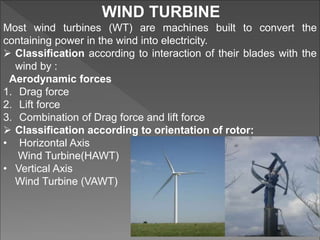
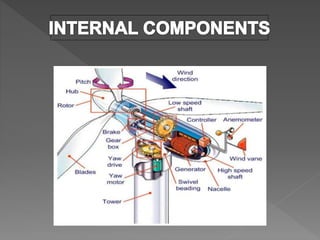
Most wind turbines (WT) are machines built to convert the
containing power in the wind into electricity.
 Classification according to interaction of their blades with the
wind by :
Aerodynamic forces
1. Drag force
2. Lift force
3. Combination of Drag force and lift force
 Classification according to orientation of rotor:
• Horizontal Axis
Wind Turbine(HAWT)
• Vertical Axis
Wind Turbine (VAWT)
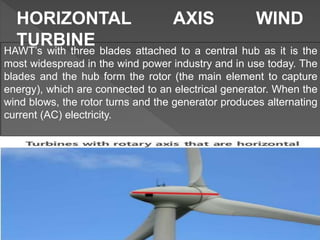
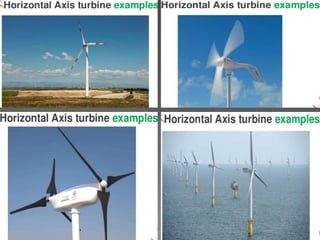
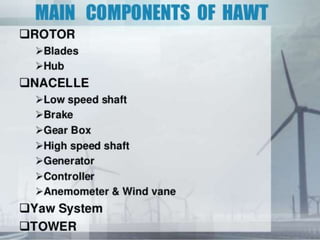
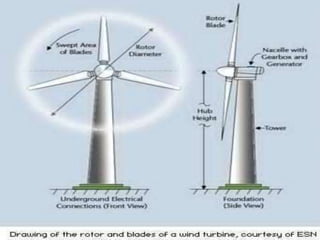
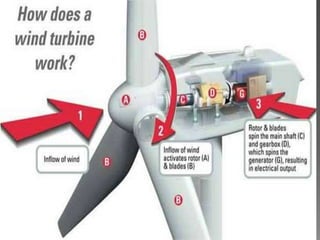
HAWT’s with three blades attached to a central hub as it is the
most widespread in the wind power industry and in use today. The
blades and the hub form the rotor (the main element to capture
energy), which are connected to an electrical generator. When the
wind blows, the rotor turns and the generator produces alternating
current (AC) electricity.
HORIZONTAL AXIS WIND
TURBINE
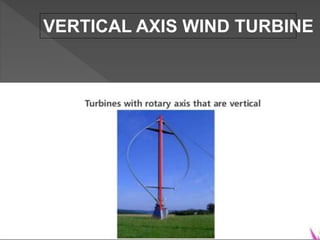
VERTICAL AXIS WIND TURBINE
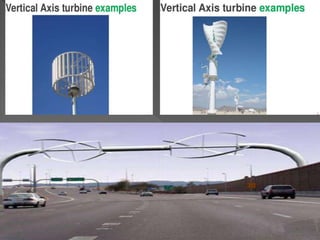
 Although vertical axis wind turbines have
existed for centuries, they are not as common
as their horizontal counterparts. The main
reason for this is that they do not take
advantage of the higher wind speeds at
higher elevations above the ground as well as
horizontal axis turbines
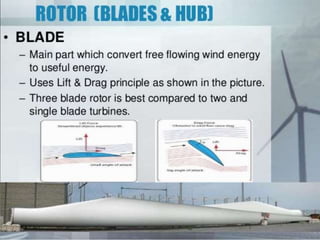
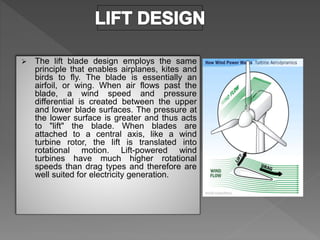
 The lift blade design employs the same
principle that enables airplanes, kites and
birds to fly. The blade is essentially an
airfoil, or wing. When air flows past the
blade, a wind speed and pressure
differential is created between the upper
and lower blade surfaces. The pressure at
the lower surface is greater and thus acts
to "lift" the blade. When blades are
attached to a central axis, like a wind
turbine rotor, the lift is translated into
rotational motion. Lift-powered wind
turbines have much higher rotational
speeds than drag types and therefore are
well suited for electricity generation.
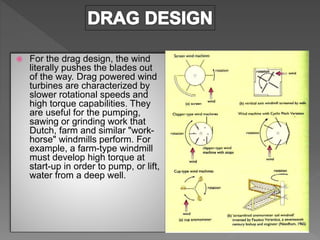
 For the drag design, the wind
literally pushes the blades out
of the way. Drag powered wind
turbines are characterized by
slower rotational speeds and
high torque capabilities. They
are useful for the pumping,
sawing or grinding work that
Dutch, farm and similar "work-
horse" windmills perform. For
example, a farm-type windmill
must develop high torque at
start-up in order to pump, or lift,
water from a deep well.
 Cup Anemometer
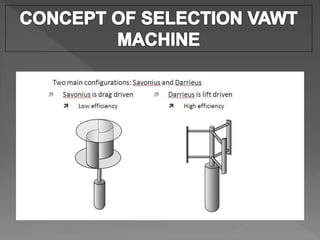
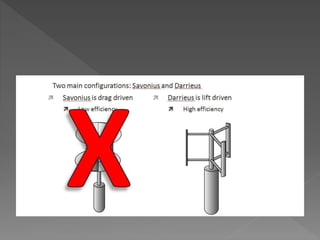
 Savonius Rotor
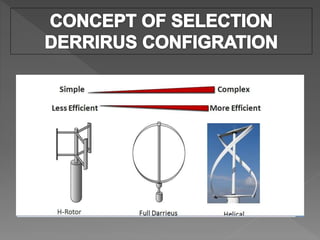
 Darrieus Rotor
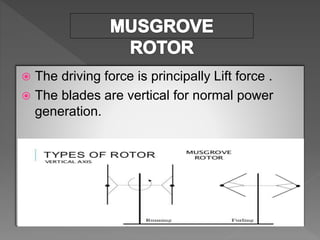
 Musgrove Rotor
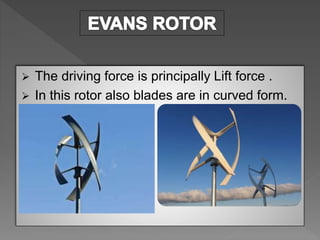
 Evans Rotor
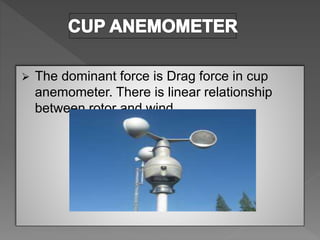
 The dominant force is Drag force in cup
anemometer. There is linear relationship
between rotor and wind.
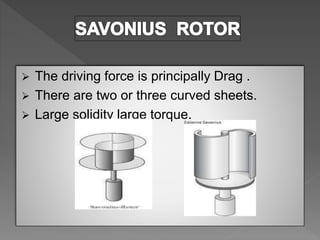
 The driving force is principally Drag .
 There are two or three curved sheets.
 Large solidity large torque.
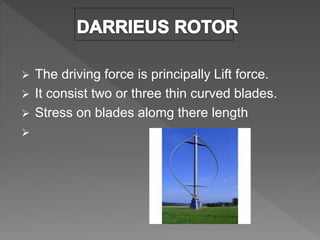
 The driving force is principally Lift force.
 It consist two or three thin curved blades.
 Stress on blades alomg there length

 The driving force is principally Lift force .
 The blades are vertical for normal power
generation.
 The driving force is principally Lift force .
 In this rotor also blades are in curved form.
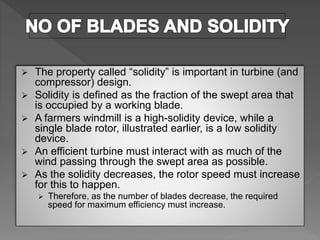
 The property called “solidity” is important in turbine (and
compressor) design.
 Solidity is defined as the fraction of the swept area that
is occupied by a working blade.
 A farmers windmill is a high-solidity device, while a
single blade rotor, illustrated earlier, is a low solidity
device.
 An efficient turbine must interact with as much of the
wind passing through the swept area as possible.
 As the solidity decreases, the rotor speed must increase
for this to happen.
 Therefore, as the number of blades decrease, the required
speed for maximum efficiency must increase.
 The generator and gearbox can be placed
on the ground
 The structure is usually simpler.
 You do not need a yaw (pointing)
mechanism to turn the rotor against the
wind.
 These are easier for hobbyists to build – little
detailed knowledge of aerodynamics is
needed for simple designs.
 These structures are low to the ground, where wind
speeds are lowest.
 The overall efficiency is much lower than horizontal
axis machines.
 Most vertical axis machines are not self starting.
 Many vertical axis machines require guy wires
which greatly increase the structural footprint.
 Maintenance is usually more difficult.
 For example, replacement of the generator typically
requires disassembly of the entire machine.

Wind power system

  • 2.
    RENEWABLE ENERGY DEFINATION: Energy obtainedfrom natural and persistent flows of energy occurring in the immediate environment Such energy may also be called Green Energy or Sustainable Energy. EXAMPLE: • Solar energy. • Wind energy.
  • 3.
    The Wind EnergyResource  The wind is an abundant, free, clean, sustainable and environmentally-friendly renewable energy source. It has served the human civilization for many centuries by propelling ships and driving windmills to grind grain and pump water, and nowadays also for electrical power production (Johnson, 2006).  Wind energy is extracted from kinetic wind power.
  • 4.
    History of WindUses Wind as source of energy has been in use by humans for many centuries Following are the ways :  About 5000 years ago used by Egyptians as sailing ships and boats .  The first windmill machines were also used around 2000 years B.C., in ancient Babylon and China,
  • 5.
    WIND TURBINE Most windturbines (WT) are machines built to convert the containing power in the wind into electricity.  Classification according to interaction of their blades with the wind by : Aerodynamic forces 1. Drag force 2. Lift force 3. Combination of Drag force and lift force  Classification according to orientation of rotor: • Horizontal Axis Wind Turbine(HAWT) • Vertical Axis Wind Turbine (VAWT)
  • 6.
    HAWT’s with threeblades attached to a central hub as it is the most widespread in the wind power industry and in use today. The blades and the hub form the rotor (the main element to capture energy), which are connected to an electrical generator. When the wind blows, the rotor turns and the generator produces alternating current (AC) electricity. HORIZONTAL AXIS WIND TURBINE
  • 28.
  • 30.
     Although verticalaxis wind turbines have existed for centuries, they are not as common as their horizontal counterparts. The main reason for this is that they do not take advantage of the higher wind speeds at higher elevations above the ground as well as horizontal axis turbines
  • 31.
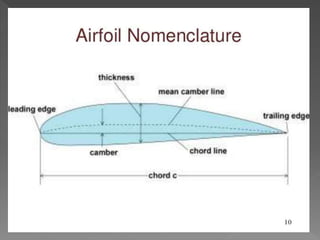
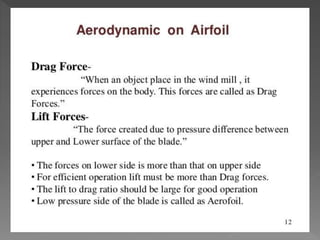
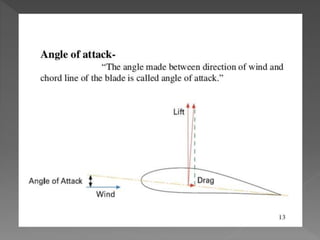
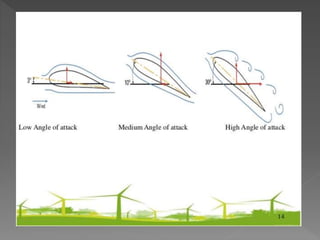
     The liftblade design employs the same principle that enables airplanes, kites and birds to fly. The blade is essentially an airfoil, or wing. When air flows past the blade, a wind speed and pressure differential is created between the upper and lower blade surfaces. The pressure at the lower surface is greater and thus acts to "lift" the blade. When blades are attached to a central axis, like a wind turbine rotor, the lift is translated into rotational motion. Lift-powered wind turbines have much higher rotational speeds than drag types and therefore are well suited for electricity generation.
  • 32.
     For thedrag design, the wind literally pushes the blades out of the way. Drag powered wind turbines are characterized by slower rotational speeds and high torque capabilities. They are useful for the pumping, sawing or grinding work that Dutch, farm and similar "work- horse" windmills perform. For example, a farm-type windmill must develop high torque at start-up in order to pump, or lift, water from a deep well.
  • 33.
     Cup Anemometer Savonius Rotor  Darrieus Rotor  Musgrove Rotor  Evans Rotor
  • 34.
     The dominantforce is Drag force in cup anemometer. There is linear relationship between rotor and wind.
  • 35.
     The drivingforce is principally Drag .  There are two or three curved sheets.  Large solidity large torque.
  • 36.
     The drivingforce is principally Lift force.  It consist two or three thin curved blades.  Stress on blades alomg there length 
  • 37.
     The drivingforce is principally Lift force .  The blades are vertical for normal power generation.
  • 38.
     The drivingforce is principally Lift force .  In this rotor also blades are in curved form.
  • 42.
     The propertycalled “solidity” is important in turbine (and compressor) design.  Solidity is defined as the fraction of the swept area that is occupied by a working blade.  A farmers windmill is a high-solidity device, while a single blade rotor, illustrated earlier, is a low solidity device.  An efficient turbine must interact with as much of the wind passing through the swept area as possible.  As the solidity decreases, the rotor speed must increase for this to happen.  Therefore, as the number of blades decrease, the required speed for maximum efficiency must increase.
  • 43.
     The generatorand gearbox can be placed on the ground  The structure is usually simpler.  You do not need a yaw (pointing) mechanism to turn the rotor against the wind.  These are easier for hobbyists to build – little detailed knowledge of aerodynamics is needed for simple designs.
  • 44.
     These structuresare low to the ground, where wind speeds are lowest.  The overall efficiency is much lower than horizontal axis machines.  Most vertical axis machines are not self starting.  Many vertical axis machines require guy wires which greatly increase the structural footprint.  Maintenance is usually more difficult.  For example, replacement of the generator typically requires disassembly of the entire machine.