ALTERNATE ENERGY IN THE TRACTIONS
L.SARAVANAN#
, P.SIVA SANKARI*, J.P.ANISH JABIN@
#*@
Department of Electrical and Electronics Jayaram College of Engineering and Technology, Trichy, India
#
lrsnpng@gmail.com
*tulasi.vt@gmail.com
@
jobin899anish@gmail.com
Abstract— The fuel requirements of the world are
increasing at an alarming rate and the source demand has been
running ahead of supply. Due to the population and development
activities increases, the requirement of the fuel will also increase.
So we need to look for the alternative of conventional sources
and the best alternative of conventional sources are the non-
conventional sources of energy which are also called renewable
source of energy. In this paper, the alternate potential in
tractions AET is investigated. The innovative method of
generating wind energy in a fast moving traction is one of the
best methods and it eliminate lot of problems facing in railways
today.
Keywords— Fuel demand, Population growth, Conventional
sources, Non-conventional sources, AET, Wind energy in
traction.
I. INTRODUCTION
The wind is a free, clean, and inexhaustible energy
source. By generating wind energy in a fast moving traction in
one of the new innovation in wind power production and also
alternate energy to traction. By placing the wind turbine on
the traction it will very efficient method to produce the energy
which has been used for inter purpose also. The main aim of
this innovation is to provide a method and a system for
generating electricity by using high wind pressure generated
in moving vehicles, using free renewable input namely air.
Wind energy is cheap, non-polluting, and capable of providing
enough electricity.
II. WIND ENERGY
The wind has been used to power sailing ships for
many centuries. many countries owed their prosperity to their
skill in sailing. the new world was explored by wind powered
ships. indeed, wind was almost the only source of power for
ships until watt invented the steam engine in the 18th century.
denmark was the first country to use the wind for generation
of electricity. the danes were using a 23 m diameter wind
turbine in 1890 to generate electricity. by 1910, several
hundred units with capacities of 5 to 25 kw were in operation
in denmark. other countries also continued wind research for a
longer period of time. the worldwide wind capacity reached
282’275 megawatt, out of which 44’609 megawatt were added
in 2012, more than ever before. wind power showed a growth
rate of 19, 2%, the lowest rate in more than a decade.
Altogether, 100 countries and regions used wind power for
electricity generation. Since many years, the wind industry has
been driven by the Big Five markets: China, USA, Germany,
Spain, and India.
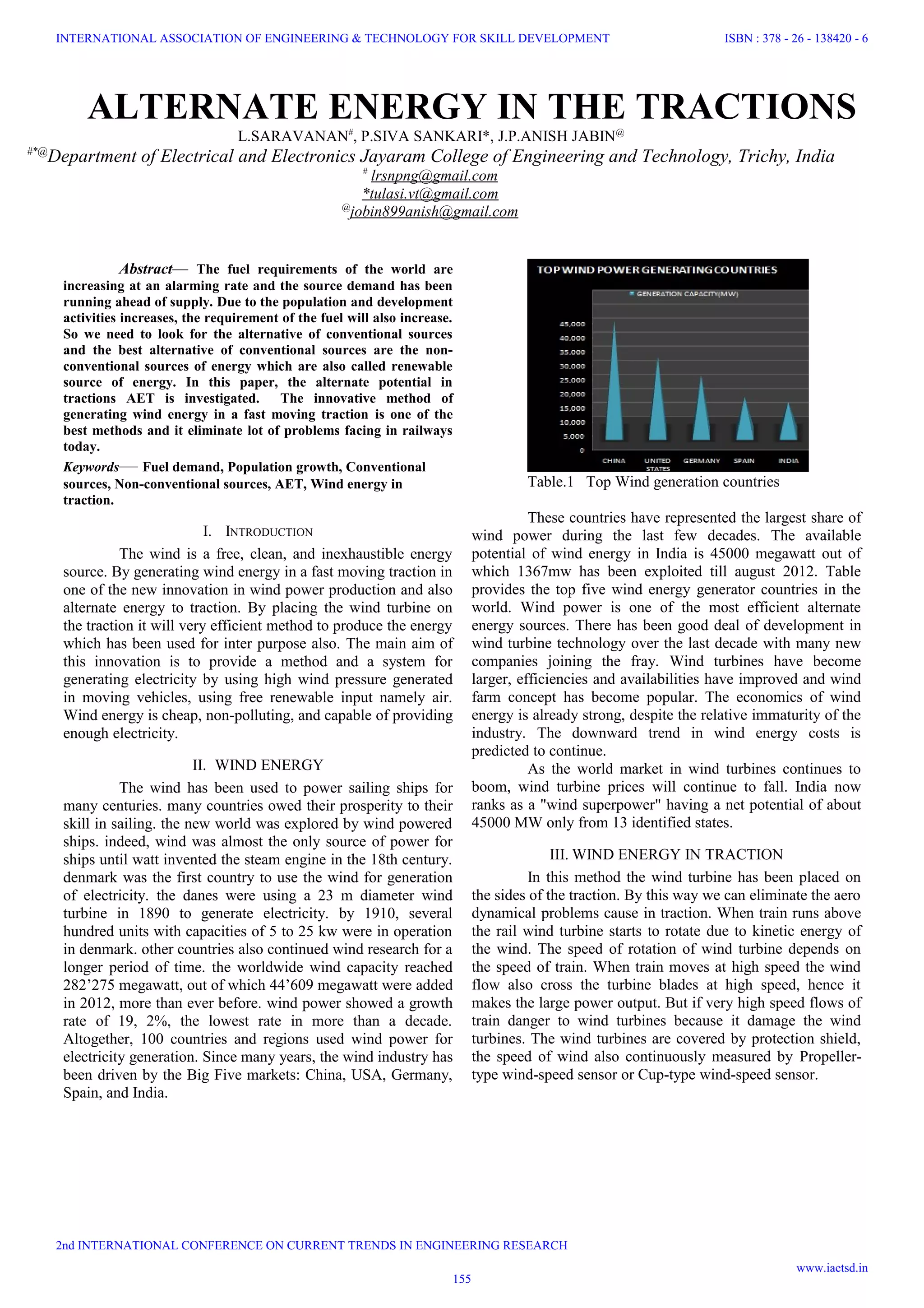
Table.1 Top Wind generation countries
These countries have represented the largest share of
wind power during the last few decades. The available
potential of wind energy in India is 45000 megawatt out of
which 1367mw has been exploited till august 2012. Table
provides the top five wind energy generator countries in the
world. Wind power is one of the most efficient alternate
energy sources. There has been good deal of development in
wind turbine technology over the last decade with many new
companies joining the fray. Wind turbines have become
larger, efficiencies and availabilities have improved and wind
farm concept has become popular. The economics of wind
energy is already strong, despite the relative immaturity of the
industry. The downward trend in wind energy costs is
predicted to continue.
As the world market in wind turbines continues to
boom, wind turbine prices will continue to fall. India now
ranks as a "wind superpower" having a net potential of about
45000 MW only from 13 identified states.
III. WIND ENERGY IN TRACTION
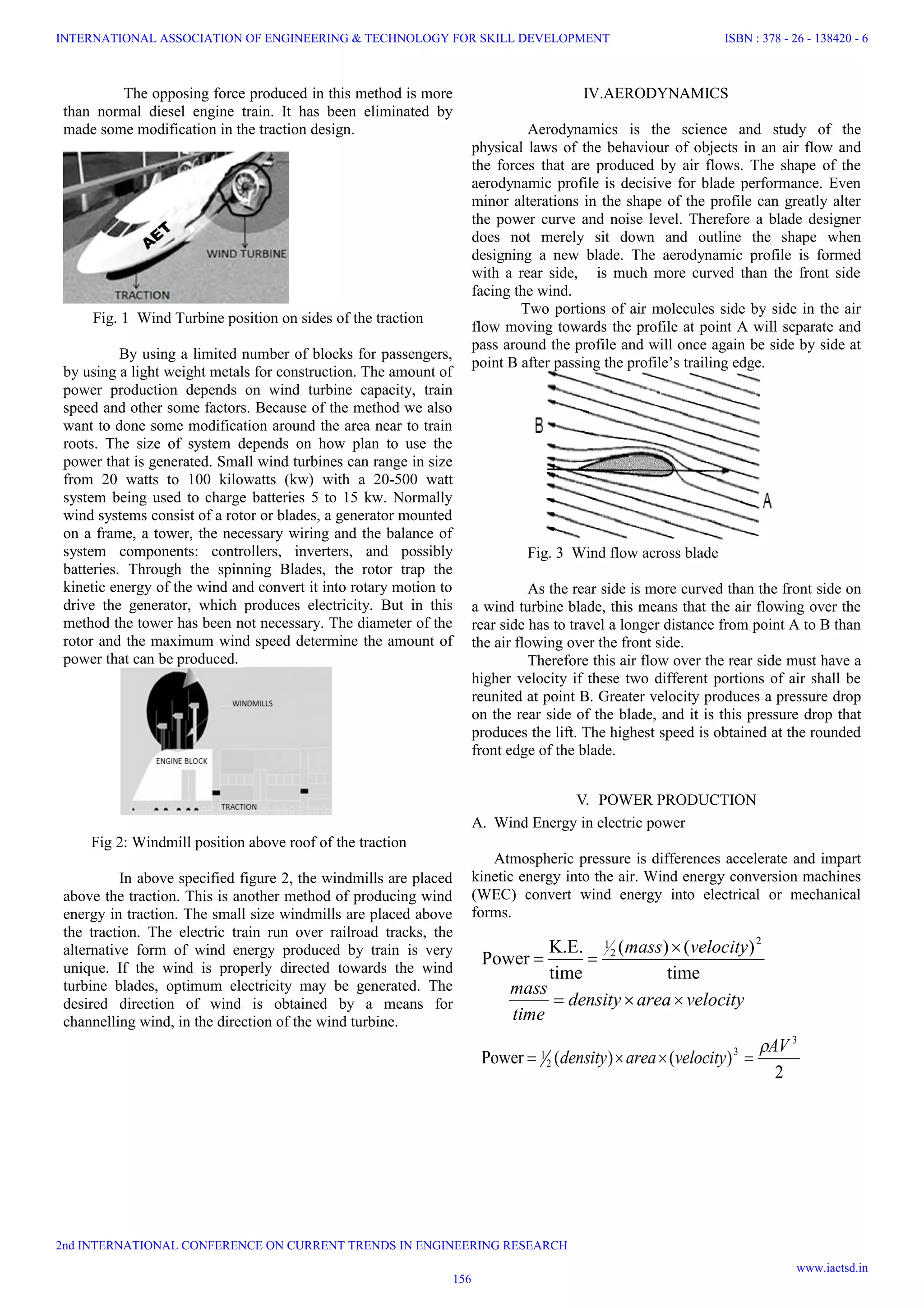
In this method the wind turbine has been placed on
the sides of the traction. By this way we can eliminate the aero
dynamical problems cause in traction. When train runs above
the rail wind turbine starts to rotate due to kinetic energy of
the wind. The speed of rotation of wind turbine depends on
the speed of train. When train moves at high speed the wind
flow also cross the turbine blades at high speed, hence it
makes the large power output. But if very high speed flows of
train danger to wind turbines because it damage the wind
turbines. The wind turbines are covered by protection shield,
the speed of wind also continuously measured by Propeller-
type wind-speed sensor or Cup-type wind-speed sensor.
155
INTERNATIONAL ASSOCIATION OF ENGINEERING & TECHNOLOGY FOR SKILL DEVELOPMENT
2nd INTERNATIONAL CONFERENCE ON CURRENT TRENDS IN ENGINEERING RESEARCH
ISBN : 378 - 26 - 138420 - 6
www.iaetsd.in
The opposing force produced in this method is more
than normal diesel engine train. It has been eliminated by
made some modification in the traction design.
Fig. 1 Wind Turbine position on sides of the traction
By using a limited number of blocks for passengers,
by using a light weight metals for construction. The amount of
power production depends on wind turbine capacity, train
speed and other some factors. Because of the method we also
want to done some modification around the area near to train
roots. The size of system depends on how plan to use the
power that is generated. Small wind turbines can range in size
from 20 watts to 100 kilowatts (kw) with a 20-500 watt
system being used to charge batteries 5 to 15 kw. Normally
wind systems consist of a rotor or blades, a generator mounted
on a frame, a tower, the necessary wiring and the balance of
system components: controllers, inverters, and possibly
batteries. Through the spinning Blades, the rotor trap the
kinetic energy of the wind and convert it into rotary motion to
drive the generator, which produces electricity. But in this
method the tower has been not necessary. The diameter of the
rotor and the maximum wind speed determine the amount of
power that can be produced.
Fig 2: Windmill position above roof of the traction
In above specified figure 2, the windmills are placed
above the traction. This is another method of producing wind
energy in traction. The small size windmills are placed above
the traction. The electric train run over railroad tracks, the
alternative form of wind energy produced by train is very
unique. If the wind is properly directed towards the wind
turbine blades, optimum electricity may be generated. The
desired direction of wind is obtained by a means for
channelling wind, in the direction of the wind turbine.
IV.AERODYNAMICS
Aerodynamics is the science and study of the
physical laws of the behaviour of objects in an air flow and
the forces that are produced by air flows. The shape of the
aerodynamic profile is decisive for blade performance. Even
minor alterations in the shape of the profile can greatly alter
the power curve and noise level. Therefore a blade designer
does not merely sit down and outline the shape when
designing a new blade. The aerodynamic profile is formed
with a rear side, is much more curved than the front side
facing the wind.
Two portions of air molecules side by side in the air
flow moving towards the profile at point A will separate and
pass around the profile and will once again be side by side at
point B after passing the profile’s trailing edge.
Fig. 3 Wind flow across blade
As the rear side is more curved than the front side on
a wind turbine blade, this means that the air flowing over the
rear side has to travel a longer distance from point A to B than
the air flowing over the front side.
Therefore this air flow over the rear side must have a
higher velocity if these two different portions of air shall be
reunited at point B. Greater velocity produces a pressure drop
on the rear side of the blade, and it is this pressure drop that
produces the lift. The highest speed is obtained at the rounded
front edge of the blade.
V. POWER PRODUCTION
A. Wind Energy in electric power
Atmospheric pressure is differences accelerate and impart
kinetic energy into the air. Wind energy conversion machines
(WEC) convert wind energy into electrical or mechanical
forms.
time
)()(
time
K.E.
Power
2
2
1 velocitymass 

velocityareadensity
time
mass

2
)()(Power
3
3
2
1
AV
velocityareadensity


156
INTERNATIONAL ASSOCIATION OF ENGINEERING & TECHNOLOGY FOR SKILL DEVELOPMENT
2nd INTERNATIONAL CONFERENCE ON CURRENT TRENDS IN ENGINEERING RESEARCH
ISBN : 378 - 26 - 138420 - 6
www.iaetsd.in
Example:
V = 10 m/s
A = (2 m)2
= 4 m2
 = 1.2 kg/m3
P=2400 w Theoretical solution.
B. Power production
A train moving at 125mph would generate a wind speed
equivalent to 60 feet/second. Wind blowing with such speed
will let a normal wind power generator harness about 3500w
of power.
If a train is about 656 feet long, running at the pace
of 187mph, and it moves along a 0.62 mile railway track in
about 18 seconds, the power generated in this small period by
the turbine laid on the tracks will be 2.6kW.
The kinetic energy of the wind is the source of the
driving force of a wind turbine. That kinetic energy can be
depicted by the formula
E = f. mspec .v3
E = the kinetic energy
mspec =the specific mass (weight) of air
v = the velocity of the moving air (the wind)
f = a calculating factor without any physic meaning
The power in the wind is proportional to:
a) The area of windmill being swept by the wind
b) The cube of the wind speed
c) The air density - which varies with altitude.
The formula used for calculating the power in the wind is
shown below:
Power = (density of air x swept area x velocity cubed)/2
P = ½. ρ (A) (V)3
Where,
P is power in watts (W)
ρ is the air density in kilograms per cubic meter (kg/m3)
A is the swept rotor area in square meters (m2) & V is the
wind speed in meters per second (m/s).
IV. PROBLEMS TO FACE
The major problem occurring in this system is some
alternation has want to made in train design the train not able
to move on the overflows or bridges, because mass of
Windmill producing opposing force toward the train. Similar
the train subjected to meet some problems related to
aerodynamically.
Fig 4: Traction facing aerodynamic problems
The wind turbine is position above the traction
reduce the speed of train and it over come by placing it on the
sides traction.
VII. GROWTH OF WIND ENERGY
These methods are implementing to produce energy
and induced new way for producing clean energy in train.
There are 14,300 trains operating daily on 63,000 route
kilometers of railway in India. This technique would be
capable of producing 1,481,000 megawatt (MW) of power in
India alone. But some changes are needed in Indian rail roots,
in tractions.
It required long time to achieve above specified
range of power production.
Fig 5: Growth of wind power production
VIII. CONCLUSIONS
The process of implementing AET we are able to
produce an alternate fuel, thus we are not only finding up a
new way of energy but also the way to protect the natural
world from fossil fuel (pollution). Thus using this new
concept and project we can expect a greener and pollution free
tomorrow. The whole project demands to call wind energy not
only used from supplying power to consumer but also
alternative fuel in transportation also. This project is still in
research stages but if it well implemented, it goes to very big
milestone in the engineering history.
REFERENCES
[1] Stephane Sanquer, Christian Barre, Marc Dufresne de Virel and
Louis-Marie Cleon (2004), “Effect of cross winds on high-speed
trains: development of new experimental methodology”, Journal
of Wind Engineering and Industrial Aerodynamics, 92(2004),
535-545.
[2] Wilson, R.E. and Lissaman, P.B.S. (1974), “Applied
Aerodynamics of Wind Power Machines”, Oregon State
University, NTIS PB 238594.
[3] Friends of Earth, “Briefing Anaerobic Digestion” (2004)
Retrieved 17.08.07. Anaerobic digestion Briefing Paper,
www.foe.co.uk.
157
INTERNATIONAL ASSOCIATION OF ENGINEERING & TECHNOLOGY FOR SKILL DEVELOPMENT
2nd INTERNATIONAL CONFERENCE ON CURRENT TRENDS IN ENGINEERING RESEARCH
ISBN : 378 - 26 - 138420 - 6
www.iaetsd.in
[4] E. Muljadi and C.P. Butterfield, “Pitch-Controlled Variable-
Speed Wind Turbine Generation”, 1999 IEEE Industry
Applications Society Annual Meeting, Phoenix, Arizona, October
3-7, 1999.
[5] Grauers, A., “Direct driven generators .Technology and
development trends”, Proceedings of the Nordic Wind Power
Conference 2000 (NWPC 2000), Trondheim, Norway, Mars 13-
14, 2000.
[6] Shyam Lal Verma, Ajay Bangar, Ankit Soni, Shravan
Gajendragadkar-2012 “Renewable and Non-Conventional Energy
Sources and Engineering System” ISSN No. 2231 –6477,
Volume-1, Issue-3.
[7] BJ Furman, K Youssefi - Wind Power and Wind Turbines
WWW/K-12/airplane/short.html.
[8] Emrah Kulunk- Aerodynamics of Wind Turbines, New Mexico
Institute of Mining and Technology USA.
[9] Ramler, J. R. and R. M. Donovan: Wind Turbines for Electric
Utilities: Development Status and Economics, Report
DOE/NASA/1028-79/23, NASA TM-79170, AIAA-79-0965,
June 1979.
[10] WWW.world wind energy association report 2012.
Www.wwindea.org.
[11] http://www.grc.nasa.gov/WWW/K-12/airplane/short.html.
[12] http://ww2010.atmos.uiuc.edu/(Gh)/guides/mtr/prs/hghdef.rxml.
[13] http://en.wikipedia.org/wiki/Wind_turbine_design.
158
INTERNATIONAL ASSOCIATION OF ENGINEERING & TECHNOLOGY FOR SKILL DEVELOPMENT
2nd INTERNATIONAL CONFERENCE ON CURRENT TRENDS IN ENGINEERING RESEARCH
ISBN : 378 - 26 - 138420 - 6
www.iaetsd.in

Iaetsd alternate energy in the tractions

  • 1.
    ALTERNATE ENERGY INTHE TRACTIONS L.SARAVANAN# , P.SIVA SANKARI*, J.P.ANISH JABIN@ #*@ Department of Electrical and Electronics Jayaram College of Engineering and Technology, Trichy, India # lrsnpng@gmail.com *tulasi.vt@gmail.com @ jobin899anish@gmail.com Abstract— The fuel requirements of the world are increasing at an alarming rate and the source demand has been running ahead of supply. Due to the population and development activities increases, the requirement of the fuel will also increase. So we need to look for the alternative of conventional sources and the best alternative of conventional sources are the non- conventional sources of energy which are also called renewable source of energy. In this paper, the alternate potential in tractions AET is investigated. The innovative method of generating wind energy in a fast moving traction is one of the best methods and it eliminate lot of problems facing in railways today. Keywords— Fuel demand, Population growth, Conventional sources, Non-conventional sources, AET, Wind energy in traction. I. INTRODUCTION The wind is a free, clean, and inexhaustible energy source. By generating wind energy in a fast moving traction in one of the new innovation in wind power production and also alternate energy to traction. By placing the wind turbine on the traction it will very efficient method to produce the energy which has been used for inter purpose also. The main aim of this innovation is to provide a method and a system for generating electricity by using high wind pressure generated in moving vehicles, using free renewable input namely air. Wind energy is cheap, non-polluting, and capable of providing enough electricity. II. WIND ENERGY The wind has been used to power sailing ships for many centuries. many countries owed their prosperity to their skill in sailing. the new world was explored by wind powered ships. indeed, wind was almost the only source of power for ships until watt invented the steam engine in the 18th century. denmark was the first country to use the wind for generation of electricity. the danes were using a 23 m diameter wind turbine in 1890 to generate electricity. by 1910, several hundred units with capacities of 5 to 25 kw were in operation in denmark. other countries also continued wind research for a longer period of time. the worldwide wind capacity reached 282’275 megawatt, out of which 44’609 megawatt were added in 2012, more than ever before. wind power showed a growth rate of 19, 2%, the lowest rate in more than a decade. Altogether, 100 countries and regions used wind power for electricity generation. Since many years, the wind industry has been driven by the Big Five markets: China, USA, Germany, Spain, and India. Table.1 Top Wind generation countries These countries have represented the largest share of wind power during the last few decades. The available potential of wind energy in India is 45000 megawatt out of which 1367mw has been exploited till august 2012. Table provides the top five wind energy generator countries in the world. Wind power is one of the most efficient alternate energy sources. There has been good deal of development in wind turbine technology over the last decade with many new companies joining the fray. Wind turbines have become larger, efficiencies and availabilities have improved and wind farm concept has become popular. The economics of wind energy is already strong, despite the relative immaturity of the industry. The downward trend in wind energy costs is predicted to continue. As the world market in wind turbines continues to boom, wind turbine prices will continue to fall. India now ranks as a "wind superpower" having a net potential of about 45000 MW only from 13 identified states. III. WIND ENERGY IN TRACTION In this method the wind turbine has been placed on the sides of the traction. By this way we can eliminate the aero dynamical problems cause in traction. When train runs above the rail wind turbine starts to rotate due to kinetic energy of the wind. The speed of rotation of wind turbine depends on the speed of train. When train moves at high speed the wind flow also cross the turbine blades at high speed, hence it makes the large power output. But if very high speed flows of train danger to wind turbines because it damage the wind turbines. The wind turbines are covered by protection shield, the speed of wind also continuously measured by Propeller- type wind-speed sensor or Cup-type wind-speed sensor. 155 INTERNATIONAL ASSOCIATION OF ENGINEERING & TECHNOLOGY FOR SKILL DEVELOPMENT 2nd INTERNATIONAL CONFERENCE ON CURRENT TRENDS IN ENGINEERING RESEARCH ISBN : 378 - 26 - 138420 - 6 www.iaetsd.in
  • 2.
    The opposing forceproduced in this method is more than normal diesel engine train. It has been eliminated by made some modification in the traction design. Fig. 1 Wind Turbine position on sides of the traction By using a limited number of blocks for passengers, by using a light weight metals for construction. The amount of power production depends on wind turbine capacity, train speed and other some factors. Because of the method we also want to done some modification around the area near to train roots. The size of system depends on how plan to use the power that is generated. Small wind turbines can range in size from 20 watts to 100 kilowatts (kw) with a 20-500 watt system being used to charge batteries 5 to 15 kw. Normally wind systems consist of a rotor or blades, a generator mounted on a frame, a tower, the necessary wiring and the balance of system components: controllers, inverters, and possibly batteries. Through the spinning Blades, the rotor trap the kinetic energy of the wind and convert it into rotary motion to drive the generator, which produces electricity. But in this method the tower has been not necessary. The diameter of the rotor and the maximum wind speed determine the amount of power that can be produced. Fig 2: Windmill position above roof of the traction In above specified figure 2, the windmills are placed above the traction. This is another method of producing wind energy in traction. The small size windmills are placed above the traction. The electric train run over railroad tracks, the alternative form of wind energy produced by train is very unique. If the wind is properly directed towards the wind turbine blades, optimum electricity may be generated. The desired direction of wind is obtained by a means for channelling wind, in the direction of the wind turbine. IV.AERODYNAMICS Aerodynamics is the science and study of the physical laws of the behaviour of objects in an air flow and the forces that are produced by air flows. The shape of the aerodynamic profile is decisive for blade performance. Even minor alterations in the shape of the profile can greatly alter the power curve and noise level. Therefore a blade designer does not merely sit down and outline the shape when designing a new blade. The aerodynamic profile is formed with a rear side, is much more curved than the front side facing the wind. Two portions of air molecules side by side in the air flow moving towards the profile at point A will separate and pass around the profile and will once again be side by side at point B after passing the profile’s trailing edge. Fig. 3 Wind flow across blade As the rear side is more curved than the front side on a wind turbine blade, this means that the air flowing over the rear side has to travel a longer distance from point A to B than the air flowing over the front side. Therefore this air flow over the rear side must have a higher velocity if these two different portions of air shall be reunited at point B. Greater velocity produces a pressure drop on the rear side of the blade, and it is this pressure drop that produces the lift. The highest speed is obtained at the rounded front edge of the blade. V. POWER PRODUCTION A. Wind Energy in electric power Atmospheric pressure is differences accelerate and impart kinetic energy into the air. Wind energy conversion machines (WEC) convert wind energy into electrical or mechanical forms. time )()( time K.E. Power 2 2 1 velocitymass   velocityareadensity time mass  2 )()(Power 3 3 2 1 AV velocityareadensity   156 INTERNATIONAL ASSOCIATION OF ENGINEERING & TECHNOLOGY FOR SKILL DEVELOPMENT 2nd INTERNATIONAL CONFERENCE ON CURRENT TRENDS IN ENGINEERING RESEARCH ISBN : 378 - 26 - 138420 - 6 www.iaetsd.in
  • 3.
    Example: V = 10m/s A = (2 m)2 = 4 m2  = 1.2 kg/m3 P=2400 w Theoretical solution. B. Power production A train moving at 125mph would generate a wind speed equivalent to 60 feet/second. Wind blowing with such speed will let a normal wind power generator harness about 3500w of power. If a train is about 656 feet long, running at the pace of 187mph, and it moves along a 0.62 mile railway track in about 18 seconds, the power generated in this small period by the turbine laid on the tracks will be 2.6kW. The kinetic energy of the wind is the source of the driving force of a wind turbine. That kinetic energy can be depicted by the formula E = f. mspec .v3 E = the kinetic energy mspec =the specific mass (weight) of air v = the velocity of the moving air (the wind) f = a calculating factor without any physic meaning The power in the wind is proportional to: a) The area of windmill being swept by the wind b) The cube of the wind speed c) The air density - which varies with altitude. The formula used for calculating the power in the wind is shown below: Power = (density of air x swept area x velocity cubed)/2 P = ½. ρ (A) (V)3 Where, P is power in watts (W) ρ is the air density in kilograms per cubic meter (kg/m3) A is the swept rotor area in square meters (m2) & V is the wind speed in meters per second (m/s). IV. PROBLEMS TO FACE The major problem occurring in this system is some alternation has want to made in train design the train not able to move on the overflows or bridges, because mass of Windmill producing opposing force toward the train. Similar the train subjected to meet some problems related to aerodynamically. Fig 4: Traction facing aerodynamic problems The wind turbine is position above the traction reduce the speed of train and it over come by placing it on the sides traction. VII. GROWTH OF WIND ENERGY These methods are implementing to produce energy and induced new way for producing clean energy in train. There are 14,300 trains operating daily on 63,000 route kilometers of railway in India. This technique would be capable of producing 1,481,000 megawatt (MW) of power in India alone. But some changes are needed in Indian rail roots, in tractions. It required long time to achieve above specified range of power production. Fig 5: Growth of wind power production VIII. CONCLUSIONS The process of implementing AET we are able to produce an alternate fuel, thus we are not only finding up a new way of energy but also the way to protect the natural world from fossil fuel (pollution). Thus using this new concept and project we can expect a greener and pollution free tomorrow. The whole project demands to call wind energy not only used from supplying power to consumer but also alternative fuel in transportation also. This project is still in research stages but if it well implemented, it goes to very big milestone in the engineering history. REFERENCES [1] Stephane Sanquer, Christian Barre, Marc Dufresne de Virel and Louis-Marie Cleon (2004), “Effect of cross winds on high-speed trains: development of new experimental methodology”, Journal of Wind Engineering and Industrial Aerodynamics, 92(2004), 535-545. [2] Wilson, R.E. and Lissaman, P.B.S. (1974), “Applied Aerodynamics of Wind Power Machines”, Oregon State University, NTIS PB 238594. [3] Friends of Earth, “Briefing Anaerobic Digestion” (2004) Retrieved 17.08.07. Anaerobic digestion Briefing Paper, www.foe.co.uk. 157 INTERNATIONAL ASSOCIATION OF ENGINEERING & TECHNOLOGY FOR SKILL DEVELOPMENT 2nd INTERNATIONAL CONFERENCE ON CURRENT TRENDS IN ENGINEERING RESEARCH ISBN : 378 - 26 - 138420 - 6 www.iaetsd.in
  • 4.
    [4] E. Muljadiand C.P. Butterfield, “Pitch-Controlled Variable- Speed Wind Turbine Generation”, 1999 IEEE Industry Applications Society Annual Meeting, Phoenix, Arizona, October 3-7, 1999. [5] Grauers, A., “Direct driven generators .Technology and development trends”, Proceedings of the Nordic Wind Power Conference 2000 (NWPC 2000), Trondheim, Norway, Mars 13- 14, 2000. [6] Shyam Lal Verma, Ajay Bangar, Ankit Soni, Shravan Gajendragadkar-2012 “Renewable and Non-Conventional Energy Sources and Engineering System” ISSN No. 2231 –6477, Volume-1, Issue-3. [7] BJ Furman, K Youssefi - Wind Power and Wind Turbines WWW/K-12/airplane/short.html. [8] Emrah Kulunk- Aerodynamics of Wind Turbines, New Mexico Institute of Mining and Technology USA. [9] Ramler, J. R. and R. M. Donovan: Wind Turbines for Electric Utilities: Development Status and Economics, Report DOE/NASA/1028-79/23, NASA TM-79170, AIAA-79-0965, June 1979. [10] WWW.world wind energy association report 2012. Www.wwindea.org. [11] http://www.grc.nasa.gov/WWW/K-12/airplane/short.html. [12] http://ww2010.atmos.uiuc.edu/(Gh)/guides/mtr/prs/hghdef.rxml. [13] http://en.wikipedia.org/wiki/Wind_turbine_design. 158 INTERNATIONAL ASSOCIATION OF ENGINEERING & TECHNOLOGY FOR SKILL DEVELOPMENT 2nd INTERNATIONAL CONFERENCE ON CURRENT TRENDS IN ENGINEERING RESEARCH ISBN : 378 - 26 - 138420 - 6 www.iaetsd.in