SYNOPSIS ON- WORKING MODEL OF MAGLEV WINDMILL
RAJKIYA ENGINEERING COLLEGE, AZAMGARH
DEPARTMENT OF MECHANICAL ENGINEERING
Submitted to- Submitted by-
Mr. Saurabh Kumar Singh(HOD) KARTIKEY SIINGH (1373640024)
Under guidance of - ASHVANI GUPTA (1373640012)
Mr.Dwivesh Dubey ANKUR SINGH (1373640009)
AJAY SINGH (1373640003)
AVANISH KUMAR (1373640014)
HARIOM MISHRA (1373640021)
RAHUL KUMAR (1373640038)
ABSTRACT
In conventional windmill there present mechanical friction and bearings are used. To
eliminate mechanical friction and use of bearing, we introduce a new model of windmill called
“Magnetic windmill”. Magnetic levitation is a method by which an object is suspended with no
support other than magnetic fields. Magnetic pressure is used to counteract the effects of the
gravitational and any other accelerations. The principal advantage of a maglev windmill from a
conventional one is, as the rotor is floating in the air due to levitation, mechanical friction is
totally eliminated i.e There is no mechanical contact, no friction. That makes the rotation
possible in very low wind speeds. Maglev wind turbines have several advantages over
conventional wind turbines. For instance, they’re able to use winds with starting speeds as low as
1.5 meters per second (m/s). Also, they could operate in winds exceeding 40 m/s. Maglev is used
to increase the efficiency. If efficiency of wind turbine is increased, then more power can be
generated thus decreasing the cost of production of electricity.
INTRODUCTION
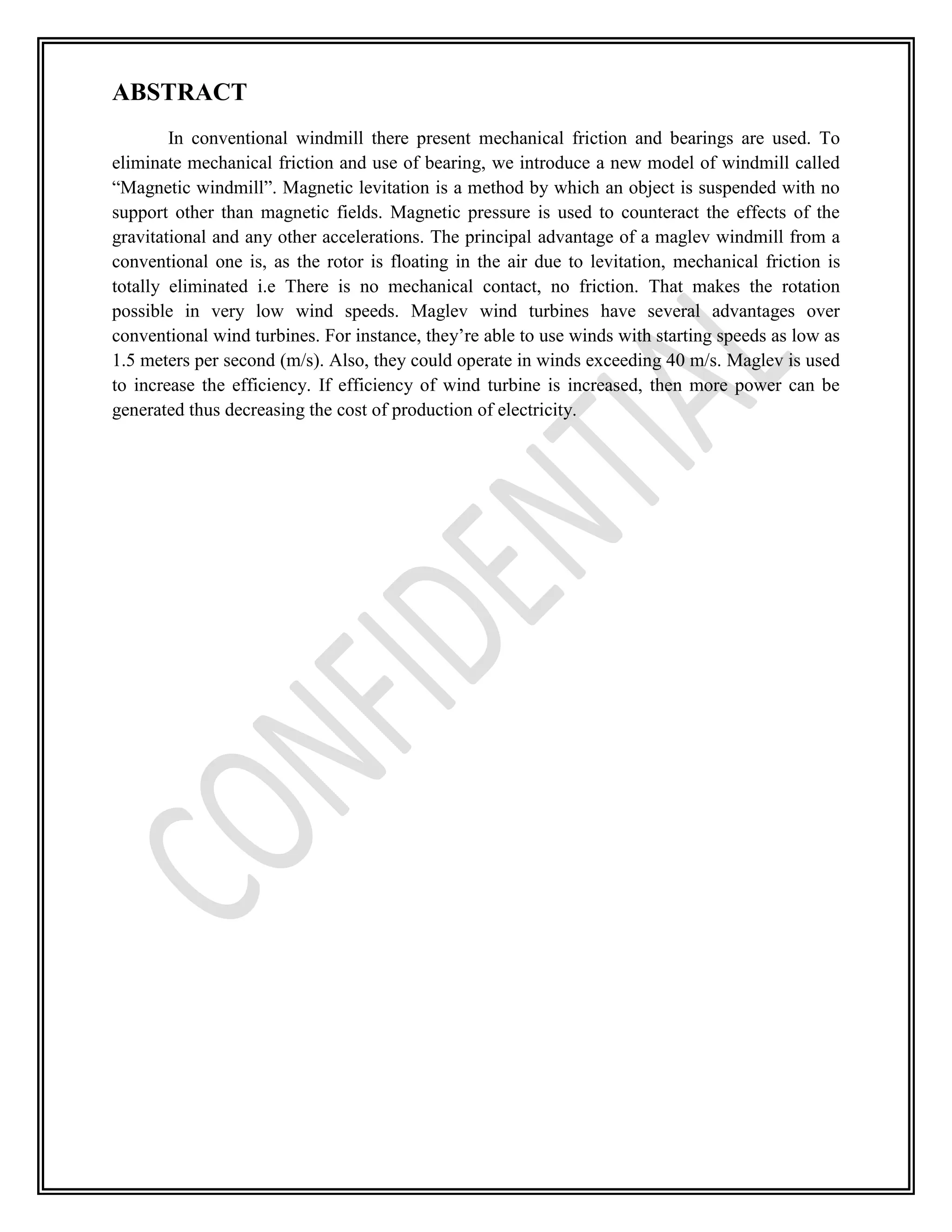
Fig. 1
Renewable energy is generally electricity supplied from sources, such as wind power,
solar power, geothermal energy, hydropower and various forms of biomass. These sources have
been coined renewable due to their continuous replenishment and availability for use over and
over again. The popularity of renewable energy has experienced a significant upsurge in recent
times due to the exhaustion of conventional power generation methods and increasing realization
of its adverse effects on the environment. This popularity has been bolstered by cutting edge
research and ground breaking technology that has been introduced so far to aid in the effective
tapping of these natural resources and it is estimated that renewable sources might contribute
about 20% – 50% to energy consumption in the latter part of the 21st
century. Facts from the
World Wind Energy Association estimates that by 2010, 160GW of wind power capacity is
expected to be installed worldwide which implies an anticipated net growth rate of more than
21% per year.
This project focuses on the utilization of wind energy as a renewable source. In the
United States alone, wind capacity has grown about 45% to 16.7GW and it continues to grow
with the facilitation of new wind projects. The aim of this major qualifying project is to design
and implement a magnetically levitated vertical axis wind turbine system that has the ability to
operate in both high and low wind speed conditions. Our choice for this model is to showcase its
efficiency in varying wind conditions as compared to the traditional horizontal axis wind turbine
and contribute to its steady growing popularity for the purpose of mass utilization in the near
future as a reliable source of power generation. Unlike the traditional horizontal axis wind
turbine, this design is levitated via maglev (magnetic levitation) vertically on a rotor shaft. This
maglev technology, which will be looked at in great detail, serves as an efficient replacement for
ball bearings used on the conventional wind turbine and is usually implemented with permanent
magnets. This levitation will be used between the rotating shaft of the turbine blades and the base
of the whole wind turbine system. The conceptual design also entails the usage of spiral shaped
blades and with continuing effective research into the functioning of sails in varying wind speeds
and other factors, an efficient shape and size will be determined for a suitable turbine blade for
the project. With the appropriate mechanisms in place, we expect to harness enough wind for
power generation by way of an axial flux generator built from permanent magnets and copper
coils. The arrangement of the magnets will cultivate an effective magnetic field and the copper
coils will facilitate voltage capture due to the changing magnetic field. The varying output
voltage obtained at this juncture will then be passed through a DC-DC converter to achieve a
steady output DC voltage.
LITERATURE REVIEW
Wind energy has been used for thousands of years for milling grain, pumping water and
other mechanical power applications. Wind power is not a new concept. The first accepted
establishment of the use of windmills was in the tenth century in Persia. Today, there are several
hundred thousand windmills in operation around the world. Modern windmills tend to be called
wind turbines partly because of their functional similarity to the steam and gas turbines and
partly to distinguish them from their traditional forbears. Wind energy was the fastest growing
energy technology in the 1990s, in terms of percentage of yearly growth of installed capacity per
technology source. The growth of wind energy, however, is not evenly distributed around the
world. By the end of 1999, around 69% of the worldwide wind energy capacity was installed in
Europe, a further 19% in North America and 10% in Asia and the Pacific. Wind energy is
expected to play an increasingly important role in the future national energy scene. Wind
turbines convert the kinetic energy of the wind to electrical energy by rotating the blades.
Greenpeace states that about 10% of electricity can be supplied by the wind by the year 2020.
In the 1990s, the cost for manufacturing wind turbines declined by about 20% every
time the number of manufactured wind turbines doubled. Currently, the production of
large-scale, grid-connected wind turbines doubles almost every 3 years. A similar cost reduction
was achieved during the first years of oil exploitation about 100 years ago. The Danish Energy
Agency predicts that a further cost reduction of 50% can be achieved until 2020, and the EU
Commission estimates in its White Book that energy cost from wind power will be reduced by at
least 30% between 1998 and 2010. A general comparison of the electricity production costs,
however, is very difficult as production costs vary significantly between countries, due to the
availability of resources, different tax structures or other reasons. In addition, market regulations
can affect the electricity prices in different countries.
We’ve found some proposed literature survey given below:
Vishal D Dhareppagol et al. [1] proposed this new model of wind turbine uses magnetic
levitation to reduce the internal friction of the rotor which is considered as a revolution in the
field of wind technology, producing 20% more energy than a conventional turbine, at the same
time decreasing operational costs by 50% over the traditional wind turbine. Hence this
technology provides an extreme efficient, versatile and elegant method of producing power from
wind with nearly zero pollution. Our choice for this model is to showcase its efficiency in
varying wind conditions as compared to the traditional horizontal axis wind turbine and
contribute to its steady growing popularity for the purpose of mass utilization in the near future
as a reliable source of power generation.
Minu John et al. [2] proposed Magnetic pressure is used to counteract the effects of the
gravitational and any other accelerations. The principal advantage of a maglev windmill from a
conventional one is, as the rotor is floating in the air due to levitation, mechanical friction is
totally eliminated. That makes the rotation possible in very low wind speeds. Maglev wind
turbines have several advantages over conventional wind turbines. For instance, they’re able to
use winds with starting speeds as low as 1.5 meters per second (m/s). Also, they could operate in
winds exceeding 40 m/s.
Dinesh N Nagarkar et.al. [3] Proposed electricity can be obtained by converting kinetic
energy of wind into electrical energy by using wind turbine. There are two types of wind
turbine, one is conventional wind turbine and other is maglev wind turbine, but generation of
electricity using maglev technology is now becoming more competitive. It works on the principle
of electromagnetism. It has colossal structure. It has several advantages over conventional wind
turbine and has certain applications.
Richard D. Thornton et.al. [4] Proposed Maglev has the potential to be more efficient and
affordable than alternative technologies for many transportation applications. To achieve this
potential we need new designs that build on what we have learned from existing maglev designs,
while taking advantage of supporting technology that did not exist when most of them were
created. The keys to reducing energy intensity are to use light vehicles with low aerodynamic
drag, use a linear synchronous motor that is excited in short sections, and operate with a dynamic
schedule that achieves a high load factor. The key to affordability is to use small, light vehicles
that can operate on less expensive guide ways, and require less power for propulsion. This paper
provides more details on these issues, provides estimates of what is feasible with today’s
technology, and discusses how to choose performance parameters, such as speed and
acceleration, so as to maximize the probability that maglev will become the technology of choice
for a wide range of applications. It also includes an historical perspective and recommendations
for future development.
Pankaj R Amratan Ingle et.al. [5] focused on the implementation of maglev principle on
vertical axis wind turbine so as to use in not only for industrial purposes but also every home can
be use renewable energy to en light their lives and to become a part of healthy society to live in a
beautiful , pollution free environment. As we all know the today fossil fuel rates, availability,
their impact on environment, if they will use continuously in a proportion now we are using then
it will be not possible to live on earth & some peoples already started to plan to live on the moon
and mars. Joke so far. By placing the magnets below the vertical rotor of the wind turbine and on
the base of the frame ,so that because of magnetic repulsion the rotor will required very low
starting wind speed, and there is very less friction and it replaces conventional ball bearing.
Nianxian Wang et.al. [6] Proposed Maglev wind turbine generator (MWTG) technology has
been widely studied due to its low loss, low maintenance cost, and high reliability. However, the
dynamics of the magnetic bearing system differ from the traditional mechanical bearing system.
A horizontal axial MWTG supported with a permanent magnetic bearing is designed in this
research and the radial forces and the natural frequencies of the rotor system are studied. The
results show that the generator has a cyclical magnetic force and an unreasonable bearing
stiffness may mean that the rotor system needs to work in the resonance region; the bearing
stiffness is the key factor to avoid this problem.
1. The first accepted establishment of the use of windmills was in the tenth century in
Persia.
Fig. 2(a) Fig. 2(b)
2. In Europe, wind energy made its appearance in the 11th century A. D. Wind machines
were introduced from the Middle East.
Fig. 3
3. By the 14th century, the Dutch used windmill widely for draining the marshes and lakes of the
Rhine River delta.
4. The wind turbines in USA during the 19th century to until 1930 were mainly used for
irrigation.
Fig. 4
5. The first attempt to generate electricity was made at the end of 19th century.
6. In 1931 Georges Jean Marie Darrieus, French aeronautical engineer designed one of the most
famous and common type of VAWT i.e. Darrieus VAWT.
Fig. 5
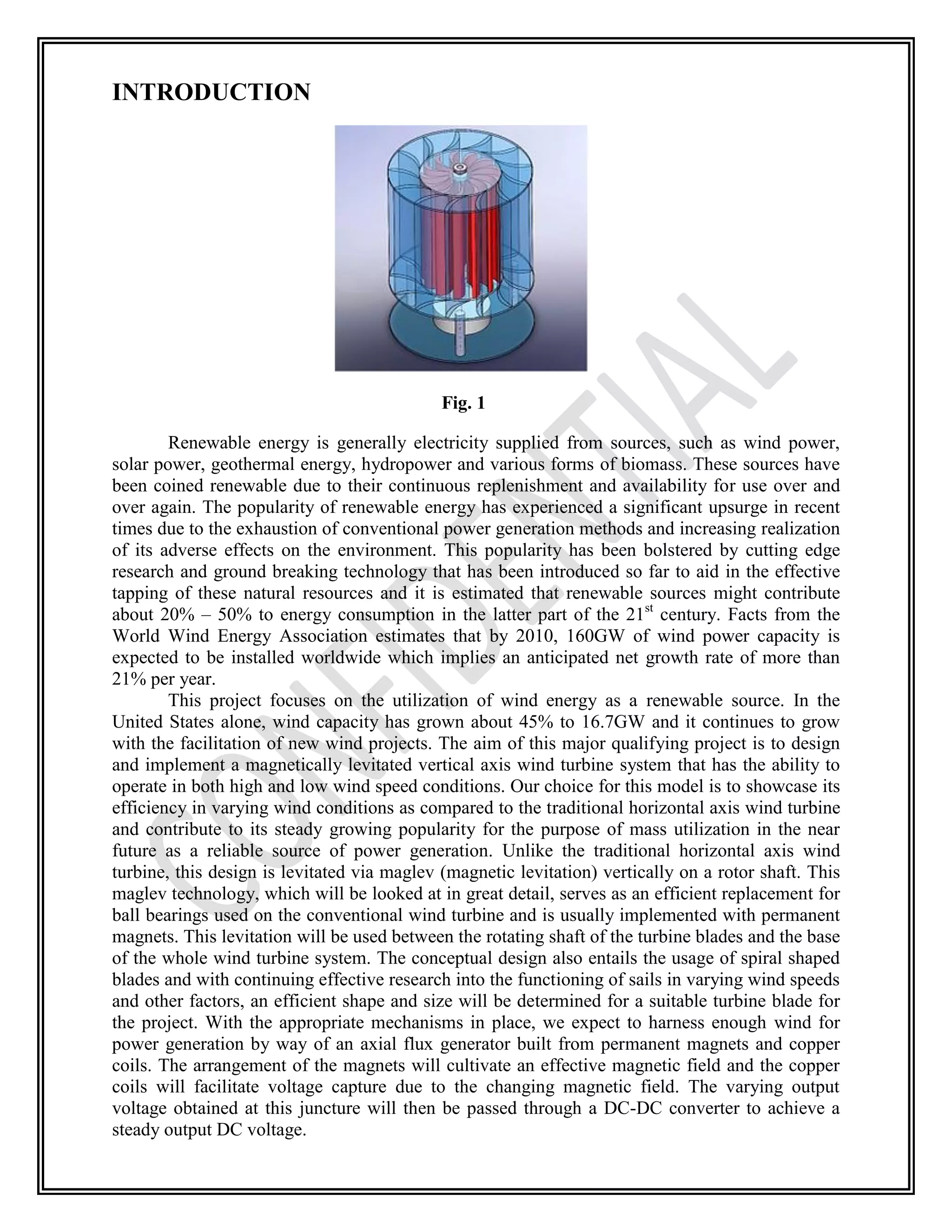
7. Finnish engineer Sigurd Johannes Savonius developed the modern drag-driven rotor in the
1920s but Johann Ernst Elias Bessler (born 1680) was the first to attempt to build a horizontal
windmill of the Savonius type in the town of Furstenberg in Germany in 1745.
Fig. 6
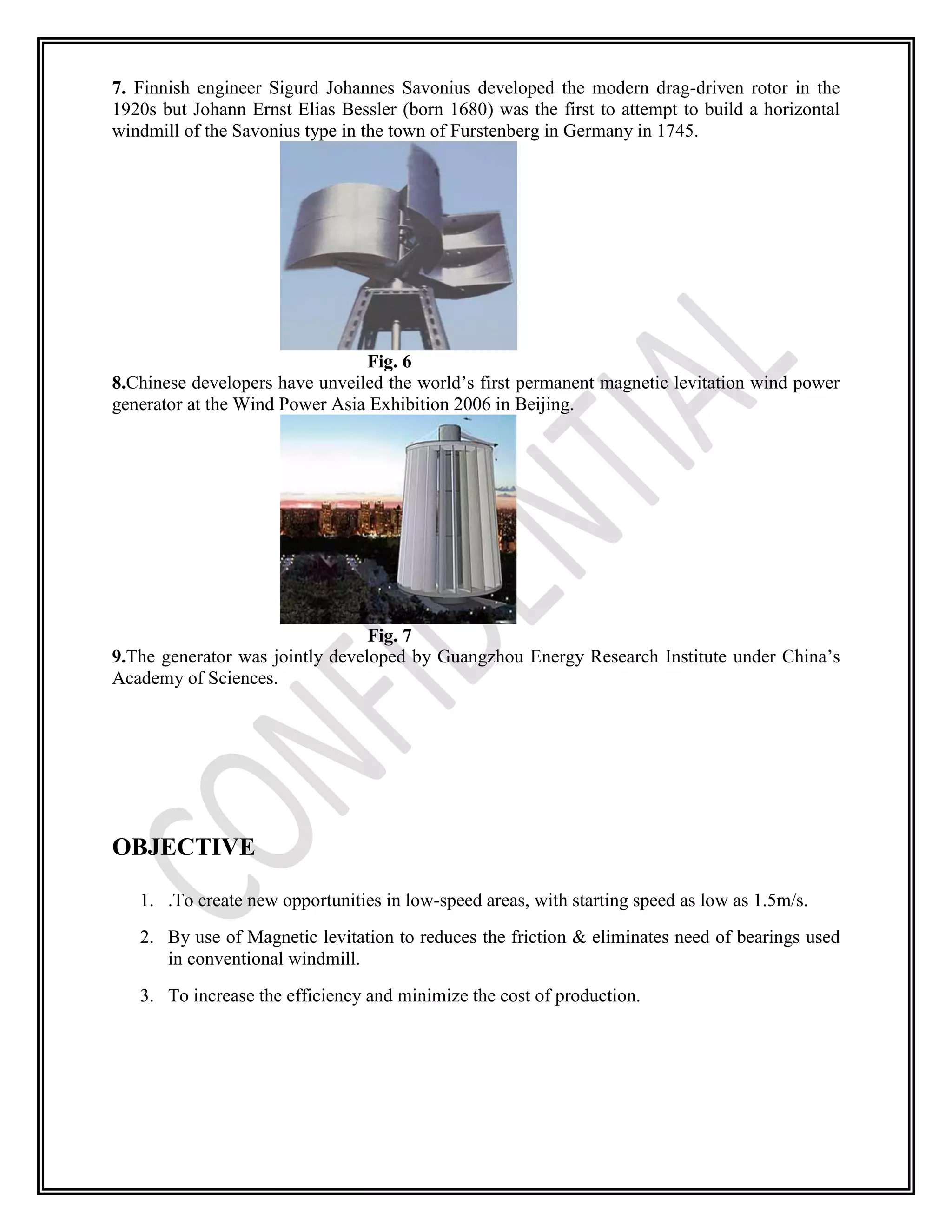
8.Chinese developers have unveiled the world’s first permanent magnetic levitation wind power
generator at the Wind Power Asia Exhibition 2006 in Beijing.
Fig. 7
9.The generator was jointly developed by Guangzhou Energy Research Institute under China’s
Academy of Sciences.
OBJECTIVE
1. .To create new opportunities in low-speed areas, with starting speed as low as 1.5m/s.
2. By use of Magnetic levitation to reduces the friction & eliminates need of bearings used
in conventional windmill.
3. To increase the efficiency and minimize the cost of production.
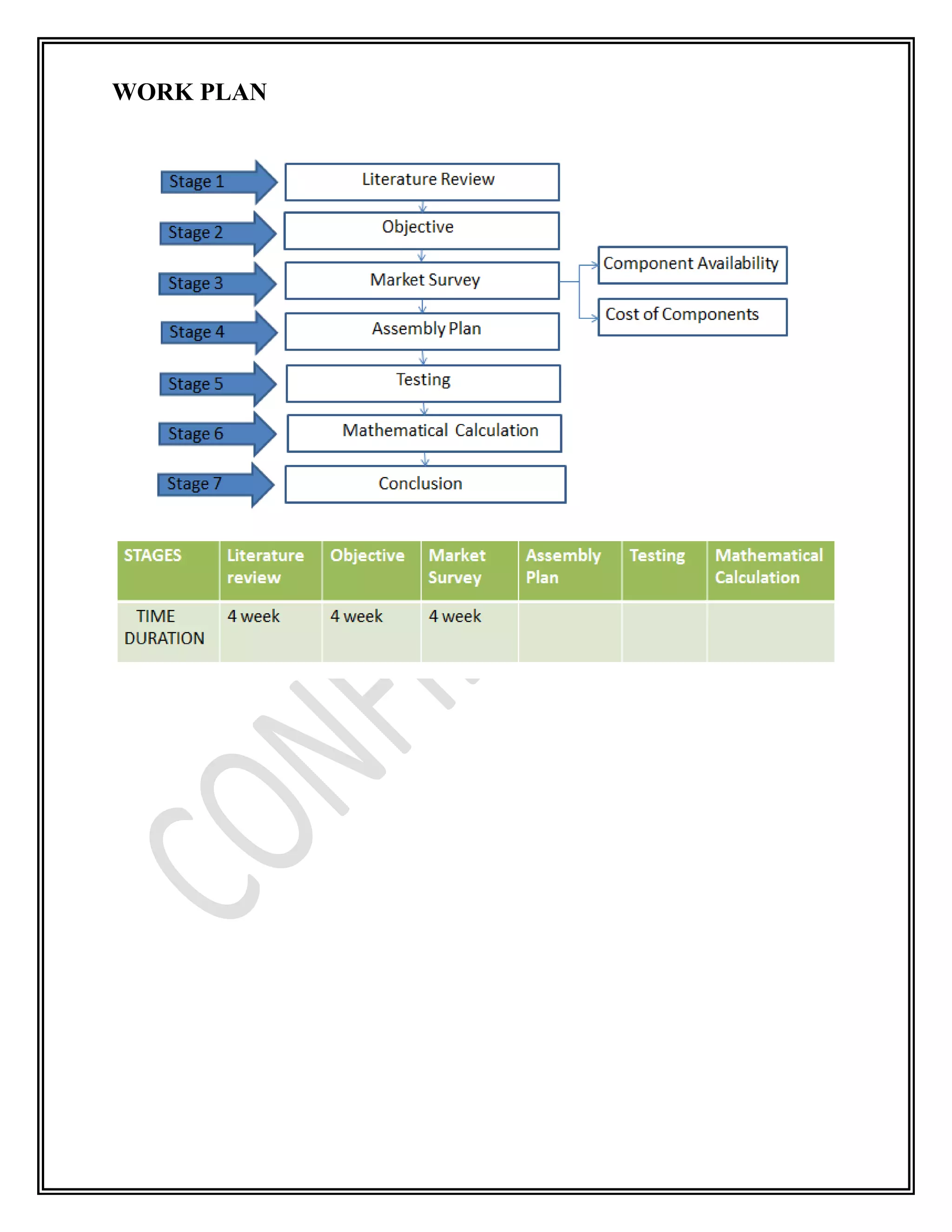
WORK PLAN
REFERENCES
[1] Vishal D Dhareppagol, Maheshwari M Konagutti “Regenedyne Maglev Wind Power
Generation”.
[2] Minu John, Rohit John, Syamily P.S, Vyshak P.A“Maglev Windmill” International
Journal of Innovative Research in Advanced Engineering Volume 1, Issue 7, August 2014.
[3] Dinesh N Nagarkar, Dr. Z. J. Khan “Wind Power Plant Using Magnetic Levitation Wind
Turbine” International Journal of Emerging Technology and Advanced Engineering Volume
5, Issue 2, February 2015.
[4] Richard D. Thornton, Fellow IEEE” Efficient and Affordable Maglev Opportunities in the
United States”
[5] Pankaj R Amratan Ingle “report on maglev vawt” IBSS College of Engineering,
University-Mardi Road, Dist. Amravati.
[6] Nianxian Wang*, Yefa Hu, Huachun Wu, Jinguang Zhang, and Chunsheng Song
“Research on Forces and Dynamics of Maglev Wind Turbine Generator”
[7]Bernhoff, H., Eriksson, S., & Leijon, M (2006). Evaluation of different turbine concepts for
wind power. Renewable & Sustainable Energy Reviews, 12(5), 1419-1434.
[8] Biswas, A., Gupta, R. & Sharma, K. K., (2008). Comparative study of a three-bucket
Savonius rotor with a combined three-bucket Savonius-three-bladed Darrieus rotor. Renewable
Energy, 33, 1974-1981.
[9] Cheremisinoff, N. P. (1978). Fundamentals of wind energy. Ann Arbor, MI: Ann Arbor
Science. Cooper, P., & Kennedy, O. (2005). Development and analysis of a novel vertical axis
wind turbine.
[10] Craig, G. (l985).lntroduction to Aerodynamics. Anderson, IN: Regenerative Press. Da Rosa,
A.D. (2009). Fundamentals of Renewable Energy Processes, 2nd Edition. New York, NY:
Elsevier
[11] Datta, P. K., Leung, P. S., & Roynarin W., (2002). The performances of a vertical Darrieus
machine with modern high lift airfoils. Proceedings from lMAREST conference MAREC 2002,
Newcastle,
[12] UK. Dom, J. (March 4, 2008). Global wind power capacity reaches 100, 000 megawatts.
Retrieved September 14, 2008 from http://www.earthpolicy.org /Indicators /Wind f2008.htm
Brown, L. D., Hua, H., and Gao, C. 2003. A widget framework for augmented interaction in
SCAPE.
[13] Fartaj, A., Islam, M., & Ting, D.S.K. (2006). Aerodynamic models for Darrieus-type
straight-bladed vertical axis wind turbines. Renewable & Sustainable Energy Reviews, 12(4),
1087-11 08.
[14] Gipe, P. (2004). Wind power. White River Junction, VT: Chelsea Green Publishing Co.
Islam, M., Ting, D., & Fartaj, A. (2007). Desirable airfoil features for
smaller-capacitystraight-bladed vawt. Wind Engineering, 31(3), 165-196.Islam, M., Ting, D., &
Fartaj, A. (2007). Design of a special-purpose airfoil for smaller capacity straight
synapsis  of maglev windmill

synapsis of maglev windmill

  • 1.
    SYNOPSIS ON- WORKINGMODEL OF MAGLEV WINDMILL RAJKIYA ENGINEERING COLLEGE, AZAMGARH DEPARTMENT OF MECHANICAL ENGINEERING Submitted to- Submitted by- Mr. Saurabh Kumar Singh(HOD) KARTIKEY SIINGH (1373640024) Under guidance of - ASHVANI GUPTA (1373640012) Mr.Dwivesh Dubey ANKUR SINGH (1373640009) AJAY SINGH (1373640003) AVANISH KUMAR (1373640014) HARIOM MISHRA (1373640021) RAHUL KUMAR (1373640038)
  • 2.
    ABSTRACT In conventional windmillthere present mechanical friction and bearings are used. To eliminate mechanical friction and use of bearing, we introduce a new model of windmill called “Magnetic windmill”. Magnetic levitation is a method by which an object is suspended with no support other than magnetic fields. Magnetic pressure is used to counteract the effects of the gravitational and any other accelerations. The principal advantage of a maglev windmill from a conventional one is, as the rotor is floating in the air due to levitation, mechanical friction is totally eliminated i.e There is no mechanical contact, no friction. That makes the rotation possible in very low wind speeds. Maglev wind turbines have several advantages over conventional wind turbines. For instance, they’re able to use winds with starting speeds as low as 1.5 meters per second (m/s). Also, they could operate in winds exceeding 40 m/s. Maglev is used to increase the efficiency. If efficiency of wind turbine is increased, then more power can be generated thus decreasing the cost of production of electricity.
  • 3.
    INTRODUCTION Fig. 1 Renewable energyis generally electricity supplied from sources, such as wind power, solar power, geothermal energy, hydropower and various forms of biomass. These sources have been coined renewable due to their continuous replenishment and availability for use over and over again. The popularity of renewable energy has experienced a significant upsurge in recent times due to the exhaustion of conventional power generation methods and increasing realization of its adverse effects on the environment. This popularity has been bolstered by cutting edge research and ground breaking technology that has been introduced so far to aid in the effective tapping of these natural resources and it is estimated that renewable sources might contribute about 20% – 50% to energy consumption in the latter part of the 21st century. Facts from the World Wind Energy Association estimates that by 2010, 160GW of wind power capacity is expected to be installed worldwide which implies an anticipated net growth rate of more than 21% per year. This project focuses on the utilization of wind energy as a renewable source. In the United States alone, wind capacity has grown about 45% to 16.7GW and it continues to grow with the facilitation of new wind projects. The aim of this major qualifying project is to design and implement a magnetically levitated vertical axis wind turbine system that has the ability to operate in both high and low wind speed conditions. Our choice for this model is to showcase its efficiency in varying wind conditions as compared to the traditional horizontal axis wind turbine and contribute to its steady growing popularity for the purpose of mass utilization in the near future as a reliable source of power generation. Unlike the traditional horizontal axis wind turbine, this design is levitated via maglev (magnetic levitation) vertically on a rotor shaft. This maglev technology, which will be looked at in great detail, serves as an efficient replacement for ball bearings used on the conventional wind turbine and is usually implemented with permanent magnets. This levitation will be used between the rotating shaft of the turbine blades and the base of the whole wind turbine system. The conceptual design also entails the usage of spiral shaped blades and with continuing effective research into the functioning of sails in varying wind speeds and other factors, an efficient shape and size will be determined for a suitable turbine blade for the project. With the appropriate mechanisms in place, we expect to harness enough wind for power generation by way of an axial flux generator built from permanent magnets and copper coils. The arrangement of the magnets will cultivate an effective magnetic field and the copper coils will facilitate voltage capture due to the changing magnetic field. The varying output voltage obtained at this juncture will then be passed through a DC-DC converter to achieve a steady output DC voltage.
  • 4.
    LITERATURE REVIEW Wind energyhas been used for thousands of years for milling grain, pumping water and other mechanical power applications. Wind power is not a new concept. The first accepted establishment of the use of windmills was in the tenth century in Persia. Today, there are several hundred thousand windmills in operation around the world. Modern windmills tend to be called wind turbines partly because of their functional similarity to the steam and gas turbines and partly to distinguish them from their traditional forbears. Wind energy was the fastest growing energy technology in the 1990s, in terms of percentage of yearly growth of installed capacity per technology source. The growth of wind energy, however, is not evenly distributed around the world. By the end of 1999, around 69% of the worldwide wind energy capacity was installed in Europe, a further 19% in North America and 10% in Asia and the Pacific. Wind energy is expected to play an increasingly important role in the future national energy scene. Wind turbines convert the kinetic energy of the wind to electrical energy by rotating the blades. Greenpeace states that about 10% of electricity can be supplied by the wind by the year 2020. In the 1990s, the cost for manufacturing wind turbines declined by about 20% every time the number of manufactured wind turbines doubled. Currently, the production of large-scale, grid-connected wind turbines doubles almost every 3 years. A similar cost reduction was achieved during the first years of oil exploitation about 100 years ago. The Danish Energy Agency predicts that a further cost reduction of 50% can be achieved until 2020, and the EU Commission estimates in its White Book that energy cost from wind power will be reduced by at least 30% between 1998 and 2010. A general comparison of the electricity production costs, however, is very difficult as production costs vary significantly between countries, due to the availability of resources, different tax structures or other reasons. In addition, market regulations can affect the electricity prices in different countries. We’ve found some proposed literature survey given below: Vishal D Dhareppagol et al. [1] proposed this new model of wind turbine uses magnetic levitation to reduce the internal friction of the rotor which is considered as a revolution in the field of wind technology, producing 20% more energy than a conventional turbine, at the same time decreasing operational costs by 50% over the traditional wind turbine. Hence this technology provides an extreme efficient, versatile and elegant method of producing power from wind with nearly zero pollution. Our choice for this model is to showcase its efficiency in varying wind conditions as compared to the traditional horizontal axis wind turbine and contribute to its steady growing popularity for the purpose of mass utilization in the near future as a reliable source of power generation. Minu John et al. [2] proposed Magnetic pressure is used to counteract the effects of the gravitational and any other accelerations. The principal advantage of a maglev windmill from a conventional one is, as the rotor is floating in the air due to levitation, mechanical friction is totally eliminated. That makes the rotation possible in very low wind speeds. Maglev wind
  • 5.
    turbines have severaladvantages over conventional wind turbines. For instance, they’re able to use winds with starting speeds as low as 1.5 meters per second (m/s). Also, they could operate in winds exceeding 40 m/s. Dinesh N Nagarkar et.al. [3] Proposed electricity can be obtained by converting kinetic energy of wind into electrical energy by using wind turbine. There are two types of wind turbine, one is conventional wind turbine and other is maglev wind turbine, but generation of electricity using maglev technology is now becoming more competitive. It works on the principle of electromagnetism. It has colossal structure. It has several advantages over conventional wind turbine and has certain applications. Richard D. Thornton et.al. [4] Proposed Maglev has the potential to be more efficient and affordable than alternative technologies for many transportation applications. To achieve this potential we need new designs that build on what we have learned from existing maglev designs, while taking advantage of supporting technology that did not exist when most of them were created. The keys to reducing energy intensity are to use light vehicles with low aerodynamic drag, use a linear synchronous motor that is excited in short sections, and operate with a dynamic schedule that achieves a high load factor. The key to affordability is to use small, light vehicles that can operate on less expensive guide ways, and require less power for propulsion. This paper provides more details on these issues, provides estimates of what is feasible with today’s technology, and discusses how to choose performance parameters, such as speed and acceleration, so as to maximize the probability that maglev will become the technology of choice for a wide range of applications. It also includes an historical perspective and recommendations for future development. Pankaj R Amratan Ingle et.al. [5] focused on the implementation of maglev principle on vertical axis wind turbine so as to use in not only for industrial purposes but also every home can be use renewable energy to en light their lives and to become a part of healthy society to live in a beautiful , pollution free environment. As we all know the today fossil fuel rates, availability, their impact on environment, if they will use continuously in a proportion now we are using then it will be not possible to live on earth & some peoples already started to plan to live on the moon and mars. Joke so far. By placing the magnets below the vertical rotor of the wind turbine and on the base of the frame ,so that because of magnetic repulsion the rotor will required very low starting wind speed, and there is very less friction and it replaces conventional ball bearing. Nianxian Wang et.al. [6] Proposed Maglev wind turbine generator (MWTG) technology has been widely studied due to its low loss, low maintenance cost, and high reliability. However, the dynamics of the magnetic bearing system differ from the traditional mechanical bearing system. A horizontal axial MWTG supported with a permanent magnetic bearing is designed in this research and the radial forces and the natural frequencies of the rotor system are studied. The results show that the generator has a cyclical magnetic force and an unreasonable bearing stiffness may mean that the rotor system needs to work in the resonance region; the bearing stiffness is the key factor to avoid this problem. 1. The first accepted establishment of the use of windmills was in the tenth century in Persia.
  • 6.
    Fig. 2(a) Fig.2(b) 2. In Europe, wind energy made its appearance in the 11th century A. D. Wind machines were introduced from the Middle East. Fig. 3 3. By the 14th century, the Dutch used windmill widely for draining the marshes and lakes of the Rhine River delta. 4. The wind turbines in USA during the 19th century to until 1930 were mainly used for irrigation. Fig. 4 5. The first attempt to generate electricity was made at the end of 19th century. 6. In 1931 Georges Jean Marie Darrieus, French aeronautical engineer designed one of the most famous and common type of VAWT i.e. Darrieus VAWT. Fig. 5
  • 7.
    7. Finnish engineerSigurd Johannes Savonius developed the modern drag-driven rotor in the 1920s but Johann Ernst Elias Bessler (born 1680) was the first to attempt to build a horizontal windmill of the Savonius type in the town of Furstenberg in Germany in 1745. Fig. 6 8.Chinese developers have unveiled the world’s first permanent magnetic levitation wind power generator at the Wind Power Asia Exhibition 2006 in Beijing. Fig. 7 9.The generator was jointly developed by Guangzhou Energy Research Institute under China’s Academy of Sciences. OBJECTIVE 1. .To create new opportunities in low-speed areas, with starting speed as low as 1.5m/s. 2. By use of Magnetic levitation to reduces the friction & eliminates need of bearings used in conventional windmill. 3. To increase the efficiency and minimize the cost of production.
  • 8.
  • 9.
    REFERENCES [1] Vishal DDhareppagol, Maheshwari M Konagutti “Regenedyne Maglev Wind Power Generation”. [2] Minu John, Rohit John, Syamily P.S, Vyshak P.A“Maglev Windmill” International Journal of Innovative Research in Advanced Engineering Volume 1, Issue 7, August 2014. [3] Dinesh N Nagarkar, Dr. Z. J. Khan “Wind Power Plant Using Magnetic Levitation Wind Turbine” International Journal of Emerging Technology and Advanced Engineering Volume 5, Issue 2, February 2015. [4] Richard D. Thornton, Fellow IEEE” Efficient and Affordable Maglev Opportunities in the United States” [5] Pankaj R Amratan Ingle “report on maglev vawt” IBSS College of Engineering, University-Mardi Road, Dist. Amravati. [6] Nianxian Wang*, Yefa Hu, Huachun Wu, Jinguang Zhang, and Chunsheng Song “Research on Forces and Dynamics of Maglev Wind Turbine Generator” [7]Bernhoff, H., Eriksson, S., & Leijon, M (2006). Evaluation of different turbine concepts for wind power. Renewable & Sustainable Energy Reviews, 12(5), 1419-1434. [8] Biswas, A., Gupta, R. & Sharma, K. K., (2008). Comparative study of a three-bucket Savonius rotor with a combined three-bucket Savonius-three-bladed Darrieus rotor. Renewable Energy, 33, 1974-1981. [9] Cheremisinoff, N. P. (1978). Fundamentals of wind energy. Ann Arbor, MI: Ann Arbor Science. Cooper, P., & Kennedy, O. (2005). Development and analysis of a novel vertical axis wind turbine. [10] Craig, G. (l985).lntroduction to Aerodynamics. Anderson, IN: Regenerative Press. Da Rosa, A.D. (2009). Fundamentals of Renewable Energy Processes, 2nd Edition. New York, NY: Elsevier [11] Datta, P. K., Leung, P. S., & Roynarin W., (2002). The performances of a vertical Darrieus machine with modern high lift airfoils. Proceedings from lMAREST conference MAREC 2002, Newcastle, [12] UK. Dom, J. (March 4, 2008). Global wind power capacity reaches 100, 000 megawatts. Retrieved September 14, 2008 from http://www.earthpolicy.org /Indicators /Wind f2008.htm Brown, L. D., Hua, H., and Gao, C. 2003. A widget framework for augmented interaction in SCAPE. [13] Fartaj, A., Islam, M., & Ting, D.S.K. (2006). Aerodynamic models for Darrieus-type straight-bladed vertical axis wind turbines. Renewable & Sustainable Energy Reviews, 12(4), 1087-11 08. [14] Gipe, P. (2004). Wind power. White River Junction, VT: Chelsea Green Publishing Co. Islam, M., Ting, D., & Fartaj, A. (2007). Desirable airfoil features for smaller-capacitystraight-bladed vawt. Wind Engineering, 31(3), 165-196.Islam, M., Ting, D., & Fartaj, A. (2007). Design of a special-purpose airfoil for smaller capacity straight