Chapter 1
Basic concepts
Introducing the course
“The whole of the science is nothing more
than the refinement of everyday thinking”.
Albert Einstein
Learning Objectives
This chapter introduces you to
 the issues macroeconomists study
 the tools macroeconomists use
 some important concepts in macroeconomic
analysis
Important issues in macroeconomics
 Why does the cost of living keep rising?
 Why a large number of people remain
unemployed?
 What causes recessions?
Can the government do anything to combat
recessions? Should it?
Macroeconomics, the study of the economy as
a whole, addresses many topical issues:
Important issues in macroeconomics
 What is the government budget deficit?
How does it affect the economy?
 Why does a country have trade deficit ?
 How does a country have balance of
payments surplus?
 Why are so many countries poor?
What policies might help them grow out of
poverty?
Macroeconomics, the study of the economy as
a whole, addresses many topical issues:
Movement of macroeconomic indicators
in Nepal
Movement of Macroeconomic Indicators
-5
0
5
10
15
20
19
85
Jul
19
86
Jul
19
87
Jul
19
88
Jul
19
89
Jul
19
90
Jul
19
91
Jul
19
92
Jul
19
93
Jul
19
94
Jul
19
95
Jul
19
96
Jul
19
97
Jul
19
98
Jul
19
99
Jul
20
00
Jul
20
01
Jul
20
02
Jul
20
03
Jul
20
04
Jul
Inflation,GrowthandInterestRates
0
50
100
150
200
250
300
350
400
450
500
NominalExchangeRateIndex
GDP growth rate
Interest rate
Inflation rate
NER Index
Why learn macroeconomics?
The macroeconomy affects society’s well-being.
For example: each one-point increase in the unemployment rate in
the US is associated with:
920 more suicides
650 more homicides
4000 more people admitted to state mental institutions
3300 more people sent to state prisons
37,000 more deaths
increases in domestic violence and homelessness
(Source: N. Gregory Mankiw, Macroeconomics)
The macroeconomy affects society’s well-being.
For example: each one-point increase in the unemployment rate in
the US is associated with:
920 more suicides
650 more homicides
4000 more people admitted to state mental institutions
3300 more people sent to state prisons
37,000 more deaths
increases in domestic violence and homelessness
(Source: N. Gregory Mankiw, Macroeconomics)
Some more on macroeconomics
Thus, the Macroeconomics also called the ‘income theory’ looks at
the total economy:
 Total output and income
 The level of unemployment and employment
 The amount of money in circulation
 The level of prices and the rate of inflation
Thus, in macroeconomics, we deal with the national economic goals
such as full employment, control of inflation, economic stability
and growth.
 Remember as micro deals with individual, macro with aggregate.
Thus, the difference is in “I” and “A” . I for individual (micro) and
A for aggregate (Macro).
Some more on macroeconomics
 The history of present day macroeconomics
started with the publication of J.M. Keynes’ “
The General Theory of Employment, Interest
and Money” in 1936.
 Before the General Theory, microeconomics
dominated the entire analysis under the
assumption of full employment.
 But the Great Depression of 1930s broke this
belief with a number of devastating
outcomes.
Basic economic problems issue
 Resources/Inputs:
 A society’s resources consist of natural endowments
such as land, forests, and minerals (traditionally
referred as land);
 Human resources both physical and mental
(traditionally referred as labor).
 Manufactured aids to production such as tools,
machinery, and buildings (commonly known as
capital).
 Entrepreneurs: Organization of production,
innovation of new goods and technologies and the
bearing of risk and uncertainty.
Basic economic problem issue
 Resources:
 Resources are used to produce the outputs
that people desire. These outputs are divided
into goods and services.
 Goods are tangibles (car, shoes etc) and
services are intangibles (e.g. haircuts, and
education).
Basic economic problem issue
 Resource scarcity (Remember a saying referring to
scarcity, “I did the best I could with what I had.”)
 Scarcity occurs because our limited resources and
time can only yield limited production and income,
but people’s wants are virtually unlimited. Output is
produced by using knowledge (technology) to apply
energy to a blend of resources. Production, in turn,
generates the income people spend on the limited
goods and services available.
Basic economic problem issue
Resource scarcity: Is there a balance?
Scarcity
Limited resources
and time (labor, land,
capital, entrepreneurship) Virtually unlimited human wants
(food, clothing, shelter, security,
comfort, medicine, jewelry,
affection, recreation, and a
number of others)
Basic economic problem issue
 Economic surplus: the benefit of any action, minus
its cost, where benefit is measured by the marginal
willingness-to-pay to undertake that action, and the
cost is the marginal opportunity cost of undertaking
that action. Also known as "total surplus" or “social
surplus.”
 Economic Efficiency: the maximization of economic
surplus.
 Economic efficiency : it is achieved when we
produce the combination of outputs with the highest
attainable total value, given our limited resources. It
can be decomposed into: allocative, productive, and
distributive.
Basic economic problem issue
 Allocative efficiency-What: Requires the pattern of
national output to mirror what people want and are
willing and able to buy.
 Productive efficiency-How: Requires minimizing
opportunity cost for a given value of output.
Maximum output using given resources. Remember,
“too many cooks spoil the broth.”
 Distributive efficiency-Who: Requires that specific
goods be used by the people who value them
relatively the most.
Basic economic problem issue
 Pareto efficiency: A situation where no one can be
made better-off without making someone else
worse-off (Zero sum game).
 Pareto improvement: A change that actually makes
someone better-off without making anyone else
worse off. Difficult!
 “Potential” Pareto-improvement: A change that
makes some people better-off by enough that they
could compensate any losers with money so that
everyone is better-off. Also known as "more
efficient" or "economic improvement."
Opportunity cost
 Choosing any scarce thing forecloses other options, such lost
options are economic (or opportunity) costs.
 Opportunity cost is the value of the best alternative surrendered
when a choice is made.
 Every time a choice is made, opportunity costs are incurred.
 Think your college education versus the job you could have.
Suppose you are paying Rs. 200,000 for your education but you
could have earned Rs. 400,000 if you had worked for 4 years.
This means opp. cost of your education is Rs. 600,000.Higher
your earning potential, higher your opport cost of the job.
Stocks vs. Flows
A flow is a quantity measured per unit of
time.
E.g., “U.S. investment was $2.5 trillion during
2006.”
Flow Stock
A stock is a
quantity measured
at a point in time.
E.g.,
“The U.S. capital stock
was $26 trillion on
January 1, 2006.”
Now you try:
Stock or flow?
 the balance on your credit card statement
 how much you study economics outside of
class
 the size of your compact disc collection
 the inflation rate
 the unemployment rate
 The broad money on Mid-July of each year.
Production possibility boundary
 Production possibility boundary illustrates three
concepts: scarcity, choice and opportunity cost.
 Scarcity is indicated by the unattainable
combinations above the boundary;
 Choice by the need to choose among the alternative
attainable points outside the boundary.
 Opportunity cost by the negative slope of the
boundary. (See the next slide)
Production possibility boundary
An example of production possibility frontier (PPF)
Economic organizations
 Traditional economy: an economy in which behavior
is based primarily on tradition, custom, and habit.
Young men follow their fathers’ occupations.
Women do what their mothers did.
 In this economy, what to produce, how to produce
and how to distribute are determined by traditions.
 In rural areas of the less developed economies, we
still find this type of society.
Economic organizations
 Command systems: Economic behavior is
determined by some central authority, usually the
government, which makes most of the necessary
decisions on what, how and for whom. Since the
planning is done at the central level, this type of
economy is also called centrally planned economy.
 By the end of 1980s, one-third of the world’s
economies were command economy. But today,
only a few. Most common examples are China,
Cuba, North Korea.
Economic organizations
 Market systems: Decision about the resource
allocation are made without any central direction.
Rather, it is made independently by individual
producers and customers. Thus, it is also called
market economy or free market economy.
 Decision making is decentralized but coordinated.
The coordinating device is the set of market
determined prices. Therefore, market economy is
also called price systems.
Economic organizations
 Mixed systems: No system is perfectly command or market.
The degree of weightage varies. In command economy,
heavy weight is given to the central planning and in market
systems heavy weight is given to the decentralized decisions
making in response to market signals.
 US, France, Canada, and Singapore rely heavily on market
systems. And China, North Korea and Cuba on central
planning.
 However, there are some state regulations even in the US in
environmental protection, restriction on the import of shoes
and textiles etc. Also in command economies there are some
market signals such as the presence of multilateral in China.
Black or underground economy
 Black economy is also called Grey/Informal/Unofficial
economy. Private cash transactions in this economy are
unreported and thus untaxed. Not only illegal activities, it also
includes legal transactions that are not reported to the tax
authorities and the income from which goes untaxed and
unreported is also included there. Macedonia is taken as the
case. If the black economy is stopped, Macedonia would go
bankrupt. Marijuana, pornography and illegal labor create the
black economy even in countries like the US.
 Country% of black economy: Russia 50-60%, England and
America 5-10%, Italy 30-40%.
Black or underground economy
 Like black economy, the underground/shadow
economy consists of all commerce on which
applicable taxes are being evaded. Thus, used
black or underground interchangeably. Includes not
only legally-prohibited commerce (e.g. drugs,
prostitution, work done by illegal migrants,
smuggling of commodities, and gambling) but also
trade in legal goods and services because some
income is not reported and consequently taxation is
evaded through money laundering, payments in
cash or other means.
Black or underground economy
 Typically cash transactions to evade traceability by
government. Also complex financial operations
involving the use of multiple subsidiaries and tax
heavens. The growth of online commerce can
increase this economy. For example: eBay has over
40 million regular users. The seller is legally
responsible to pay taxes but it is evaded.
Economic models
 Mathematical presentation of economic
theories designed to show the relationship
among variables.
 Thus, …are simplified versions of a more
complex reality
 irrelevant details are stripped away
 …are used to
 show relationships between variables
 explain the economy’s behavior
 devise policies to improve economic performance
Example of a model:
Supply & demand for new cars shows how various events affect price and
quantity of cars
 assumes the market is competitive
 Variables:
Q d
= quantity of cars that buyers demand
Q s
= quantity that producers supply
P = price of new cars
Y = aggregate income
Ps = price of steel (an input)
The demand for cars
demand equation: Q d
= D (P,Y )
 shows that the quantity of cars consumers
demand is related to the price of cars and
aggregate income
Digression: functional notation
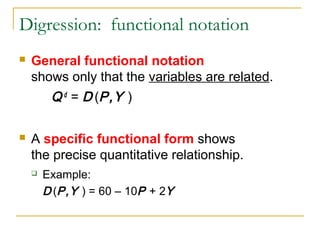
 General functional notation
shows only that the variables are related.
Q d
= D (P,Y )
 A specific functional form shows
the precise quantitative relationship.
 Example:
D (P,Y ) = 60 – 10P + 2Y
The market for cars: Demand
Q
Quantity
of cars
P
Price
of cars
D
The demand curve
shows the relationship
between quantity
demanded and price,
other things equal.
demand equation:
( , )=d
Q D P Y
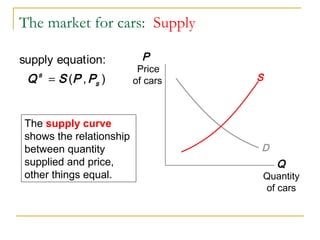
The market for cars: Supply
Q
Quantity
of cars
P
Price
of cars
D
supply equation:
( , )=s
sQ S P P S
The supply curve
shows the relationship
between quantity
supplied and price,
other things equal.
The market for cars: Equilibrium
Q
Quantity
of cars
P
Price
of cars S
D
equilibrium
price
equilibrium
quantity
The effects of an increase in income
Q
Quantity
of cars
P
Price
of cars S
D1
Q1
P1
An increase in income
increases the quantity
of cars consumers
demand at each price…
…which increases
the equilibrium price
and quantity.
P2
Q2
demand equation:
( , )=d
Q D P Y
D2
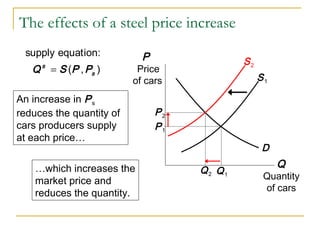
The effects of a steel price increase
Q
Quantity
of cars
P
Price
of cars S1
D
Q1
P1
An increase in Ps
reduces the quantity of
cars producers supply
at each price…
…which increases the
market price and
reduces the quantity.
P2
Q2
S2
supply equation:
( , )=s
sQ S P P
Endogenous vs. exogenous variables
 The values of endogenous variables
are determined in the model.
 The values of exogenous variables
are determined outside the model:
the model takes their values & behavior
as given. In the model of supply & demand
for cars,
endogenous: , ,d s
P Q Q
exogenous: , sY P
A multitude of models
 No one model can address all the issues we
care about.
 e.g., our supply-demand model of the car
market…
 can tell us how a fall in aggregate income affects
price & quantity of cars.
 cannot tell us why aggregate income falls.
A multitude of models
 So we will learn different models for studying
different issues (e.g., unemployment,
inflation, long-run growth).
 For each new model, you should keep track
of
 its assumptions
 which variables are endogenous,
which are exogenous
 the questions it can help us understand,
and those it cannot
Prices: flexible vs. sticky
 Market clearing: An assumption that prices
are flexible, adjust to equate supply and
demand.
 In the short run, many prices are sticky –
adjust sluggishly in response to changes in
supply or demand. For example,
 many labor contracts fix the nominal wage
for a year or longer
 many magazine publishers change prices
only once every 3-4 years
Prices: flexible vs. sticky
 The economy’s behavior depends partly on
whether prices are sticky or flexible:
 If prices are sticky, then demand won’t
always equal supply. This helps explain
 unemployment (excess supply of labor)
 why firms cannot always sell all the goods
they produce
 Long run: prices flexible, markets clear,
economy behaves very differently
Equilibrium and Disequilibrium
 Equilibrium
 A situation in which nobody has any
immediate reason to change their actions, so
that the status quo can continue, at least
temporarily. This is a state of balance
between opposing forces/actions.
 In Microeconomics, the simplest form of
equilibrium analysis looks at a single market.
The intersection of demand and supply gives
an equilibrium price (see the previous
figures).
Equilibrium and Disequilibrium
 Equilibrium
 In Macroeconomics, equilibrium refers to
situations when activity and price levels are
such that the plans of various groups such as
savers and investors are consistent, so that
they can all be implemented. Macroeconomic
model covers thousands of different goods
and services supplied and demanded in the
market. In macroeconomic equilibrium, AD
and AS curve intersect each other (draw
graph).
Equilibrium and Disequilibrium
 Equilibrium
 In game theory, an equilibrium in strategies
exists if, given the strategies that all other
agents are using, no individual agent finds
any change of strategy to be desirable. Such
an equilibrium may involve all parties taking
the others’ strategies as given: this is called a
Nash Equilibrium.
Equilibrium and Disequilibrium
 Disequilibrium
 A situation in which plans can not be carried
out. Disequilibrium can arise in particular
markets, in the level of activity as a whole, or
in the external relations between countries: it
is the normal state of the real world economy.
It produces discrepancies between ex ante
plans and ex post facts, which lead to a
dynamic process of change.
Value added
definition:
A firm’s value added is
the value of its output
minus
the value of the intermediate goods
the firm used to produce that output.
Exercise:
 A farmer grows a bushel of wheat
and sells it to a miller for $1.00.
 The miller turns the wheat into flour
and sells it to a baker for $3.00.
 The baker uses the flour to make a loaf of
bread and sells it to an engineer for $6.00.
 The engineer eats the bread.
Compute & compare
value added at each stage of production
and GDP
Business Cycle
 Business cycle: Alternating periods of
expansion and contraction in economic
activity.
 Classified into (a) the peak or boom, (b) a
recession or contraction (c) a depression
or trough, and (d) a recovery
Business Cycle
The peak or boom
 Optimum level of economic activity is achieved and
factors of production are fully employed.
 Demand, output, employment and income are at a high
level
 Prices rise but the factor share of income does not rise in
proportion to price rise.
 Rise in expectations lead to high lending, investment,
and demand for consumables.
 The expansionary process becomes self reinforcing,
leading to full employment and inflationary price hike.
 Finally, scarcity of resources and stable propensity to
consumption leads to recession.
Business Cycle
Recession or contraction
 A situation when demand is sluggish, real
output is not rising and unemployment is
increasing. A recession is usually identified
when real GDP falls for two consecutive
quarters. It is not severe as a depression.
 Consumption demand falls (think its effect)
 Labor demand also declines
 Inflation declines or deflation occurs
 Business profits also fall
Business Cycle
Depression/slump or trough
 A prolonged period of abnormally low
economic activity and abnormally high
unemployment. This is often accompanied by
a tendency for prices to fall, and by a fall in
the relative prices of primary products as
compared with those of industrial products.
 Price mechanism collapses and output
slumps heavily.
 Begins with some price shock, stock market
crash or similar other large shocks.
Business Cycle
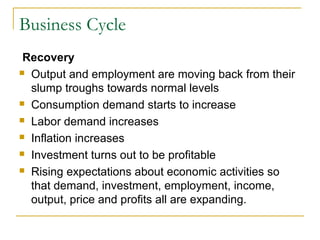
Recovery
 Output and employment are moving back from their
slump troughs towards normal levels
 Consumption demand starts to increase
 Labor demand increases
 Inflation increases
 Investment turns out to be profitable
 Rising expectations about economic activities so
that demand, investment, employment, income,
output, price and profits all are expanding.
Chapter SummaryChapter Summary
 Macroeconomics is the study of the economy
as a whole, including
 growth in incomes,
 changes in the overall level of prices,
 the unemployment rate.
 Macroeconomists attempt to explain the
economy and to devise policies to improve its
performance.
slide 54
Chapter SummaryChapter Summary
 Economists use different models to examine
different issues.
 Models with flexible prices describe the
economy in the long run; models with sticky
prices describe the economy in the short run.
 Macroeconomic events and performance
arise from many microeconomic transactions,
so macroeconomics uses many of the tools of
microeconomics.
slide 55

Chapter 1 - basic concepts about macroeconomics for BBA

  • 1.
  • 2.
    Introducing the course “Thewhole of the science is nothing more than the refinement of everyday thinking”. Albert Einstein
  • 3.
    Learning Objectives This chapterintroduces you to  the issues macroeconomists study  the tools macroeconomists use  some important concepts in macroeconomic analysis
  • 4.
    Important issues inmacroeconomics  Why does the cost of living keep rising?  Why a large number of people remain unemployed?  What causes recessions? Can the government do anything to combat recessions? Should it? Macroeconomics, the study of the economy as a whole, addresses many topical issues:
  • 5.
    Important issues inmacroeconomics  What is the government budget deficit? How does it affect the economy?  Why does a country have trade deficit ?  How does a country have balance of payments surplus?  Why are so many countries poor? What policies might help them grow out of poverty? Macroeconomics, the study of the economy as a whole, addresses many topical issues:
  • 6.
    Movement of macroeconomicindicators in Nepal Movement of Macroeconomic Indicators -5 0 5 10 15 20 19 85 Jul 19 86 Jul 19 87 Jul 19 88 Jul 19 89 Jul 19 90 Jul 19 91 Jul 19 92 Jul 19 93 Jul 19 94 Jul 19 95 Jul 19 96 Jul 19 97 Jul 19 98 Jul 19 99 Jul 20 00 Jul 20 01 Jul 20 02 Jul 20 03 Jul 20 04 Jul Inflation,GrowthandInterestRates 0 50 100 150 200 250 300 350 400 450 500 NominalExchangeRateIndex GDP growth rate Interest rate Inflation rate NER Index
  • 7.
    Why learn macroeconomics? Themacroeconomy affects society’s well-being. For example: each one-point increase in the unemployment rate in the US is associated with: 920 more suicides 650 more homicides 4000 more people admitted to state mental institutions 3300 more people sent to state prisons 37,000 more deaths increases in domestic violence and homelessness (Source: N. Gregory Mankiw, Macroeconomics) The macroeconomy affects society’s well-being. For example: each one-point increase in the unemployment rate in the US is associated with: 920 more suicides 650 more homicides 4000 more people admitted to state mental institutions 3300 more people sent to state prisons 37,000 more deaths increases in domestic violence and homelessness (Source: N. Gregory Mankiw, Macroeconomics)
  • 8.
    Some more onmacroeconomics Thus, the Macroeconomics also called the ‘income theory’ looks at the total economy:  Total output and income  The level of unemployment and employment  The amount of money in circulation  The level of prices and the rate of inflation Thus, in macroeconomics, we deal with the national economic goals such as full employment, control of inflation, economic stability and growth.  Remember as micro deals with individual, macro with aggregate. Thus, the difference is in “I” and “A” . I for individual (micro) and A for aggregate (Macro).
  • 9.
    Some more onmacroeconomics  The history of present day macroeconomics started with the publication of J.M. Keynes’ “ The General Theory of Employment, Interest and Money” in 1936.  Before the General Theory, microeconomics dominated the entire analysis under the assumption of full employment.  But the Great Depression of 1930s broke this belief with a number of devastating outcomes.
  • 10.
    Basic economic problemsissue  Resources/Inputs:  A society’s resources consist of natural endowments such as land, forests, and minerals (traditionally referred as land);  Human resources both physical and mental (traditionally referred as labor).  Manufactured aids to production such as tools, machinery, and buildings (commonly known as capital).  Entrepreneurs: Organization of production, innovation of new goods and technologies and the bearing of risk and uncertainty.
  • 11.
    Basic economic problemissue  Resources:  Resources are used to produce the outputs that people desire. These outputs are divided into goods and services.  Goods are tangibles (car, shoes etc) and services are intangibles (e.g. haircuts, and education).
  • 12.
    Basic economic problemissue  Resource scarcity (Remember a saying referring to scarcity, “I did the best I could with what I had.”)  Scarcity occurs because our limited resources and time can only yield limited production and income, but people’s wants are virtually unlimited. Output is produced by using knowledge (technology) to apply energy to a blend of resources. Production, in turn, generates the income people spend on the limited goods and services available.
  • 13.
    Basic economic problemissue Resource scarcity: Is there a balance? Scarcity Limited resources and time (labor, land, capital, entrepreneurship) Virtually unlimited human wants (food, clothing, shelter, security, comfort, medicine, jewelry, affection, recreation, and a number of others)
  • 14.
    Basic economic problemissue  Economic surplus: the benefit of any action, minus its cost, where benefit is measured by the marginal willingness-to-pay to undertake that action, and the cost is the marginal opportunity cost of undertaking that action. Also known as "total surplus" or “social surplus.”  Economic Efficiency: the maximization of economic surplus.  Economic efficiency : it is achieved when we produce the combination of outputs with the highest attainable total value, given our limited resources. It can be decomposed into: allocative, productive, and distributive.
  • 15.
    Basic economic problemissue  Allocative efficiency-What: Requires the pattern of national output to mirror what people want and are willing and able to buy.  Productive efficiency-How: Requires minimizing opportunity cost for a given value of output. Maximum output using given resources. Remember, “too many cooks spoil the broth.”  Distributive efficiency-Who: Requires that specific goods be used by the people who value them relatively the most.
  • 16.
    Basic economic problemissue  Pareto efficiency: A situation where no one can be made better-off without making someone else worse-off (Zero sum game).  Pareto improvement: A change that actually makes someone better-off without making anyone else worse off. Difficult!  “Potential” Pareto-improvement: A change that makes some people better-off by enough that they could compensate any losers with money so that everyone is better-off. Also known as "more efficient" or "economic improvement."
  • 17.
    Opportunity cost  Choosingany scarce thing forecloses other options, such lost options are economic (or opportunity) costs.  Opportunity cost is the value of the best alternative surrendered when a choice is made.  Every time a choice is made, opportunity costs are incurred.  Think your college education versus the job you could have. Suppose you are paying Rs. 200,000 for your education but you could have earned Rs. 400,000 if you had worked for 4 years. This means opp. cost of your education is Rs. 600,000.Higher your earning potential, higher your opport cost of the job.
  • 18.
    Stocks vs. Flows Aflow is a quantity measured per unit of time. E.g., “U.S. investment was $2.5 trillion during 2006.” Flow Stock A stock is a quantity measured at a point in time. E.g., “The U.S. capital stock was $26 trillion on January 1, 2006.”
  • 19.
    Now you try: Stockor flow?  the balance on your credit card statement  how much you study economics outside of class  the size of your compact disc collection  the inflation rate  the unemployment rate  The broad money on Mid-July of each year.
  • 20.
    Production possibility boundary Production possibility boundary illustrates three concepts: scarcity, choice and opportunity cost.  Scarcity is indicated by the unattainable combinations above the boundary;  Choice by the need to choose among the alternative attainable points outside the boundary.  Opportunity cost by the negative slope of the boundary. (See the next slide)
  • 21.
    Production possibility boundary Anexample of production possibility frontier (PPF)
  • 22.
    Economic organizations  Traditionaleconomy: an economy in which behavior is based primarily on tradition, custom, and habit. Young men follow their fathers’ occupations. Women do what their mothers did.  In this economy, what to produce, how to produce and how to distribute are determined by traditions.  In rural areas of the less developed economies, we still find this type of society.
  • 23.
    Economic organizations  Commandsystems: Economic behavior is determined by some central authority, usually the government, which makes most of the necessary decisions on what, how and for whom. Since the planning is done at the central level, this type of economy is also called centrally planned economy.  By the end of 1980s, one-third of the world’s economies were command economy. But today, only a few. Most common examples are China, Cuba, North Korea.
  • 24.
    Economic organizations  Marketsystems: Decision about the resource allocation are made without any central direction. Rather, it is made independently by individual producers and customers. Thus, it is also called market economy or free market economy.  Decision making is decentralized but coordinated. The coordinating device is the set of market determined prices. Therefore, market economy is also called price systems.
  • 25.
    Economic organizations  Mixedsystems: No system is perfectly command or market. The degree of weightage varies. In command economy, heavy weight is given to the central planning and in market systems heavy weight is given to the decentralized decisions making in response to market signals.  US, France, Canada, and Singapore rely heavily on market systems. And China, North Korea and Cuba on central planning.  However, there are some state regulations even in the US in environmental protection, restriction on the import of shoes and textiles etc. Also in command economies there are some market signals such as the presence of multilateral in China.
  • 26.
    Black or undergroundeconomy  Black economy is also called Grey/Informal/Unofficial economy. Private cash transactions in this economy are unreported and thus untaxed. Not only illegal activities, it also includes legal transactions that are not reported to the tax authorities and the income from which goes untaxed and unreported is also included there. Macedonia is taken as the case. If the black economy is stopped, Macedonia would go bankrupt. Marijuana, pornography and illegal labor create the black economy even in countries like the US.  Country% of black economy: Russia 50-60%, England and America 5-10%, Italy 30-40%.
  • 27.
    Black or undergroundeconomy  Like black economy, the underground/shadow economy consists of all commerce on which applicable taxes are being evaded. Thus, used black or underground interchangeably. Includes not only legally-prohibited commerce (e.g. drugs, prostitution, work done by illegal migrants, smuggling of commodities, and gambling) but also trade in legal goods and services because some income is not reported and consequently taxation is evaded through money laundering, payments in cash or other means.
  • 28.
    Black or undergroundeconomy  Typically cash transactions to evade traceability by government. Also complex financial operations involving the use of multiple subsidiaries and tax heavens. The growth of online commerce can increase this economy. For example: eBay has over 40 million regular users. The seller is legally responsible to pay taxes but it is evaded.
  • 29.
    Economic models  Mathematicalpresentation of economic theories designed to show the relationship among variables.  Thus, …are simplified versions of a more complex reality  irrelevant details are stripped away  …are used to  show relationships between variables  explain the economy’s behavior  devise policies to improve economic performance
  • 30.
    Example of amodel: Supply & demand for new cars shows how various events affect price and quantity of cars  assumes the market is competitive  Variables: Q d = quantity of cars that buyers demand Q s = quantity that producers supply P = price of new cars Y = aggregate income Ps = price of steel (an input)
  • 31.
    The demand forcars demand equation: Q d = D (P,Y )  shows that the quantity of cars consumers demand is related to the price of cars and aggregate income
  • 32.
    Digression: functional notation General functional notation shows only that the variables are related. Q d = D (P,Y )  A specific functional form shows the precise quantitative relationship.  Example: D (P,Y ) = 60 – 10P + 2Y
  • 33.
    The market forcars: Demand Q Quantity of cars P Price of cars D The demand curve shows the relationship between quantity demanded and price, other things equal. demand equation: ( , )=d Q D P Y
  • 34.
    The market forcars: Supply Q Quantity of cars P Price of cars D supply equation: ( , )=s sQ S P P S The supply curve shows the relationship between quantity supplied and price, other things equal.
  • 35.
    The market forcars: Equilibrium Q Quantity of cars P Price of cars S D equilibrium price equilibrium quantity
  • 36.
    The effects ofan increase in income Q Quantity of cars P Price of cars S D1 Q1 P1 An increase in income increases the quantity of cars consumers demand at each price… …which increases the equilibrium price and quantity. P2 Q2 demand equation: ( , )=d Q D P Y D2
  • 37.
    The effects ofa steel price increase Q Quantity of cars P Price of cars S1 D Q1 P1 An increase in Ps reduces the quantity of cars producers supply at each price… …which increases the market price and reduces the quantity. P2 Q2 S2 supply equation: ( , )=s sQ S P P
  • 38.
    Endogenous vs. exogenousvariables  The values of endogenous variables are determined in the model.  The values of exogenous variables are determined outside the model: the model takes their values & behavior as given. In the model of supply & demand for cars, endogenous: , ,d s P Q Q exogenous: , sY P
  • 39.
    A multitude ofmodels  No one model can address all the issues we care about.  e.g., our supply-demand model of the car market…  can tell us how a fall in aggregate income affects price & quantity of cars.  cannot tell us why aggregate income falls.
  • 40.
    A multitude ofmodels  So we will learn different models for studying different issues (e.g., unemployment, inflation, long-run growth).  For each new model, you should keep track of  its assumptions  which variables are endogenous, which are exogenous  the questions it can help us understand, and those it cannot
  • 41.
    Prices: flexible vs.sticky  Market clearing: An assumption that prices are flexible, adjust to equate supply and demand.  In the short run, many prices are sticky – adjust sluggishly in response to changes in supply or demand. For example,  many labor contracts fix the nominal wage for a year or longer  many magazine publishers change prices only once every 3-4 years
  • 42.
    Prices: flexible vs.sticky  The economy’s behavior depends partly on whether prices are sticky or flexible:  If prices are sticky, then demand won’t always equal supply. This helps explain  unemployment (excess supply of labor)  why firms cannot always sell all the goods they produce  Long run: prices flexible, markets clear, economy behaves very differently
  • 43.
    Equilibrium and Disequilibrium Equilibrium  A situation in which nobody has any immediate reason to change their actions, so that the status quo can continue, at least temporarily. This is a state of balance between opposing forces/actions.  In Microeconomics, the simplest form of equilibrium analysis looks at a single market. The intersection of demand and supply gives an equilibrium price (see the previous figures).
  • 44.
    Equilibrium and Disequilibrium Equilibrium  In Macroeconomics, equilibrium refers to situations when activity and price levels are such that the plans of various groups such as savers and investors are consistent, so that they can all be implemented. Macroeconomic model covers thousands of different goods and services supplied and demanded in the market. In macroeconomic equilibrium, AD and AS curve intersect each other (draw graph).
  • 45.
    Equilibrium and Disequilibrium Equilibrium  In game theory, an equilibrium in strategies exists if, given the strategies that all other agents are using, no individual agent finds any change of strategy to be desirable. Such an equilibrium may involve all parties taking the others’ strategies as given: this is called a Nash Equilibrium.
  • 46.
    Equilibrium and Disequilibrium Disequilibrium  A situation in which plans can not be carried out. Disequilibrium can arise in particular markets, in the level of activity as a whole, or in the external relations between countries: it is the normal state of the real world economy. It produces discrepancies between ex ante plans and ex post facts, which lead to a dynamic process of change.
  • 47.
    Value added definition: A firm’svalue added is the value of its output minus the value of the intermediate goods the firm used to produce that output.
  • 48.
    Exercise:  A farmergrows a bushel of wheat and sells it to a miller for $1.00.  The miller turns the wheat into flour and sells it to a baker for $3.00.  The baker uses the flour to make a loaf of bread and sells it to an engineer for $6.00.  The engineer eats the bread. Compute & compare value added at each stage of production and GDP
  • 49.
    Business Cycle  Businesscycle: Alternating periods of expansion and contraction in economic activity.  Classified into (a) the peak or boom, (b) a recession or contraction (c) a depression or trough, and (d) a recovery
  • 50.
    Business Cycle The peakor boom  Optimum level of economic activity is achieved and factors of production are fully employed.  Demand, output, employment and income are at a high level  Prices rise but the factor share of income does not rise in proportion to price rise.  Rise in expectations lead to high lending, investment, and demand for consumables.  The expansionary process becomes self reinforcing, leading to full employment and inflationary price hike.  Finally, scarcity of resources and stable propensity to consumption leads to recession.
  • 51.
    Business Cycle Recession orcontraction  A situation when demand is sluggish, real output is not rising and unemployment is increasing. A recession is usually identified when real GDP falls for two consecutive quarters. It is not severe as a depression.  Consumption demand falls (think its effect)  Labor demand also declines  Inflation declines or deflation occurs  Business profits also fall
  • 52.
    Business Cycle Depression/slump ortrough  A prolonged period of abnormally low economic activity and abnormally high unemployment. This is often accompanied by a tendency for prices to fall, and by a fall in the relative prices of primary products as compared with those of industrial products.  Price mechanism collapses and output slumps heavily.  Begins with some price shock, stock market crash or similar other large shocks.
  • 53.
    Business Cycle Recovery  Outputand employment are moving back from their slump troughs towards normal levels  Consumption demand starts to increase  Labor demand increases  Inflation increases  Investment turns out to be profitable  Rising expectations about economic activities so that demand, investment, employment, income, output, price and profits all are expanding.
  • 54.
    Chapter SummaryChapter Summary Macroeconomics is the study of the economy as a whole, including  growth in incomes,  changes in the overall level of prices,  the unemployment rate.  Macroeconomists attempt to explain the economy and to devise policies to improve its performance. slide 54
  • 55.
    Chapter SummaryChapter Summary Economists use different models to examine different issues.  Models with flexible prices describe the economy in the long run; models with sticky prices describe the economy in the short run.  Macroeconomic events and performance arise from many microeconomic transactions, so macroeconomics uses many of the tools of microeconomics. slide 55
Editor's Notes

  • #5 This slide and the next contain a list of some topical issues that macro can help students understand. Feel free to substitute others as new issues emerge.
  • #8 It might be useful to briefly define the unemployment rate so that students will be able to understand this and the next few slides. Source: Barry Bluestone and Bennett Harrison, The Deindustrialization of America (New York: Basic Books, 1982), Chapter 3, cited in Robert J. Gordon, Macroeconomics, 4th edition (Boston: Little, Brown and Company), p.334. If you know of more recent estimates, please email me so I can update this slide!!! Thanks! (My email address is roncron@unlv.nevada.edu)
  • #19 The bathtub example is the classic means of explaining stocks and flows.
  • #20 Here are the answers, and explanations: The balance on your credit card statement is a stock. (A corresponding flow would be the amount of new purchases on your credit card statement.) How much you study is a flow. The statement “I study 10 hours” is only meaningful if we know the time period – whether 10 years per day, per week, per month, etc. The size of your compact disc collection is a stock. (A corresponding flow would be how many CDs you buy per month.) The inflation rate is a flow: we say “prices are increasing by 3.2% per year” or “by 0.4% per month”. The unemployment rate is a stock: It’s the number of unemployed people divided by the number of people in the workforce. In contrast, the number of newly unemployed people per month would be a flow.
  • #31 Students will realize that the auto market is not competitive. However, if all we want to know is how an increase in the price of steel or a fall in consumer income affects the price and quantity of autos, then it’s fine to use this model. In general, making unrealistic assumptions is okay, even desirable, if they simplify the analysis without affecting its validity. DEFINE COMPETITIVE MKT? --- Many buyers and sellers, so many that they cannot individually affect market price or quantity. Freedom of entry and exit.
  • #33 We often aren’t concerned with the exact quantitative relationship between variables, so we will often just use the general functional notation.
  • #49 When students compute GDP, they should assume that these are the only transactions in the economy. Lessons of this problem: GDP = value of final goods = sum of value at all stages of production We don’t include the value of intermediate goods in GDP because their value is already embodied in the value of the final goods. Answer: Each person’s value-added (VA) equals the value of what he/she produced minus the value of the intermediate inputs he/she started with. Farmer’s VA = $1 Miller’s VA = $2 Baker’s VA = $3 GDP = $6 Note that GDP = value of final good = sum of value-added at all stages of production. Even though this problem is highly simplified, its main lesson holds in the real world: the value of all final goods produced equals the sum of value-added in all stages of production of all goods.