INTRODUCTION TO BUSINESS
ECONOMICS
Mrs.P.REVATHI, MBA, (Ph.D)
Assistant Professor (Sl.Gr.)
Department of Management Studies
KIT-Kalaignarkarunanidhi Institute of Technology
Coimbatore
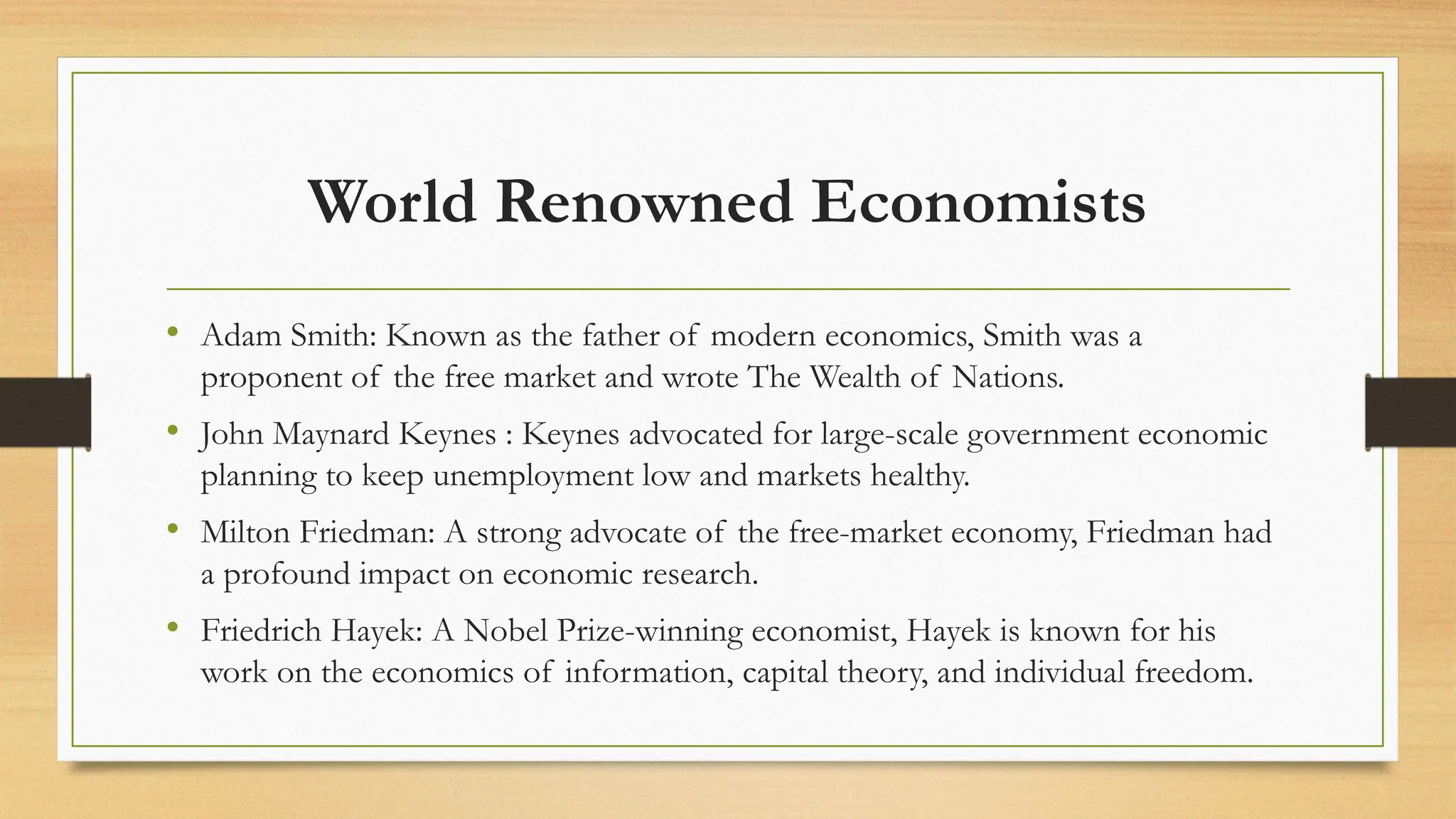
World Renowned Economists
• Adam Smith: Known as the father of modern economics, Smith was a
proponent of the free market and wrote The Wealth of Nations.
• John Maynard Keynes : Keynes advocated for large-scale government economic
planning to keep unemployment low and markets healthy.
• Milton Friedman: A strong advocate of the free-market economy, Friedman had
a profound impact on economic research.
• Friedrich Hayek: A Nobel Prize-winning economist, Hayek is known for his
work on the economics of information, capital theory, and individual freedom.
• David Ricardo: A British political economist and stock trader, Ricardo is often
credited with systematizing economics.
• Karl Marx: Known for his theories on capitalism and communism.
• Amartya Sen: An Indian economist who won the 1998 Nobel Prize in Economic
Sciences for his contributions to welfare economics and social choice.
• Alan Greenspan: The Chairman of the Federal Reserve from 1987 to 2006,
Greenspan is believed to be one of the most influential economists of our time.
• Elinor Ostrom: The first and only woman to win the Nobel Prize for Economics,
Ostrom's theorizing of the commons opened the way for non-capitalist economic
alternatives.
PRINCIPLES OF ECONOMICS
• Gregory Mankiw in his Principles of Economics outlines Ten Principles of Economics that we will replicate here, they are:
• People face trade-offs.
• The cost of something is what you give up getting it.
• Rational people think at the marginal cost and marginal revenue.
• People respond to incentives.
• Trade can make everyone better off.
• Markets are usually a good way to organize economic activity.
• Governments can sometimes improve market outcomes.
• A country's standard of living depends on its ability to produce goods and services.
• Growth of money leads to inflation
• Society faces a short-run tradeoff between Inflation and unemployment.
Definition of Economics
• British economist Alfred Marshall defined economics as the study of how people earn and spend their
income in the course of their ordinary lives. He believed economics was a social science, not a natural
science like chemistry or physics.
• Marshall's definition of economics included the following ideas:
• Wealth and well-being: Economics is the study of wealth creation and how people use the wealth they
create.
• People at the center: Economics is centered on people, and other material aspects revolve around them.
• Social science: Economics is a social science, not a natural science like physics or chemistry.
• Marshall founded the Cambridge School, which focused on welfare economics, the theory of the firm,
and increasing returns.
Basic Assumptions of Economics
• Perfect competition
• Efficiency
• Fixed preferences
• Unlimited wants
• Self-interest in decision-making
• Rational decision-making
• Bounded rationality
Economic Analysis
• Economic analysis is the evaluation of costs and benefits. It can help governments make the best use
of taxpayers' funds and generate maximum benefit for society.
• Budget impact analysis: Estimates the financial consequences of a proposed intervention
• Economic forecasting: Determines the future prosperity of an investment pattern
• Return-on-investment analysis: Measures the efficiency of an investment by dividing the benefit by
the intervention cost
• Economic assessment: Compares the expected costs and benefits of a proposal, policy, or regulation
• Business analysis: Helps companies identify needs, overcome difficulties, and attract capital
• Factor analysis: A specific type of economic analysis
• Financial and management analysis: Used by financial and credit organizations to improve
efficiency
Economic Decisions
• Economic decisions are made in a variety of ways, depending on the economic system in place:
• Mixed economy: Economic decisions are made by both the government and individuals. This
system is a combination of a command economy and a free market economy.
• Market economy: Economic decisions are made through markets, and are guided by price signals.
(USA, Canada, Germany )
• Traditional economic system: This basic system is based on established trends for goods, services,
and work. There is little specialization or division of labor.
• Command economic system: The government controls economic decision-making, including what
to produce, how much to produce, and who gets the products.
• Microeconomic decisions: This branch of economics focuses on the economic and financial
decisions made by individuals, households, and businesses.
• Capitalist economy: Private investors own the forms of equity and make economic decisions for
their businesses. (Hong Kong, Singapore, New Zealand, Switzerland, Australia, United States)
• All economies must make three basic decisions: what to produce, how to produce it, and who will
consume it.
MICRO ECONOMIC ANALYSIS
• Microeconomics is concerned with how supply and demand interact in
individual markets for goods and services.
• Microeconomics shows how and why different goods have different values.
It addresses how individuals and businesses conduct and benefit from
efficient production and exchange and how individuals can best coordinate
and cooperate with each other.
Basic Concepts of Microeconomics
• Incentives and behaviours
• Utility theory
• Production theory
• Price theory
Where Is Microeconomics Used?
• Policymakers may use microeconomics to understand the effect of setting a
minimum wage or subsidizing the production of certain commodities.
• Businesses may use microeconomics to analyze pricing or production
choices.
• Individuals may use it to assess purchasing and spending decisions.
Theory of Firms
• In neoclassical economics—an approach to economics focusing on the
determination of goods, outputs, and income distributions in markets
through supply and demand—the theory of the firm is a microeconomic
concept that states that a firm exists and make decisions to maximize profits.
• Whether a company's goal is to maximize profits in the short-term or long-
term. Modern takes on the theory of the firm sometimes distinguish
between long-run motivations, such as sustainability, and short-run
motivations, such as profit maximization.
• If a company's goal is to maximize short-term profits, it might find ways to increase
efficiency, boost revenue and reduce costs. However, companies that utilize fixed
assets, like equipment, would ultimately need to make capital investments to ensure
the company is profitable in the long-term.
• If competition is strong, the company will need to not only maximize profits but
also stay one step ahead of its competitors by reinventing itself and adapting its
offerings. Therefore, long-term profits could only be maximized if there's a balance
between short-term profits and investing in the future.
Forms of Ownership
• Limited Liability Company: A business that is a separate legal entity from its owners and directors. The company
enters into contracts, owns assets, and can be sued
• Sole proprietorship
• Partnership
• Publicly listed company
• One person company: A One Person Company (OPC) is a business structure in India that allows a single person to
own and operate a company. The Companies Act of 2013 introduced the concept of OPCs to promote entrepreneurship
and formalize small and medium-sized businesses.
• Private limited company
• Cooperative
• Hindu Undivided Family
• Section 8 Company: A Section 8 company is a non-profit organization (NPO) in India that promotes social welfare, the
arts, education, sports, science, research, and other causes. Section 8 companies are registered under the Companies Act
of 2013 and are exempt from some requirements of other commercial companies.
PROFIT MAXIMIZATION THEORY
• Profit maximization theory is an economic theory that assumes a company's primary goal is to maximize
its profits. The theory also assumes that companies will choose the least expensive way to achieve this
goal.
• Profit maximization
• The point at which a company's profit is at its highest. This occurs when marginal revenue (MR) equals
marginal cost (MC). MR is the price per unit of a product or service, and MC is the cost per unit.
• Economic efficiency
• The theory suggests that profit-maximizing behavior leads to economic efficiency, which is the efficient
allocation of resources.
• Utilitarian thought
• The idea that maximizing both private and social benefit is the foundation of utilitarian thought.
• Competition
• The theory suggests that businesses should develop a sustainable competitive advantage over their rivals.

Introduction to Business Economicss.pptx

  • 1.
    INTRODUCTION TO BUSINESS ECONOMICS Mrs.P.REVATHI,MBA, (Ph.D) Assistant Professor (Sl.Gr.) Department of Management Studies KIT-Kalaignarkarunanidhi Institute of Technology Coimbatore
  • 2.
    World Renowned Economists •Adam Smith: Known as the father of modern economics, Smith was a proponent of the free market and wrote The Wealth of Nations. • John Maynard Keynes : Keynes advocated for large-scale government economic planning to keep unemployment low and markets healthy. • Milton Friedman: A strong advocate of the free-market economy, Friedman had a profound impact on economic research. • Friedrich Hayek: A Nobel Prize-winning economist, Hayek is known for his work on the economics of information, capital theory, and individual freedom.
  • 3.
    • David Ricardo:A British political economist and stock trader, Ricardo is often credited with systematizing economics. • Karl Marx: Known for his theories on capitalism and communism. • Amartya Sen: An Indian economist who won the 1998 Nobel Prize in Economic Sciences for his contributions to welfare economics and social choice. • Alan Greenspan: The Chairman of the Federal Reserve from 1987 to 2006, Greenspan is believed to be one of the most influential economists of our time. • Elinor Ostrom: The first and only woman to win the Nobel Prize for Economics, Ostrom's theorizing of the commons opened the way for non-capitalist economic alternatives.
  • 4.
    PRINCIPLES OF ECONOMICS •Gregory Mankiw in his Principles of Economics outlines Ten Principles of Economics that we will replicate here, they are: • People face trade-offs. • The cost of something is what you give up getting it. • Rational people think at the marginal cost and marginal revenue. • People respond to incentives. • Trade can make everyone better off. • Markets are usually a good way to organize economic activity. • Governments can sometimes improve market outcomes. • A country's standard of living depends on its ability to produce goods and services. • Growth of money leads to inflation • Society faces a short-run tradeoff between Inflation and unemployment.
  • 5.
    Definition of Economics •British economist Alfred Marshall defined economics as the study of how people earn and spend their income in the course of their ordinary lives. He believed economics was a social science, not a natural science like chemistry or physics. • Marshall's definition of economics included the following ideas: • Wealth and well-being: Economics is the study of wealth creation and how people use the wealth they create. • People at the center: Economics is centered on people, and other material aspects revolve around them. • Social science: Economics is a social science, not a natural science like physics or chemistry. • Marshall founded the Cambridge School, which focused on welfare economics, the theory of the firm, and increasing returns.
  • 6.
    Basic Assumptions ofEconomics • Perfect competition • Efficiency • Fixed preferences • Unlimited wants • Self-interest in decision-making • Rational decision-making • Bounded rationality
  • 7.
    Economic Analysis • Economicanalysis is the evaluation of costs and benefits. It can help governments make the best use of taxpayers' funds and generate maximum benefit for society. • Budget impact analysis: Estimates the financial consequences of a proposed intervention • Economic forecasting: Determines the future prosperity of an investment pattern • Return-on-investment analysis: Measures the efficiency of an investment by dividing the benefit by the intervention cost • Economic assessment: Compares the expected costs and benefits of a proposal, policy, or regulation • Business analysis: Helps companies identify needs, overcome difficulties, and attract capital • Factor analysis: A specific type of economic analysis • Financial and management analysis: Used by financial and credit organizations to improve efficiency
  • 8.
    Economic Decisions • Economicdecisions are made in a variety of ways, depending on the economic system in place: • Mixed economy: Economic decisions are made by both the government and individuals. This system is a combination of a command economy and a free market economy. • Market economy: Economic decisions are made through markets, and are guided by price signals. (USA, Canada, Germany ) • Traditional economic system: This basic system is based on established trends for goods, services, and work. There is little specialization or division of labor. • Command economic system: The government controls economic decision-making, including what to produce, how much to produce, and who gets the products. • Microeconomic decisions: This branch of economics focuses on the economic and financial decisions made by individuals, households, and businesses. • Capitalist economy: Private investors own the forms of equity and make economic decisions for their businesses. (Hong Kong, Singapore, New Zealand, Switzerland, Australia, United States) • All economies must make three basic decisions: what to produce, how to produce it, and who will consume it.
  • 9.
    MICRO ECONOMIC ANALYSIS •Microeconomics is concerned with how supply and demand interact in individual markets for goods and services. • Microeconomics shows how and why different goods have different values. It addresses how individuals and businesses conduct and benefit from efficient production and exchange and how individuals can best coordinate and cooperate with each other.
  • 10.
    Basic Concepts ofMicroeconomics • Incentives and behaviours • Utility theory • Production theory • Price theory
  • 11.
    Where Is MicroeconomicsUsed? • Policymakers may use microeconomics to understand the effect of setting a minimum wage or subsidizing the production of certain commodities. • Businesses may use microeconomics to analyze pricing or production choices. • Individuals may use it to assess purchasing and spending decisions.
  • 12.
    Theory of Firms •In neoclassical economics—an approach to economics focusing on the determination of goods, outputs, and income distributions in markets through supply and demand—the theory of the firm is a microeconomic concept that states that a firm exists and make decisions to maximize profits. • Whether a company's goal is to maximize profits in the short-term or long- term. Modern takes on the theory of the firm sometimes distinguish between long-run motivations, such as sustainability, and short-run motivations, such as profit maximization.
  • 13.
    • If acompany's goal is to maximize short-term profits, it might find ways to increase efficiency, boost revenue and reduce costs. However, companies that utilize fixed assets, like equipment, would ultimately need to make capital investments to ensure the company is profitable in the long-term. • If competition is strong, the company will need to not only maximize profits but also stay one step ahead of its competitors by reinventing itself and adapting its offerings. Therefore, long-term profits could only be maximized if there's a balance between short-term profits and investing in the future.
  • 14.
    Forms of Ownership •Limited Liability Company: A business that is a separate legal entity from its owners and directors. The company enters into contracts, owns assets, and can be sued • Sole proprietorship • Partnership • Publicly listed company • One person company: A One Person Company (OPC) is a business structure in India that allows a single person to own and operate a company. The Companies Act of 2013 introduced the concept of OPCs to promote entrepreneurship and formalize small and medium-sized businesses. • Private limited company • Cooperative • Hindu Undivided Family • Section 8 Company: A Section 8 company is a non-profit organization (NPO) in India that promotes social welfare, the arts, education, sports, science, research, and other causes. Section 8 companies are registered under the Companies Act of 2013 and are exempt from some requirements of other commercial companies.
  • 15.
    PROFIT MAXIMIZATION THEORY •Profit maximization theory is an economic theory that assumes a company's primary goal is to maximize its profits. The theory also assumes that companies will choose the least expensive way to achieve this goal. • Profit maximization • The point at which a company's profit is at its highest. This occurs when marginal revenue (MR) equals marginal cost (MC). MR is the price per unit of a product or service, and MC is the cost per unit. • Economic efficiency • The theory suggests that profit-maximizing behavior leads to economic efficiency, which is the efficient allocation of resources. • Utilitarian thought • The idea that maximizing both private and social benefit is the foundation of utilitarian thought. • Competition • The theory suggests that businesses should develop a sustainable competitive advantage over their rivals.