MICRO ECONOMICS
INTRODUCTION
WHAT IS ECONOMICS?
 Economics is the study of a way in which a society decides or chooses to use limited
resources with alternative uses for the production of goods and services and to
ultimately distribute the product among different sections of the society.
 Economics is about choosing among different alternatives in the presence of scarcity. It
aims to ensure that the resources are used in the best possible manner.
 Why Economics is considered as a social science?
 The term science stands for a systematic and organised body of knowledge.
Economics is also a science as it is a systematic and organised study of the economic
behaviour of human beings. But, it is not an exact science like Physics and Chemistry
as it deals with the study of human behaviour. Therefore, it is known as social science.
POSITIVE AND NORMATIVE ECONOMICS
 Positive economics is the study of the facts of life. It means that it deals with the real life economic
problems as they are and how these problems are solved.
 Positive economics is objective and fact-based where the statements are precise, descriptive, and
clearly measurable. These statements can be measured against tangible evidence or historical
instances. There are no instances of approval-disapproval in positive economics.
 An example of a positive economic statement: "Government-provided healthcare increases public
expenditures." This statement is fact-based and has no value judgment attached to it. Its validity can
be proven (or disproven) by studying healthcare spending where governments provide healthcare.
 Normative economics deals with finding out solutions to economic problems. Simply put, it answers the question
of ‘what ought to be done’.
 Normative economics focuses on value-based judgments aimed at improving economic development, investment
projects, and the distribution of wealth. Its goal is to summarize the desirability (or lack thereof) of various
economic developments, situations, and programs by asking what should happen or what ought to be.
 An example of a normative economic statement is: "The government should provide basic healthcare to all
citizens." As you can deduce from this statement, it is value-based, rooted in personal perspective, and satisfies
the requirement of what "should" be.
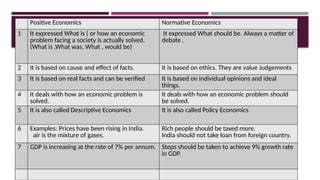
Positive Economics Normative Economics
1 It expressed What is ( or how an economic
problem facing a society is actually solved.
(What is ,What was, What , would be)
It expressed What should be. Always a matter of
debate .
2 It is based on cause and effect of facts. It is based on ethics. They are value Judgements
3 It is based on real facts and can be verified It is based on individual opinions and ideal
things.
4 It deals with how an economic problem is
solved.
It deals with how an economic problem should
be solved.
5 It is also called Descriptive Economics It is also called Policy Economics
6 Examples: Prices have been rising in India.
air is the mixture of gases.
Rich people should be taxed more.
India should not take loan from foreign country.
7 GDP is increasing at the rate of 7% per annum. Steps should be taken to achieve 9% growth rate
in GDP.
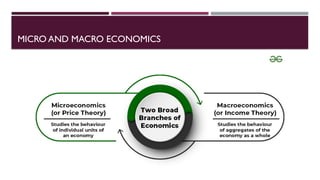
MICRO AND MACRO ECONOMICS
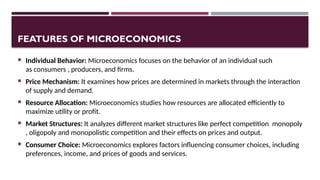
FEATURES OF MICROECONOMICS
 Individual Behavior: Microeconomics focuses on the behavior of an individual such
as consumers , producers, and firms.
 Price Mechanism: It examines how prices are determined in markets through the interaction
of supply and demand.
 Resource Allocation: Microeconomics studies how resources are allocated efficiently to
maximize utility or profit.
 Market Structures: It analyzes different market structures like perfect competition monopoly
, oligopoly and monopolistic competition and their effects on prices and output.
 Consumer Choice: Microeconomics explores factors influencing consumer choices, including
preferences, income, and prices of goods and services.
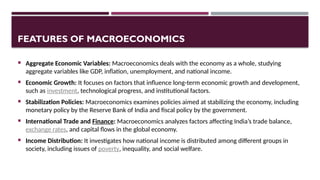
FEATURES OF MACROECONOMICS
 Aggregate Economic Variables: Macroeconomics deals with the economy as a whole, studying
aggregate variables like GDP, inflation, unemployment, and national income.
 Economic Growth: It focuses on factors that influence long-term economic growth and development,
such as investment, technological progress, and institutional factors.
 Stabilization Policies: Macroeconomics examines policies aimed at stabilizing the economy, including
monetary policy by the Reserve Bank of India and fiscal policy by the government.
 International Trade and Finance: Macroeconomics analyzes factors affecting India’s trade balance,
exchange rates, and capital flows in the global economy.
 Income Distribution: It investigates how national income is distributed among different groups in
society, including issues of poverty, inequality, and social welfare.
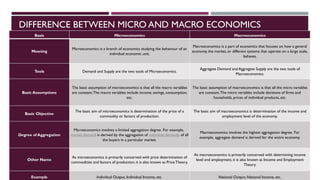
DIFFERENCE BETWEEN MICRO AND MACRO ECONOMICS
Basis Microeconomics Macroeconomics
Meaning
Microeconomics is a branch of economics studying the behaviour of an
individual economic unit.
Macroeconomics is a part of economics that focuses on how a general
economy, the market, or different systems that operate on a large scale,
behaves.
Tools Demand and Supply are the two tools of Microeconomics.
Aggregate Demand and Aggregate Supply are the two tools of
Macroeconomics.
Basic Assumptions
The basic assumption of microeconomics is that all the macro variables
are constant.The macro variables include income, savings, consumption,
etc.
The basic assumption of macroeconomics is that all the micro variables
are constant.The micro variables include decisions of firms and
households, prices of individual products, etc.
Basic Objective
The basic aim of microeconomics is determination of the price of a
commodity or factors of production.
The basic aim of macroeconomics is determination of the income and
employment level of the economy.
Degree of Aggregation
Microeconomics involves a limited aggregation degree. For example,
market demand is derived by the aggregation of individual demands of all
the buyers in a particular market.
Macroeconomics involves the highest aggregation degree. For
example, aggregate demand is derived for the entire economy.
Other Name
As microeconomics is primarily concerned with price determination of
commodities and factors of production, it is also known as Price Theory.
As macroeconomics is primarily concerned with determining income
level and employment, it is also known as Income and Employment
Theory.
Example Individual Output, Individual Income, etc. National Output, National Income, etc.
WHAT IS AN ECONOMY?
 Economy is a system that provides individuals with the means to work and earn a
living to satisfy their needs and wants.They can do so through the process of
manufacturing, consumption, investment, and exchange.
 It is a whole collection of production units operating in a defined area or region by
which people of that area earn their living
 Functioning of an economy: Production, consumption and investment
BASIC PROBLEMS OF AN ECONOMY
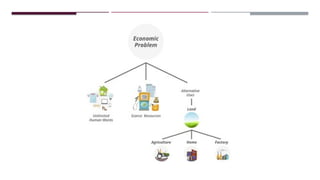
 Economic problem is the problem of choosing from among different options that arise because of
three major reasons limited resources, unlimited human wants, and alternative use of the limited
resources.
 Scarcity of resources: Resources such as capital, land, labor and organisation are limited in an
economy as compared to their demand.Therefore, an economy cannot manufacture everything they
want which creates an economic problem.
 Unlimited human wants: An individual’s wants never end, they always want something and can
never be satisfied completely.Also the increase in population leads to increase in demand for goods
and services.
 Alternative uses: The resources available in the economy are not only scarce, but they also have
alternative uses. It means that a resource can be used in different ways, which makes the need to
choose among the available resources essential, ultimately giving rise to the economic problem.
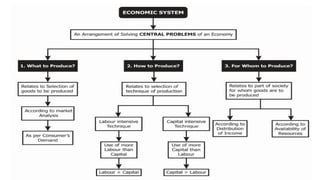
CENTRAL PROBLEMS OF AN ECONOMY
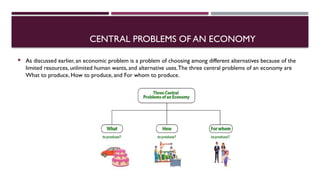
 As discussed earlier, an economic problem is a problem of choosing among different alternatives because of the
limited resources, unlimited human wants, and alternative uses.The three central problems of an economy are
What to produce, How to produce, and For whom to produce.
WHATTO PRODUCE?
 With limited resources, an economy cannot produce all goods and services. It has to choose among
the different goods and services.
 Therefore, the first central problem of an economy includes selecting goods and services to produce
and the number of units or quantity of each commodity to be produced.
 For example, a farmer has to make choice between different crops as to which he should grow on
one piece of land. He can decide to grow one crop of the whole land or grow different proportions of
more than one crop.
 What possible commodities to produce: The first aspect of the problem of ‘What to produce’ is
deciding which commodities to be produced in an economy. It means that an economy has to choose
between different consumer goods (clothes, wheat, etc.) and capital goods (machinery, etc.) to
produce. Similarly, it has to choose between different war goods (tanks, guns, bullets, etc.) and civil
goods (milk, bread, butter, etc.).
 How much to produce: Once the economy has decided the commodity to be
produced, it has to decide the quantity of each selected commodity to be produced.
Simply put, it means deciding the quantity of each selected consumer good, capital
good, civil good, and war good to be produced in an economy.
 As the two aspects of the first central problem of an economy are What possible
commodities to produce and How much to produce, it is also known as What to
Produce and in What Quantity. This problem can be solved by allocating the
resources of an economy in a way that provides maximum aggregate satisfaction to
society.
HOWTO PRODUCE?
 After deciding what to produce, another central problem of how to manufacture the
goods and services arises.
 It involves selecting a technique of production from among different techniques.
Usually, there are two techniques of production, labour intensive techniques, and
capital intensive techniques.
 The former technique involves more use of labour, and the latter involves more use
of machines. An organization can decide the technique based on different factors like
the nature of the product, size of the market, size of the location, budget, etc.
 For example, a poor farmer can adopt labour intensive techniques as they are cheap.
However, a rich farmer can adopt capital intensive techniques as he can afford to
purchase machines.
Usually, there are two techniques of production, Labour Intensive Techniques
(LIT) and Capital Intensive Techniques (CIT). The former technique involves more use of
labour, and the latter involves more use of machines.
An organization can decide the technique based on different factors like the nature of the
product, size of the market, size of the location, budget, etc.
For example, a poor farmer can adopt labour-intensive techniques as they are cheap.
However, a rich farmer can adopt capital-intensive techniques as he can afford to
purchase machines.
While selecting the technique of production, an economy aims at raising the standard of
living of people and providing employment to everyone.
For Instance, labour Intensive Techniques are preferred in countries like India as labour is
found in abundance in these countries. However, Capital Intensive Techniques are
preferred in countries like the USA as capital is found in abundance in these countries.
The problem of How to Produce can be solved by combining the factors of production of
an economy in a way that it can produce maximum output at minimum cost by using the
least possible scarce resources.
FORWHOMTO PRODUCE?
 The last central problem of an economy after deciding what and how to produce is for whom
to produce.
 As an economy cannot satisfy the needs and wants of every individual of the society, it has to
make a decision for who to produce a commodity and service. Simply put, it involves
deciding who should get how much of the goods and services, i.e., how much production
should be done for the poor and how much for the rich. For example, an organization can
decide to produce necessity goods for the poor section of society. However, another firm can
decide to produce luxury goods for the rich section of society.
 Besides these problems, there are two more problems that arise in underdeveloped
countries like India. These are the problems of the growth of resources and the problem of
the underutilization of resources.
 As every economy has scarce resources and cannot fulfil every want of people, it
faces the problem of choice between different sections of society. Hence, an
economy produces goods for those people who can pay for them which depends on
their income level.
 It means that the problem of ‘for whom to produce’ is concerned with the income
distribution among the different factors of production (like land, labour, capital, and
enterprise) which contribute to the production process.
 Functional Distribution: Functional Distribution means deciding the share of
different factors of production in a country’s total national product in the form Rent,
Wages, Interest and profit.
 The problem of For Whom to Produce can be solved by making sure that the urgent
wants of each productive factor of the society are fulfilled to the maximum possible
extent.
ALLOCATION OF RESOURCES
 The problem in which an economy has to assign the scarce available resources in a
way that the maximum wants of the society are fulfilled is known as the allocation of
resources.
 The need to allocate the resources arise because of the limited availability of
resources and unlimited wants of society.
 Therefore, the basic aim behind the allocation of resources is to economize the use
of available resources and utilize them in the best possible efficient manner.
 Simply put, an economy has to allocate the resources and choose from different
options of goods (What to Produce), choose from different production techniques
(How to Produce), and decide the end consumer of the goods (For Whom to
Produce).
Basic problems can be solved either by the free interaction of the individuals pursuing their own
objectives as is done in the market or in a planned manner by some central authority like the
government.
The Centrally Planned Economy
In a centrally planned economy, the government or the central authority plans all the important
activities in the economy. All important decisions regarding production, exchange and
consumption of goods and services are made by the government.
The central authority may try to achieve a particular allocation of resources and a consequent
distribution of the final combination of goods and services which is thought to be desirable for
society as a whole. For example, if it is found that a good or service which is very important for the
prosperity and well-being of the economy as a whole, e.g. education or health service, is not
produced in adequate amount by the individuals on their own, the government might try to induce
the individuals to produce adequate amount of such a good or service or, alternatively, the
government may itself decide to produce the good or service in question.
The central authority may intervene and try to achieve an equitable distribution of the final mix of
goods and services.
Market Economy
A market, as studied in economics, is an institution which organises the free
interaction of individuals pursuing their respective economic activities. In other
words, a market is a set of arrangements where economic agents can freely
exchange their products with each other.
It is important to note that the term ‘market’ as used in economics is quite different
from the common sense understanding of a market.
For buying and selling commodities, individuals may or may not meet each other in
an actual physical location. Interaction between buyers and sellers can take place in a
variety of situations such as a village chowk or a super market in a city, or
alternatively, buyers and sellers can interact with each other through telephone or
internet and conduct the exchange of commodities.
The arrangements which allow people to buy and sell commodities freely are the
defining features of a market.
In a market system, all goods or services come with a price (which is mutually
agreed upon by the buyers and sellers) at which the exchanges take place.
The price reflects, on an average, the society’s valuation of the good or service
in question.
If the buyers demand more of a certain good, the price of that good will rise.
This signals to the producers of that good that the society as a whole wants
more of that good than is currently being produced and the producers of the
good, in their turn, are likely to increase their production.
In this way, prices of goods and services send important information to all the
individuals across the market and help achieve coordination in a market
system.
Thus, in a market system, the central problems regarding how much and what
to produce are solved through the coordination of economic activities brought
about by the price signals.
In reality, all economies are Mixed economies where some important
decisions are taken by the government and the economic activities are by
and large conducted through the market. Public and Private sectors exist
together.
The only difference is in terms of the extent of the role of the
government in deciding the course of economic activities.
In the United States of America, the role of the government is minimal.
The closest example of a centrally planned economy is the China for the
major part of the twentieth century. In India, since Independence, the
government has played a major role in planning economic activities.
However, the role of the government in the Indian economy has been
reduced considerably in the last three decades.
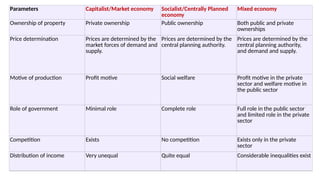
Parameters Capitalist/Market economy Socialist/Centrally Planned
economy
Mixed economy
Ownership of property Private ownership Public ownership Both public and private
ownerships
Price determination Prices are determined by the
market forces of demand and
supply.
Prices are determined by the
central planning authority.
Prices are determined by the
central planning authority,
and demand and supply.
Motive of production Profit motive Social welfare Profit motive in the private
sector and welfare motive in
the public sector
Role of government Minimal role Complete role Full role in the public sector
and limited role in the private
sector
Competition Exists No competition Exists only in the private
sector
Distribution of income Very unequal Quite equal Considerable inequalities exist
OPPORTUNITY COST
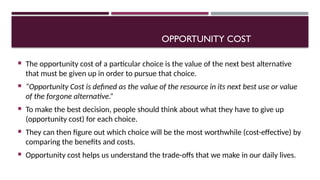
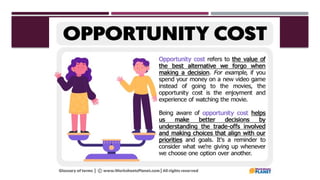
 The opportunity cost of a particular choice is the value of the next best alternative
that must be given up in order to pursue that choice.
 “Opportunity Cost is defined as the value of the resource in its next best use or value
of the forgone alternative.”
 To make the best decision, people should think about what they have to give up
(opportunity cost) for each choice.
 They can then figure out which choice will be the most worthwhile (cost-effective) by
comparing the benefits and costs.
 Opportunity cost helps us understand the trade-offs that we make in our daily lives.
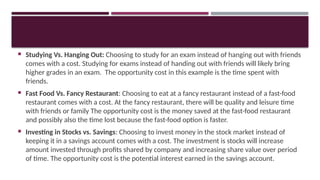
 Studying Vs. Hanging Out: Choosing to study for an exam instead of hanging out with friends
comes with a cost. Studying for exams instead of handing out with friends will likely bring
higher grades in an exam. The opportunity cost in this example is the time spent with
friends.
 Fast Food Vs. Fancy Restaurant: Choosing to eat at a fancy restaurant instead of a fast-food
restaurant comes with a cost. At the fancy restaurant, there will be quality and leisure time
with friends or family The opportunity cost is the money saved at the fast-food restaurant
and possibly also the time lost because the fast-food option is faster.
 Investing in Stocks vs. Savings: Choosing to invest money in the stock market instead of
keeping it in a savings account comes with a cost. The investment is stocks will increase
amount invested through profits shared by company and increasing share value over period
of time. The opportunity cost is the potential interest earned in the savings account.
Benefits of Opportunity Cost
1. Evaluation of different Alternatives: Opportunity costs
highlight the loss of benefit that an individual/a company bears
when they decide to choose one alternative over another.
2. Comparison of Prices: Opportunity costs help in comparing
prices of different alternatives along with their respective risks and
returns. Comparison of the total value of benefits derived from
different alternatives is the main motive of this concept.
To sum up
 The concept of opportunity cost is based on the principle that
resources are limited.
 Every decision to choose a product over another has an opportunity
cost associated with it.
 Opportunity cost helps to determine the most efficient allocation of
resources.
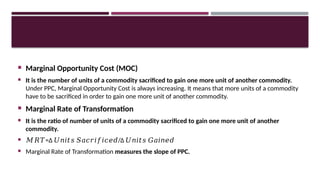
 Marginal Opportunity Cost (MOC)
 It is the number of units of a commodity sacrificed to gain one more unit of another commodity.
Under PPC, Marginal Opportunity Cost is always increasing. It means that more units of a commodity
have to be sacrificed in order to gain one more unit of another commodity.
 Marginal Rate of Transformation
 It is the ratio of number of units of a commodity sacrificed to gain one more unit of another
commodity.
 𝑀𝑅𝑇=Δ /Δ ​
𝑈𝑛𝑖𝑡𝑠 𝑆𝑎𝑐𝑟𝑖𝑓𝑖𝑐𝑒𝑑 𝑈𝑛𝑖𝑡𝑠 𝐺𝑎𝑖𝑛𝑒𝑑
 Marginal Rate of Transformation measures the slope of PPC.
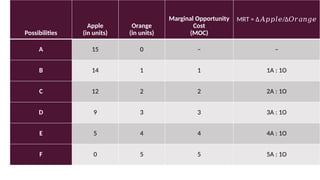
Possibilities
Apple
(in units)
Orange
(in units)
Marginal Opportunity
Cost
(MOC)
MRT = Δ /Δ
𝐴𝑝𝑝𝑙𝑒 𝑂𝑟𝑎𝑛𝑔𝑒
A 15 0 – –
B 14 1 1 1A : 1O
C 12 2 2 2A : 1O
D 9 3 3 3A : 1O
E 5 4 4 4A : 1O
F 0 5 5 5A : 1O
PRODUCTION POSSIBILITIES CURVE (PPC): MEANING,ASSUMPTIONS, PROPERTIES
AND EXAMPLE
 As the resources available around us are scarce, we cannot satisfy all of our needs and wants.
And even if all the resources in the economy are utilized in the best possible manner, their
capabilities are restricted due to scarce resources.
 Therefore, we are forced to make economic decisions and choose among alternate goods
and services to satisfy our wants in the best possible manner.
 Hence, society has to decide what to produce out of the infinite possibilities. The graphical
presentation of this range of possibilities is known as Production Possibility Curve
(PPC) or Production Possibility Frontier (PPF).
 Production Possibility Curve (PPC) is the graphical representation of all the possible combinations of two goods
that can be produced with the given resources and technology.
Assumptions of PPC
 Fixed Resources: The quantity and quality of resources available in the economy is assumed to be fixed. This
includes factors of production such as labour, capital, land, and technology. However, one can transfer the
resources from one use to another.
 Fixed Technology: The PPC assumes that the level of technology available for production remains constant. This
means that the methods, processes, and efficiency of production do not change.
 Full Employment of Resources: The PPC assumes that all available resources in the economy are fully
employed and utilized efficiently.
 Two Goods: The PPC assumes that with the given resources, only two goods can be produced.
 Unequal Efficiency in Production: Under PPC, it is assumed that the resources are not equally efficient in the
production of all goods. Therefore, when the resources are transferred from one use to another (production of
one good to another), the productivity declines.
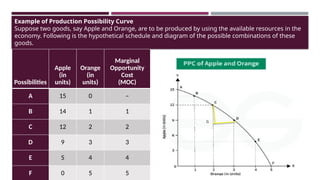
Example of Production Possibility Curve
Suppose two goods, say Apple and Orange, are to be produced by using the available resources in the
economy. Following is the hypothetical schedule and diagram of the possible combinations of these
goods.
Possibilities
Apple
(in
units)
Orange
(in
units)
Marginal
Opportunity
Cost
(MOC)
A 15 0 –
B 14 1 1
C 12 2 2
D 9 3 3
E 5 4 4
F 0 5 5
G
OBSERVATIONS
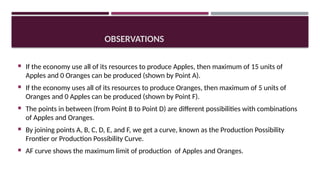
 If the economy use all of its resources to produce Apples, then maximum of 15 units of
Apples and 0 Oranges can be produced (shown by Point A).
 If the economy uses all of its resources to produce Oranges, then maximum of 5 units of
Oranges and 0 Apples can be produced (shown by Point F).
 The points in between (from Point B to Point D) are different possibilities with combinations
of Apples and Oranges.
 By joining points A, B, C, D, E, and F, we get a curve, known as the Production Possibility
Frontier or Production Possibility Curve.
 AF curve shows the maximum limit of production of Apples and Oranges.
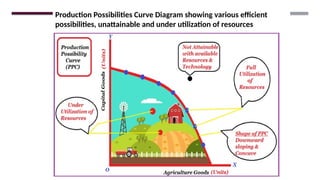
Production Possibilities Curve Diagram showing various efficient
possibilities, unattainable and under utilization of resources
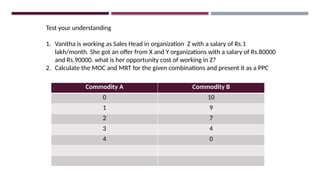
Test your understanding
1. Vanitha is working as Sales Head in organization Z with a salary of Rs.1
lakh/month. She got an offer from X and Y organizations with a salary of Rs.80000
and Rs.90000. what is her opportunity cost of working in Z?
2. Calculate the MOC and MRT for the given combinations and present it as a PPC
Commodity A Commodity B
0 10
1 9
2 7
3 4
4 0
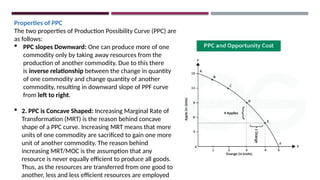
Properties of PPC
The two properties of Production Possibility Curve (PPC) are
as follows:
 PPC slopes Downward: One can produce more of one
commodity only by taking away resources from the
production of another commodity. Due to this there
is inverse relationship between the change in quantity
of one commodity and change quantity of another
commodity, resulting in downward slope of PPF curve
from left to right.
 2. PPC is Concave Shaped: Increasing Marginal Rate of
Transformation (MRT) is the reason behind concave
shape of a PPC curve. Increasing MRT means that more
units of one commodity are sacrificed to gain one more
unit of another commodity. The reason behind
increasing MRT/MOC is the assumption that any
resource is never equally efficient to produce all goods.
Thus, as the resources are transferred from one good to
another, less and less efficient resources are employed
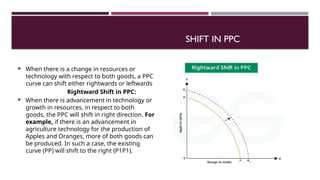
SHIFT IN PPC
 When there is a change in resources or
technology with respect to both goods, a PPC
curve can shift either rightwards or leftwards
Rightward Shift in PPC:
 When there is advancement in technology or
growth in resources, in respect to both
goods, the PPC will shift in right direction. For
example, if there is an advancement in
agriculture technology for the production of
Apples and Oranges, more of both goods can
be produced. In such a case, the existing
curve (PP) will shift to the right (P1P1).
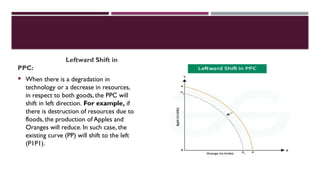
Leftward Shift in
PPC:
 When there is a degradation in
technology or a decrease in resources,
in respect to both goods, the PPC will
shift in left direction. For example, if
there is destruction of resources due to
floods, the production of Apples and
Oranges will reduce. In such case, the
existing curve (PP) will shift to the left
(P1P1).
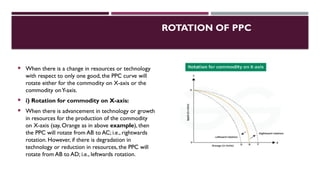
ROTATION OF PPC
 When there is a change in resources or technology
with respect to only one good, the PPC curve will
rotate either for the commodity on X-axis or the
commodity onY-axis.
 i) Rotation for commodity on X-axis:
 When there is advancement in technology or growth
in resources for the production of the commodity
on X-axis (say, Orange as in above example), then
the PPC will rotate from AB to AC; i.e., rightwards
rotation. However, if there is degradation in
technology or reduction in resources, the PPC will
rotate from AB to AD; i.e., leftwards rotation.
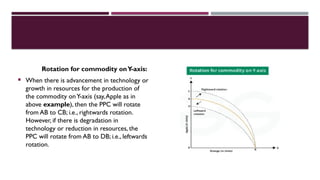
Rotation for commodity onY-axis:
 When there is advancement in technology or
growth in resources for the production of
the commodity onY-axis (say,Apple as in
above example), then the PPC will rotate
from AB to CB; i.e., rightwards rotation.
However, if there is degradation in
technology or reduction in resources, the
PPC will rotate from AB to DB; i.e., leftwards
rotation.
 Will an economy always operate on PPF?
 No.A PPC curve does not always show the point at which the economy will operate. It only shows the possible
combinations which can be produced.The operation point depends on the efficiency to which the resources are
used.
 When will an economy operate on PPC?
 An economy will operate on PPC in the following cases:
 An economy will operate on PPC (Attainable Combinations) only when the resources are fully and efficiently
utilized.
 It will operate at any point inside the PPC (Attainable Combinations) in case resources are not fully and
efficiently utilized.
 However, an economy cannot operate at any point outside the PPC (Unattainable Combinations) as it is not
possible to attain them with the available resources.
 What do you mean by Attainable Combinations?
 Attainable Combinations are the ones at which an economy can operate.There are two attainable
options:
 Optimum Utilization of Resources: If the resources are used in the best possible manner, then
the economy will operate at any point lying on the PPC Curve.
 Inefficient Utilization of Resources: If the resources are not fully utilized or are wasted, then the
economy will operate at any point inside the PPC Curve.
 What do you mean by Unattainable Combinations?
 It is impossible for an economy to produce more than the given possible combinations of two goods,
with the available resources.Therefore, unattainable combinations are the points outside the PPC
Curve on which an economy can never operate.
Can PPC be a straight line?
 Yes, PPC can be a straight line if MRT is assumed to be constant. Constant MRT means that to gain
additional unit of a commodity, same unit of another commodity is sacrificed. It can only be possible if
it is assumed that all resources are equally efficient for the production of all goods.
Can PPC be convex to origin?
 Yes. PPC can be convex to origin if MRT is assumed to be decreasing. Decreasing MRT means that to
gain additional unit of a commodity, less unit of another commodity is sacrificed.


Introduction for micro economics .pptx

  • 1.
  • 2.
    WHAT IS ECONOMICS? Economics is the study of a way in which a society decides or chooses to use limited resources with alternative uses for the production of goods and services and to ultimately distribute the product among different sections of the society.  Economics is about choosing among different alternatives in the presence of scarcity. It aims to ensure that the resources are used in the best possible manner.  Why Economics is considered as a social science?  The term science stands for a systematic and organised body of knowledge. Economics is also a science as it is a systematic and organised study of the economic behaviour of human beings. But, it is not an exact science like Physics and Chemistry as it deals with the study of human behaviour. Therefore, it is known as social science.
  • 3.
    POSITIVE AND NORMATIVEECONOMICS  Positive economics is the study of the facts of life. It means that it deals with the real life economic problems as they are and how these problems are solved.  Positive economics is objective and fact-based where the statements are precise, descriptive, and clearly measurable. These statements can be measured against tangible evidence or historical instances. There are no instances of approval-disapproval in positive economics.  An example of a positive economic statement: "Government-provided healthcare increases public expenditures." This statement is fact-based and has no value judgment attached to it. Its validity can be proven (or disproven) by studying healthcare spending where governments provide healthcare.
  • 4.
     Normative economicsdeals with finding out solutions to economic problems. Simply put, it answers the question of ‘what ought to be done’.  Normative economics focuses on value-based judgments aimed at improving economic development, investment projects, and the distribution of wealth. Its goal is to summarize the desirability (or lack thereof) of various economic developments, situations, and programs by asking what should happen or what ought to be.  An example of a normative economic statement is: "The government should provide basic healthcare to all citizens." As you can deduce from this statement, it is value-based, rooted in personal perspective, and satisfies the requirement of what "should" be.
  • 5.
    Positive Economics NormativeEconomics 1 It expressed What is ( or how an economic problem facing a society is actually solved. (What is ,What was, What , would be) It expressed What should be. Always a matter of debate . 2 It is based on cause and effect of facts. It is based on ethics. They are value Judgements 3 It is based on real facts and can be verified It is based on individual opinions and ideal things. 4 It deals with how an economic problem is solved. It deals with how an economic problem should be solved. 5 It is also called Descriptive Economics It is also called Policy Economics 6 Examples: Prices have been rising in India. air is the mixture of gases. Rich people should be taxed more. India should not take loan from foreign country. 7 GDP is increasing at the rate of 7% per annum. Steps should be taken to achieve 9% growth rate in GDP.
  • 6.
    MICRO AND MACROECONOMICS
  • 7.
    FEATURES OF MICROECONOMICS Individual Behavior: Microeconomics focuses on the behavior of an individual such as consumers , producers, and firms.  Price Mechanism: It examines how prices are determined in markets through the interaction of supply and demand.  Resource Allocation: Microeconomics studies how resources are allocated efficiently to maximize utility or profit.  Market Structures: It analyzes different market structures like perfect competition monopoly , oligopoly and monopolistic competition and their effects on prices and output.  Consumer Choice: Microeconomics explores factors influencing consumer choices, including preferences, income, and prices of goods and services.
  • 8.
    FEATURES OF MACROECONOMICS Aggregate Economic Variables: Macroeconomics deals with the economy as a whole, studying aggregate variables like GDP, inflation, unemployment, and national income.  Economic Growth: It focuses on factors that influence long-term economic growth and development, such as investment, technological progress, and institutional factors.  Stabilization Policies: Macroeconomics examines policies aimed at stabilizing the economy, including monetary policy by the Reserve Bank of India and fiscal policy by the government.  International Trade and Finance: Macroeconomics analyzes factors affecting India’s trade balance, exchange rates, and capital flows in the global economy.  Income Distribution: It investigates how national income is distributed among different groups in society, including issues of poverty, inequality, and social welfare.
  • 9.
    DIFFERENCE BETWEEN MICROAND MACRO ECONOMICS Basis Microeconomics Macroeconomics Meaning Microeconomics is a branch of economics studying the behaviour of an individual economic unit. Macroeconomics is a part of economics that focuses on how a general economy, the market, or different systems that operate on a large scale, behaves. Tools Demand and Supply are the two tools of Microeconomics. Aggregate Demand and Aggregate Supply are the two tools of Macroeconomics. Basic Assumptions The basic assumption of microeconomics is that all the macro variables are constant.The macro variables include income, savings, consumption, etc. The basic assumption of macroeconomics is that all the micro variables are constant.The micro variables include decisions of firms and households, prices of individual products, etc. Basic Objective The basic aim of microeconomics is determination of the price of a commodity or factors of production. The basic aim of macroeconomics is determination of the income and employment level of the economy. Degree of Aggregation Microeconomics involves a limited aggregation degree. For example, market demand is derived by the aggregation of individual demands of all the buyers in a particular market. Macroeconomics involves the highest aggregation degree. For example, aggregate demand is derived for the entire economy. Other Name As microeconomics is primarily concerned with price determination of commodities and factors of production, it is also known as Price Theory. As macroeconomics is primarily concerned with determining income level and employment, it is also known as Income and Employment Theory. Example Individual Output, Individual Income, etc. National Output, National Income, etc.
  • 10.
    WHAT IS ANECONOMY?  Economy is a system that provides individuals with the means to work and earn a living to satisfy their needs and wants.They can do so through the process of manufacturing, consumption, investment, and exchange.  It is a whole collection of production units operating in a defined area or region by which people of that area earn their living  Functioning of an economy: Production, consumption and investment
  • 11.
    BASIC PROBLEMS OFAN ECONOMY  Economic problem is the problem of choosing from among different options that arise because of three major reasons limited resources, unlimited human wants, and alternative use of the limited resources.  Scarcity of resources: Resources such as capital, land, labor and organisation are limited in an economy as compared to their demand.Therefore, an economy cannot manufacture everything they want which creates an economic problem.  Unlimited human wants: An individual’s wants never end, they always want something and can never be satisfied completely.Also the increase in population leads to increase in demand for goods and services.  Alternative uses: The resources available in the economy are not only scarce, but they also have alternative uses. It means that a resource can be used in different ways, which makes the need to choose among the available resources essential, ultimately giving rise to the economic problem.
  • 13.
    CENTRAL PROBLEMS OFAN ECONOMY  As discussed earlier, an economic problem is a problem of choosing among different alternatives because of the limited resources, unlimited human wants, and alternative uses.The three central problems of an economy are What to produce, How to produce, and For whom to produce.
  • 15.
    WHATTO PRODUCE?  Withlimited resources, an economy cannot produce all goods and services. It has to choose among the different goods and services.  Therefore, the first central problem of an economy includes selecting goods and services to produce and the number of units or quantity of each commodity to be produced.  For example, a farmer has to make choice between different crops as to which he should grow on one piece of land. He can decide to grow one crop of the whole land or grow different proportions of more than one crop.  What possible commodities to produce: The first aspect of the problem of ‘What to produce’ is deciding which commodities to be produced in an economy. It means that an economy has to choose between different consumer goods (clothes, wheat, etc.) and capital goods (machinery, etc.) to produce. Similarly, it has to choose between different war goods (tanks, guns, bullets, etc.) and civil goods (milk, bread, butter, etc.).
  • 16.
     How muchto produce: Once the economy has decided the commodity to be produced, it has to decide the quantity of each selected commodity to be produced. Simply put, it means deciding the quantity of each selected consumer good, capital good, civil good, and war good to be produced in an economy.  As the two aspects of the first central problem of an economy are What possible commodities to produce and How much to produce, it is also known as What to Produce and in What Quantity. This problem can be solved by allocating the resources of an economy in a way that provides maximum aggregate satisfaction to society.
  • 17.
    HOWTO PRODUCE?  Afterdeciding what to produce, another central problem of how to manufacture the goods and services arises.  It involves selecting a technique of production from among different techniques. Usually, there are two techniques of production, labour intensive techniques, and capital intensive techniques.  The former technique involves more use of labour, and the latter involves more use of machines. An organization can decide the technique based on different factors like the nature of the product, size of the market, size of the location, budget, etc.  For example, a poor farmer can adopt labour intensive techniques as they are cheap. However, a rich farmer can adopt capital intensive techniques as he can afford to purchase machines.
  • 18.
    Usually, there aretwo techniques of production, Labour Intensive Techniques (LIT) and Capital Intensive Techniques (CIT). The former technique involves more use of labour, and the latter involves more use of machines. An organization can decide the technique based on different factors like the nature of the product, size of the market, size of the location, budget, etc. For example, a poor farmer can adopt labour-intensive techniques as they are cheap. However, a rich farmer can adopt capital-intensive techniques as he can afford to purchase machines. While selecting the technique of production, an economy aims at raising the standard of living of people and providing employment to everyone. For Instance, labour Intensive Techniques are preferred in countries like India as labour is found in abundance in these countries. However, Capital Intensive Techniques are preferred in countries like the USA as capital is found in abundance in these countries. The problem of How to Produce can be solved by combining the factors of production of an economy in a way that it can produce maximum output at minimum cost by using the least possible scarce resources.
  • 19.
    FORWHOMTO PRODUCE?  Thelast central problem of an economy after deciding what and how to produce is for whom to produce.  As an economy cannot satisfy the needs and wants of every individual of the society, it has to make a decision for who to produce a commodity and service. Simply put, it involves deciding who should get how much of the goods and services, i.e., how much production should be done for the poor and how much for the rich. For example, an organization can decide to produce necessity goods for the poor section of society. However, another firm can decide to produce luxury goods for the rich section of society.  Besides these problems, there are two more problems that arise in underdeveloped countries like India. These are the problems of the growth of resources and the problem of the underutilization of resources.
  • 20.
     As everyeconomy has scarce resources and cannot fulfil every want of people, it faces the problem of choice between different sections of society. Hence, an economy produces goods for those people who can pay for them which depends on their income level.  It means that the problem of ‘for whom to produce’ is concerned with the income distribution among the different factors of production (like land, labour, capital, and enterprise) which contribute to the production process.  Functional Distribution: Functional Distribution means deciding the share of different factors of production in a country’s total national product in the form Rent, Wages, Interest and profit.  The problem of For Whom to Produce can be solved by making sure that the urgent wants of each productive factor of the society are fulfilled to the maximum possible extent.
  • 21.
    ALLOCATION OF RESOURCES The problem in which an economy has to assign the scarce available resources in a way that the maximum wants of the society are fulfilled is known as the allocation of resources.  The need to allocate the resources arise because of the limited availability of resources and unlimited wants of society.  Therefore, the basic aim behind the allocation of resources is to economize the use of available resources and utilize them in the best possible efficient manner.  Simply put, an economy has to allocate the resources and choose from different options of goods (What to Produce), choose from different production techniques (How to Produce), and decide the end consumer of the goods (For Whom to Produce).
  • 22.
    Basic problems canbe solved either by the free interaction of the individuals pursuing their own objectives as is done in the market or in a planned manner by some central authority like the government. The Centrally Planned Economy In a centrally planned economy, the government or the central authority plans all the important activities in the economy. All important decisions regarding production, exchange and consumption of goods and services are made by the government. The central authority may try to achieve a particular allocation of resources and a consequent distribution of the final combination of goods and services which is thought to be desirable for society as a whole. For example, if it is found that a good or service which is very important for the prosperity and well-being of the economy as a whole, e.g. education or health service, is not produced in adequate amount by the individuals on their own, the government might try to induce the individuals to produce adequate amount of such a good or service or, alternatively, the government may itself decide to produce the good or service in question. The central authority may intervene and try to achieve an equitable distribution of the final mix of goods and services.
  • 23.
    Market Economy A market,as studied in economics, is an institution which organises the free interaction of individuals pursuing their respective economic activities. In other words, a market is a set of arrangements where economic agents can freely exchange their products with each other. It is important to note that the term ‘market’ as used in economics is quite different from the common sense understanding of a market. For buying and selling commodities, individuals may or may not meet each other in an actual physical location. Interaction between buyers and sellers can take place in a variety of situations such as a village chowk or a super market in a city, or alternatively, buyers and sellers can interact with each other through telephone or internet and conduct the exchange of commodities. The arrangements which allow people to buy and sell commodities freely are the defining features of a market.
  • 24.
    In a marketsystem, all goods or services come with a price (which is mutually agreed upon by the buyers and sellers) at which the exchanges take place. The price reflects, on an average, the society’s valuation of the good or service in question. If the buyers demand more of a certain good, the price of that good will rise. This signals to the producers of that good that the society as a whole wants more of that good than is currently being produced and the producers of the good, in their turn, are likely to increase their production. In this way, prices of goods and services send important information to all the individuals across the market and help achieve coordination in a market system. Thus, in a market system, the central problems regarding how much and what to produce are solved through the coordination of economic activities brought about by the price signals.
  • 25.
    In reality, alleconomies are Mixed economies where some important decisions are taken by the government and the economic activities are by and large conducted through the market. Public and Private sectors exist together. The only difference is in terms of the extent of the role of the government in deciding the course of economic activities. In the United States of America, the role of the government is minimal. The closest example of a centrally planned economy is the China for the major part of the twentieth century. In India, since Independence, the government has played a major role in planning economic activities. However, the role of the government in the Indian economy has been reduced considerably in the last three decades.
  • 26.
    Parameters Capitalist/Market economySocialist/Centrally Planned economy Mixed economy Ownership of property Private ownership Public ownership Both public and private ownerships Price determination Prices are determined by the market forces of demand and supply. Prices are determined by the central planning authority. Prices are determined by the central planning authority, and demand and supply. Motive of production Profit motive Social welfare Profit motive in the private sector and welfare motive in the public sector Role of government Minimal role Complete role Full role in the public sector and limited role in the private sector Competition Exists No competition Exists only in the private sector Distribution of income Very unequal Quite equal Considerable inequalities exist
  • 27.
    OPPORTUNITY COST  Theopportunity cost of a particular choice is the value of the next best alternative that must be given up in order to pursue that choice.  “Opportunity Cost is defined as the value of the resource in its next best use or value of the forgone alternative.”  To make the best decision, people should think about what they have to give up (opportunity cost) for each choice.  They can then figure out which choice will be the most worthwhile (cost-effective) by comparing the benefits and costs.  Opportunity cost helps us understand the trade-offs that we make in our daily lives.
  • 29.
     Studying Vs.Hanging Out: Choosing to study for an exam instead of hanging out with friends comes with a cost. Studying for exams instead of handing out with friends will likely bring higher grades in an exam. The opportunity cost in this example is the time spent with friends.  Fast Food Vs. Fancy Restaurant: Choosing to eat at a fancy restaurant instead of a fast-food restaurant comes with a cost. At the fancy restaurant, there will be quality and leisure time with friends or family The opportunity cost is the money saved at the fast-food restaurant and possibly also the time lost because the fast-food option is faster.  Investing in Stocks vs. Savings: Choosing to invest money in the stock market instead of keeping it in a savings account comes with a cost. The investment is stocks will increase amount invested through profits shared by company and increasing share value over period of time. The opportunity cost is the potential interest earned in the savings account.
  • 30.
    Benefits of OpportunityCost 1. Evaluation of different Alternatives: Opportunity costs highlight the loss of benefit that an individual/a company bears when they decide to choose one alternative over another. 2. Comparison of Prices: Opportunity costs help in comparing prices of different alternatives along with their respective risks and returns. Comparison of the total value of benefits derived from different alternatives is the main motive of this concept. To sum up  The concept of opportunity cost is based on the principle that resources are limited.  Every decision to choose a product over another has an opportunity cost associated with it.  Opportunity cost helps to determine the most efficient allocation of resources.
  • 31.
     Marginal OpportunityCost (MOC)  It is the number of units of a commodity sacrificed to gain one more unit of another commodity. Under PPC, Marginal Opportunity Cost is always increasing. It means that more units of a commodity have to be sacrificed in order to gain one more unit of another commodity.  Marginal Rate of Transformation  It is the ratio of number of units of a commodity sacrificed to gain one more unit of another commodity.  𝑀𝑅𝑇=Δ /Δ ​ 𝑈𝑛𝑖𝑡𝑠 𝑆𝑎𝑐𝑟𝑖𝑓𝑖𝑐𝑒𝑑 𝑈𝑛𝑖𝑡𝑠 𝐺𝑎𝑖𝑛𝑒𝑑  Marginal Rate of Transformation measures the slope of PPC.
  • 32.
    Possibilities Apple (in units) Orange (in units) MarginalOpportunity Cost (MOC) MRT = Δ /Δ 𝐴𝑝𝑝𝑙𝑒 𝑂𝑟𝑎𝑛𝑔𝑒 A 15 0 – – B 14 1 1 1A : 1O C 12 2 2 2A : 1O D 9 3 3 3A : 1O E 5 4 4 4A : 1O F 0 5 5 5A : 1O
  • 33.
    PRODUCTION POSSIBILITIES CURVE(PPC): MEANING,ASSUMPTIONS, PROPERTIES AND EXAMPLE  As the resources available around us are scarce, we cannot satisfy all of our needs and wants. And even if all the resources in the economy are utilized in the best possible manner, their capabilities are restricted due to scarce resources.  Therefore, we are forced to make economic decisions and choose among alternate goods and services to satisfy our wants in the best possible manner.  Hence, society has to decide what to produce out of the infinite possibilities. The graphical presentation of this range of possibilities is known as Production Possibility Curve (PPC) or Production Possibility Frontier (PPF).
  • 34.
     Production PossibilityCurve (PPC) is the graphical representation of all the possible combinations of two goods that can be produced with the given resources and technology. Assumptions of PPC  Fixed Resources: The quantity and quality of resources available in the economy is assumed to be fixed. This includes factors of production such as labour, capital, land, and technology. However, one can transfer the resources from one use to another.  Fixed Technology: The PPC assumes that the level of technology available for production remains constant. This means that the methods, processes, and efficiency of production do not change.  Full Employment of Resources: The PPC assumes that all available resources in the economy are fully employed and utilized efficiently.  Two Goods: The PPC assumes that with the given resources, only two goods can be produced.  Unequal Efficiency in Production: Under PPC, it is assumed that the resources are not equally efficient in the production of all goods. Therefore, when the resources are transferred from one use to another (production of one good to another), the productivity declines.
  • 35.
    Example of ProductionPossibility Curve Suppose two goods, say Apple and Orange, are to be produced by using the available resources in the economy. Following is the hypothetical schedule and diagram of the possible combinations of these goods. Possibilities Apple (in units) Orange (in units) Marginal Opportunity Cost (MOC) A 15 0 – B 14 1 1 C 12 2 2 D 9 3 3 E 5 4 4 F 0 5 5 G
  • 36.
    OBSERVATIONS  If theeconomy use all of its resources to produce Apples, then maximum of 15 units of Apples and 0 Oranges can be produced (shown by Point A).  If the economy uses all of its resources to produce Oranges, then maximum of 5 units of Oranges and 0 Apples can be produced (shown by Point F).  The points in between (from Point B to Point D) are different possibilities with combinations of Apples and Oranges.  By joining points A, B, C, D, E, and F, we get a curve, known as the Production Possibility Frontier or Production Possibility Curve.  AF curve shows the maximum limit of production of Apples and Oranges.
  • 37.
    Production Possibilities CurveDiagram showing various efficient possibilities, unattainable and under utilization of resources
  • 38.
    Test your understanding 1.Vanitha is working as Sales Head in organization Z with a salary of Rs.1 lakh/month. She got an offer from X and Y organizations with a salary of Rs.80000 and Rs.90000. what is her opportunity cost of working in Z? 2. Calculate the MOC and MRT for the given combinations and present it as a PPC Commodity A Commodity B 0 10 1 9 2 7 3 4 4 0
  • 39.
    Properties of PPC Thetwo properties of Production Possibility Curve (PPC) are as follows:  PPC slopes Downward: One can produce more of one commodity only by taking away resources from the production of another commodity. Due to this there is inverse relationship between the change in quantity of one commodity and change quantity of another commodity, resulting in downward slope of PPF curve from left to right.  2. PPC is Concave Shaped: Increasing Marginal Rate of Transformation (MRT) is the reason behind concave shape of a PPC curve. Increasing MRT means that more units of one commodity are sacrificed to gain one more unit of another commodity. The reason behind increasing MRT/MOC is the assumption that any resource is never equally efficient to produce all goods. Thus, as the resources are transferred from one good to another, less and less efficient resources are employed
  • 40.
    SHIFT IN PPC When there is a change in resources or technology with respect to both goods, a PPC curve can shift either rightwards or leftwards Rightward Shift in PPC:  When there is advancement in technology or growth in resources, in respect to both goods, the PPC will shift in right direction. For example, if there is an advancement in agriculture technology for the production of Apples and Oranges, more of both goods can be produced. In such a case, the existing curve (PP) will shift to the right (P1P1).
  • 41.
    Leftward Shift in PPC: When there is a degradation in technology or a decrease in resources, in respect to both goods, the PPC will shift in left direction. For example, if there is destruction of resources due to floods, the production of Apples and Oranges will reduce. In such case, the existing curve (PP) will shift to the left (P1P1).
  • 42.
    ROTATION OF PPC When there is a change in resources or technology with respect to only one good, the PPC curve will rotate either for the commodity on X-axis or the commodity onY-axis.  i) Rotation for commodity on X-axis:  When there is advancement in technology or growth in resources for the production of the commodity on X-axis (say, Orange as in above example), then the PPC will rotate from AB to AC; i.e., rightwards rotation. However, if there is degradation in technology or reduction in resources, the PPC will rotate from AB to AD; i.e., leftwards rotation.
  • 43.
    Rotation for commodityonY-axis:  When there is advancement in technology or growth in resources for the production of the commodity onY-axis (say,Apple as in above example), then the PPC will rotate from AB to CB; i.e., rightwards rotation. However, if there is degradation in technology or reduction in resources, the PPC will rotate from AB to DB; i.e., leftwards rotation.
  • 44.
     Will aneconomy always operate on PPF?  No.A PPC curve does not always show the point at which the economy will operate. It only shows the possible combinations which can be produced.The operation point depends on the efficiency to which the resources are used.  When will an economy operate on PPC?  An economy will operate on PPC in the following cases:  An economy will operate on PPC (Attainable Combinations) only when the resources are fully and efficiently utilized.  It will operate at any point inside the PPC (Attainable Combinations) in case resources are not fully and efficiently utilized.  However, an economy cannot operate at any point outside the PPC (Unattainable Combinations) as it is not possible to attain them with the available resources.
  • 45.
     What doyou mean by Attainable Combinations?  Attainable Combinations are the ones at which an economy can operate.There are two attainable options:  Optimum Utilization of Resources: If the resources are used in the best possible manner, then the economy will operate at any point lying on the PPC Curve.  Inefficient Utilization of Resources: If the resources are not fully utilized or are wasted, then the economy will operate at any point inside the PPC Curve.  What do you mean by Unattainable Combinations?  It is impossible for an economy to produce more than the given possible combinations of two goods, with the available resources.Therefore, unattainable combinations are the points outside the PPC Curve on which an economy can never operate.
  • 46.
    Can PPC bea straight line?  Yes, PPC can be a straight line if MRT is assumed to be constant. Constant MRT means that to gain additional unit of a commodity, same unit of another commodity is sacrificed. It can only be possible if it is assumed that all resources are equally efficient for the production of all goods. Can PPC be convex to origin?  Yes. PPC can be convex to origin if MRT is assumed to be decreasing. Decreasing MRT means that to gain additional unit of a commodity, less unit of another commodity is sacrificed.