MICRO & MACRO
  ECONOMICS
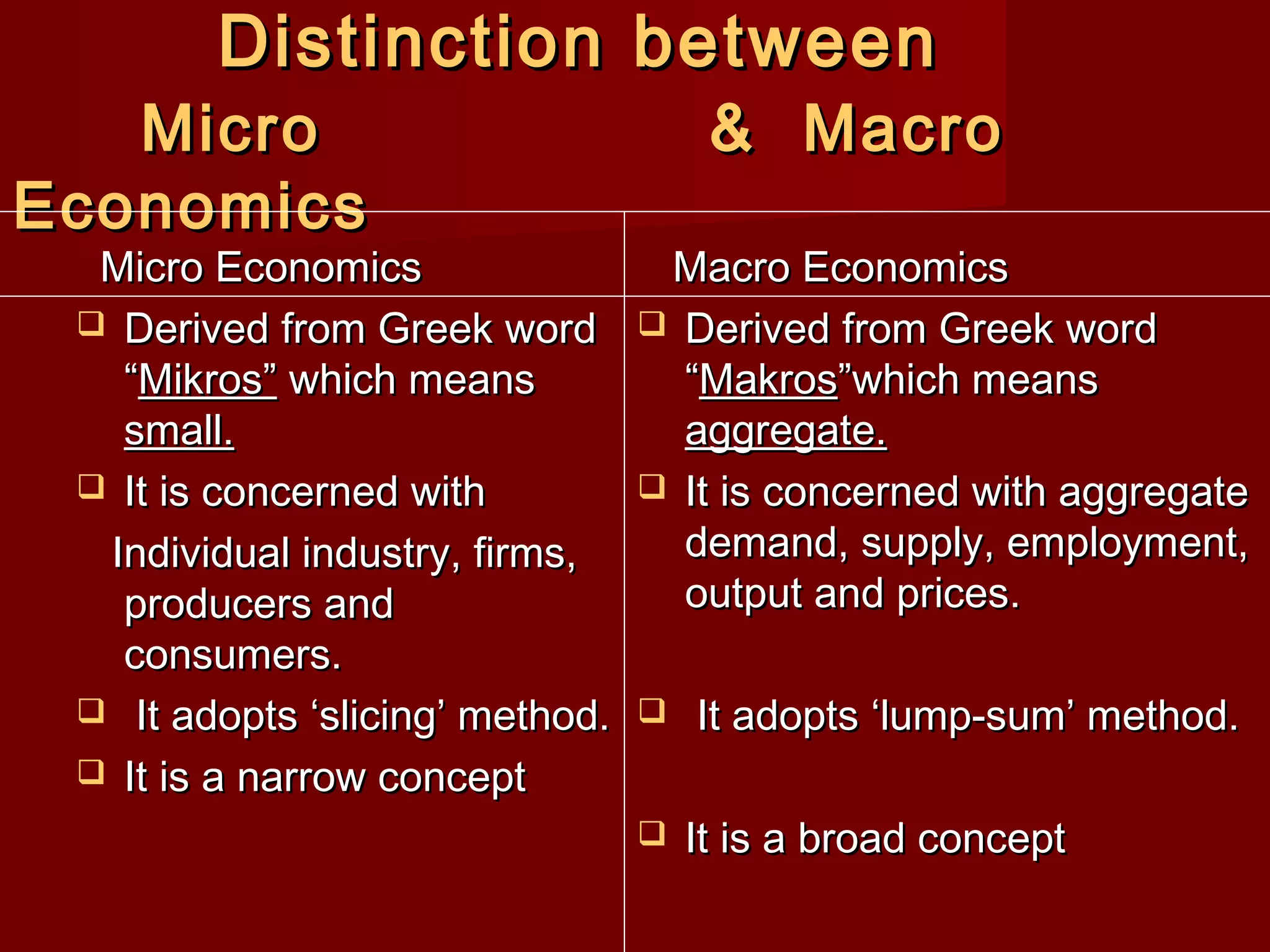
Distinction between
   Micro                              & Macro
Economics
  Micro Economics                 Macro Economics
  Derived from Greek word        Derived from Greek word
   “Mikros” which means            “Makros”which means
   small.                          aggregate.
  It is concerned with           It is concerned with aggregate

  Individual industry, firms,      demand, supply, employment,
   producers and                   output and prices.
   consumers.
  It adopts ‘slicing’ method.      It adopts ‘lump-sum’ method.
  It is a narrow concept
                                    It is a broad concept
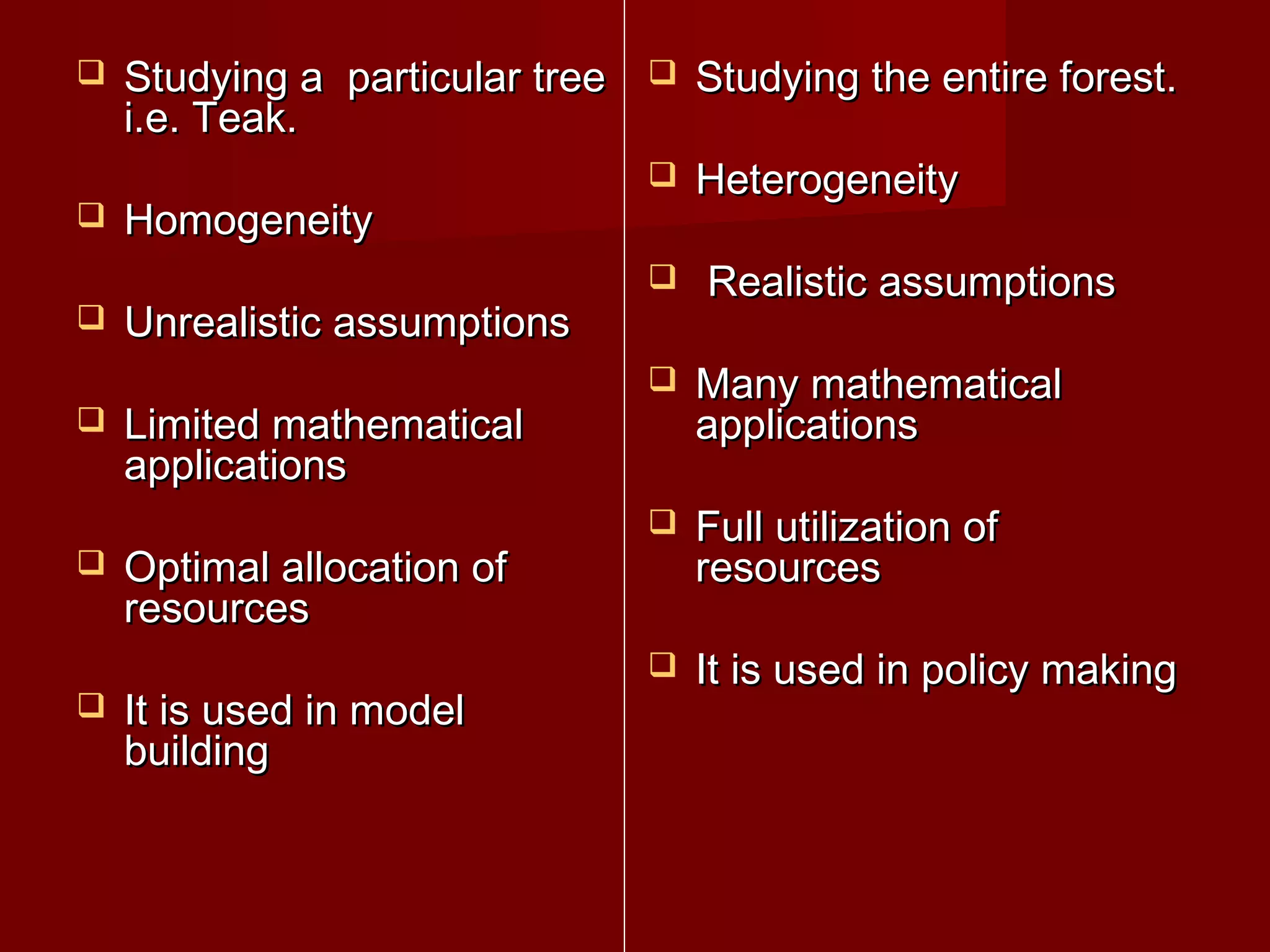
   Studying a particular tree      Studying the entire forest.
    i.e. Teak.
                                    Heterogeneity
   Homogeneity
                                    Realistic assumptions
   Unrealistic assumptions
                                    Many mathematical
   Limited mathematical             applications
    applications
                                    Full utilization of
   Optimal allocation of            resources
    resources
                                    It is used in policy making
   It is used in model
    building
 Economics is the study of how society
  manages its scarce resources.
 Resources are allocated by combined
  actions of millions of household and firms.
Measuring a Nation’s Income
Macroeconomics answers questions like the
following:
   Why is average income is high in some
    countries and low in others?
   Why do prices rise rapidly in some time
    periods while they are more stable in others?
   Why do production and employment expand
    in some years and contract in others?
THE ECONOMY’S INCOME
    AND EXPENDITURE

 When judging whether the economy is
 doing well or poorly, it is natural to look at
 the total income that everyone in the
 economy is earning.
THE ECONOMY’S INCOME
    AND EXPENDITURE

For an economy as a whole, income must
 equal expenditure because:

  – Every transaction has a buyer and a seller.

  – Every RUPEE of spending by some buyer is a
    RUPEE of income for some seller.
THE MEASUREMENT OF
GROSS DOMESTIC PRODUCT


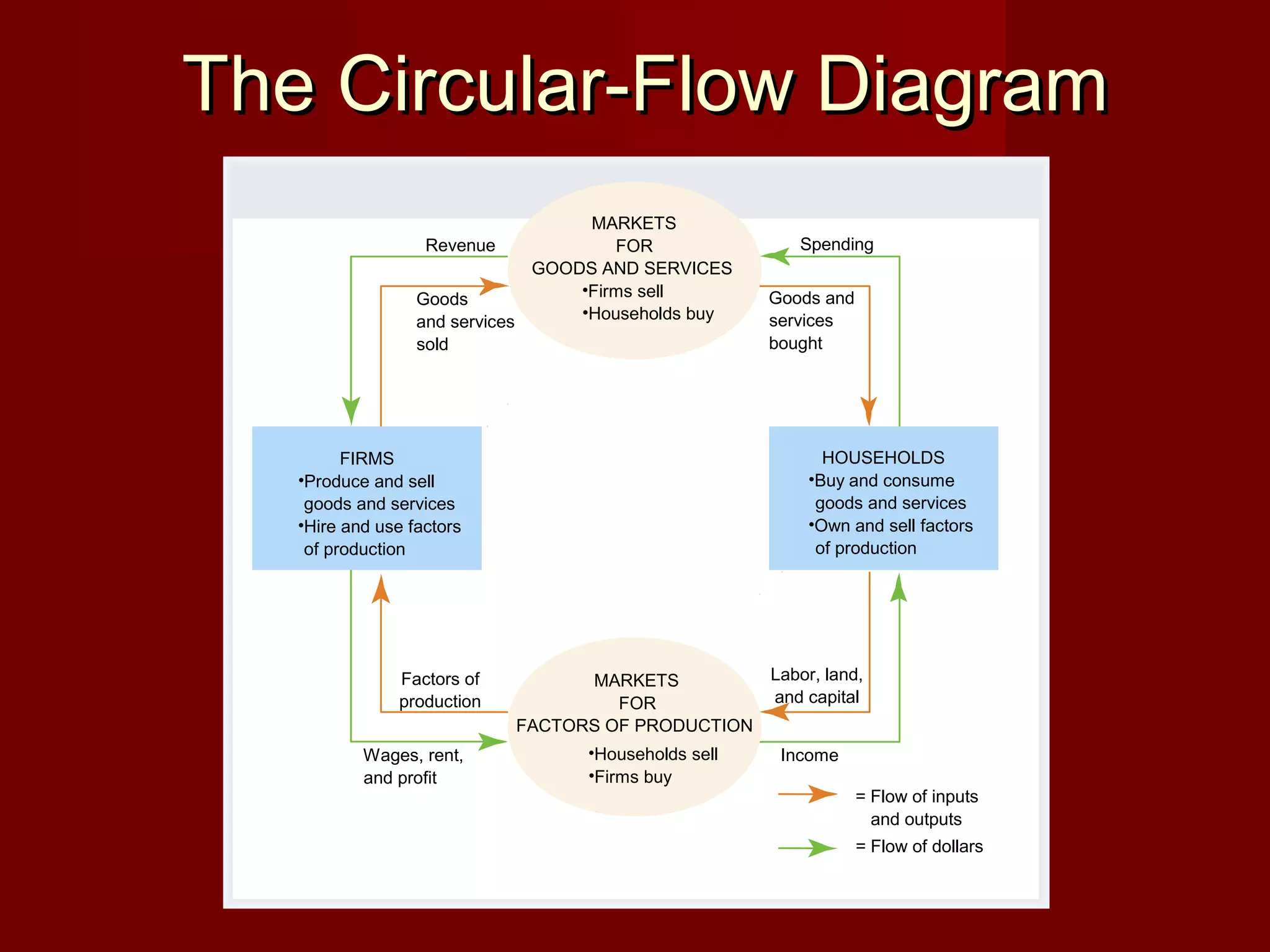
 The equality of income and expenditure is
 illustrated with the circular-flow diagram.
The Circular-Flow Diagram
                                    MARKETS
                   Revenue             FOR                Spending
                               GOODS AND SERVICES
                                   •Firms sell         Goods and
                  Goods
                                   •Households buy     services
                  and services
                  sold                                 bought


         FIRMS                                               HOUSEHOLDS
   •Produce and sell                                       •Buy and consume
    goods and services                                      goods and services
   •Hire and use factors                                   •Own and sell factors
    of production                                           of production


                Factors of         MARKETS         Labor, land,
                production            FOR          and capital
                             FACTORS OF PRODUCTION
           Wages, rent,             •Households sell    Income
           and profit               •Firms buy
                                                                   = Flow of inputs
                                                                     and outputs
                                                                   = Flow of dollars
THE MEASUREMENT OF
GROSS DOMESTIC PRODUCT

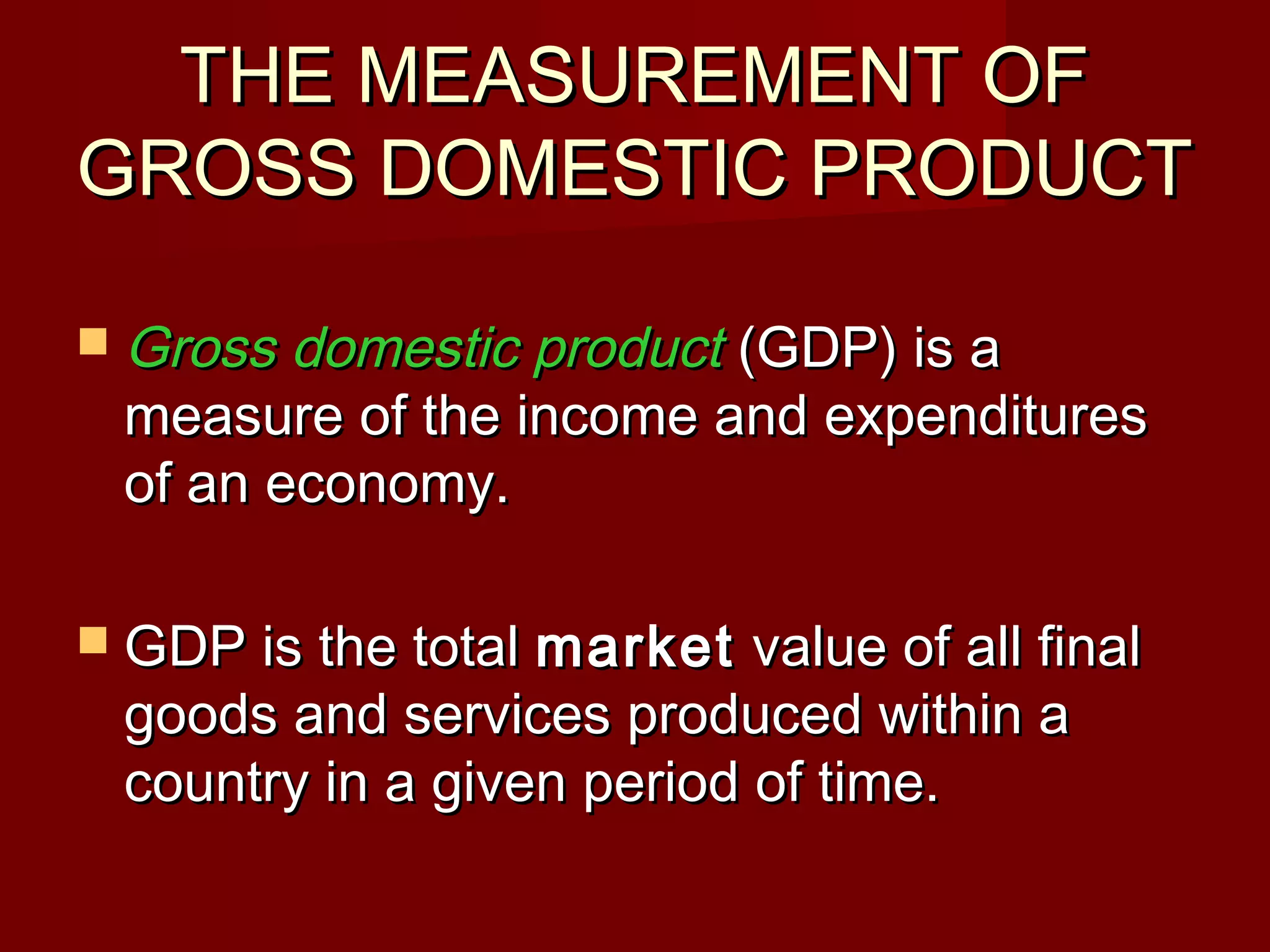
 Gross domestic product(GDP) is a
 measure of the income and expenditures
 of an economy.

 GDP is the total market  value of all final
 goods and services produced within a
 country in a given period of time.
THE MEASUREMENT OF
GROSS DOMESTIC PRODUCT
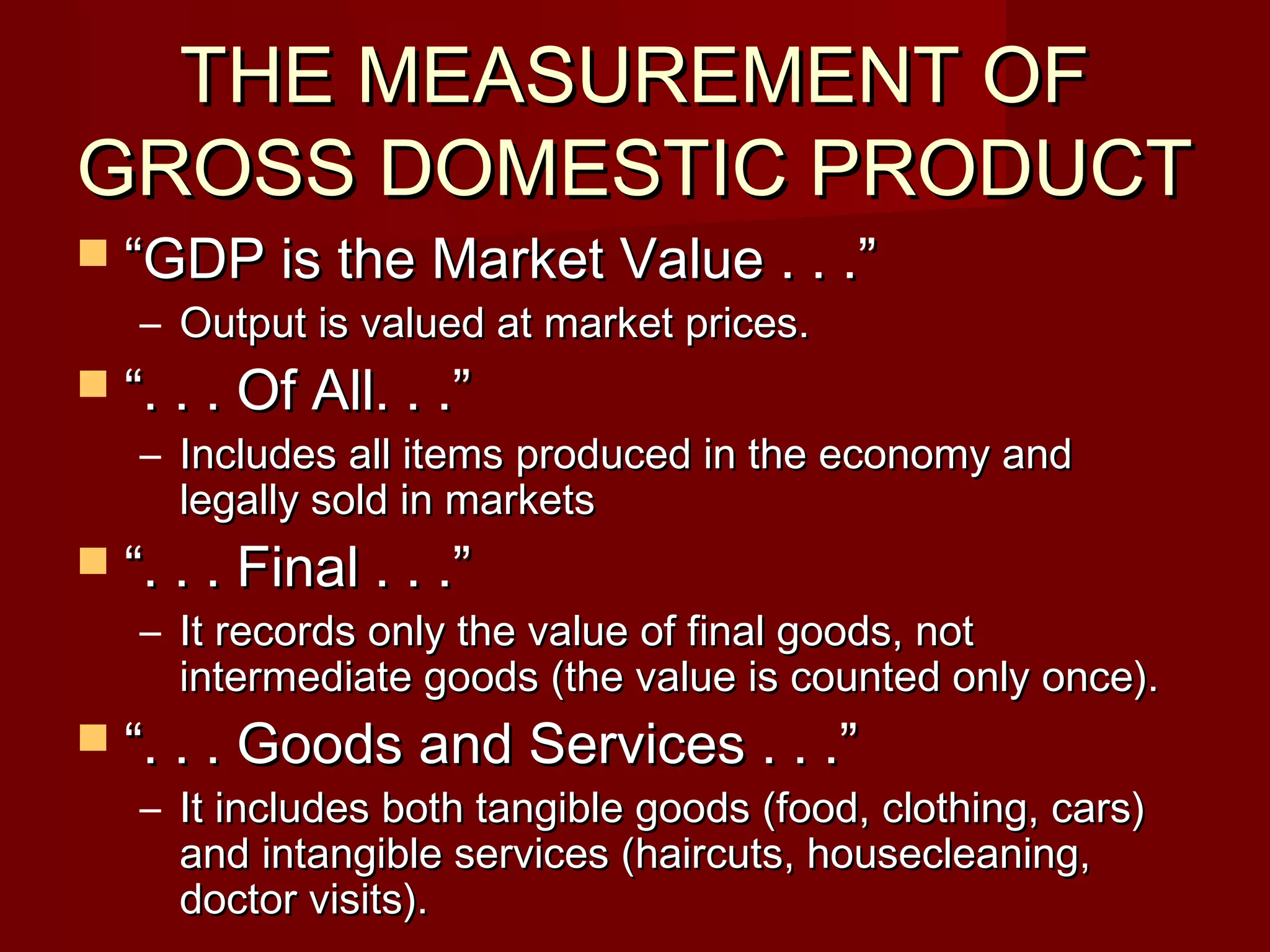
 “GDP is the Market Value . . .”
   – Output is valued at market prices.
 “. . . Of All. . .”
   – Includes all items produced in the economy and
     legally sold in markets
 “. . . Final . . .”
   – It records only the value of final goods, not
     intermediate goods (the value is counted only once).
 “. . . Goods and Services . . .”
   – It includes both tangible goods (food, clothing, cars)
     and intangible services (haircuts, housecleaning,
     doctor visits).
THE MEASUREMENT OF
GROSS DOMESTIC PRODUCT
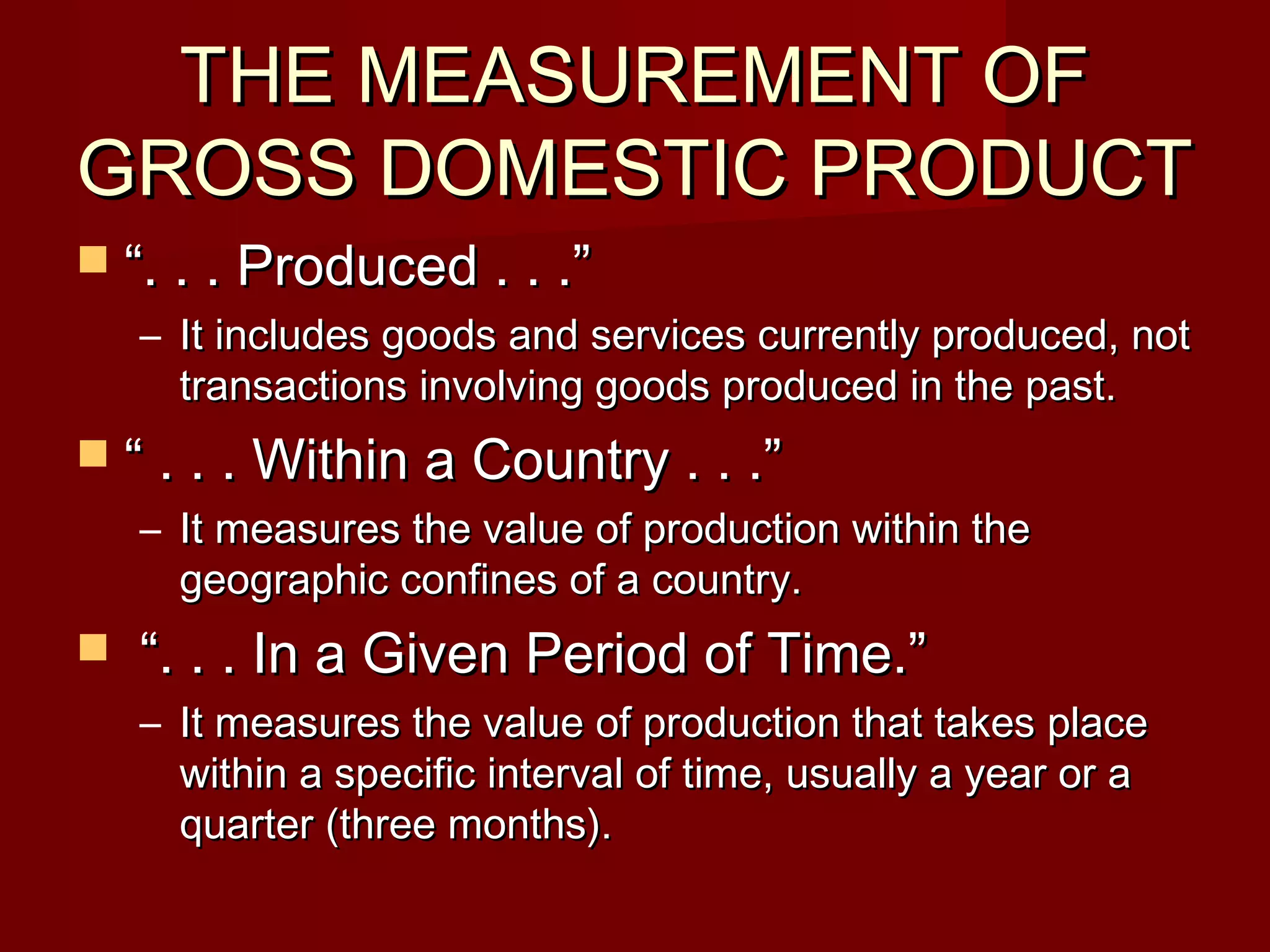
 “. . . Produced . . .”
    – It includes goods and services currently produced, not
      transactions involving goods produced in the past.
 “ . . . Within a Country . . .”
    – It measures the value of production within the
      geographic confines of a country.
   “. . . In a Given Period of Time.”
    – It measures the value of production that takes place
      within a specific interval of time, usually a year or a
      quarter (three months).
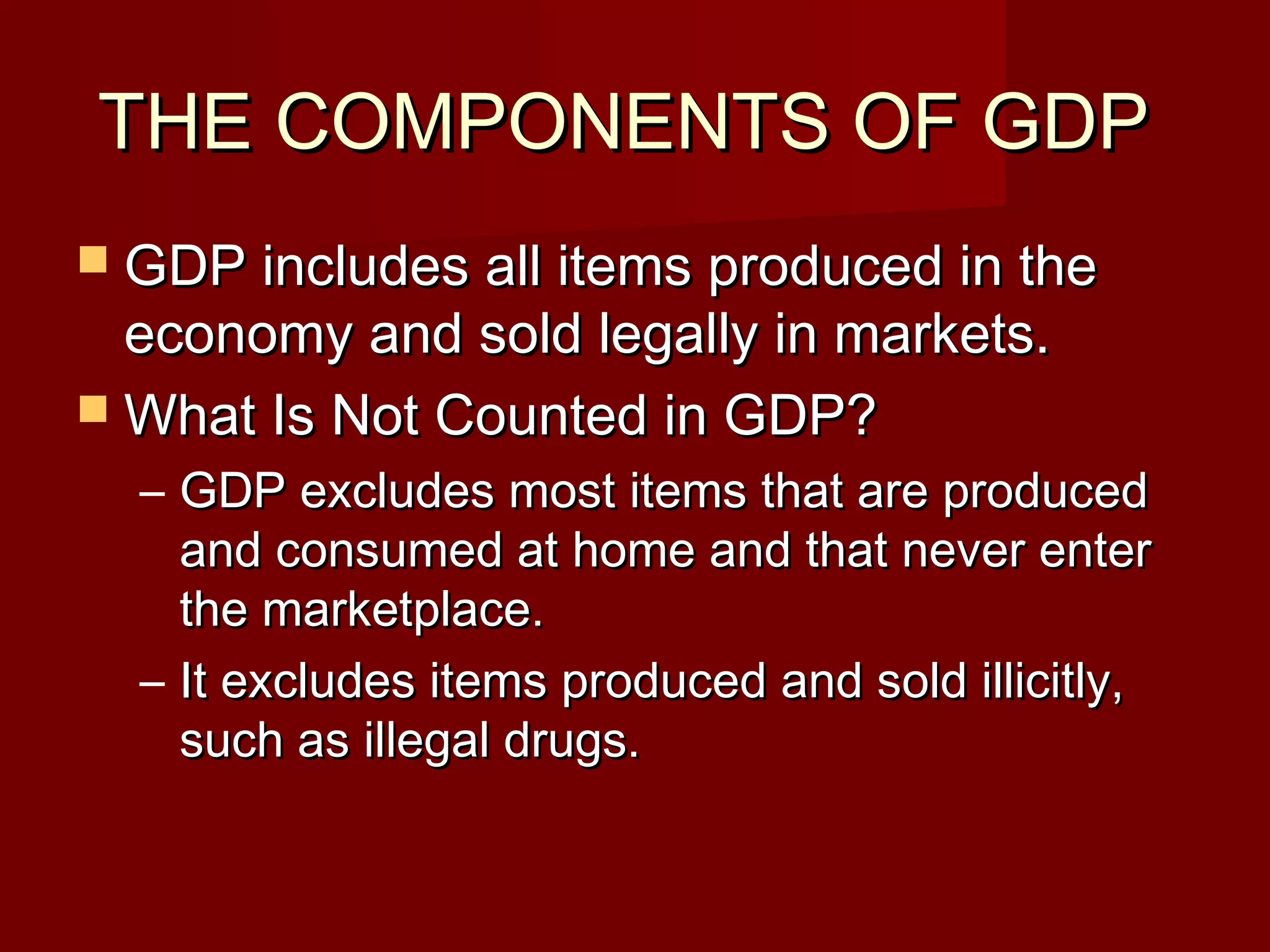
THE COMPONENTS OF GDP
 GDP includes all items produced in the
  economy and sold legally in markets.
 What Is Not Counted in GDP?
  – GDP excludes most items that are produced
    and consumed at home and that never enter
    the marketplace.
  – It excludes items produced and sold illicitly,
    such as illegal drugs.
THE COMPONENTS OF GDP
GDP (Y) is the sum of the following:
     Consumption (C)
     Investment (I)
     Government Purchases (G)
     Net Exports (NX)


            Y = C + I + G + NX
THE COMPONENTS OF GDP
 Consumption (C):
  • The spending by households on goods and
    services, with the exception of purchases of
    new housing.
 Investment (I):
  • The spending on capital equipment,
    inventories, and structures, including new
    housing.
THE COMPONENTS OF GDP
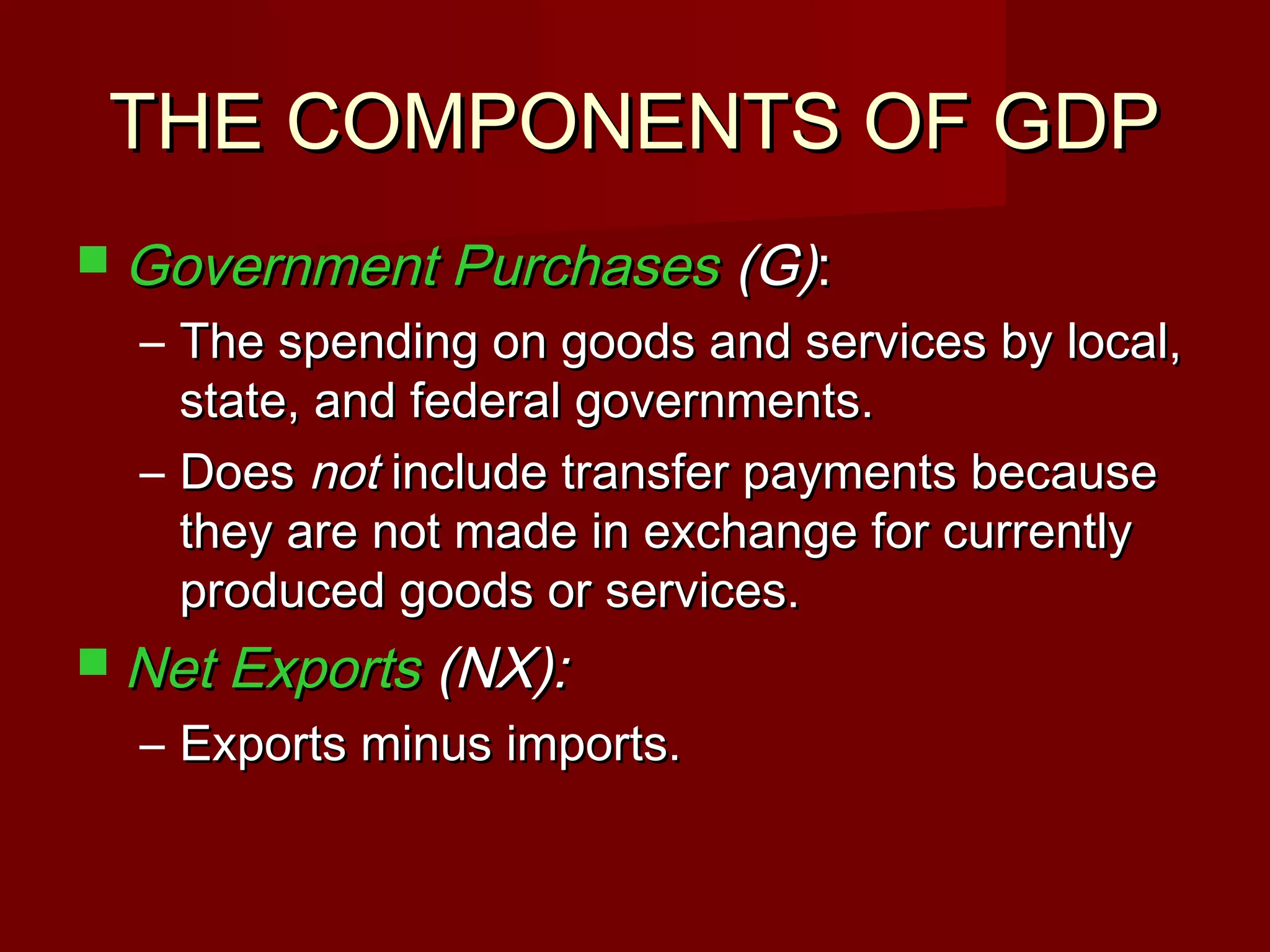
 Government Purchases       (G):
  – The spending on goods and services by local,
    state, and federal governments.
  – Does not include transfer payments because
    they are not made in exchange for currently
    produced goods or services.
 Net Exports (NX):
  – Exports minus imports.
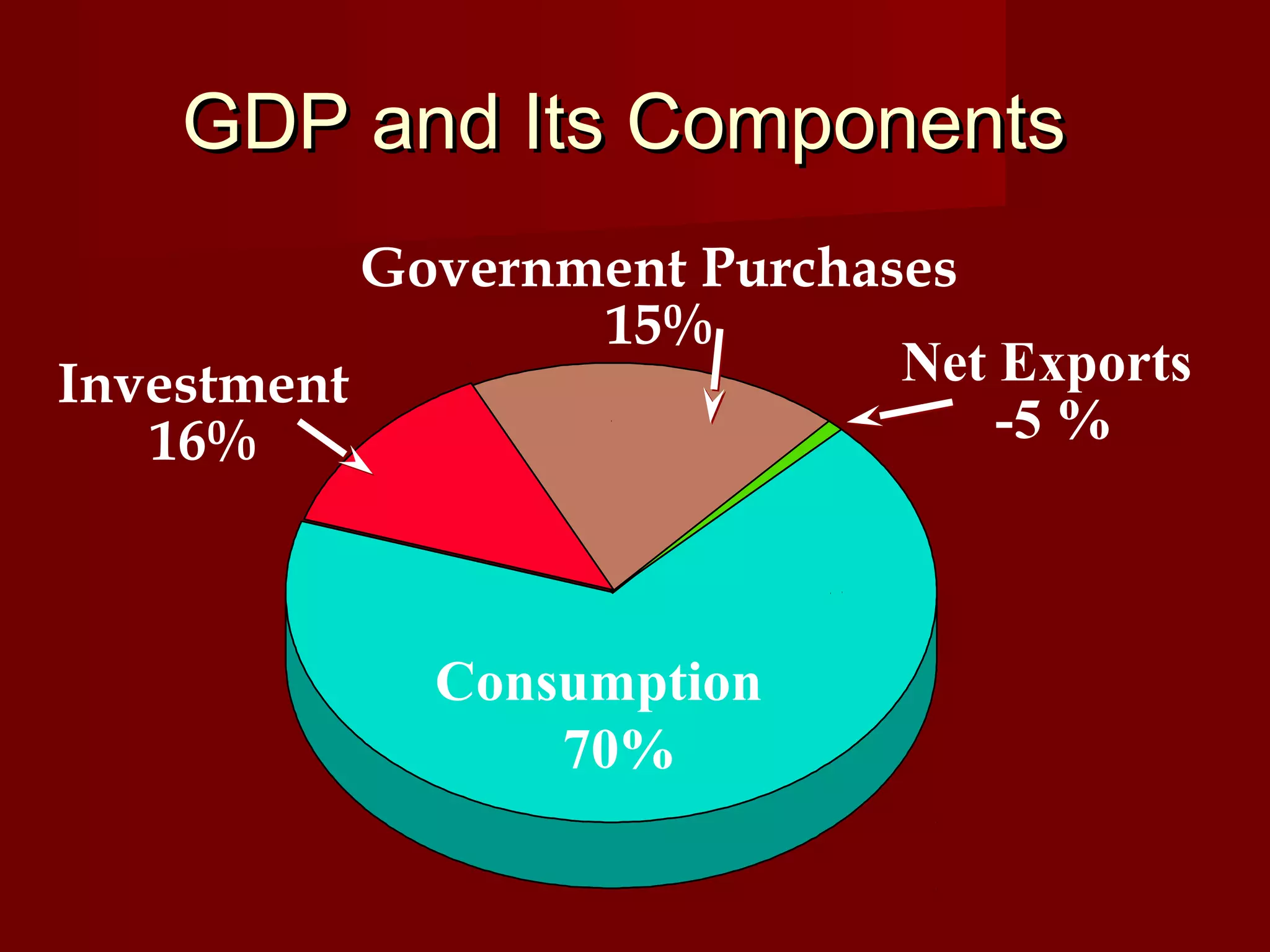
GDP and Its Components
           Government Purchases
                  15%
Investment                   Net Exports
   16%                           -5 %


             Consumption
                 70%
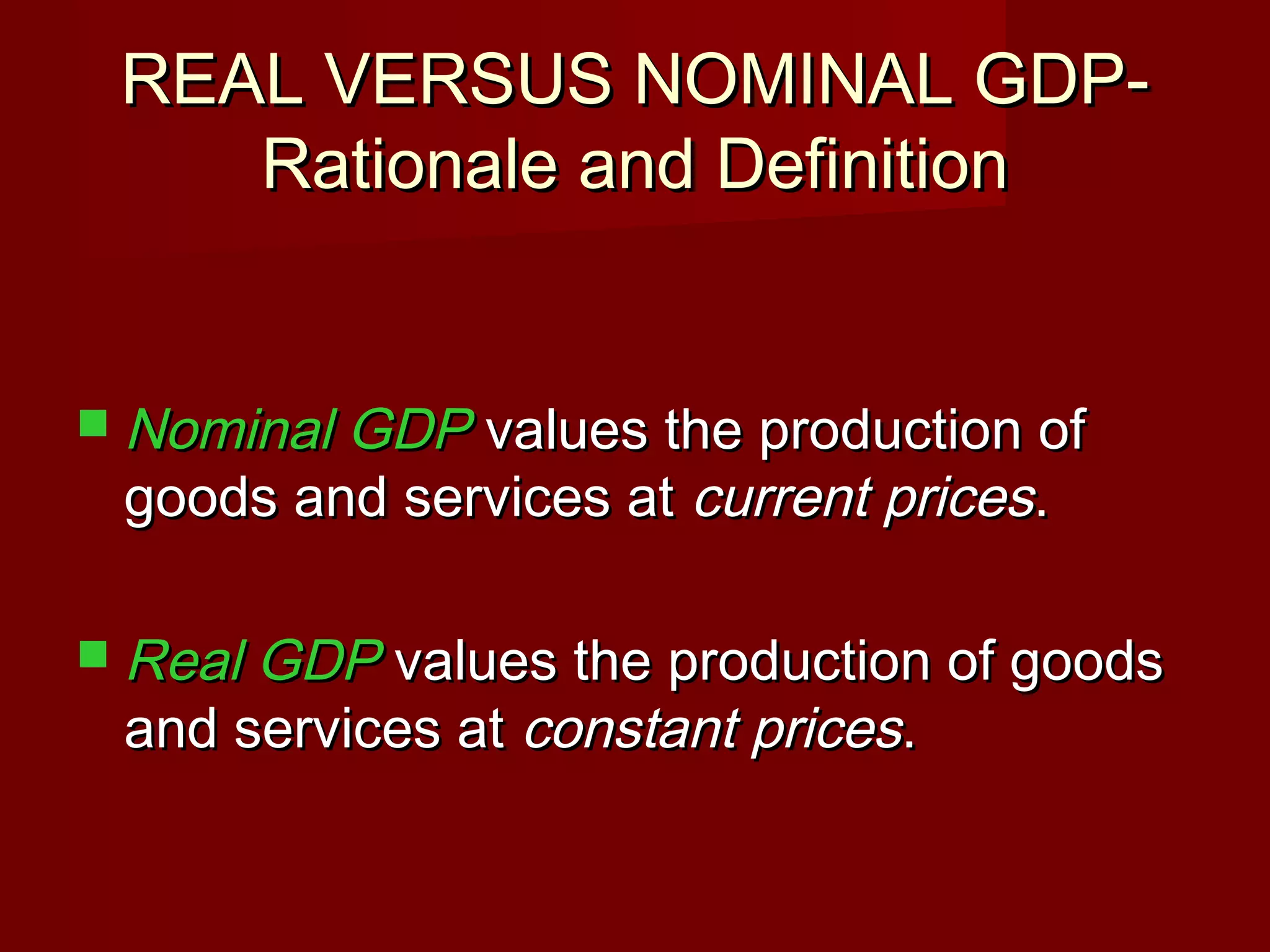
REAL VERSUS NOMINAL GDP-
    Rationale and Definition


 Nominal GDP values the production of
 goods and services at current prices.

 Real GDP values the production of goods
 and services at constant prices.
IS GDP A GOOD MEASURE
OF ECONOMIC WELL-BEING?
 GDP is the best single measure of the
  economic well-being of a society.
 GDP per person tells us the income and
  expenditure of the average person in the
  economy.
 Higher GDP per person indicates a higher
  standard of living.
 GDP is not a perfect measure of the
  happiness or quality of life, however.
GDP AND ECONOMIC
          WELL-BEING
 Some things that contribute to well-being
 are not included in GDP.
  –   The value of leisure.
  –   The value of a clean environment.
  –   The value of almost all activity that takes
      place outside of markets, such as the value of
      the time parents spend with their children and
      the value of volunteer work.
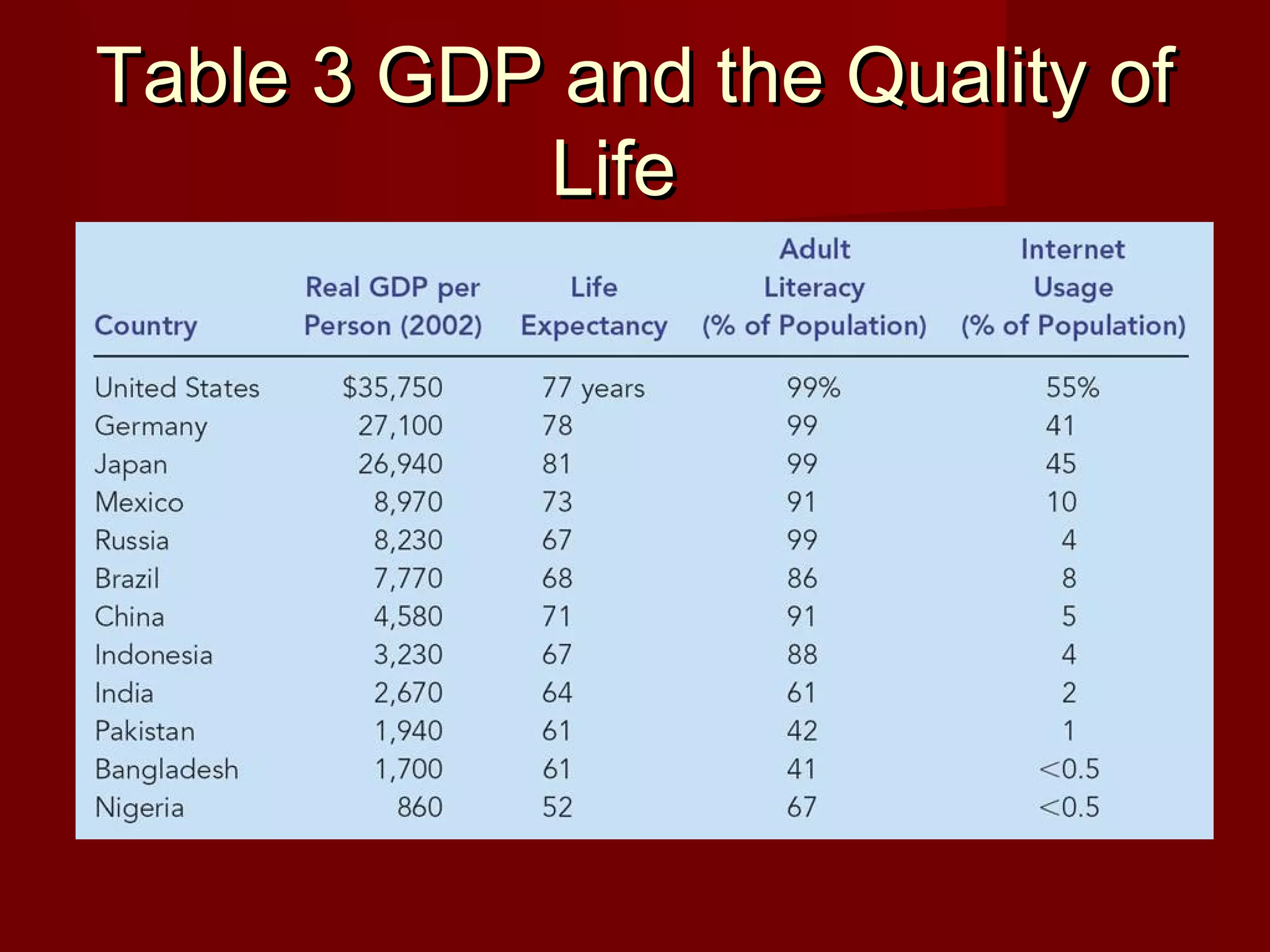
Table 3 GDP and the Quality of
           Life
Importance of Macro-
              Economics
1.   It explains the working of the economic system
     as a whole
2.   It is very important to management students to
     understand the fundamentals of macro-
     economic system
3.   It is helpful to planners and policy makers to
     get information and guide to the functioning of
     the economy
4.   The estimate of national income is very useful
      tool to analyze the performance of an
     economy
Importance of Macro-
              Economics
5.   An analysis of the composition of National
     income provides the contribution of each sector
     of the economy to the national income
6.   It is helpful to know the total earnings (or N.Y)
     of the economy during a given period of time
7.   It deals with some difficult and challenging
     issues like
     unemployment,inflation,taxes,balanced budget
     and unbalanced budgets and role of Govt in the
     economy
8.   It throws light on the material well-being of the
     community
THANK YOU

Macroeconomics

  • 1.
    MICRO & MACRO ECONOMICS
  • 2.
    Distinction between Micro & Macro Economics Micro Economics Macro Economics  Derived from Greek word  Derived from Greek word “Mikros” which means “Makros”which means small. aggregate.  It is concerned with  It is concerned with aggregate Individual industry, firms, demand, supply, employment, producers and output and prices. consumers.  It adopts ‘slicing’ method.  It adopts ‘lump-sum’ method.  It is a narrow concept  It is a broad concept
  • 3.
    Studying a particular tree  Studying the entire forest. i.e. Teak.  Heterogeneity  Homogeneity  Realistic assumptions  Unrealistic assumptions  Many mathematical  Limited mathematical applications applications  Full utilization of  Optimal allocation of resources resources  It is used in policy making  It is used in model building
  • 4.
     Economics isthe study of how society manages its scarce resources.  Resources are allocated by combined actions of millions of household and firms.
  • 5.
    Measuring a Nation’sIncome Macroeconomics answers questions like the following:  Why is average income is high in some countries and low in others?  Why do prices rise rapidly in some time periods while they are more stable in others?  Why do production and employment expand in some years and contract in others?
  • 6.
    THE ECONOMY’S INCOME AND EXPENDITURE  When judging whether the economy is doing well or poorly, it is natural to look at the total income that everyone in the economy is earning.
  • 7.
    THE ECONOMY’S INCOME AND EXPENDITURE For an economy as a whole, income must equal expenditure because: – Every transaction has a buyer and a seller. – Every RUPEE of spending by some buyer is a RUPEE of income for some seller.
  • 8.
    THE MEASUREMENT OF GROSSDOMESTIC PRODUCT  The equality of income and expenditure is illustrated with the circular-flow diagram.
  • 9.
    The Circular-Flow Diagram MARKETS Revenue FOR Spending GOODS AND SERVICES •Firms sell Goods and Goods •Households buy services and services sold bought FIRMS HOUSEHOLDS •Produce and sell •Buy and consume goods and services goods and services •Hire and use factors •Own and sell factors of production of production Factors of MARKETS Labor, land, production FOR and capital FACTORS OF PRODUCTION Wages, rent, •Households sell Income and profit •Firms buy = Flow of inputs and outputs = Flow of dollars
  • 10.
    THE MEASUREMENT OF GROSSDOMESTIC PRODUCT  Gross domestic product(GDP) is a measure of the income and expenditures of an economy.  GDP is the total market value of all final goods and services produced within a country in a given period of time.
  • 11.
    THE MEASUREMENT OF GROSSDOMESTIC PRODUCT  “GDP is the Market Value . . .” – Output is valued at market prices.  “. . . Of All. . .” – Includes all items produced in the economy and legally sold in markets  “. . . Final . . .” – It records only the value of final goods, not intermediate goods (the value is counted only once).  “. . . Goods and Services . . .” – It includes both tangible goods (food, clothing, cars) and intangible services (haircuts, housecleaning, doctor visits).
  • 12.
    THE MEASUREMENT OF GROSSDOMESTIC PRODUCT  “. . . Produced . . .” – It includes goods and services currently produced, not transactions involving goods produced in the past.  “ . . . Within a Country . . .” – It measures the value of production within the geographic confines of a country.  “. . . In a Given Period of Time.” – It measures the value of production that takes place within a specific interval of time, usually a year or a quarter (three months).
  • 13.
    THE COMPONENTS OFGDP  GDP includes all items produced in the economy and sold legally in markets.  What Is Not Counted in GDP? – GDP excludes most items that are produced and consumed at home and that never enter the marketplace. – It excludes items produced and sold illicitly, such as illegal drugs.
  • 14.
    THE COMPONENTS OFGDP GDP (Y) is the sum of the following:  Consumption (C)  Investment (I)  Government Purchases (G)  Net Exports (NX) Y = C + I + G + NX
  • 15.
    THE COMPONENTS OFGDP  Consumption (C): • The spending by households on goods and services, with the exception of purchases of new housing.  Investment (I): • The spending on capital equipment, inventories, and structures, including new housing.
  • 16.
    THE COMPONENTS OFGDP  Government Purchases (G): – The spending on goods and services by local, state, and federal governments. – Does not include transfer payments because they are not made in exchange for currently produced goods or services.  Net Exports (NX): – Exports minus imports.
  • 17.
    GDP and ItsComponents Government Purchases 15% Investment Net Exports 16% -5 % Consumption 70%
  • 18.
    REAL VERSUS NOMINALGDP- Rationale and Definition  Nominal GDP values the production of goods and services at current prices.  Real GDP values the production of goods and services at constant prices.
  • 19.
    IS GDP AGOOD MEASURE OF ECONOMIC WELL-BEING?  GDP is the best single measure of the economic well-being of a society.  GDP per person tells us the income and expenditure of the average person in the economy.  Higher GDP per person indicates a higher standard of living.  GDP is not a perfect measure of the happiness or quality of life, however.
  • 20.
    GDP AND ECONOMIC WELL-BEING  Some things that contribute to well-being are not included in GDP. – The value of leisure. – The value of a clean environment. – The value of almost all activity that takes place outside of markets, such as the value of the time parents spend with their children and the value of volunteer work.
  • 21.
    Table 3 GDPand the Quality of Life
  • 22.
    Importance of Macro- Economics 1. It explains the working of the economic system as a whole 2. It is very important to management students to understand the fundamentals of macro- economic system 3. It is helpful to planners and policy makers to get information and guide to the functioning of the economy 4. The estimate of national income is very useful tool to analyze the performance of an economy
  • 23.
    Importance of Macro- Economics 5. An analysis of the composition of National income provides the contribution of each sector of the economy to the national income 6. It is helpful to know the total earnings (or N.Y) of the economy during a given period of time 7. It deals with some difficult and challenging issues like unemployment,inflation,taxes,balanced budget and unbalanced budgets and role of Govt in the economy 8. It throws light on the material well-being of the community
  • 24.