MICRO ECONOMICS:
UNIT 1
Rahi Alhat
WHAT IS ECONOMICS?
Economics is like a big puzzle about how people make
choices when they have limited resources, such as
money, time, and materials. It looks at how these choices
affect things like prices, jobs, and the overall well-being
of a society. It's basically about understanding how
people decide what to do with what they have.
Jurisprudential
Aspects.
Aristotle: problems concerning how to manage a
household
David Hume: complex set of interactions that
produce and distribute consumption goods and
the resources and tools that produce them
Whatley called economics as Catallactics or the
science of exchange
Ingram named it as Chrematistics or science of
money making
This Photo by Unknown author is licensed under CC BY-SA.
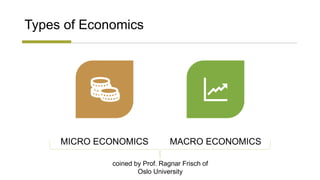
Types of Economics
MICRO ECONOMICS MACRO ECONOMICS
coined by Prof. Ragnar Frisch of
Oslo University
Microeconomics
branch of economic analysis which studies the economic behavior
of the individual unit, may be a person, a particular household, or a
particular unit rather all the units combined together.
It studies the behavior of micro quantities or micro variables.
It splits up the economic system into smaller parts for the purpose
of intensive study and hence is referred as slicing method.
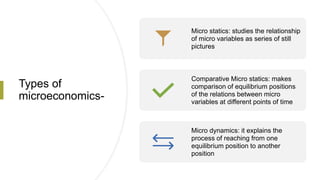
Types of
microeconomics-
Micro statics: studies the relationship
of micro variables as series of still
pictures
Comparative Micro statics: makes
comparison of equilibrium positions
of the relations between micro
variables at different points of time
Micro dynamics: it explains the
process of reaching from one
equilibrium position to another
position
Importance of Microeconomic Studies
• It is helpful in the efficient allocation of resources as resources are limited in quantity, it helps in formulation of
suitable policies that can be adopted by the government to promote economic efficiency.
• It helps in understanding free enterprise economies without any central control. It helps in decision, making of both
consumers as to what and how much to consume and producers to take decision of what to produce, how to
produce and for whom to produce.
• It is useful in understanding the development of International trade as it explains gains from trade, BOP
disequilibrium and determination of foreign exchange rate.
• Microeconomics is helpful in understanding the implication of taxation and its impact on the social welfare.
• As emerged as basis for development of Welfare Economics as the whole concept of welfare economics is
developed on price theory.
• It provides tools for evaluating economic Policies of the states.
• It has been helpful in developing economic models to understand the actual economic phenomenon.
• It is basis for prediction of forthcoming economic changes.
• Microeconomic studies help in construction of growth models and provides application for use of these models.
Limitations
• Certain variables that microeconomics deals may hold good for study of individual units, but not applicable for aggregates. Thus
the results of microeconomic variables must be applied to microeconomic variables with caution.
• The microeconomic theories are all based on assumption of full employment, which has made this concept unrealistic
• It mainly concentrates on study of small segments of an economic system and thus fails to throw light on collective functioning.
• The study does not provide solutions for all economic problems which cannot be analyzed with the help of microeconomic
variables.
• It lacks abstractness as it fails to explain the description of the actual world.
• It is based on the assumption of Laissez faire policy or free enterprise economy which is assumption based and does not exists.
Macro Economics
• The term Macro economics is derived from Greek word
‘Macros’ meaning large.
• which studies the behavior of not one particular unit, but all
the units combined together
• It is the study of aggregates and is also called as aggregative
economics
Types of
macro
economics
Macro statics:It explains certain aggregative
relations in a stationary state. It deals with
the equilibrium of a national economy at a
particular point of time
Comparative Macro statics:it explains
comparative study of different equilibrium
attained by the economy
Macro Dynamics:It provides highlights of
the process of progressive growth of the
whole economic system
Importance of the study of macroeconomics
The study helps in the formulation and
implementation of governmental
economic policies. Today’s
Governments depend on aggregate
variables for formulation of sound
economic policies, and
macroeconomics provides the details
of these variables.
Economic study will be complete only
with the study of aggregates as it is
difficult to study the individual terms or
units. The decision making is based
on averages and generalizations
It helps in analyzing the behavioral
pattern of aggregate variables by
collecting studying the experiences of
masses or individual behaviours.
It is an indispensable tool for growth of
macroeconomics. It helps in
government to achieve uninterrupted
economic growth with the help of
suitable policies.
Limitations
It has the danger of excessive generalization of from
the individual experience to the system as a whole.
The aggregate concepts are not homogeneous, and
may result in wrong analysis.
The aggregate tendencies may not influence all the
sectors of the economy in the same manner as
impact on all sectors will not be the same at all
times. At times, policies framed on aggregate
concepts may pose problem for the economic
system
Activity
Price
determination of
a particular
commodity.
Consumer
equilibrium.
Output
generated by an
individual
organization.
Individual
income and
savings.
National income
and savings.
General price
level.
Aggregate
demand and
Aggregate
Supply
Poverty.
Rate of
unemployment
10 Principles of
Economics
• In brief Economics study how
Money Supply, Business and
Industry are organized
• Gregory Mankiw in his Principles
of Economics outlines Ten
Principles of Economics
The Principles
• People face trade-offs.
• The cost of something is what you give up getting it.
• Rational people think at the marginal cost and marginal revenue.
• People respond to incentives.
• Trade can make everyone better off.
• Markets are usually a good way to organize economic activity.
• Governments can sometimes improve market outcomes.
• A country's standard of living depends on its ability to produce goods and services.
• Growth of money leads to inflation
• Society faces a short-run tradeoff between Inflation and unemployment
.
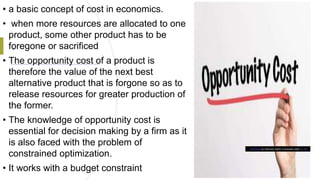
• a basic concept of cost in economics.
• when more resources are allocated to one
product, some other product has to be
foregone or sacrificed
• The opportunity cost of a product is
therefore the value of the next best
alternative product that is forgone so as to
release resources for greater production of
the former.
• The knowledge of opportunity cost is
essential for decision making by a firm as it
is also faced with the problem of
constrained optimization.
• It works with a budget constraint
This Photo by Unknown author is licensed under CC BY.
Activity (Decision-Making Game)
Studying for 2
hours
Partying for 2
hours
Attending Guest
lecture for 2 ours
on Moot Court
Social Media for 2
hours
Sleeping for 2
hours
Production Possibility
Frontier (PPF)
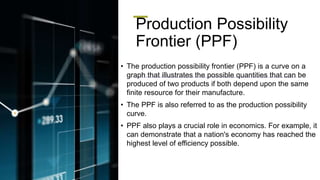
• The production possibility frontier (PPF) is a curve on a
graph that illustrates the possible quantities that can be
produced of two products if both depend upon the same
finite resource for their manufacture.
• The PPF is also referred to as the production possibility
curve.
• PPF also plays a crucial role in economics. For example, it
can demonstrate that a nation's economy has reached the
highest level of efficiency possible.
.
10

Micro Economics Unit 1.pptx

  • 1.
  • 2.
    WHAT IS ECONOMICS? Economicsis like a big puzzle about how people make choices when they have limited resources, such as money, time, and materials. It looks at how these choices affect things like prices, jobs, and the overall well-being of a society. It's basically about understanding how people decide what to do with what they have.
  • 3.
    Jurisprudential Aspects. Aristotle: problems concerninghow to manage a household David Hume: complex set of interactions that produce and distribute consumption goods and the resources and tools that produce them Whatley called economics as Catallactics or the science of exchange Ingram named it as Chrematistics or science of money making This Photo by Unknown author is licensed under CC BY-SA.
  • 4.
    Types of Economics MICROECONOMICS MACRO ECONOMICS coined by Prof. Ragnar Frisch of Oslo University
  • 5.
    Microeconomics branch of economicanalysis which studies the economic behavior of the individual unit, may be a person, a particular household, or a particular unit rather all the units combined together. It studies the behavior of micro quantities or micro variables. It splits up the economic system into smaller parts for the purpose of intensive study and hence is referred as slicing method.
  • 6.
    Types of microeconomics- Micro statics:studies the relationship of micro variables as series of still pictures Comparative Micro statics: makes comparison of equilibrium positions of the relations between micro variables at different points of time Micro dynamics: it explains the process of reaching from one equilibrium position to another position
  • 7.
    Importance of MicroeconomicStudies • It is helpful in the efficient allocation of resources as resources are limited in quantity, it helps in formulation of suitable policies that can be adopted by the government to promote economic efficiency. • It helps in understanding free enterprise economies without any central control. It helps in decision, making of both consumers as to what and how much to consume and producers to take decision of what to produce, how to produce and for whom to produce. • It is useful in understanding the development of International trade as it explains gains from trade, BOP disequilibrium and determination of foreign exchange rate. • Microeconomics is helpful in understanding the implication of taxation and its impact on the social welfare. • As emerged as basis for development of Welfare Economics as the whole concept of welfare economics is developed on price theory. • It provides tools for evaluating economic Policies of the states. • It has been helpful in developing economic models to understand the actual economic phenomenon. • It is basis for prediction of forthcoming economic changes. • Microeconomic studies help in construction of growth models and provides application for use of these models.
  • 8.
    Limitations • Certain variablesthat microeconomics deals may hold good for study of individual units, but not applicable for aggregates. Thus the results of microeconomic variables must be applied to microeconomic variables with caution. • The microeconomic theories are all based on assumption of full employment, which has made this concept unrealistic • It mainly concentrates on study of small segments of an economic system and thus fails to throw light on collective functioning. • The study does not provide solutions for all economic problems which cannot be analyzed with the help of microeconomic variables. • It lacks abstractness as it fails to explain the description of the actual world. • It is based on the assumption of Laissez faire policy or free enterprise economy which is assumption based and does not exists.
  • 9.
    Macro Economics • Theterm Macro economics is derived from Greek word ‘Macros’ meaning large. • which studies the behavior of not one particular unit, but all the units combined together • It is the study of aggregates and is also called as aggregative economics
  • 10.
    Types of macro economics Macro statics:Itexplains certain aggregative relations in a stationary state. It deals with the equilibrium of a national economy at a particular point of time Comparative Macro statics:it explains comparative study of different equilibrium attained by the economy Macro Dynamics:It provides highlights of the process of progressive growth of the whole economic system
  • 11.
    Importance of thestudy of macroeconomics The study helps in the formulation and implementation of governmental economic policies. Today’s Governments depend on aggregate variables for formulation of sound economic policies, and macroeconomics provides the details of these variables. Economic study will be complete only with the study of aggregates as it is difficult to study the individual terms or units. The decision making is based on averages and generalizations It helps in analyzing the behavioral pattern of aggregate variables by collecting studying the experiences of masses or individual behaviours. It is an indispensable tool for growth of macroeconomics. It helps in government to achieve uninterrupted economic growth with the help of suitable policies.
  • 12.
    Limitations It has thedanger of excessive generalization of from the individual experience to the system as a whole. The aggregate concepts are not homogeneous, and may result in wrong analysis. The aggregate tendencies may not influence all the sectors of the economy in the same manner as impact on all sectors will not be the same at all times. At times, policies framed on aggregate concepts may pose problem for the economic system
  • 13.
    Activity Price determination of a particular commodity. Consumer equilibrium. Output generatedby an individual organization. Individual income and savings. National income and savings. General price level. Aggregate demand and Aggregate Supply Poverty. Rate of unemployment
  • 14.
    10 Principles of Economics •In brief Economics study how Money Supply, Business and Industry are organized • Gregory Mankiw in his Principles of Economics outlines Ten Principles of Economics
  • 15.
    The Principles • Peopleface trade-offs. • The cost of something is what you give up getting it. • Rational people think at the marginal cost and marginal revenue. • People respond to incentives. • Trade can make everyone better off. • Markets are usually a good way to organize economic activity. • Governments can sometimes improve market outcomes. • A country's standard of living depends on its ability to produce goods and services. • Growth of money leads to inflation • Society faces a short-run tradeoff between Inflation and unemployment
  • 16.
    . • a basicconcept of cost in economics. • when more resources are allocated to one product, some other product has to be foregone or sacrificed • The opportunity cost of a product is therefore the value of the next best alternative product that is forgone so as to release resources for greater production of the former. • The knowledge of opportunity cost is essential for decision making by a firm as it is also faced with the problem of constrained optimization. • It works with a budget constraint This Photo by Unknown author is licensed under CC BY.
  • 17.
    Activity (Decision-Making Game) Studyingfor 2 hours Partying for 2 hours Attending Guest lecture for 2 ours on Moot Court Social Media for 2 hours Sleeping for 2 hours
  • 18.
    Production Possibility Frontier (PPF) •The production possibility frontier (PPF) is a curve on a graph that illustrates the possible quantities that can be produced of two products if both depend upon the same finite resource for their manufacture. • The PPF is also referred to as the production possibility curve. • PPF also plays a crucial role in economics. For example, it can demonstrate that a nation's economy has reached the highest level of efficiency possible.
  • 20.