Chapter 3

Organic Molecules and Cells
The Variety of Organic Molecules
       Makes Life Diverse
The chemistry of carbon makes diverse molecules
  possible
• Organic Chemistry – the chemistry of carbon
• Carbon has 6 electrons so it needs to bond with
  other elements (CHNOPS) to fill its outer shell
• Hydrocarbons – chains of carbons bonded to
  hydrogen
• Carbon can have single, double, or triple bonds
• Biomolecules are made of 4 classes
  –   Carbohydrates
  –   Lipids
  –   Proteins
  –   Nucleic acids
• Carbon is the essential ingredient to
  biomolecules
• Functional groups add to the variety of
  biomolecules
  – Carbon chain – backbone of a biomolecule
  – Functional group – specific combination of bonded
    atoms that always react in the same way, regardless
    of the particular carbon backbone
  – R – rest of the molecule
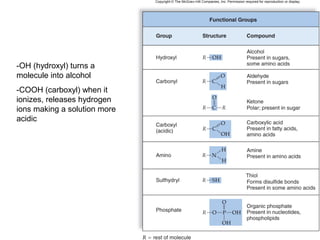
-OH (hydroxyl) turns a
molecule into alcohol
-COOH (carboxyl) when it
ionizes, releases hydrogen
ions making a solution more
acidic
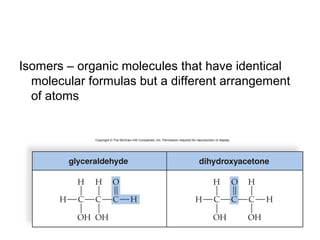
Isomers – organic molecules that have identical
  molecular formulas but a different arrangement
  of atoms
Molecular subunits can be linked to
 form varied large biomolecules
• Polymer
  – Largest of the biomolecules
  – Made of many monomers
  – Glucose is a monomer of starch, a polymer
  – Proteins are made up of many amino acids
  – Nucleic acids contain many nucleotides
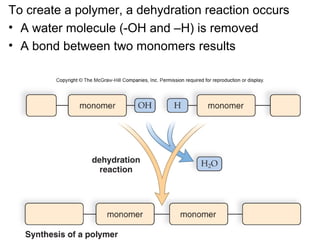
To create a polymer, a dehydration reaction occurs
• A water molecule (-OH and –H) is removed
• A bond between two monomers results
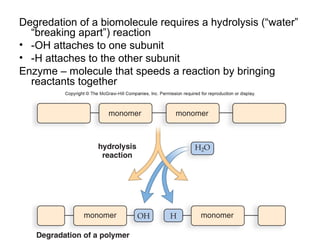
Degredation of a biomolecule requires a hydrolysis (“water”
  “breaking apart”) reaction
• -OH attaches to one subunit
• -H attaches to the other subunit
Enzyme – molecule that speeds a reaction by bringing
  reactants together
Carbohydrates are energy sources
   and structural components
Simple carbohydrates provide quick energy
• Monosaccharide
  – Single sugar molecule
  – Carbon backbone of 3-7 carbons
• Glucose (C6H12O6)
  – Monosaccharide with 6 carbons
  – Glucose has isomers such as fructose and galactose
• Ribose and deoxyribose
  – Monosaccarides with 5 carbon atoms
  – Found in RNA and DNA respectively
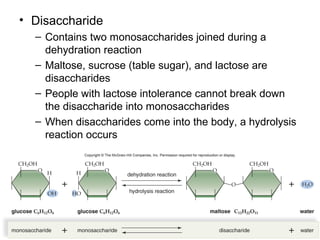
• Disaccharide
  – Contains two monosaccharides joined during a
    dehydration reaction
  – Maltose, sucrose (table sugar), and lactose are
    disaccharides
  – People with lactose intolerance cannot break down
    the disaccharide into monosaccharides
  – When disaccharides come into the body, a hydrolysis
    reaction occurs
Complex carbohydrates store energy
   and provide structural support
Complex carbohydrates are polysaccharides
  (polymers of monosaccharides)
• Some polysaccharides (glycogen and starch)
  are storage molecules
  – Potatoes contain starch during the winter until it is
    needed for growth in the spring
• Structural polysaccharides
  – Cellulose in plants
  – Chitin in animals
  – Peptidoglycan in bacteria
Lipids store energy and have other functions
Fats and oils are rich energy-storage molecules
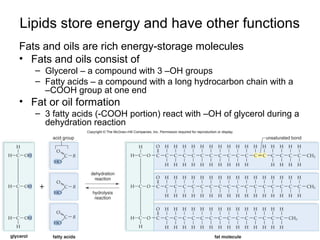
• Fats and oils consist of
   – Glycerol – a compound with 3 –OH groups
   – Fatty acids – a compound with a long hydrocarbon chain with a
     –COOH group at one end
• Fat or oil formation
   – 3 fatty acids (-COOH portion) react with –OH of glycerol during a
     dehydration reaction
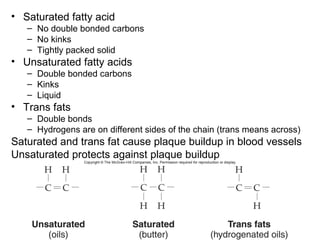
• Saturated fatty acid
   – No double bonded carbons
   – No kinks
   – Tightly packed solid
• Unsaturated fatty acids
   – Double bonded carbons
   – Kinks
   – Liquid
• Trans fats
   – Double bonds
   – Hydrogens are on different sides of the chain (trans means across)
Saturated and trans fat cause plaque buildup in blood vessels
Unsaturated protects against plaque buildup
Other lipids have structural,
  hormonal, or protective functions
Phospholipids, steroids, and waxes
• Phospholipids
   –   Glycerol, 2 fatty acids, phosphate
   –   Fatty acids are hydrophobic
   –   Head is hydrophilic
   –   In water a phospholipid bilayer naturally occurs
        • Cell membrane is a phospholipid bilayer
• Steroids
   – 4 fused carbon rings
   – Cholesterol – participates in plaque formation
   – Estrogen and testosterone – sex hormones
• Waxes
   – Combines fatty acids and alcohols
   – Hydrophobic so waterproof and resistant to degredation
   – Plant leaves, animal skin and fun, ear canal, honey storage
Proteins have many vital functions
Proteins are the most versatile of life’s molecules
• Proteins – polymers of amino acids
    – Support
        • Structure
        • Silk, hair, fingernails
    – Metabolism
        • Enzymes – bring reactants together
    – Transport
        • Allow substances to enter and exit cells
    – Defense
        • Antibodies
    – Regulation
        • Hormones
        • Intercellular messengers
    – Motion
        • Contractile proteins allow parts of the cell to move and cause muscles to
          contract
Each protein is a sequence of particular amino acids
• A monomer of a protein is an amino acid
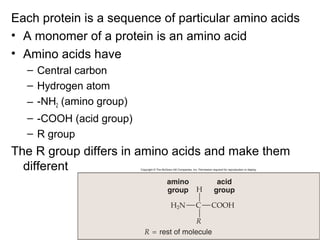
• Amino acids have
  – Central carbon
  – Hydrogen atom
  – -NH2 (amino group)
  – -COOH (acid group)
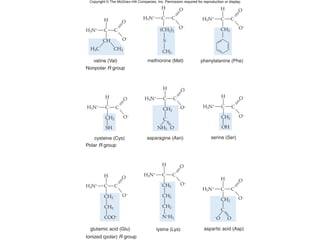
  – R group
The R group differs in amino acids and make them
  different
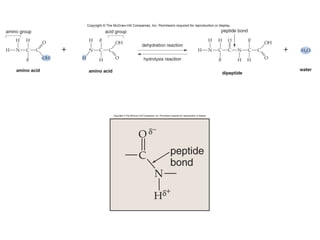
• Amino acids bond via a dehydration reaction
• Peptide – two or more amino acids bonded
  together
• Polypeptide – chain of many amino acids joined
  by peptide bonds
• Peptide bond – covalent bond between two
  amino acids
  –   Oxygen attracts electrons more than nitrogen
  –   Oxygen is slightly negative
  –   Hydrogen is slightly positive
  –   Polarity allows hydrogen bonds between –CO of one
      amino acid and –NH of another amino acid
The shape of a protein is necessary
          to its function
• Collagen
  – Provides strength and support
  – Super-coiled
• Hemoglobin
  – Globular
  – Allows it to travel in blood vessels
Extreme temperatures and pH can denature (alter
  shape) so it can no longer perform its usual
  function
Alcohol and salts of heavy metals also denature
  proteins
Levels of Protein
  Organization
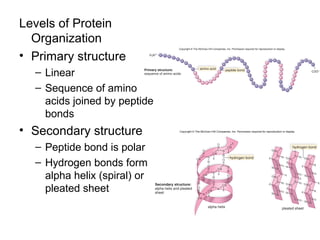
• Primary structure
  – Linear
  – Sequence of amino
    acids joined by peptide
    bonds
• Secondary structure
  – Peptide bond is polar
  – Hydrogen bonds form
    alpha helix (spiral) or
    pleated sheet
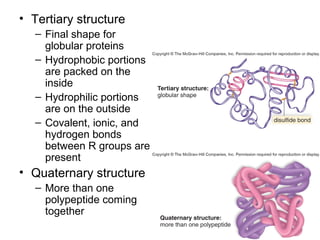
• Tertiary structure
   – Final shape for
     globular proteins
   – Hydrophobic portions
     are packed on the
     inside
   – Hydrophilic portions
     are on the outside
   – Covalent, ionic, and
     hydrogen bonds
     between R groups are
     present
• Quaternary structure
   – More than one
     polypeptide coming
     together
Nucleic acids are information
             molecules
DNA stores coded information
• Genes
  – Hereditary units composed of DNA (deoxyribonucleic
    acid)
  – Control structure and function of cells and organisms
    by coding for proteins
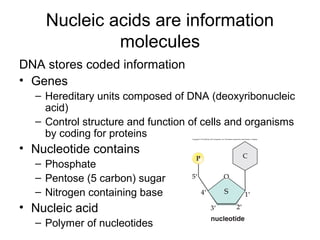
• Nucleotide contains
  – Phosphate
  – Pentose (5 carbon) sugar
  – Nitrogen containing base
• Nucleic acid
  – Polymer of nucleotides
• DNA and RNA (ribonucleic acid) are
  nucleic acids
• DNA structure contains complementary
  paired bases that are held together by
  hydrogen bonds
  – Thymine (T) always pairs with Adenine (A)
  – Guanine (G) always pairs with Cytosine (C)
• Genome – DNA base sequence of all
  genes of an organism
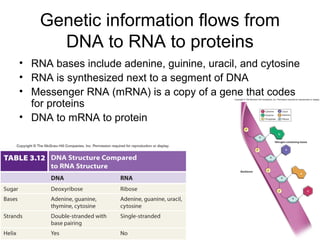
Genetic information flows from
      DNA to RNA to proteins
• RNA bases include adenine, guinine, uracil, and cytosine
• RNA is synthesized next to a segment of DNA
• Messenger RNA (mRNA) is a copy of a gene that codes
  for proteins
• DNA to mRNA to protein
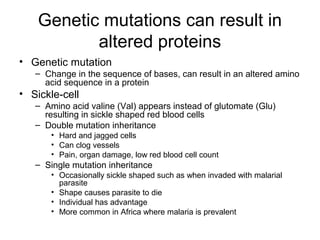
Genetic mutations can result in
           altered proteins
• Genetic mutation
   – Change in the sequence of bases, can result in an altered amino
     acid sequence in a protein
• Sickle-cell
   – Amino acid valine (Val) appears instead of glutomate (Glu)
     resulting in sickle shaped red blood cells
   – Double mutation inheritance
      • Hard and jagged cells
      • Can clog vessels
      • Pain, organ damage, low red blood cell count
   – Single mutation inheritance
      • Occasionally sickle shaped such as when invaded with malarial
        parasite
      • Shape causes parasite to die
      • Individual has advantage
      • More common in Africa where malaria is prevalent
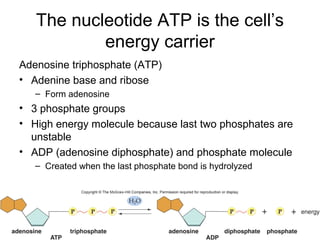
The nucleotide ATP is the cell’s
           energy carrier
Adenosine triphosphate (ATP)
• Adenine base and ribose
   – Form adenosine
• 3 phosphate groups
• High energy molecule because last two phosphates are
  unstable
• ADP (adenosine diphosphate) and phosphate molecule
   – Created when the last phosphate bond is hydrolyzed
• ATP breaks down, releases energy, which
  is used by cells to create biomolecules
• Muscle cells use it for muscle contractions
• Nerve cells use it for nerve impulses

Bio 100 Chapter 3

  • 1.
  • 2.
    The Variety ofOrganic Molecules Makes Life Diverse The chemistry of carbon makes diverse molecules possible • Organic Chemistry – the chemistry of carbon • Carbon has 6 electrons so it needs to bond with other elements (CHNOPS) to fill its outer shell • Hydrocarbons – chains of carbons bonded to hydrogen • Carbon can have single, double, or triple bonds
  • 3.
    • Biomolecules aremade of 4 classes – Carbohydrates – Lipids – Proteins – Nucleic acids • Carbon is the essential ingredient to biomolecules • Functional groups add to the variety of biomolecules – Carbon chain – backbone of a biomolecule – Functional group – specific combination of bonded atoms that always react in the same way, regardless of the particular carbon backbone – R – rest of the molecule
  • 4.
    -OH (hydroxyl) turnsa molecule into alcohol -COOH (carboxyl) when it ionizes, releases hydrogen ions making a solution more acidic
  • 5.
    Isomers – organicmolecules that have identical molecular formulas but a different arrangement of atoms
  • 6.
    Molecular subunits canbe linked to form varied large biomolecules • Polymer – Largest of the biomolecules – Made of many monomers – Glucose is a monomer of starch, a polymer – Proteins are made up of many amino acids – Nucleic acids contain many nucleotides
  • 7.
    To create apolymer, a dehydration reaction occurs • A water molecule (-OH and –H) is removed • A bond between two monomers results
  • 8.
    Degredation of abiomolecule requires a hydrolysis (“water” “breaking apart”) reaction • -OH attaches to one subunit • -H attaches to the other subunit Enzyme – molecule that speeds a reaction by bringing reactants together
  • 9.
    Carbohydrates are energysources and structural components Simple carbohydrates provide quick energy • Monosaccharide – Single sugar molecule – Carbon backbone of 3-7 carbons • Glucose (C6H12O6) – Monosaccharide with 6 carbons – Glucose has isomers such as fructose and galactose • Ribose and deoxyribose – Monosaccarides with 5 carbon atoms – Found in RNA and DNA respectively
  • 10.
    • Disaccharide – Contains two monosaccharides joined during a dehydration reaction – Maltose, sucrose (table sugar), and lactose are disaccharides – People with lactose intolerance cannot break down the disaccharide into monosaccharides – When disaccharides come into the body, a hydrolysis reaction occurs
  • 11.
    Complex carbohydrates storeenergy and provide structural support Complex carbohydrates are polysaccharides (polymers of monosaccharides) • Some polysaccharides (glycogen and starch) are storage molecules – Potatoes contain starch during the winter until it is needed for growth in the spring • Structural polysaccharides – Cellulose in plants – Chitin in animals – Peptidoglycan in bacteria
  • 12.
    Lipids store energyand have other functions Fats and oils are rich energy-storage molecules • Fats and oils consist of – Glycerol – a compound with 3 –OH groups – Fatty acids – a compound with a long hydrocarbon chain with a –COOH group at one end • Fat or oil formation – 3 fatty acids (-COOH portion) react with –OH of glycerol during a dehydration reaction
  • 13.
    • Saturated fattyacid – No double bonded carbons – No kinks – Tightly packed solid • Unsaturated fatty acids – Double bonded carbons – Kinks – Liquid • Trans fats – Double bonds – Hydrogens are on different sides of the chain (trans means across) Saturated and trans fat cause plaque buildup in blood vessels Unsaturated protects against plaque buildup
  • 14.
    Other lipids havestructural, hormonal, or protective functions Phospholipids, steroids, and waxes • Phospholipids – Glycerol, 2 fatty acids, phosphate – Fatty acids are hydrophobic – Head is hydrophilic – In water a phospholipid bilayer naturally occurs • Cell membrane is a phospholipid bilayer • Steroids – 4 fused carbon rings – Cholesterol – participates in plaque formation – Estrogen and testosterone – sex hormones • Waxes – Combines fatty acids and alcohols – Hydrophobic so waterproof and resistant to degredation – Plant leaves, animal skin and fun, ear canal, honey storage
  • 15.
    Proteins have manyvital functions Proteins are the most versatile of life’s molecules • Proteins – polymers of amino acids – Support • Structure • Silk, hair, fingernails – Metabolism • Enzymes – bring reactants together – Transport • Allow substances to enter and exit cells – Defense • Antibodies – Regulation • Hormones • Intercellular messengers – Motion • Contractile proteins allow parts of the cell to move and cause muscles to contract
  • 16.
    Each protein isa sequence of particular amino acids • A monomer of a protein is an amino acid • Amino acids have – Central carbon – Hydrogen atom – -NH2 (amino group) – -COOH (acid group) – R group The R group differs in amino acids and make them different
  • 18.
    • Amino acidsbond via a dehydration reaction • Peptide – two or more amino acids bonded together • Polypeptide – chain of many amino acids joined by peptide bonds • Peptide bond – covalent bond between two amino acids – Oxygen attracts electrons more than nitrogen – Oxygen is slightly negative – Hydrogen is slightly positive – Polarity allows hydrogen bonds between –CO of one amino acid and –NH of another amino acid
  • 20.
    The shape ofa protein is necessary to its function • Collagen – Provides strength and support – Super-coiled • Hemoglobin – Globular – Allows it to travel in blood vessels Extreme temperatures and pH can denature (alter shape) so it can no longer perform its usual function Alcohol and salts of heavy metals also denature proteins
  • 21.
    Levels of Protein Organization • Primary structure – Linear – Sequence of amino acids joined by peptide bonds • Secondary structure – Peptide bond is polar – Hydrogen bonds form alpha helix (spiral) or pleated sheet
  • 22.
    • Tertiary structure – Final shape for globular proteins – Hydrophobic portions are packed on the inside – Hydrophilic portions are on the outside – Covalent, ionic, and hydrogen bonds between R groups are present • Quaternary structure – More than one polypeptide coming together
  • 23.
    Nucleic acids areinformation molecules DNA stores coded information • Genes – Hereditary units composed of DNA (deoxyribonucleic acid) – Control structure and function of cells and organisms by coding for proteins • Nucleotide contains – Phosphate – Pentose (5 carbon) sugar – Nitrogen containing base • Nucleic acid – Polymer of nucleotides
  • 24.
    • DNA andRNA (ribonucleic acid) are nucleic acids • DNA structure contains complementary paired bases that are held together by hydrogen bonds – Thymine (T) always pairs with Adenine (A) – Guanine (G) always pairs with Cytosine (C) • Genome – DNA base sequence of all genes of an organism
  • 25.
    Genetic information flowsfrom DNA to RNA to proteins • RNA bases include adenine, guinine, uracil, and cytosine • RNA is synthesized next to a segment of DNA • Messenger RNA (mRNA) is a copy of a gene that codes for proteins • DNA to mRNA to protein
  • 26.
    Genetic mutations canresult in altered proteins • Genetic mutation – Change in the sequence of bases, can result in an altered amino acid sequence in a protein • Sickle-cell – Amino acid valine (Val) appears instead of glutomate (Glu) resulting in sickle shaped red blood cells – Double mutation inheritance • Hard and jagged cells • Can clog vessels • Pain, organ damage, low red blood cell count – Single mutation inheritance • Occasionally sickle shaped such as when invaded with malarial parasite • Shape causes parasite to die • Individual has advantage • More common in Africa where malaria is prevalent
  • 27.
    The nucleotide ATPis the cell’s energy carrier Adenosine triphosphate (ATP) • Adenine base and ribose – Form adenosine • 3 phosphate groups • High energy molecule because last two phosphates are unstable • ADP (adenosine diphosphate) and phosphate molecule – Created when the last phosphate bond is hydrolyzed
  • 28.
    • ATP breaksdown, releases energy, which is used by cells to create biomolecules • Muscle cells use it for muscle contractions • Nerve cells use it for nerve impulses