Mature B-cell Lymphmoas/Leukemias
By:
Ahmed Makboul Ahmed
M.B.B.Ch, M.Sc
Assistant Lecturer, Clinical Pathology Department, South Egypt Cancer Institute
INTRODUCTION
IMMUNE SYSTEM
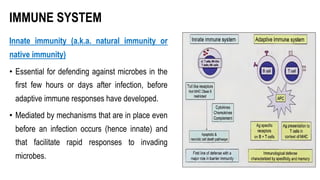
Innate immunity (a.k.a. natural immunity or
native immunity)
• Essential for defending against microbes in the
first few hours or days after infection, before
adaptive immune responses have developed.
• Mediated by mechanisms that are in place even
before an infection occurs (hence innate) and
that facilitate rapid responses to invading
microbes.
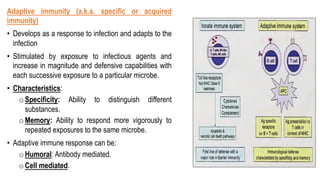
Adaptive immunity (a.k.a. specific or acquired
immunity)
• Develops as a response to infection and adapts to the
infection
• Stimulated by exposure to infectious agents and
increase in magnitude and defensive capabilities with
each successive exposure to a particular microbe.
• Characteristics:
oSpecificity: Ability to distinguish different
substances.
oMemory: Ability to respond more vigorously to
repeated exposures to the same microbe.
• Adaptive immune response can be:
oHumoral: Antibody mediated.
oCell mediated.
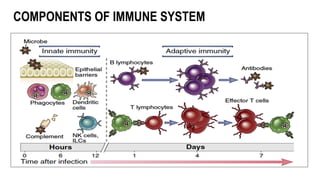
COMPONENTS OF IMMUNE SYSTEM
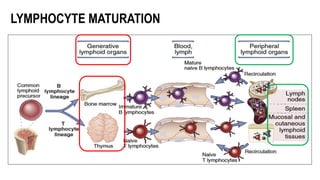
LYMPHOCYTE MATURATION
• Lymphocytes develop from bone marrow (BM) stem cells, mature in the generative
(primary) lymphoid organs (BM for B-cells and Thymus for T-cells).
• Fully mature T cells leave the thymus, but immature B cells leave the bone marrow
and complete their maturation in secondary lymphoid organs (lymph nodes, spleen,
regional lymphoid tissues such as mucosa-associated lymphoid tissues).
• Naive lymphocytes may respond to foreign antigens in these secondary lymphoid
tissues or return by lymphatic drainage to the blood and recirculate through other
secondary lymphoid organs.
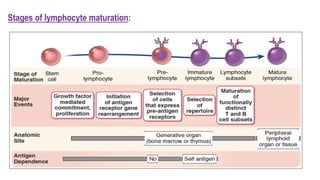
Stages of lymphocyte maturation:
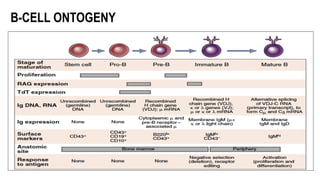
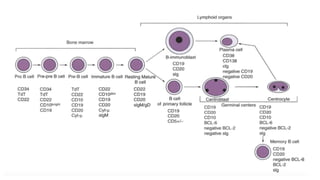
B-CELL ONTOGENY
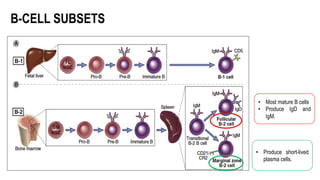
B-CELL SUBSETS
• Most mature B cells
• Produce IgD and
IgM.
• Produce short-lived
plasma cells.
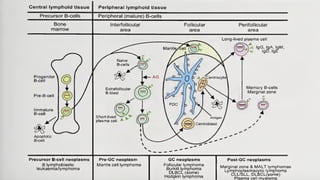
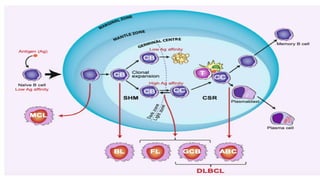
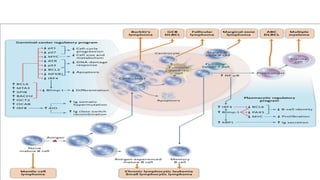
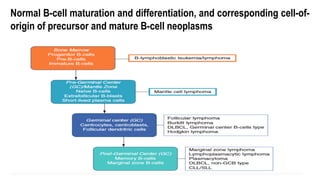
Normal B-cell maturation and differentiation, and corresponding cell-of-
origin of precursor and mature B-cell neoplasms
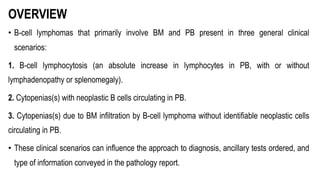
OVERVIEW
• B-cell lymphomas that primarily involve BM and PB present in three general clinical
scenarios:
1. B-cell lymphocytosis (an absolute increase in lymphocytes in PB, with or without
lymphadenopathy or splenomegaly).
2. Cytopenias(s) with neoplastic B cells circulating in PB.
3. Cytopenias(s) due to BM infiltration by B-cell lymphoma without identifiable neoplastic cells
circulating in PB.
• These clinical scenarios can influence the approach to diagnosis, ancillary tests ordered, and
type of information conveyed in the pathology report.
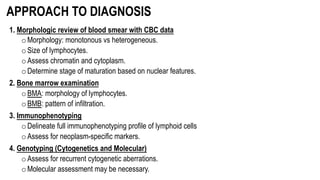
APPROACH TO DIAGNOSIS
1. Morphologic review of blood smear with CBC data
oMorphology: monotonous vs heterogeneous.
oSize of lymphocytes.
oAssess chromatin and cytoplasm.
oDetermine stage of maturation based on nuclear features.
2. Bone marrow examination
oBMA: morphology of lymphocytes.
oBMB: pattern of infiltration.
3. Immunophenotyping
oDelineate full immunophenotyping profile of lymphoid cells
oAssess for neoplasm-specific markers.
4. Genotyping (Cytogenetics and Molecular)
oAssess for recurrent cytogenetic aberrations.
oMolecular assessment may be necessary.
Pattern of BM infiltration in mature B-cell
lymphomas
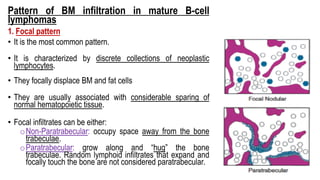
1. Focal pattern
• It is the most common pattern.
• It is characterized by discrete collections of neoplastic
lymphocytes.
• They focally displace BM and fat cells
• They are usually associated with considerable sparing of
normal hematopoietic tissue.
• Focal infiltrates can be either:
oNon-Paratrabecular: occupy space away from the bone
trabeculae.
oParatrabecular: grow along and “hug” the bone
trabeculae. Random lymphoid infiltrates that expand and
focally touch the bone are not considered paratrabecular.
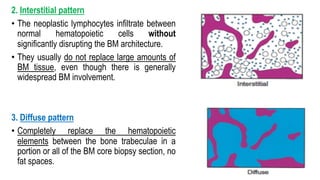
2. Interstitial pattern
• The neoplastic lymphocytes infiltrate between
normal hematopoietic cells without
significantly disrupting the BM architecture.
• They usually do not replace large amounts of
BM tissue, even though there is generally
widespread BM involvement.
3. Diffuse pattern
• Completely replace the hematopoietic
elements between the bone trabeculae in a
portion or all of the BM core biopsy section, no
fat spaces.
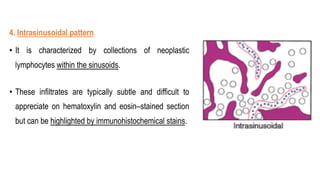
4. Intrasinusoidal pattern
• It is characterized by collections of neoplastic
lymphocytes within the sinusoids.
• These infiltrates are typically subtle and difficult to
appreciate on hematoxylin and eosin–stained section
but can be highlighted by immunohistochemical stains.
Classification
A simplified classification scheme of mature B-cell neoplasms that infiltrate PB & BM:
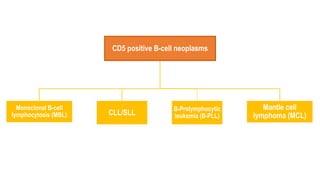
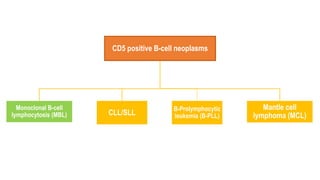
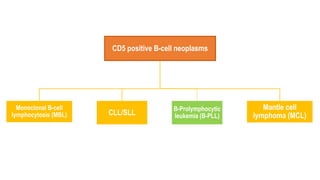
1. CD5 positive mature B-cell neoplasms
• Monoclonal B-cell lymphocytosis (MBL).
• CLL/SLL
• B-cell Prolymphocytic leukemia (B-PLL).
• Mantle cell lymphoma (MCL).
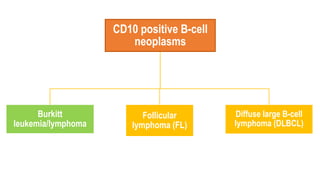
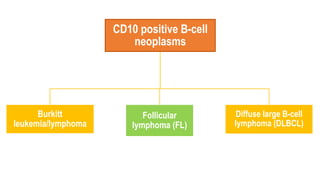
2. CD10 positive mature B-cell neoplasms
• Burkitt leukemia/lymphoma.
• Folicular lymphoma.
• Diffuse large B-cell lymphoma (DLBCL).
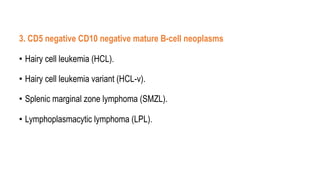
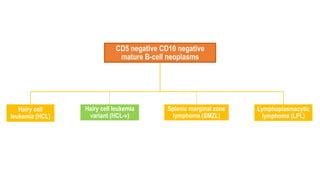
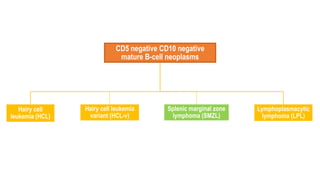
3. CD5 negative CD10 negative mature B-cell neoplasms
• Hairy cell leukemia (HCL).
• Hairy cell leukemia variant (HCL-v).
• Splenic marginal zone lymphoma (SMZL).
• Lymphoplasmacytic lymphoma (LPL).
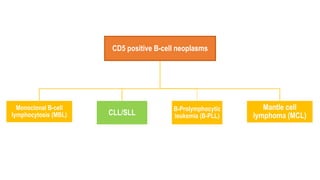
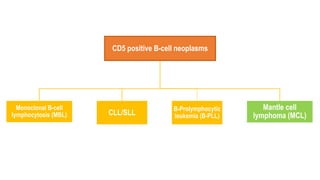
CD5 Positive B-cell Neoplasms
CD5 positive B-cell neoplasms
Monoclonal B-cell
lymphocytosis (MBL) CLL/SLL
B-Prolymphocytic
leukemia (B-PLL)
Mantle cell
lymphoma (MCL)
CD5 positive B-cell neoplasms
Monoclonal B-cell
lymphocytosis (MBL) CLL/SLL
B-Prolymphocytic
leukemia (B-PLL)
Mantle cell
lymphoma (MCL)
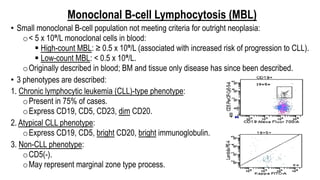
Monoclonal B-cell Lymphocytosis (MBL)
• Small monoclonal B-cell population not meeting criteria for outright neoplasia:
o< 5 x 10⁹/L monoclonal cells in blood:
§ High-count MBL: ≥ 0.5 x 10⁹/L (associated with increased risk of progression to CLL).
§ Low-count MBL: < 0.5 x 10⁹/L.
oOriginally described in blood; BM and tissue only disease has since been described.
• 3 phenotypes are described:
1. Chronic lymphocytic leukemia (CLL)-type phenotype:
oPresent in 75% of cases.
oExpress CD19, CD5, CD23, dim CD20.
2. Atypical CLL phenotype:
oExpress CD19, CD5, bright CD20, bright immunoglobulin.
3. Non-CLL phenotype:
oCD5(-).
oMay represent marginal zone type process.
CD5 positive B-cell neoplasms
Monoclonal B-cell
lymphocytosis (MBL) CLL/SLL
B-Prolymphocytic
leukemia (B-PLL)
Mantle cell
lymphoma (MCL)
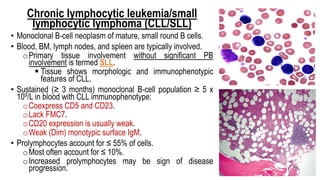
Chronic lymphocytic leukemia/small
lymphocytic lymphoma (CLL/SLL)
• Monoclonal B-cell neoplasm of mature, small round B cells.
• Blood, BM, lymph nodes, and spleen are typically involved.
oPrimary tissue involvement without significant PB
involvement is termed SLL.
§ Tissue shows morphologic and immunophenotypic
features of CLL.
• Sustained (≥ 3 months) monoclonal B-cell population ≥ 5 x
109/L in blood with CLL immunophenotype:
oCoexpress CD5 and CD23.
oLack FMC7.
oCD20 expression is usually weak.
oWeak (Dim) monotypic surface IgM.
• Prolymphocytes account for ≤ 55% of cells.
oMost often account for ≤ 10%.
oIncreased prolymphocytes may be sign of disease
progression.
CLINICAL FEATURES
Age: Median age at diagnosis of CLL is 60–70 years.
Gender: Male predominance.
Manifestations:
• Patients often are asymptomatic and are diagnosed when lymphocytosis is found on
routine blood testing.
• Generalized lymphadenopathy.
• Splenomegaly may result of infiltration, leads to hypersplenism, and peripheral cytopenias.
• Autoimmunity frequently seen in CLL/SLL:
oUp to 25% of patients develop Coombs positive autoimmune hemolytic anemia.
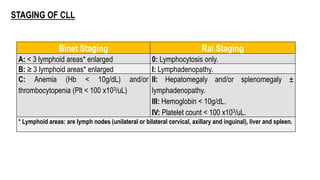
STAGING OF CLL
Binet Staging Rai Staging
A: < 3 lymphoid areas* enlarged 0: Lymphocytosis only.
B: ≥ 3 lymphoid areas* enlarged I: Lymphadenopathy.
C: Anemia (Hb < 10g/dL) and/or
thrombocytopenia (Plt < 100 x103/uL)
II: Hepatomegaly and/or splenomegaly ±
lymphadenopathy.
III: Hemoglobin < 10g/dL.
IV: Platelet count < 100 x103/uL.
* Lymphoid areas: are lymph nodes (unilateral or bilateral cervical, axillary and inguinal), liver and spleen.
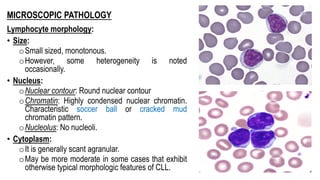
MICROSCOPIC PATHOLOGY
Lymphocyte morphology:
• Size:
oSmall sized, monotonous.
oHowever, some heterogeneity is noted
occasionally.
• Nucleus:
oNuclear contour: Round nuclear contour
oChromatin: Highly condensed nuclear chromatin.
Characteristic soccer ball or cracked mud
chromatin pattern.
oNucleolus: No nucleoli.
• Cytoplasm:
oIt is generally scant agranular.
oMay be more moderate in some cases that exhibit
otherwise typical morphologic features of CLL.
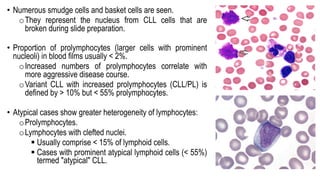
• Numerous smudge cells and basket cells are seen.
oThey represent the nucleus from CLL cells that are
broken during slide preparation.
• Proportion of prolymphocytes (larger cells with prominent
nucleoli) in blood films usually < 2%.
oIncreased numbers of prolymphocytes correlate with
more aggressive disease course.
oVariant CLL with increased prolymphocytes (CLL/PL) is
defined by > 10% but < 55% prolymphocytes.
• Atypical cases show greater heterogeneity of lymphocytes:
oProlymphocytes.
oLymphocytes with clefted nuclei.
§ Usually comprise < 15% of lymphoid cells.
§ Cases with prominent atypical lymphoid cells (< 55%)
termed "atypical" CLL.
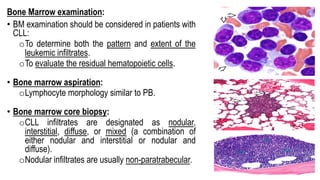
Bone Marrow examination:
• BM examination should be considered in patients with
CLL:
oTo determine both the pattern and extent of the
leukemic infiltrates.
oTo evaluate the residual hematopoietic cells.
• Bone marrow aspiration:
oLymphocyte morphology similar to PB.
• Bone marrow core biopsy:
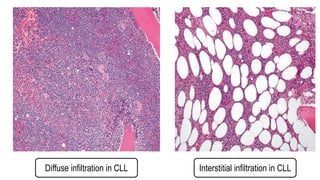
oCLL infiltrates are designated as nodular,
interstitial, diffuse, or mixed (a combination of
either nodular and interstitial or nodular and
diffuse).
oNodular infiltrates are usually non-paratrabecular.
Diffuse infiltration in CLL Interstitial infiltration in CLL
ANCILLARY STUDIES
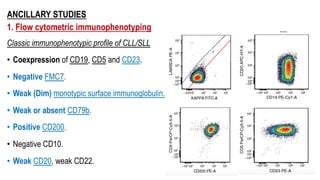
1. Flow cytometric immunophenotyping
Classic immunophenotypic profile of CLL/SLL
• Coexpression of CD19, CD5 and CD23.
• Negative FMC7.
• Weak (Dim) monotypic surface immunoglobulin..
• Weak or absent CD79b.
• Positive CD200.
• Negative CD10.
• Weak CD20, weak CD22.
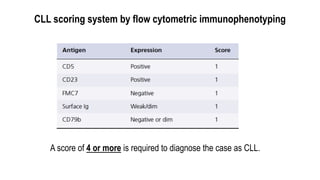
CLL scoring system by flow cytometric immunophenotyping
A score of 4 or more is required to diagnose the case as CLL.
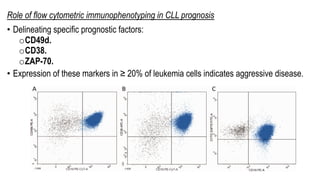
Role of flow cytometric immunophenotyping in CLL prognosis
• Delineating specific prognostic factors:
oCD49d.
oCD38.
oZAP-70.
• Expression of these markers in ≥ 20% of leukemia cells indicates aggressive disease.
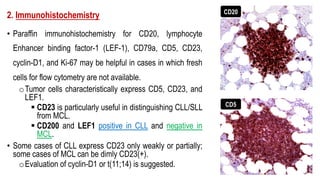
2. Immunohistochemistry
• Paraffin immunohistochemistry for CD20, lymphocyte
Enhancer binding factor-1 (LEF-1), CD79a, CD5, CD23,
cyclin-D1, and Ki-67 may be helpful in cases in which fresh
cells for flow cytometry are not available.
oTumor cells characteristically express CD5, CD23, and
LEF1.
§ CD23 is particularly useful in distinguishing CLL/SLL
from MCL.
§ CD200 and LEF1 positive in CLL and negative in
MCL.
• Some cases of CLL express CD23 only weakly or partially;
some cases of MCL can be dimly CD23(+).
oEvaluation of cyclin-D1 or t(11;14) is suggested.
CD20
CD5
3. Cytogenetic studies
• Essential in defining prognostic groups.
• Interphase FISH preferable to karyotyping due to low proliferation rate of CLL cells.
• Molecular testing may provide additional prognostic information.
• Acquired cytogenetic abnormalities seen in 80% of cases.
oNot sensitive or specific for diagnosis of CLL.
oCarry implications for disease behavior and prognosis.
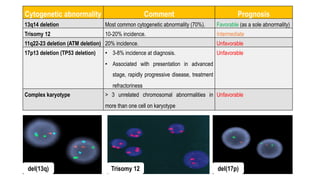
Cytogenetic abnormality Comment Prognosis
13q14 deletion Most common cytogenetic abnormality (70%). Favorable (as a sole abnormality)
Trisomy 12 10-20% incidence. Intermediate
11q22-23 deletion (ATM deletion) 20% incidence. Unfavorable
17p13 deletion (TP53 deletion) • 3-8% incidence at diagnosis.
• Associated with presentation in advanced
stage, rapidly progressive disease, treatment
refractoriness
Unfavorable
Complex karyotype > 3 unrelated chromosomal abnormalities in
more than one cell on karyotype
Unfavorable
del(13q) del(17p)
Trisomy 12
4. IGHV mutational status
• Somatic mutation of IGHV is a physiologic process:
oSomatic hypermutation in IGHV occurs after antigen exposure.
oIncreases B-cell affinity for antigen.
• Testing compares sequence of IGH variable region (patient sample) to the closest IGH
variable sequences in data base (normal cell lines). If > 2% nucleotide difference is
considered mutated CLL.
oMutated CLL:
§ More indolent behavior and better outcome.
oUnmutated CLL:
§ Greater likelihood of progression, treatment requirement, and shorter survival.
DISEASE TRANSFORMATION IN CLL
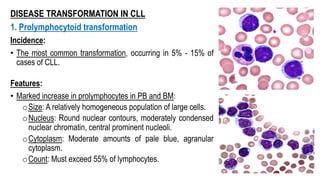
1. Prolymphocytoid transformation
Incidence:
• The most common transformation, occurring in 5% - 15% of
cases of CLL.
Features:
• Marked increase in prolymphocytes in PB and BM:
oSize: A relatively homogeneous population of large cells.
oNucleus: Round nuclear contours, moderately condensed
nuclear chromatin, central prominent nucleoli.
oCytoplasm: Moderate amounts of pale blue, agranular
cytoplasm.
oCount: Must exceed 55% of lymphocytes.
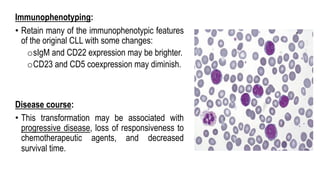
Immunophenotyping:
• Retain many of the immunophenotypic features
of the original CLL with some changes:
osIgM and CD22 expression may be brighter.
oCD23 and CD5 coexpression may diminish.
Disease course:
• This transformation may be associated with
progressive disease, loss of responsiveness to
chemotherapeutic agents, and decreased
survival time.
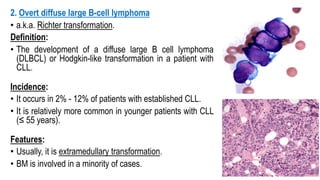
2. Overt diffuse large B-cell lymphoma
• a.k.a. Richter transformation.
Definition:
• The development of a diffuse large B cell lymphoma
(DLBCL) or Hodgkin-like transformation in a patient with
CLL.
Incidence:
• It occurs in 2% - 12% of patients with established CLL.
• It is relatively more common in younger patients with CLL
(≤ 55 years).
Features:
• Usually, it is extramedullary transformation.
• BM is involved in a minority of cases.
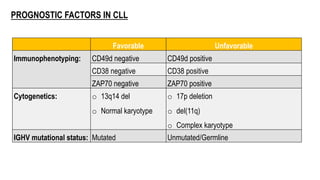
PROGNOSTIC FACTORS IN CLL
Favorable Unfavorable
Immunophenotyping: CD49d negative CD49d positive
CD38 negative CD38 positive
ZAP70 negative ZAP70 positive
Cytogenetics: o 13q14 del
o Normal karyotype
o 17p deletion
o del(11q)
o Complex karyotype
IGHV mutational status: Mutated Unmutated/Germline
CD5 positive B-cell neoplasms
Monoclonal B-cell
lymphocytosis (MBL) CLL/SLL
B-Prolymphocytic
leukemia (B-PLL)
Mantle cell
lymphoma (MCL)
B-cell prolymphocytic leukemia (B-PLL)
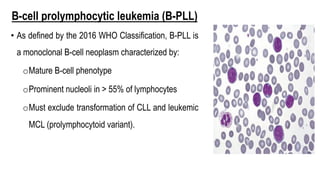
• As defined by the 2016 WHO Classification, B-PLL is
a monoclonal B-cell neoplasm characterized by:
oMature B-cell phenotype
oProminent nucleoli in > 55% of lymphocytes
oMust exclude transformation of CLL and leukemic
MCL (prolymphocytoid variant).
CLINICAL FEATURES
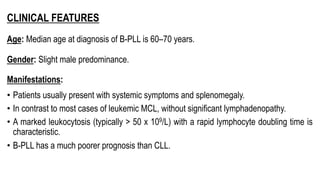
Age: Median age at diagnosis of B-PLL is 60–70 years.
Gender: Slight male predominance.
Manifestations:
• Patients usually present with systemic symptoms and splenomegaly.
• In contrast to most cases of leukemic MCL, without significant lymphadenopathy.
• A marked leukocytosis (typically > 50 x 109/L) with a rapid lymphocyte doubling time is
characteristic.
• B-PLL has a much poorer prognosis than CLL.
MICROSCOPIC PATHOLOGY
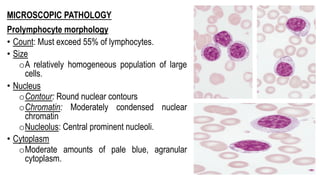
Prolymphocyte morphology
• Count: Must exceed 55% of lymphocytes.
• Size
oA relatively homogeneous population of large
cells.
• Nucleus
oContour: Round nuclear contours
oChromatin: Moderately condensed nuclear
chromatin
oNucleolus: Central prominent nucleoli.
• Cytoplasm
oModerate amounts of pale blue, agranular
cytoplasm.
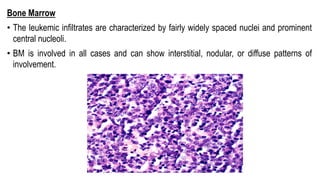
Bone Marrow
• The leukemic infiltrates are characterized by fairly widely spaced nuclei and prominent
central nucleoli.
• BM is involved in all cases and can show interstitial, nodular, or diffuse patterns of
involvement.
ANCILLARY STUDIES
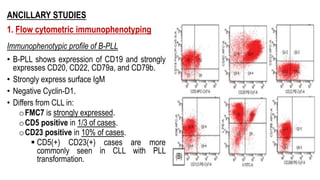
1. Flow cytometric immunophenotyping
Immunophenotypic profile of B-PLL
• B-PLL shows expression of CD19 and strongly
expresses CD20, CD22, CD79a, and CD79b.
• Strongly express surface IgM
• Negative Cyclin-D1.
• Differs from CLL in:
oFMC7 is strongly expressed.
oCD5 positive in 1/3 of cases.
oCD23 positive in 10% of cases.
§ CD5(+) CD23(+) cases are more
commonly seen in CLL with PLL
transformation.
3. Cytogenetic studies
• Cytogenetic and FISH analysis shows some genetic relationship with CLL:
odel(17p) is present in half the cases.
oTP53 mutations are frequent.
odel(13q) also is common.
• IGHV mutation status
oCan have mutated or unmutated immunoglobulin heavy chain variable region (IGHV).
oUnlike CLL, no clear association between IGHV mutation, ZAP70, or CD38
expression and prognosis.
§ This supports the separation of B-PLL from CLL advocated in the WHO
Classification system.
CD5 positive B-cell neoplasms
Monoclonal B-cell
lymphocytosis (MBL) CLL/SLL
B-Prolymphocytic
leukemia (B-PLL)
Mantle cell
lymphoma (MCL)
Mantle cell lymphoma (MCL)
• Mantle cell lymphoma is a systemic B-cell lymphoma that usually
presents with diffuse lymphadenopathy.
• It involves the bone marrow in nearly all cases at diagnosis, and
circulating lymphoma cells can be detected in the peripheral
smear and by flow cytometric immunophenotyping in most
patients.
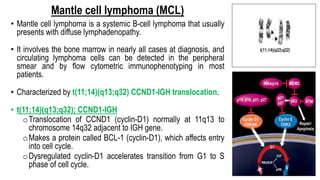
• Characterized by t(11;14)(q13;q32) CCND1-IGH translocation.
• t(11;14)(q13;q32); CCND1-IGH
oTranslocation of CCND1 (cyclin-D1) normally at 11q13 to
chromosome 14q32 adjacent to IGH gene.
oMakes a protein called BCL-1 (cyclin-D1), which affects entry
into cell cycle.
oDysregulated cyclin-D1 accelerates transition from G1 to S
phase of cell cycle.
CLINICAL FEATURES
Age: Median age at diagnosis of MCL is 60 years (Age range: 30 – 80 years).
Gender: Male predominance.
Manifestations:
• About 25% of patients have peripheral lymphocytosis (> 5 x 10⁹/L)
• Leukemic presentation with marked leukocytosis that may mimic an acute leukemia.
oSuch patients usually present with symptoms related to splenomegaly and/or cytopenias.
Unlike in CLL, incidental discovery of leukemic MCL on a routine blood count evaluation is
rare.
• Leukemic non-nodal MCL:
oA specific disease variant in the 2016 WHO Classification.
oRefers to patients presenting with blood and BM involvement, but without significant
lymphadenopathy.
oPatients with this variant of disease appear to have a better prognosis compared to patients
with classic MCL, often manifesting a stable disease for many years
MICROSCOPIC PATHOLOGY
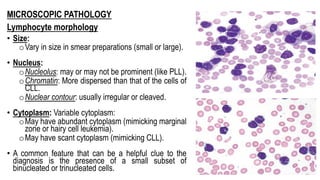
Lymphocyte morphology
• Size:
oVary in size in smear preparations (small or large).
• Nucleus:
oNucleolus: may or may not be prominent (like PLL).
oChromatin: More dispersed than that of the cells of
CLL.
oNuclear contour: usually irregular or cleaved.
• Cytoplasm: Variable cytoplasm:
oMay have abundant cytoplasm (mimicking marginal
zone or hairy cell leukemia).
oMay have scant cytoplasm (mimicking CLL).
• A common feature that can be a helpful clue to the
diagnosis is the presence of a small subset of
binucleated or trinucleated cells.
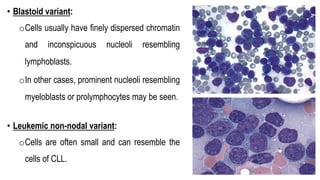
• Blastoid variant:
oCells usually have finely dispersed chromatin
and inconspicuous nucleoli resembling
lymphoblasts.
oIn other cases, prominent nucleoli resembling
myeloblasts or prolymphocytes may be seen.
• Leukemic non-nodal variant:
oCells are often small and can resemble the
cells of CLL.
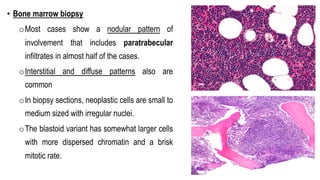
• Bone marrow biopsy
oMost cases show a nodular pattern of
involvement that includes paratrabecular
infiltrates in almost half of the cases.
oInterstitial and diffuse patterns also are
common
oIn biopsy sections, neoplastic cells are small to
medium sized with irregular nuclei.
oThe blastoid variant has somewhat larger cells
with more dispersed chromatin and a brisk
mitotic rate.
ANCILLARY STUDIES
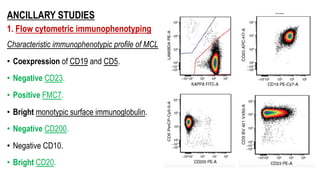
1. Flow cytometric immunophenotyping
Characteristic immunophenotypic profile of MCL
• Coexpression of CD19 and CD5.
• Negative CD23.
• Positive FMC7.
• Bright monotypic surface immunoglobulin.
• Negative CD200.
• Negative CD10.
• Bright CD20.
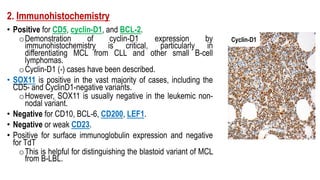
2. Immunohistochemistry
• Positive for CD5, cyclin-D1, and BCL-2.
oDemonstration of cyclin-D1 expression by
immunohistochemistry is critical, particularly in
differentiating MCL from CLL and other small B-cell
lymphomas.
oCyclin-D1 (-) cases have been described.
• SOX11 is positive in the vast majority of cases, including the
CD5- and CyclinD1-negative variants.
oHowever, SOX11 is usually negative in the leukemic non-
nodal variant.
• Negative for CD10, BCL-6, CD200, LEF1.
• Negative or weak CD23.
• Positive for surface immunoglobulin expression and negative
for TdT
oThis is helpful for distinguishing the blastoid variant of MCL
from B-LBL.
Cyclin-D1
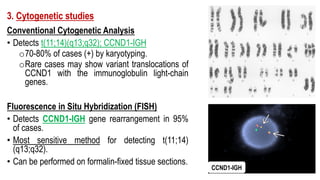
3. Cytogenetic studies
Conventional Cytogenetic Analysis
• Detects t(11;14)(q13;q32); CCND1-IGH
o70-80% of cases (+) by karyotyping.
oRare cases may show variant translocations of
CCND1 with the immunoglobulin light-chain
genes.
Fluorescence in Situ Hybridization (FISH)
• Detects CCND1-IGH gene rearrangement in 95%
of cases.
• Most sensitive method for detecting t(11;14)
(q13;q32).
• Can be performed on formalin-fixed tissue sections.
CCND1-IGH
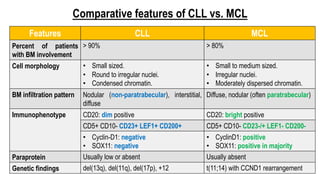
Comparative features of CLL vs. MCL
Features CLL MCL
Percent of patients
with BM involvement
> 90% > 80%
Cell morphology • Small sized.
• Round to irregular nuclei.
• Condensed chromatin.
• Small to medium sized.
• Irregular nuclei.
• Moderately dispersed chromatin.
BM infiltration pattern Nodular (non-paratrabecular), interstitial,
diffuse
Diffuse, nodular (often paratrabecular)
Immunophenotype CD20: dim positive CD20: bright positive
CD5+ CD10- CD23+ LEF1+ CD200+ CD5+ CD10- CD23-/+ LEF1- CD200-
• Cyclin-D1: negative
• SOX11: negative
• CyclinD1: positive
• SOX11: positive in majority
Paraprotein Usually low or absent Usually absent
Genetic findings del(13q), del(11q), del(17p), +12 t(11;14) with CCND1 rearrangement
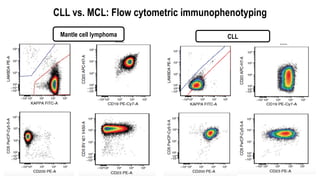
Mantle cell lymphoma CLL
CLL vs. MCL: Flow cytometric immunophenotyping
CD10 Positive B-cell Neoplasms
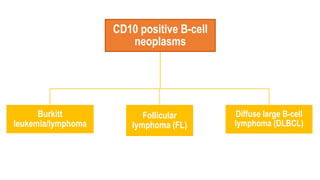
CD10 positive B-cell
neoplasms
Burkitt
leukemia/lymphoma
Follicular
lymphoma (FL)
Diffuse large B-cell
lymphoma (DLBCL)
CD10 positive B-cell
neoplasms
Burkitt
leukemia/lymphoma
Follicular
lymphoma (FL)
Diffuse large B-cell
lymphoma (DLBCL)
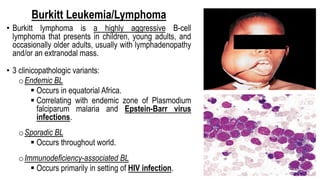
Burkitt Leukemia/Lymphoma
• Burkitt lymphoma is a highly aggressive B-cell
lymphoma that presents in children, young adults, and
occasionally older adults, usually with lymphadenopathy
and/or an extranodal mass.
• 3 clinicopathologic variants:
oEndemic BL
§ Occurs in equatorial Africa.
§ Correlating with endemic zone of Plasmodium
falciparum malaria and Epstein-Barr virus
infections.
oSporadic BL
§ Occurs throughout world.
oImmunodeficiency-associated BL
§ Occurs primarily in setting of HIV infection.
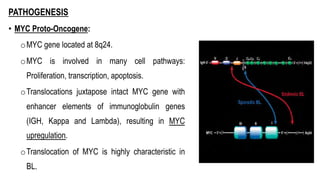
PATHOGENESIS
• MYC Proto-Oncogene:
oMYC gene located at 8q24.
oMYC is involved in many cell pathways:
Proliferation, transcription, apoptosis.
oTranslocations juxtapose intact MYC gene with
enhancer elements of immunoglobulin genes
(IGH, Kappa and Lambda), resulting in MYC
upregulation.
oTranslocation of MYC is highly characteristic in
BL.
CLINICAL FEATURES
Age
• Endemic BL: Peak incidence between 4-7 years.
• Sporadic BL:
oPredominantly children and young adults.
oMedian age for adults is 30 years.
• Immunodeficiency associated BL: Primarily adults.
Gender: Male predominance.
Clinical presentation
• 2/3 of patients present with advanced-stage disease with rapidly growing bulky disease of
only few weeks duration.
• Endemic BL
oJaw/facial bone mass is most frequent presentation.
• Sporadic BL
oAbdominal mass is most common presentation due to Ileum or cecum involvement.
oRetroperitoneal mass or lymphadenopathy can be seen.
• Immunodeficiency-associated BL
oCommonly manifests as leukemia with blood and BM involvement.
oHigh incidence of CNS involvement.
• Lymphoma cell doubling time is 24-26 hours, and tumor size may double within 1 day.
oPatients die of disease within weeks if left untreated.
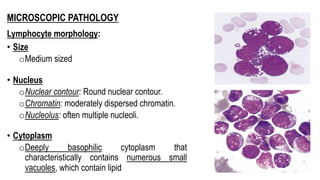
MICROSCOPIC PATHOLOGY
Lymphocyte morphology:
• Size
oMedium sized
• Nucleus
oNuclear contour: Round nuclear contour.
oChromatin: moderately dispersed chromatin.
oNucleolus: often multiple nucleoli.
• Cytoplasm
oDeeply basophilic cytoplasm that
characteristically contains numerous small
vacuoles, which contain lipid
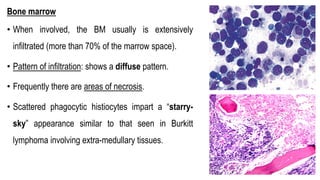
Bone marrow
• When involved, the BM usually is extensively
infiltrated (more than 70% of the marrow space).
• Pattern of infiltration: shows a diffuse pattern.
• Frequently there are areas of necrosis.
• Scattered phagocytic histiocytes impart a “starry-
sky” appearance similar to that seen in Burkitt
lymphoma involving extra-medullary tissues.
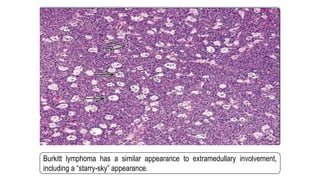
Burkitt lymphoma has a similar appearance to extramedullary involvement,
including a “starry-sky” appearance.
ANCILLARY STUDIES
1. Flow cytometric immunophenotyping
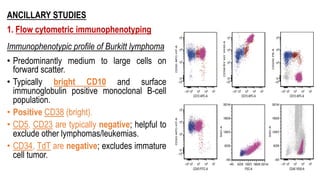
Immunophenotypic profile of Burkitt lymphoma
• Predominantly medium to large cells on
forward scatter.
• Typically bright CD10 and surface
immunoglobulin positive monoclonal B-cell
population.
• Positive CD38 (bright).
• CD5, CD23 are typically negative; helpful to
exclude other lymphomas/leukemias.
• CD34, TdT are negative; excludes immature
cell tumor.
2. Immunohistochemistry
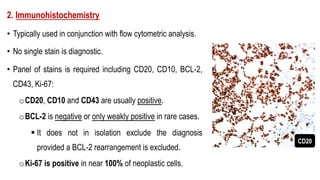
• Typically used in conjunction with flow cytometric analysis.
• No single stain is diagnostic.
• Panel of stains is required including CD20, CD10, BCL-2,
CD43, Ki-67:
oCD20, CD10 and CD43 are usually positive.
oBCL-2 is negative or only weakly positive in rare cases.
§ It does not in isolation exclude the diagnosis
provided a BCL-2 rearrangement is excluded.
oKi-67 is positive in near 100% of neoplastic cells.
CD20
3. Cytogenetic studies
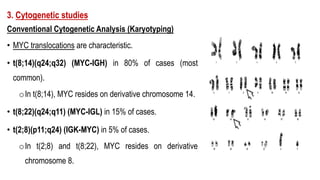
Conventional Cytogenetic Analysis (Karyotyping)
• MYC translocations are characteristic.
• t(8;14)(q24;q32) (MYC-IGH) in 80% of cases (most
common).
oIn t(8;14), MYC resides on derivative chromosome 14.
• t(8;22)(q24;q11) (MYC-IGL) in 15% of cases.
• t(2;8)(p11;q24) (IGK-MYC) in 5% of cases.
oIn t(2;8) and t(8;22), MYC resides on derivative
chromosome 8.
Fluorescence in Situ Hybridization (FISH)
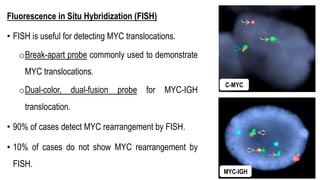
• FISH is useful for detecting MYC translocations.
oBreak-apart probe commonly used to demonstrate
MYC translocations.
oDual-color, dual-fusion probe for MYC-IGH
translocation.
• 90% of cases detect MYC rearrangement by FISH.
• 10% of cases do not show MYC rearrangement by
FISH.
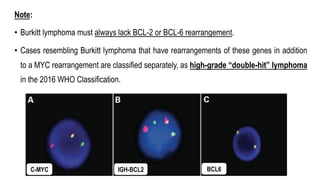
C-MYC
MYC-IGH
Note:
• Burkitt lymphoma must always lack BCL-2 or BCL-6 rearrangement.
• Cases resembling Burkitt lymphoma that have rearrangements of these genes in addition
to a MYC rearrangement are classified separately, as high-grade “double-hit” lymphoma
in the 2016 WHO Classification.
C-MYC IGH-BCL2 BCL6
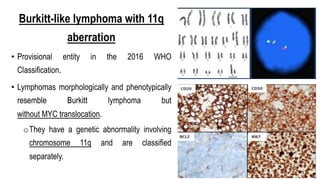
Burkitt-like lymphoma with 11q
aberration
• Provisional entity in the 2016 WHO
Classification.
• Lymphomas morphologically and phenotypically
resemble Burkitt lymphoma but
without MYC translocation.
oThey have a genetic abnormality involving
chromosome 11q and are classified
separately.
CD10 positive B-cell
neoplasms
Burkitt
leukemia/lymphoma
Follicular
lymphoma (FL)
Diffuse large B-cell
lymphoma (DLBCL)
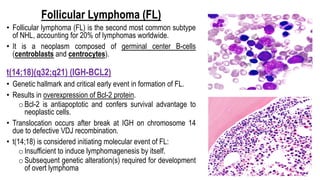
Follicular Lymphoma (FL)
• Follicular lymphoma (FL) is the second most common subtype
of NHL, accounting for 20% of lymphomas worldwide.
• It is a neoplasm composed of germinal center B-cells
(centroblasts and centrocytes).
t(14;18)(q32;q21) (IGH-BCL2)
• Genetic hallmark and critical early event in formation of FL.
• Results in overexpression of Bcl-2 protein.
oBcl-2 is antiapoptotic and confers survival advantage to
neoplastic cells.
• Translocation occurs after break at IGH on chromosome 14
due to defective VDJ recombination.
• t(14;18) is considered initiating molecular event of FL:
oInsufficient to induce lymphomagenesis by itself.
oSubsequent genetic alteration(s) required for development
of overt lymphoma
CLINICAL FEATURES
Age: Median age at diagnosis of FL is 60 years.
Manifestations
• Often presents with diffuse lymphadenopathy ± organomegaly.
• Rare cases of follicular lymphoma may present as leukemia with a high WBC count, clinically
mimicking CLL.
oThese patients almost always have concurrent splenomegaly and generalized
lymphadenopathy.
Disease course
• FL typically follows indolent clinical course; some cases may progress rapidly with relapses and
shorter survival.
• FL can transform to DLBCL, aggressive B-cell lymphoma, unclassifiable, or Burkitt lymphoma.
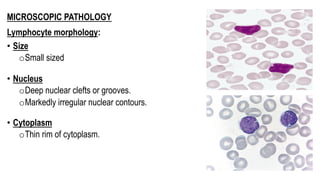
MICROSCOPIC PATHOLOGY
Lymphocyte morphology:
• Size
oSmall sized
• Nucleus
oDeep nuclear clefts or grooves.
oMarkedly irregular nuclear contours.
• Cytoplasm
oThin rim of cytoplasm.
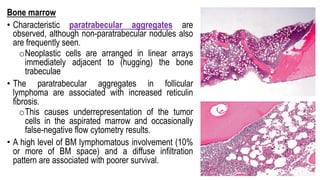
Bone marrow
• Characteristic paratrabecular aggregates are
observed, although non-paratrabecular nodules also
are frequently seen.
oNeoplastic cells are arranged in linear arrays
immediately adjacent to (hugging) the bone
trabeculae
• The paratrabecular aggregates in follicular
lymphoma are associated with increased reticulin
fibrosis.
oThis causes underrepresentation of the tumor
cells in the aspirated marrow and occasionally
false-negative flow cytometry results.
• A high level of BM lymphomatous involvement (10%
or more of BM space) and a diffuse infiltration
pattern are associated with poorer survival.
ANCILLARY STUDIES
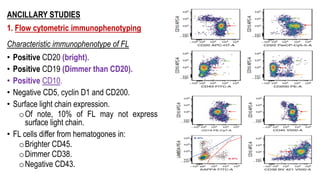
1. Flow cytometric immunophenotyping
Characteristic immunophenotype of FL
• Positive CD20 (bright).
• Positive CD19 (Dimmer than CD20).
• Positive CD10.
• Negative CD5, cyclin D1 and CD200.
• Surface light chain expression.
oOf note, 10% of FL may not express
surface light chain.
• FL cells differ from hematogones in:
oBrighter CD45.
oDimmer CD38.
oNegative CD43.
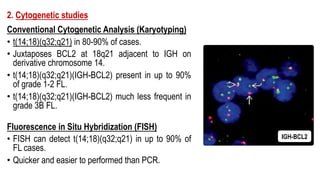
2. Cytogenetic studies
Conventional Cytogenetic Analysis (Karyotyping)
• t(14;18)(q32;q21) in 80-90% of cases.
• Juxtaposes BCL2 at 18q21 adjacent to IGH on
derivative chromosome 14.
• t(14;18)(q32;q21)(IGH-BCL2) present in up to 90%
of grade 1-2 FL.
• t(14;18)(q32;q21)(IGH-BCL2) much less frequent in
grade 3B FL.
Fluorescence in Situ Hybridization (FISH)
• FISH can detect t(14;18)(q32;q21) in up to 90% of
FL cases.
• Quicker and easier to performed than PCR.
IGH-BCL2
CD10 positive B-cell
neoplasms
Burkitt
leukemia/lymphoma
Follicular
lymphoma (FL)
Diffuse large B-cell
lymphoma (DLBCL)
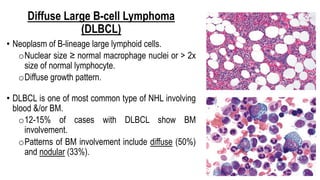
Diffuse Large B-cell Lymphoma
(DLBCL)
• Neoplasm of B-lineage large lymphoid cells.
oNuclear size ≥ normal macrophage nuclei or > 2x
size of normal lymphocyte.
oDiffuse growth pattern.
• DLBCL is one of most common type of NHL involving
blood &/or BM.
o12-15% of cases with DLBCL show BM
involvement.
oPatterns of BM involvement include diffuse (50%)
and nodular (33%).
• Common WHO subtype of DLBCL with higher incidence of blood &/or BM
involvement:
oDLBCL, not otherwise specified (NOS).
• Other WHO subtypes of LBCL with high incidence of blood &/or BM involvement:
oT-cell/histiocyte-rich LBCL.
oEBV-positive DLBCL, NOS.
oIntravascular LBCL.
oHHV8-positive DLBCL.
oHigh-grade B-cell lymphoma, NOS.
oHigh-grade B-cell lymphoma with MYC and BCL-2 &/or BCL-6.
CLINICAL FEATURES
Age: DLBCL is more common in elderly.
Clinical Presentation
• Nodal or extranodal disease.
• Initial presentation at extranodal sites in up to 40% of cases.
oGastrointestinal tract is most common site.
oOther sites include spleen, Waldeyer ring, salivary gland, testis, thyroid, liver, bone,
kidney, and adrenal gland.
oBone marrow involvement by DLBCL in 12-15% of cases.
MICROSCOPIC PATHOLOGY
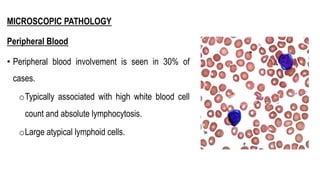
Peripheral Blood
• Peripheral blood involvement is seen in 30% of
cases.
oTypically associated with high white blood cell
count and absolute lymphocytosis.
oLarge atypical lymphoid cells.
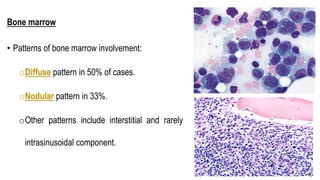
Bone marrow
• Patterns of bone marrow involvement:
oDiffuse pattern in 50% of cases.
oNodular pattern in 33%.
oOther patterns include interstitial and rarely
intrasinusoidal component.
ANCILLARY STUDIES
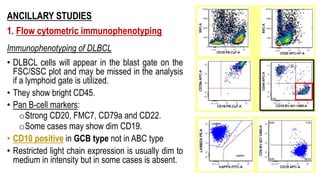
1. Flow cytometric immunophenotyping
Immunophenotyping of DLBCL
• DLBCL cells will appear in the blast gate on the
FSC/SSC plot and may be missed in the analysis
if a lymphoid gate is utilized.
• They show bright CD45.
• Pan B-cell markers:
oStrong CD20, FMC7, CD79a and CD22.
oSome cases may show dim CD19.
• CD10 positive in GCB type not in ABC type
• Restricted light chain expression is usually dim to
medium in intensity but in some cases is absent.
2. Immunohistochemistry
• Expression of B-cell-associated antigens including CD20, CD79a, PAX-5.
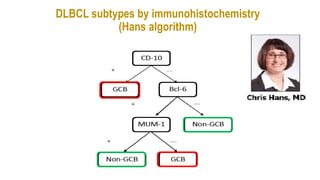
• Expression of CD10, BCL-6 and MUM1 can help in subclassifying DLBCL into GCB
and non-GCB types.
• BCL-2 coexpression in subset.
• Expression of MYC (in > 40% of neoplastic cells) in subset.
• Increased proliferation rate with typically > 50% rate of Ki-67 positivity.
Double expressor lymphoma
oAssociated with poorer prognosis.
oExpression of MYC and BCL-2 by immunohistochemistry.
oPrognosis better than double-hit lymphoma.
DLBCL subtypes by immunohistochemistry
(Hans algorithm)
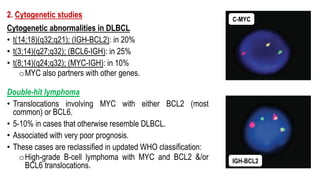
2. Cytogenetic studies
Cytogenetic abnormalities in DLBCL
• t(14;18)(q32;q21); (IGH-BCL2): in 20%
• t(3;14)(q27;q32); (BCL6-IGH): in 25%
• t(8;14)(q24;q32); (MYC-IGH): in 10%
oMYC also partners with other genes.
Double-hit lymphoma
• Translocations involving MYC with either BCL2 (most
common) or BCL6.
• 5-10% in cases that otherwise resemble DLBCL.
• Associated with very poor prognosis.
• These cases are reclassified in updated WHO classification:
oHigh-grade B-cell lymphoma with MYC and BCL2 &/or
BCL6 translocations.
BCL2-IGH
C-MYC
IGH-BCL2
3. Gene Expression Profiling (GEP)
• Expression microarray studies have established 2 major groups of DLBCL
oGerminal center B-cell (GCB)
§ Gene expression profile similar to GC B-cells.
oActivated B-cell (ABC) (Non-GCB)
§ Gene expression profile similar to activated B-cells.
• GCB-DLBCL is associated with better prognosis than Non-GCB / ABC-DLBCL when
patients treated with R-CHOP therapy.
CD5 negative CD10 negative B-cell Neoplasms
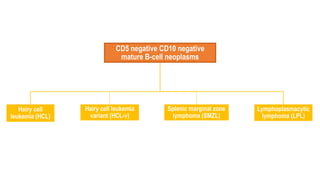
CD5 negative CD10 negative
mature B-cell neoplasms
Hairy cell
leukemia (HCL)
Hairy cell leukemia
variant (HCL-v)
Splenic marginal zone
lymphoma (SMZL)
Lymphoplasmacytic
lymphoma (LPL)
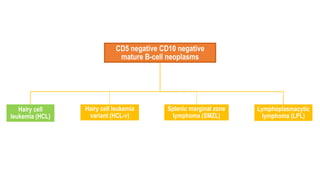
CD5 negative CD10 negative
mature B-cell neoplasms
Hairy cell
leukemia (HCL)
Hairy cell leukemia
variant (HCL-v)
Splenic marginal zone
lymphoma (SMZL)
Lymphoplasmacytic
lymphoma (LPL)
Hairy cell leukemia (HCL)
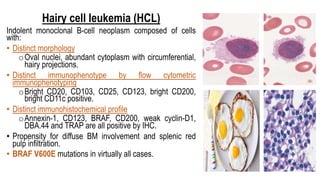
Indolent monoclonal B-cell neoplasm composed of cells
with:
• Distinct morphology
oOval nuclei, abundant cytoplasm with circumferential,
hairy projections.
• Distinct immunophenotype by flow cytometric
immunophenotyping
oBright CD20, CD103, CD25, CD123, bright CD200,
bright CD11c positive.
• Distinct immunohistochemical profile
oAnnexin-1, CD123, BRAF, CD200, weak cyclin-D1,
DBA.44 and TRAP are all positive by IHC.
• Propensity for diffuse BM involvement and splenic red
pulp infiltration.
• BRAF V600E mutations in virtually all cases.
CLINICAL FEATURES
Age: Median age at diagnosis of HCL is 50 years.
Gender: Marked male predominance (M:F ratio= 4:1).
Manifestations
• Patients with HCL present most often with symptoms related to one or more cytopenias, such as
infections, weakness, or fatigue.
• Unlike most other B-cell lymphomas, HCL is characterized by leukopenic rather than a leukemic
presentation.
o Presence of marked leukocytosis with numerous circulating neoplastic cells tends to suggest hairy
cell variant (HCLv) or another lymphoma subtype.
• Monocytopenia is present in almost all cases at diagnosis and can be a helpful clue in suggesting a
diagnosis of HCL in a cytopenic patient. Diagnosis of HCL would be very unusual in a patient with a
normal monocyte count.
• Palpable splenomegaly is present in most patients at diagnosis.
• Peripheral lymphadenopathy is uncommon, in contrast to many other mature B-cell leukemias.
MICROSCOPIC PATHOLOGY
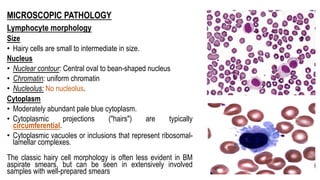
Lymphocyte morphology
Size
• Hairy cells are small to intermediate in size.
Nucleus
• Nuclear contour: Central oval to bean-shaped nucleus
• Chromatin: uniform chromatin
• Nucleolus: No nucleolus.
Cytoplasm
• Moderately abundant pale blue cytoplasm.
• Cytoplasmic projections ("hairs") are typically
circumferential.
• Cytoplasmic vacuoles or inclusions that represent ribosomal-
lamellar complexes.
The classic hairy cell morphology is often less evident in BM
aspirate smears, but can be seen in extensively involved
samples with well-prepared smears
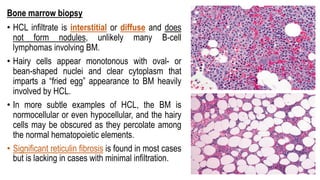
Bone marrow biopsy
• HCL infiltrate is interstitial or diffuse and does
not form nodules, unlikely many B-cell
lymphomas involving BM.
• Hairy cells appear monotonous with oval- or
bean-shaped nuclei and clear cytoplasm that
imparts a “fried egg” appearance to BM heavily
involved by HCL.
• In more subtle examples of HCL, the BM is
normocellular or even hypocellular, and the hairy
cells may be obscured as they percolate among
the normal hematopoietic elements.
• Significant reticulin fibrosis is found in most cases
but is lacking in cases with minimal infiltration.
ANCILLARY STUDIES
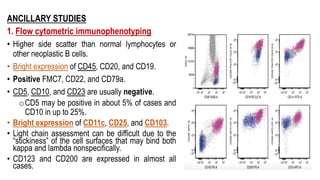
1. Flow cytometric immunophenotyping
• Higher side scatter than normal lymphocytes or
other neoplastic B cells.
• Bright expression of CD45, CD20, and CD19.
• Positive FMC7, CD22, and CD79a.
• CD5, CD10, and CD23 are usually negative.
oCD5 may be positive in about 5% of cases and
CD10 in up to 25%.
• Bright expression of CD11c, CD25, and CD103.
• Light chain assessment can be difficult due to the
“stickiness” of the cell surfaces that may bind both
kappa and lambda nonspecifically.
• CD123 and CD200 are expressed in almost all
cases.
2. Immunohistochemistry
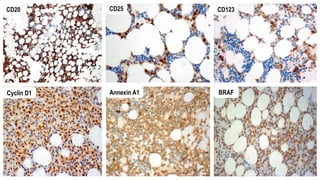
• Panel of immunohistochemical stains provides high diagnostic sensitivity and specificity
for HCL:
oCD25, CD11c, Annexin-A1, CD123, CD200, CD103, BRAF, and DBA.44 all useful.
• HCL cells express CD25, CD123, CD11c, and Annexin A1 by immunohistochemistry.
oSome of these antigens also are expressed in other marrow cells (such as Annexin
A1 positivity in neutrophils).
• DBA.44 stains hairy cells in BM trephine sections
oHowever, it may not stain all the neoplastic cells, and it is expressed in other
lymphomas, as SMZL.
• Cyclin D1 is weakly expressed in most cases but lacks any associated CCND1
rearrangement in HCL.
CD20 CD25 CD123
Cyclin D1 Annexin A1 BRAF
3. Cytochemistry
Tartrate Resistant Acid Phosphatase (TRAP)
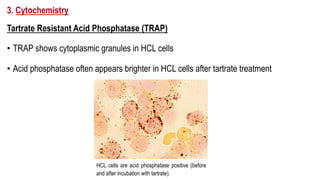
• TRAP shows cytoplasmic granules in HCL cells
• Acid phosphatase often appears brighter in HCL cells after tartrate treatment
HCL cells are acid phosphatase positive (before
and after incubation with tartrate).
4. Genetic studies
• Routine cytogenetic analysis of HCL is generally not
indicated, and no prognostic cytogenetic markers have
been identified.
• Despite Cyclin-D1 expression in most HCL cases,
translocations involving the CCND1 locus do not occur
in HCL.
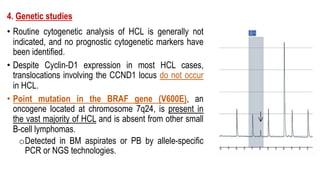
• Point mutation in the BRAF gene (V600E), an
oncogene located at chromosome 7q24, is present in
the vast majority of HCL and is absent from other small
B-cell lymphomas.
oDetected in BM aspirates or PB by allele-specific
PCR or NGS technologies.
BCL2-IGH
C-MYC
IGH-BCL2
CD5 negative CD10 negative
mature B-cell neoplasms
Hairy cell
leukemia (HCL)
Hairy cell leukemia
variant (HCL-v)
Splenic marginal zone
lymphoma (SMZL)
Lymphoplasmacytic
lymphoma (LPL)
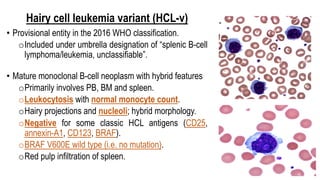
Hairy cell leukemia variant (HCL-v)
• Provisional entity in the 2016 WHO classification.
oIncluded under umbrella designation of “splenic B-cell
lymphoma/leukemia, unclassifiable”.
• Mature monoclonal B-cell neoplasm with hybrid features
oPrimarily involves PB, BM and spleen.
oLeukocytosis with normal monocyte count.
oHairy projections and nucleoli; hybrid morphology.
oNegative for some classic HCL antigens (CD25,
annexin-A1, CD123, BRAF).
oBRAF V600E wild type (i.e. no mutation).
oRed pulp infiltration of spleen.
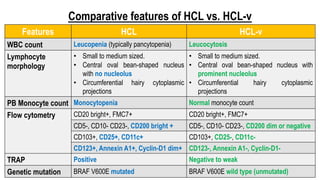
Comparative features of HCL vs. HCL-v
Features HCL HCL-v
WBC count Leucopenia (typically pancytopenia) Leucocytosis
Lymphocyte
morphology
• Small to medium sized.
• Central oval bean-shaped nucleus
with no nucleolus
• Circumferential hairy cytoplasmic
projections
• Small to medium sized.
• Central oval bean-shaped nucleus with
prominent nucleolus
• Circumferential hairy cytoplasmic
projections
PB Monocyte count Monocytopenia Normal monocyte count
Flow cytometry CD20 bright+, FMC7+ CD20 bright+, FMC7+
CD5-, CD10- CD23-, CD200 bright + CD5-, CD10- CD23-, CD200 dim or negative
CD103+, CD25+, CD11c+ CD103+, CD25-, CD11c-
CD123+, Annexin A1+, Cyclin-D1 dim+ CD123-, Annexin A1-, Cyclin-D1-
TRAP Positive Negative to weak
Genetic mutation BRAF V600E mutated BRAF V600E wild type (unmutated)
CD5 negative CD10 negative
mature B-cell neoplasms
Hairy cell
leukemia (HCL)
Hairy cell leukemia
variant (HCL-v)
Splenic marginal zone
lymphoma (SMZL)
Lymphoplasmacytic
lymphoma (LPL)
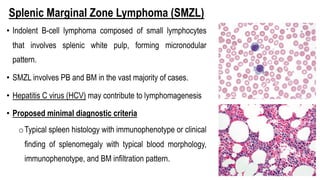
Splenic Marginal Zone Lymphoma (SMZL)
• Indolent B-cell lymphoma composed of small lymphocytes
that involves splenic white pulp, forming micronodular
pattern.
• SMZL involves PB and BM in the vast majority of cases.
• Hepatitis C virus (HCV) may contribute to lymphomagenesis
• Proposed minimal diagnostic criteria
oTypical spleen histology with immunophenotype or clinical
finding of splenomegaly with typical blood morphology,
immunophenotype, and BM infiltration pattern.
CLINICAL FEATURES
Age: Median age at diagnosis of SMZL is 68 years.
Gender: No gender predominance.
Manifestations
• Patients usually present with huge splenomegaly and lymphocytosis.
oMost patients have absolute lymphocytosis, and rare patients may present with
lymphocytosis before the development of splenomegaly.
oEven in patients lacking lymphocytosis at presentation, neoplastic cells usually can be
identified on the peripheral smear and/or detected by flow cytometry.
• Patients often present with other cytopenias due to hypersplenism and/or BM infiltration.
• Up to 25% have lymphadenopathy, but this usually is localized to the abdomen.
Peripheral lymphadenopathy at presentation is rare.
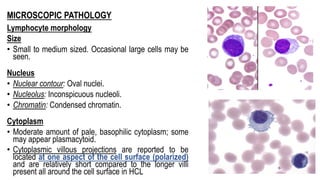
MICROSCOPIC PATHOLOGY
Lymphocyte morphology
Size
• Small to medium sized. Occasional large cells may be
seen.
Nucleus
• Nuclear contour: Oval nuclei.
• Nucleolus: Inconspicuous nucleoli.
• Chromatin: Condensed chromatin.
Cytoplasm
• Moderate amount of pale, basophilic cytoplasm; some
may appear plasmacytoid.
• Cytoplasmic villous projections are reported to be
located at one aspect of the cell surface (polarized)
and are relatively short compared to the longer villi
present all around the cell surface in HCL
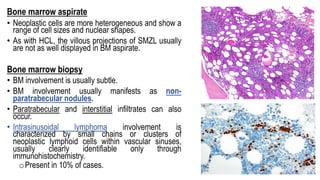
Bone marrow aspirate
• Neoplastic cells are more heterogeneous and show a
range of cell sizes and nuclear shapes.
• As with HCL, the villous projections of SMZL usually
are not as well displayed in BM aspirate.
Bone marrow biopsy
• BM involvement is usually subtle.
• BM involvement usually manifests as non-
paratrabecular nodules.
• Paratrabecular and interstitial infiltrates can also
occur.
• Intrasinusoidal lymphoma involvement is
characterized by small chains or clusters of
neoplastic lymphoid cells within vascular sinuses,
usually clearly identifiable only through
immunohistochemistry.
oPresent in 10% of cases.
ANCILLARY STUDIES
1. Flow cytometric immunophenotyping
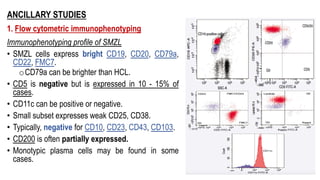
Immunophenotyping profile of SMZL
• SMZL cells express bright CD19, CD20, CD79a,
CD22, FMC7.
oCD79a can be brighter than HCL.
• CD5 is negative but is expressed in 10 - 15% of
cases.
• CD11c can be positive or negative.
• Small subset expresses weak CD25, CD38.
• Typically, negative for CD10, CD23, CD43, CD103.
• CD200 is often partially expressed.
• Monotypic plasma cells may be found in some
cases.
2. Cytogenetic studies
• There are no specific cytogenetic findings in SMZL.
• Of note, about one-third of cases show deletion of 7q, which is not frequently found in
other lymphoma subtypes
• A smaller number have a t(2;7)(p12;q21).
• No BCL2 or CCND1 rearrangements.
BCL2-IGH
C-MYC
IGH-BCL2
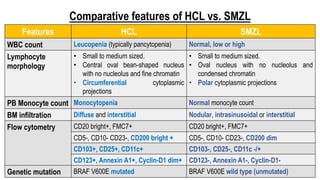
Comparative features of HCL vs. SMZL
Features HCL SMZL
WBC count Leucopenia (typically pancytopenia) Normal, low or high
Lymphocyte
morphology
• Small to medium sized.
• Central oval bean-shaped nucleus
with no nucleolus and fine chromatin
• Circumferential cytoplasmic
projections
• Small to medium sized.
• Oval nucleus with no nucleolus and
condensed chromatin
• Polar cytoplasmic projections
PB Monocyte count Monocytopenia Normal monocyte count
BM infiltration Diffuse and interstitial Nodular, intrasinusoidal or interstitial
Flow cytometry CD20 bright+, FMC7+ CD20 bright+, FMC7+
CD5-, CD10- CD23-, CD200 bright + CD5-, CD10- CD23-, CD200 dim
CD103+, CD25+, CD11c+ CD103-, CD25-, CD11c -/+
CD123+, Annexin A1+, Cyclin-D1 dim+ CD123-, Annexin A1-, Cyclin-D1-
Genetic mutation BRAF V600E mutated BRAF V600E wild type (unmutated)
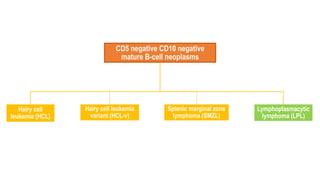
CD5 negative CD10 negative
mature B-cell neoplasms
Hairy cell
leukemia (HCL)
Hairy cell leukemia
variant (HCL-v)
Splenic marginal zone
lymphoma (SMZL)
Lymphoplasmacytic
lymphoma (LPL)
Lymphoplasmacytic Lymphoma (LPL)
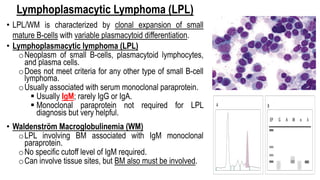
• LPL/WM is characterized by clonal expansion of small
mature B-cells with variable plasmacytoid differentiation.
• Lymphoplasmacytic lymphoma (LPL)
oNeoplasm of small B-cells, plasmacytoid lymphocytes,
and plasma cells.
oDoes not meet criteria for any other type of small B-cell
lymphoma.
oUsually associated with serum monoclonal paraprotein.
§ Usually IgM; rarely IgG or IgA.
§ Monoclonal paraprotein not required for LPL
diagnosis but very helpful.
• Waldenström Macroglobulinemia (WM)
oLPL involving BM associated with IgM monoclonal
paraprotein.
oNo specific cutoff level of IgM required.
oCan involve tissue sites, but BM also must be involved.
CLINICAL FEATURES
Age: Mean age at diagnosis of LPL is > 70 years.
Gender: Male predominance.
Manifestations
• Most patients present with symptoms related to BM infiltration as anemia or infections.
• There is almost always serum M protein, usually IgM and rarely IgG or other
immunoglobulin subtypes.
• Patients who present with the hyperviscosity picture of Waldenström macroglobulinemia
have a particularly high serum IgM level.
oOronasal bleeding, visual disturbance due to retinal bleeding.
oHeadache, neurologic changes, and cardiac failure.
• Some cases may be associated with hepatitis C infection,
• Up to 30% of patients have lymphadenopathy and/or splenomegaly.
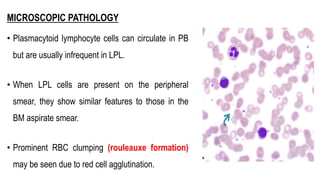
MICROSCOPIC PATHOLOGY
• Plasmacytoid lymphocyte cells can circulate in PB
but are usually infrequent in LPL.
• When LPL cells are present on the peripheral
smear, they show similar features to those in the
BM aspirate smear.
• Prominent RBC clumping (rouleauxe formation)
may be seen due to red cell agglutination.
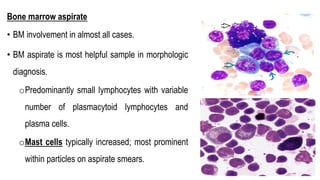
Bone marrow aspirate
• BM involvement in almost all cases.
• BM aspirate is most helpful sample in morphologic
diagnosis.
oPredominantly small lymphocytes with variable
number of plasmacytoid lymphocytes and
plasma cells.
oMast cells typically increased; most prominent
within particles on aspirate smears.
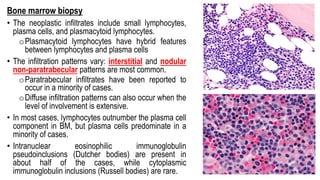
Bone marrow biopsy
• The neoplastic infiltrates include small lymphocytes,
plasma cells, and plasmacytoid lymphocytes.
oPlasmacytoid lymphocytes have hybrid features
between lymphocytes and plasma cells
• The infiltration patterns vary: interstitial and nodular
non-paratrabecular patterns are most common.
oParatrabecular infiltrates have been reported to
occur in a minority of cases.
oDiffuse infiltration patterns can also occur when the
level of involvement is extensive.
• In most cases, lymphocytes outnumber the plasma cell
component in BM, but plasma cells predominate in a
minority of cases.
• Intranuclear eosinophilic immunoglobulin
pseudoinclusions (Dutcher bodies) are present in
about half of the cases, while cytoplasmic
immunoglobulin inclusions (Russell bodies) are rare.
ANCILLARY STUDIES
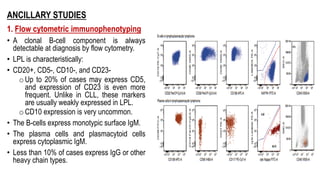
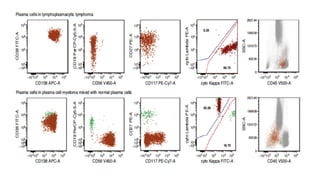
1. Flow cytometric immunophenotyping
• A clonal B-cell component is always
detectable at diagnosis by flow cytometry.
• LPL is characteristically:
• CD20+, CD5-, CD10-, and CD23-
oUp to 20% of cases may express CD5,
and expression of CD23 is even more
frequent. Unlike in CLL, these markers
are usually weakly expressed in LPL.
oCD10 expression is very uncommon.
• The B-cells express monotypic surface IgM.
• The plasma cells and plasmacytoid cells
express cytoplasmic IgM.
• Less than 10% of cases express IgG or other
heavy chain types.
2. Genetic studies
• About 50% of cases bear 6q deletion.
oIt is not specific for LPL but has been associated with an adverse prognosis
• A recently identified genetic hallmark of LPL is the presence of MYD88 mutation, which
characterizes over 90% of cases.
BCL2-IGH
C-MYC
IGH-BCL2
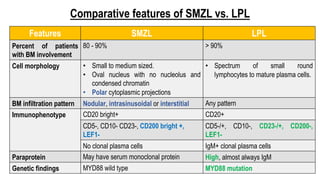
Comparative features of SMZL vs. LPL
Features SMZL LPL
Percent of patients
with BM involvement
80 - 90% > 90%
Cell morphology • Small to medium sized.
• Oval nucleus with no nucleolus and
condensed chromatin
• Polar cytoplasmic projections
• Spectrum of small round
lymphocytes to mature plasma cells.
BM infiltration pattern Nodular, intrasinusoidal or interstitial Any pattern
Immunophenotype CD20 bright+ CD20+
CD5-, CD10- CD23-, CD200 bright +,
LEF1-
CD5-/+, CD10-, CD23-/+, CD200-,
LEF1-
No clonal plasma cells IgM+ clonal plasma cells
Paraprotein May have serum monoclonal protein High, almost always IgM
Genetic findings MYD88 wild type MYD88 mutation
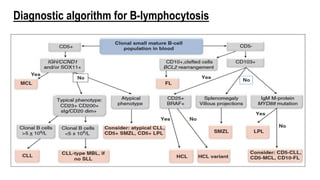
Diagnostic algorithm for B-lymphocytosis

Mature B-cell Neoplasms

  • 1.
    Mature B-cell Lymphmoas/Leukemias By: AhmedMakboul Ahmed M.B.B.Ch, M.Sc Assistant Lecturer, Clinical Pathology Department, South Egypt Cancer Institute
  • 2.
  • 3.
    IMMUNE SYSTEM Innate immunity(a.k.a. natural immunity or native immunity) • Essential for defending against microbes in the first few hours or days after infection, before adaptive immune responses have developed. • Mediated by mechanisms that are in place even before an infection occurs (hence innate) and that facilitate rapid responses to invading microbes.
  • 4.
    Adaptive immunity (a.k.a.specific or acquired immunity) • Develops as a response to infection and adapts to the infection • Stimulated by exposure to infectious agents and increase in magnitude and defensive capabilities with each successive exposure to a particular microbe. • Characteristics: oSpecificity: Ability to distinguish different substances. oMemory: Ability to respond more vigorously to repeated exposures to the same microbe. • Adaptive immune response can be: oHumoral: Antibody mediated. oCell mediated.
  • 5.
  • 6.
  • 7.
    • Lymphocytes developfrom bone marrow (BM) stem cells, mature in the generative (primary) lymphoid organs (BM for B-cells and Thymus for T-cells). • Fully mature T cells leave the thymus, but immature B cells leave the bone marrow and complete their maturation in secondary lymphoid organs (lymph nodes, spleen, regional lymphoid tissues such as mucosa-associated lymphoid tissues). • Naive lymphocytes may respond to foreign antigens in these secondary lymphoid tissues or return by lymphatic drainage to the blood and recirculate through other secondary lymphoid organs.
  • 8.
  • 9.
  • 10.
    B-CELL SUBSETS • Mostmature B cells • Produce IgD and IgM. • Produce short-lived plasma cells.
  • 15.
    Normal B-cell maturationand differentiation, and corresponding cell-of- origin of precursor and mature B-cell neoplasms
  • 16.
    OVERVIEW • B-cell lymphomasthat primarily involve BM and PB present in three general clinical scenarios: 1. B-cell lymphocytosis (an absolute increase in lymphocytes in PB, with or without lymphadenopathy or splenomegaly). 2. Cytopenias(s) with neoplastic B cells circulating in PB. 3. Cytopenias(s) due to BM infiltration by B-cell lymphoma without identifiable neoplastic cells circulating in PB. • These clinical scenarios can influence the approach to diagnosis, ancillary tests ordered, and type of information conveyed in the pathology report.
  • 17.
    APPROACH TO DIAGNOSIS 1.Morphologic review of blood smear with CBC data oMorphology: monotonous vs heterogeneous. oSize of lymphocytes. oAssess chromatin and cytoplasm. oDetermine stage of maturation based on nuclear features. 2. Bone marrow examination oBMA: morphology of lymphocytes. oBMB: pattern of infiltration. 3. Immunophenotyping oDelineate full immunophenotyping profile of lymphoid cells oAssess for neoplasm-specific markers. 4. Genotyping (Cytogenetics and Molecular) oAssess for recurrent cytogenetic aberrations. oMolecular assessment may be necessary.
  • 18.
    Pattern of BMinfiltration in mature B-cell lymphomas 1. Focal pattern • It is the most common pattern. • It is characterized by discrete collections of neoplastic lymphocytes. • They focally displace BM and fat cells • They are usually associated with considerable sparing of normal hematopoietic tissue. • Focal infiltrates can be either: oNon-Paratrabecular: occupy space away from the bone trabeculae. oParatrabecular: grow along and “hug” the bone trabeculae. Random lymphoid infiltrates that expand and focally touch the bone are not considered paratrabecular.
  • 19.
    2. Interstitial pattern •The neoplastic lymphocytes infiltrate between normal hematopoietic cells without significantly disrupting the BM architecture. • They usually do not replace large amounts of BM tissue, even though there is generally widespread BM involvement. 3. Diffuse pattern • Completely replace the hematopoietic elements between the bone trabeculae in a portion or all of the BM core biopsy section, no fat spaces.
  • 20.
    4. Intrasinusoidal pattern •It is characterized by collections of neoplastic lymphocytes within the sinusoids. • These infiltrates are typically subtle and difficult to appreciate on hematoxylin and eosin–stained section but can be highlighted by immunohistochemical stains.
  • 21.
  • 22.
    A simplified classificationscheme of mature B-cell neoplasms that infiltrate PB & BM: 1. CD5 positive mature B-cell neoplasms • Monoclonal B-cell lymphocytosis (MBL). • CLL/SLL • B-cell Prolymphocytic leukemia (B-PLL). • Mantle cell lymphoma (MCL). 2. CD10 positive mature B-cell neoplasms • Burkitt leukemia/lymphoma. • Folicular lymphoma. • Diffuse large B-cell lymphoma (DLBCL).
  • 23.
    3. CD5 negativeCD10 negative mature B-cell neoplasms • Hairy cell leukemia (HCL). • Hairy cell leukemia variant (HCL-v). • Splenic marginal zone lymphoma (SMZL). • Lymphoplasmacytic lymphoma (LPL).
  • 24.
  • 25.
    CD5 positive B-cellneoplasms Monoclonal B-cell lymphocytosis (MBL) CLL/SLL B-Prolymphocytic leukemia (B-PLL) Mantle cell lymphoma (MCL)
  • 26.
    CD5 positive B-cellneoplasms Monoclonal B-cell lymphocytosis (MBL) CLL/SLL B-Prolymphocytic leukemia (B-PLL) Mantle cell lymphoma (MCL)
  • 27.
    Monoclonal B-cell Lymphocytosis(MBL) • Small monoclonal B-cell population not meeting criteria for outright neoplasia: o< 5 x 10⁹/L monoclonal cells in blood: § High-count MBL: ≥ 0.5 x 10⁹/L (associated with increased risk of progression to CLL). § Low-count MBL: < 0.5 x 10⁹/L. oOriginally described in blood; BM and tissue only disease has since been described. • 3 phenotypes are described: 1. Chronic lymphocytic leukemia (CLL)-type phenotype: oPresent in 75% of cases. oExpress CD19, CD5, CD23, dim CD20. 2. Atypical CLL phenotype: oExpress CD19, CD5, bright CD20, bright immunoglobulin. 3. Non-CLL phenotype: oCD5(-). oMay represent marginal zone type process.
  • 28.
    CD5 positive B-cellneoplasms Monoclonal B-cell lymphocytosis (MBL) CLL/SLL B-Prolymphocytic leukemia (B-PLL) Mantle cell lymphoma (MCL)
  • 29.
    Chronic lymphocytic leukemia/small lymphocyticlymphoma (CLL/SLL) • Monoclonal B-cell neoplasm of mature, small round B cells. • Blood, BM, lymph nodes, and spleen are typically involved. oPrimary tissue involvement without significant PB involvement is termed SLL. § Tissue shows morphologic and immunophenotypic features of CLL. • Sustained (≥ 3 months) monoclonal B-cell population ≥ 5 x 10⁹/L in blood with CLL immunophenotype: oCoexpress CD5 and CD23. oLack FMC7. oCD20 expression is usually weak. oWeak (Dim) monotypic surface IgM. • Prolymphocytes account for ≤ 55% of cells. oMost often account for ≤ 10%. oIncreased prolymphocytes may be sign of disease progression.
  • 30.
    CLINICAL FEATURES Age: Medianage at diagnosis of CLL is 60–70 years. Gender: Male predominance. Manifestations: • Patients often are asymptomatic and are diagnosed when lymphocytosis is found on routine blood testing. • Generalized lymphadenopathy. • Splenomegaly may result of infiltration, leads to hypersplenism, and peripheral cytopenias. • Autoimmunity frequently seen in CLL/SLL: oUp to 25% of patients develop Coombs positive autoimmune hemolytic anemia.
  • 31.
    STAGING OF CLL BinetStaging Rai Staging A: < 3 lymphoid areas* enlarged 0: Lymphocytosis only. B: ≥ 3 lymphoid areas* enlarged I: Lymphadenopathy. C: Anemia (Hb < 10g/dL) and/or thrombocytopenia (Plt < 100 x103/uL) II: Hepatomegaly and/or splenomegaly ± lymphadenopathy. III: Hemoglobin < 10g/dL. IV: Platelet count < 100 x103/uL. * Lymphoid areas: are lymph nodes (unilateral or bilateral cervical, axillary and inguinal), liver and spleen.
  • 32.
    MICROSCOPIC PATHOLOGY Lymphocyte morphology: •Size: oSmall sized, monotonous. oHowever, some heterogeneity is noted occasionally. • Nucleus: oNuclear contour: Round nuclear contour oChromatin: Highly condensed nuclear chromatin. Characteristic soccer ball or cracked mud chromatin pattern. oNucleolus: No nucleoli. • Cytoplasm: oIt is generally scant agranular. oMay be more moderate in some cases that exhibit otherwise typical morphologic features of CLL.
  • 33.
    • Numerous smudgecells and basket cells are seen. oThey represent the nucleus from CLL cells that are broken during slide preparation. • Proportion of prolymphocytes (larger cells with prominent nucleoli) in blood films usually < 2%. oIncreased numbers of prolymphocytes correlate with more aggressive disease course. oVariant CLL with increased prolymphocytes (CLL/PL) is defined by > 10% but < 55% prolymphocytes. • Atypical cases show greater heterogeneity of lymphocytes: oProlymphocytes. oLymphocytes with clefted nuclei. § Usually comprise < 15% of lymphoid cells. § Cases with prominent atypical lymphoid cells (< 55%) termed "atypical" CLL.
  • 34.
    Bone Marrow examination: •BM examination should be considered in patients with CLL: oTo determine both the pattern and extent of the leukemic infiltrates. oTo evaluate the residual hematopoietic cells. • Bone marrow aspiration: oLymphocyte morphology similar to PB. • Bone marrow core biopsy: oCLL infiltrates are designated as nodular, interstitial, diffuse, or mixed (a combination of either nodular and interstitial or nodular and diffuse). oNodular infiltrates are usually non-paratrabecular.
  • 35.
    Diffuse infiltration inCLL Interstitial infiltration in CLL
  • 36.
    ANCILLARY STUDIES 1. Flowcytometric immunophenotyping Classic immunophenotypic profile of CLL/SLL • Coexpression of CD19, CD5 and CD23. • Negative FMC7. • Weak (Dim) monotypic surface immunoglobulin.. • Weak or absent CD79b. • Positive CD200. • Negative CD10. • Weak CD20, weak CD22.
  • 37.
    CLL scoring systemby flow cytometric immunophenotyping A score of 4 or more is required to diagnose the case as CLL.
  • 38.
    Role of flowcytometric immunophenotyping in CLL prognosis • Delineating specific prognostic factors: oCD49d. oCD38. oZAP-70. • Expression of these markers in ≥ 20% of leukemia cells indicates aggressive disease.
  • 39.
    2. Immunohistochemistry • Paraffinimmunohistochemistry for CD20, lymphocyte Enhancer binding factor-1 (LEF-1), CD79a, CD5, CD23, cyclin-D1, and Ki-67 may be helpful in cases in which fresh cells for flow cytometry are not available. oTumor cells characteristically express CD5, CD23, and LEF1. § CD23 is particularly useful in distinguishing CLL/SLL from MCL. § CD200 and LEF1 positive in CLL and negative in MCL. • Some cases of CLL express CD23 only weakly or partially; some cases of MCL can be dimly CD23(+). oEvaluation of cyclin-D1 or t(11;14) is suggested. CD20 CD5
  • 40.
    3. Cytogenetic studies •Essential in defining prognostic groups. • Interphase FISH preferable to karyotyping due to low proliferation rate of CLL cells. • Molecular testing may provide additional prognostic information. • Acquired cytogenetic abnormalities seen in 80% of cases. oNot sensitive or specific for diagnosis of CLL. oCarry implications for disease behavior and prognosis.
  • 41.
    Cytogenetic abnormality CommentPrognosis 13q14 deletion Most common cytogenetic abnormality (70%). Favorable (as a sole abnormality) Trisomy 12 10-20% incidence. Intermediate 11q22-23 deletion (ATM deletion) 20% incidence. Unfavorable 17p13 deletion (TP53 deletion) • 3-8% incidence at diagnosis. • Associated with presentation in advanced stage, rapidly progressive disease, treatment refractoriness Unfavorable Complex karyotype > 3 unrelated chromosomal abnormalities in more than one cell on karyotype Unfavorable del(13q) del(17p) Trisomy 12
  • 42.
    4. IGHV mutationalstatus • Somatic mutation of IGHV is a physiologic process: oSomatic hypermutation in IGHV occurs after antigen exposure. oIncreases B-cell affinity for antigen. • Testing compares sequence of IGH variable region (patient sample) to the closest IGH variable sequences in data base (normal cell lines). If > 2% nucleotide difference is considered mutated CLL. oMutated CLL: § More indolent behavior and better outcome. oUnmutated CLL: § Greater likelihood of progression, treatment requirement, and shorter survival.
  • 43.
    DISEASE TRANSFORMATION INCLL 1. Prolymphocytoid transformation Incidence: • The most common transformation, occurring in 5% - 15% of cases of CLL. Features: • Marked increase in prolymphocytes in PB and BM: oSize: A relatively homogeneous population of large cells. oNucleus: Round nuclear contours, moderately condensed nuclear chromatin, central prominent nucleoli. oCytoplasm: Moderate amounts of pale blue, agranular cytoplasm. oCount: Must exceed 55% of lymphocytes.
  • 44.
    Immunophenotyping: • Retain manyof the immunophenotypic features of the original CLL with some changes: osIgM and CD22 expression may be brighter. oCD23 and CD5 coexpression may diminish. Disease course: • This transformation may be associated with progressive disease, loss of responsiveness to chemotherapeutic agents, and decreased survival time.
  • 45.
    2. Overt diffuselarge B-cell lymphoma • a.k.a. Richter transformation. Definition: • The development of a diffuse large B cell lymphoma (DLBCL) or Hodgkin-like transformation in a patient with CLL. Incidence: • It occurs in 2% - 12% of patients with established CLL. • It is relatively more common in younger patients with CLL (≤ 55 years). Features: • Usually, it is extramedullary transformation. • BM is involved in a minority of cases.
  • 46.
    PROGNOSTIC FACTORS INCLL Favorable Unfavorable Immunophenotyping: CD49d negative CD49d positive CD38 negative CD38 positive ZAP70 negative ZAP70 positive Cytogenetics: o 13q14 del o Normal karyotype o 17p deletion o del(11q) o Complex karyotype IGHV mutational status: Mutated Unmutated/Germline
  • 47.
    CD5 positive B-cellneoplasms Monoclonal B-cell lymphocytosis (MBL) CLL/SLL B-Prolymphocytic leukemia (B-PLL) Mantle cell lymphoma (MCL)
  • 48.
    B-cell prolymphocytic leukemia(B-PLL) • As defined by the 2016 WHO Classification, B-PLL is a monoclonal B-cell neoplasm characterized by: oMature B-cell phenotype oProminent nucleoli in > 55% of lymphocytes oMust exclude transformation of CLL and leukemic MCL (prolymphocytoid variant).
  • 49.
    CLINICAL FEATURES Age: Medianage at diagnosis of B-PLL is 60–70 years. Gender: Slight male predominance. Manifestations: • Patients usually present with systemic symptoms and splenomegaly. • In contrast to most cases of leukemic MCL, without significant lymphadenopathy. • A marked leukocytosis (typically > 50 x 109/L) with a rapid lymphocyte doubling time is characteristic. • B-PLL has a much poorer prognosis than CLL.
  • 50.
    MICROSCOPIC PATHOLOGY Prolymphocyte morphology •Count: Must exceed 55% of lymphocytes. • Size oA relatively homogeneous population of large cells. • Nucleus oContour: Round nuclear contours oChromatin: Moderately condensed nuclear chromatin oNucleolus: Central prominent nucleoli. • Cytoplasm oModerate amounts of pale blue, agranular cytoplasm.
  • 51.
    Bone Marrow • Theleukemic infiltrates are characterized by fairly widely spaced nuclei and prominent central nucleoli. • BM is involved in all cases and can show interstitial, nodular, or diffuse patterns of involvement.
  • 52.
    ANCILLARY STUDIES 1. Flowcytometric immunophenotyping Immunophenotypic profile of B-PLL • B-PLL shows expression of CD19 and strongly expresses CD20, CD22, CD79a, and CD79b. • Strongly express surface IgM • Negative Cyclin-D1. • Differs from CLL in: oFMC7 is strongly expressed. oCD5 positive in 1/3 of cases. oCD23 positive in 10% of cases. § CD5(+) CD23(+) cases are more commonly seen in CLL with PLL transformation.
  • 53.
    3. Cytogenetic studies •Cytogenetic and FISH analysis shows some genetic relationship with CLL: odel(17p) is present in half the cases. oTP53 mutations are frequent. odel(13q) also is common. • IGHV mutation status oCan have mutated or unmutated immunoglobulin heavy chain variable region (IGHV). oUnlike CLL, no clear association between IGHV mutation, ZAP70, or CD38 expression and prognosis. § This supports the separation of B-PLL from CLL advocated in the WHO Classification system.
  • 54.
    CD5 positive B-cellneoplasms Monoclonal B-cell lymphocytosis (MBL) CLL/SLL B-Prolymphocytic leukemia (B-PLL) Mantle cell lymphoma (MCL)
  • 55.
    Mantle cell lymphoma(MCL) • Mantle cell lymphoma is a systemic B-cell lymphoma that usually presents with diffuse lymphadenopathy. • It involves the bone marrow in nearly all cases at diagnosis, and circulating lymphoma cells can be detected in the peripheral smear and by flow cytometric immunophenotyping in most patients. • Characterized by t(11;14)(q13;q32) CCND1-IGH translocation. • t(11;14)(q13;q32); CCND1-IGH oTranslocation of CCND1 (cyclin-D1) normally at 11q13 to chromosome 14q32 adjacent to IGH gene. oMakes a protein called BCL-1 (cyclin-D1), which affects entry into cell cycle. oDysregulated cyclin-D1 accelerates transition from G1 to S phase of cell cycle.
  • 56.
    CLINICAL FEATURES Age: Medianage at diagnosis of MCL is 60 years (Age range: 30 – 80 years). Gender: Male predominance. Manifestations: • About 25% of patients have peripheral lymphocytosis (> 5 x 10⁹/L) • Leukemic presentation with marked leukocytosis that may mimic an acute leukemia. oSuch patients usually present with symptoms related to splenomegaly and/or cytopenias. Unlike in CLL, incidental discovery of leukemic MCL on a routine blood count evaluation is rare. • Leukemic non-nodal MCL: oA specific disease variant in the 2016 WHO Classification. oRefers to patients presenting with blood and BM involvement, but without significant lymphadenopathy. oPatients with this variant of disease appear to have a better prognosis compared to patients with classic MCL, often manifesting a stable disease for many years
  • 57.
    MICROSCOPIC PATHOLOGY Lymphocyte morphology •Size: oVary in size in smear preparations (small or large). • Nucleus: oNucleolus: may or may not be prominent (like PLL). oChromatin: More dispersed than that of the cells of CLL. oNuclear contour: usually irregular or cleaved. • Cytoplasm: Variable cytoplasm: oMay have abundant cytoplasm (mimicking marginal zone or hairy cell leukemia). oMay have scant cytoplasm (mimicking CLL). • A common feature that can be a helpful clue to the diagnosis is the presence of a small subset of binucleated or trinucleated cells.
  • 58.
    • Blastoid variant: oCellsusually have finely dispersed chromatin and inconspicuous nucleoli resembling lymphoblasts. oIn other cases, prominent nucleoli resembling myeloblasts or prolymphocytes may be seen. • Leukemic non-nodal variant: oCells are often small and can resemble the cells of CLL.
  • 59.
    • Bone marrowbiopsy oMost cases show a nodular pattern of involvement that includes paratrabecular infiltrates in almost half of the cases. oInterstitial and diffuse patterns also are common oIn biopsy sections, neoplastic cells are small to medium sized with irregular nuclei. oThe blastoid variant has somewhat larger cells with more dispersed chromatin and a brisk mitotic rate.
  • 60.
    ANCILLARY STUDIES 1. Flowcytometric immunophenotyping Characteristic immunophenotypic profile of MCL • Coexpression of CD19 and CD5. • Negative CD23. • Positive FMC7. • Bright monotypic surface immunoglobulin. • Negative CD200. • Negative CD10. • Bright CD20.
  • 61.
    2. Immunohistochemistry • Positivefor CD5, cyclin-D1, and BCL-2. oDemonstration of cyclin-D1 expression by immunohistochemistry is critical, particularly in differentiating MCL from CLL and other small B-cell lymphomas. oCyclin-D1 (-) cases have been described. • SOX11 is positive in the vast majority of cases, including the CD5- and CyclinD1-negative variants. oHowever, SOX11 is usually negative in the leukemic non- nodal variant. • Negative for CD10, BCL-6, CD200, LEF1. • Negative or weak CD23. • Positive for surface immunoglobulin expression and negative for TdT oThis is helpful for distinguishing the blastoid variant of MCL from B-LBL. Cyclin-D1
  • 62.
    3. Cytogenetic studies ConventionalCytogenetic Analysis • Detects t(11;14)(q13;q32); CCND1-IGH o70-80% of cases (+) by karyotyping. oRare cases may show variant translocations of CCND1 with the immunoglobulin light-chain genes. Fluorescence in Situ Hybridization (FISH) • Detects CCND1-IGH gene rearrangement in 95% of cases. • Most sensitive method for detecting t(11;14) (q13;q32). • Can be performed on formalin-fixed tissue sections. CCND1-IGH
  • 63.
    Comparative features ofCLL vs. MCL Features CLL MCL Percent of patients with BM involvement > 90% > 80% Cell morphology • Small sized. • Round to irregular nuclei. • Condensed chromatin. • Small to medium sized. • Irregular nuclei. • Moderately dispersed chromatin. BM infiltration pattern Nodular (non-paratrabecular), interstitial, diffuse Diffuse, nodular (often paratrabecular) Immunophenotype CD20: dim positive CD20: bright positive CD5+ CD10- CD23+ LEF1+ CD200+ CD5+ CD10- CD23-/+ LEF1- CD200- • Cyclin-D1: negative • SOX11: negative • CyclinD1: positive • SOX11: positive in majority Paraprotein Usually low or absent Usually absent Genetic findings del(13q), del(11q), del(17p), +12 t(11;14) with CCND1 rearrangement
  • 64.
    Mantle cell lymphomaCLL CLL vs. MCL: Flow cytometric immunophenotyping
  • 65.
  • 66.
  • 67.
  • 68.
    Burkitt Leukemia/Lymphoma • Burkittlymphoma is a highly aggressive B-cell lymphoma that presents in children, young adults, and occasionally older adults, usually with lymphadenopathy and/or an extranodal mass. • 3 clinicopathologic variants: oEndemic BL § Occurs in equatorial Africa. § Correlating with endemic zone of Plasmodium falciparum malaria and Epstein-Barr virus infections. oSporadic BL § Occurs throughout world. oImmunodeficiency-associated BL § Occurs primarily in setting of HIV infection.
  • 69.
    PATHOGENESIS • MYC Proto-Oncogene: oMYCgene located at 8q24. oMYC is involved in many cell pathways: Proliferation, transcription, apoptosis. oTranslocations juxtapose intact MYC gene with enhancer elements of immunoglobulin genes (IGH, Kappa and Lambda), resulting in MYC upregulation. oTranslocation of MYC is highly characteristic in BL.
  • 70.
    CLINICAL FEATURES Age • EndemicBL: Peak incidence between 4-7 years. • Sporadic BL: oPredominantly children and young adults. oMedian age for adults is 30 years. • Immunodeficiency associated BL: Primarily adults. Gender: Male predominance.
  • 71.
    Clinical presentation • 2/3of patients present with advanced-stage disease with rapidly growing bulky disease of only few weeks duration. • Endemic BL oJaw/facial bone mass is most frequent presentation. • Sporadic BL oAbdominal mass is most common presentation due to Ileum or cecum involvement. oRetroperitoneal mass or lymphadenopathy can be seen. • Immunodeficiency-associated BL oCommonly manifests as leukemia with blood and BM involvement. oHigh incidence of CNS involvement. • Lymphoma cell doubling time is 24-26 hours, and tumor size may double within 1 day. oPatients die of disease within weeks if left untreated.
  • 72.
    MICROSCOPIC PATHOLOGY Lymphocyte morphology: •Size oMedium sized • Nucleus oNuclear contour: Round nuclear contour. oChromatin: moderately dispersed chromatin. oNucleolus: often multiple nucleoli. • Cytoplasm oDeeply basophilic cytoplasm that characteristically contains numerous small vacuoles, which contain lipid
  • 73.
    Bone marrow • Wheninvolved, the BM usually is extensively infiltrated (more than 70% of the marrow space). • Pattern of infiltration: shows a diffuse pattern. • Frequently there are areas of necrosis. • Scattered phagocytic histiocytes impart a “starry- sky” appearance similar to that seen in Burkitt lymphoma involving extra-medullary tissues.
  • 74.
    Burkitt lymphoma hasa similar appearance to extramedullary involvement, including a “starry-sky” appearance.
  • 75.
    ANCILLARY STUDIES 1. Flowcytometric immunophenotyping Immunophenotypic profile of Burkitt lymphoma • Predominantly medium to large cells on forward scatter. • Typically bright CD10 and surface immunoglobulin positive monoclonal B-cell population. • Positive CD38 (bright). • CD5, CD23 are typically negative; helpful to exclude other lymphomas/leukemias. • CD34, TdT are negative; excludes immature cell tumor.
  • 76.
    2. Immunohistochemistry • Typicallyused in conjunction with flow cytometric analysis. • No single stain is diagnostic. • Panel of stains is required including CD20, CD10, BCL-2, CD43, Ki-67: oCD20, CD10 and CD43 are usually positive. oBCL-2 is negative or only weakly positive in rare cases. § It does not in isolation exclude the diagnosis provided a BCL-2 rearrangement is excluded. oKi-67 is positive in near 100% of neoplastic cells. CD20
  • 77.
    3. Cytogenetic studies ConventionalCytogenetic Analysis (Karyotyping) • MYC translocations are characteristic. • t(8;14)(q24;q32) (MYC-IGH) in 80% of cases (most common). oIn t(8;14), MYC resides on derivative chromosome 14. • t(8;22)(q24;q11) (MYC-IGL) in 15% of cases. • t(2;8)(p11;q24) (IGK-MYC) in 5% of cases. oIn t(2;8) and t(8;22), MYC resides on derivative chromosome 8.
  • 78.
    Fluorescence in SituHybridization (FISH) • FISH is useful for detecting MYC translocations. oBreak-apart probe commonly used to demonstrate MYC translocations. oDual-color, dual-fusion probe for MYC-IGH translocation. • 90% of cases detect MYC rearrangement by FISH. • 10% of cases do not show MYC rearrangement by FISH. C-MYC MYC-IGH
  • 79.
    Note: • Burkitt lymphomamust always lack BCL-2 or BCL-6 rearrangement. • Cases resembling Burkitt lymphoma that have rearrangements of these genes in addition to a MYC rearrangement are classified separately, as high-grade “double-hit” lymphoma in the 2016 WHO Classification. C-MYC IGH-BCL2 BCL6
  • 80.
    Burkitt-like lymphoma with11q aberration • Provisional entity in the 2016 WHO Classification. • Lymphomas morphologically and phenotypically resemble Burkitt lymphoma but without MYC translocation. oThey have a genetic abnormality involving chromosome 11q and are classified separately.
  • 81.
  • 82.
    Follicular Lymphoma (FL) •Follicular lymphoma (FL) is the second most common subtype of NHL, accounting for 20% of lymphomas worldwide. • It is a neoplasm composed of germinal center B-cells (centroblasts and centrocytes). t(14;18)(q32;q21) (IGH-BCL2) • Genetic hallmark and critical early event in formation of FL. • Results in overexpression of Bcl-2 protein. oBcl-2 is antiapoptotic and confers survival advantage to neoplastic cells. • Translocation occurs after break at IGH on chromosome 14 due to defective VDJ recombination. • t(14;18) is considered initiating molecular event of FL: oInsufficient to induce lymphomagenesis by itself. oSubsequent genetic alteration(s) required for development of overt lymphoma
  • 83.
    CLINICAL FEATURES Age: Medianage at diagnosis of FL is 60 years. Manifestations • Often presents with diffuse lymphadenopathy ± organomegaly. • Rare cases of follicular lymphoma may present as leukemia with a high WBC count, clinically mimicking CLL. oThese patients almost always have concurrent splenomegaly and generalized lymphadenopathy. Disease course • FL typically follows indolent clinical course; some cases may progress rapidly with relapses and shorter survival. • FL can transform to DLBCL, aggressive B-cell lymphoma, unclassifiable, or Burkitt lymphoma.
  • 84.
    MICROSCOPIC PATHOLOGY Lymphocyte morphology: •Size oSmall sized • Nucleus oDeep nuclear clefts or grooves. oMarkedly irregular nuclear contours. • Cytoplasm oThin rim of cytoplasm.
  • 85.
    Bone marrow • Characteristicparatrabecular aggregates are observed, although non-paratrabecular nodules also are frequently seen. oNeoplastic cells are arranged in linear arrays immediately adjacent to (hugging) the bone trabeculae • The paratrabecular aggregates in follicular lymphoma are associated with increased reticulin fibrosis. oThis causes underrepresentation of the tumor cells in the aspirated marrow and occasionally false-negative flow cytometry results. • A high level of BM lymphomatous involvement (10% or more of BM space) and a diffuse infiltration pattern are associated with poorer survival.
  • 86.
    ANCILLARY STUDIES 1. Flowcytometric immunophenotyping Characteristic immunophenotype of FL • Positive CD20 (bright). • Positive CD19 (Dimmer than CD20). • Positive CD10. • Negative CD5, cyclin D1 and CD200. • Surface light chain expression. oOf note, 10% of FL may not express surface light chain. • FL cells differ from hematogones in: oBrighter CD45. oDimmer CD38. oNegative CD43.
  • 87.
    2. Cytogenetic studies ConventionalCytogenetic Analysis (Karyotyping) • t(14;18)(q32;q21) in 80-90% of cases. • Juxtaposes BCL2 at 18q21 adjacent to IGH on derivative chromosome 14. • t(14;18)(q32;q21)(IGH-BCL2) present in up to 90% of grade 1-2 FL. • t(14;18)(q32;q21)(IGH-BCL2) much less frequent in grade 3B FL. Fluorescence in Situ Hybridization (FISH) • FISH can detect t(14;18)(q32;q21) in up to 90% of FL cases. • Quicker and easier to performed than PCR. IGH-BCL2
  • 88.
  • 89.
    Diffuse Large B-cellLymphoma (DLBCL) • Neoplasm of B-lineage large lymphoid cells. oNuclear size ≥ normal macrophage nuclei or > 2x size of normal lymphocyte. oDiffuse growth pattern. • DLBCL is one of most common type of NHL involving blood &/or BM. o12-15% of cases with DLBCL show BM involvement. oPatterns of BM involvement include diffuse (50%) and nodular (33%).
  • 90.
    • Common WHOsubtype of DLBCL with higher incidence of blood &/or BM involvement: oDLBCL, not otherwise specified (NOS). • Other WHO subtypes of LBCL with high incidence of blood &/or BM involvement: oT-cell/histiocyte-rich LBCL. oEBV-positive DLBCL, NOS. oIntravascular LBCL. oHHV8-positive DLBCL. oHigh-grade B-cell lymphoma, NOS. oHigh-grade B-cell lymphoma with MYC and BCL-2 &/or BCL-6.
  • 91.
    CLINICAL FEATURES Age: DLBCLis more common in elderly. Clinical Presentation • Nodal or extranodal disease. • Initial presentation at extranodal sites in up to 40% of cases. oGastrointestinal tract is most common site. oOther sites include spleen, Waldeyer ring, salivary gland, testis, thyroid, liver, bone, kidney, and adrenal gland. oBone marrow involvement by DLBCL in 12-15% of cases.
  • 92.
    MICROSCOPIC PATHOLOGY Peripheral Blood •Peripheral blood involvement is seen in 30% of cases. oTypically associated with high white blood cell count and absolute lymphocytosis. oLarge atypical lymphoid cells.
  • 93.
    Bone marrow • Patternsof bone marrow involvement: oDiffuse pattern in 50% of cases. oNodular pattern in 33%. oOther patterns include interstitial and rarely intrasinusoidal component.
  • 94.
    ANCILLARY STUDIES 1. Flowcytometric immunophenotyping Immunophenotyping of DLBCL • DLBCL cells will appear in the blast gate on the FSC/SSC plot and may be missed in the analysis if a lymphoid gate is utilized. • They show bright CD45. • Pan B-cell markers: oStrong CD20, FMC7, CD79a and CD22. oSome cases may show dim CD19. • CD10 positive in GCB type not in ABC type • Restricted light chain expression is usually dim to medium in intensity but in some cases is absent.
  • 95.
    2. Immunohistochemistry • Expressionof B-cell-associated antigens including CD20, CD79a, PAX-5. • Expression of CD10, BCL-6 and MUM1 can help in subclassifying DLBCL into GCB and non-GCB types. • BCL-2 coexpression in subset. • Expression of MYC (in > 40% of neoplastic cells) in subset. • Increased proliferation rate with typically > 50% rate of Ki-67 positivity. Double expressor lymphoma oAssociated with poorer prognosis. oExpression of MYC and BCL-2 by immunohistochemistry. oPrognosis better than double-hit lymphoma.
  • 96.
    DLBCL subtypes byimmunohistochemistry (Hans algorithm)
  • 97.
    2. Cytogenetic studies Cytogeneticabnormalities in DLBCL • t(14;18)(q32;q21); (IGH-BCL2): in 20% • t(3;14)(q27;q32); (BCL6-IGH): in 25% • t(8;14)(q24;q32); (MYC-IGH): in 10% oMYC also partners with other genes. Double-hit lymphoma • Translocations involving MYC with either BCL2 (most common) or BCL6. • 5-10% in cases that otherwise resemble DLBCL. • Associated with very poor prognosis. • These cases are reclassified in updated WHO classification: oHigh-grade B-cell lymphoma with MYC and BCL2 &/or BCL6 translocations. BCL2-IGH C-MYC IGH-BCL2
  • 98.
    3. Gene ExpressionProfiling (GEP) • Expression microarray studies have established 2 major groups of DLBCL oGerminal center B-cell (GCB) § Gene expression profile similar to GC B-cells. oActivated B-cell (ABC) (Non-GCB) § Gene expression profile similar to activated B-cells. • GCB-DLBCL is associated with better prognosis than Non-GCB / ABC-DLBCL when patients treated with R-CHOP therapy.
  • 99.
    CD5 negative CD10negative B-cell Neoplasms
  • 100.
    CD5 negative CD10negative mature B-cell neoplasms Hairy cell leukemia (HCL) Hairy cell leukemia variant (HCL-v) Splenic marginal zone lymphoma (SMZL) Lymphoplasmacytic lymphoma (LPL)
  • 101.
    CD5 negative CD10negative mature B-cell neoplasms Hairy cell leukemia (HCL) Hairy cell leukemia variant (HCL-v) Splenic marginal zone lymphoma (SMZL) Lymphoplasmacytic lymphoma (LPL)
  • 102.
    Hairy cell leukemia(HCL) Indolent monoclonal B-cell neoplasm composed of cells with: • Distinct morphology oOval nuclei, abundant cytoplasm with circumferential, hairy projections. • Distinct immunophenotype by flow cytometric immunophenotyping oBright CD20, CD103, CD25, CD123, bright CD200, bright CD11c positive. • Distinct immunohistochemical profile oAnnexin-1, CD123, BRAF, CD200, weak cyclin-D1, DBA.44 and TRAP are all positive by IHC. • Propensity for diffuse BM involvement and splenic red pulp infiltration. • BRAF V600E mutations in virtually all cases.
  • 103.
    CLINICAL FEATURES Age: Medianage at diagnosis of HCL is 50 years. Gender: Marked male predominance (M:F ratio= 4:1). Manifestations • Patients with HCL present most often with symptoms related to one or more cytopenias, such as infections, weakness, or fatigue. • Unlike most other B-cell lymphomas, HCL is characterized by leukopenic rather than a leukemic presentation. o Presence of marked leukocytosis with numerous circulating neoplastic cells tends to suggest hairy cell variant (HCLv) or another lymphoma subtype. • Monocytopenia is present in almost all cases at diagnosis and can be a helpful clue in suggesting a diagnosis of HCL in a cytopenic patient. Diagnosis of HCL would be very unusual in a patient with a normal monocyte count. • Palpable splenomegaly is present in most patients at diagnosis. • Peripheral lymphadenopathy is uncommon, in contrast to many other mature B-cell leukemias.
  • 104.
    MICROSCOPIC PATHOLOGY Lymphocyte morphology Size •Hairy cells are small to intermediate in size. Nucleus • Nuclear contour: Central oval to bean-shaped nucleus • Chromatin: uniform chromatin • Nucleolus: No nucleolus. Cytoplasm • Moderately abundant pale blue cytoplasm. • Cytoplasmic projections ("hairs") are typically circumferential. • Cytoplasmic vacuoles or inclusions that represent ribosomal- lamellar complexes. The classic hairy cell morphology is often less evident in BM aspirate smears, but can be seen in extensively involved samples with well-prepared smears
  • 105.
    Bone marrow biopsy •HCL infiltrate is interstitial or diffuse and does not form nodules, unlikely many B-cell lymphomas involving BM. • Hairy cells appear monotonous with oval- or bean-shaped nuclei and clear cytoplasm that imparts a “fried egg” appearance to BM heavily involved by HCL. • In more subtle examples of HCL, the BM is normocellular or even hypocellular, and the hairy cells may be obscured as they percolate among the normal hematopoietic elements. • Significant reticulin fibrosis is found in most cases but is lacking in cases with minimal infiltration.
  • 106.
    ANCILLARY STUDIES 1. Flowcytometric immunophenotyping • Higher side scatter than normal lymphocytes or other neoplastic B cells. • Bright expression of CD45, CD20, and CD19. • Positive FMC7, CD22, and CD79a. • CD5, CD10, and CD23 are usually negative. oCD5 may be positive in about 5% of cases and CD10 in up to 25%. • Bright expression of CD11c, CD25, and CD103. • Light chain assessment can be difficult due to the “stickiness” of the cell surfaces that may bind both kappa and lambda nonspecifically. • CD123 and CD200 are expressed in almost all cases.
  • 107.
    2. Immunohistochemistry • Panelof immunohistochemical stains provides high diagnostic sensitivity and specificity for HCL: oCD25, CD11c, Annexin-A1, CD123, CD200, CD103, BRAF, and DBA.44 all useful. • HCL cells express CD25, CD123, CD11c, and Annexin A1 by immunohistochemistry. oSome of these antigens also are expressed in other marrow cells (such as Annexin A1 positivity in neutrophils). • DBA.44 stains hairy cells in BM trephine sections oHowever, it may not stain all the neoplastic cells, and it is expressed in other lymphomas, as SMZL. • Cyclin D1 is weakly expressed in most cases but lacks any associated CCND1 rearrangement in HCL.
  • 108.
    CD20 CD25 CD123 CyclinD1 Annexin A1 BRAF
  • 109.
    3. Cytochemistry Tartrate ResistantAcid Phosphatase (TRAP) • TRAP shows cytoplasmic granules in HCL cells • Acid phosphatase often appears brighter in HCL cells after tartrate treatment HCL cells are acid phosphatase positive (before and after incubation with tartrate).
  • 110.
    4. Genetic studies •Routine cytogenetic analysis of HCL is generally not indicated, and no prognostic cytogenetic markers have been identified. • Despite Cyclin-D1 expression in most HCL cases, translocations involving the CCND1 locus do not occur in HCL. • Point mutation in the BRAF gene (V600E), an oncogene located at chromosome 7q24, is present in the vast majority of HCL and is absent from other small B-cell lymphomas. oDetected in BM aspirates or PB by allele-specific PCR or NGS technologies. BCL2-IGH C-MYC IGH-BCL2
  • 111.
    CD5 negative CD10negative mature B-cell neoplasms Hairy cell leukemia (HCL) Hairy cell leukemia variant (HCL-v) Splenic marginal zone lymphoma (SMZL) Lymphoplasmacytic lymphoma (LPL)
  • 112.
    Hairy cell leukemiavariant (HCL-v) • Provisional entity in the 2016 WHO classification. oIncluded under umbrella designation of “splenic B-cell lymphoma/leukemia, unclassifiable”. • Mature monoclonal B-cell neoplasm with hybrid features oPrimarily involves PB, BM and spleen. oLeukocytosis with normal monocyte count. oHairy projections and nucleoli; hybrid morphology. oNegative for some classic HCL antigens (CD25, annexin-A1, CD123, BRAF). oBRAF V600E wild type (i.e. no mutation). oRed pulp infiltration of spleen.
  • 113.
    Comparative features ofHCL vs. HCL-v Features HCL HCL-v WBC count Leucopenia (typically pancytopenia) Leucocytosis Lymphocyte morphology • Small to medium sized. • Central oval bean-shaped nucleus with no nucleolus • Circumferential hairy cytoplasmic projections • Small to medium sized. • Central oval bean-shaped nucleus with prominent nucleolus • Circumferential hairy cytoplasmic projections PB Monocyte count Monocytopenia Normal monocyte count Flow cytometry CD20 bright+, FMC7+ CD20 bright+, FMC7+ CD5-, CD10- CD23-, CD200 bright + CD5-, CD10- CD23-, CD200 dim or negative CD103+, CD25+, CD11c+ CD103+, CD25-, CD11c- CD123+, Annexin A1+, Cyclin-D1 dim+ CD123-, Annexin A1-, Cyclin-D1- TRAP Positive Negative to weak Genetic mutation BRAF V600E mutated BRAF V600E wild type (unmutated)
  • 114.
    CD5 negative CD10negative mature B-cell neoplasms Hairy cell leukemia (HCL) Hairy cell leukemia variant (HCL-v) Splenic marginal zone lymphoma (SMZL) Lymphoplasmacytic lymphoma (LPL)
  • 115.
    Splenic Marginal ZoneLymphoma (SMZL) • Indolent B-cell lymphoma composed of small lymphocytes that involves splenic white pulp, forming micronodular pattern. • SMZL involves PB and BM in the vast majority of cases. • Hepatitis C virus (HCV) may contribute to lymphomagenesis • Proposed minimal diagnostic criteria oTypical spleen histology with immunophenotype or clinical finding of splenomegaly with typical blood morphology, immunophenotype, and BM infiltration pattern.
  • 116.
    CLINICAL FEATURES Age: Medianage at diagnosis of SMZL is 68 years. Gender: No gender predominance. Manifestations • Patients usually present with huge splenomegaly and lymphocytosis. oMost patients have absolute lymphocytosis, and rare patients may present with lymphocytosis before the development of splenomegaly. oEven in patients lacking lymphocytosis at presentation, neoplastic cells usually can be identified on the peripheral smear and/or detected by flow cytometry. • Patients often present with other cytopenias due to hypersplenism and/or BM infiltration. • Up to 25% have lymphadenopathy, but this usually is localized to the abdomen. Peripheral lymphadenopathy at presentation is rare.
  • 117.
    MICROSCOPIC PATHOLOGY Lymphocyte morphology Size •Small to medium sized. Occasional large cells may be seen. Nucleus • Nuclear contour: Oval nuclei. • Nucleolus: Inconspicuous nucleoli. • Chromatin: Condensed chromatin. Cytoplasm • Moderate amount of pale, basophilic cytoplasm; some may appear plasmacytoid. • Cytoplasmic villous projections are reported to be located at one aspect of the cell surface (polarized) and are relatively short compared to the longer villi present all around the cell surface in HCL
  • 118.
    Bone marrow aspirate •Neoplastic cells are more heterogeneous and show a range of cell sizes and nuclear shapes. • As with HCL, the villous projections of SMZL usually are not as well displayed in BM aspirate. Bone marrow biopsy • BM involvement is usually subtle. • BM involvement usually manifests as non- paratrabecular nodules. • Paratrabecular and interstitial infiltrates can also occur. • Intrasinusoidal lymphoma involvement is characterized by small chains or clusters of neoplastic lymphoid cells within vascular sinuses, usually clearly identifiable only through immunohistochemistry. oPresent in 10% of cases.
  • 119.
    ANCILLARY STUDIES 1. Flowcytometric immunophenotyping Immunophenotyping profile of SMZL • SMZL cells express bright CD19, CD20, CD79a, CD22, FMC7. oCD79a can be brighter than HCL. • CD5 is negative but is expressed in 10 - 15% of cases. • CD11c can be positive or negative. • Small subset expresses weak CD25, CD38. • Typically, negative for CD10, CD23, CD43, CD103. • CD200 is often partially expressed. • Monotypic plasma cells may be found in some cases.
  • 120.
    2. Cytogenetic studies •There are no specific cytogenetic findings in SMZL. • Of note, about one-third of cases show deletion of 7q, which is not frequently found in other lymphoma subtypes • A smaller number have a t(2;7)(p12;q21). • No BCL2 or CCND1 rearrangements. BCL2-IGH C-MYC IGH-BCL2
  • 121.
    Comparative features ofHCL vs. SMZL Features HCL SMZL WBC count Leucopenia (typically pancytopenia) Normal, low or high Lymphocyte morphology • Small to medium sized. • Central oval bean-shaped nucleus with no nucleolus and fine chromatin • Circumferential cytoplasmic projections • Small to medium sized. • Oval nucleus with no nucleolus and condensed chromatin • Polar cytoplasmic projections PB Monocyte count Monocytopenia Normal monocyte count BM infiltration Diffuse and interstitial Nodular, intrasinusoidal or interstitial Flow cytometry CD20 bright+, FMC7+ CD20 bright+, FMC7+ CD5-, CD10- CD23-, CD200 bright + CD5-, CD10- CD23-, CD200 dim CD103+, CD25+, CD11c+ CD103-, CD25-, CD11c -/+ CD123+, Annexin A1+, Cyclin-D1 dim+ CD123-, Annexin A1-, Cyclin-D1- Genetic mutation BRAF V600E mutated BRAF V600E wild type (unmutated)
  • 122.
    CD5 negative CD10negative mature B-cell neoplasms Hairy cell leukemia (HCL) Hairy cell leukemia variant (HCL-v) Splenic marginal zone lymphoma (SMZL) Lymphoplasmacytic lymphoma (LPL)
  • 123.
    Lymphoplasmacytic Lymphoma (LPL) •LPL/WM is characterized by clonal expansion of small mature B-cells with variable plasmacytoid differentiation. • Lymphoplasmacytic lymphoma (LPL) oNeoplasm of small B-cells, plasmacytoid lymphocytes, and plasma cells. oDoes not meet criteria for any other type of small B-cell lymphoma. oUsually associated with serum monoclonal paraprotein. § Usually IgM; rarely IgG or IgA. § Monoclonal paraprotein not required for LPL diagnosis but very helpful. • Waldenström Macroglobulinemia (WM) oLPL involving BM associated with IgM monoclonal paraprotein. oNo specific cutoff level of IgM required. oCan involve tissue sites, but BM also must be involved.
  • 124.
    CLINICAL FEATURES Age: Meanage at diagnosis of LPL is > 70 years. Gender: Male predominance. Manifestations • Most patients present with symptoms related to BM infiltration as anemia or infections. • There is almost always serum M protein, usually IgM and rarely IgG or other immunoglobulin subtypes. • Patients who present with the hyperviscosity picture of Waldenström macroglobulinemia have a particularly high serum IgM level. oOronasal bleeding, visual disturbance due to retinal bleeding. oHeadache, neurologic changes, and cardiac failure. • Some cases may be associated with hepatitis C infection, • Up to 30% of patients have lymphadenopathy and/or splenomegaly.
  • 125.
    MICROSCOPIC PATHOLOGY • Plasmacytoidlymphocyte cells can circulate in PB but are usually infrequent in LPL. • When LPL cells are present on the peripheral smear, they show similar features to those in the BM aspirate smear. • Prominent RBC clumping (rouleauxe formation) may be seen due to red cell agglutination.
  • 126.
    Bone marrow aspirate •BM involvement in almost all cases. • BM aspirate is most helpful sample in morphologic diagnosis. oPredominantly small lymphocytes with variable number of plasmacytoid lymphocytes and plasma cells. oMast cells typically increased; most prominent within particles on aspirate smears.
  • 127.
    Bone marrow biopsy •The neoplastic infiltrates include small lymphocytes, plasma cells, and plasmacytoid lymphocytes. oPlasmacytoid lymphocytes have hybrid features between lymphocytes and plasma cells • The infiltration patterns vary: interstitial and nodular non-paratrabecular patterns are most common. oParatrabecular infiltrates have been reported to occur in a minority of cases. oDiffuse infiltration patterns can also occur when the level of involvement is extensive. • In most cases, lymphocytes outnumber the plasma cell component in BM, but plasma cells predominate in a minority of cases. • Intranuclear eosinophilic immunoglobulin pseudoinclusions (Dutcher bodies) are present in about half of the cases, while cytoplasmic immunoglobulin inclusions (Russell bodies) are rare.
  • 128.
    ANCILLARY STUDIES 1. Flowcytometric immunophenotyping • A clonal B-cell component is always detectable at diagnosis by flow cytometry. • LPL is characteristically: • CD20+, CD5-, CD10-, and CD23- oUp to 20% of cases may express CD5, and expression of CD23 is even more frequent. Unlike in CLL, these markers are usually weakly expressed in LPL. oCD10 expression is very uncommon. • The B-cells express monotypic surface IgM. • The plasma cells and plasmacytoid cells express cytoplasmic IgM. • Less than 10% of cases express IgG or other heavy chain types.
  • 130.
    2. Genetic studies •About 50% of cases bear 6q deletion. oIt is not specific for LPL but has been associated with an adverse prognosis • A recently identified genetic hallmark of LPL is the presence of MYD88 mutation, which characterizes over 90% of cases. BCL2-IGH C-MYC IGH-BCL2
  • 131.
    Comparative features ofSMZL vs. LPL Features SMZL LPL Percent of patients with BM involvement 80 - 90% > 90% Cell morphology • Small to medium sized. • Oval nucleus with no nucleolus and condensed chromatin • Polar cytoplasmic projections • Spectrum of small round lymphocytes to mature plasma cells. BM infiltration pattern Nodular, intrasinusoidal or interstitial Any pattern Immunophenotype CD20 bright+ CD20+ CD5-, CD10- CD23-, CD200 bright +, LEF1- CD5-/+, CD10-, CD23-/+, CD200-, LEF1- No clonal plasma cells IgM+ clonal plasma cells Paraprotein May have serum monoclonal protein High, almost always IgM Genetic findings MYD88 wild type MYD88 mutation
  • 132.
    Diagnostic algorithm forB-lymphocytosis