1
Lymphoma
by Dr.Hayelom k
Final year Pathology resident
Jimma university medical center
hayelomk21@gmail.com
Lymphocytes in different phases
of maturation ???
Normal lymph node architecture
Cortex
Medulla
Plasma cells
Paracortex
T-cells
Lymphoid
Follicle
B-cells
Lymphocyte constantly recirculate
Lymphoid follicle (B-Cell region)
Germinal center
Centroblasts, centrocytes
Mantle and marginal
zones
Small centrocyte-arrowhead, large centrocyte-arrow, centroblast - thick arrow
Mitosis – curved arrow
Germinal center cells
LYMPHADENOPATHY
BENIGN
NEOPLASTIC
PRIMARY:
LYMPHOMA
SECONDARY:
METASTASIS
Summary of lymph node pathology
Clinical manifestations of lymph node
diseases
-Enlarged
-Tender/non tender
-Systemic symptoms
LYMPHADENOPATHY
BENIGN
NEOPLASTIC
PRIMARY:
LYMPHOMA
SECONDARY:
METASTASIS
Summary of lymph node pathology
reactive changes in the nodes
Follicular hyperplasia
Rheumatoid arthritis, Toxoplasmosis
Follicular hyperplasia
tingible body macrophages
Resting
lymphocytes in
the mantle
zone
Interfollicular/paracortical hyperplasia
T-cell response, acute viral infections(mononucleosis)
Sinus histiocytosis
Dilated sinusoids, increased number and size of cells lining the sinusoids
Toxoplasmosis pink, epitheloid macrophages, follicular hyperplasia
Mixed type lymphadenopathy
Necrotizing lymphadenitis
Microabscesses Bartonella Henselae
(silver stain) cats scratch
Granulomatous lymphadenitis
Lymphadenopathy
LYMPHADENOPATHY
BENIGN
NEOPLASTIC
PRIMARY:
LYMPHOMA
SECONDARY:
METASTASIS
Metastatic adenocarcinoma
Lymphadenopathy (cont)
LYMPHADENOPATHY
BENIGN
NEOPLASTIC
PRIMARY:
LYMPHOMA
SECONDARY:
METASTASIS
·Willis (1948)
“… nowhere in pathology has a chaos of
names so clouded clear concepts as in
the subject of lymphoid tumors ….”
•Hopwood (1957)
“… the urge to classify is a fundamental
human instinct: like a predisposition to
sin, it accompanies us into the world at
birth and stays with us to the end …”
Lymphoma classification
Rappaport
1966
Lukes Collins
1974
Working formula
1982
Kiel
1988
REAL
1994
WHO
2001
2008
Is this the REAL
thing…..?
WHO ……knows!
WHO Classification of lymphomas
At least 30 types of lymphoma are recognized
3 broad flavors
- B-cell lymphomas
Precursor (immature),
peripheral (“mature”)
- T-cell lymphomas
- Hodgkin lymphoma ( bona fide lymphoma)
~ 85% in North America and Europe are B-cell
· two types account for > 50% of lymphomas
- diffuse large B-cell lymphoma (~ 30 - 40%)
- follicular lymphomas (~ 25 - 30%)
·
Etiology of lymphomas
Translocations involving the IgH are
requent
Etiology of lymphomas
Inherited genetic factors-genomic instability:
-Down syndrome, NF type I
Autoimmune disorders: Sjogren, Hashimoto
Viruses: EBV, HTLV1 and herpes virus
Environmental agents:
-Chronic inflammation, Helicobacter Pylori and MALT
lymphoma
-Gluten sensitive enteropathy and intestinal lymphoma
Iatrogenic:
-Radiotherapy
-Chemotherapy
Diagnosing lymphomas
Diagnosing lymphoid neoplasias
HOW ?
WHY ?
Flow cytometry
Immunohistochemistry
Karyotyping
Diagnosis
Monitoring
Prognosis
Diagnosing lymphomas
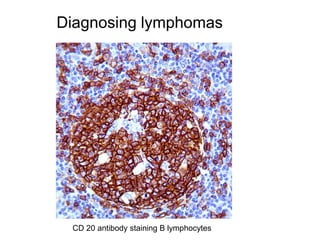
CD 20 antibody staining B lymphocytes
Diagnosing lymphoid neoplasias
• T-cell markers
– CD3 mature T cells
– CD4 – helper T cell
– CD5 – T cell, small
subset of B cells
– CD8 – cytotoxic T cell
• B cell markers
– CD19 - mature B cell
– CD20 - mature B cell
– CD23 - activated
mature B cell
– CD10
– Bcl-6
Lymphoid leukemia versus lymphoma
Somewhat arbitrary, distinctions for
lymphoid neoplasias
Lymphoid leukemia presents with mainly
bone marrow and blood involvement
Lymphoma presents with nodal or
extranodal mass with minimal
blood/marrow involvement
Many diseases overlap or evolve from one
another
Signs and symptoms
Lymphoid leukemias present with signs and
symptoms related to bone marrow
involvement
Anemia, thrombocytopenia, leukopenia
Lymphomas present as nontender mass (>2
cm)
Extranodal- skin, GI tract, brain,
Fever, weight loss, night sweats (B-symptoms)
Patients may have any combination of the
above
Origin of B-cell lymphomas
Marginal zone
Mantle zone
Germinal center
Naive B-cell
Mantle cell
lymphoma
Follicular lymphoma
Burkitt lymphoma
Large cell lymphoma
Memory B-cell
CLL/SLL
Marginal zone
lymphoma
Plasma cell
Myeloma
Chronic Lymphocytic Leukemia/Small
Lymphocytic Lymphoma
CLINICAL
•commonest leukemia
•CLL often picked up on routine CBC
•typically indolent (but not always!)
•rare less than 40 years
•complications:
• autoimmune (10-15%) (ITP, AIHA)
• hypogammaglobulinemia
• transformation (DLBCL)
PATHOLOGY
•diffuse growth pattern
Spleen is frequently involved
proliferation center-mitotically active cells=this is
where the tumor cells grow
Chronic Lymphocytic Leukemia/Small
Lymphocytic Lymphoma
MORPHOLOGY
- small, mature lymphocytes >4000/mm3
- smudge cells characteristic
IMMUNOPHENOTYPE
CD19, CD20, CD23, CD5
GENETICS
13q deletion (good prognosis)
trisomy of 12
11q deletion (bad prognosis)
Chronic Lymphocytic Leukemia/Small
Lymphocytic Lymphoma
Chronic Lymphocytic Leukemia/Small
Lymphocytic Lymphoma
Nucleated erythrocyte Spherocytes Smudge cells Small lymphocytes
3.Chronic Lymphocytic Leukemia/Small
Lymphocytic Lymphoma
TRANSFORMATION
1. LARGE CELL LYMPHOMA
(Richter)
- 10%
2.Prolymphocytic lymphoma
-15-30%
average survival 1 year
FOLLICULAR LYMPHOMA
15-20 000/year, less common in Europe, Asia
-Middle age patient’s
-Most common indolent lymphoma
-Peripheral blood 10%
-Bone marrow 85% involved
-Spleen and liver also commonly involved
-Can undergo transformation into large cell lymphoma
Follicular lymphoma
Classic low power view
- back-to-back follicles
- loss of interfollicular
zones
- extranodal follicles
- uniform size of follicles
Follicular lymphoma
Back to back, uniform follicles, attenuated mantle
zone, no tingible body macrophages
Follicular lymphoma
diagnostic hallmark t(14;18)
Translocates the bcl-2 gene
next to IgH
over expression of bcl-2 prevents
apoptosis
Bcl-2 +
Bcl-2 – staining in normal
Lymphoid follicle
APOTOSIS (Hippocratic Greek) APOPTOSIS (modern Greek)
Follicular lymphoma
centrocyte:
-cleaved/notched/twisted
-raisin
-buttock
50% transforms into large cell
lymphoma
Follicular lymphoma
Centroblasts- important in grading
Splenic involvement in follicular lymphoma
Origin of B-cell lymphomas
Marginal zone
Mantle zone
Germinal center
Naive B-cell
Mantle cell
lymphoma
Follicular lymphoma
Burkitt lymphoma
Large cell lymphoma
Memory B-cell
CLL/SLL
Marginal zone
lymphoma
Plasma cell
Myeloma
CB/CC
Diffuse Large B-cell Lymphoma
Most common non Hodgkin lymphoma(~40%)
- 25, 000 new cases/year
- median age 6th decade - all age
groups
- typically present with a single rapidly
enlarging mass
- often (~ 40%) extranodal
Variable clinical outcome
aggressive, has to be treated immediately
Diffuse Large B-cell lymphoma
Etiology and clinicopathologic subtypes
- de novo
-BCL-6 mutation freezes the differentiation of cells in the
germinal center + blocks the effect of p53
-can occur anywhere in the body
- transformed from either follicular lymphoma (t14;18) or CLL/SLL
- immunosuppressed patients
- transplant patients, AIDS patients
- KSHV, EBV, HHV-8 infection
Diffuse Large B-cell Lymphoma
Note the population of large tumor cells, diffuse growth pattern, variation in size
and shape of cells, cells with vesicular nucleus and cleaved cells
Origin of B-cell lymphomas
Marginal zone
Mantle zone
Germinal center
Naive B-cell
Mantle cell
lymphoma
Follicular lymphoma
Burkitt lymphoma
Large cell lymphoma
Memory B-cell
CLL/SLL
Marginal zone
lymphoma
Plasma cell
Myeloma
CB/CC
Burkitt’s lymphoma
Extremely aggressive, high grade lymphoma
T(8;14) activates c-myc oncogene
Clinical-genetic classification
- endemic
- sporadic
- immunodeficiency-associated
Extremely aggressive high grade lymphoma
T(8-14) activates c-myc oncogene
Endemic Non-endemic Immunodeficiency
children and young adults
Site Jaw/Facial Ileocecal area Systemic/non-CNS
EBV ~ 100% ~ 15-20% ~ 25%
BM not involved can be can be
Cure rate high high ?
Burkitt lymphoma
t(8;14) which activates c-myc oncogene
Burkitt lymphoma endemic variant
Burkitt lymphoma
small round cells in a “starry sky” pattern created by macrophages
engulfing cellular debris, mitoses
Clinically:
- typically presents in elderly males
- frequently extranodal:
- leukemic phase
- GI: lymphomatous polyposis
- much more aggressive than other
- poor response to conventional
chemotherapy
- median survival 3 - 4 years
Mantle cell lymphoma
•classic cytogenetics [~ 90%]:
t(11;14)(q13;q32)
upregulates cyclinD1
expression, dysregulates
cell cycle
immunohistochemically:
intranuclear cyclin D1
Origin: CD5 positive, naïve cells of
the mantle zone
CD19+, CD20+, CD23 -
Mantel cell lymphoma
Origin of B-cell lymphomas
Marginal zone
Mantle zone
Germinal center
Naive B-cell
Mantle cell
Lymphoma
CLL/SLL
Follicular lymphoma
Burkitt lymphoma
Large cell lymphoma
Memory B-cell
CLL/SLL
Marginal zone
lymphoma
4.Plasma cell
Myeloma
CC/CB
Extra-nodal marginal zone lymphoma,
MALToma
• Pathogenesis:
– Autoimmune disorders: thyroid(Hashimoto), salivary glands
(Sjogren)
– Chronic infection: stomach, lung, skin, conjunctiva
– Begins as a polycloncal reactive process, over time becomes a
monoclonal B cell lymphoma
– In stomach, highly associated with helicobacter pylori
• monocytoid B cells, plasma cells, germinal centers,
lymphoepithelial lesions
• Survival: indolent in early stages
• Cell of origin: marginal zone B cell
MALTOMA
Gastric MALToma
Origin of B-cell lymphomas
Marginal zone
Mantle zone
Germinal center
Naive B-cell
Mantle cell
lymphoma
Follicular lymphoma
Burkitt lymphoma
Large cell lymphoma
Memory B-cell
CLL/SLL
Marginal zone
lymphoma
4.Plasma cell
Myeloma
CC/CB
typically presents as:
- male in 6th decade
- splenomegaly
- no lymphadenopathy
- CBC:
- pancytopenia
- marked monocytopenia
•splenic disease:
- red pulp (unique )
Hairy cell leukemia
Hodgkin lymphoma
Incidence
- ~ 1% of all new cancers in USA
- ~ 7,500 new cases/year
- constant recent increase
Age
- bimodal age-curve (unique in
cancer)
- 15 - 35
- > 50
Sex
- M:F = ~ 4:3 (except nodular
sclerosis)
Hodgkin Lymphoma
• Painless lymphadenopathy
- cervical ~ 70%
- axillary ~ 15%
- inguinal ~ 10%
• Constitutional symptoms
- fever
- night sweats
- weight loss
• Infections: fungal, TB
unique amongst
cancers: rarity of
the neoplastic
cell in involved
tissue
DIAGNOSTIC
REED-STERNBERG
CELL or variants
Pleomorphic cellular
infiltrate:
- lymphocytes
- macrophages
- plasma cells
- eosinophils
- fibroblasts
- neutrophils
• predominate
• vary according to
classification
• reactive
Hodgkin lymphoma
LYMPHOCYTE
PREDOMINANT
nodular sclerosis
mixed cellularity
lymphocyte
depletion
lymphocyte rich
95% 5%
Hodgkin lymphoma
Hodgkin lymphoma
Classic Reed-Sternberg cell
Hodgkin lymphoma
A B
C D
A. Classic B. Mononuclear variant C. Lacunar variant D. Lympho-histiocytic variant
Hodgkin Lymphoma
CD15 and CD30 antibodies are used to stain
Reed Sternberg cells
Nodular sclerosing
Clinical:
-adolescent and young adult,
-females > males
-usually lower cervical,
supraclavicular, or mediastinal
LN
Histology:
- occasional R-S cells,
Lacunar cells, inflammatory
cells, bands of sclerosis
Survival: Excellent
Hodgkin lymphoma, nodular sclerosing
NS MC LD LR
Frequency ~70% ~20% <1% ~5%
Usual age 15-30 any/middle >50 any
middle
Clinically females abdominal advanced early
mediastinal splenic marrow stage
5yr survival ~80% ~60% ~30% ~90%
Hodgkin lymphoma features
Staging of HL
• I: Single LN region or extra-nodal site
• II: 2 or more LN regions on same side of diaphragm
• III: LN on both sides of diaphragm, may include spleen
• IV: Multiple or disseminated foci
• Further divided into absence (A) or presence (B) of fever,
night sweats, unexplained weight loss of >10% body
weight
•clinically:
- adults
- Mycosis fungoides
patch, plaque, tumor
- Sezary Syndrome
- erythroderma
- generalized adenopathy
- circulating tumor cells
- MF: indolent but progressive
- SS: unfavorable (10-20%/5
year survival)
•pathologically:
- classic epidermotropism
- papillary dermal fibrosis
- cerebriform nuclei
•immunophenotype: CD4
T-cell lymphomas
Mycosis fungoides
Plaque phase tumor phase
Sezary syndrome
Generalized exfoliative erythroderma
Reference
Robbins 10th edition
Ackerman histopathology text book 11th edition
Deciy text book of hematology

Lymphoma lecture(1)