Mature
Lymphoproliferative
disorders (1)
Dr. Douaa Mohammed Sayed
Overview
 Concepts, classification,lymphomagenesis
 Epidemiology
 Clinical presentation
 Diagnosis
 Staging
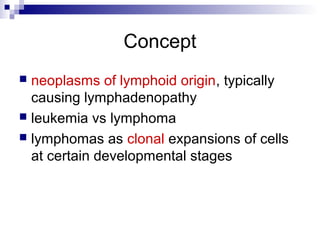
Concept
 neoplasms of lymphoid origin, typically
causing lymphadenopathy
 leukemia vs lymphoma
 lymphomas as clonal expansions of cells
at certain developmental stages
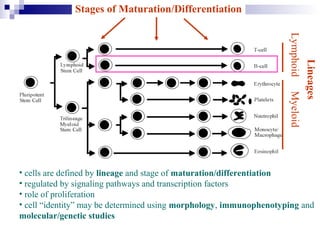
Stages of Maturation/Differentiation
Lineages
LymphoidMyeloid
• cells are defined by lineage and stage of maturation/differentiation
• regulated by signaling pathways and transcription factors
• role of proliferation
• cell “identity” may be determined using morphology, immunophenotyping and
molecular/genetic studies
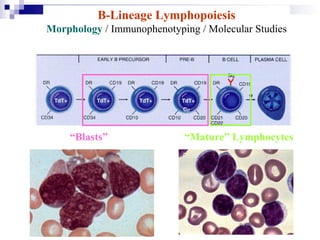
B-Lineage Lymphopoiesis
Morphology / Immunophenotyping / Molecular Studies
“Blasts” “Mature” Lymphocytes
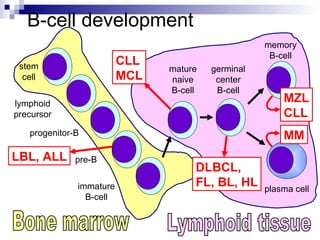
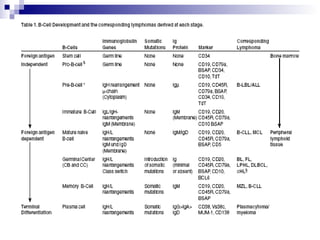
B-cell development
stem
cell
lymphoid
precursor
progenitor-B
pre-B
immature
B-cell
mature
naive
B-cell
germinal
center
B-cell
memory
B-cell
plasma cell
DLBCL,
FL, BL, HL
LBL, ALL
CLL
MCL
MM
MZL
CLL
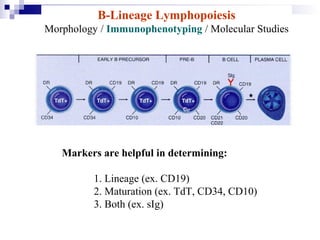
B-Lineage Lymphopoiesis
Morphology / Immunophenotyping / Molecular Studies
Markers are helpful in determining:
1. Lineage (ex. CD19)
2. Maturation (ex. TdT, CD34, CD10)
3. Both (ex. sIg)
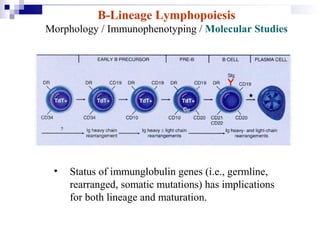
B-Lineage Lymphopoiesis
Morphology / Immunophenotyping / Molecular Studies
• Status of immunglobulin genes (i.e., germline,
rearranged, somatic mutations) has implications
for both lineage and maturation.
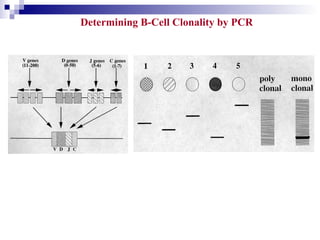
Determining B-Cell Clonality by PCR
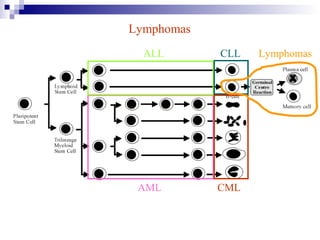
AML
ALL CLL
CML
Lymphomas
Lymphomas
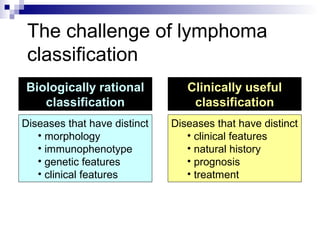
The challenge of lymphoma
classification
Clinically useful
classification
Diseases that have distinct
• clinical features
• natural history
• prognosis
• treatment
Biologically rational
classification
Diseases that have distinct
• morphology
• immunophenotype
• genetic features
• clinical features
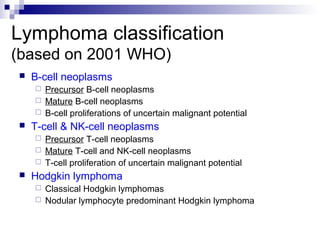
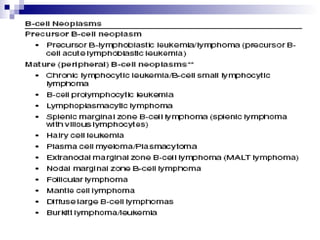
Lymphoma classification
(based on 2001 WHO)
 B-cell neoplasms
 Precursor B-cell neoplasms
 Mature B-cell neoplasms
 B-cell proliferations of uncertain malignant potential
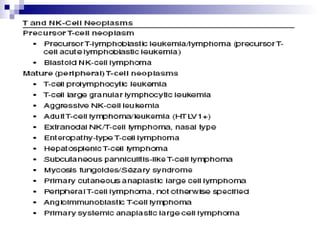
 T-cell & NK-cell neoplasms
 Precursor T-cell neoplasms
 Mature T-cell and NK-cell neoplasms
 T-cell proliferation of uncertain malignant potential
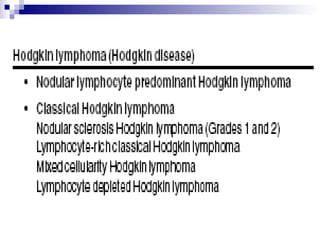
 Hodgkin lymphoma
 Classical Hodgkin lymphomas
 Nodular lymphocyte predominant Hodgkin lymphoma
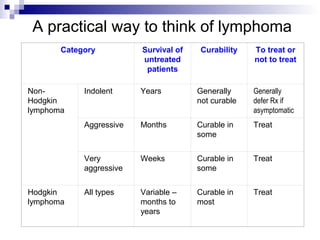
A practical way to think of lymphoma
Category Survival of
untreated
patients
Curability To treat or
not to treat
Non-
Hodgkin
lymphoma
Indolent Years Generally
not curable
Generally
defer Rx if
asymptomatic
Aggressive Months Curable in
some
Treat
Very
aggressive
Weeks Curable in
some
Treat
Hodgkin
lymphoma
All types Variable –
months to
years
Curable in
most
Treat
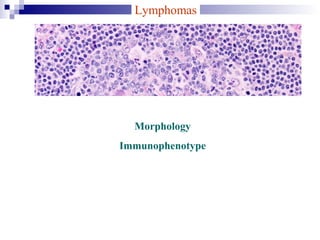
Lymphomas
Morphology
Immunophenotype
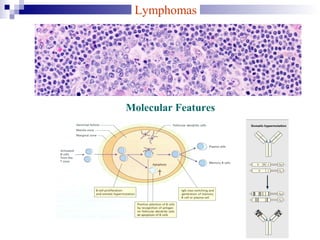
Lymphomas
Molecular Features
Mechanisms of
lymphomagenesis
 Genetic alterations
 Infection
 Antigen stimulation
 Immunosuppression
MOLECULAR PATHOGENESIS OF
NON-HODGKIN’S LYMPHOMAS
 Non-Hodgkin’s lymphomas (NHL) represent a
heterogeneous group of diseases deriving from
mature B cells 85% of cases) and, in a minority
of cases, from T cells.
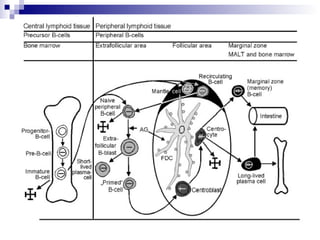
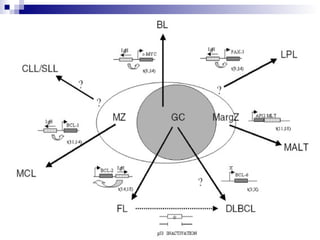
 Among B-NHL, most histologic subtypes arise
from germinal center (GC) or post-GC B cells,
since they have undergone hypermutation of the
immunoglobulin variable region (IgV) genes, a
phenomenon restricted to GC B cells.
Activation of Proto-oncogenes by
Chromosomal Translocation
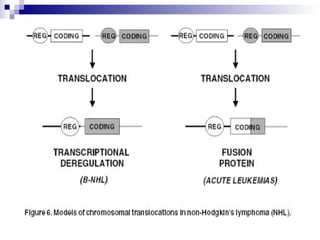
 In contrast with neoplasms of precursor
lymphoid cells, chromosomal translocations
associated with mature B and T-cell
malignancies do not generally lead to coding
fusions between two genes.
 They juxtapose the proto-oncogene to
heterologous regulatory sequences derived from
the partner chromosome.
 These sequences may derive from antigen
receptor loci as well as from other loci that are
expressed at sustained levels in normal cells
corresponding to the differentiation stage of the
lymphoma.
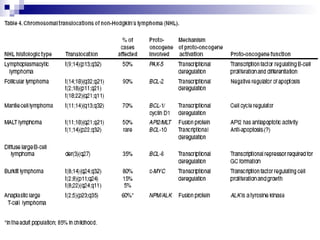
 The two exceptions to the deregulation
model of NHL translocations are
represented by the t(2;5) of T-cell
anaplastic large cell lymphoma and the
t(11;18) of MALT lymphoma, which cause
gene fusions coding for chimeric proteins.
Inactivation of tumor suppressor
loci
 Disruption of tumor suppressor loci in NHL
occurs through mechanisms similar to those
associated with other human cancers and
generally leads to biallelic inactivation, most
frequently through deletion of one allele and
mutation the other. The tumor suppressor genes
most frequently involved in the pathogenesis of
NHL are represented by p53, p16, and ATM (for
ataxia telangiectasia mutated).
 In addition, NHL frequently carry specific
chromosomal deletions, which presumably
represent sites of not yet identified tumor
suppressor loci. The most frequent of
these deletions involve the long arm of
chromosomes 6 (6q) and 13 (13q).
Somatic hypermutation
 Recent evidence suggests that important
genetic changes associated with
lymphomagenesis may derive from an
apparently aberrant activity of the somatic
hypermutation process that normally
engenders Ig diversity in germinal center
B cells by mutating the IgV genes.

Lymphoproliferative disorders

  • 1.
  • 2.
    Overview  Concepts, classification,lymphomagenesis Epidemiology  Clinical presentation  Diagnosis  Staging
  • 3.
    Concept  neoplasms oflymphoid origin, typically causing lymphadenopathy  leukemia vs lymphoma  lymphomas as clonal expansions of cells at certain developmental stages
  • 4.
    Stages of Maturation/Differentiation Lineages LymphoidMyeloid •cells are defined by lineage and stage of maturation/differentiation • regulated by signaling pathways and transcription factors • role of proliferation • cell “identity” may be determined using morphology, immunophenotyping and molecular/genetic studies
  • 5.
    B-Lineage Lymphopoiesis Morphology /Immunophenotyping / Molecular Studies “Blasts” “Mature” Lymphocytes
  • 7.
  • 8.
    B-Lineage Lymphopoiesis Morphology /Immunophenotyping / Molecular Studies Markers are helpful in determining: 1. Lineage (ex. CD19) 2. Maturation (ex. TdT, CD34, CD10) 3. Both (ex. sIg)
  • 9.
    B-Lineage Lymphopoiesis Morphology /Immunophenotyping / Molecular Studies • Status of immunglobulin genes (i.e., germline, rearranged, somatic mutations) has implications for both lineage and maturation.
  • 10.
  • 12.
  • 13.
    The challenge oflymphoma classification Clinically useful classification Diseases that have distinct • clinical features • natural history • prognosis • treatment Biologically rational classification Diseases that have distinct • morphology • immunophenotype • genetic features • clinical features
  • 14.
    Lymphoma classification (based on2001 WHO)  B-cell neoplasms  Precursor B-cell neoplasms  Mature B-cell neoplasms  B-cell proliferations of uncertain malignant potential  T-cell & NK-cell neoplasms  Precursor T-cell neoplasms  Mature T-cell and NK-cell neoplasms  T-cell proliferation of uncertain malignant potential  Hodgkin lymphoma  Classical Hodgkin lymphomas  Nodular lymphocyte predominant Hodgkin lymphoma
  • 18.
    A practical wayto think of lymphoma Category Survival of untreated patients Curability To treat or not to treat Non- Hodgkin lymphoma Indolent Years Generally not curable Generally defer Rx if asymptomatic Aggressive Months Curable in some Treat Very aggressive Weeks Curable in some Treat Hodgkin lymphoma All types Variable – months to years Curable in most Treat
  • 19.
  • 20.
  • 21.
    Mechanisms of lymphomagenesis  Geneticalterations  Infection  Antigen stimulation  Immunosuppression
  • 22.
    MOLECULAR PATHOGENESIS OF NON-HODGKIN’SLYMPHOMAS  Non-Hodgkin’s lymphomas (NHL) represent a heterogeneous group of diseases deriving from mature B cells 85% of cases) and, in a minority of cases, from T cells.  Among B-NHL, most histologic subtypes arise from germinal center (GC) or post-GC B cells, since they have undergone hypermutation of the immunoglobulin variable region (IgV) genes, a phenomenon restricted to GC B cells.
  • 24.
    Activation of Proto-oncogenesby Chromosomal Translocation  In contrast with neoplasms of precursor lymphoid cells, chromosomal translocations associated with mature B and T-cell malignancies do not generally lead to coding fusions between two genes.  They juxtapose the proto-oncogene to heterologous regulatory sequences derived from the partner chromosome.  These sequences may derive from antigen receptor loci as well as from other loci that are expressed at sustained levels in normal cells corresponding to the differentiation stage of the lymphoma.
  • 26.
     The twoexceptions to the deregulation model of NHL translocations are represented by the t(2;5) of T-cell anaplastic large cell lymphoma and the t(11;18) of MALT lymphoma, which cause gene fusions coding for chimeric proteins.
  • 28.
    Inactivation of tumorsuppressor loci  Disruption of tumor suppressor loci in NHL occurs through mechanisms similar to those associated with other human cancers and generally leads to biallelic inactivation, most frequently through deletion of one allele and mutation the other. The tumor suppressor genes most frequently involved in the pathogenesis of NHL are represented by p53, p16, and ATM (for ataxia telangiectasia mutated).
  • 29.
     In addition,NHL frequently carry specific chromosomal deletions, which presumably represent sites of not yet identified tumor suppressor loci. The most frequent of these deletions involve the long arm of chromosomes 6 (6q) and 13 (13q).
  • 30.
    Somatic hypermutation  Recentevidence suggests that important genetic changes associated with lymphomagenesis may derive from an apparently aberrant activity of the somatic hypermutation process that normally engenders Ig diversity in germinal center B cells by mutating the IgV genes.