IHC needed in 10-25% of malignant tumors for
 Narrowing of possibilities
 Specific diagnosis
 Unsuspected diagnosis
 A correct histopathological diagnosis saves time,
money and inconvenience for the patients and
clinicians.
 Likelihood of a given diagnosis.
 Relevant differential diagnoses.
 Optimal selection of antibodies for a diagnostic
algorithm
Primary antibody panels and secondary antibody
panels
 Panel should include not only antibodies that would
expect to be positive in a given tumor , but also
antibodies that would be expected to be negative .
 IHC has revolutionized the field of
histopathology .
 Today IHC markers of almost every tumor has
been defined.
 IHC still has the long way to know the
histogenesis of yet unknown lesions.
 Immunohistochemistry is a technique for
identifying tissue constituents (antigens) by
means of antigen-antibody interactions.
 The site of antibody binding being identified
either by direct labeling of the antibody, or by
use of secondary antibody labeling method.
IMMUNOHSITOCHEMISTRY STEPS
Slide 3 of 23
Tissue sections
Antigen retrieval
Blocking endogenous enzymes
Secondary antibody
Primary antibody
Microscopy Observation
Blocking background staining
Chromogen Substrate
Counterstain
Mounting
 Tissue sections are incubated with primary
antibodies against the target antigen.
 The specimens are then washed and a
secondary antibody against primary antibody
is added.
 The secondary antibodies are often
biotinylated, that is, conjugated to biotin, a
vitamin with an extremely high affinity for the
protein streptavidine.
 A complex made of streptavidin and the
enzyme peroxidase is used for staining.
 The addition of a chromogenic substrate such
as diaminobenzidine (DAB) or
aminoethylcarbazole (AEC), leads to a color
staining reaction that accurately reflects the
distribution of the target antigen in the tissue
sample.
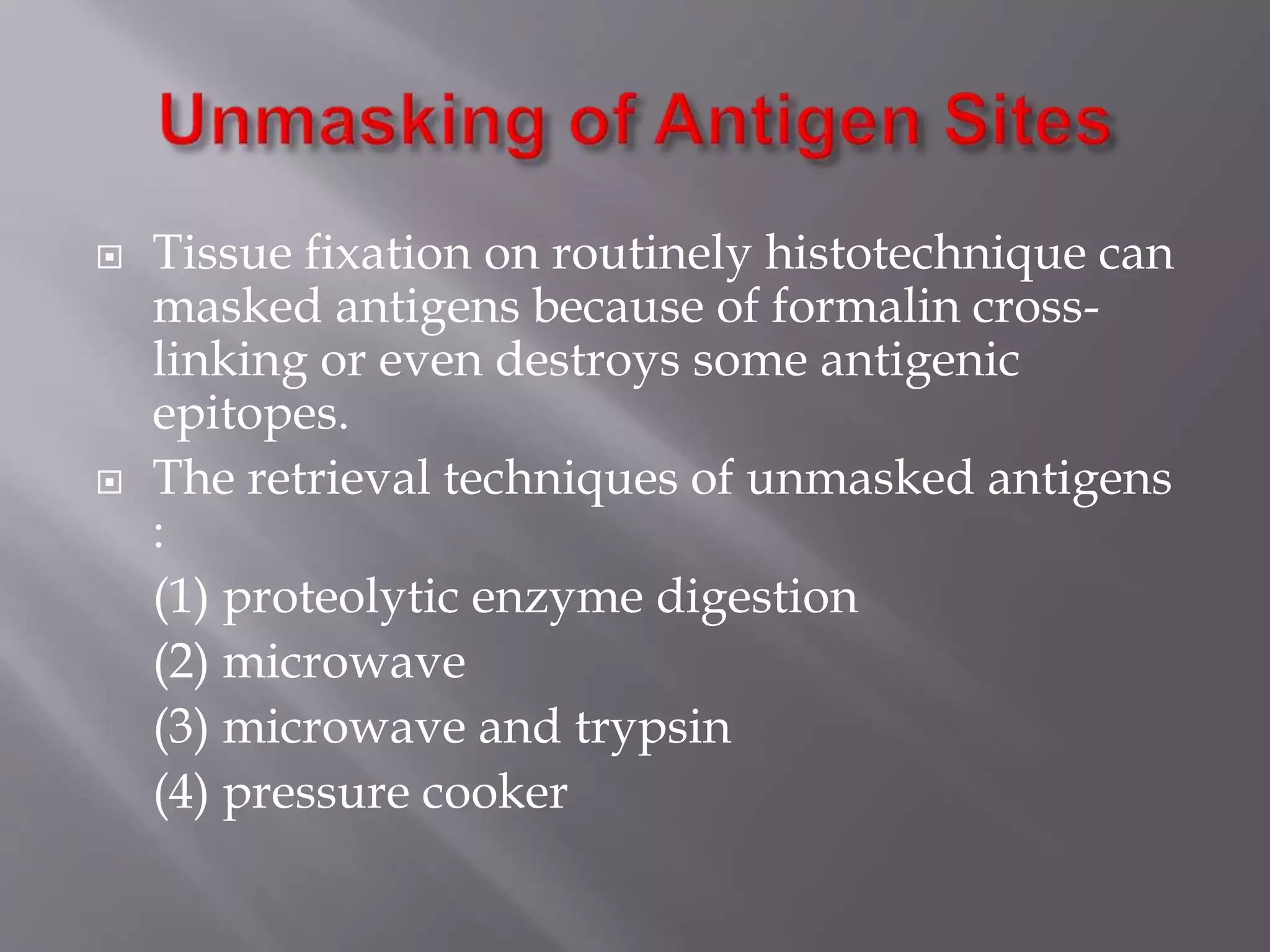
 Tissue fixation on routinely histotechnique can
masked antigens because of formalin cross-
linking or even destroys some antigenic
epitopes.
 The retrieval techniques of unmasked antigens
:
(1) proteolytic enzyme digestion
(2) microwave
(3) microwave and trypsin
(4) pressure cooker
1’Ab : primary antibody
2’Ab : secondary antibody
B : biotin
SA : streptavidine
HRP : horseradish
peroxidase
Target is antigen (protein
argets)
Blocking reagent : BSA
(bovine serum
albumin)
The sandwich of antigen recognition
on tissue samples.
Direct labeling of antibody Secondary antibody
labeling
 Enzyme labels
 Colloidal metal labels
 Fluorescent labels
 Radiolabels
 Horseradish peroxidase
 Alkaline phosphatase
 Bacterial-derived beta-D-galactosidase
GENERIC CATEGORIES
 Round-cell tumors
 Undifferentiated tumors
 Metastatic tumors
 Spindle-cell tumors
 Hematopoietic tumors
 Small cell carcinoma
 Malignant melanoma
 Lymphoma
 Neuroblastoma
 Ewing sarcoma/Primitive neuroectodermaltumor (ES/PNET)
 Rhabdomyosarcoma(RMS)
 Poorly differentiated synovial sarcoma( PDSS)
 Desmoplasticround cell tumor (DRCT)
 KERATIN S100
 EMA HMB45
 CD45 MART-1
 CD15 FLI-1
 VIMENTIN SYN
 DES CD56
 MSA CD99
 MYOGENIN
N0N
SARC
OMA
NS NS SARC
OMA
S S S S
Small
cell
carcin
oma
melan
oma
lymph
oma
neurob
lastom
a
rhabdo
myosa
rcoma
ES/
PNET
PDSS DRCT
CK + +/- - - RARE +/- + +
S -100 - + - + - +/- +/- -
Desmi
n
- +/- - - + - - +
CD99
(Mic 2)
- - +/- - -/+ + + RARE
LCA
(CD
45)
- - + - - - - -
Lympho
ma
carcinom
a
melanom
a
sarcoma Mesothel
ioma
glioma
LCA (CD
-45)
+ - - - - -
CK - + - - + -
S-100 - -/+ + -/+ - -
Vimentin -/+ -/+ + + + +
GFAP - - - - - +
HMB 45 - - + - - -
LYMPHOMA WHICH CAN BE LCA (CD 45) -NEGATIVE
 Lymphoblastic Lymphoma
 Anaplastic large cell Lymphoma
 Plasmablastic Lymphoma
 Peripheral T-cell type ( Some cases) Lymphoma
 Classic Hodgkin lymphoma ( RS cells)
LYMPHOMA
LCA (CD 45) +
CK -
S -100 -
Vimentin -/+
GFAP -
HMB 45 -
CARCINOMAS WHICH CAN BE LMW-CK
NEGETIVE
 Renal cell carcinoma
 Adrenal cortical carcinoma
 Small cell carcinoma
CARCINOMA
LCA (CD 45) -
CK +
S-100 -/+
Vimentin -/+
GFAP -
HMB-45 -
SARCOMA WHICH CAN BE CK-POSITIVE
 Synovial sarcoma
 Epitheloid sarcoma
 Malignant rhabdoid tumor
 Myogenic tumor (some)
 Angio sarcoma(some)
sarcoma
LCA (CD45) -
CK -
S-100 -/+
Vimentin +
GFAP -
HMB 45 -
If LCA ,CK and S-100 all are negative
Possibilities are
 Angiosarcoma(add CD 31)
 Anaplasticplasmacytoma( add CD79a & Kappa / lambda)
 Hodgkin lymphoma
 Germinoma
 Various sarcomas
EMA Desmin p53
Reactive
mesothelial cells
- or focal + + -
Malignant
mesothelioma
+ (membranous) - Or focal + +
Msothelioma Adenocarcinoma
Calretinin + (nuclear) -
CK 5/6 + -
WT – 1 + (nuclear) -
CEA - +
MOC – 31 - +
B 72.3 - +
 CK & EMA
 S100 protein
 CD15
 PSA
 Thyroglobulin
 TTF-1
 CEA
 CA19.9
 CA-125
 Placental alkaline phosphatase
 ER , PR
male
PSA - Prostate
common
Thyroglobulin /
calcitonin-
thyroid
CK 7 & CK 20
female
CA -125 –
Genital tract
adenocarcinoma
GCDFP-15 -
bREAST
CK 7 +VE ADENOCA CK 20-VE
ADENOCA
Prediction of primary site of a squamouscell carcinoma is a difficult task.
In some cases the following can be done :
 CK20 + ( CK7 +) : Transitional carcinoma of urinary bladder
 EBV + : Nasopharyngeal carcinoma /lymphoepitheliomalike carcinoma
 Mediastinaltumor :
CD 5 : positive = primary thymiccarcinoma
negative = metastatic carcinoma
CYTOKERATINPO
SITIVE
 Synovial sarcoma
 Fibrosarcoma
 Malignant peripheral nerve sheath tumor(MPNST)
 Leiomyosarcoma
 Solitary fibrous tumor
 KERATIN S100 PROTEIN
 ACTIN CD34
 EMA CD56
 VIMENTIN CD31
 DESMIN CD57
 THROMBOMODULIN CD99
Synovial
sarcoma
MPNST Fibro
sarcoma
Leiomyo
sarcoma
Solitary
fibrous
tumor
CK + - - Rare Rare
S-100 +/- + - Rare -
CD 34 - +/- - Rare +
Smooth
muscle
actin
- - +/-
(myofibros
arcoma)
+ -
S-100
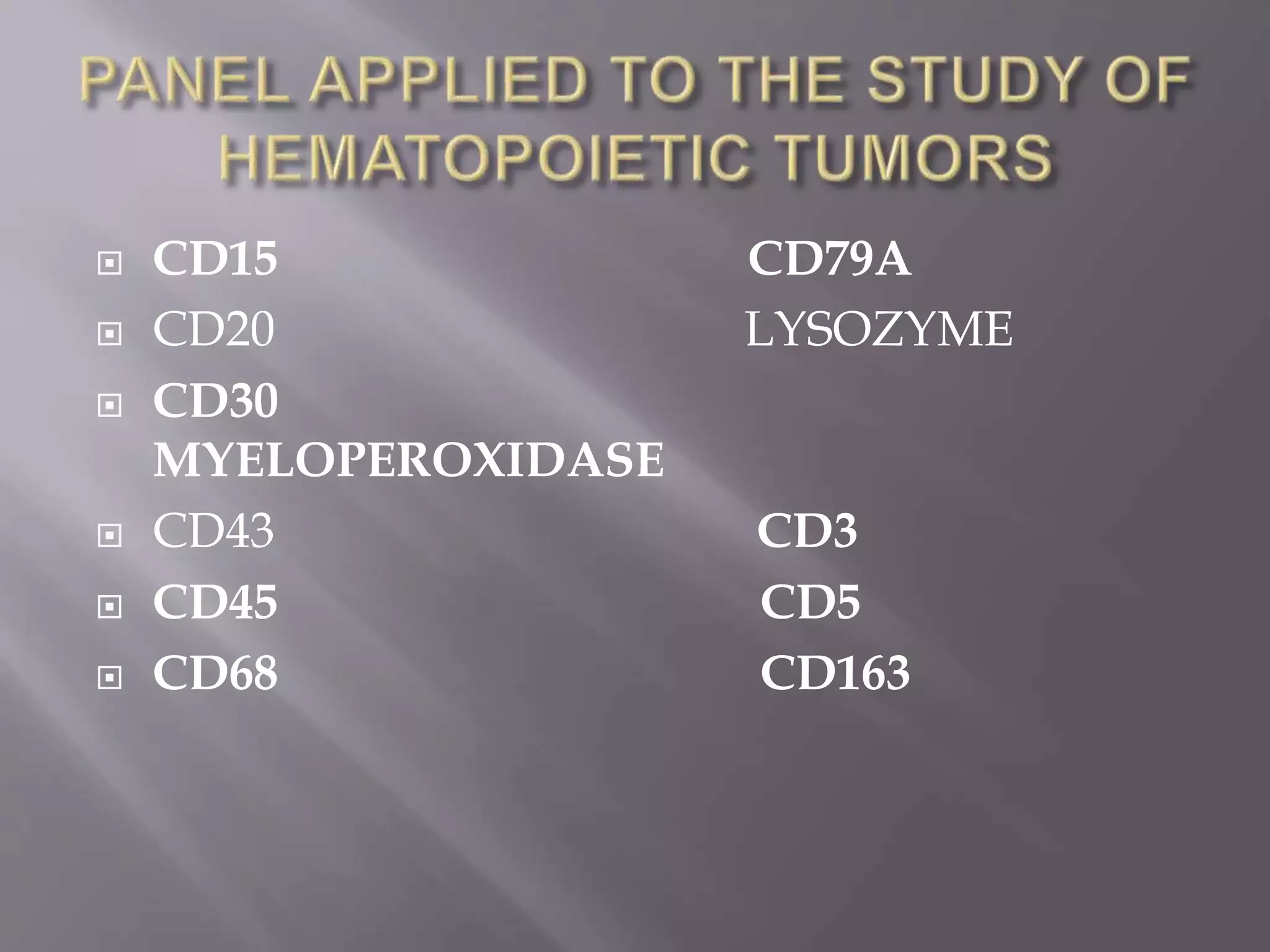
 CD15 CD79A
 CD20 LYSOZYME
 CD30
MYELOPEROXIDASE
 CD43 CD3
 CD45 CD5
 CD68 CD163
 LCA (CD 45) : to differentiate lymphoid from
other non-lymphoid lesions
 Bcl-2 : + in follicular lymphomas-in follicular
hyperplasia
 Kappa & lambda chain restriction : monoclonal
neoplastic proliferation from polyclonal
reactive plasma cell proliferation
CD 45 CD3 CD45
RO
CD20 CD15 CD30 CD68 CD99
B cell
lymph
oma
+ - - + - +/- - -
T cell + + + - - + - -
Hodgk
in’s
dis.
+/- - - - + + - -
lymph
oblasti
c
+/- - - - - - - +
histioc
ytic
+/- - - - - - + -
NLPHL ClassicalHL
LCA (CD 45)
+ _
CD20
+ +/_
CD30 _ +
CD 15 _ +
EMA + _
CD- 57
Many small lymphocytes
form rosettes the L &H
cells
Few CD 57+ small
lymhocytes
CD-5 CD-23 IgD CyclinD1 Bcl-6
B-
Chronicly
mphocytic
leukemia /
small
lyphocyticl
ymphoma
+ + + _ _
Mantle cell
lymphoma
+ _ + + _
Minimum markers are : ER, PR & c-erbB2
ER+ ,PR+ tumors are a/w better prognosis
Show better response to hormonal therapy
ER positive in invasive lobular carcinoma of breast
Gastric carcinoma Keratin, EMA , CEA +
CK 7 + , CK20 +
Carcinoidtumor ACTH , NSE , Chromogranin+
Synaptophysin, keratin +
Colorectal Carcinoma CK20 + , CK 7 –( D/D lung & ovarian
adenocarcinoma
GIST CD117 + (100%)
Cytoplasmic & membrane
( D/D Fibromatosis)
Tumor Antibody panel
Prostate Carcinoma PAP & PSA +
34BE12 –(d/d benign lesion)
P504S +
Seminoma PLAP , CD117 , LDH , Vimentin+
EMA , CD 30 , HMWK –
EmbryonalCa EMA ,CD30 , HMWK +
Choriocarcinoma hCG+
Tumor Antibody panel
Hepatocellularcarcinoma AFP , Keratin , EMA +
Hep-par1 +
CEA -
Cholangiocarcinoma EMA , CEA,Keratin +
GB Carcinoma CK 7+ & CK20 + (d/d
cholangiocarcinoma)
Pancreaticcarcinoma Keratin , EMA , CEA , CD 19-9+
Tumor Antibody panel
Renalcell carcinoma Coexpressionof keratin + vimentin
A103 , inhibin–(d/d adrenocorticalca)
CA125 -(d/d ovarian ca)
TTF -1 , thyroglobulin–( d/d
thymiccarcinoma)
Transitional carcinoma of bladder CK 7+ & CK20 +
CEA , cathepsinB +
Tumor Antibody panel
Pheochromocytoma Catecholamine, neuronal marker +
S-100 +
Neuroblastoma NSE , neurophilaments+
Chromogranin, Synaptophysin+
Adrenocorticalneoplasm Vimentin, Synaptophysin+
Inhibin, A103 +
Chromogranin
Tumor Antibody panel
Osteoid Osteonectin,
osteopontin+
Osteocalcin+
Cartilage S-100 +
Ewing’ ssarcoma CD99 , vimentin+
NSE , neurophilaments+
Tumor Antibody panel
Papillary carcinoma CK 7 + , CK 20 -,
CK 19 +
HMWK +
Follicular carcinoma Thyroglobulin, TTF –1+
LMWK , EMA +
Medullarycarcinoma Calcitonin, CEA +
Chromogranin+
Tumor Antibody panel
Adenocarcinomacervix Keratin , EMA , CEA , HPV +
Endometrial carcinoma ER , PR +
HER2/ neu, GLUT 1 +
Ovarian carcinoma CK 7 + , CK 20 -,
CA 125+
Mesothelioma Calretinin, thrombomodulin+
CK 5/6 +
Tumor Antibody panel
Astrocyticneoplasm GFAP +
AE 1/3CK cocktail -
Oligodendroglioma S100 , Leu7+
Ependymoma GFAP , S100 , vimentin+
Meningioma EMA , S 100 +
CK 20-
Tumor Antibody panel
MucoepidermoidCarcinoma CK 7 , CK 14 +
Aciniccell carcinoma Keratin , amylase , IgA +
Transferrin, lactoferrin+
Adenoid cystic carcinoma Keratin, CEA,S100 , CD117 +
Lysosome, lactoferrin+
Myoepithelioma Keratin , S100 +
Vimentin, actin, myosin+
Tumor Antibody panel
Thymic carcinoma CD5 , CD 70 +
TTF -1 -(d/d from lung carcinoma)
Thymoma Keratin , EMA , CEA+
CD 99, CD 1a +
S100 +
 ANTIBODY TO SPECIFICITY
 CK Carcinoma ( epithelial tumors)
 Vimentin Sarcoma (mesenchymaltumors)
 GFAP Gliomas
 HMB -45 Melanoma
 S-100 Neoplasm of neural origin
 CD 68 Proliferationof mast cell
 CD 45 Neoplasm of lymphoid origin
 CD 45 RO Neoplasm of T cell origin
 CD 3 Neoplasm of T cell origin
 CD 20 Neoplasm of B cell origin
 CD 15 Hodgkin’s disease
 CD117 GIST
 CD5 Mantle cell lymphoma
 NB -84 Neuroblastoma
 Chromogranin Neuroendocrinetumors ( pan-endocrine marker)
Cancer and ihc markers

Cancer and ihc markers

  • 2.
    IHC needed in10-25% of malignant tumors for  Narrowing of possibilities  Specific diagnosis  Unsuspected diagnosis  A correct histopathological diagnosis saves time, money and inconvenience for the patients and clinicians.
  • 3.
     Likelihood ofa given diagnosis.  Relevant differential diagnoses.  Optimal selection of antibodies for a diagnostic algorithm Primary antibody panels and secondary antibody panels  Panel should include not only antibodies that would expect to be positive in a given tumor , but also antibodies that would be expected to be negative .
  • 4.
     IHC hasrevolutionized the field of histopathology .  Today IHC markers of almost every tumor has been defined.  IHC still has the long way to know the histogenesis of yet unknown lesions.
  • 5.
     Immunohistochemistry isa technique for identifying tissue constituents (antigens) by means of antigen-antibody interactions.  The site of antibody binding being identified either by direct labeling of the antibody, or by use of secondary antibody labeling method.
  • 6.
    IMMUNOHSITOCHEMISTRY STEPS Slide 3of 23 Tissue sections Antigen retrieval Blocking endogenous enzymes Secondary antibody Primary antibody Microscopy Observation Blocking background staining Chromogen Substrate Counterstain Mounting
  • 7.
     Tissue sectionsare incubated with primary antibodies against the target antigen.  The specimens are then washed and a secondary antibody against primary antibody is added.  The secondary antibodies are often biotinylated, that is, conjugated to biotin, a vitamin with an extremely high affinity for the protein streptavidine.
  • 8.
     A complexmade of streptavidin and the enzyme peroxidase is used for staining.  The addition of a chromogenic substrate such as diaminobenzidine (DAB) or aminoethylcarbazole (AEC), leads to a color staining reaction that accurately reflects the distribution of the target antigen in the tissue sample.
  • 9.
     Tissue fixationon routinely histotechnique can masked antigens because of formalin cross- linking or even destroys some antigenic epitopes.  The retrieval techniques of unmasked antigens : (1) proteolytic enzyme digestion (2) microwave (3) microwave and trypsin (4) pressure cooker
  • 10.
    1’Ab : primaryantibody 2’Ab : secondary antibody B : biotin SA : streptavidine HRP : horseradish peroxidase Target is antigen (protein argets) Blocking reagent : BSA (bovine serum albumin) The sandwich of antigen recognition on tissue samples.
  • 11.
    Direct labeling ofantibody Secondary antibody labeling
  • 12.
     Enzyme labels Colloidal metal labels  Fluorescent labels  Radiolabels
  • 13.
     Horseradish peroxidase Alkaline phosphatase  Bacterial-derived beta-D-galactosidase
  • 14.
    GENERIC CATEGORIES  Round-celltumors  Undifferentiated tumors  Metastatic tumors  Spindle-cell tumors  Hematopoietic tumors
  • 15.
     Small cellcarcinoma  Malignant melanoma  Lymphoma  Neuroblastoma  Ewing sarcoma/Primitive neuroectodermaltumor (ES/PNET)  Rhabdomyosarcoma(RMS)  Poorly differentiated synovial sarcoma( PDSS)  Desmoplasticround cell tumor (DRCT)
  • 16.
     KERATIN S100 EMA HMB45  CD45 MART-1  CD15 FLI-1  VIMENTIN SYN  DES CD56  MSA CD99  MYOGENIN
  • 17.
    N0N SARC OMA NS NS SARC OMA SS S S Small cell carcin oma melan oma lymph oma neurob lastom a rhabdo myosa rcoma ES/ PNET PDSS DRCT CK + +/- - - RARE +/- + + S -100 - + - + - +/- +/- - Desmi n - +/- - - + - - + CD99 (Mic 2) - - +/- - -/+ + + RARE LCA (CD 45) - - + - - - - -
  • 18.
    Lympho ma carcinom a melanom a sarcoma Mesothel ioma glioma LCA (CD -45) +- - - - - CK - + - - + - S-100 - -/+ + -/+ - - Vimentin -/+ -/+ + + + + GFAP - - - - - + HMB 45 - - + - - -
  • 19.
    LYMPHOMA WHICH CANBE LCA (CD 45) -NEGATIVE  Lymphoblastic Lymphoma  Anaplastic large cell Lymphoma  Plasmablastic Lymphoma  Peripheral T-cell type ( Some cases) Lymphoma  Classic Hodgkin lymphoma ( RS cells) LYMPHOMA LCA (CD 45) + CK - S -100 - Vimentin -/+ GFAP - HMB 45 -
  • 20.
    CARCINOMAS WHICH CANBE LMW-CK NEGETIVE  Renal cell carcinoma  Adrenal cortical carcinoma  Small cell carcinoma CARCINOMA LCA (CD 45) - CK + S-100 -/+ Vimentin -/+ GFAP - HMB-45 -
  • 21.
    SARCOMA WHICH CANBE CK-POSITIVE  Synovial sarcoma  Epitheloid sarcoma  Malignant rhabdoid tumor  Myogenic tumor (some)  Angio sarcoma(some) sarcoma LCA (CD45) - CK - S-100 -/+ Vimentin + GFAP - HMB 45 -
  • 22.
    If LCA ,CKand S-100 all are negative Possibilities are  Angiosarcoma(add CD 31)  Anaplasticplasmacytoma( add CD79a & Kappa / lambda)  Hodgkin lymphoma  Germinoma  Various sarcomas
  • 23.
    EMA Desmin p53 Reactive mesothelialcells - or focal + + - Malignant mesothelioma + (membranous) - Or focal + +
  • 24.
    Msothelioma Adenocarcinoma Calretinin +(nuclear) - CK 5/6 + - WT – 1 + (nuclear) - CEA - + MOC – 31 - + B 72.3 - +
  • 26.
     CK &EMA  S100 protein  CD15  PSA  Thyroglobulin  TTF-1  CEA  CA19.9  CA-125  Placental alkaline phosphatase  ER , PR
  • 27.
    male PSA - Prostate common Thyroglobulin/ calcitonin- thyroid CK 7 & CK 20 female CA -125 – Genital tract adenocarcinoma GCDFP-15 - bREAST
  • 29.
    CK 7 +VEADENOCA CK 20-VE ADENOCA
  • 30.
    Prediction of primarysite of a squamouscell carcinoma is a difficult task. In some cases the following can be done :  CK20 + ( CK7 +) : Transitional carcinoma of urinary bladder  EBV + : Nasopharyngeal carcinoma /lymphoepitheliomalike carcinoma  Mediastinaltumor : CD 5 : positive = primary thymiccarcinoma negative = metastatic carcinoma
  • 31.
  • 33.
     Synovial sarcoma Fibrosarcoma  Malignant peripheral nerve sheath tumor(MPNST)  Leiomyosarcoma  Solitary fibrous tumor
  • 34.
     KERATIN S100PROTEIN  ACTIN CD34  EMA CD56  VIMENTIN CD31  DESMIN CD57  THROMBOMODULIN CD99
  • 35.
    Synovial sarcoma MPNST Fibro sarcoma Leiomyo sarcoma Solitary fibrous tumor CK +- - Rare Rare S-100 +/- + - Rare - CD 34 - +/- - Rare + Smooth muscle actin - - +/- (myofibros arcoma) + -
  • 36.
  • 37.
     CD15 CD79A CD20 LYSOZYME  CD30 MYELOPEROXIDASE  CD43 CD3  CD45 CD5  CD68 CD163
  • 38.
     LCA (CD45) : to differentiate lymphoid from other non-lymphoid lesions  Bcl-2 : + in follicular lymphomas-in follicular hyperplasia  Kappa & lambda chain restriction : monoclonal neoplastic proliferation from polyclonal reactive plasma cell proliferation
  • 39.
    CD 45 CD3CD45 RO CD20 CD15 CD30 CD68 CD99 B cell lymph oma + - - + - +/- - - T cell + + + - - + - - Hodgk in’s dis. +/- - - - + + - - lymph oblasti c +/- - - - - - - + histioc ytic +/- - - - - - + -
  • 40.
    NLPHL ClassicalHL LCA (CD45) + _ CD20 + +/_ CD30 _ + CD 15 _ + EMA + _ CD- 57 Many small lymphocytes form rosettes the L &H cells Few CD 57+ small lymhocytes
  • 41.
    CD-5 CD-23 IgDCyclinD1 Bcl-6 B- Chronicly mphocytic leukemia / small lyphocyticl ymphoma + + + _ _ Mantle cell lymphoma + _ + + _
  • 43.
    Minimum markers are: ER, PR & c-erbB2 ER+ ,PR+ tumors are a/w better prognosis Show better response to hormonal therapy ER positive in invasive lobular carcinoma of breast
  • 44.
    Gastric carcinoma Keratin,EMA , CEA + CK 7 + , CK20 + Carcinoidtumor ACTH , NSE , Chromogranin+ Synaptophysin, keratin + Colorectal Carcinoma CK20 + , CK 7 –( D/D lung & ovarian adenocarcinoma GIST CD117 + (100%) Cytoplasmic & membrane ( D/D Fibromatosis)
  • 45.
    Tumor Antibody panel ProstateCarcinoma PAP & PSA + 34BE12 –(d/d benign lesion) P504S + Seminoma PLAP , CD117 , LDH , Vimentin+ EMA , CD 30 , HMWK – EmbryonalCa EMA ,CD30 , HMWK + Choriocarcinoma hCG+
  • 46.
    Tumor Antibody panel HepatocellularcarcinomaAFP , Keratin , EMA + Hep-par1 + CEA - Cholangiocarcinoma EMA , CEA,Keratin + GB Carcinoma CK 7+ & CK20 + (d/d cholangiocarcinoma) Pancreaticcarcinoma Keratin , EMA , CEA , CD 19-9+
  • 47.
    Tumor Antibody panel Renalcellcarcinoma Coexpressionof keratin + vimentin A103 , inhibin–(d/d adrenocorticalca) CA125 -(d/d ovarian ca) TTF -1 , thyroglobulin–( d/d thymiccarcinoma) Transitional carcinoma of bladder CK 7+ & CK20 + CEA , cathepsinB +
  • 48.
    Tumor Antibody panel PheochromocytomaCatecholamine, neuronal marker + S-100 + Neuroblastoma NSE , neurophilaments+ Chromogranin, Synaptophysin+ Adrenocorticalneoplasm Vimentin, Synaptophysin+ Inhibin, A103 + Chromogranin
  • 49.
    Tumor Antibody panel OsteoidOsteonectin, osteopontin+ Osteocalcin+ Cartilage S-100 + Ewing’ ssarcoma CD99 , vimentin+ NSE , neurophilaments+
  • 50.
    Tumor Antibody panel Papillarycarcinoma CK 7 + , CK 20 -, CK 19 + HMWK + Follicular carcinoma Thyroglobulin, TTF –1+ LMWK , EMA + Medullarycarcinoma Calcitonin, CEA + Chromogranin+
  • 51.
    Tumor Antibody panel AdenocarcinomacervixKeratin , EMA , CEA , HPV + Endometrial carcinoma ER , PR + HER2/ neu, GLUT 1 + Ovarian carcinoma CK 7 + , CK 20 -, CA 125+ Mesothelioma Calretinin, thrombomodulin+ CK 5/6 +
  • 52.
    Tumor Antibody panel AstrocyticneoplasmGFAP + AE 1/3CK cocktail - Oligodendroglioma S100 , Leu7+ Ependymoma GFAP , S100 , vimentin+ Meningioma EMA , S 100 + CK 20-
  • 53.
    Tumor Antibody panel MucoepidermoidCarcinomaCK 7 , CK 14 + Aciniccell carcinoma Keratin , amylase , IgA + Transferrin, lactoferrin+ Adenoid cystic carcinoma Keratin, CEA,S100 , CD117 + Lysosome, lactoferrin+ Myoepithelioma Keratin , S100 + Vimentin, actin, myosin+
  • 54.
    Tumor Antibody panel Thymiccarcinoma CD5 , CD 70 + TTF -1 -(d/d from lung carcinoma) Thymoma Keratin , EMA , CEA+ CD 99, CD 1a + S100 +
  • 55.
     ANTIBODY TOSPECIFICITY  CK Carcinoma ( epithelial tumors)  Vimentin Sarcoma (mesenchymaltumors)  GFAP Gliomas  HMB -45 Melanoma  S-100 Neoplasm of neural origin  CD 68 Proliferationof mast cell  CD 45 Neoplasm of lymphoid origin  CD 45 RO Neoplasm of T cell origin  CD 3 Neoplasm of T cell origin  CD 20 Neoplasm of B cell origin  CD 15 Hodgkin’s disease  CD117 GIST  CD5 Mantle cell lymphoma  NB -84 Neuroblastoma  Chromogranin Neuroendocrinetumors ( pan-endocrine marker)