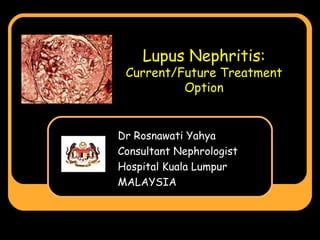
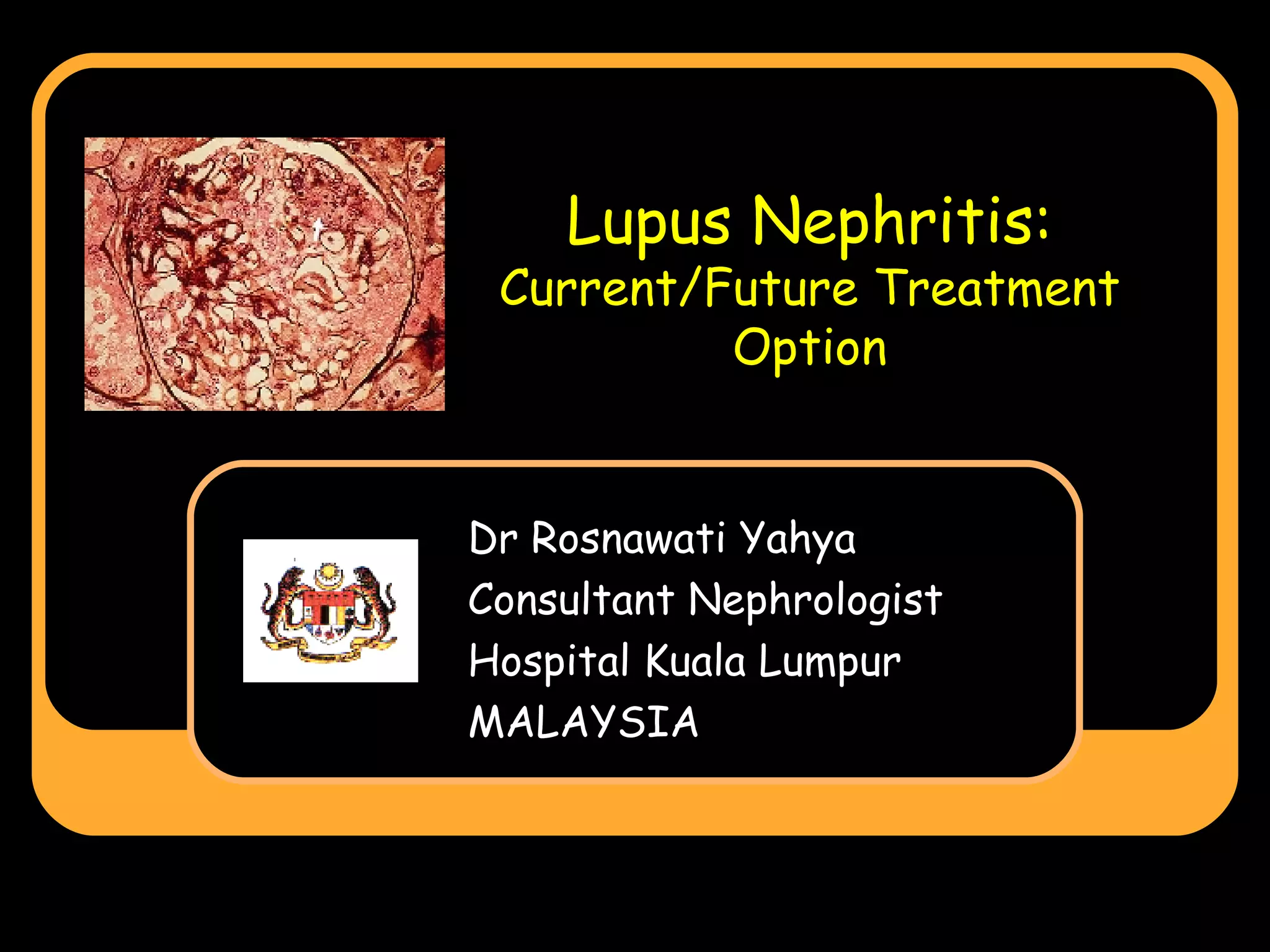


Lupus Nephritis: Current/Future Treatment Option Dr Rosnawati Yahya Consultant Nephrologist Hospital Kuala Lumpur MALAYSIA
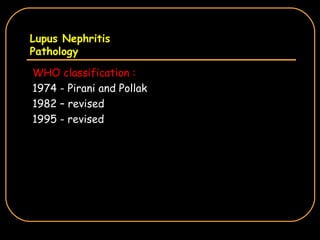
Lupus Nephritis Pathology WHO classification : 1974 - Pirani and Pollak 1982 – revised 1995 - revised
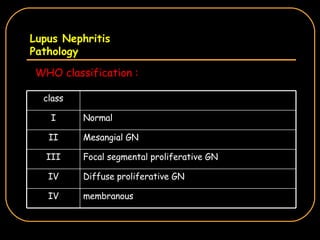
Lupus Nephritis Pathology WHO classification : membranous IV Diffuse proliferative GN IV Focal segmental proliferative GN III Mesangial GN II Normal I class
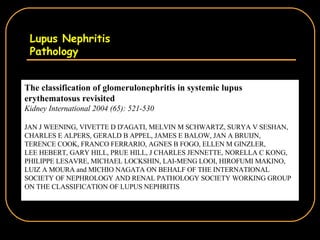
Lupus Nephritis Pathology The classification of glomerulonephritis in systemic lupus erythematosus revisited Kidney International 2004 (65): 521-530 JAN J WEENING, VIVETTE D D'AGATI, MELVIN M SCHWARTZ, SURYA V SESHAN, CHARLES E ALPERS, GERALD B APPEL, JAMES E BALOW, JAN A BRUIJN, TERENCE COOK, FRANCO FERRARIO, AGNES B FOGO, ELLEN M GINZLER, LEE HEBERT, GARY HILL, PRUE HILL, J CHARLES JENNETTE, NORELLA C KONG, PHILIPPE LESAVRE, MICHAEL LOCKSHIN, LAI-MENG LOOI, HIROFUMI MAKINO, LUIZ A MOURA and MICHIO NAGATA ON BEHALF OF THE INTERNATIONAL SOCIETY OF NEPHROLOGY AND RENAL PATHOLOGY SOCIETY WORKING GROUP ON THE CLASSIFICATION OF LUPUS NEPHRITIS
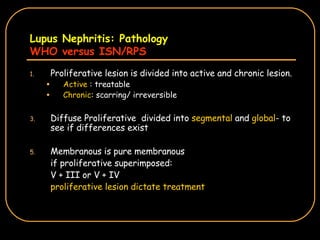
Lupus Nephritis: Pathology WHO versus ISN/RPS Proliferative lesion is divided into active and chronic lesion. Active  : treatable Chronic : scarring/ irreversible Diffuse Proliferative  divided into  segmental  and  global - to see if differences exist Membranous is pure membranous  if proliferative superimposed: V + III or V + IV proliferative lesion dictate treatment
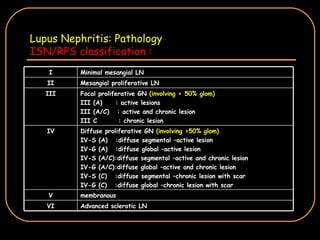
Lupus Nephritis: Pathology ISN/RPS classification : membranous V Advanced sclerotic LN VI Diffuse proliferative GN  (involving >50% glom) IV-S (A)  :diffuse segmental –active lesion IV-G (A)  :diffuse global –active lesion IV-S (A/C):diffuse segmental –active and chronic lesion IV-G (A/C):diffuse global –active and chronic lesion IV-S (C)  :diffuse segmental –chronic lesion with scar IV-G (C)  :diffuse global –chronic lesion with scar IV Focal proliferative GN  (involving < 50% glom) III (A)  : active lesions III (A/C)  : active and chronic lesion III C  : chronic lesion III Mesangial proliferative LN II Minimal mesangial LN I
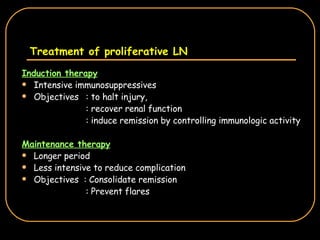
Treatment of proliferative LN Induction therapy Intensive immunosuppressives Objectives : to halt injury,  : recover renal function  : induce remission by controlling immunologic activity Maintenance therapy Longer period Less intensive to reduce complication Objectives  : Consolidate remission : Prevent flares
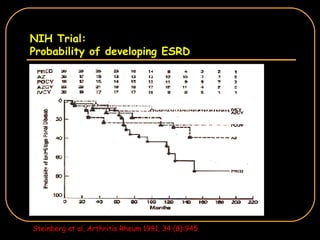
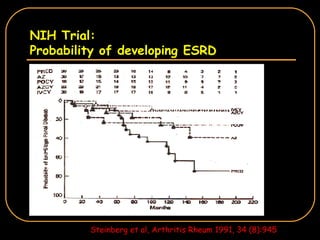
NIH Trial: Probability of developing ESRD   Steinberg et al, Arthritis Rheum 1991, 34 (8):945
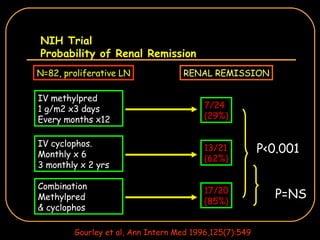
NIH Trial Probability of Renal Remission N=82, proliferative LN IV methylpred 1 g/m2 x3 days Every months x12 IV cyclophos. Monthly x 6 3 monthly x 2 yrs Combination  Methylpred & cyclophos 7/24 (29%) 13/21 (62%) RENAL REMISSION 17/20 (85%) P<0.001 P=NS Gourley et al, Ann Intern Med 1996,125(7):549
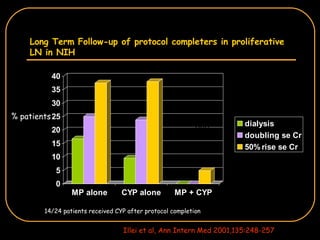
Long Term Follow-up of protocol completers in proliferative LN in NIH Comb CYP MP Illei et al, Ann Intern Med 2001,135:248-257 14/24 patients received CYP after protocol completion % patients
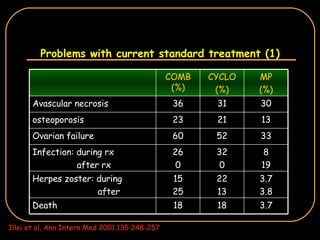
Problems with current standard treatment (1) Illei et al, Ann Intern Med 2001,135:248-257 3.7 3.8 22 13 15 25 Herpes zoster: during after 3.7 18 18 Death 8 19 32 0 26 0 Infection: during rx after rx 33 52 60 Ovarian failure 13 21 23 osteoporosis 30 31 36 Avascular necrosis MP (%) CYCLO (%) COMB (%)
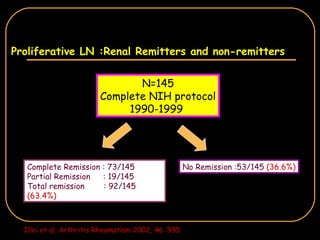
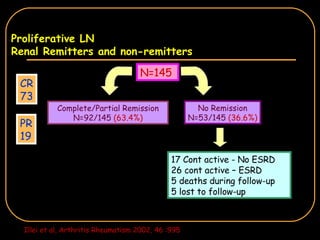
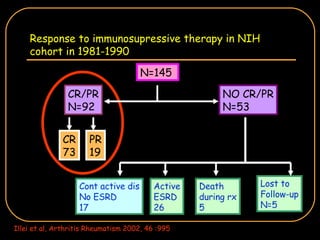
Proliferative LN :Renal Remitters and non-remitters N=145 Complete NIH protocol 1990-1999  Complete Remission : 73/145 Partial Remission   : 19/145 Total remission  : 92/145  (63.4%) No Remission :53/145  (36.6%) Illei et al, Arthritis Rheumatism 2002, 46 :995
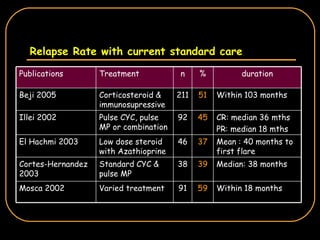
Relapse Rate with current standard care Median: 38 months 39 38 Standard CYC & pulse MP Cortes-Hernandez 2003 Varied treatment Low dose steroid with Azathioprine Pulse CYC, pulse MP or combination Corticosteroid & immunosupressive Treatment Within 18 months 59 91 Mosca 2002 Mean : 40 months to first flare 37 46 El Hachmi 2003 CR: median 36 mths PR: median 18 mths 45 92 Illei 2002 Within 103 months 51 211 Beji 2005 duration % n Publications
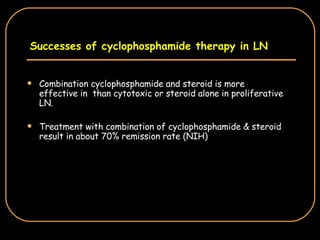
Successes of cyclophosphamide therapy in LN Combination cyclophosphamide and steroid is more effective in  than cytotoxic or steroid alone in proliferative LN. Treatment with combination of cyclophosphamide & steroid result in about 70% remission rate (NIH)
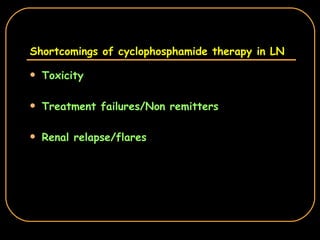
Shortcomings of cyclophosphamide therapy in LN Toxicity Treatment failures/Non remitters Renal relapse/flares
Shortcomings of cyclophosphamide therapy in LN TOXICITY Do we have treatment with similar efficacy but better tolerability profile ?
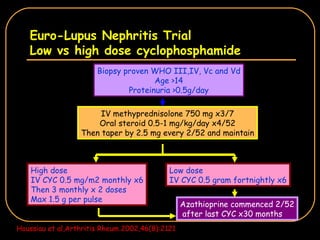
Euro-Lupus Nephritis Trial Low vs high dose cyclophosphamide Biopsy proven WHO III,IV, Vc and Vd Age >14 Proteinuria >0.5g/day IV methyprednisolone 750 mg x3/7 Oral steroid 0.5-1 mg/kg/day x4/52 Then taper by 2.5 mg every 2/52 and maintain High dose IV CYC 0.5 mg/m2 monthly x6 Then 3 monthly x 2 doses  Max 1.5 g per pulse Low dose IV CYC 0.5 gram fortnightly x6 Azathioprine commenced 2/52 after last CYC x30 months Houssiau et al,Arthritis Rheum 2002,46(8):2121
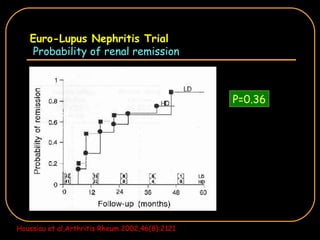
Euro-Lupus Nephritis Trial   Probability of renal remission P=0.36 Houssiau et al,Arthritis Rheum 2002,46(8):2121
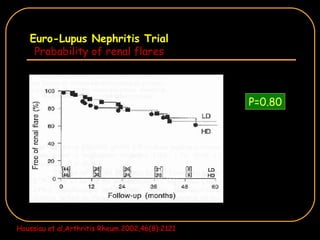
Euro-Lupus Nephritis Trial   Probability of renal flares P=0.80 Houssiau et al,Arthritis Rheum 2002,46(8):2121
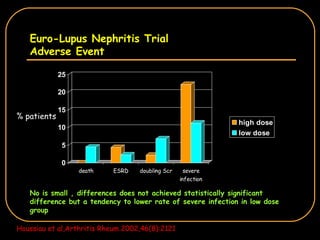
Euro-Lupus Nephritis Trial Adverse Event % patients No is small , differences does not achieved statistically significant difference but a tendency to lower rate of severe infection in low dose group Houssiau et al,Arthritis Rheum 2002,46(8):2121
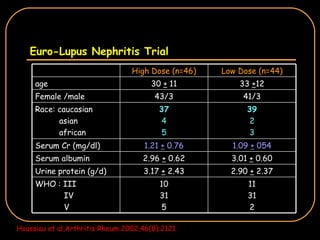
Euro-Lupus Nephritis Trial Houssiau et al,Arthritis Rheum 2002,46(8):2121 11 31 2 10 31 5 WHO : III IV V 2.90  +  2.37 3.17  +  2.43 Urine protein (g/d) 3.01  +  0.60 2.96  +  0.62 Serum albumin 1.09  +  054 1.21  +  0.76 Serum Cr (mg/dl) 39 2 3 37 4 5 Race: caucasian asian african 41/3 43/3 Female /male 33  + 12 30  +  11 age Low Dose (n=44) High Dose (n=46)
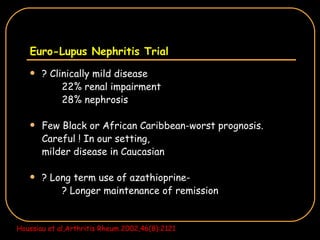
Euro-Lupus Nephritis Trial ? Clinically mild disease 22% renal impairment  28% nephrosis Few Black or African Caribbean-worst prognosis. Careful ! In our setting,  milder disease in Caucasian ? Long term use of azathioprine- ? Longer maintenance of remission Houssiau et al,Arthritis Rheum 2002,46(8):2121
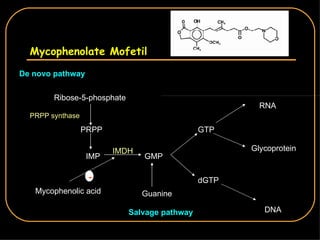
Mycophenolate Mofetil De novo pathway Ribose-5-phosphate PRPP PRPP synthase IMP GMP GTP RNA Glycoprotein dGTP DNA Guanine Mycophenolic acid Salvage pathway - IMDH
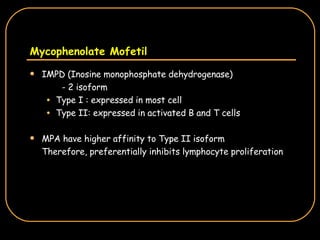
Mycophenolate Mofetil IMPD (Inosine monophosphate dehydrogenase) - 2 isoform Type I : expressed in most cell Type II: expressed in activated B and T cells MPA have higher affinity to Type II isoform Therefore, preferentially inhibits lymphocyte proliferation
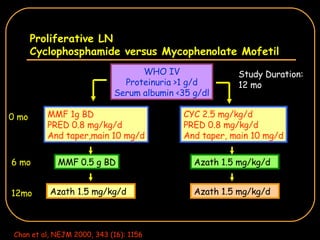
Proliferative LN Cyclophosphamide versus Mycophenolate Mofetil WHO IV Proteinuria >1 g/d Serum albumin <35 g/dl MMF 1g BD PRED 0.8 mg/kg/d And taper,main 10 mg/d CYC 2.5 mg/kg/d PRED 0.8 mg/kg/d And taper, main 10 mg/d MMF 0.5 g BD Azath 1.5 mg/kg/d   Azath 1.5 mg/kg/d   Azath 1.5 mg/kg/d   6 mo 12mo 0 mo Study Duration: 12 mo Chan et al, NEJM 2000, 343 (16): 1156
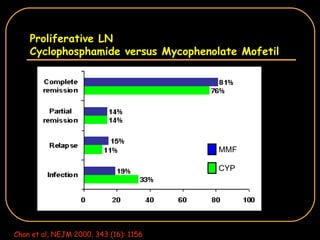
Proliferative LN Cyclophosphamide versus Mycophenolate Mofetil MMF CYP Chan et al, NEJM 2000, 343 (16): 1156 MMF CYP
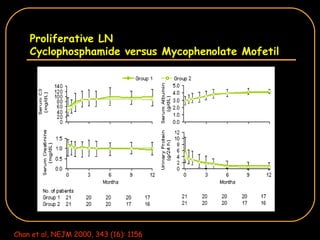
Proliferative LN Cyclophosphamide versus Mycophenolate Mofetil Chan et al, NEJM 2000, 343 (16): 1156
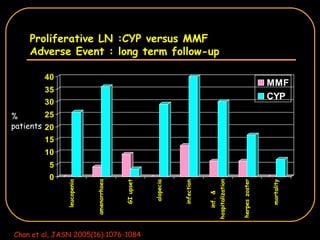
Proliferative LN :CYP versus MMF Adverse Event : long term follow-up Chan et al, JASN 2005(16):1076-1084 % patients
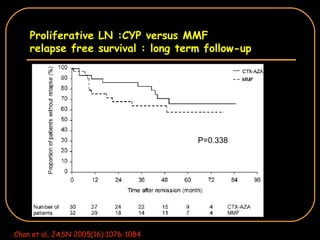
Chan et al, JASN 2005(16):1076-1084 Proliferative LN :CYP versus MMF relapse free survival : long term follow-up P=0.338 P=0.338
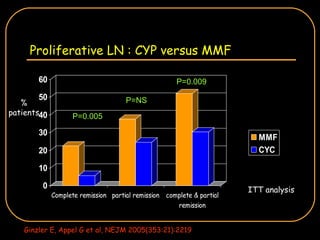
Proliferative LN : CYP versus MMF Ginzler E, Appel G et al, NEJM 2005(353:21):2219 P=0.005 % patients P=NS P=0.009 ITT analysis
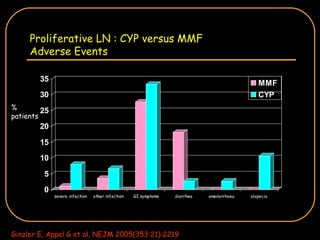
Proliferative LN : CYP versus MMF Adverse Events Ginzler E, Appel G et al, NEJM 2005(353:21):2219 %  patients
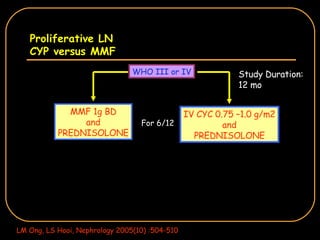
Proliferative LN CYP versus MMF WHO III or IV MMF 1g BD and PREDNISOLONE IV CYC 0.75 –1.0 g/m2 and PREDNISOLONE Study Duration: 12 mo LM Ong, LS Hooi, Nephrology 2005(10) :504-510 For 6/12
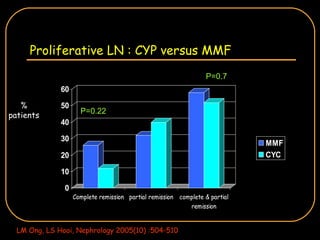
Proliferative LN : CYP versus MMF P=0.22 % patients P=0.7 LM Ong, LS Hooi, Nephrology 2005(10) :504-510
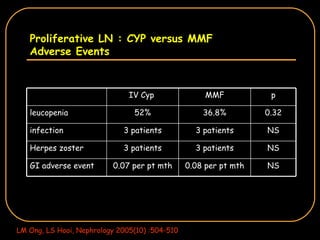
Proliferative LN : CYP versus MMF Adverse Events LM Ong, LS Hooi, Nephrology 2005(10) :504-510 NS 0.08 per pt mth 0.07 per pt mth GI adverse event NS 3 patients 3 patients Herpes zoster NS 3 patients 3 patients infection 0.32 36.8% 52% leucopenia p MMF IV Cyp
Summary of MMF versus cyclophosphamide
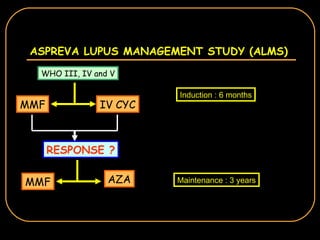
ASPREVA LUPUS MANAGEMENT STUDY (ALMS) WHO III, IV and V MMF IV CYC Induction : 6 months RESPONSE ? MMF AZA Maintenance : 3 years
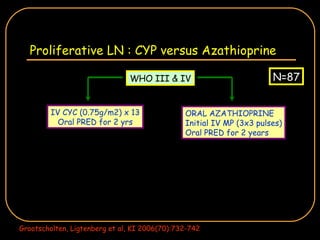
Proliferative LN : CYP versus Azathioprine WHO III & IV IV CYC (0.75g/m2) x 13 Oral PRED for 2 yrs ORAL AZATHIOPRINE Initial IV MP (3x3 pulses) Oral PRED for 2 years N=87 Grootscholten, Ligtenberg et al, KI 2006(70):732-742
How about Azathioprine ? Is it better ?  Is it safer ?
NIH Trial: Probability of developing ESRD   Steinberg et al, Arthritis Rheum 1991, 34 (8):945
Proliferative LN : CYP versus Azathioprine Grootscholten, Ligtenberg et al, KI 2006(70):732-742 Get figure 3
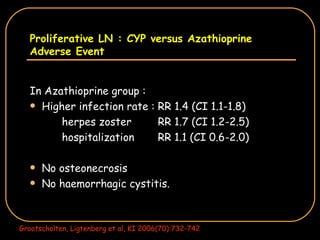
Proliferative LN : CYP versus Azathioprine Adverse Event In Azathioprine group : Higher infection rate : RR 1.4 (CI 1.1-1.8) herpes zoster RR 1.7 (CI 1.2-2.5) hospitalization RR 1.1 (CI 0.6-2.0) No osteonecrosis No haemorrhagic cystitis. Grootscholten, Ligtenberg et al, KI 2006(70):732-742
Proliferative LN : CYP versus Azathioprine At last follow-up Grootscholten, Ligtenberg et al, KI 2006(70):732-742 Azathioprine N=37 Cyclophosphamide N=50 Follow-up
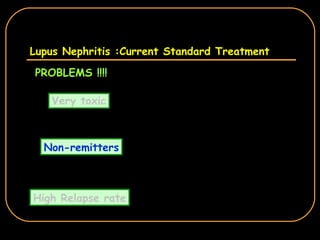
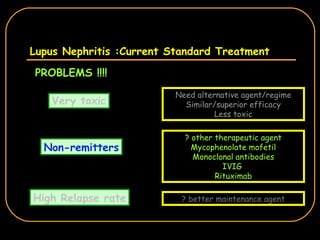
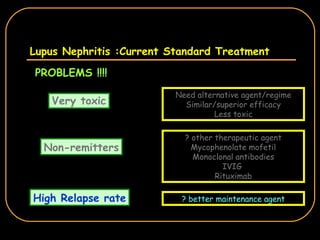
Lupus Nephritis :Current Standard Treatment Very toxic Non-remitters High Relapse rate PROBLEMS !!!!
Proliferative LN  Renal Remitters and non-remitters N=145   Complete/Partial Remission N=92/145  (63.4%) No Remission N=53/145  (36.6%) 17 Cont active - No ESRD 26 cont active – ESRD 5 deaths during follow-up 5 lost to follow-up PR 19 CR 73 Illei et al, Arthritis Rheumatism 2002, 46 :995
Lupus Nephritis :Current Standard Treatment Very toxic Non-remitters High Relapse rate Need alternative agent/regime Similar/superior efficacy Less toxic ? other therapeutic agent Mycophenolate mofetil Monoclonal antibodies IVIG  Rituximab ? better maintenance agent PROBLEMS !!!!
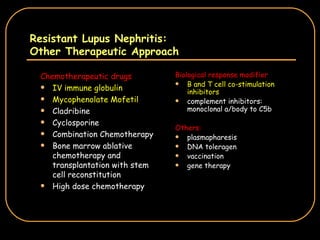
Resistant Lupus Nephritis:  Other Therapeutic Approach Chemotherapeutic drugs IV immune globulin Mycophenolate Mofetil Cladribine Cyclosporine Combination Chemotherapy Bone marrow ablative chemotherapy and transplantation with stem cell reconstitution High dose chemotherapy Biological response modifier B and T cell co-stimulation inhibitors complement inhibitors: monoclonal a/body to C5b Others: plasmapharesis DNA toleragen vaccination gene therapy
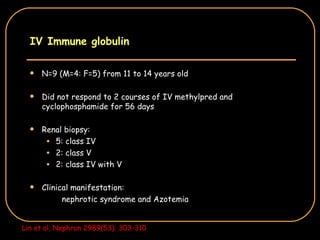
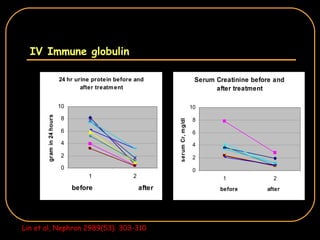
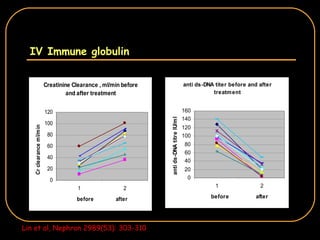
IV Immune globulin N=9 (M=4: F=5) from 11 to 14 years old Did not respond to 2 courses of IV methylpred and cyclophosphamide for 56 days Renal biopsy: 5: class IV 2: class V 2: class IV with V Clinical manifestation: nephrotic syndrome and Azotemia Lin et al, Nephron 2989(53): 303-310
IV Immune globulin Lin et al, Nephron 2989(53): 303-310
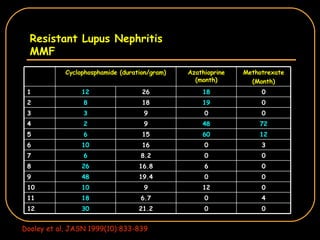
Resistant Lupus Nephritis MMF Dooley et al, JASN 1999(10):833-839 30 18 10 48 26 6 10 6 2 3 8 12 Cyclophosphamide (duration/gram) 0 0 21.2 12 11 10 9 8 7 6 5 4 3 2 1 4 0 6.7 0 12 9 0 0 19.4 0 6 16.8 0 0 8.2 3 0 16 12 60 15 72 48 9 0 0 9 0 19 18 0 18 26 Methotrexate (Month) Azathioprine (month)
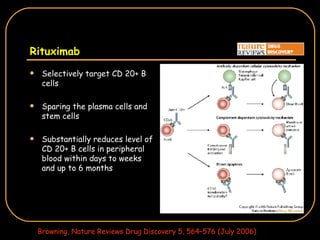
Rituximab Selectively target CD 20+ B cells Sparing the plasma cells and stem cells Substantially reduces level of CD 20+ B cells in peripheral blood within days to weeks and up to 6 months Browning, Nature Reviews Drug Discovery 5, 564 – 576 (July 2006)
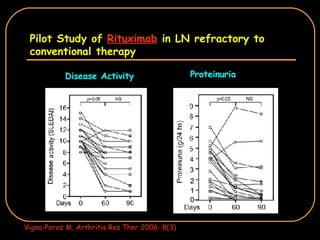
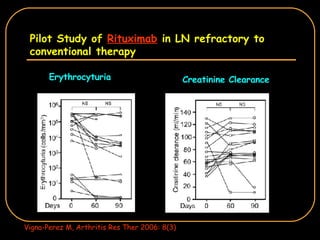
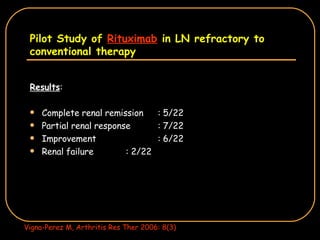
Pilot Study of  Rituximab  in LN refractory to conventional therapy 22 patients with SLE class III and IV Refractory to conventional therapy Rituximab (0.5 to 1.0 g) at day 1 and 15 added to current therapies Vigna-Perez M, Arthritis Res Ther 2006: 8(3)
Pilot Study of  Rituximab  in LN refractory to conventional therapy Disease Activity Proteinuria Vigna-Perez M, Arthritis Res Ther 2006: 8(3)
Pilot Study of  Rituximab  in LN refractory to conventional therapy Erythrocyturia Creatinine Clearance Vigna-Perez M, Arthritis Res Ther 2006: 8(3)
Pilot Study of  Rituximab  in LN refractory to conventional therapy Results : Complete renal remission : 5/22 Partial renal response : 7/22 Improvement : 6/22 Renal failure : 2/22 Vigna-Perez M, Arthritis Res Ther 2006: 8(3)
Lupus Nephritis :Current Standard Treatment Very toxic Non-remitters High Relapse rate Need alternative agent/regime Similar/superior efficacy Less toxic ? other therapeutic agent Mycophenolate mofetil Monoclonal antibodies IVIG  Rituximab ? better maintenance agent PROBLEMS !!!!
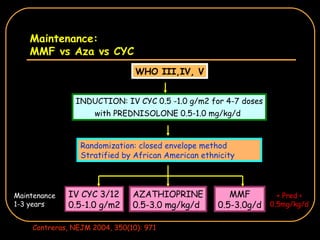
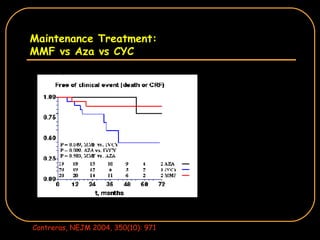
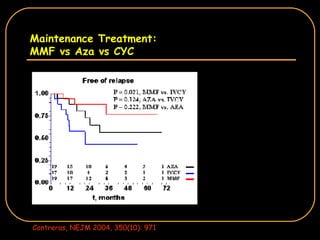
Maintenance: MMF vs Aza vs CYC WHO III,IV, V INDUCTION: IV CYC 0.5 -1.0 g/m2 for 4-7 doses with PREDNISOLONE 0.5-1.0 mg/kg/d   Randomization: closed envelope method Stratified by African American ethnicity IV CYC 3/12 0.5-1.0 g/m2 AZATHIOPRINE 0.5-3.0 mg/kg/d MMF 0.5-3.0g/d + Pred < 0.5mg/kg/d Maintenance 1-3 years Contreras, NEJM 2004, 350(10): 971
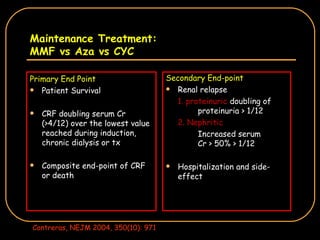
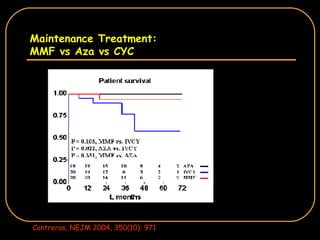
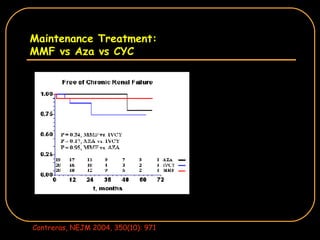
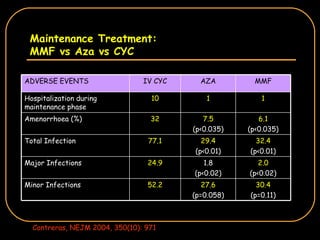
Maintenance Treatment: MMF vs Aza vs CYC Primary End Point Patient Survival CRF doubling serum Cr (>4/12) over the lowest value reached during induction, chronic dialysis or tx Composite end-point of CRF or death Secondary End-point Renal relapse 1. proteinuric   doubling of  proteinuria > 1/12 2. Nephritic Increased serum  Cr > 50% > 1/12 Hospitalization and side-effect Contreras, NEJM 2004, 350(10): 971
Maintenance Treatment: MMF vs Aza vs CYC Contreras, NEJM 2004, 350(10): 971
Maintenance Treatment: MMF vs Aza vs CYC Contreras, NEJM 2004, 350(10): 971 30.4 (p=0.11) 27.6 (p=0.058) 52.2 Minor Infections 2.0 (p<0.02) 1.8 (p<0.02) 24.9 Major Infections 32.4 (p<0.01) 29.4 (p<0.01) 77.1 Total Infection 6.1 (p<0.035) 7.5 (p<0.035) 32 Amenorrhoea (%) 1 1 10 Hospitalization during maintenance phase  MMF AZA IV CYC ADVERSE EVENTS
Lupus Nephritis Renal Flares
Response to immunosupressive therapy in NIH cohort in 1981-1990 N=145   Active ESRD 26 CR/PR N=92 NO CR/PR N=53 Death  during rx 5 Lost to Follow-up N=5 Cont active dis No ESRD 17 PR 19 CR 73 Illei et al, Arthritis Rheumatism 2002, 46 :995
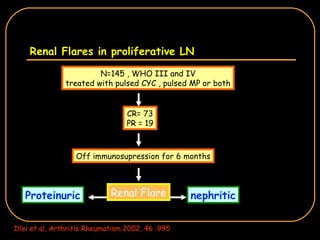
Renal Flares in proliferative LN N=145 , WHO III and IV treated with pulsed CYC , pulsed MP or both Proteinuric nephritic Illei et al, Arthritis Rheumatism 2002, 46 :995 CR= 73 PR = 19 Off immunosupression for 6 months Renal Flare
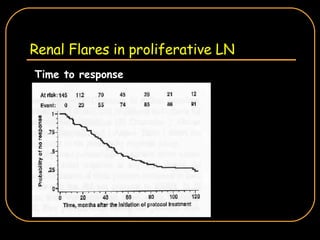
Renal Flares in proliferative LN Time to response
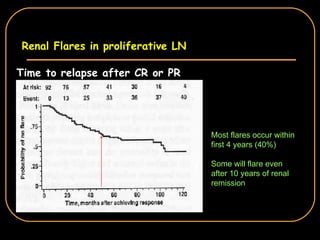
Renal Flares in proliferative LN Time to relapse after CR or PR Most flares occur within first 4 years (40%) Some will flare even after 10 years of renal remission
Predictors of renal flares : multivariate analysis Entire cohort Persistently low C4 Africo-american Partial response  Likelihood ratio to have a renal flare : 2.1 (95% CI 1.08 –4.2) Complete Response Group Persistently low C4 Africo-american Chronicity index at baseline Illei et al, Arthritis Rheumatism 2002, 46 :995
Factors ass. with ESRD in patient who had CR/PR : univariate analysis severe nephritic flare serum Cr > 2.0 mg/dl at time of response Partial response chronicity index at baseline activity index at baseline proteinuria > 0.5 g at time of response Hematocrit < 33% Any flares Illei et al, Arthritis Rheumatism 2002, 46 :995
Thank You

Lupus Nephritis

  • 1.
    Lupus Nephritis: Current/FutureTreatment Option Dr Rosnawati Yahya Consultant Nephrologist Hospital Kuala Lumpur MALAYSIA
  • 2.
    Lupus Nephritis PathologyWHO classification : 1974 - Pirani and Pollak 1982 – revised 1995 - revised
  • 3.
    Lupus Nephritis PathologyWHO classification : membranous IV Diffuse proliferative GN IV Focal segmental proliferative GN III Mesangial GN II Normal I class
  • 4.
    Lupus Nephritis PathologyThe classification of glomerulonephritis in systemic lupus erythematosus revisited Kidney International 2004 (65): 521-530 JAN J WEENING, VIVETTE D D'AGATI, MELVIN M SCHWARTZ, SURYA V SESHAN, CHARLES E ALPERS, GERALD B APPEL, JAMES E BALOW, JAN A BRUIJN, TERENCE COOK, FRANCO FERRARIO, AGNES B FOGO, ELLEN M GINZLER, LEE HEBERT, GARY HILL, PRUE HILL, J CHARLES JENNETTE, NORELLA C KONG, PHILIPPE LESAVRE, MICHAEL LOCKSHIN, LAI-MENG LOOI, HIROFUMI MAKINO, LUIZ A MOURA and MICHIO NAGATA ON BEHALF OF THE INTERNATIONAL SOCIETY OF NEPHROLOGY AND RENAL PATHOLOGY SOCIETY WORKING GROUP ON THE CLASSIFICATION OF LUPUS NEPHRITIS
  • 5.
    Lupus Nephritis: PathologyWHO versus ISN/RPS Proliferative lesion is divided into active and chronic lesion. Active : treatable Chronic : scarring/ irreversible Diffuse Proliferative divided into segmental and global - to see if differences exist Membranous is pure membranous if proliferative superimposed: V + III or V + IV proliferative lesion dictate treatment
  • 6.
    Lupus Nephritis: PathologyISN/RPS classification : membranous V Advanced sclerotic LN VI Diffuse proliferative GN (involving >50% glom) IV-S (A) :diffuse segmental –active lesion IV-G (A) :diffuse global –active lesion IV-S (A/C):diffuse segmental –active and chronic lesion IV-G (A/C):diffuse global –active and chronic lesion IV-S (C) :diffuse segmental –chronic lesion with scar IV-G (C) :diffuse global –chronic lesion with scar IV Focal proliferative GN (involving < 50% glom) III (A) : active lesions III (A/C) : active and chronic lesion III C : chronic lesion III Mesangial proliferative LN II Minimal mesangial LN I
  • 7.
    Treatment of proliferativeLN Induction therapy Intensive immunosuppressives Objectives : to halt injury, : recover renal function : induce remission by controlling immunologic activity Maintenance therapy Longer period Less intensive to reduce complication Objectives : Consolidate remission : Prevent flares
  • 8.
    NIH Trial: Probabilityof developing ESRD Steinberg et al, Arthritis Rheum 1991, 34 (8):945
  • 9.
    NIH Trial Probabilityof Renal Remission N=82, proliferative LN IV methylpred 1 g/m2 x3 days Every months x12 IV cyclophos. Monthly x 6 3 monthly x 2 yrs Combination Methylpred & cyclophos 7/24 (29%) 13/21 (62%) RENAL REMISSION 17/20 (85%) P<0.001 P=NS Gourley et al, Ann Intern Med 1996,125(7):549
  • 10.
    Long Term Follow-upof protocol completers in proliferative LN in NIH Comb CYP MP Illei et al, Ann Intern Med 2001,135:248-257 14/24 patients received CYP after protocol completion % patients
  • 11.
    Problems with currentstandard treatment (1) Illei et al, Ann Intern Med 2001,135:248-257 3.7 3.8 22 13 15 25 Herpes zoster: during after 3.7 18 18 Death 8 19 32 0 26 0 Infection: during rx after rx 33 52 60 Ovarian failure 13 21 23 osteoporosis 30 31 36 Avascular necrosis MP (%) CYCLO (%) COMB (%)
  • 12.
    Proliferative LN :RenalRemitters and non-remitters N=145 Complete NIH protocol 1990-1999 Complete Remission : 73/145 Partial Remission : 19/145 Total remission : 92/145 (63.4%) No Remission :53/145 (36.6%) Illei et al, Arthritis Rheumatism 2002, 46 :995
  • 13.
    Relapse Rate withcurrent standard care Median: 38 months 39 38 Standard CYC & pulse MP Cortes-Hernandez 2003 Varied treatment Low dose steroid with Azathioprine Pulse CYC, pulse MP or combination Corticosteroid & immunosupressive Treatment Within 18 months 59 91 Mosca 2002 Mean : 40 months to first flare 37 46 El Hachmi 2003 CR: median 36 mths PR: median 18 mths 45 92 Illei 2002 Within 103 months 51 211 Beji 2005 duration % n Publications
  • 14.
    Successes of cyclophosphamidetherapy in LN Combination cyclophosphamide and steroid is more effective in than cytotoxic or steroid alone in proliferative LN. Treatment with combination of cyclophosphamide & steroid result in about 70% remission rate (NIH)
  • 15.
    Shortcomings of cyclophosphamidetherapy in LN Toxicity Treatment failures/Non remitters Renal relapse/flares
  • 16.
    Shortcomings of cyclophosphamidetherapy in LN TOXICITY Do we have treatment with similar efficacy but better tolerability profile ?
  • 17.
    Euro-Lupus Nephritis TrialLow vs high dose cyclophosphamide Biopsy proven WHO III,IV, Vc and Vd Age >14 Proteinuria >0.5g/day IV methyprednisolone 750 mg x3/7 Oral steroid 0.5-1 mg/kg/day x4/52 Then taper by 2.5 mg every 2/52 and maintain High dose IV CYC 0.5 mg/m2 monthly x6 Then 3 monthly x 2 doses Max 1.5 g per pulse Low dose IV CYC 0.5 gram fortnightly x6 Azathioprine commenced 2/52 after last CYC x30 months Houssiau et al,Arthritis Rheum 2002,46(8):2121
  • 18.
    Euro-Lupus Nephritis Trial Probability of renal remission P=0.36 Houssiau et al,Arthritis Rheum 2002,46(8):2121
  • 19.
    Euro-Lupus Nephritis Trial Probability of renal flares P=0.80 Houssiau et al,Arthritis Rheum 2002,46(8):2121
  • 20.
    Euro-Lupus Nephritis TrialAdverse Event % patients No is small , differences does not achieved statistically significant difference but a tendency to lower rate of severe infection in low dose group Houssiau et al,Arthritis Rheum 2002,46(8):2121
  • 21.
    Euro-Lupus Nephritis TrialHoussiau et al,Arthritis Rheum 2002,46(8):2121 11 31 2 10 31 5 WHO : III IV V 2.90 + 2.37 3.17 + 2.43 Urine protein (g/d) 3.01 + 0.60 2.96 + 0.62 Serum albumin 1.09 + 054 1.21 + 0.76 Serum Cr (mg/dl) 39 2 3 37 4 5 Race: caucasian asian african 41/3 43/3 Female /male 33 + 12 30 + 11 age Low Dose (n=44) High Dose (n=46)
  • 22.
    Euro-Lupus Nephritis Trial? Clinically mild disease 22% renal impairment 28% nephrosis Few Black or African Caribbean-worst prognosis. Careful ! In our setting, milder disease in Caucasian ? Long term use of azathioprine- ? Longer maintenance of remission Houssiau et al,Arthritis Rheum 2002,46(8):2121
  • 23.
    Mycophenolate Mofetil Denovo pathway Ribose-5-phosphate PRPP PRPP synthase IMP GMP GTP RNA Glycoprotein dGTP DNA Guanine Mycophenolic acid Salvage pathway - IMDH
  • 24.
    Mycophenolate Mofetil IMPD(Inosine monophosphate dehydrogenase) - 2 isoform Type I : expressed in most cell Type II: expressed in activated B and T cells MPA have higher affinity to Type II isoform Therefore, preferentially inhibits lymphocyte proliferation
  • 25.
    Proliferative LN Cyclophosphamideversus Mycophenolate Mofetil WHO IV Proteinuria >1 g/d Serum albumin <35 g/dl MMF 1g BD PRED 0.8 mg/kg/d And taper,main 10 mg/d CYC 2.5 mg/kg/d PRED 0.8 mg/kg/d And taper, main 10 mg/d MMF 0.5 g BD Azath 1.5 mg/kg/d Azath 1.5 mg/kg/d Azath 1.5 mg/kg/d 6 mo 12mo 0 mo Study Duration: 12 mo Chan et al, NEJM 2000, 343 (16): 1156
  • 26.
    Proliferative LN Cyclophosphamideversus Mycophenolate Mofetil MMF CYP Chan et al, NEJM 2000, 343 (16): 1156 MMF CYP
  • 27.
    Proliferative LN Cyclophosphamideversus Mycophenolate Mofetil Chan et al, NEJM 2000, 343 (16): 1156
  • 28.
    Proliferative LN :CYPversus MMF Adverse Event : long term follow-up Chan et al, JASN 2005(16):1076-1084 % patients
  • 29.
    Chan et al,JASN 2005(16):1076-1084 Proliferative LN :CYP versus MMF relapse free survival : long term follow-up P=0.338 P=0.338
  • 30.
    Proliferative LN :CYP versus MMF Ginzler E, Appel G et al, NEJM 2005(353:21):2219 P=0.005 % patients P=NS P=0.009 ITT analysis
  • 31.
    Proliferative LN :CYP versus MMF Adverse Events Ginzler E, Appel G et al, NEJM 2005(353:21):2219 % patients
  • 32.
    Proliferative LN CYPversus MMF WHO III or IV MMF 1g BD and PREDNISOLONE IV CYC 0.75 –1.0 g/m2 and PREDNISOLONE Study Duration: 12 mo LM Ong, LS Hooi, Nephrology 2005(10) :504-510 For 6/12
  • 33.
    Proliferative LN :CYP versus MMF P=0.22 % patients P=0.7 LM Ong, LS Hooi, Nephrology 2005(10) :504-510
  • 34.
    Proliferative LN :CYP versus MMF Adverse Events LM Ong, LS Hooi, Nephrology 2005(10) :504-510 NS 0.08 per pt mth 0.07 per pt mth GI adverse event NS 3 patients 3 patients Herpes zoster NS 3 patients 3 patients infection 0.32 36.8% 52% leucopenia p MMF IV Cyp
  • 35.
    Summary of MMFversus cyclophosphamide
  • 36.
    ASPREVA LUPUS MANAGEMENTSTUDY (ALMS) WHO III, IV and V MMF IV CYC Induction : 6 months RESPONSE ? MMF AZA Maintenance : 3 years
  • 37.
    Proliferative LN :CYP versus Azathioprine WHO III & IV IV CYC (0.75g/m2) x 13 Oral PRED for 2 yrs ORAL AZATHIOPRINE Initial IV MP (3x3 pulses) Oral PRED for 2 years N=87 Grootscholten, Ligtenberg et al, KI 2006(70):732-742
  • 38.
    How about Azathioprine? Is it better ? Is it safer ?
  • 39.
    NIH Trial: Probabilityof developing ESRD Steinberg et al, Arthritis Rheum 1991, 34 (8):945
  • 40.
    Proliferative LN :CYP versus Azathioprine Grootscholten, Ligtenberg et al, KI 2006(70):732-742 Get figure 3
  • 41.
    Proliferative LN :CYP versus Azathioprine Adverse Event In Azathioprine group : Higher infection rate : RR 1.4 (CI 1.1-1.8) herpes zoster RR 1.7 (CI 1.2-2.5) hospitalization RR 1.1 (CI 0.6-2.0) No osteonecrosis No haemorrhagic cystitis. Grootscholten, Ligtenberg et al, KI 2006(70):732-742
  • 42.
    Proliferative LN :CYP versus Azathioprine At last follow-up Grootscholten, Ligtenberg et al, KI 2006(70):732-742 Azathioprine N=37 Cyclophosphamide N=50 Follow-up
  • 43.
    Lupus Nephritis :CurrentStandard Treatment Very toxic Non-remitters High Relapse rate PROBLEMS !!!!
  • 44.
    Proliferative LN Renal Remitters and non-remitters N=145 Complete/Partial Remission N=92/145 (63.4%) No Remission N=53/145 (36.6%) 17 Cont active - No ESRD 26 cont active – ESRD 5 deaths during follow-up 5 lost to follow-up PR 19 CR 73 Illei et al, Arthritis Rheumatism 2002, 46 :995
  • 45.
    Lupus Nephritis :CurrentStandard Treatment Very toxic Non-remitters High Relapse rate Need alternative agent/regime Similar/superior efficacy Less toxic ? other therapeutic agent Mycophenolate mofetil Monoclonal antibodies IVIG Rituximab ? better maintenance agent PROBLEMS !!!!
  • 46.
    Resistant Lupus Nephritis: Other Therapeutic Approach Chemotherapeutic drugs IV immune globulin Mycophenolate Mofetil Cladribine Cyclosporine Combination Chemotherapy Bone marrow ablative chemotherapy and transplantation with stem cell reconstitution High dose chemotherapy Biological response modifier B and T cell co-stimulation inhibitors complement inhibitors: monoclonal a/body to C5b Others: plasmapharesis DNA toleragen vaccination gene therapy
  • 47.
    IV Immune globulinN=9 (M=4: F=5) from 11 to 14 years old Did not respond to 2 courses of IV methylpred and cyclophosphamide for 56 days Renal biopsy: 5: class IV 2: class V 2: class IV with V Clinical manifestation: nephrotic syndrome and Azotemia Lin et al, Nephron 2989(53): 303-310
  • 48.
    IV Immune globulinLin et al, Nephron 2989(53): 303-310
  • 49.
    IV Immune globulinLin et al, Nephron 2989(53): 303-310
  • 50.
    Resistant Lupus NephritisMMF Dooley et al, JASN 1999(10):833-839 30 18 10 48 26 6 10 6 2 3 8 12 Cyclophosphamide (duration/gram) 0 0 21.2 12 11 10 9 8 7 6 5 4 3 2 1 4 0 6.7 0 12 9 0 0 19.4 0 6 16.8 0 0 8.2 3 0 16 12 60 15 72 48 9 0 0 9 0 19 18 0 18 26 Methotrexate (Month) Azathioprine (month)
  • 51.
    Rituximab Selectively targetCD 20+ B cells Sparing the plasma cells and stem cells Substantially reduces level of CD 20+ B cells in peripheral blood within days to weeks and up to 6 months Browning, Nature Reviews Drug Discovery 5, 564 – 576 (July 2006)
  • 52.
    Pilot Study of Rituximab in LN refractory to conventional therapy 22 patients with SLE class III and IV Refractory to conventional therapy Rituximab (0.5 to 1.0 g) at day 1 and 15 added to current therapies Vigna-Perez M, Arthritis Res Ther 2006: 8(3)
  • 53.
    Pilot Study of Rituximab in LN refractory to conventional therapy Disease Activity Proteinuria Vigna-Perez M, Arthritis Res Ther 2006: 8(3)
  • 54.
    Pilot Study of Rituximab in LN refractory to conventional therapy Erythrocyturia Creatinine Clearance Vigna-Perez M, Arthritis Res Ther 2006: 8(3)
  • 55.
    Pilot Study of Rituximab in LN refractory to conventional therapy Results : Complete renal remission : 5/22 Partial renal response : 7/22 Improvement : 6/22 Renal failure : 2/22 Vigna-Perez M, Arthritis Res Ther 2006: 8(3)
  • 56.
    Lupus Nephritis :CurrentStandard Treatment Very toxic Non-remitters High Relapse rate Need alternative agent/regime Similar/superior efficacy Less toxic ? other therapeutic agent Mycophenolate mofetil Monoclonal antibodies IVIG Rituximab ? better maintenance agent PROBLEMS !!!!
  • 57.
    Maintenance: MMF vsAza vs CYC WHO III,IV, V INDUCTION: IV CYC 0.5 -1.0 g/m2 for 4-7 doses with PREDNISOLONE 0.5-1.0 mg/kg/d Randomization: closed envelope method Stratified by African American ethnicity IV CYC 3/12 0.5-1.0 g/m2 AZATHIOPRINE 0.5-3.0 mg/kg/d MMF 0.5-3.0g/d + Pred < 0.5mg/kg/d Maintenance 1-3 years Contreras, NEJM 2004, 350(10): 971
  • 58.
    Maintenance Treatment: MMFvs Aza vs CYC Primary End Point Patient Survival CRF doubling serum Cr (>4/12) over the lowest value reached during induction, chronic dialysis or tx Composite end-point of CRF or death Secondary End-point Renal relapse 1. proteinuric doubling of proteinuria > 1/12 2. Nephritic Increased serum Cr > 50% > 1/12 Hospitalization and side-effect Contreras, NEJM 2004, 350(10): 971
  • 59.
    Maintenance Treatment: MMFvs Aza vs CYC Contreras, NEJM 2004, 350(10): 971
  • 60.
    Maintenance Treatment: MMFvs Aza vs CYC Contreras, NEJM 2004, 350(10): 971
  • 61.
    Maintenance Treatment: MMFvs Aza vs CYC Contreras, NEJM 2004, 350(10): 971
  • 62.
    Maintenance Treatment: MMFvs Aza vs CYC Contreras, NEJM 2004, 350(10): 971
  • 63.
    Maintenance Treatment: MMFvs Aza vs CYC Contreras, NEJM 2004, 350(10): 971 30.4 (p=0.11) 27.6 (p=0.058) 52.2 Minor Infections 2.0 (p<0.02) 1.8 (p<0.02) 24.9 Major Infections 32.4 (p<0.01) 29.4 (p<0.01) 77.1 Total Infection 6.1 (p<0.035) 7.5 (p<0.035) 32 Amenorrhoea (%) 1 1 10 Hospitalization during maintenance phase MMF AZA IV CYC ADVERSE EVENTS
  • 64.
  • 65.
    Response to immunosupressivetherapy in NIH cohort in 1981-1990 N=145 Active ESRD 26 CR/PR N=92 NO CR/PR N=53 Death during rx 5 Lost to Follow-up N=5 Cont active dis No ESRD 17 PR 19 CR 73 Illei et al, Arthritis Rheumatism 2002, 46 :995
  • 66.
    Renal Flares inproliferative LN N=145 , WHO III and IV treated with pulsed CYC , pulsed MP or both Proteinuric nephritic Illei et al, Arthritis Rheumatism 2002, 46 :995 CR= 73 PR = 19 Off immunosupression for 6 months Renal Flare
  • 67.
    Renal Flares inproliferative LN Time to response
  • 68.
    Renal Flares inproliferative LN Time to relapse after CR or PR Most flares occur within first 4 years (40%) Some will flare even after 10 years of renal remission
  • 69.
    Predictors of renalflares : multivariate analysis Entire cohort Persistently low C4 Africo-american Partial response Likelihood ratio to have a renal flare : 2.1 (95% CI 1.08 –4.2) Complete Response Group Persistently low C4 Africo-american Chronicity index at baseline Illei et al, Arthritis Rheumatism 2002, 46 :995
  • 70.
    Factors ass. withESRD in patient who had CR/PR : univariate analysis severe nephritic flare serum Cr > 2.0 mg/dl at time of response Partial response chronicity index at baseline activity index at baseline proteinuria > 0.5 g at time of response Hematocrit < 33% Any flares Illei et al, Arthritis Rheumatism 2002, 46 :995
  • 71.

Editor's Notes

  • #2 Good evening ladies and gentleman. Thank you Prof …. For the introduction. First and foremost I would like to thanks the organizing committee for the invitation to speak in today’s meeting. I have been asked to update you on current and future treatment of lupus nephritis.