Mohammed Abdulqader SuwaidMohammed Abdulqader Suwaid
Egyptian Fellowship Board CandidateEgyptian Fellowship Board Candidate
Medical OncologyMedical Oncology
RENAL IMPAIRMENT INRENAL IMPAIRMENT IN
MULTIPLE MYELOMAMULTIPLE MYELOMA
INTRODUCTIONINTRODUCTION
Introduction
 Multiple myeloma (MM) is a clonal B-cell disease of slowly
proliferating plasma cells, accompanied by monoclonal
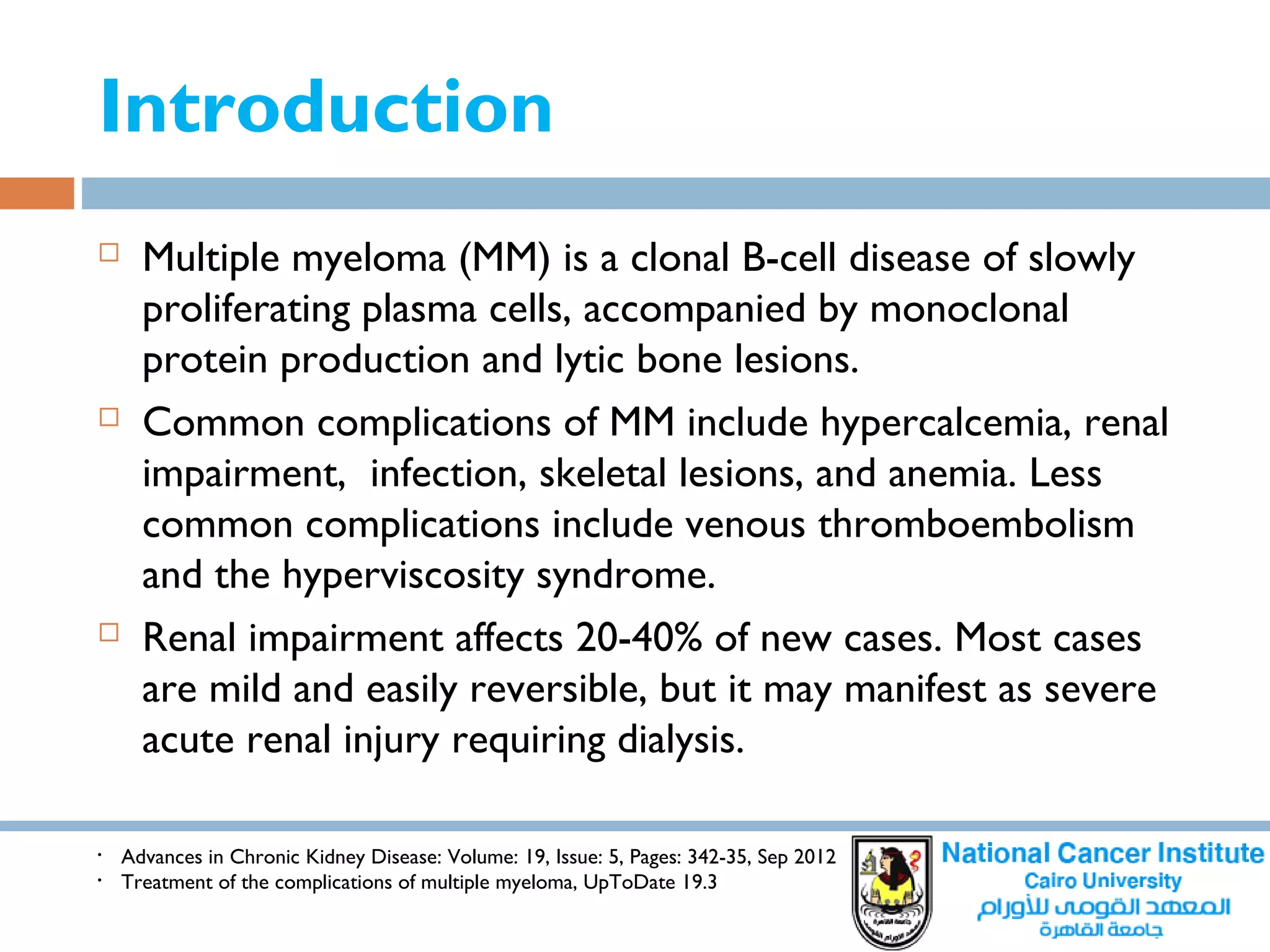
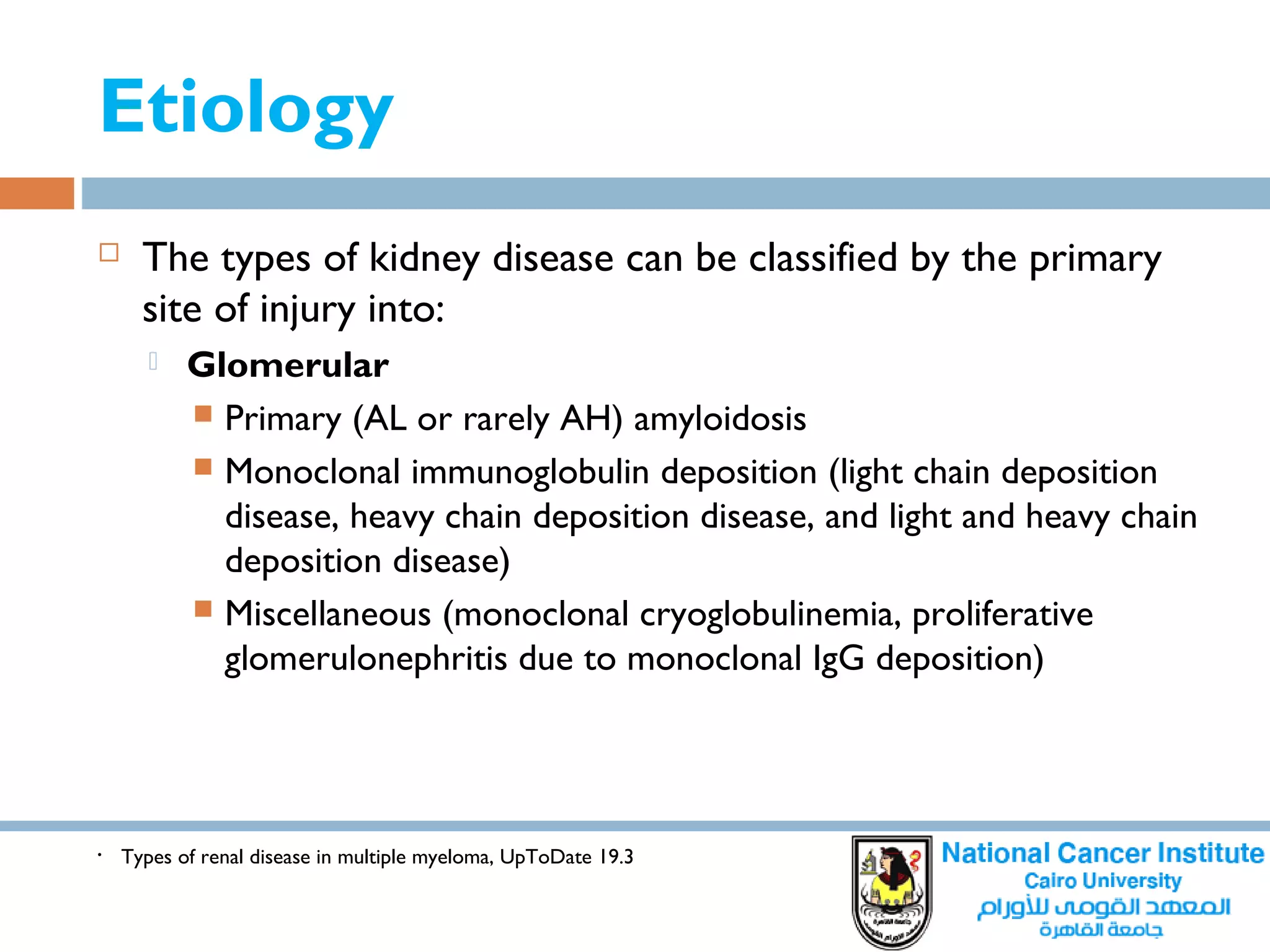
protein production and lytic bone lesions.
 Common complications of MM include hypercalcemia, renal
impairment, infection, skeletal lesions, and anemia. Less
common complications include venous thromboembolism
and the hyperviscosity syndrome.
 Renal impairment affects 20-40% of new cases. Most cases
are mild and easily reversible, but it may manifest as severe
acute renal injury requiring dialysis.
• Advances in Chronic Kidney Disease: Volume: 19, Issue: 5, Pages: 342-35, Sep 2012
• Treatment of the complications of multiple myeloma, UpToDate 19.3
Introduction
• Advances in Chronic Kidney Disease: Volume: 19, Issue: 5, Pages: 342-35, Sep 2012
 Renal impairment is associated with a large tumor mass and
consequently confers a poor prognosis.
 The prognosis of MM has been improved with the introduction
of novel agents and autologous stem cell transplantation.
 These improvements appear to apply equally to patients with
renal impairment, although the risk of complications is usually
higher in this group of patients.
 In addition to improved overall survival, there is some evidence
that novel therapies have improved the renal prognosis.
ETIOLOGY
Etiology
 Nephropathy is one of the serious adverse complications
that can be observed at the time of clinical presentation of
MM.
 The etiology of renal failure can be multifactorial.
 It is usually the result of monoclonal immunoglobulin light
chains.
 In rare occasions, monoclonal heavy chains or the entire
immunoglobulins may be involved.
 Non-monoclonal protein-related renal injury may also
occur.
• Devita, Hellman & Rosenberg's Cancer: Principles & Practice of Oncology, 8th
Edition
• Types of renal disease in multiple myeloma, UpToDate 19.3
Etiology
• Types of renal disease in multiple myeloma, UpToDate 19.3
 The types of kidney disease can be classified by the primary
site of injury into:
 Glomerular
 Primary (AL or rarely AH) amyloidosis
 Monoclonal immunoglobulin deposition (light chain deposition
disease, heavy chain deposition disease, and light and heavy chain
deposition disease)
 Miscellaneous (monoclonal cryoglobulinemia, proliferative
glomerulonephritis due to monoclonal IgG deposition)
Etiology
• Types of renal disease in multiple myeloma, UpToDate 19.3
 The types of kidney disease can be classified by the primary
site of injury into:
 Tubular
 Light chain cast nephropathy
(myeloma kidney)
 Distal tubular dysfunction
 Proximal tubule dysfunction
or acquired Fanconi's syndrome
 Interstitial
 Plasma cell infiltration
 Interstitial nephritis
Myeloma kidney. Dense intratubular casts are shown,
with accompanying tubular cell atrophy (H&E, x200).
Etiology
 Additional factors exacerbating renal failure in myeloma
patients include:
 Volume depletion
 Use of nonsteroidal anti-inflammatory drugs for pain control
 Hyperuricemia
 Nephrotoxic chemotherapeutic agents
 Intravenous contrast for radiographic studies
 Bisphosphonate therapy
 Calcium deposition and stones in the kidney
• Devita, Hellman & Rosenberg's Cancer: Principles & Practice of Oncology, 8th
Edition
• Rodgers & Young: Bethesda Handbook of Clinical Oncology, 2nd
Edition
MANAGEMENT
Diagnosis
 While in some patients, renal failure is the only isolated sign
of MM, other patients have further simultaneous symptoms
(signs of bone destruction, hypercalcemia & cytopenia).
 Therefore, differential diagnosis of renal failure should always
include monoclonal gammopathy-associated nephropathy.
 Early diagnosis at the time when renal impairment is still
reversible is extremely important for the patient's prognosis.
• The Treatment of Renal Failure in Multiple Myeloma: Vnitr Lek. 2009 Jun; 55(6):
570-82.
Diagnosis
• Types of renal disease in multiple myeloma, UpToDate 19.3
 The diagnosis must be suspected in the older patient
presenting with acute or subacute renal failure, particularly if
the urine dipstick is negative for protein, whether or not the
patient has a previously diagnosed MM or monoclonal
gammopathy.
 The diagnosis can only be made definitively with a kidney
biopsy. However, the diagnosis is often established in cases
of acute renal failure by identifying the presence of large
amounts of monoclonal free light chains in the serum and the
presence of a monoclonal protein in the urine, by protein
electrophoresis and immunofixation.
Treatment
• The Treatment of Renal Failure in Multiple Myeloma: Vnitr Lek. 2009 Jun;
55(6): 570-82.
 Reversible causes (Dehydration, Ca↑ ++
, NSAID-induced, IV
contrast) should always be excluded or corrected
accordingly.
 Treatment regimens with high-dose glucocorticoids form the
basis of treatment.
 Combined treatments with new, highly effective drugs
(bortezomib or thalidomide) with high-dose glucocorticoids
and an alkylating cytostatic agent, or with doxorubicin, have
the fastest onset of action and thus provide the highest
likelihood that hematological treatment response will be
followed by improved renal function.
Treatment
• The Treatment of Renal Failure in Multiple Myeloma: Vnitr Lek. 2009 Jun;
55(6): 570-82.
 High-dose chemotherapy is recommended in patients with
persisting renal failure, particularly in the subgroup of patients
with chemotherapy-sensitive disease.
No Yes
Yes
No
No
NoYes
Yes
NoYes
Algorithm to approach renal failure in MM
•Approach to acute renal failure with multiple myeloma: role of plasmapheresis.
Ther Apher Dial. 2005 Oct;9(5):417-22.
SUMMARY
Summary
 Renal impairment is a common complication of MM.
 The most important causes include:
 light chain tubular casts (myeloma kidney).
 Hypercalcemia.
 light chain deposition disease (associated with kappa light chain).
 AL amyloidosis (associated with lambda light chain).
 Others (e.g. NSAIDs, hyperuricemia, chemotherapy, IV contrast, etc.)
Summary
 It was generally associated a poor prognosis but with
introduction of novel therapies renal prognosis have been
improved.
 Treatment depends on:
 good hydration
 correction of hypercalcemia or any contributing condition
 use of effective agents which are safe in renal impairment (e.g.
steroids, melphalan, cyclophosphamide, bortezomib, and thalidomide)
 Plasmapheresis &/or dialysis (in certain situations)
January 20January 20thth
, 2013, 2013
TT h a nh a n k Y ok Y o uu

Renal Impairment in Multiple Myeloma

  • 1.
    Mohammed Abdulqader SuwaidMohammedAbdulqader Suwaid Egyptian Fellowship Board CandidateEgyptian Fellowship Board Candidate Medical OncologyMedical Oncology RENAL IMPAIRMENT INRENAL IMPAIRMENT IN MULTIPLE MYELOMAMULTIPLE MYELOMA
  • 2.
  • 3.
    Introduction  Multiple myeloma(MM) is a clonal B-cell disease of slowly proliferating plasma cells, accompanied by monoclonal protein production and lytic bone lesions.  Common complications of MM include hypercalcemia, renal impairment, infection, skeletal lesions, and anemia. Less common complications include venous thromboembolism and the hyperviscosity syndrome.  Renal impairment affects 20-40% of new cases. Most cases are mild and easily reversible, but it may manifest as severe acute renal injury requiring dialysis. • Advances in Chronic Kidney Disease: Volume: 19, Issue: 5, Pages: 342-35, Sep 2012 • Treatment of the complications of multiple myeloma, UpToDate 19.3
  • 4.
    Introduction • Advances inChronic Kidney Disease: Volume: 19, Issue: 5, Pages: 342-35, Sep 2012  Renal impairment is associated with a large tumor mass and consequently confers a poor prognosis.  The prognosis of MM has been improved with the introduction of novel agents and autologous stem cell transplantation.  These improvements appear to apply equally to patients with renal impairment, although the risk of complications is usually higher in this group of patients.  In addition to improved overall survival, there is some evidence that novel therapies have improved the renal prognosis.
  • 5.
  • 6.
    Etiology  Nephropathy isone of the serious adverse complications that can be observed at the time of clinical presentation of MM.  The etiology of renal failure can be multifactorial.  It is usually the result of monoclonal immunoglobulin light chains.  In rare occasions, monoclonal heavy chains or the entire immunoglobulins may be involved.  Non-monoclonal protein-related renal injury may also occur. • Devita, Hellman & Rosenberg's Cancer: Principles & Practice of Oncology, 8th Edition • Types of renal disease in multiple myeloma, UpToDate 19.3
  • 7.
    Etiology • Types ofrenal disease in multiple myeloma, UpToDate 19.3  The types of kidney disease can be classified by the primary site of injury into:  Glomerular  Primary (AL or rarely AH) amyloidosis  Monoclonal immunoglobulin deposition (light chain deposition disease, heavy chain deposition disease, and light and heavy chain deposition disease)  Miscellaneous (monoclonal cryoglobulinemia, proliferative glomerulonephritis due to monoclonal IgG deposition)
  • 8.
    Etiology • Types ofrenal disease in multiple myeloma, UpToDate 19.3  The types of kidney disease can be classified by the primary site of injury into:  Tubular  Light chain cast nephropathy (myeloma kidney)  Distal tubular dysfunction  Proximal tubule dysfunction or acquired Fanconi's syndrome  Interstitial  Plasma cell infiltration  Interstitial nephritis Myeloma kidney. Dense intratubular casts are shown, with accompanying tubular cell atrophy (H&E, x200).
  • 9.
    Etiology  Additional factorsexacerbating renal failure in myeloma patients include:  Volume depletion  Use of nonsteroidal anti-inflammatory drugs for pain control  Hyperuricemia  Nephrotoxic chemotherapeutic agents  Intravenous contrast for radiographic studies  Bisphosphonate therapy  Calcium deposition and stones in the kidney • Devita, Hellman & Rosenberg's Cancer: Principles & Practice of Oncology, 8th Edition • Rodgers & Young: Bethesda Handbook of Clinical Oncology, 2nd Edition
  • 10.
  • 11.
    Diagnosis  While insome patients, renal failure is the only isolated sign of MM, other patients have further simultaneous symptoms (signs of bone destruction, hypercalcemia & cytopenia).  Therefore, differential diagnosis of renal failure should always include monoclonal gammopathy-associated nephropathy.  Early diagnosis at the time when renal impairment is still reversible is extremely important for the patient's prognosis. • The Treatment of Renal Failure in Multiple Myeloma: Vnitr Lek. 2009 Jun; 55(6): 570-82.
  • 12.
    Diagnosis • Types ofrenal disease in multiple myeloma, UpToDate 19.3  The diagnosis must be suspected in the older patient presenting with acute or subacute renal failure, particularly if the urine dipstick is negative for protein, whether or not the patient has a previously diagnosed MM or monoclonal gammopathy.  The diagnosis can only be made definitively with a kidney biopsy. However, the diagnosis is often established in cases of acute renal failure by identifying the presence of large amounts of monoclonal free light chains in the serum and the presence of a monoclonal protein in the urine, by protein electrophoresis and immunofixation.
  • 13.
    Treatment • The Treatmentof Renal Failure in Multiple Myeloma: Vnitr Lek. 2009 Jun; 55(6): 570-82.  Reversible causes (Dehydration, Ca↑ ++ , NSAID-induced, IV contrast) should always be excluded or corrected accordingly.  Treatment regimens with high-dose glucocorticoids form the basis of treatment.  Combined treatments with new, highly effective drugs (bortezomib or thalidomide) with high-dose glucocorticoids and an alkylating cytostatic agent, or with doxorubicin, have the fastest onset of action and thus provide the highest likelihood that hematological treatment response will be followed by improved renal function.
  • 14.
    Treatment • The Treatmentof Renal Failure in Multiple Myeloma: Vnitr Lek. 2009 Jun; 55(6): 570-82.  High-dose chemotherapy is recommended in patients with persisting renal failure, particularly in the subgroup of patients with chemotherapy-sensitive disease.
  • 15.
    No Yes Yes No No NoYes Yes NoYes Algorithm toapproach renal failure in MM •Approach to acute renal failure with multiple myeloma: role of plasmapheresis. Ther Apher Dial. 2005 Oct;9(5):417-22.
  • 16.
  • 17.
    Summary  Renal impairmentis a common complication of MM.  The most important causes include:  light chain tubular casts (myeloma kidney).  Hypercalcemia.  light chain deposition disease (associated with kappa light chain).  AL amyloidosis (associated with lambda light chain).  Others (e.g. NSAIDs, hyperuricemia, chemotherapy, IV contrast, etc.)
  • 18.
    Summary  It wasgenerally associated a poor prognosis but with introduction of novel therapies renal prognosis have been improved.  Treatment depends on:  good hydration  correction of hypercalcemia or any contributing condition  use of effective agents which are safe in renal impairment (e.g. steroids, melphalan, cyclophosphamide, bortezomib, and thalidomide)  Plasmapheresis &/or dialysis (in certain situations)
  • 19.
    January 20January 20thth ,2013, 2013 TT h a nh a n k Y ok Y o uu