Prepared by : Dr. Ahmed Ibrahim Eldesouky Abouelela
Family Medicine Registrar
MBBch
Family Medicine Master degree
MRCGP.int
Objectives
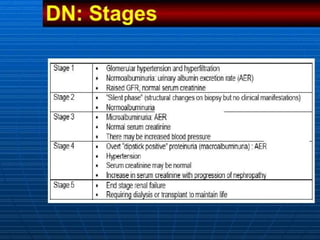
 What are the stages of diabetic nephropathy.
 Diagnosis of diabetic nephropathy.
 Approach of prevention of diabetic
nephropathy.
 New and updated management of diabetic
nephropathy.
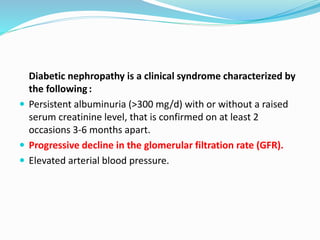
Diabetic nephropathy is a clinical syndrome characterized by
the following:
 Persistent albuminuria (>300 mg/d) with or without a raised
serum creatinine level, that is confirmed on at least 2
occasions 3-6 months apart.
 Progressive decline in the glomerular filtration rate (GFR).
 Elevated arterial blood pressure.
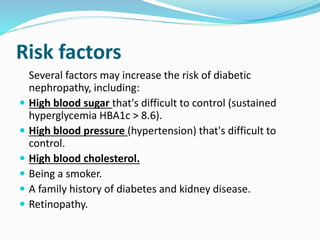
Risk factors
Several factors may increase the risk of diabetic
nephropathy, including:
 High blood sugar that's difficult to control (sustained
hyperglycemia HBA1c > 8.6).
 High blood pressure (hypertension) that's difficult to
control.
 High blood cholesterol.
 Being a smoker.
 A family history of diabetes and kidney disease.
 Retinopathy.
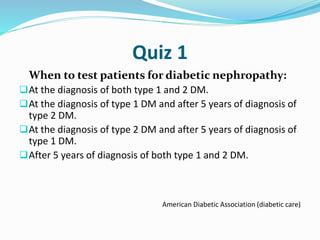
Quiz 1
When to test patients for diabetic nephropathy:
At the diagnosis of both type 1 and 2 DM.
At the diagnosis of type 1 DM and after 5 years of diagnosis of
type 2 DM.
At the diagnosis of type 2 DM and after 5 years of diagnosis of
type 1 DM.
After 5 years of diagnosis of both type 1 and 2 DM.
American Diabetic Association (diabetic care)
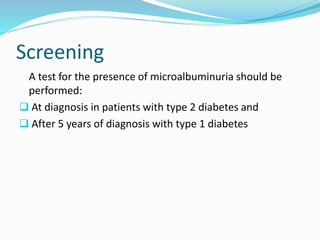
Screening
A test for the presence of microalbuminuria should be
performed:
 At diagnosis in patients with type 2 diabetes and
 After 5 years of diagnosis with type 1 diabetes
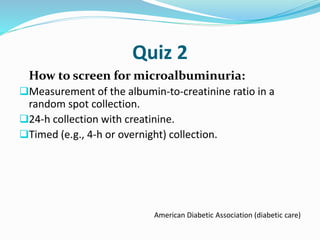
Quiz 2
How to screen for microalbuminuria:
Measurement of the albumin-to-creatinine ratio in a
random spot collection.
24-h collection with creatinine.
Timed (e.g., 4-h or overnight) collection.
American Diabetic Association (diabetic care)
Screening for microalbuminuria can be performed by
three methods:
1) Measurement of the albumin-to-creatinine ratio in a
random spot collection.
2) 24-h collection with creatinine, allowing the
simultaneous measurement of creatinine clearance.
3) Timed (e.g., 4-h or overnight) collection.
Quiz 3
Albumin: Creatinine Ratio (ACR) can be measured by:
Morning urine sample.
Evening urine sample.
Random urine samples.
Morning urine sample, however random urine samples
can be used.
Australian National Evidence Based Guideline
Albumin: Creatinine Ratio (ACR)
should be measured using a morning
urine sample, however random urine
samples can be used
Quiz 4
Measurement of urinary albumin can be influenced by:
Urinary tract infection.
High dietary protein intake.
Vaginal discharge.
NSAIDS drugs.
Australian National Evidence Based Guideline
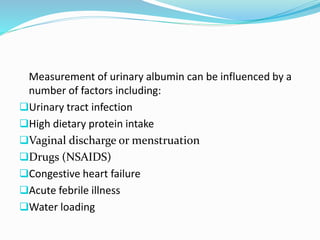
Measurement of urinary albumin can be influenced by a
number of factors including:
Urinary tract infection
High dietary protein intake
Vaginal discharge or menstruation
Drugs (NSAIDS)
Congestive heart failure
Acute febrile illness
Water loading
Quiz 5
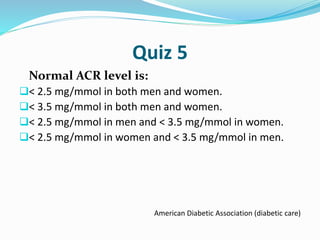
Normal ACR level is:
< 2.5 mg/mmol in both men and women.
< 3.5 mg/mmol in both men and women.
< 2.5 mg/mmol in men and < 3.5 mg/mmol in women.
< 2.5 mg/mmol in women and < 3.5 mg/mmol in men.
American Diabetic Association (diabetic care)
Quiz 6
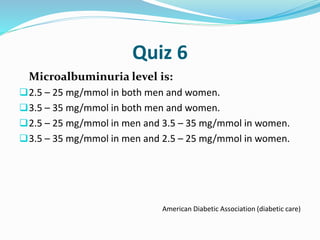
Microalbuminuria level is:
2.5 – 25 mg/mmol in both men and women.
3.5 – 35 mg/mmol in both men and women.
2.5 – 25 mg/mmol in men and 3.5 – 35 mg/mmol in women.
3.5 – 35 mg/mmol in men and 2.5 – 25 mg/mmol in women.
American Diabetic Association (diabetic care)
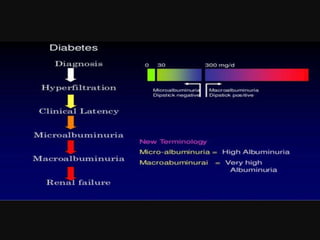
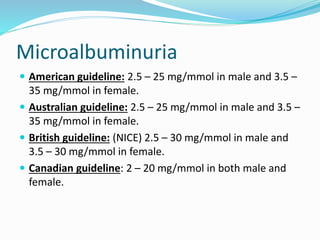
Microalbuminuria
 American guideline: 2.5 – 25 mg/mmol in male and 3.5 –
35 mg/mmol in female.
 Australian guideline: 2.5 – 25 mg/mmol in male and 3.5 –
35 mg/mmol in female.
 British guideline: (NICE) 2.5 – 30 mg/mmol in male and
3.5 – 30 mg/mmol in female.
 Canadian guideline: 2 – 20 mg/mmol in both male and
female.
Quiz 7
Microalbuminuria is confirmed by:
By only one elevated test.
By 2 elevated test out of 3 within 3 – 4 months.
By 2 elevated test out of 3 within 5 – 6 months.
By 3 elevated test out of 4 within 5 – 6 months.
Australian National Evidence Based Guideline
To confirm microalbuminuria:
 Perform additional ACR measurements 1 to 2 times
within 3 months.
 Microalbuminuria is confirmed if at least 2 of 3 tests
(including the screening test) are positive.
Quiz 8
To calculate GFR you need:
Serum creatinine.
Serum creatinine and urea.
Serum creatinine and age.
Serum creatinine, urea and age.
How to calculate GFR
 There is some website provide eGFR calculation.
Ex: http://egfrcalc.renal.org/
 Also there are some equation.
Ex: the MDRD equation
GFR (mL/min/1.73 m2) = 175 × (Scr)-1.154 × (Age)-0.203 × (0.742 if
female) × (1.212 if African American)
http://nephron.org/mdrd_gfr_si
Ex: the Cockcroft-Gault formula
GFR (mL/min/1.73 m2) = (140 – Age) × Weight in Kg × (1.04 if
female – 1.23 if malr) / serum creatinine in mmol/L
http://touchcalc.com/calculators/cg
Quiz 9
Prevention of diabetic nephropathy depend on:
Patient education.
Glycemic control.
Blood preasure control.
Smoking cessation if smoker.
American Diabetic Association (diabetic care)
Prevention of Diabetic Nephropathy
 Patient education is the key in trying to prevent DN.
 Appropriate education, follow-up, and regular doctor
visits are important in prevention of DN.
 Glycemic control reduces the onset of microalbuminuria
and slow progression of DN.
Evidence Level I
 Control of blood preasure in diabetic patients reduce
progression of DN.
Evidence Level I
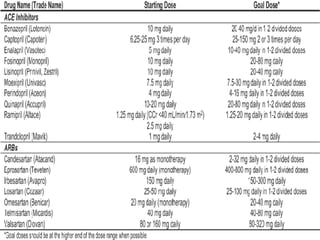
 ACEi and ARBs decrease progression of kidney
dysfunction.
Evidence Level I
 Smoking increases risk of development and progression
of CKD in people with type 2 diabetes.
Evidence Level II
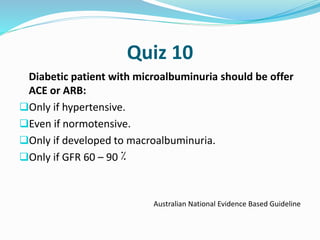
Quiz 10
Diabetic patient with microalbuminuria should be offer
ACE or ARB:
Only if hypertensive.
Even if normotensive.
Only if developed to macroalbuminuria.
Only if GFR 60 – 90 ٪
Australian National Evidence Based Guideline
Normotensive persons with diabetes
and microalbuminuria should be
given an ACE inhibitor or ARB to
reduce progression to
macroalbuminuria
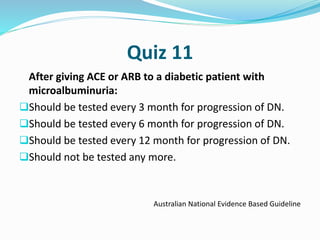
Quiz 11
After giving ACE or ARB to a diabetic patient with
microalbuminuria:
Should be tested every 3 month for progression of DN.
Should be tested every 6 month for progression of DN.
Should be tested every 12 month for progression of DN.
Should not be tested any more.
Australian National Evidence Based Guideline
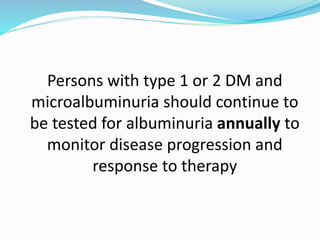
Persons with type 1 or 2 DM and
microalbuminuria should continue to
be tested for albuminuria annually to
monitor disease progression and
response to therapy
Quiz 12
If diabetic nephropathy is still progressed after ACE or
ARB medication:
Follow up until developed to next stage.
Shift to another agent.
Titrate the medication until control or maximum dose.
Combine ACE and ARB.
NKF KDOQI GUIDELINES
Combination therapy with ACE
inhibitors and angiotensin II receptor
blockers should be avoided in
persons with diabetes,
atherosclerosis, and evidence of end-
organ damage
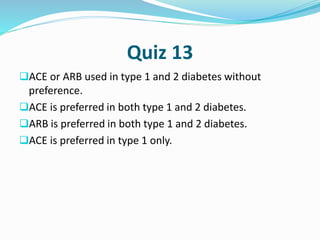
Quiz 13
ACE or ARB used in type 1 and 2 diabetes without
preference.
ACE is preferred in both type 1 and 2 diabetes.
ARB is preferred in both type 1 and 2 diabetes.
ACE is preferred in type 1 only.
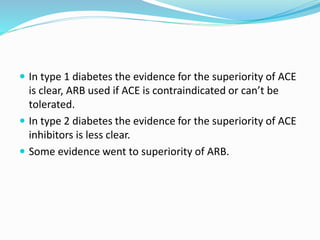
 In type 1 diabetes the evidence for the superiority of ACE
is clear, ARB used if ACE is contraindicated or can’t be
tolerated.
 In type 2 diabetes the evidence for the superiority of ACE
inhibitors is less clear.
 Some evidence went to superiority of ARB.
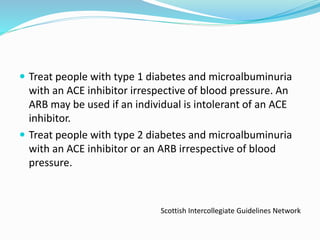
 Treat people with type 1 diabetes and microalbuminuria
with an ACE inhibitor irrespective of blood pressure. An
ARB may be used if an individual is intolerant of an ACE
inhibitor.
 Treat people with type 2 diabetes and microalbuminuria
with an ACE inhibitor or an ARB irrespective of blood
pressure.
Scottish Intercollegiate Guidelines Network
When should patient with diabetic nephropathy
referred to nephrologists:
Once microalbuminuria is diagnosed.
Once macroalbuminuria is diagnosed.
If there is rapid progression of chronic kidney disease.
Stage 3 chronic kidney disease (estimated glomerular
filtration rate 30 – 59 mL per minute per 1.73 m2).
Referral to nephrologists
 Acute kidney injury
 Rapid progression of chronic kidney disease
 Stage 4 chronic kidney disease (estimated glomerular
filtration rate < 30 mL per minute per 1.73 m2)
American Diabetic Association (diabetic care)
Home messages
 Screening of microalbuminuria at diagnosis in type 2
DM and after 5 years of diagnosis with type 1 DM.
 Microalbuminuria is confirmed with positive 2 of 3
tests.
 Patient education is the cornerstone in preventing DN.
 Patient with DN should be offered ACE or ARB even if
normotensive.
 Patients with microalbuminuria should be tested for
albuminuria annually to monitor disease progression
and response to therapy.
‫ح‬‫لي‬‫ع‬‫ا‬‫ر‬‫ي‬‫خ‬‫هللا‬‫م‬‫ك‬‫ا‬‫ز‬‫ج‬‫و‬‫سن‬
‫اع‬‫م‬‫ت‬‫س‬‫اال‬

Diabetic nephropathy

  • 1.
    Prepared by :Dr. Ahmed Ibrahim Eldesouky Abouelela Family Medicine Registrar MBBch Family Medicine Master degree MRCGP.int
  • 2.
    Objectives  What arethe stages of diabetic nephropathy.  Diagnosis of diabetic nephropathy.  Approach of prevention of diabetic nephropathy.  New and updated management of diabetic nephropathy.
  • 3.
    Diabetic nephropathy isa clinical syndrome characterized by the following:  Persistent albuminuria (>300 mg/d) with or without a raised serum creatinine level, that is confirmed on at least 2 occasions 3-6 months apart.  Progressive decline in the glomerular filtration rate (GFR).  Elevated arterial blood pressure.
  • 4.
    Risk factors Several factorsmay increase the risk of diabetic nephropathy, including:  High blood sugar that's difficult to control (sustained hyperglycemia HBA1c > 8.6).  High blood pressure (hypertension) that's difficult to control.  High blood cholesterol.  Being a smoker.  A family history of diabetes and kidney disease.  Retinopathy.
  • 9.
    Quiz 1 When totest patients for diabetic nephropathy: At the diagnosis of both type 1 and 2 DM. At the diagnosis of type 1 DM and after 5 years of diagnosis of type 2 DM. At the diagnosis of type 2 DM and after 5 years of diagnosis of type 1 DM. After 5 years of diagnosis of both type 1 and 2 DM. American Diabetic Association (diabetic care)
  • 10.
    Screening A test forthe presence of microalbuminuria should be performed:  At diagnosis in patients with type 2 diabetes and  After 5 years of diagnosis with type 1 diabetes
  • 11.
    Quiz 2 How toscreen for microalbuminuria: Measurement of the albumin-to-creatinine ratio in a random spot collection. 24-h collection with creatinine. Timed (e.g., 4-h or overnight) collection. American Diabetic Association (diabetic care)
  • 12.
    Screening for microalbuminuriacan be performed by three methods: 1) Measurement of the albumin-to-creatinine ratio in a random spot collection. 2) 24-h collection with creatinine, allowing the simultaneous measurement of creatinine clearance. 3) Timed (e.g., 4-h or overnight) collection.
  • 13.
    Quiz 3 Albumin: CreatinineRatio (ACR) can be measured by: Morning urine sample. Evening urine sample. Random urine samples. Morning urine sample, however random urine samples can be used. Australian National Evidence Based Guideline
  • 14.
    Albumin: Creatinine Ratio(ACR) should be measured using a morning urine sample, however random urine samples can be used
  • 15.
    Quiz 4 Measurement ofurinary albumin can be influenced by: Urinary tract infection. High dietary protein intake. Vaginal discharge. NSAIDS drugs. Australian National Evidence Based Guideline
  • 16.
    Measurement of urinaryalbumin can be influenced by a number of factors including: Urinary tract infection High dietary protein intake Vaginal discharge or menstruation Drugs (NSAIDS) Congestive heart failure Acute febrile illness Water loading
  • 17.
    Quiz 5 Normal ACRlevel is: < 2.5 mg/mmol in both men and women. < 3.5 mg/mmol in both men and women. < 2.5 mg/mmol in men and < 3.5 mg/mmol in women. < 2.5 mg/mmol in women and < 3.5 mg/mmol in men. American Diabetic Association (diabetic care)
  • 18.
    Quiz 6 Microalbuminuria levelis: 2.5 – 25 mg/mmol in both men and women. 3.5 – 35 mg/mmol in both men and women. 2.5 – 25 mg/mmol in men and 3.5 – 35 mg/mmol in women. 3.5 – 35 mg/mmol in men and 2.5 – 25 mg/mmol in women. American Diabetic Association (diabetic care)
  • 19.
    Microalbuminuria  American guideline:2.5 – 25 mg/mmol in male and 3.5 – 35 mg/mmol in female.  Australian guideline: 2.5 – 25 mg/mmol in male and 3.5 – 35 mg/mmol in female.  British guideline: (NICE) 2.5 – 30 mg/mmol in male and 3.5 – 30 mg/mmol in female.  Canadian guideline: 2 – 20 mg/mmol in both male and female.
  • 20.
    Quiz 7 Microalbuminuria isconfirmed by: By only one elevated test. By 2 elevated test out of 3 within 3 – 4 months. By 2 elevated test out of 3 within 5 – 6 months. By 3 elevated test out of 4 within 5 – 6 months. Australian National Evidence Based Guideline
  • 21.
    To confirm microalbuminuria: Perform additional ACR measurements 1 to 2 times within 3 months.  Microalbuminuria is confirmed if at least 2 of 3 tests (including the screening test) are positive.
  • 22.
    Quiz 8 To calculateGFR you need: Serum creatinine. Serum creatinine and urea. Serum creatinine and age. Serum creatinine, urea and age.
  • 23.
    How to calculateGFR  There is some website provide eGFR calculation. Ex: http://egfrcalc.renal.org/  Also there are some equation. Ex: the MDRD equation GFR (mL/min/1.73 m2) = 175 × (Scr)-1.154 × (Age)-0.203 × (0.742 if female) × (1.212 if African American) http://nephron.org/mdrd_gfr_si Ex: the Cockcroft-Gault formula GFR (mL/min/1.73 m2) = (140 – Age) × Weight in Kg × (1.04 if female – 1.23 if malr) / serum creatinine in mmol/L http://touchcalc.com/calculators/cg
  • 25.
    Quiz 9 Prevention ofdiabetic nephropathy depend on: Patient education. Glycemic control. Blood preasure control. Smoking cessation if smoker. American Diabetic Association (diabetic care)
  • 26.
    Prevention of DiabeticNephropathy  Patient education is the key in trying to prevent DN.  Appropriate education, follow-up, and regular doctor visits are important in prevention of DN.
  • 27.
     Glycemic controlreduces the onset of microalbuminuria and slow progression of DN. Evidence Level I  Control of blood preasure in diabetic patients reduce progression of DN. Evidence Level I  ACEi and ARBs decrease progression of kidney dysfunction. Evidence Level I  Smoking increases risk of development and progression of CKD in people with type 2 diabetes. Evidence Level II
  • 29.
    Quiz 10 Diabetic patientwith microalbuminuria should be offer ACE or ARB: Only if hypertensive. Even if normotensive. Only if developed to macroalbuminuria. Only if GFR 60 – 90 ٪ Australian National Evidence Based Guideline
  • 30.
    Normotensive persons withdiabetes and microalbuminuria should be given an ACE inhibitor or ARB to reduce progression to macroalbuminuria
  • 31.
    Quiz 11 After givingACE or ARB to a diabetic patient with microalbuminuria: Should be tested every 3 month for progression of DN. Should be tested every 6 month for progression of DN. Should be tested every 12 month for progression of DN. Should not be tested any more. Australian National Evidence Based Guideline
  • 32.
    Persons with type1 or 2 DM and microalbuminuria should continue to be tested for albuminuria annually to monitor disease progression and response to therapy
  • 33.
    Quiz 12 If diabeticnephropathy is still progressed after ACE or ARB medication: Follow up until developed to next stage. Shift to another agent. Titrate the medication until control or maximum dose. Combine ACE and ARB. NKF KDOQI GUIDELINES
  • 35.
    Combination therapy withACE inhibitors and angiotensin II receptor blockers should be avoided in persons with diabetes, atherosclerosis, and evidence of end- organ damage
  • 36.
    Quiz 13 ACE orARB used in type 1 and 2 diabetes without preference. ACE is preferred in both type 1 and 2 diabetes. ARB is preferred in both type 1 and 2 diabetes. ACE is preferred in type 1 only.
  • 37.
     In type1 diabetes the evidence for the superiority of ACE is clear, ARB used if ACE is contraindicated or can’t be tolerated.  In type 2 diabetes the evidence for the superiority of ACE inhibitors is less clear.  Some evidence went to superiority of ARB.
  • 38.
     Treat peoplewith type 1 diabetes and microalbuminuria with an ACE inhibitor irrespective of blood pressure. An ARB may be used if an individual is intolerant of an ACE inhibitor.  Treat people with type 2 diabetes and microalbuminuria with an ACE inhibitor or an ARB irrespective of blood pressure. Scottish Intercollegiate Guidelines Network
  • 39.
    When should patientwith diabetic nephropathy referred to nephrologists: Once microalbuminuria is diagnosed. Once macroalbuminuria is diagnosed. If there is rapid progression of chronic kidney disease. Stage 3 chronic kidney disease (estimated glomerular filtration rate 30 – 59 mL per minute per 1.73 m2).
  • 40.
    Referral to nephrologists Acute kidney injury  Rapid progression of chronic kidney disease  Stage 4 chronic kidney disease (estimated glomerular filtration rate < 30 mL per minute per 1.73 m2) American Diabetic Association (diabetic care)
  • 41.
    Home messages  Screeningof microalbuminuria at diagnosis in type 2 DM and after 5 years of diagnosis with type 1 DM.  Microalbuminuria is confirmed with positive 2 of 3 tests.  Patient education is the cornerstone in preventing DN.  Patient with DN should be offered ACE or ARB even if normotensive.  Patients with microalbuminuria should be tested for albuminuria annually to monitor disease progression and response to therapy.
  • 42.