LUPUS NEPHRITIS:
Clinical Pearls
DR. ABDELAZEIM ELHEFNY MD
PROF. OF RHEUMATOLOGY & IMMUNOLOGY
AIN SHAMS UNIVERSITY
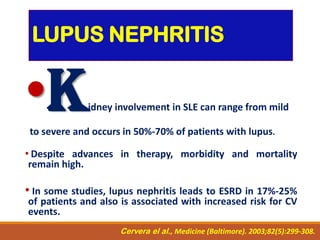
LUPUS NEPHRITIS
•Kidney involvement in SLE can range from mild
to severe and occurs in 50%-70% of patients with lupus.
• Despite advances in therapy, morbidity and mortality
remain high.
• In some studies, lupus nephritis leads to ESRD in 17%-25%
of patients and also is associated with increased risk for CV
events.
Cervera el al., Medicine (Baltimore). 2003;82(5):299-308.
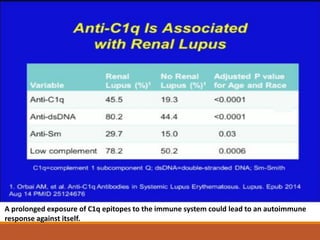
A prolonged exposure of C1q epitopes to the immune system could lead to an autoimmune
response against itself.
?
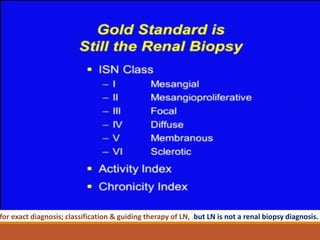
for exact diagnosis; classification & guiding therapy of LN, but LN is not a renal biopsy diagnosis.
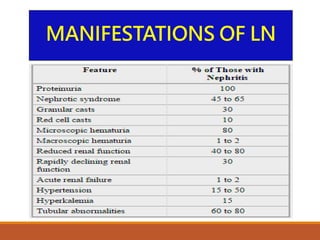
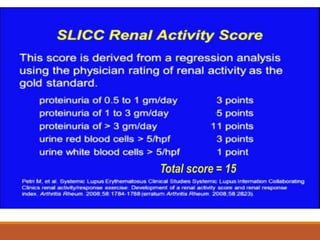
MANIFESTATIONS OF LN
Total score = 15
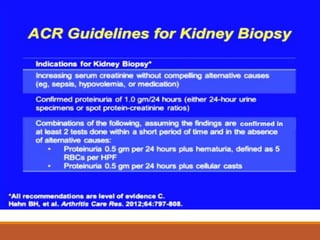
confirmed in
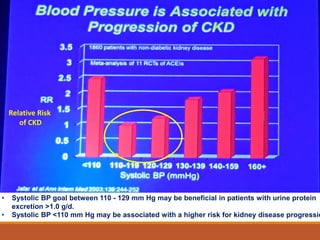
• Systolic BP goal between 110 - 129 mm Hg may be beneficial in patients with urine protein
excretion >1.0 g/d.
• Systolic BP <110 mm Hg may be associated with a higher risk for kidney disease progressio
Relative Risk
of CKD
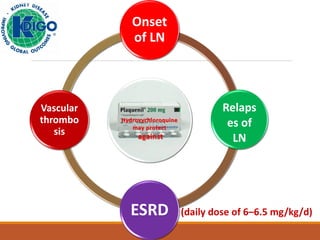
Hydroxychloroquine
may protect
against
Onset
of LN
Relaps
es of
LN
ESRD
Vascular
thrombo
sis
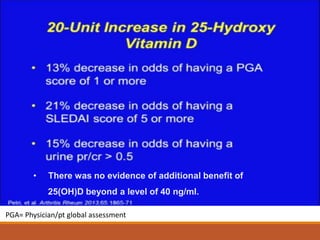
PGA= Physician/pt global assessment
• There was no evidence of additional benefit of
25(OH)D beyond a level of 40 ng/ml.
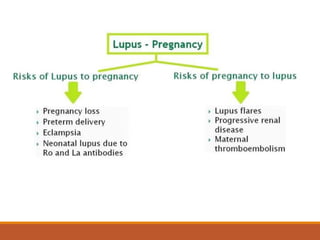
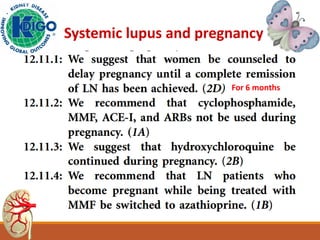
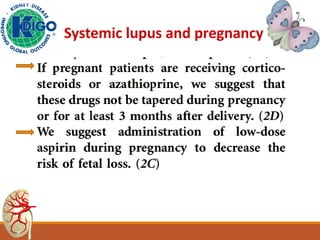
LUPUS & Pregnancy
Never MMF, stop 3 month before conception,
If taking MMF shift to AZA & wait for 3 month to start peg
For 6 months
mg
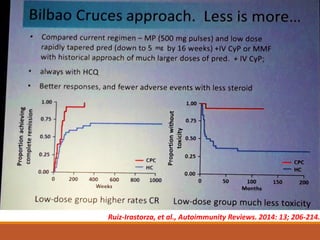
Ruiz-Irastorza, et al., Autoimmunity Reviews. 2014: 13; 206-214.
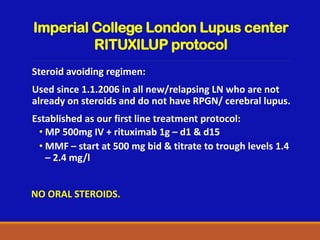
Imperial College London Lupus center
RITUXILUP protocol
Steroid avoiding regimen:
Used since 1.1.2006 in all new/relapsing LN who are not
already on steroids and do not have RPGN/ cerebral lupus.
Established as our first line treatment protocol:
• MP 500mg IV + rituximab 1g – d1 & d15
• MMF – start at 500 mg bid & titrate to trough levels 1.4
– 2.4 mg/l
NO ORAL STEROIDS.
RITUXILUP
• Rituxilup regimen leads to remission, preservation of renal
function & minimal oral steroid use in a significant proportion
of patients.
• Relapses were only in patients with class IV or V disease,
majority responded to retreatment, again with no oral steroids.
• Flares were not uncommon but did not predict poor outcomes.
• Poor outcomes were predicted by baseline creatinine > 1.4
mg/dl or a failure to achieve partial renal remission (PR) at 6
months.
• The minimal use of oral steroids in the majority would be
expected to have long term benefits in terms of CV risk &
reduced side effects.
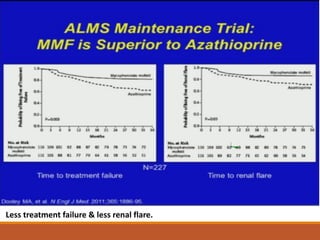
Less treatment failure & less renal flare.
1.4 – 2.4 mg/l
The Future?
• Multi-target therapy: adding biologics or CNI
to MMF.
• Tracking disease activity without renal
biopsy.
• Preventing renal fibrosis.
CONCLUSION
 I note that the present and the future are brighter for lupus nephritis.
 Previously, LN was the primary cause of death in SLE. Today, we realize
that it is not as common as thought even a few years ago, yet it still does
affect around 50% of patients.
 To our patients: make sure to take your hydroxychloroquine every day,
take vitamin D regularly to keep your blood 25-OH vitamin D level 40 ng/mL,
and use your sunscreen religiously every day (even if you don’t go outside)
in the hopes of decreasing your chances of getting nephritis.

 See your rheumatologist at least every few months & give a urine sample
to look for LN, even if you feel perfectly fine (remember that most people
with nephritis do not have any symptoms at all) in the hopes of catching
lupus nephritis in the earliest stages possible.
 In the near future, we will have newer and better therapies for LN and will
hopefully be able to use much lower doses of steroids in its treatment; while
we await the discovery of a cure for this disease.
Lupus nephritis peals

Lupus nephritis peals

  • 1.
    LUPUS NEPHRITIS: Clinical Pearls DR.ABDELAZEIM ELHEFNY MD PROF. OF RHEUMATOLOGY & IMMUNOLOGY AIN SHAMS UNIVERSITY
  • 2.
    LUPUS NEPHRITIS •Kidney involvementin SLE can range from mild to severe and occurs in 50%-70% of patients with lupus. • Despite advances in therapy, morbidity and mortality remain high. • In some studies, lupus nephritis leads to ESRD in 17%-25% of patients and also is associated with increased risk for CV events. Cervera el al., Medicine (Baltimore). 2003;82(5):299-308.
  • 5.
    A prolonged exposureof C1q epitopes to the immune system could lead to an autoimmune response against itself.
  • 6.
  • 7.
    for exact diagnosis;classification & guiding therapy of LN, but LN is not a renal biopsy diagnosis.
  • 8.
  • 9.
  • 12.
  • 14.
    • Systolic BPgoal between 110 - 129 mm Hg may be beneficial in patients with urine protein excretion >1.0 g/d. • Systolic BP <110 mm Hg may be associated with a higher risk for kidney disease progressio Relative Risk of CKD
  • 18.
  • 20.
    PGA= Physician/pt globalassessment • There was no evidence of additional benefit of 25(OH)D beyond a level of 40 ng/ml.
  • 21.
  • 23.
    Never MMF, stop3 month before conception, If taking MMF shift to AZA & wait for 3 month to start peg
  • 24.
  • 28.
    mg Ruiz-Irastorza, et al.,Autoimmunity Reviews. 2014: 13; 206-214.
  • 32.
    Imperial College LondonLupus center RITUXILUP protocol Steroid avoiding regimen: Used since 1.1.2006 in all new/relapsing LN who are not already on steroids and do not have RPGN/ cerebral lupus. Established as our first line treatment protocol: • MP 500mg IV + rituximab 1g – d1 & d15 • MMF – start at 500 mg bid & titrate to trough levels 1.4 – 2.4 mg/l NO ORAL STEROIDS.
  • 33.
    RITUXILUP • Rituxilup regimenleads to remission, preservation of renal function & minimal oral steroid use in a significant proportion of patients. • Relapses were only in patients with class IV or V disease, majority responded to retreatment, again with no oral steroids. • Flares were not uncommon but did not predict poor outcomes. • Poor outcomes were predicted by baseline creatinine > 1.4 mg/dl or a failure to achieve partial renal remission (PR) at 6 months. • The minimal use of oral steroids in the majority would be expected to have long term benefits in terms of CV risk & reduced side effects.
  • 36.
    Less treatment failure& less renal flare.
  • 37.
  • 43.
    The Future? • Multi-targettherapy: adding biologics or CNI to MMF. • Tracking disease activity without renal biopsy. • Preventing renal fibrosis.
  • 44.
    CONCLUSION  I notethat the present and the future are brighter for lupus nephritis.  Previously, LN was the primary cause of death in SLE. Today, we realize that it is not as common as thought even a few years ago, yet it still does affect around 50% of patients.  To our patients: make sure to take your hydroxychloroquine every day, take vitamin D regularly to keep your blood 25-OH vitamin D level 40 ng/mL, and use your sunscreen religiously every day (even if you don’t go outside) in the hopes of decreasing your chances of getting nephritis.  See your rheumatologist at least every few months & give a urine sample to look for LN, even if you feel perfectly fine (remember that most people with nephritis do not have any symptoms at all) in the hopes of catching lupus nephritis in the earliest stages possible.  In the near future, we will have newer and better therapies for LN and will hopefully be able to use much lower doses of steroids in its treatment; while we await the discovery of a cure for this disease.