American College of
 Rheumatology Guidelines for
  Screening, Treatment, and
Management of Lupus Nephritis


           Dr. Amit Agrawal
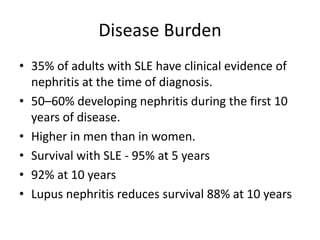
Disease Burden
• 35% of adults with SLE have clinical evidence of
  nephritis at the time of diagnosis.
• 50–60% developing nephritis during the first 10
  years of disease.
• Higher in men than in women.
• Survival with SLE - 95% at 5 years
• 92% at 10 years
• Lupus nephritis reduces survival 88% at 10 years
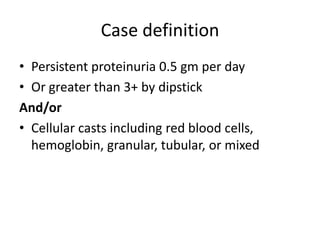
Case definition
• Persistent proteinuria 0.5 gm per day
• Or greater than 3+ by dipstick
And/or
• Cellular casts including red blood cells,
  hemoglobin, granular, tubular, or mixed
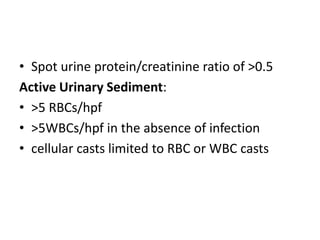
• Spot urine protein/creatinine ratio of >0.5
Active Urinary Sediment:
• >5 RBCs/hpf
• >5WBCs/hpf in the absence of infection
• cellular casts limited to RBC or WBC casts
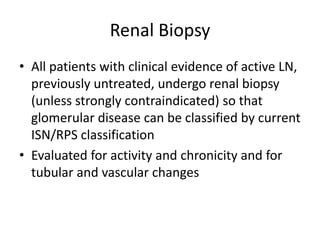
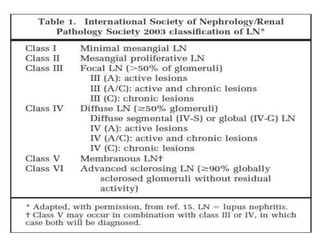
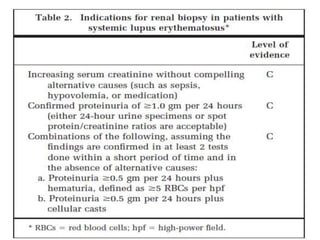
Renal Biopsy
• All patients with clinical evidence of active LN,
  previously untreated, undergo renal biopsy
  (unless strongly contraindicated) so that
  glomerular disease can be classified by current
  ISN/RPS classification
• Evaluated for activity and chronicity and for
  tubular and vascular changes
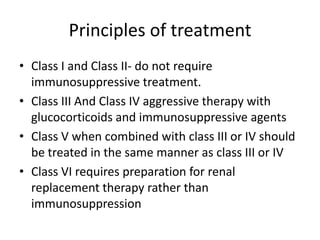
Principles of treatment
• Class I and Class II- do not require
  immunosuppressive treatment.
• Class III And Class IV aggressive therapy with
  glucocorticoids and immunosuppressive agents
• Class V when combined with class III or IV should
  be treated in the same manner as class III or IV
• Class VI requires preparation for renal
  replacement therapy rather than
  immunosuppression
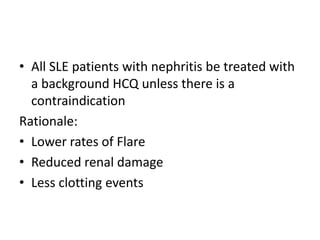
• All SLE patients with nephritis be treated with
  a background HCQ unless there is a
  contraindication
Rationale:
• Lower rates of Flare
• Reduced renal damage
• Less clotting events
• LN patients with proteinuria >0.5 gm per 24
  hours should have blockade of the renin–
  angiotensin system, which drives
  intraglomerular pressure
Rationale:
• Reduces proteinuria by 30%, and
• Significantly delays doubling of serum
  creatinine
• Delays progression to end-stage renal disease
• Control of hypertension, with a target of
  <130/80 mm Hg
• Statin therapy be introduced in patients with
  low-density lipoprotein cholesterol >100
  mg/dl
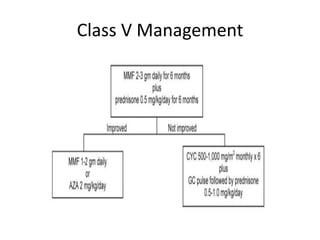
Class V Management
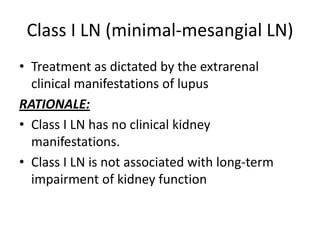
Class I LN (minimal-mesangial LN)
• Treatment as dictated by the extrarenal
  clinical manifestations of lupus
RATIONALE:
• Class I LN has no clinical kidney
  manifestations.
• Class I LN is not associated with long-term
  impairment of kidney function
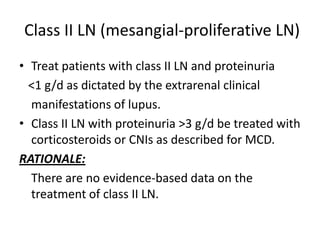
Class II LN (mesangial-proliferative LN)
• Treat patients with class II LN and proteinuria
  <1 g/d as dictated by the extrarenal clinical
  manifestations of lupus.
• Class II LN with proteinuria >3 g/d be treated with
  corticosteroids or CNIs as described for MCD.
RATIONALE:
  There are no evidence-based data on the
  treatment of class II LN.
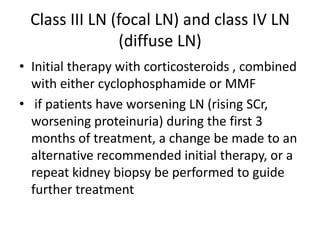
Class III LN (focal LN) and class IV LN
               (diffuse LN)
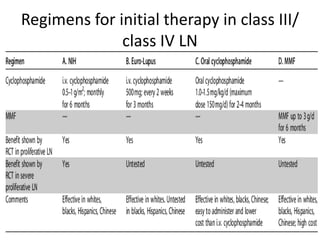
• Initial therapy with corticosteroids , combined
  with either cyclophosphamide or MMF
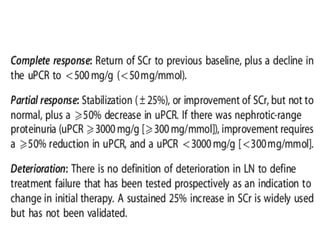
• if patients have worsening LN (rising SCr,
  worsening proteinuria) during the first 3
  months of treatment, a change be made to an
  alternative recommended initial therapy, or a
  repeat kidney biopsy be performed to guide
  further treatment
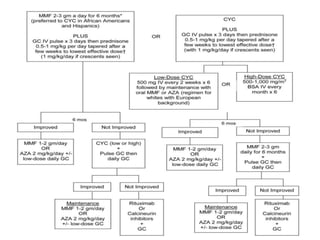
Regimens for initial therapy in class III/
              class IV LN
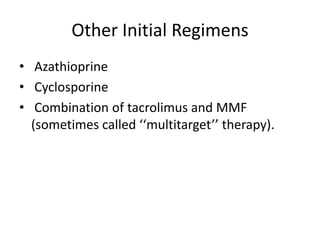
Other Initial Regimens
• Azathioprine
• Cyclosporine
• Combination of tacrolimus and MMF
  (sometimes called ‘‘multitarget’’ therapy).
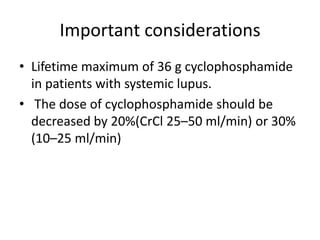
Important considerations
• Lifetime maximum of 36 g cyclophosphamide
  in patients with systemic lupus.
• The dose of cyclophosphamide should be
  decreased by 20%(CrCl 25–50 ml/min) or 30%
  (10–25 ml/min)
Choice of Initial Therapy
• In severe class III/IV LN, a cyclophosphamide-
  containing protocol for initial therapy may be
  preferred.
• In patients with less severe proliferative LN, an
  initial regimen not containing
  cyclophosphamide should be considered.
Class III LN and class IV LN
          maintenance therapy
• Patients with class III and IV LN receive
  maintenance therapy with
• Azathioprine (1.5–2.5 mg/kg/d) or
• MMF (1–2 g/d in divided doses), and
• low-dose oral corticosteroids
• CNIs with low-dose cortico-steroids be used
  for maintenance therapy in patients who are
  intolerant of MMF and azathioprine.
• After complete remission is achieved,
  maintenance therapy be continued for at least
  1 year before consideration is given to
  tapering the immunosuppression.
• If complete remission has not been achieved
  after 12 months of maintenance therapy,
  consider performing a repeat kidney biopsy
  before determining if a change in therapy is
  indicated.
• While maintenance therapy is being tapered, if
  kidney function deteriorates and/or proteinuria
  worsens, treatment be increased to the previous
  level of immunosuppression that controlled the
  LN.
Duration of Therapy
• There is no evidence to help determine the
  duration of maintenance therapy.
• The average duration of immunosuppression
  was 3.5 years in seven RCTs.
• Immunosuppressive therapy should usually be
  slowly tapered after patients have been in
  complete remission for a year.
• Immunosuppression should be continued for
  patients who achieve only a partial remission.
• The strategy of trying to convert a partial
  remission to a complete remission by
  increasing corticosteroids or using alternative
  immunosuppressive agents is not supported
  by evidence.
Predictors of Response to Treatment of
             Class III/IV LN
Predictors for not achieving remission:
• SCr at the start of treatment
• Magnitude of increase in SCr during relapse
• Delay in starting therapy for more than 3
  months after a clinical diagnosis of LN.
• Severity of proteinuria
• Failure to achieve complete remission a major
  risk factor for kidney relapse.
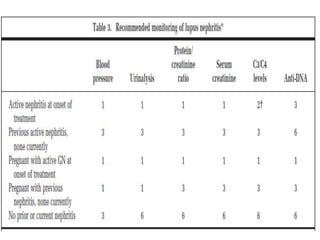
Monitoring Therapy of Class III/IV LN
•   Proteinuria
•   SCr
•   Urine sediment
•   C3 and C4,
•   Anti–double-stranded DNA antibodies
Class V LN (membranous LN)
• Patients with class V LN,normal kidney
  function, and non–nephrotic-range
  proteinuria be treated with antiproteinuric
  and antihypertensive medications, and only
  receive corticosteroids and immunosup-
  pressives as dictated by the extrarenal man-
  ifestations of systemic lupus.
• Pure class V LN and persistent nephrotic
  proteinuria be treated with corticosteroids
  plus an additional immunosuppressive agent:
• cyclophosphamide
• CNI
• MMF
• Azathioprine
General treatment of LN
• All patients with LN of any class are treated
  with hydroxychloroquine(maximum daily dose
  of 6–6.5 mg/kg ideal body weight), unless
  they have a specific contraindication to this
  drug.
Class VI LN (advanced sclerosis LN)
• Treated with corticosteroids and immuno-
  suppressives only as dictated by the extrarenal
  manifestations of systemic lupus.
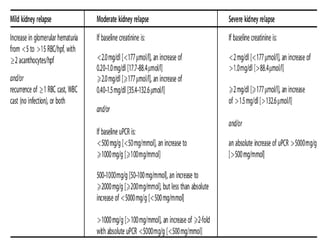
Relapse of LN
• Relapse of LN after complete or partial
  remission be treated with the initial therapy
  followed by the maintenance therapy that was
  effective in inducing the original remission
• If resuming the original therapy would put
  the patient at risk for excessive lifetime
  cyclophosphamide exposure, then we suggest
  a non cyclophosphamide based initial regimen
  be used.
• Consider a repeat kidney biopsy during
  relapse if there is suspicion that the histologic
  class of LN has changed, or there is
  uncertainty whether a rising SCr and/or
  worsening proteinuria represents disease
  activity or chronicity.
Treatment of resistant disease
• In patients with worsening SCr and/or protei-
  nuria after completing one of the initial
  treatment regimens, consider performing a
  repeat kidney biopsy to distinguish active LN
  from scarring.
• Treat patients with worsening SCr and/or
  proteinuria who continue to have active LN on
  biopsy with one of the alternative initial treat-
  ment regimens.
• Nonresponders who have failed more than
  one of the recommended initial regimens may
  be considered for treatment with rituximab,
  i.v.immunoglobulin, or CNIs.
Systemic lupus and thrombotic
           microangiopathy
• The antiphospholipid anti-body syndrome
  (APS) involving the kidney in systemic lupus
  patients, with or without LN,be treated by
  anticoagulation target INR 2–3.
• Patients with systemic lupus and thrombotic
  thrombocytopenic purpura (TTP) receive
  plasma exchange as for patients with TTP
  without systemic lupus.

Lupus nephritis 2012

  • 1.
    American College of Rheumatology Guidelines for Screening, Treatment, and Management of Lupus Nephritis Dr. Amit Agrawal
  • 2.
    Disease Burden • 35%of adults with SLE have clinical evidence of nephritis at the time of diagnosis. • 50–60% developing nephritis during the first 10 years of disease. • Higher in men than in women. • Survival with SLE - 95% at 5 years • 92% at 10 years • Lupus nephritis reduces survival 88% at 10 years
  • 3.
    Case definition • Persistentproteinuria 0.5 gm per day • Or greater than 3+ by dipstick And/or • Cellular casts including red blood cells, hemoglobin, granular, tubular, or mixed
  • 4.
    • Spot urineprotein/creatinine ratio of >0.5 Active Urinary Sediment: • >5 RBCs/hpf • >5WBCs/hpf in the absence of infection • cellular casts limited to RBC or WBC casts
  • 5.
    Renal Biopsy • Allpatients with clinical evidence of active LN, previously untreated, undergo renal biopsy (unless strongly contraindicated) so that glomerular disease can be classified by current ISN/RPS classification • Evaluated for activity and chronicity and for tubular and vascular changes
  • 8.
    Principles of treatment •Class I and Class II- do not require immunosuppressive treatment. • Class III And Class IV aggressive therapy with glucocorticoids and immunosuppressive agents • Class V when combined with class III or IV should be treated in the same manner as class III or IV • Class VI requires preparation for renal replacement therapy rather than immunosuppression
  • 9.
    • All SLEpatients with nephritis be treated with a background HCQ unless there is a contraindication Rationale: • Lower rates of Flare • Reduced renal damage • Less clotting events
  • 10.
    • LN patientswith proteinuria >0.5 gm per 24 hours should have blockade of the renin– angiotensin system, which drives intraglomerular pressure Rationale: • Reduces proteinuria by 30%, and • Significantly delays doubling of serum creatinine • Delays progression to end-stage renal disease
  • 11.
    • Control ofhypertension, with a target of <130/80 mm Hg • Statin therapy be introduced in patients with low-density lipoprotein cholesterol >100 mg/dl
  • 13.
  • 16.
    Class I LN(minimal-mesangial LN) • Treatment as dictated by the extrarenal clinical manifestations of lupus RATIONALE: • Class I LN has no clinical kidney manifestations. • Class I LN is not associated with long-term impairment of kidney function
  • 17.
    Class II LN(mesangial-proliferative LN) • Treat patients with class II LN and proteinuria <1 g/d as dictated by the extrarenal clinical manifestations of lupus. • Class II LN with proteinuria >3 g/d be treated with corticosteroids or CNIs as described for MCD. RATIONALE: There are no evidence-based data on the treatment of class II LN.
  • 18.
    Class III LN(focal LN) and class IV LN (diffuse LN) • Initial therapy with corticosteroids , combined with either cyclophosphamide or MMF • if patients have worsening LN (rising SCr, worsening proteinuria) during the first 3 months of treatment, a change be made to an alternative recommended initial therapy, or a repeat kidney biopsy be performed to guide further treatment
  • 19.
    Regimens for initialtherapy in class III/ class IV LN
  • 21.
    Other Initial Regimens •Azathioprine • Cyclosporine • Combination of tacrolimus and MMF (sometimes called ‘‘multitarget’’ therapy).
  • 22.
    Important considerations • Lifetimemaximum of 36 g cyclophosphamide in patients with systemic lupus. • The dose of cyclophosphamide should be decreased by 20%(CrCl 25–50 ml/min) or 30% (10–25 ml/min)
  • 23.
    Choice of InitialTherapy • In severe class III/IV LN, a cyclophosphamide- containing protocol for initial therapy may be preferred. • In patients with less severe proliferative LN, an initial regimen not containing cyclophosphamide should be considered.
  • 24.
    Class III LNand class IV LN maintenance therapy • Patients with class III and IV LN receive maintenance therapy with • Azathioprine (1.5–2.5 mg/kg/d) or • MMF (1–2 g/d in divided doses), and • low-dose oral corticosteroids
  • 25.
    • CNIs withlow-dose cortico-steroids be used for maintenance therapy in patients who are intolerant of MMF and azathioprine. • After complete remission is achieved, maintenance therapy be continued for at least 1 year before consideration is given to tapering the immunosuppression.
  • 26.
    • If completeremission has not been achieved after 12 months of maintenance therapy, consider performing a repeat kidney biopsy before determining if a change in therapy is indicated. • While maintenance therapy is being tapered, if kidney function deteriorates and/or proteinuria worsens, treatment be increased to the previous level of immunosuppression that controlled the LN.
  • 27.
    Duration of Therapy •There is no evidence to help determine the duration of maintenance therapy. • The average duration of immunosuppression was 3.5 years in seven RCTs. • Immunosuppressive therapy should usually be slowly tapered after patients have been in complete remission for a year.
  • 28.
    • Immunosuppression shouldbe continued for patients who achieve only a partial remission. • The strategy of trying to convert a partial remission to a complete remission by increasing corticosteroids or using alternative immunosuppressive agents is not supported by evidence.
  • 29.
    Predictors of Responseto Treatment of Class III/IV LN Predictors for not achieving remission: • SCr at the start of treatment • Magnitude of increase in SCr during relapse • Delay in starting therapy for more than 3 months after a clinical diagnosis of LN. • Severity of proteinuria • Failure to achieve complete remission a major risk factor for kidney relapse.
  • 30.
    Monitoring Therapy ofClass III/IV LN • Proteinuria • SCr • Urine sediment • C3 and C4, • Anti–double-stranded DNA antibodies
  • 31.
    Class V LN(membranous LN) • Patients with class V LN,normal kidney function, and non–nephrotic-range proteinuria be treated with antiproteinuric and antihypertensive medications, and only receive corticosteroids and immunosup- pressives as dictated by the extrarenal man- ifestations of systemic lupus.
  • 32.
    • Pure classV LN and persistent nephrotic proteinuria be treated with corticosteroids plus an additional immunosuppressive agent: • cyclophosphamide • CNI • MMF • Azathioprine
  • 33.
    General treatment ofLN • All patients with LN of any class are treated with hydroxychloroquine(maximum daily dose of 6–6.5 mg/kg ideal body weight), unless they have a specific contraindication to this drug.
  • 34.
    Class VI LN(advanced sclerosis LN) • Treated with corticosteroids and immuno- suppressives only as dictated by the extrarenal manifestations of systemic lupus.
  • 35.
    Relapse of LN •Relapse of LN after complete or partial remission be treated with the initial therapy followed by the maintenance therapy that was effective in inducing the original remission • If resuming the original therapy would put the patient at risk for excessive lifetime cyclophosphamide exposure, then we suggest a non cyclophosphamide based initial regimen be used.
  • 36.
    • Consider arepeat kidney biopsy during relapse if there is suspicion that the histologic class of LN has changed, or there is uncertainty whether a rising SCr and/or worsening proteinuria represents disease activity or chronicity.
  • 38.
    Treatment of resistantdisease • In patients with worsening SCr and/or protei- nuria after completing one of the initial treatment regimens, consider performing a repeat kidney biopsy to distinguish active LN from scarring. • Treat patients with worsening SCr and/or proteinuria who continue to have active LN on biopsy with one of the alternative initial treat- ment regimens.
  • 39.
    • Nonresponders whohave failed more than one of the recommended initial regimens may be considered for treatment with rituximab, i.v.immunoglobulin, or CNIs.
  • 40.
    Systemic lupus andthrombotic microangiopathy • The antiphospholipid anti-body syndrome (APS) involving the kidney in systemic lupus patients, with or without LN,be treated by anticoagulation target INR 2–3. • Patients with systemic lupus and thrombotic thrombocytopenic purpura (TTP) receive plasma exchange as for patients with TTP without systemic lupus.