Psoriatic Arthritis
BY
EMMANUEL EZRA ABI
GROUP 3
Definition
Inflammatory arthritis associated with psoriasis
Usually seronegative for Rheumatoid Factor
and cyclic citrullinated peptides (CCP)
Classified with HLA-B27-associated
spondyloarthropathies
Epidemiology
Likely in up to 25-34% of patients with
presence of skin disease
Overall prevalence 0.04-1.2%
M=F although it differs in subsets
Peak age of onset between 30-55 years
CASPAR criteria
evidence of psoriasis
current - 2
history of - 1
family history of - 1
psoriatic nail dystrophy (onycholysis, pitting,
hyperkeratosis)
negative rheumatoid factor
dactylitis, either current or history of
radiological evidence of juxta-articular new
bone formation
Subtypes
DIP joint pattern
oligoarticular (<5 joints) pattern, usually
assymetric
polyarticular (>=5 joints), symmetric in half
arthritis mutilans
spondyloarthritis
Other Rheum Findings
enthesitis (inflammation at site of tendon
insertion)
tenosynovitis (inflammation of tendon and its
enveloping sheath)
dactylitis or “sausage digit”
Extra-articular findings
skin - psoriasis
nails - pits and onycholysis
pitting edema - often asymmetrical
ocular inflammation - conjunctivitis, iritis
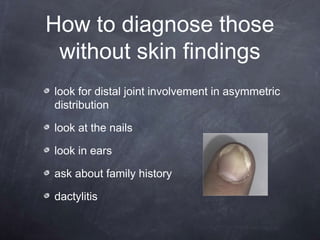
look for distal joint involvement in asymmetric
distribution
look at the nails
look in ears
ask about family history
dactylitis
How to diagnose those
without skin findings
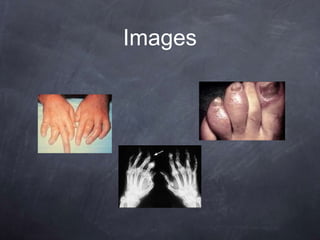
Images
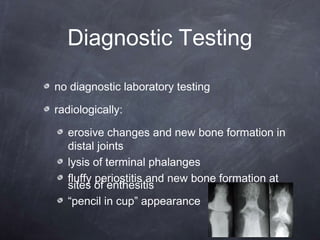
Diagnostic Testing
no diagnostic laboratory testing
radiologically:
erosive changes and new bone formation in
distal joints
lysis of terminal phalanges
fluffy periostitis and new bone formation at
sites of enthesitis
“pencil in cup” appearance
Differential
Reactive (Reiter’s) Arthritis
Rheumatoid Arthritis with concomitant
psoriasis
ankylosing spondylitis
gouty arthritis
Treatment
NSAIDs if disease is mild.
PT, OT, splinting devices
If erosive disease, treat aggressively with
DMARDs (MTX, Sulfasalazine, CsA).
If skin disease is the major issue, should be
managed by a dermatologist.
Early referral to rheumatology for initiation of
DMARDs to prevent progression.
Course and Prognosis
20% of patients have a severe an debilitating
form of arthritis
originally thought to be more benign course
than RhA
progression of clinical damage occurs in a
majority of patients
radiologic changes occur over time despite
treatment
 psoriatic  arthritis

psoriatic arthritis

  • 1.
  • 2.
    Definition Inflammatory arthritis associatedwith psoriasis Usually seronegative for Rheumatoid Factor and cyclic citrullinated peptides (CCP) Classified with HLA-B27-associated spondyloarthropathies
  • 3.
    Epidemiology Likely in upto 25-34% of patients with presence of skin disease Overall prevalence 0.04-1.2% M=F although it differs in subsets Peak age of onset between 30-55 years
  • 4.
    CASPAR criteria evidence ofpsoriasis current - 2 history of - 1 family history of - 1 psoriatic nail dystrophy (onycholysis, pitting, hyperkeratosis) negative rheumatoid factor dactylitis, either current or history of radiological evidence of juxta-articular new bone formation
  • 5.
    Subtypes DIP joint pattern oligoarticular(<5 joints) pattern, usually assymetric polyarticular (>=5 joints), symmetric in half arthritis mutilans spondyloarthritis
  • 6.
    Other Rheum Findings enthesitis(inflammation at site of tendon insertion) tenosynovitis (inflammation of tendon and its enveloping sheath) dactylitis or “sausage digit”
  • 7.
    Extra-articular findings skin -psoriasis nails - pits and onycholysis pitting edema - often asymmetrical ocular inflammation - conjunctivitis, iritis
  • 8.
    look for distaljoint involvement in asymmetric distribution look at the nails look in ears ask about family history dactylitis How to diagnose those without skin findings
  • 9.
  • 10.
    Diagnostic Testing no diagnosticlaboratory testing radiologically: erosive changes and new bone formation in distal joints lysis of terminal phalanges fluffy periostitis and new bone formation at sites of enthesitis “pencil in cup” appearance
  • 11.
    Differential Reactive (Reiter’s) Arthritis RheumatoidArthritis with concomitant psoriasis ankylosing spondylitis gouty arthritis
  • 12.
    Treatment NSAIDs if diseaseis mild. PT, OT, splinting devices If erosive disease, treat aggressively with DMARDs (MTX, Sulfasalazine, CsA). If skin disease is the major issue, should be managed by a dermatologist. Early referral to rheumatology for initiation of DMARDs to prevent progression.
  • 13.
    Course and Prognosis 20%of patients have a severe an debilitating form of arthritis originally thought to be more benign course than RhA progression of clinical damage occurs in a majority of patients radiologic changes occur over time despite treatment

Editor's Notes

  • #5 CASPAR = Classification of Psoriatic Arthritis based on study of 588 pts with PsA, 536 pts with other inflammatory arthritis Once presence of MSK inflammatory condition is established, if they score three + points, can be classified as PsA with sensitivity 91.4%, specificity of 98.7%.
  • #6 Patterns of involvement may be helpful early in course of disease, but over time the pattern often changes. But it is useful as a predictor of prognosis. Distal and arthritis mutilans are most specific for PsA but not most common. Polyarthritis is most common, followed by oligoarthritis.
  • #8 articular disease can develop before skin changes in ~15% of adults, ~15% concomitantly, ~70% skin first pits = sharply defined depressions in the plate usually occuring in large numbers and involving several nails onycholysis = separation of nail from its bed (sometimes need to distinguish from fungal infection) while skin dz does not necessarily correlate with joint disease, nail involvement does seem to correlate more . nonpitting edema from chronic lymphedema is a rare extra-articular finding
  • #9 nail lesions are present in 80-90% of those with PsA, 46% of those with psoriasis uncomplicated by arthritis
  • #11 can have elevated ESR and leukocytosis in 1/3 from inflammatory response can see anemia from AoCD RhF positive in 2-10%, ANA low titer in ~1/2, clinically significant titers ~14%, anti-dsDNA 3%, anti-CCP in 8-16%
  • #12 reactive - lack of preceding infectious episode, absence of genitourinary involvement rheumatoid - involvement of DIPs, asymmetry, spondyloarthropathy, dactylitis, skin and nail findings, radiologic ankylosing spondylitis - radiography, more frequent involvement of cervical spine &amp; less of lumbar spine, asymmetric sacroiliitis, skin and nail findings
  • #13 Only two RCTs of MTX in PsA and the evidence is not overwhelming in terms of efficacy of MTX. Sulfasalazine involved in 6 RCTs with only modest effect. CsA effective for both skin and joint manifestations, but not well tolerated. Other DMARDs = azathioprine, gold, antimalarials, anti-TNF agents (etanercept, infliximab, adalimumab, golimumab), and newer T-cell directed agents not yet approved for PsA (although approved for psoriasis)
  • #14 presence of &amp;gt;=5 swollen joints + high medication level were predictors for progression of clinical damage low ESR protective. HLA B22 protective, but others (HLA-B27, HLA-DR7, HLA-B39, HLA-DQw3 in absence of HLA-DR7) predict progression