CHALLENGE:1
FILTERING AND LINEAR
WAVE SHAPING
The challenge 1 involves four objectives
Objective 1: To design a low pass
filter of cut off frequency 1kHz
Objective 2: To design a
integrator
Objective 3: To design a high pass
filter of cut off frequency 1kHz
Objective 4: To design a
differentiator
Objective 1: To design a low pass filter
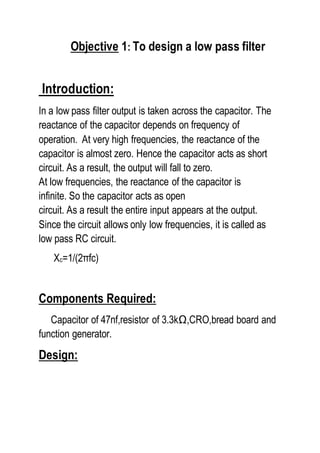
Introduction:
In a low pass filter output is taken across the capacitor. The
reactance of the capacitor depends on frequency of
operation. At very high frequencies, the reactance of the
capacitor is almost zero. Hence the capacitor acts as short
circuit. As a result, the output will fall to zero.
At low frequencies, the reactance of the capacitor is
infinite. So the capacitor acts as open
circuit. As a result the entire input appears at the output.
Since the circuit allows only low frequencies, it is called as
low pass RC circuit.
Xc=1/(2πfc)
Components Required:
Capacitor of 47nf,resistor of 3.3kΩ,CRO,bread board and
function generator.
Design:
Assumptions:
Capacitor of value 47nf
If capacitor is in pf range resistaince is in mega
range which is not available in the lab.
If µf range capacitor is taken resistaince is in
ohm but loading effect is high.
So we take capacitor in nf range so that we get resistaince in
kΩ range so that we use it.
Cut off frequency = 1kHz
Resistaince = 1/2πfc =1/2π103*47*10-9 = 3.38kΩ
But in lab we have the standard value of 3.3kΩ in the lab
Vinput = 10v[peak-peak]
C1
47nF
R1
3.3kΩ
Procedure:
a) Verify the circuit design.
b) Set up the circuit as in the design using resistor and
capacitor.
c) Give the input voltage 10v and frequency [varying].
d) Measure and record output voltage according to varying
frequency around the cut off frequency.
e) Determine the gain through the formula gain =
20log[vout/vinp].
f) Plot the graph [x-axis frequency and y-axis output].
Tabular Column
No Frequency
[Hz]
Output
Voltage [V]
Gain [dB]=
20log[vout/vin]
1 100Hz 10 0
2 300Hz 10 0
3 500Hz 10 0
4 600Hz 9 -0.91
5 900Hz 8 -1.93
6 1000Hz 7 -3.09
7 1100Hz 6.2 -4.15
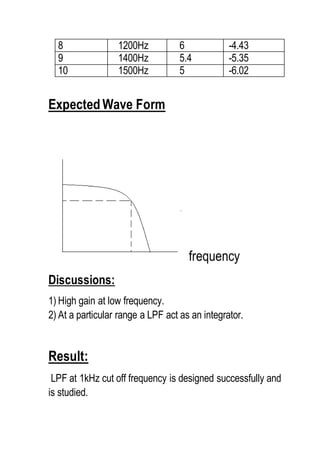
8 1200Hz 6 -4.43
9 1400Hz 5.4 -5.35
10 1500Hz 5 -6.02
Expected Wave Form
frequency
Discussions:
1) High gain at low frequency.
2) At a particular range a LPF act as an integrator.
Result:
LPF at 1kHz cut off frequency is designed successfully and
is studied.
Low pass filter as an integrator:
Theory:
In low pass circuit, if the time constant is very large in
comparison with the time required for the input signal to make
an appreciable change, the circuit is called an
“integrator”. Under these circumstances the voltage drop
across C will be very small in comparison to the drop across
R and almost the total input Vi appears across R .i.e., i =
Vi/R.
∴The output signal across C is
i.e., the output is proportional to the integral of the
input. Hence the low pass RC circuit acts as a integrator
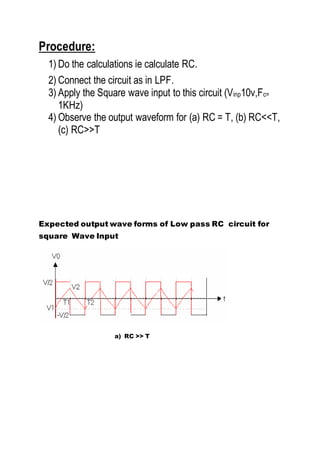
for RC >> T.
For observing this 3 conditions are to be taken
a) RC = T b) RC>> T c) RC<<T
RC = 3.3*103*47*10-9 = 1.551*10-4
So 1/RC = 6447.45Hz [as 1/T = frequency]
The output waveform is obtained for 3 conditions and it is
plotted on the graph.
Procedure:
1) Do the calculations ie calculate RC.
2) Connect the circuit as in LPF.
3) Apply the Square wave input to this circuit (Vinp10v,Fc=
1KHz)
4) Observe the output waveform for (a) RC = T, (b) RC<<T,
(c) RC>>T
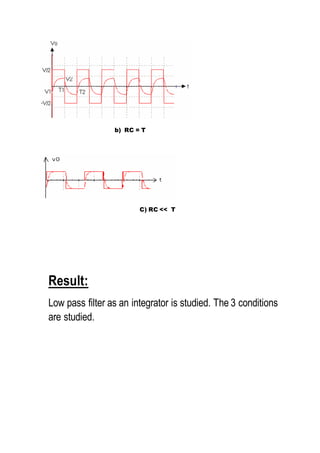
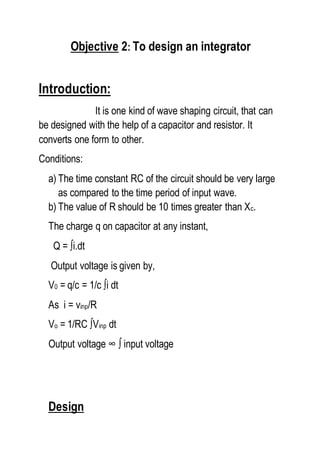
Expected output wave forms of Low pass RC circuit for
square Wave Input
a) RC >> T
b) RC = T
C) RC << T
Result:
Low pass filter as an integrator is studied. The 3 conditions
are studied.
Objective 2: To design an integrator
Introduction:
It is one kind of wave shaping circuit, that can
be designed with the help of a capacitor and resistor. It
converts one form to other.
Conditions:
a) The time constant RC of the circuit should be very large
as compared to the time period of input wave.
b) The value of R should be 10 times greater than Xc.
The charge q on capacitor at any instant,
Q = ∫i.dt
Output voltage is given by,
V0 = q/c = 1/c ∫i dt
As i = vinp/R
Vo = 1/RC ∫Vinp dt
Output voltage ∞ ∫ input voltage
Design
Let us assume the frequency = 1kHz
Fc = 1/2πRC
Xc = 1/2πFc = 1/2π*103*47*10-9
So we take resistaince and capacitance value as same in
LPF we designed,
Xc = 3.38kΩ
In an integrator, R>>10Xc so R>>10*3.38kΩ = R>>33.8kΩ
Components Required:
1) Capacitor 47nf 2) resistor 33.8kΩ[33kΩ standard value]
3) CRO 4) function generator 5) bread board
Procedure:
a) Set up the circuit as per the design
R1
33kΩ
C1
47F
b) Give a square input of 10V [peak-peak] using a function
generator.
c) Analyse and observe the output on CRO.
d) Sketch obtained graph
Expected Wave form:
Observation:
a) For a square input the result is a triangular wave.
b) For a sin wave input the output is sin wave with a phase
difference.
c) Integrator act as a Low pass filter below / above a
particular frequency which is calculated[Fc].
Result:
Integrator with cut off frequency 1kHz is designed and
the wave form is obtained.
Integrator as a low pass filter
A integrator acts as a LPF over a range of frequencies.
This is found out in this activity.
here, Fc = 1/2πRC
= 1/2π*34*103*47*10-9 = 86.82Hz
So we vary the frequency above and below this range so that
we can obtain the LPF observation.
Procedure
a) Connect the same circuit as that of integrator.
b) Calculate Fc of the circuit
c) Vary these Fc above and below its range.
d) Obtain the observation.
Tabular form
No Frequency[Hz] Output
voltage[vout]
Gain[dB]
=20log[vout/vin]
1 50Hz 8 -4.46
2 60Hz 7.6 -5.48
3 75Hz 6.8 -6.51
4 86Hz 6.4 -8.92
5 100Hz 6 -10.21
6 120Hz 5.2 -13.07
7 140Hz 4.8 -14.67
Result:
Integrator as a low pass filter is studied and the particular
frequency is obtained.
Done By George K Cibi
Anitta Roy

Low pass filter and Integrator

  • 1.
    CHALLENGE:1 FILTERING AND LINEAR WAVESHAPING The challenge 1 involves four objectives Objective 1: To design a low pass filter of cut off frequency 1kHz Objective 2: To design a integrator Objective 3: To design a high pass filter of cut off frequency 1kHz Objective 4: To design a differentiator
  • 2.
    Objective 1: Todesign a low pass filter Introduction: In a low pass filter output is taken across the capacitor. The reactance of the capacitor depends on frequency of operation. At very high frequencies, the reactance of the capacitor is almost zero. Hence the capacitor acts as short circuit. As a result, the output will fall to zero. At low frequencies, the reactance of the capacitor is infinite. So the capacitor acts as open circuit. As a result the entire input appears at the output. Since the circuit allows only low frequencies, it is called as low pass RC circuit. Xc=1/(2πfc) Components Required: Capacitor of 47nf,resistor of 3.3kΩ,CRO,bread board and function generator. Design:
  • 3.
    Assumptions: Capacitor of value47nf If capacitor is in pf range resistaince is in mega range which is not available in the lab. If µf range capacitor is taken resistaince is in ohm but loading effect is high. So we take capacitor in nf range so that we get resistaince in kΩ range so that we use it. Cut off frequency = 1kHz Resistaince = 1/2πfc =1/2π103*47*10-9 = 3.38kΩ But in lab we have the standard value of 3.3kΩ in the lab Vinput = 10v[peak-peak] C1 47nF R1 3.3kΩ
  • 4.
    Procedure: a) Verify thecircuit design. b) Set up the circuit as in the design using resistor and capacitor. c) Give the input voltage 10v and frequency [varying]. d) Measure and record output voltage according to varying frequency around the cut off frequency. e) Determine the gain through the formula gain = 20log[vout/vinp]. f) Plot the graph [x-axis frequency and y-axis output]. Tabular Column No Frequency [Hz] Output Voltage [V] Gain [dB]= 20log[vout/vin] 1 100Hz 10 0 2 300Hz 10 0 3 500Hz 10 0 4 600Hz 9 -0.91 5 900Hz 8 -1.93 6 1000Hz 7 -3.09 7 1100Hz 6.2 -4.15
  • 5.
    8 1200Hz 6-4.43 9 1400Hz 5.4 -5.35 10 1500Hz 5 -6.02 Expected Wave Form frequency Discussions: 1) High gain at low frequency. 2) At a particular range a LPF act as an integrator. Result: LPF at 1kHz cut off frequency is designed successfully and is studied.
  • 6.
    Low pass filteras an integrator: Theory: In low pass circuit, if the time constant is very large in comparison with the time required for the input signal to make an appreciable change, the circuit is called an “integrator”. Under these circumstances the voltage drop across C will be very small in comparison to the drop across R and almost the total input Vi appears across R .i.e., i = Vi/R. ∴The output signal across C is i.e., the output is proportional to the integral of the input. Hence the low pass RC circuit acts as a integrator for RC >> T. For observing this 3 conditions are to be taken a) RC = T b) RC>> T c) RC<<T RC = 3.3*103*47*10-9 = 1.551*10-4 So 1/RC = 6447.45Hz [as 1/T = frequency] The output waveform is obtained for 3 conditions and it is plotted on the graph.
  • 7.
    Procedure: 1) Do thecalculations ie calculate RC. 2) Connect the circuit as in LPF. 3) Apply the Square wave input to this circuit (Vinp10v,Fc= 1KHz) 4) Observe the output waveform for (a) RC = T, (b) RC<<T, (c) RC>>T Expected output wave forms of Low pass RC circuit for square Wave Input a) RC >> T
  • 8.
    b) RC =T C) RC << T Result: Low pass filter as an integrator is studied. The 3 conditions are studied.
  • 9.
    Objective 2: Todesign an integrator Introduction: It is one kind of wave shaping circuit, that can be designed with the help of a capacitor and resistor. It converts one form to other. Conditions: a) The time constant RC of the circuit should be very large as compared to the time period of input wave. b) The value of R should be 10 times greater than Xc. The charge q on capacitor at any instant, Q = ∫i.dt Output voltage is given by, V0 = q/c = 1/c ∫i dt As i = vinp/R Vo = 1/RC ∫Vinp dt Output voltage ∞ ∫ input voltage Design
  • 10.
    Let us assumethe frequency = 1kHz Fc = 1/2πRC Xc = 1/2πFc = 1/2π*103*47*10-9 So we take resistaince and capacitance value as same in LPF we designed, Xc = 3.38kΩ In an integrator, R>>10Xc so R>>10*3.38kΩ = R>>33.8kΩ Components Required: 1) Capacitor 47nf 2) resistor 33.8kΩ[33kΩ standard value] 3) CRO 4) function generator 5) bread board Procedure: a) Set up the circuit as per the design R1 33kΩ C1 47F
  • 11.
    b) Give asquare input of 10V [peak-peak] using a function generator. c) Analyse and observe the output on CRO. d) Sketch obtained graph Expected Wave form: Observation: a) For a square input the result is a triangular wave. b) For a sin wave input the output is sin wave with a phase difference. c) Integrator act as a Low pass filter below / above a particular frequency which is calculated[Fc]. Result: Integrator with cut off frequency 1kHz is designed and the wave form is obtained.
  • 12.
    Integrator as alow pass filter A integrator acts as a LPF over a range of frequencies. This is found out in this activity. here, Fc = 1/2πRC = 1/2π*34*103*47*10-9 = 86.82Hz So we vary the frequency above and below this range so that we can obtain the LPF observation. Procedure a) Connect the same circuit as that of integrator. b) Calculate Fc of the circuit c) Vary these Fc above and below its range. d) Obtain the observation. Tabular form No Frequency[Hz] Output voltage[vout] Gain[dB] =20log[vout/vin] 1 50Hz 8 -4.46 2 60Hz 7.6 -5.48 3 75Hz 6.8 -6.51 4 86Hz 6.4 -8.92 5 100Hz 6 -10.21 6 120Hz 5.2 -13.07 7 140Hz 4.8 -14.67
  • 13.
    Result: Integrator as alow pass filter is studied and the particular frequency is obtained. Done By George K Cibi Anitta Roy