NATIONAL COLLEGE OF SCIENCE AND TECHNOLOGY
                      Amafel Bldg. Aguinaldo Highway Dasmariñas City, Cavite


                               EXPERIMENT # 2
                     Passive Band-Pass and Band-Stop Filter


Cauan, Sarah Krystelle P.                                        July 05, 2011
Signal Spectra and Signal Processing/BSECE 41A1                  Score:


                                Eng’r. Grace Ramones
                                      Instructor
OBJECTIVES


1.   Plot the gain-frequency response of an L-C series resonant and an L-C parallel
     resonant band-pass filter.
2.   Determine the center frequency and the bandwidth of the L-C band pass filter.
3.   Determine how the circuit resistance affects the bandwidth of an L-C band-pass
     filter.
4.   Plot the gain-frequency response of an L-C series resonant and an L-C parallel
     resonant band-stop (notch) filter.
5.   Determine the center frequency and the bandwidth of the L-C band-stop filter.
6.   Determine how the circuit resistance affects the bandwidth of an L-C band-stop
     filter.
SAMPLE COMPUTATIONS


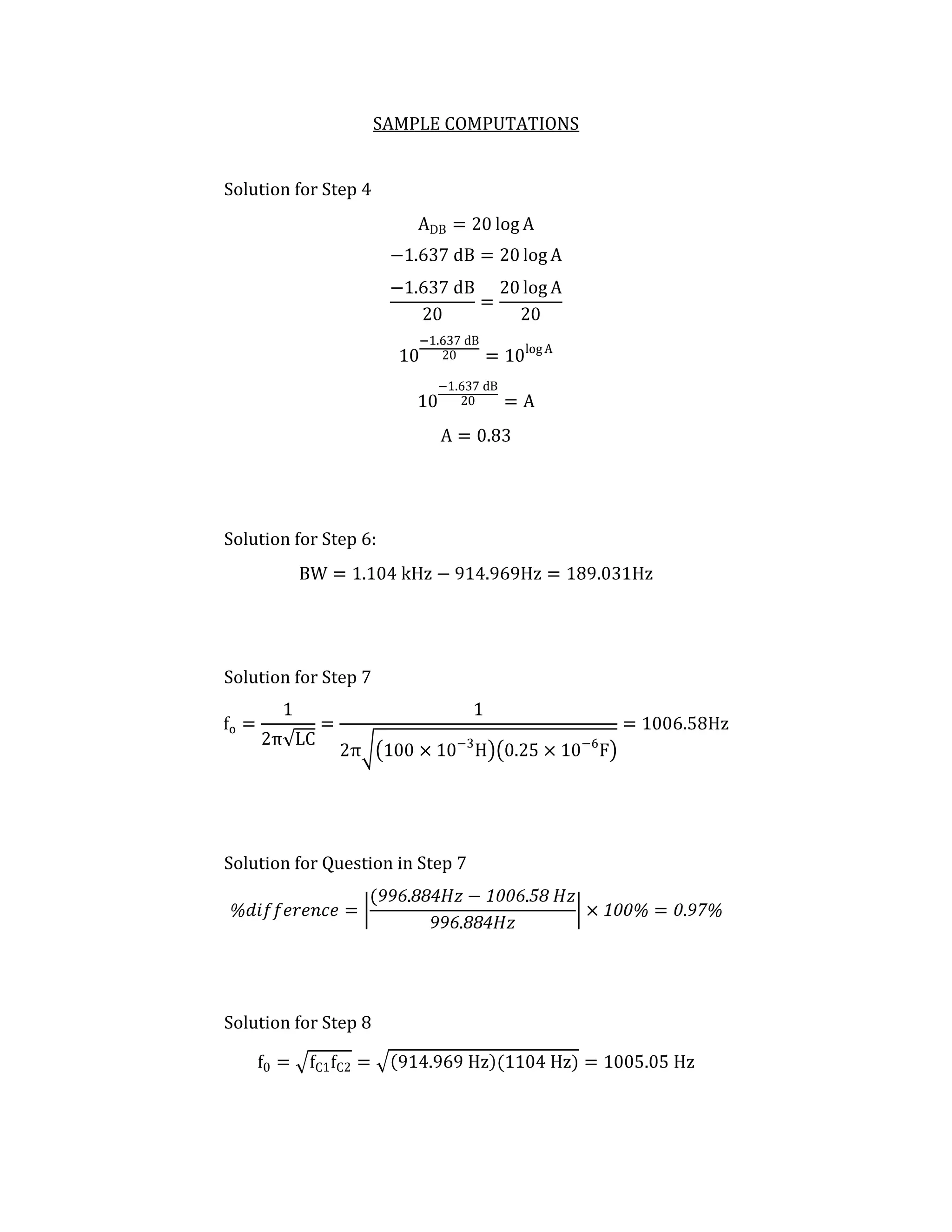
Solution for Step 4


Solution for Step 6:


Solution for Step 7


Solution for Question in Step 7


Solution for Step 8
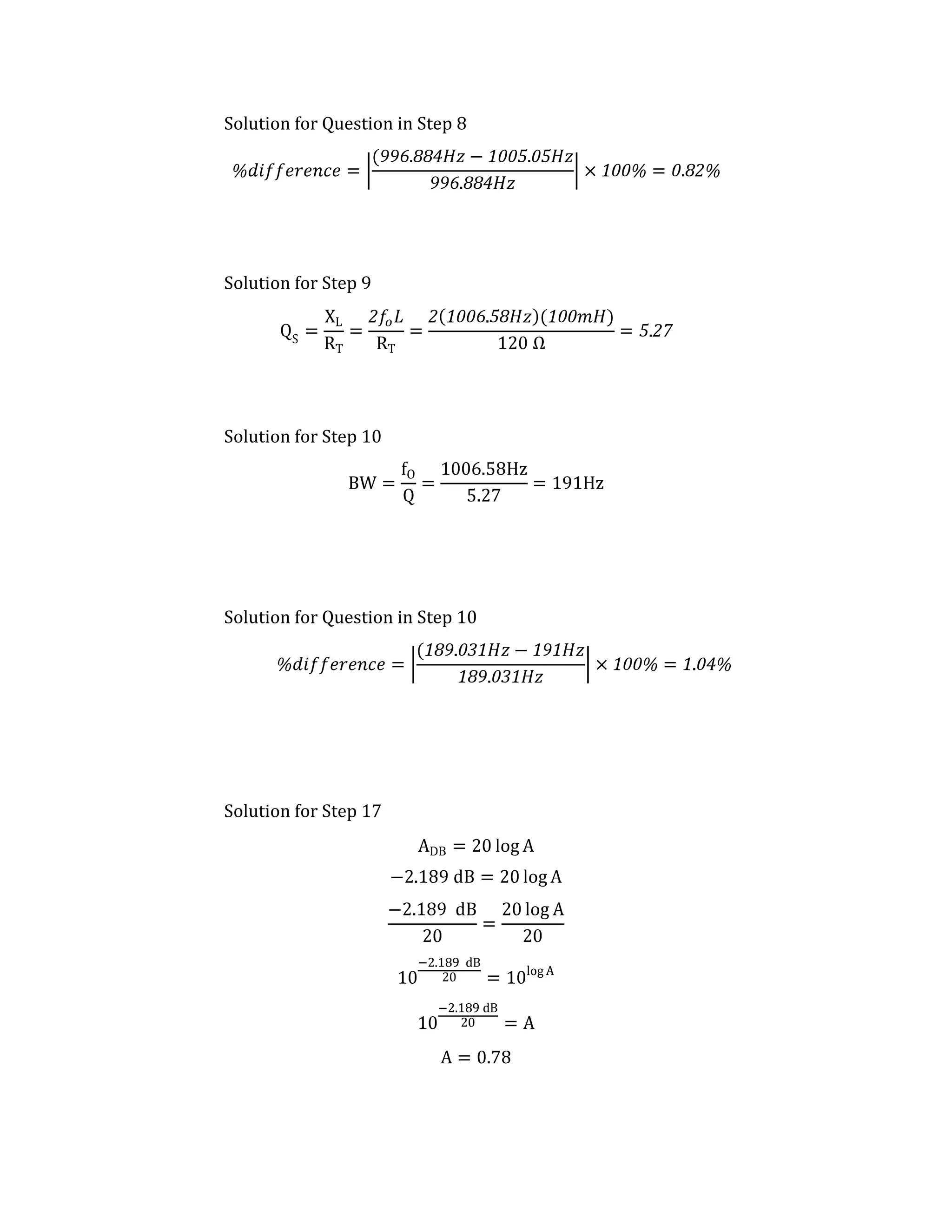
Solution for Question in Step 8


Solution for Step 9


Solution for Step 10


Solution for Question in Step 10


Solution for Step 17
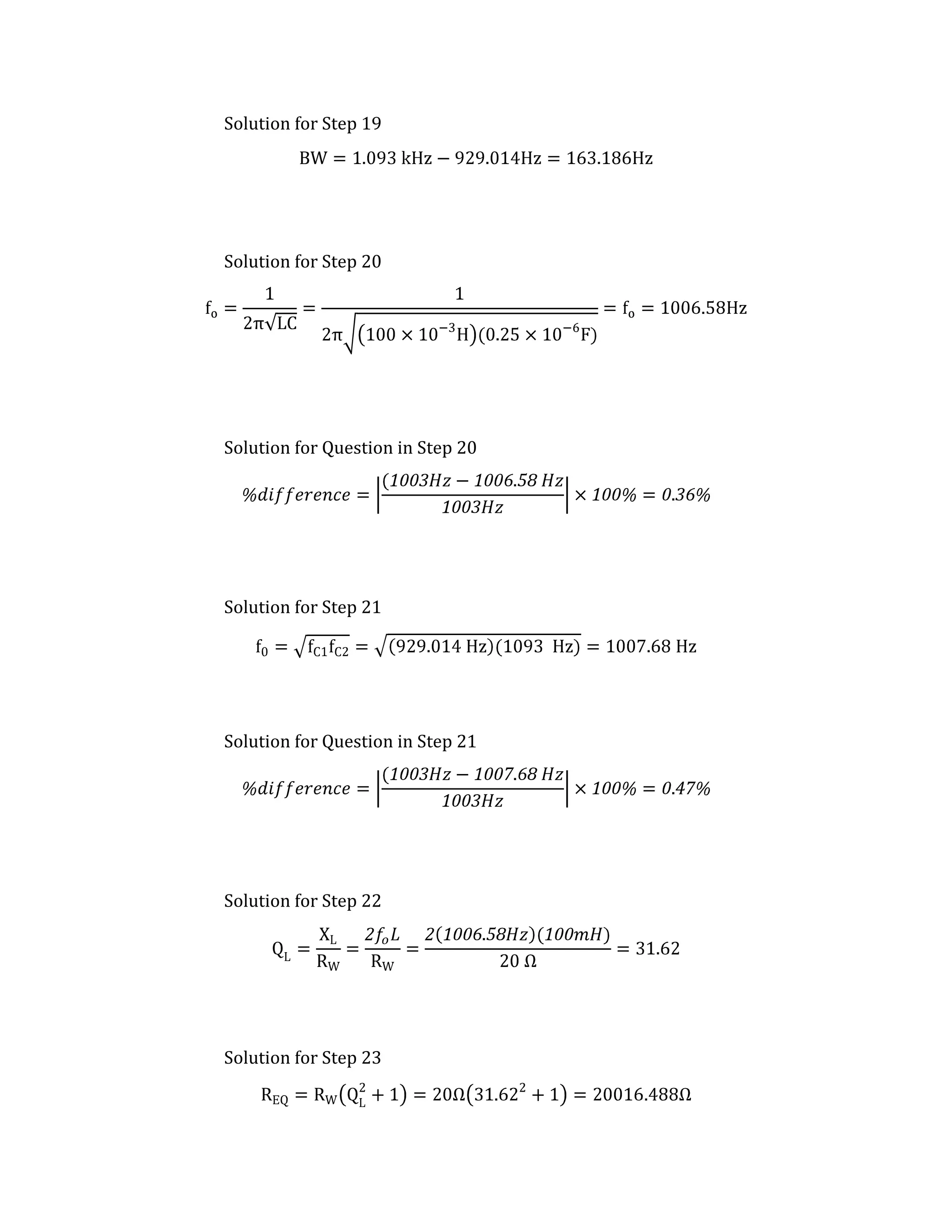
Solution for Step 19


Solution for Step 20


Solution for Question in Step 20


Solution for Step 21


Solution for Question in Step 21


Solution for Step 22


Solution for Step 23
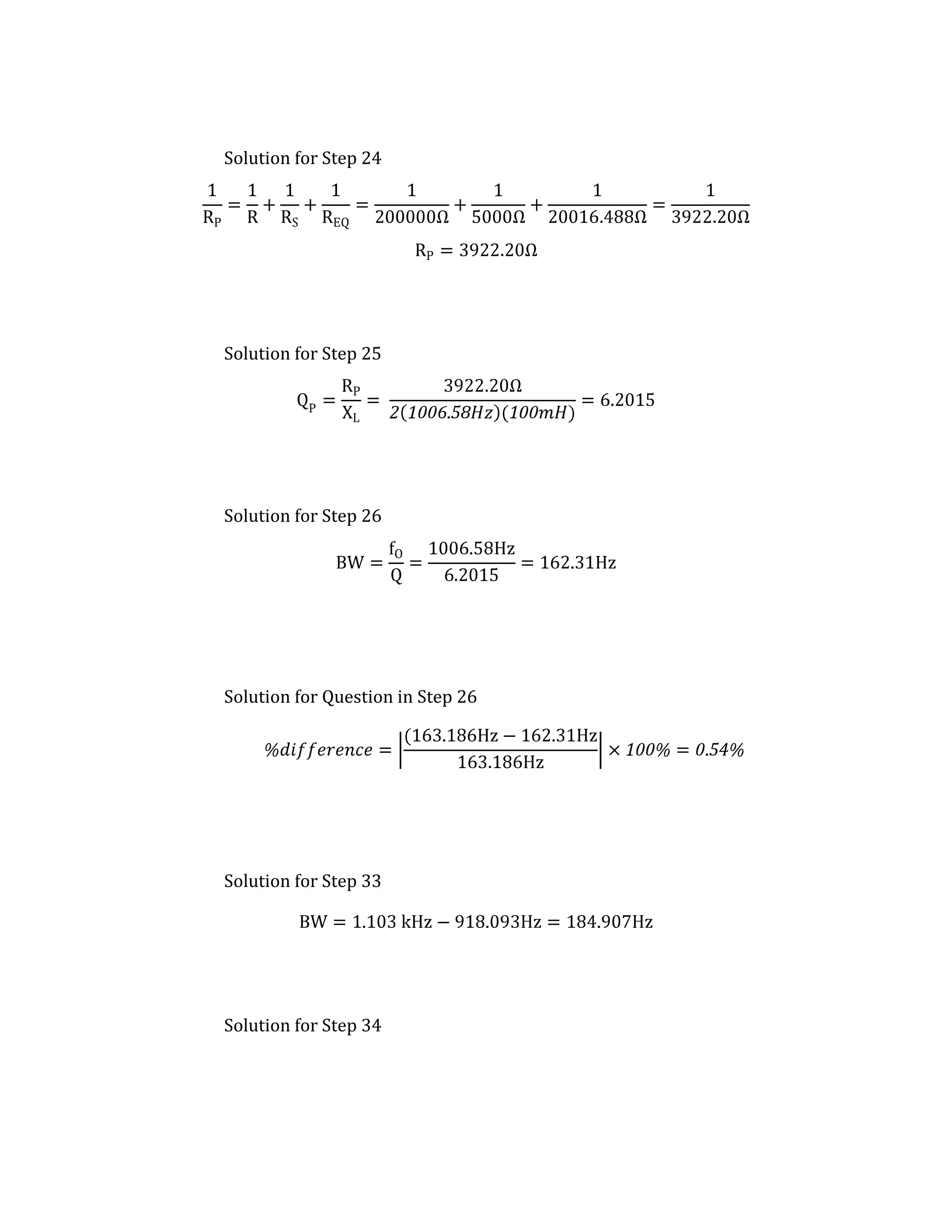
Solution for Step 24


Solution for Step 25


Solution for Step 26


Solution for Question in Step 26


Solution for Step 33


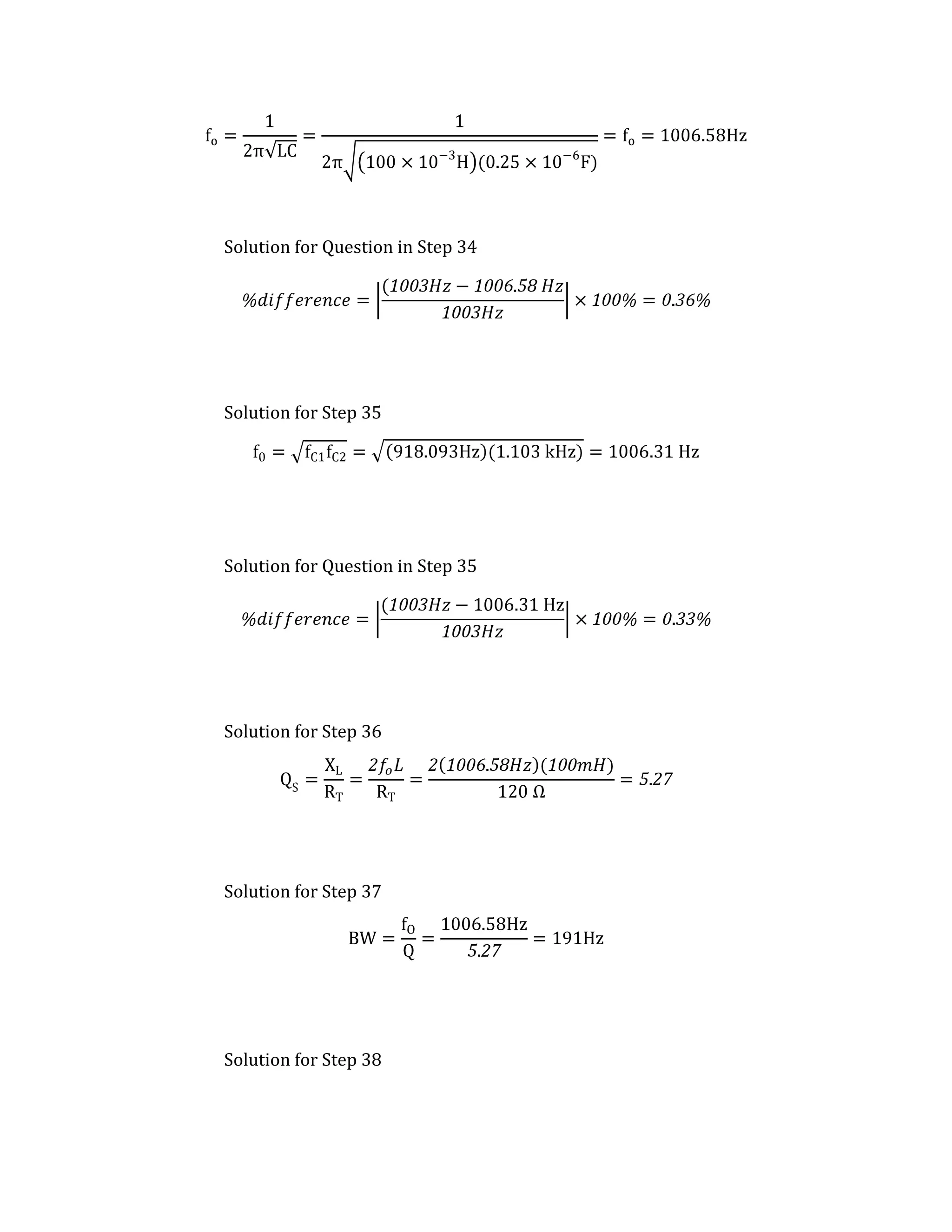
Solution for Step 34
Solution for Question in Step 34


Solution for Step 35


Solution for Question in Step 35


Solution for Step 36


Solution for Step 37


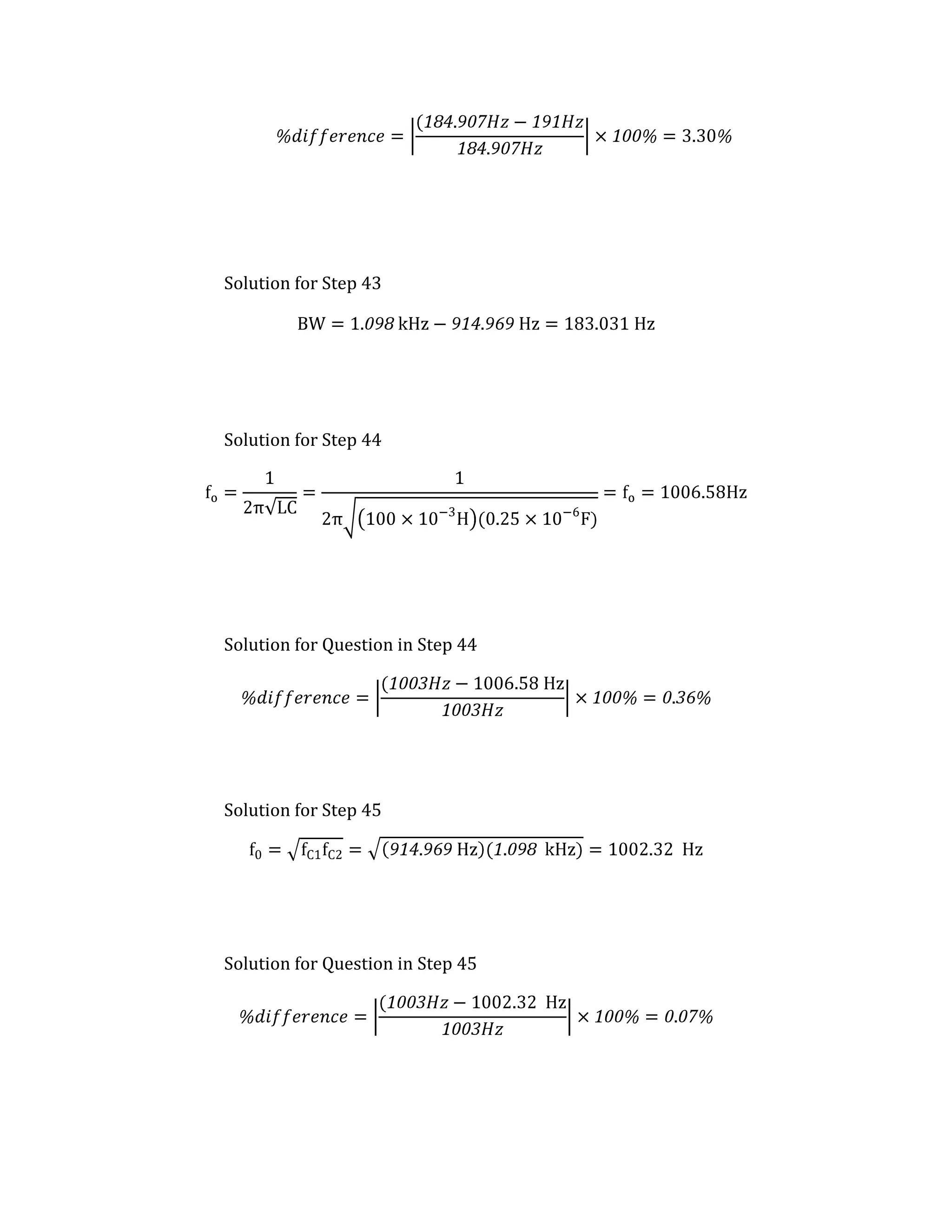
Solution for Step 38
Solution for Step 43


Solution for Step 44


Solution for Question in Step 44


Solution for Step 45


Solution for Question in Step 45
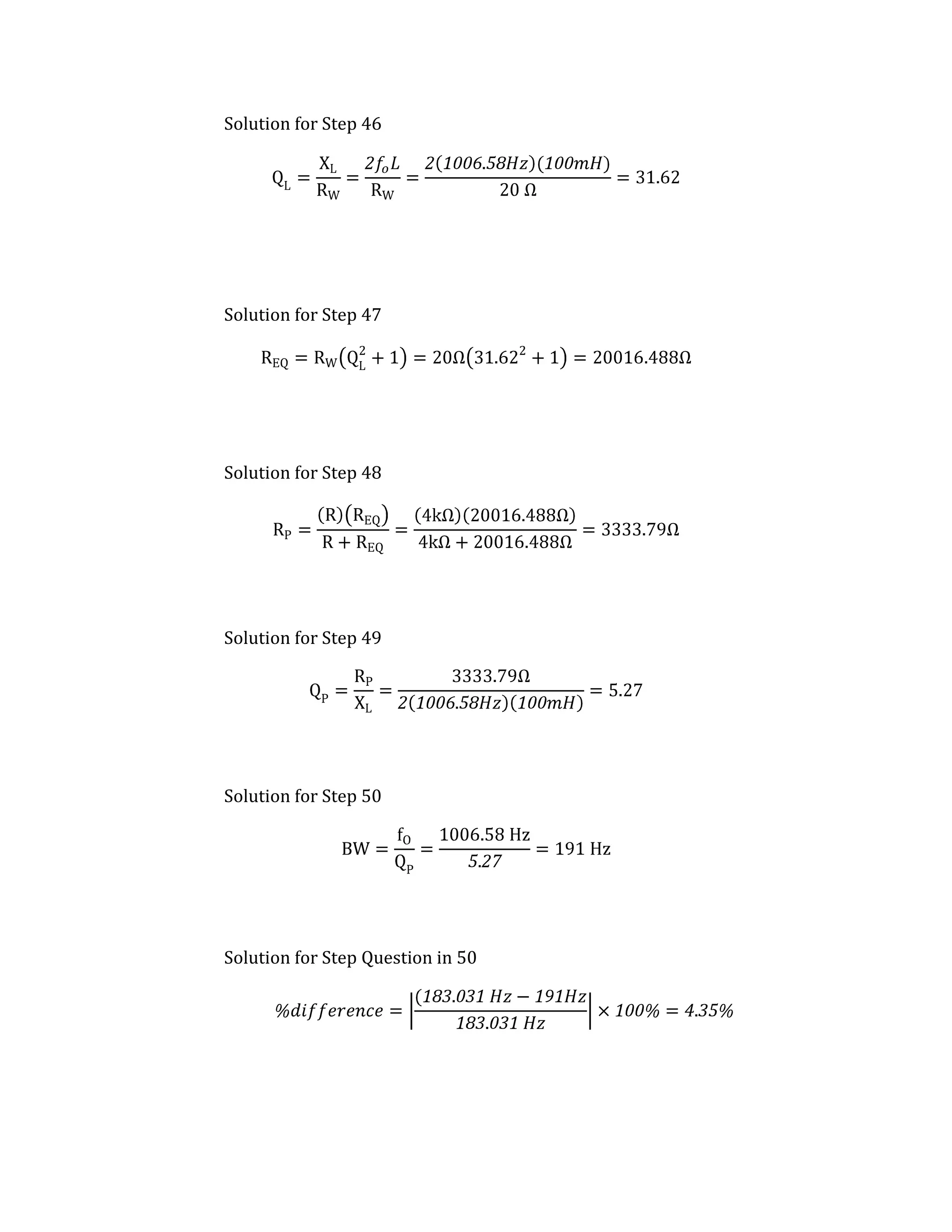
Solution for Step 46


Solution for Step 47


Solution for Step 48


Solution for Step 49


Solution for Step 50


Solution for Step Question in 50
DATA SHEET
MATERIALS
One function generator
One dual-trace oscilloscope
Capacitors: one 0.1µF, one 0.25 µF
Inductors: one 50 mH, one 100 mH
Resistors: 100 Ω, 200 Ω, 2 kΩ, 4 kΩ, 5kΩ, 200kΩ


THEORY
         In electronic communications systems, it is often necessary to separate a specific
range of frequency from the total frequency spectrum. This is normally accomplished with
filters. A filter is circuit that passes a specific range of frequencies while rejecting other
frequencies. A passive filter consists of passive circuit elements, such as capacitors,
inductors, and resistors. There are four basic types of filters, low-pass, high-pass, band-
pass, and band-stop. A low-pass filter is designed to pass all frequencies below the cutoff
frequency and reject all frequencies above the cutoff frequency. A high-pass filter is
designed to pass all frequencies above the cutoff frequency. A high-pass filter is designed to
pass all frequencies above the cutoff frequency and reject all frequencies below the cutoff
frequency. A band-pass filter passes all frequencies within a band of frequencies and rejects
all other frequencies outside the band. A band-stop filter rejects all frequencies within a
band of frequencies outside the band. A band-stop filter is often referred to as a notch filter.
In this experiment, you will study band-pass and band-stop (notch) filters.
        The most common way to describe the frequency response characteristics of a filter
is to plot the filter voltage gain (Vo/Vi) in db as function of frequency (f). The frequency at
which the output power gain drops is 50% of the maximum value is called the cutoff
frequency (fC). When the output power gain drops to 50%, the voltage gain drops 3 db
(0.707 of the maximum value). When the filter dB voltage gain is plotted as a function of
frequency on semi log graph using straight lines to approximately the actual frequency
response, it is called a Bode plot. A bode plot is an ideal plot of filter frequency response
because it assumes that the voltage gain remains constant in the passband until the cutoff
frequency is reached, and then drops in straight line. The filter network voltage gain in dB
is calculated from the actual voltage gain (A) using the equation
                                            AdB = 20 log A
       Where A = Vo/Vi
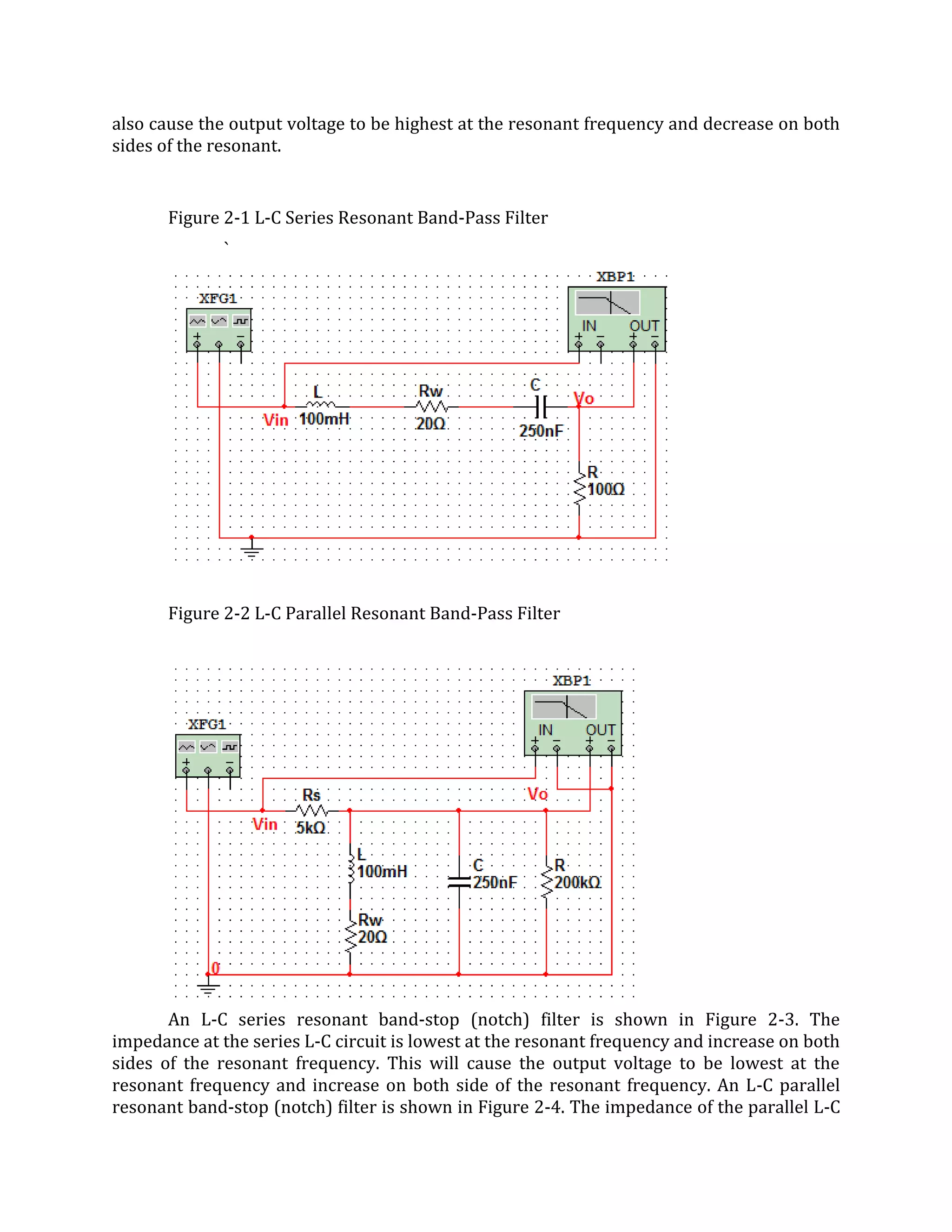
       An L-C series resonant band-pass filter is shown in Figure 2-1. The impedance of the
series L-C circuit is lowest at the resonant frequency and increases on both sides of the
resonant frequency. This will cause the output voltage to be highest at the resonant
frequency and decrease on both sides of the resonant frequency. At L-C parallel resonant
band-pas filter is shown in Figure 2-2. The impedance of the parallel L-C circuit is highest at
the resonant frequency and decreases on both sides of the resonant frequency. This will
also cause the output voltage to be highest at the resonant frequency and decrease on both
sides of the resonant.


       Figure 2-1 L-C Series Resonant Band-Pass Filter
              `


       Figure 2-2 L-C Parallel Resonant Band-Pass Filter


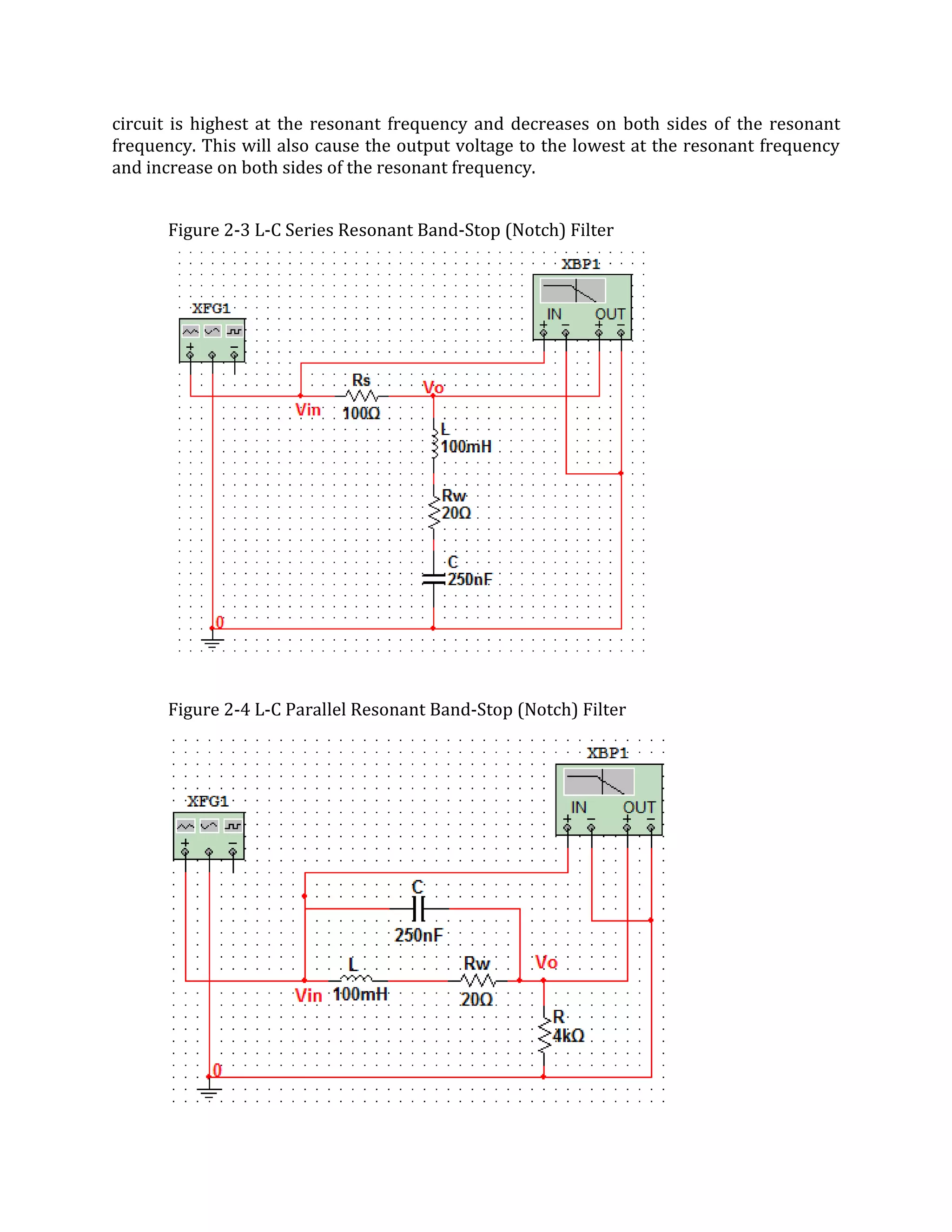
       An L-C series resonant band-stop (notch) filter is shown in Figure 2-3. The
impedance at the series L-C circuit is lowest at the resonant frequency and increase on both
sides of the resonant frequency. This will cause the output voltage to be lowest at the
resonant frequency and increase on both side of the resonant frequency. An L-C parallel
resonant band-stop (notch) filter is shown in Figure 2-4. The impedance of the parallel L-C
circuit is highest at the resonant frequency and decreases on both sides of the resonant
frequency. This will also cause the output voltage to the lowest at the resonant frequency
and increase on both sides of the resonant frequency.


      Figure 2-3 L-C Series Resonant Band-Stop (Notch) Filter


      Figure 2-4 L-C Parallel Resonant Band-Stop (Notch) Filter
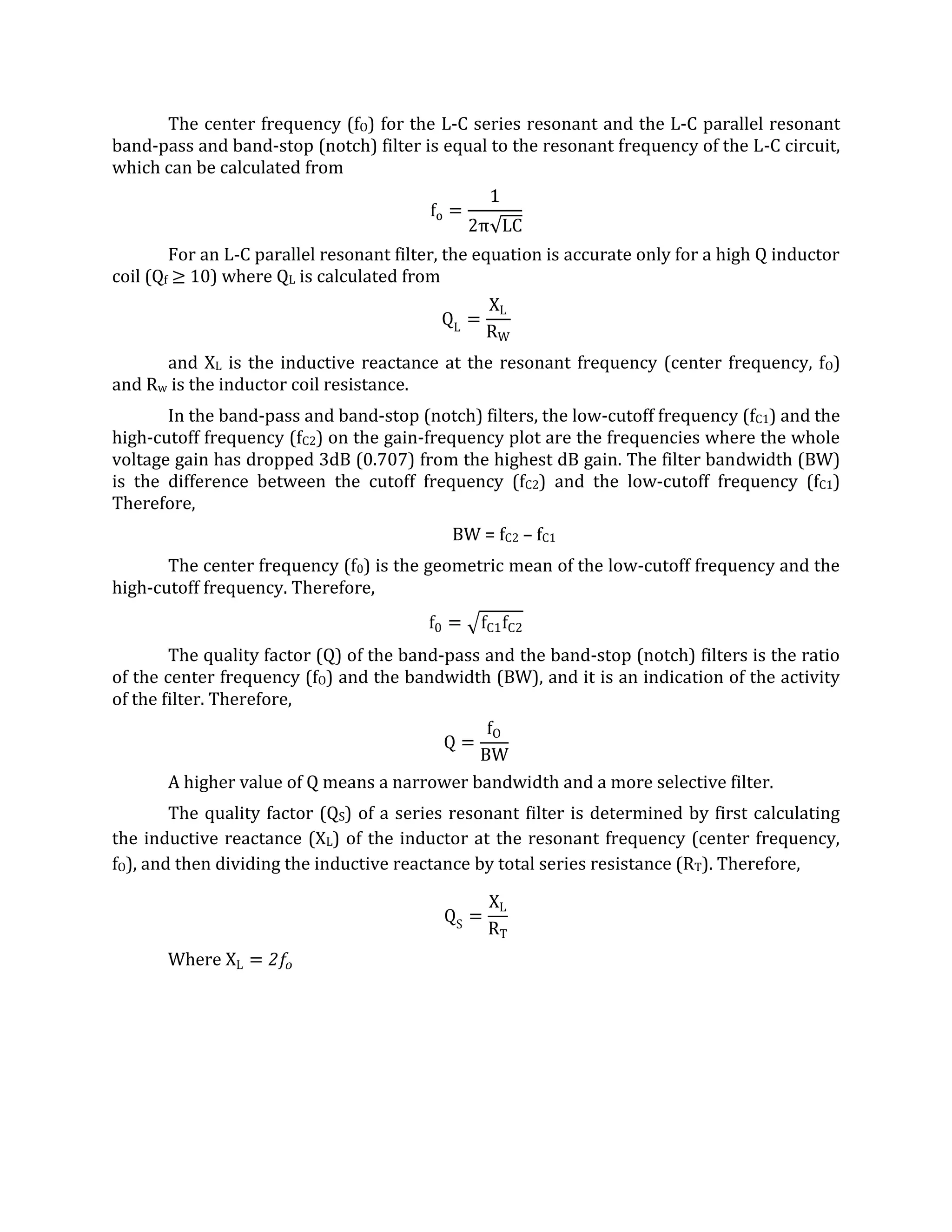
The center frequency (fO) for the L-C series resonant and the L-C parallel resonant
band-pass and band-stop (notch) filter is equal to the resonant frequency of the L-C circuit,
which can be calculated from


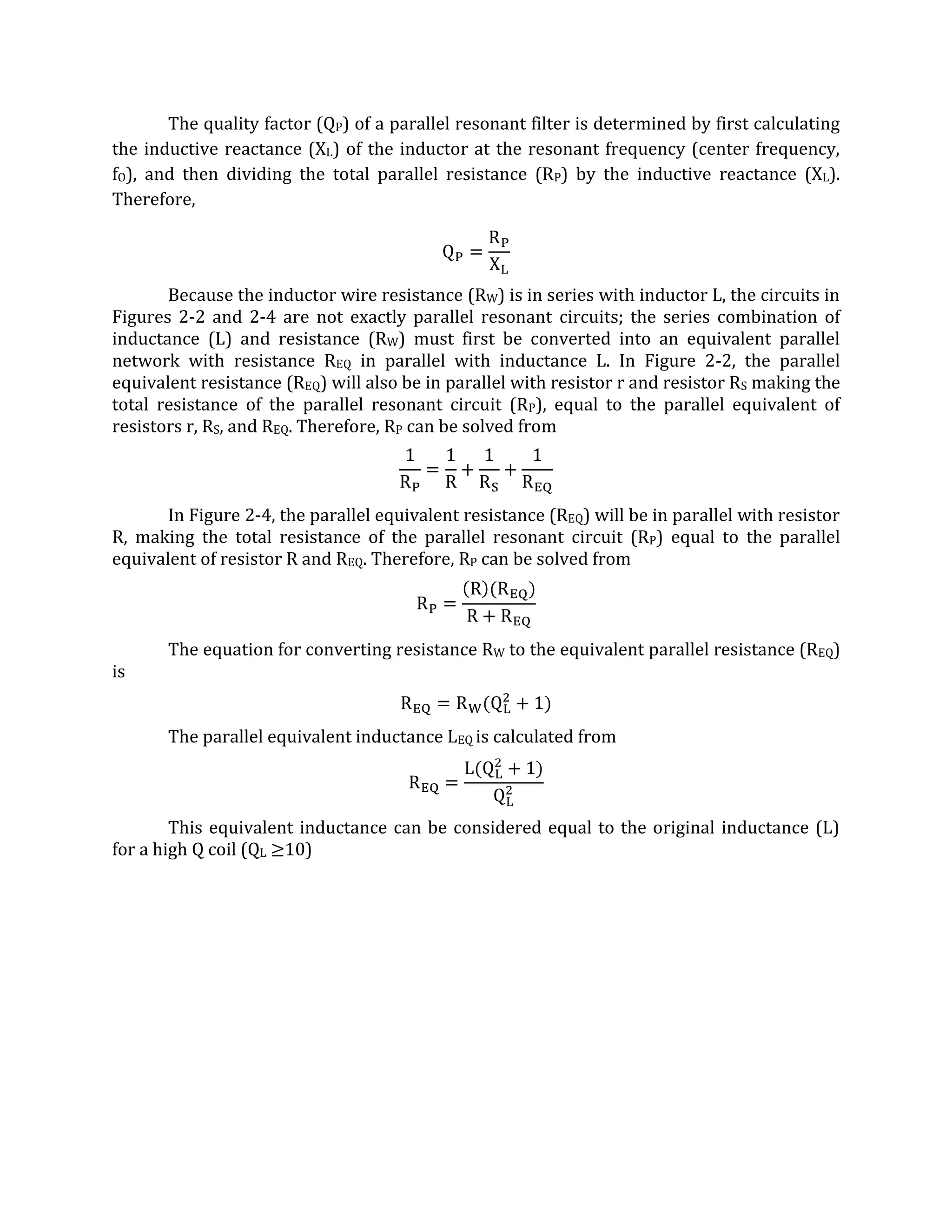
        For an L-C parallel resonant filter, the equation is accurate only for a high Q inductor
coil (Qf 10) where QL is calculated from


      and XL is the inductive reactance at the resonant frequency (center frequency, fO)
and Rw is the inductor coil resistance.
       In the band-pass and band-stop (notch) filters, the low-cutoff frequency (fC1) and the
high-cutoff frequency (fC2) on the gain-frequency plot are the frequencies where the whole
voltage gain has dropped 3dB (0.707) from the highest dB gain. The filter bandwidth (BW)
is the difference between the cutoff frequency (fC2) and the low-cutoff frequency (fC1)
Therefore,
                                            BW = fC2 – fC1
       The center frequency (f0) is the geometric mean of the low-cutoff frequency and the
high-cutoff frequency. Therefore,


        The quality factor (Q) of the band-pass and the band-stop (notch) filters is the ratio
of the center frequency (fO) and the bandwidth (BW), and it is an indication of the activity
of the filter. Therefore,


       A higher value of Q means a narrower bandwidth and a more selective filter.
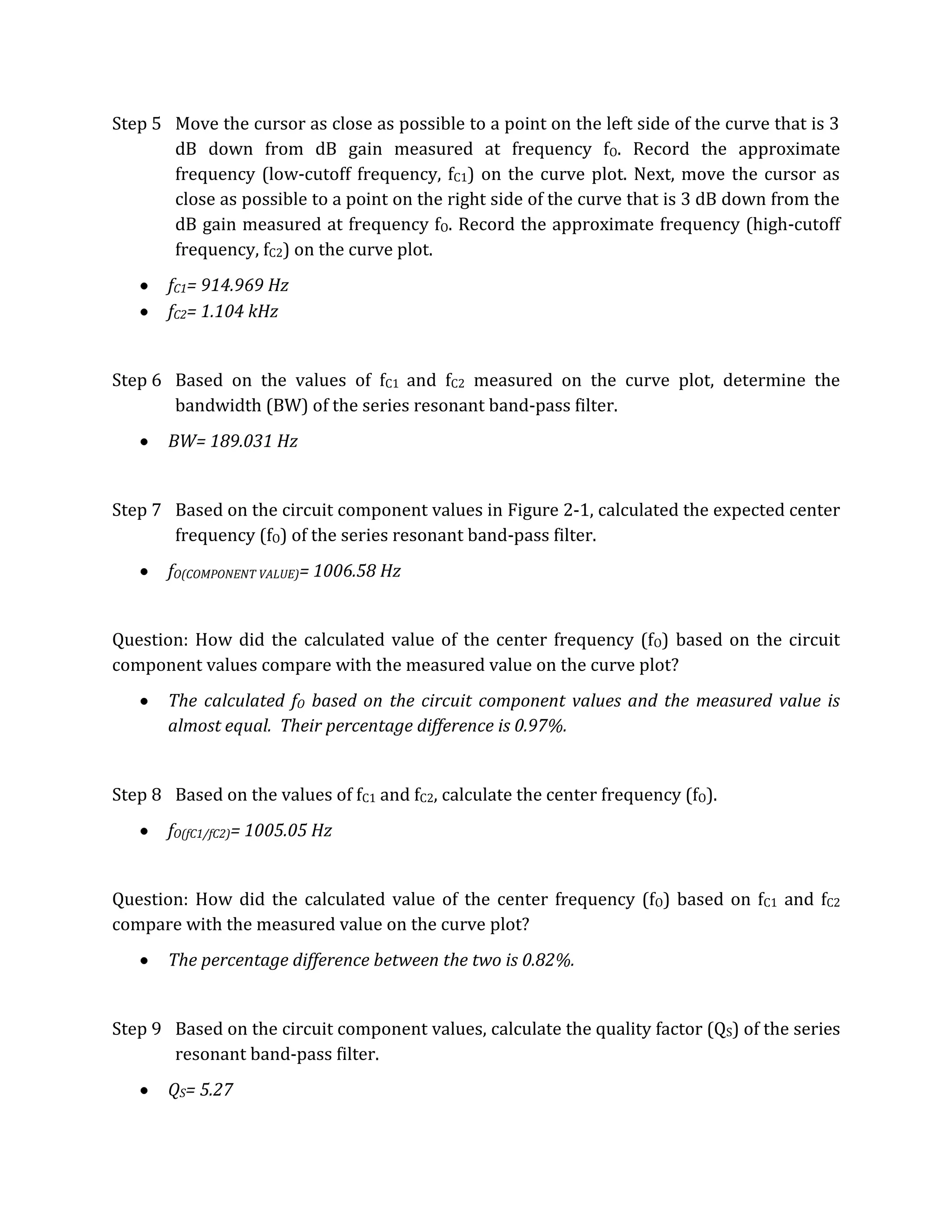
        The quality factor (QS) of a series resonant filter is determined by first calculating
the inductive reactance (XL) of the inductor at the resonant frequency (center frequency,
fO), and then dividing the inductive reactance by total series resistance (RT). Therefore,


       Where
The quality factor (QP) of a parallel resonant filter is determined by first calculating
the inductive reactance (XL) of the inductor at the resonant frequency (center frequency,
fO), and then dividing the total parallel resistance (RP) by the inductive reactance (XL).
Therefore,


       Because the inductor wire resistance (RW) is in series with inductor L, the circuits in
Figures 2-2 and 2-4 are not exactly parallel resonant circuits; the series combination of
inductance (L) and resistance (RW) must first be converted into an equivalent parallel
network with resistance REQ in parallel with inductance L. In Figure 2-2, the parallel
equivalent resistance (REQ) will also be in parallel with resistor r and resistor RS making the
total resistance of the parallel resonant circuit (RP), equal to the parallel equivalent of
resistors r, RS, and REQ. Therefore, RP can be solved from


       In Figure 2-4, the parallel equivalent resistance (REQ) will be in parallel with resistor
R, making the total resistance of the parallel resonant circuit (RP) equal to the parallel
equivalent of resistor R and REQ. Therefore, RP can be solved from


       The equation for converting resistance RW to the equivalent parallel resistance (REQ)
is


       The parallel equivalent inductance LEQ is calculated from


        This equivalent inductance can be considered equal to the original inductance (L)
for a high Q coil (QL 10)
PROCEDURE
Band-Pass Filters
Step 1 Open circuit file Fig 2-1. Make sure that the following Bode plotter settings are
       selected. Magnitude, Vertical (Log, F=0 dB, I=–20dB), Horizontal (Log, F=2 kHz,
       I=500Hz)


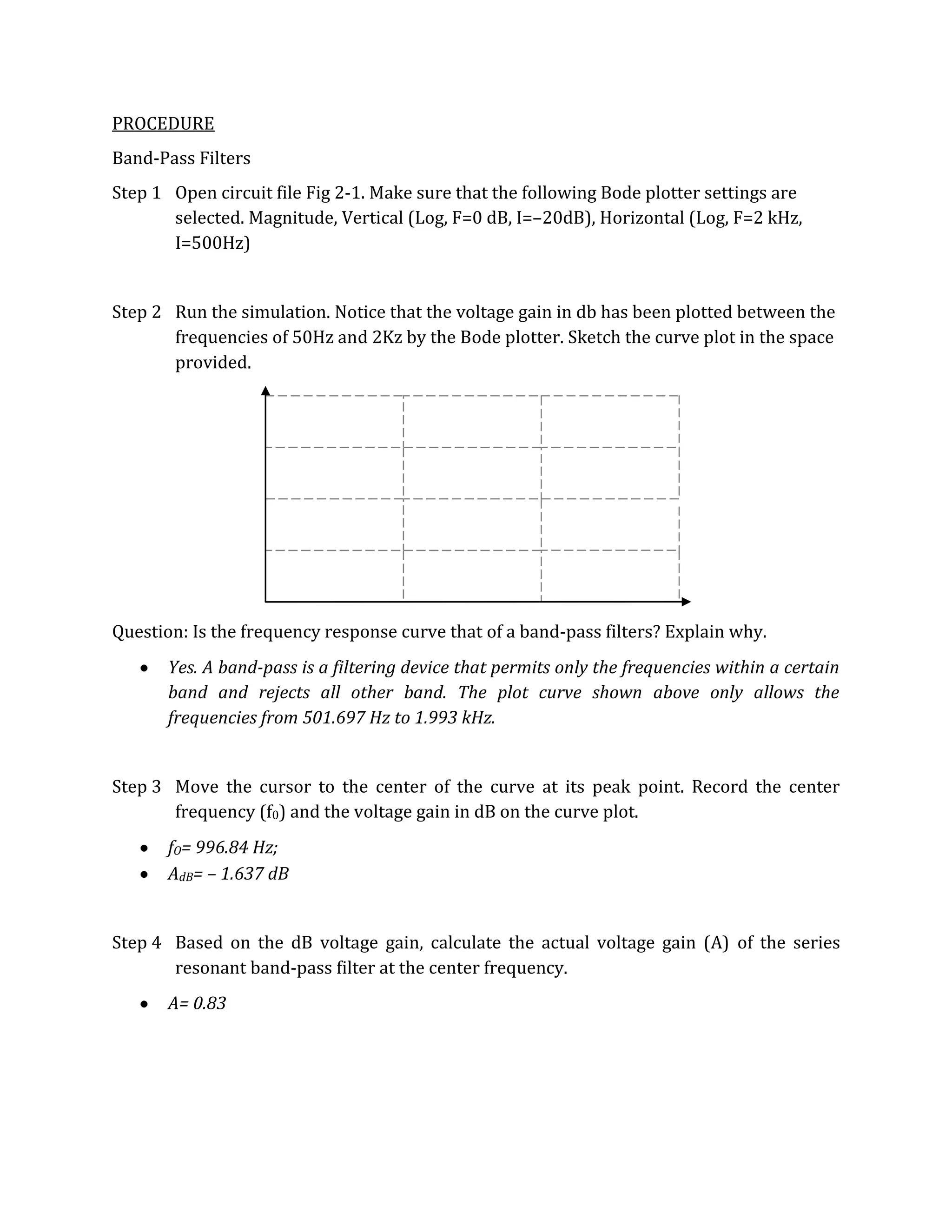
Step 2 Run the simulation. Notice that the voltage gain in db has been plotted between the
       frequencies of 50Hz and 2Kz by the Bode plotter. Sketch the curve plot in the space
       provided.


Question: Is the frequency response curve that of a band-pass filters? Explain why.
       Yes. A band-pass is a filtering device that permits only the frequencies within a certain
       band and rejects all other band. The plot curve shown above only allows the
       frequencies from 501.697 Hz to 1.993 kHz.


Step 3 Move the cursor to the center of the curve at its peak point. Record the center
       frequency (f0) and the voltage gain in dB on the curve plot.
       fO= 996.84 Hz;
       AdB= – 1.637 dB


Step 4 Based on the dB voltage gain, calculate the actual voltage gain (A) of the series
       resonant band-pass filter at the center frequency.
       A= 0.83
Step 5 Move the cursor as close as possible to a point on the left side of the curve that is 3
       dB down from dB gain measured at frequency fO. Record the approximate
       frequency (low-cutoff frequency, fC1) on the curve plot. Next, move the cursor as
       close as possible to a point on the right side of the curve that is 3 dB down from the
       dB gain measured at frequency fO. Record the approximate frequency (high-cutoff
       frequency, fC2) on the curve plot.
       fC1= 914.969 Hz
       fC2= 1.104 kHz


Step 6 Based on the values of fC1 and fC2 measured on the curve plot, determine the
       bandwidth (BW) of the series resonant band-pass filter.
       BW= 189.031 Hz


Step 7 Based on the circuit component values in Figure 2-1, calculated the expected center
       frequency (fO) of the series resonant band-pass filter.
       fO(COMPONENT VALUE)= 1006.58 Hz


Question: How did the calculated value of the center frequency (fO) based on the circuit
component values compare with the measured value on the curve plot?
       The calculated fO based on the circuit component values and the measured value is
       almost equal. Their percentage difference is 0.97%.


Step 8 Based on the values of fC1 and fC2, calculate the center frequency (fO).
       fO(fC1/fC2)= 1005.05 Hz


Question: How did the calculated value of the center frequency (fO) based on fC1 and fC2
compare with the measured value on the curve plot?
       The percentage difference between the two is 0.82%.


Step 9 Based on the circuit component values, calculate the quality factor (QS) of the series
       resonant band-pass filter.
       QS= 5.27
Step 10 Based on the circuit quality factor (QS) and the center frequency (fO), calculate the
        expected bandwidth (BW) of the series resonant band-pass filter.
       BW(EXPECTED)= 191.00 Hz


Question: How did the expected bandwidth calculated from the value of QS and the center
frequency compare with the bandwidth measured on the curve plot?
       The percentage difference between the two is 1.04%.


Step 11 Change the resistance of R to 200 Ω. Run the simulation again. Measure the center
        frequency (fO) and the bandwidth (BW) from the curve plot and record the values.
       fO=996.84 Hz
       BW= 350.136 Hz


Questions: What effect did changing the resistance R have on the center frequency of the
series resonant band-pass filter? What effect did changing the resistance of R have on the
bandwidth of the series resonant band-pass filter? Explain.
       The center frequency remain constant or did not change its value while the bandwidth
       changed, it increased as the resistor increase. Therefore, the center frequency f O of a
       series resonant band-pass filter is constant with change in the resistance R while the
       bandwidth of the series resonant band-pass filter is directly proportional to the
       resistance R.


Step 12 Change the capacitance of C to 0.1 µF. Run the simulation again. Measure the center
        frequency (fO) and the bandwidth (BW) on the curve plot and record the values
        Change the Bode plotter settings as needed.
       fO=1.583 kHz
       BW= 350 Hz
Questions: What effect did changing the capacitance of C have on the center frequency of
the series resonant band-pass filter? What effect did changing the capacitance of C have on
the bandwidth of the series resonant band-pass filter? Explain.
       The bandwidth remains constant or did not change its value. The center frequency
       however changed, it increased as the resistor increase. Therefore, the bandwidth of a
       series resonant band-pass filter is affected by the change of capacitance C while the
       center frequency of the series resonant band-pass filter is inversely proportional to the
       capacitance C.


Step 13 Change the inductance of L to 50 mH. Run the simulation again. Measure the center
        frequency (fO) and the bandwidth (BW) on the curve plot and record the values.
        Change the Bode plotter settings as needed.
       fO=1.423 kHz
       BW= 386 Hz


Questions: What effect did the changing the inductance of L has on the center frequency of
the series resonant band-pass filter? What effect did changing the inductance of L have on
the bandwidth of the series resonant band-pass filter? Explain.
       The center frequency and bandwidth was compared to the original circuit. By
       changing the inductance, bandwidth BW and center frequency f O increased. Therefore,
       bandwidth and the center frequency of the series resonant band-pass filter are
       inversely proportional to the inductance of L
Step 14 Open circuit file Fig 2-2. Make sure that the following Bode plotter settings are
        selected: Magnitude, Vertical (Log, F=0 dB, I=–20dB), Horizontal (Log, F=2 kHz,
        I=500Hz)
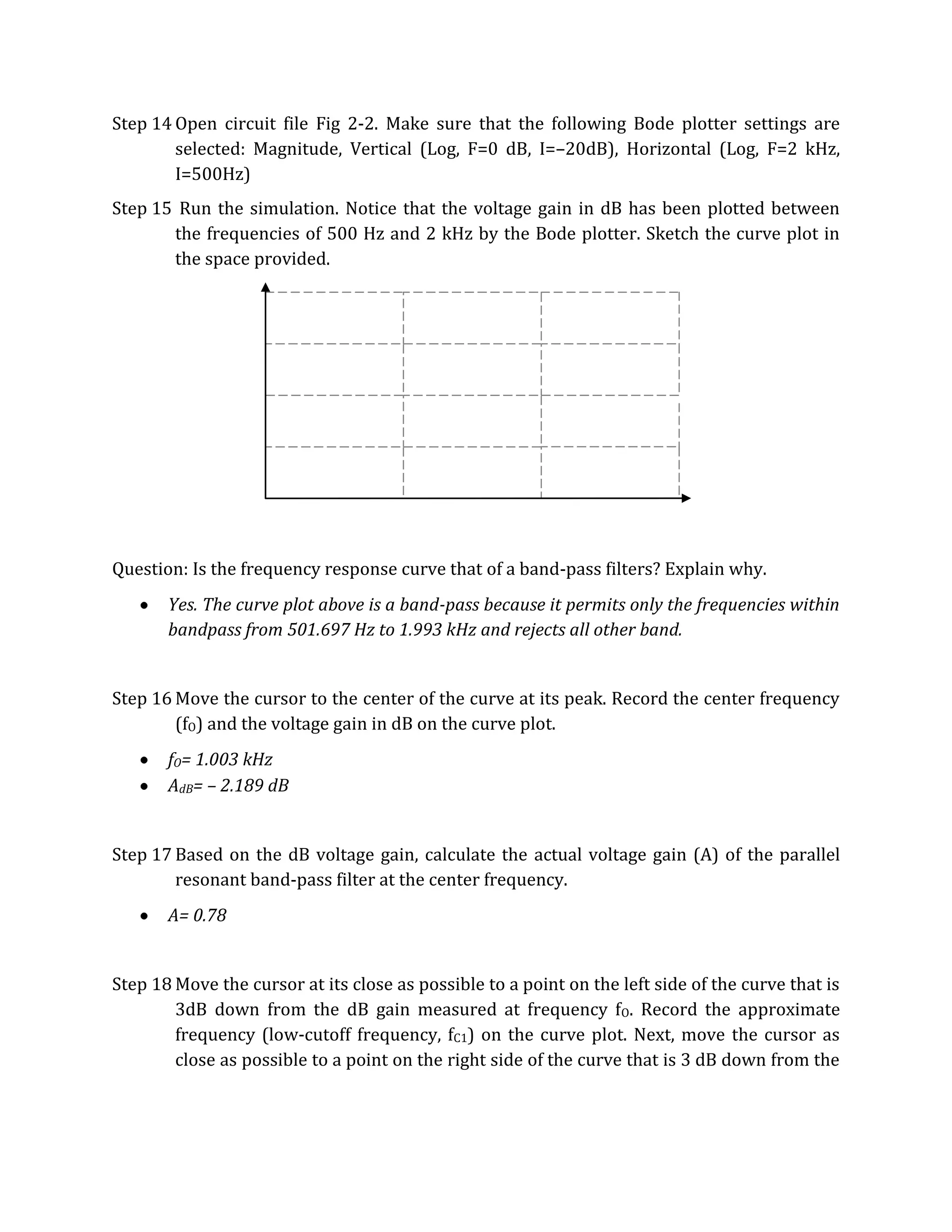
Step 15 Run the simulation. Notice that the voltage gain in dB has been plotted between
       the frequencies of 500 Hz and 2 kHz by the Bode plotter. Sketch the curve plot in
       the space provided.


Question: Is the frequency response curve that of a band-pass filters? Explain why.
       Yes. The curve plot above is a band-pass because it permits only the frequencies within
       bandpass from 501.697 Hz to 1.993 kHz and rejects all other band.


Step 16 Move the cursor to the center of the curve at its peak. Record the center frequency
        (fO) and the voltage gain in dB on the curve plot.
       fO= 1.003 kHz
       AdB= – 2.189 dB


Step 17 Based on the dB voltage gain, calculate the actual voltage gain (A) of the parallel
        resonant band-pass filter at the center frequency.
       A= 0.78


Step 18 Move the cursor at its close as possible to a point on the left side of the curve that is
        3dB down from the dB gain measured at frequency fO. Record the approximate
        frequency (low-cutoff frequency, fC1) on the curve plot. Next, move the cursor as
        close as possible to a point on the right side of the curve that is 3 dB down from the
dB gain measured at frequency fO. Record the approximate frequency (high-cutoff
        frequency fC2) on the curve plot.
       fC1= 929.014 Hz
       fC2= 1.093 kHz


Step 19 Based on the values of fC1 and fC2, determine the bandwidth (BW) of the parallel
        resonant band-pass filter.
       BW= 163.186 Hz


Step 20 Based on the circuit component values in Fig 2-2, calculate the expected center
        frequency (fO) of the parallel resonant band-pass filter.
       fO(COMPONENT VALUE)= 1006.58 Hz


Question: How did the calculated values of the center frequency (fO) base on the circuit
component values compare with measured values recorded on the curve plot?
       The percentage difference between the calculated fO based on the circuit component
       values and the measured value is only 0.37%.


Step 21 Based on the values of fC1 and fC2, calculate the center frequency (fO).
       fO(fC1/fC2)= 1007.68 Hz


Question: How did the calculated value of the center frequency (fO) base on the fC1 and fC2
compare with the measured value on the curve plot?
       The percentage difference between the two is 0.47%.


Step 22 Based on the value of L and RW, calculate the quality factor (QL) of the inductor.
       QL=31.62


Step 23 Based on the quality factor (QL) of the inductor, calculate the equivalent parallel
        inductor resistance (REQ) across the tank circuit.
       REQ= 20016.488Ω
Step 24 Based on the value of REQ, RS, and R, calculate the total parallel resistance (RP)
        across the tank circuit.
       RP= 3922.20Ω


Step 25 Based on the value of RP, calculate the quality factor (QP) of the parallel resonant
        band-pass filter.
       QP= 6.2015


Step 26 Based on the filter quality (QP) and the center frequency (fO), calculate the expected
        bandwidth (BW) of the parallel resonant band-pass filter.
       BW= 162.31 Hz


Question: How did the expected bandwidth calculated from the value of QP and the center
frequency compare with the bandwidth measured on the curve plot?
       The percentage difference between the two is 0.54%.


Step 27 Change the resistance of R to 5kΩ. Run the simulation again. Measure the center
        frequency (fO) and the bandwidth (BW) from the curve plot and record the values.
       fO=1.003 kHz
       BW= 289.456 Hz


Questions: What effect did changing the resistance of R have on the center frequency of the
parallel resonant band-pass filter? What effect did changing the resistance R have on the
bandwidth of the parallel resonant band-pass filter? Explain why.
       The center frequency remain constant or did not change its value while the bandwidth
       changed, it increased as the resistor decrease. Therefore, the center frequency f O of a
       series resonant band-pass filter is constant with change in the resistance R while the
       bandwidth of the series resonant band-pass filter is inversely proportional to the
       resistance R.
Band-Stop (Notch) Filters
Step 28 Open the circuit file Fig 2-3. Make sure that the following Bode plotter settings are
        selected: Magnitude, Vertical (Log, F=0 dB, I=–20dB), Horizontal (Log, F=2 kHz,
        I=500Hz)
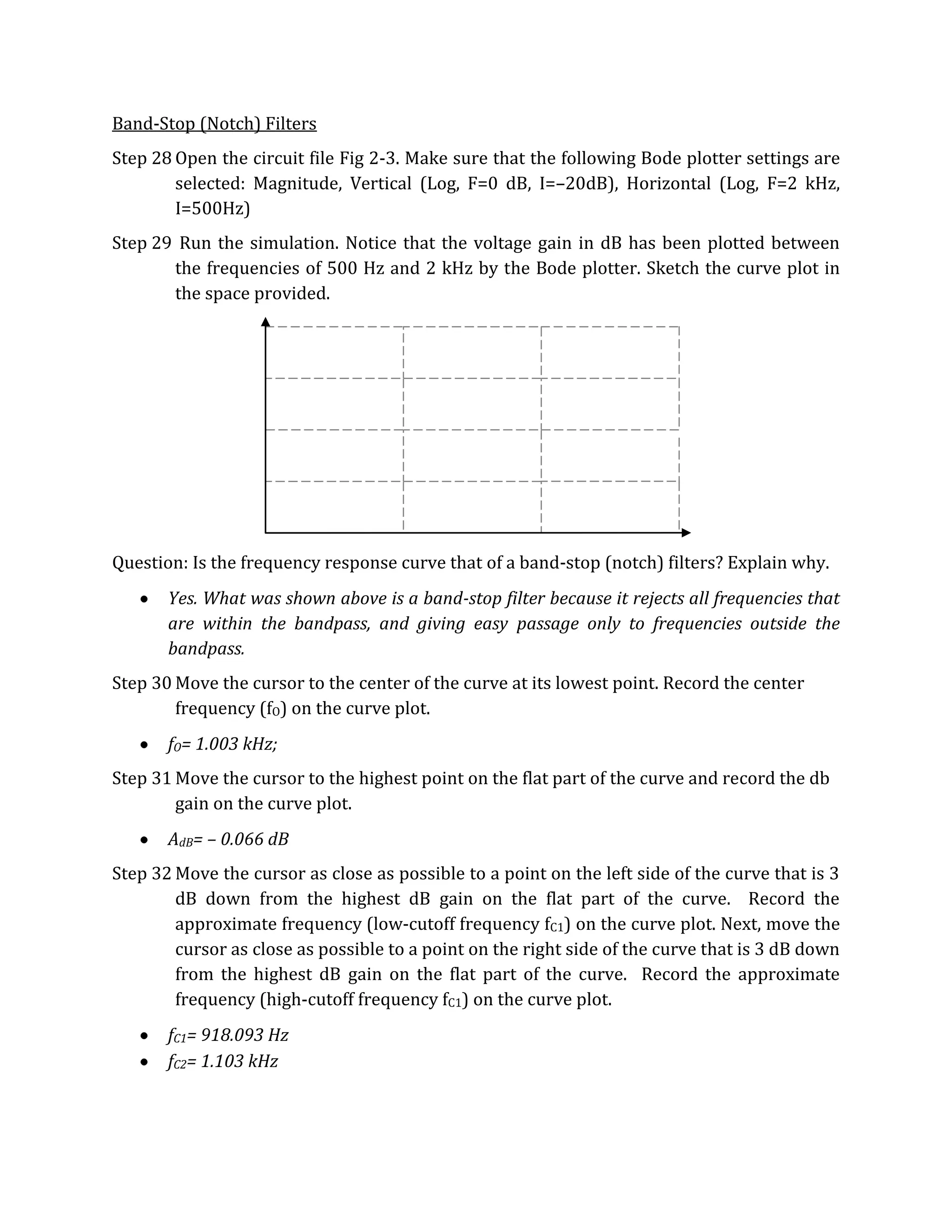
Step 29 Run the simulation. Notice that the voltage gain in dB has been plotted between
       the frequencies of 500 Hz and 2 kHz by the Bode plotter. Sketch the curve plot in
       the space provided.


Question: Is the frequency response curve that of a band-stop (notch) filters? Explain why.
       Yes. What was shown above is a band-stop filter because it rejects all frequencies that
       are within the bandpass, and giving easy passage only to frequencies outside the
       bandpass.
Step 30 Move the cursor to the center of the curve at its lowest point. Record the center
        frequency (fO) on the curve plot.
       fO= 1.003 kHz;
Step 31 Move the cursor to the highest point on the flat part of the curve and record the db
        gain on the curve plot.
       AdB= – 0.066 dB
Step 32 Move the cursor as close as possible to a point on the left side of the curve that is 3
        dB down from the highest dB gain on the flat part of the curve. Record the
        approximate frequency (low-cutoff frequency fC1) on the curve plot. Next, move the
        cursor as close as possible to a point on the right side of the curve that is 3 dB down
        from the highest dB gain on the flat part of the curve. Record the approximate
        frequency (high-cutoff frequency fC1) on the curve plot.
       fC1= 918.093 Hz
       fC2= 1.103 kHz
Step 33 Based on the values of fC1 and fC2, determine the bandwidth (BW) of the series
       resonant band-stop (notch) filter.
       BW= 184.907 Hz


Step 34 Based on the circuit component values in Fig 2-3, calculate the expected center
        frequency (fO) of the series resonant band-stop (notch) filter.
       fO(COMPONENT VALUE)= 1006.58 Hz


Question: How did the calculated value of the center frequency (fO) base on circuit
component values compare with the measured value recorded on the curve plot?
       The percentage difference between the calculated fO based on the circuit component
       values and the measured value is only 0.36%.


Step 35 Based on the values of fC1 and fC2, calculate the center frequency (fO)
       fO(fC1/fC2)= 1006.31 Hz


Question: How did the calculated value of the center frequency (fO) base on the fC1 and fC2
compare with the measured value on the curve plot?
       The percentage difference between the two is 0.33%.


Step 36 Based on the circuit component values calculate the quality factor (Qs) of the series
        resonant band-stop (notch) filter.
       QS= 5.27


Step 37 Based on the circuit quality factor (QS) and the center frequency (fO), calculate the
        expected bandwidth (BW) of the series resonant band-stop (notch) filter.
       BW(EXPECTED)= 191.00 Hz


Question: How did the expected bandwidth calculated from the value of QS and the center
frequency compare with the bandwidth measured on the curve plot?
       The percentage difference between the two is 3.30%.
Step 38 Open circuit file Fig 2-4. Make sure that the following Bode plotter settings are
        selected: Magnitude, Vertical (Log, F=0 dB, I=–20dB), Horizontal (Log, F=2 kHz,
        I=500Hz)
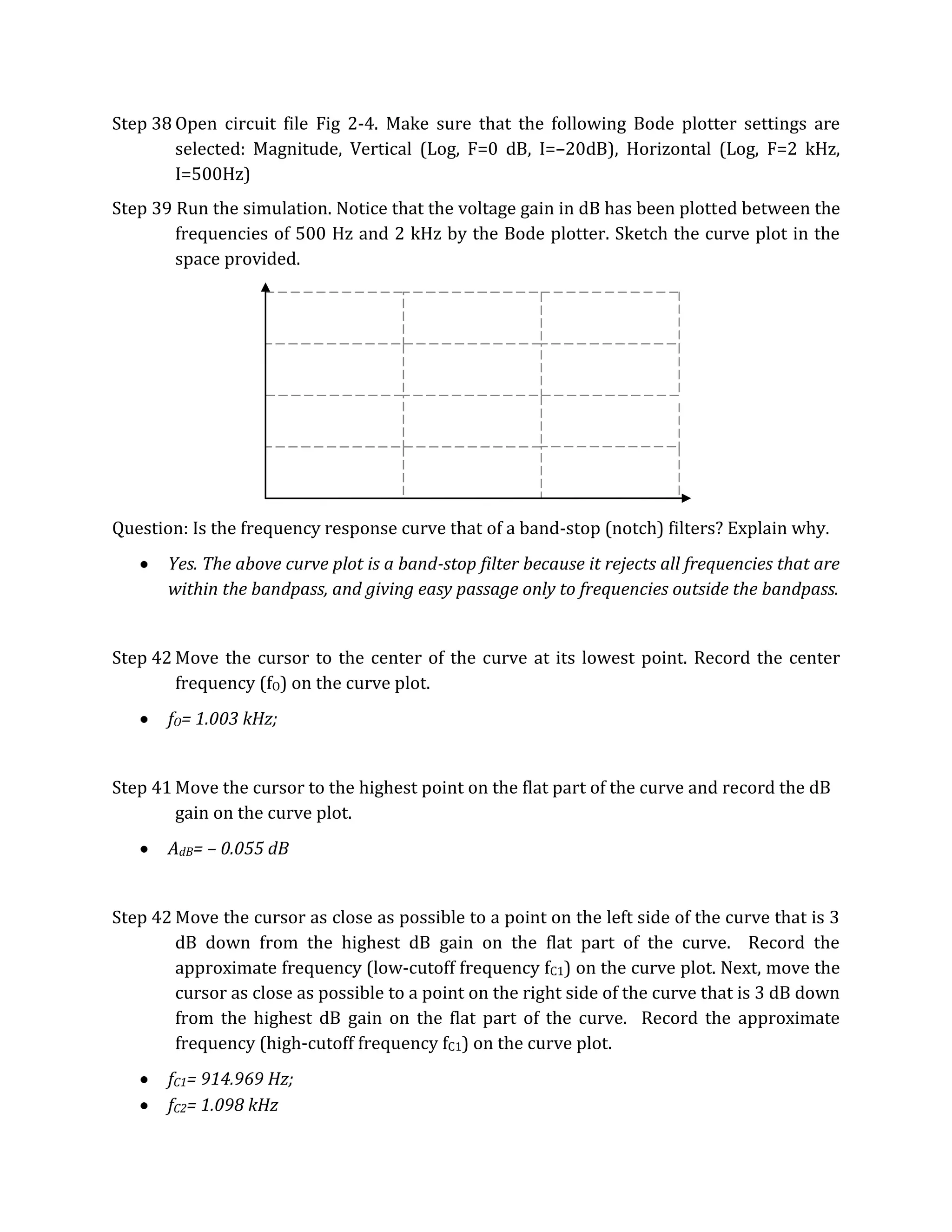
Step 39 Run the simulation. Notice that the voltage gain in dB has been plotted between the
        frequencies of 500 Hz and 2 kHz by the Bode plotter. Sketch the curve plot in the
        space provided.


Question: Is the frequency response curve that of a band-stop (notch) filters? Explain why.
       Yes. The above curve plot is a band-stop filter because it rejects all frequencies that are
       within the bandpass, and giving easy passage only to frequencies outside the bandpass.


Step 42 Move the cursor to the center of the curve at its lowest point. Record the center
        frequency (fO) on the curve plot.
       fO= 1.003 kHz;


Step 41 Move the cursor to the highest point on the flat part of the curve and record the dB
        gain on the curve plot.
       AdB= – 0.055 dB


Step 42 Move the cursor as close as possible to a point on the left side of the curve that is 3
        dB down from the highest dB gain on the flat part of the curve. Record the
        approximate frequency (low-cutoff frequency fC1) on the curve plot. Next, move the
        cursor as close as possible to a point on the right side of the curve that is 3 dB down
        from the highest dB gain on the flat part of the curve. Record the approximate
        frequency (high-cutoff frequency fC1) on the curve plot.
       fC1= 914.969 Hz;
       fC2= 1.098 kHz
Step 43 Based on the values of fC1 and fC2, determine the bandwidth (BW) of the parallel
        resonant band-stop (notch) filter.
       BW= 183.031 Hz


Step 44 Based on the circuit component values in Fig 2-4, calculate the expected center
        frequency (fO) of the parallel resonant band-stop (notch) filter.
       fO(COMPONENT VALUE)= 1006.58 Hz


Question: How did the calculated values of the center frequency (fO) base on the circuit
       component values compare with measured values recorded on the curve plot?
       The percentage difference between the calculated fO based on the circuit component
       values and the measured value is only 0.36%.


Step 45 Based on the values of fC1 and fC2, calculate the center frequency (fO).
       fO(fC1/fC2)= 1002.32 Hz


Question: How did the calculated value of the center frequency (fO) base on the fC1 and fC2
       compare with the measured value on the curve plot?
       The percentage difference between the two is 0.07%.


Step 46 Based on the value of L and RW, calculate the quality factor (QL) of the inductor.
       QL=31.62


Step 47 Based on the quality factor (QL) of the inductor, calculate the equivalent parallel
        inductor resistance (REQ) across the tank circuit.
       REQ= 20016.48Ω
Step 48 Based on the value of REQ and R, calculate the total parallel resistance (RP) across
        the tank circuit.
       RP= 3333.79Ω
Step 49 Based on the value of RP, calculate the quality factor (QP) of the parallel resonant
        band-stop (notch) filter.
       QP= 5.27


Step 50 Based on the filter quality (QP) and the center frequency (fO), calculate the expected
        bandwidth (BW) of the parallel resonant band-stop (notch) filter.
       BW= 191 Hz


Question: How did the expected bandwidth calculated from the value of QP and the center
       frequency compare with the bandwidth measured on the curve plot?
       The percentage difference between the two is 4.35%.


Step 51 Change the resistance of R to 2kΩ. Run the simulation again. Measure the center
        frequency (fO) and the bandwidth (BW) from the curve plot and record the values.
       fO=1.003 kHz          BW= 337.136 Hz


Questions: What effect did changing the resistance of R have on the center frequency of the
       parallel resonant band-stop (notch) filter? What effect did changing the resistance
       R have on the bandwidth of the parallel resonant band-stop (notch) filter? Explain.
       The center frequency remain constant or did not change its value while the bandwidth
       changed, it increases as the resistor decreases. Therefore, the center frequency f O of a
       series resonant band-pass filter is constant with the change of the value of the
       resistance of resistor R while the bandwidth of the series resonant band-pass filter is
       inversely proportional to the value of the resistance of resistor R.
CONCLUSIONS

Based on the output signal in the bode plotter the band-pass filter only allows frequencies
within the band and blocks all frequencies outside the band. Its counterpart is the band-
stop (notch) filter which blocks all frequencies within the band and allows all other
frequencies outside the band.

In addition to that, the voltage gain and the center frequency of the band-pass filter are at
the peak point of the curve plot. On the other hand, the voltage gain and the center
frequency of the band-stop filter are at the lowest point of the curve plot. Bandwidth can be
determine from subtracting the frequencies 3 dB down and up from dB gain measured at
center frequency fO.

Lastly, I concluded that the center frequency of the curve plot was not affected by the
resistance and is inversely proportional to the capacitance and inductance. Bandwidth is
not affected by capacitance, but inversely proportional to the inductance. The bandwidth in
L-C series resonant band-pass/stop filter is directly proportional to the resistance, while
bandwidth in L-C series resonant band-pass/stop filter is inversely proportional to the
resistance.

Exp2 passive band pass and band-stop filter

  • 1.
    NATIONAL COLLEGE OFSCIENCE AND TECHNOLOGY Amafel Bldg. Aguinaldo Highway Dasmariñas City, Cavite EXPERIMENT # 2 Passive Band-Pass and Band-Stop Filter Cauan, Sarah Krystelle P. July 05, 2011 Signal Spectra and Signal Processing/BSECE 41A1 Score: Eng’r. Grace Ramones Instructor
  • 2.
    OBJECTIVES 1. Plot the gain-frequency response of an L-C series resonant and an L-C parallel resonant band-pass filter. 2. Determine the center frequency and the bandwidth of the L-C band pass filter. 3. Determine how the circuit resistance affects the bandwidth of an L-C band-pass filter. 4. Plot the gain-frequency response of an L-C series resonant and an L-C parallel resonant band-stop (notch) filter. 5. Determine the center frequency and the bandwidth of the L-C band-stop filter. 6. Determine how the circuit resistance affects the bandwidth of an L-C band-stop filter.
  • 3.
    SAMPLE COMPUTATIONS Solution forStep 4 Solution for Step 6: Solution for Step 7 Solution for Question in Step 7 Solution for Step 8
  • 5.
    Solution for Questionin Step 8 Solution for Step 9 Solution for Step 10 Solution for Question in Step 10 Solution for Step 17
  • 6.
    Solution for Step19 Solution for Step 20 Solution for Question in Step 20 Solution for Step 21 Solution for Question in Step 21 Solution for Step 22 Solution for Step 23
  • 7.
    Solution for Step24 Solution for Step 25 Solution for Step 26 Solution for Question in Step 26 Solution for Step 33 Solution for Step 34
  • 8.
    Solution for Questionin Step 34 Solution for Step 35 Solution for Question in Step 35 Solution for Step 36 Solution for Step 37 Solution for Step 38
  • 9.
    Solution for Step43 Solution for Step 44 Solution for Question in Step 44 Solution for Step 45 Solution for Question in Step 45
  • 10.
    Solution for Step46 Solution for Step 47 Solution for Step 48 Solution for Step 49 Solution for Step 50 Solution for Step Question in 50
  • 11.
    DATA SHEET MATERIALS One functiongenerator One dual-trace oscilloscope Capacitors: one 0.1µF, one 0.25 µF Inductors: one 50 mH, one 100 mH Resistors: 100 Ω, 200 Ω, 2 kΩ, 4 kΩ, 5kΩ, 200kΩ THEORY In electronic communications systems, it is often necessary to separate a specific range of frequency from the total frequency spectrum. This is normally accomplished with filters. A filter is circuit that passes a specific range of frequencies while rejecting other frequencies. A passive filter consists of passive circuit elements, such as capacitors, inductors, and resistors. There are four basic types of filters, low-pass, high-pass, band- pass, and band-stop. A low-pass filter is designed to pass all frequencies below the cutoff frequency and reject all frequencies above the cutoff frequency. A high-pass filter is designed to pass all frequencies above the cutoff frequency. A high-pass filter is designed to pass all frequencies above the cutoff frequency and reject all frequencies below the cutoff frequency. A band-pass filter passes all frequencies within a band of frequencies and rejects all other frequencies outside the band. A band-stop filter rejects all frequencies within a band of frequencies outside the band. A band-stop filter is often referred to as a notch filter. In this experiment, you will study band-pass and band-stop (notch) filters. The most common way to describe the frequency response characteristics of a filter is to plot the filter voltage gain (Vo/Vi) in db as function of frequency (f). The frequency at which the output power gain drops is 50% of the maximum value is called the cutoff frequency (fC). When the output power gain drops to 50%, the voltage gain drops 3 db (0.707 of the maximum value). When the filter dB voltage gain is plotted as a function of frequency on semi log graph using straight lines to approximately the actual frequency response, it is called a Bode plot. A bode plot is an ideal plot of filter frequency response because it assumes that the voltage gain remains constant in the passband until the cutoff frequency is reached, and then drops in straight line. The filter network voltage gain in dB is calculated from the actual voltage gain (A) using the equation AdB = 20 log A Where A = Vo/Vi An L-C series resonant band-pass filter is shown in Figure 2-1. The impedance of the series L-C circuit is lowest at the resonant frequency and increases on both sides of the resonant frequency. This will cause the output voltage to be highest at the resonant frequency and decrease on both sides of the resonant frequency. At L-C parallel resonant band-pas filter is shown in Figure 2-2. The impedance of the parallel L-C circuit is highest at the resonant frequency and decreases on both sides of the resonant frequency. This will
  • 12.
    also cause theoutput voltage to be highest at the resonant frequency and decrease on both sides of the resonant. Figure 2-1 L-C Series Resonant Band-Pass Filter ` Figure 2-2 L-C Parallel Resonant Band-Pass Filter An L-C series resonant band-stop (notch) filter is shown in Figure 2-3. The impedance at the series L-C circuit is lowest at the resonant frequency and increase on both sides of the resonant frequency. This will cause the output voltage to be lowest at the resonant frequency and increase on both side of the resonant frequency. An L-C parallel resonant band-stop (notch) filter is shown in Figure 2-4. The impedance of the parallel L-C
  • 13.
    circuit is highestat the resonant frequency and decreases on both sides of the resonant frequency. This will also cause the output voltage to the lowest at the resonant frequency and increase on both sides of the resonant frequency. Figure 2-3 L-C Series Resonant Band-Stop (Notch) Filter Figure 2-4 L-C Parallel Resonant Band-Stop (Notch) Filter
  • 14.
    The center frequency(fO) for the L-C series resonant and the L-C parallel resonant band-pass and band-stop (notch) filter is equal to the resonant frequency of the L-C circuit, which can be calculated from For an L-C parallel resonant filter, the equation is accurate only for a high Q inductor coil (Qf 10) where QL is calculated from and XL is the inductive reactance at the resonant frequency (center frequency, fO) and Rw is the inductor coil resistance. In the band-pass and band-stop (notch) filters, the low-cutoff frequency (fC1) and the high-cutoff frequency (fC2) on the gain-frequency plot are the frequencies where the whole voltage gain has dropped 3dB (0.707) from the highest dB gain. The filter bandwidth (BW) is the difference between the cutoff frequency (fC2) and the low-cutoff frequency (fC1) Therefore, BW = fC2 – fC1 The center frequency (f0) is the geometric mean of the low-cutoff frequency and the high-cutoff frequency. Therefore, The quality factor (Q) of the band-pass and the band-stop (notch) filters is the ratio of the center frequency (fO) and the bandwidth (BW), and it is an indication of the activity of the filter. Therefore, A higher value of Q means a narrower bandwidth and a more selective filter. The quality factor (QS) of a series resonant filter is determined by first calculating the inductive reactance (XL) of the inductor at the resonant frequency (center frequency, fO), and then dividing the inductive reactance by total series resistance (RT). Therefore, Where
  • 15.
    The quality factor(QP) of a parallel resonant filter is determined by first calculating the inductive reactance (XL) of the inductor at the resonant frequency (center frequency, fO), and then dividing the total parallel resistance (RP) by the inductive reactance (XL). Therefore, Because the inductor wire resistance (RW) is in series with inductor L, the circuits in Figures 2-2 and 2-4 are not exactly parallel resonant circuits; the series combination of inductance (L) and resistance (RW) must first be converted into an equivalent parallel network with resistance REQ in parallel with inductance L. In Figure 2-2, the parallel equivalent resistance (REQ) will also be in parallel with resistor r and resistor RS making the total resistance of the parallel resonant circuit (RP), equal to the parallel equivalent of resistors r, RS, and REQ. Therefore, RP can be solved from In Figure 2-4, the parallel equivalent resistance (REQ) will be in parallel with resistor R, making the total resistance of the parallel resonant circuit (RP) equal to the parallel equivalent of resistor R and REQ. Therefore, RP can be solved from The equation for converting resistance RW to the equivalent parallel resistance (REQ) is The parallel equivalent inductance LEQ is calculated from This equivalent inductance can be considered equal to the original inductance (L) for a high Q coil (QL 10)
  • 16.
    PROCEDURE Band-Pass Filters Step 1Open circuit file Fig 2-1. Make sure that the following Bode plotter settings are selected. Magnitude, Vertical (Log, F=0 dB, I=–20dB), Horizontal (Log, F=2 kHz, I=500Hz) Step 2 Run the simulation. Notice that the voltage gain in db has been plotted between the frequencies of 50Hz and 2Kz by the Bode plotter. Sketch the curve plot in the space provided. Question: Is the frequency response curve that of a band-pass filters? Explain why. Yes. A band-pass is a filtering device that permits only the frequencies within a certain band and rejects all other band. The plot curve shown above only allows the frequencies from 501.697 Hz to 1.993 kHz. Step 3 Move the cursor to the center of the curve at its peak point. Record the center frequency (f0) and the voltage gain in dB on the curve plot. fO= 996.84 Hz; AdB= – 1.637 dB Step 4 Based on the dB voltage gain, calculate the actual voltage gain (A) of the series resonant band-pass filter at the center frequency. A= 0.83
  • 17.
    Step 5 Movethe cursor as close as possible to a point on the left side of the curve that is 3 dB down from dB gain measured at frequency fO. Record the approximate frequency (low-cutoff frequency, fC1) on the curve plot. Next, move the cursor as close as possible to a point on the right side of the curve that is 3 dB down from the dB gain measured at frequency fO. Record the approximate frequency (high-cutoff frequency, fC2) on the curve plot. fC1= 914.969 Hz fC2= 1.104 kHz Step 6 Based on the values of fC1 and fC2 measured on the curve plot, determine the bandwidth (BW) of the series resonant band-pass filter. BW= 189.031 Hz Step 7 Based on the circuit component values in Figure 2-1, calculated the expected center frequency (fO) of the series resonant band-pass filter. fO(COMPONENT VALUE)= 1006.58 Hz Question: How did the calculated value of the center frequency (fO) based on the circuit component values compare with the measured value on the curve plot? The calculated fO based on the circuit component values and the measured value is almost equal. Their percentage difference is 0.97%. Step 8 Based on the values of fC1 and fC2, calculate the center frequency (fO). fO(fC1/fC2)= 1005.05 Hz Question: How did the calculated value of the center frequency (fO) based on fC1 and fC2 compare with the measured value on the curve plot? The percentage difference between the two is 0.82%. Step 9 Based on the circuit component values, calculate the quality factor (QS) of the series resonant band-pass filter. QS= 5.27
  • 18.
    Step 10 Basedon the circuit quality factor (QS) and the center frequency (fO), calculate the expected bandwidth (BW) of the series resonant band-pass filter. BW(EXPECTED)= 191.00 Hz Question: How did the expected bandwidth calculated from the value of QS and the center frequency compare with the bandwidth measured on the curve plot? The percentage difference between the two is 1.04%. Step 11 Change the resistance of R to 200 Ω. Run the simulation again. Measure the center frequency (fO) and the bandwidth (BW) from the curve plot and record the values. fO=996.84 Hz BW= 350.136 Hz Questions: What effect did changing the resistance R have on the center frequency of the series resonant band-pass filter? What effect did changing the resistance of R have on the bandwidth of the series resonant band-pass filter? Explain. The center frequency remain constant or did not change its value while the bandwidth changed, it increased as the resistor increase. Therefore, the center frequency f O of a series resonant band-pass filter is constant with change in the resistance R while the bandwidth of the series resonant band-pass filter is directly proportional to the resistance R. Step 12 Change the capacitance of C to 0.1 µF. Run the simulation again. Measure the center frequency (fO) and the bandwidth (BW) on the curve plot and record the values Change the Bode plotter settings as needed. fO=1.583 kHz BW= 350 Hz
  • 19.
    Questions: What effectdid changing the capacitance of C have on the center frequency of the series resonant band-pass filter? What effect did changing the capacitance of C have on the bandwidth of the series resonant band-pass filter? Explain. The bandwidth remains constant or did not change its value. The center frequency however changed, it increased as the resistor increase. Therefore, the bandwidth of a series resonant band-pass filter is affected by the change of capacitance C while the center frequency of the series resonant band-pass filter is inversely proportional to the capacitance C. Step 13 Change the inductance of L to 50 mH. Run the simulation again. Measure the center frequency (fO) and the bandwidth (BW) on the curve plot and record the values. Change the Bode plotter settings as needed. fO=1.423 kHz BW= 386 Hz Questions: What effect did the changing the inductance of L has on the center frequency of the series resonant band-pass filter? What effect did changing the inductance of L have on the bandwidth of the series resonant band-pass filter? Explain. The center frequency and bandwidth was compared to the original circuit. By changing the inductance, bandwidth BW and center frequency f O increased. Therefore, bandwidth and the center frequency of the series resonant band-pass filter are inversely proportional to the inductance of L
  • 20.
    Step 14 Opencircuit file Fig 2-2. Make sure that the following Bode plotter settings are selected: Magnitude, Vertical (Log, F=0 dB, I=–20dB), Horizontal (Log, F=2 kHz, I=500Hz) Step 15 Run the simulation. Notice that the voltage gain in dB has been plotted between the frequencies of 500 Hz and 2 kHz by the Bode plotter. Sketch the curve plot in the space provided. Question: Is the frequency response curve that of a band-pass filters? Explain why. Yes. The curve plot above is a band-pass because it permits only the frequencies within bandpass from 501.697 Hz to 1.993 kHz and rejects all other band. Step 16 Move the cursor to the center of the curve at its peak. Record the center frequency (fO) and the voltage gain in dB on the curve plot. fO= 1.003 kHz AdB= – 2.189 dB Step 17 Based on the dB voltage gain, calculate the actual voltage gain (A) of the parallel resonant band-pass filter at the center frequency. A= 0.78 Step 18 Move the cursor at its close as possible to a point on the left side of the curve that is 3dB down from the dB gain measured at frequency fO. Record the approximate frequency (low-cutoff frequency, fC1) on the curve plot. Next, move the cursor as close as possible to a point on the right side of the curve that is 3 dB down from the
  • 21.
    dB gain measuredat frequency fO. Record the approximate frequency (high-cutoff frequency fC2) on the curve plot. fC1= 929.014 Hz fC2= 1.093 kHz Step 19 Based on the values of fC1 and fC2, determine the bandwidth (BW) of the parallel resonant band-pass filter. BW= 163.186 Hz Step 20 Based on the circuit component values in Fig 2-2, calculate the expected center frequency (fO) of the parallel resonant band-pass filter. fO(COMPONENT VALUE)= 1006.58 Hz Question: How did the calculated values of the center frequency (fO) base on the circuit component values compare with measured values recorded on the curve plot? The percentage difference between the calculated fO based on the circuit component values and the measured value is only 0.37%. Step 21 Based on the values of fC1 and fC2, calculate the center frequency (fO). fO(fC1/fC2)= 1007.68 Hz Question: How did the calculated value of the center frequency (fO) base on the fC1 and fC2 compare with the measured value on the curve plot? The percentage difference between the two is 0.47%. Step 22 Based on the value of L and RW, calculate the quality factor (QL) of the inductor. QL=31.62 Step 23 Based on the quality factor (QL) of the inductor, calculate the equivalent parallel inductor resistance (REQ) across the tank circuit. REQ= 20016.488Ω
  • 22.
    Step 24 Basedon the value of REQ, RS, and R, calculate the total parallel resistance (RP) across the tank circuit. RP= 3922.20Ω Step 25 Based on the value of RP, calculate the quality factor (QP) of the parallel resonant band-pass filter. QP= 6.2015 Step 26 Based on the filter quality (QP) and the center frequency (fO), calculate the expected bandwidth (BW) of the parallel resonant band-pass filter. BW= 162.31 Hz Question: How did the expected bandwidth calculated from the value of QP and the center frequency compare with the bandwidth measured on the curve plot? The percentage difference between the two is 0.54%. Step 27 Change the resistance of R to 5kΩ. Run the simulation again. Measure the center frequency (fO) and the bandwidth (BW) from the curve plot and record the values. fO=1.003 kHz BW= 289.456 Hz Questions: What effect did changing the resistance of R have on the center frequency of the parallel resonant band-pass filter? What effect did changing the resistance R have on the bandwidth of the parallel resonant band-pass filter? Explain why. The center frequency remain constant or did not change its value while the bandwidth changed, it increased as the resistor decrease. Therefore, the center frequency f O of a series resonant band-pass filter is constant with change in the resistance R while the bandwidth of the series resonant band-pass filter is inversely proportional to the resistance R.
  • 23.
    Band-Stop (Notch) Filters Step28 Open the circuit file Fig 2-3. Make sure that the following Bode plotter settings are selected: Magnitude, Vertical (Log, F=0 dB, I=–20dB), Horizontal (Log, F=2 kHz, I=500Hz) Step 29 Run the simulation. Notice that the voltage gain in dB has been plotted between the frequencies of 500 Hz and 2 kHz by the Bode plotter. Sketch the curve plot in the space provided. Question: Is the frequency response curve that of a band-stop (notch) filters? Explain why. Yes. What was shown above is a band-stop filter because it rejects all frequencies that are within the bandpass, and giving easy passage only to frequencies outside the bandpass. Step 30 Move the cursor to the center of the curve at its lowest point. Record the center frequency (fO) on the curve plot. fO= 1.003 kHz; Step 31 Move the cursor to the highest point on the flat part of the curve and record the db gain on the curve plot. AdB= – 0.066 dB Step 32 Move the cursor as close as possible to a point on the left side of the curve that is 3 dB down from the highest dB gain on the flat part of the curve. Record the approximate frequency (low-cutoff frequency fC1) on the curve plot. Next, move the cursor as close as possible to a point on the right side of the curve that is 3 dB down from the highest dB gain on the flat part of the curve. Record the approximate frequency (high-cutoff frequency fC1) on the curve plot. fC1= 918.093 Hz fC2= 1.103 kHz
  • 24.
    Step 33 Basedon the values of fC1 and fC2, determine the bandwidth (BW) of the series resonant band-stop (notch) filter. BW= 184.907 Hz Step 34 Based on the circuit component values in Fig 2-3, calculate the expected center frequency (fO) of the series resonant band-stop (notch) filter. fO(COMPONENT VALUE)= 1006.58 Hz Question: How did the calculated value of the center frequency (fO) base on circuit component values compare with the measured value recorded on the curve plot? The percentage difference between the calculated fO based on the circuit component values and the measured value is only 0.36%. Step 35 Based on the values of fC1 and fC2, calculate the center frequency (fO) fO(fC1/fC2)= 1006.31 Hz Question: How did the calculated value of the center frequency (fO) base on the fC1 and fC2 compare with the measured value on the curve plot? The percentage difference between the two is 0.33%. Step 36 Based on the circuit component values calculate the quality factor (Qs) of the series resonant band-stop (notch) filter. QS= 5.27 Step 37 Based on the circuit quality factor (QS) and the center frequency (fO), calculate the expected bandwidth (BW) of the series resonant band-stop (notch) filter. BW(EXPECTED)= 191.00 Hz Question: How did the expected bandwidth calculated from the value of QS and the center frequency compare with the bandwidth measured on the curve plot? The percentage difference between the two is 3.30%.
  • 25.
    Step 38 Opencircuit file Fig 2-4. Make sure that the following Bode plotter settings are selected: Magnitude, Vertical (Log, F=0 dB, I=–20dB), Horizontal (Log, F=2 kHz, I=500Hz) Step 39 Run the simulation. Notice that the voltage gain in dB has been plotted between the frequencies of 500 Hz and 2 kHz by the Bode plotter. Sketch the curve plot in the space provided. Question: Is the frequency response curve that of a band-stop (notch) filters? Explain why. Yes. The above curve plot is a band-stop filter because it rejects all frequencies that are within the bandpass, and giving easy passage only to frequencies outside the bandpass. Step 42 Move the cursor to the center of the curve at its lowest point. Record the center frequency (fO) on the curve plot. fO= 1.003 kHz; Step 41 Move the cursor to the highest point on the flat part of the curve and record the dB gain on the curve plot. AdB= – 0.055 dB Step 42 Move the cursor as close as possible to a point on the left side of the curve that is 3 dB down from the highest dB gain on the flat part of the curve. Record the approximate frequency (low-cutoff frequency fC1) on the curve plot. Next, move the cursor as close as possible to a point on the right side of the curve that is 3 dB down from the highest dB gain on the flat part of the curve. Record the approximate frequency (high-cutoff frequency fC1) on the curve plot. fC1= 914.969 Hz; fC2= 1.098 kHz
  • 26.
    Step 43 Basedon the values of fC1 and fC2, determine the bandwidth (BW) of the parallel resonant band-stop (notch) filter. BW= 183.031 Hz Step 44 Based on the circuit component values in Fig 2-4, calculate the expected center frequency (fO) of the parallel resonant band-stop (notch) filter. fO(COMPONENT VALUE)= 1006.58 Hz Question: How did the calculated values of the center frequency (fO) base on the circuit component values compare with measured values recorded on the curve plot? The percentage difference between the calculated fO based on the circuit component values and the measured value is only 0.36%. Step 45 Based on the values of fC1 and fC2, calculate the center frequency (fO). fO(fC1/fC2)= 1002.32 Hz Question: How did the calculated value of the center frequency (fO) base on the fC1 and fC2 compare with the measured value on the curve plot? The percentage difference between the two is 0.07%. Step 46 Based on the value of L and RW, calculate the quality factor (QL) of the inductor. QL=31.62 Step 47 Based on the quality factor (QL) of the inductor, calculate the equivalent parallel inductor resistance (REQ) across the tank circuit. REQ= 20016.48Ω Step 48 Based on the value of REQ and R, calculate the total parallel resistance (RP) across the tank circuit. RP= 3333.79Ω
  • 27.
    Step 49 Basedon the value of RP, calculate the quality factor (QP) of the parallel resonant band-stop (notch) filter. QP= 5.27 Step 50 Based on the filter quality (QP) and the center frequency (fO), calculate the expected bandwidth (BW) of the parallel resonant band-stop (notch) filter. BW= 191 Hz Question: How did the expected bandwidth calculated from the value of QP and the center frequency compare with the bandwidth measured on the curve plot? The percentage difference between the two is 4.35%. Step 51 Change the resistance of R to 2kΩ. Run the simulation again. Measure the center frequency (fO) and the bandwidth (BW) from the curve plot and record the values. fO=1.003 kHz BW= 337.136 Hz Questions: What effect did changing the resistance of R have on the center frequency of the parallel resonant band-stop (notch) filter? What effect did changing the resistance R have on the bandwidth of the parallel resonant band-stop (notch) filter? Explain. The center frequency remain constant or did not change its value while the bandwidth changed, it increases as the resistor decreases. Therefore, the center frequency f O of a series resonant band-pass filter is constant with the change of the value of the resistance of resistor R while the bandwidth of the series resonant band-pass filter is inversely proportional to the value of the resistance of resistor R.
  • 28.
    CONCLUSIONS Based on theoutput signal in the bode plotter the band-pass filter only allows frequencies within the band and blocks all frequencies outside the band. Its counterpart is the band- stop (notch) filter which blocks all frequencies within the band and allows all other frequencies outside the band. In addition to that, the voltage gain and the center frequency of the band-pass filter are at the peak point of the curve plot. On the other hand, the voltage gain and the center frequency of the band-stop filter are at the lowest point of the curve plot. Bandwidth can be determine from subtracting the frequencies 3 dB down and up from dB gain measured at center frequency fO. Lastly, I concluded that the center frequency of the curve plot was not affected by the resistance and is inversely proportional to the capacitance and inductance. Bandwidth is not affected by capacitance, but inversely proportional to the inductance. The bandwidth in L-C series resonant band-pass/stop filter is directly proportional to the resistance, while bandwidth in L-C series resonant band-pass/stop filter is inversely proportional to the resistance.