ANALOG CIRCUITS
For
ECE / EE / IN
By
www.thegateacademy.com
Syllabus Analog Circuits
THE GATE ACADEMY PVT.LTD. H.O.: #74, Keshava Krupa (third Floor), 30th
Cross, 10th
Main, Jayanagar 4th
Block, Bangalore-11
: 080-65700750,  info@thegateacademy.com © Copyright reserved. Web: www.thegateacademy.com
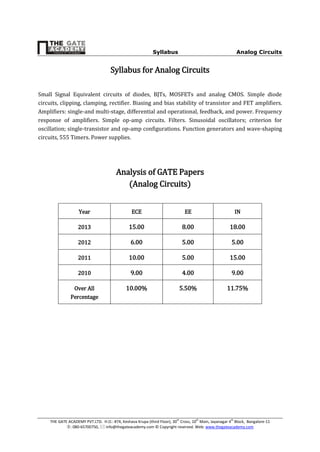
Syllabus for Analog Circuits
Small Signal Equivalent circuits of diodes, BJTs, MOSFETs and analog CMOS. Simple diode
circuits, clipping, clamping, rectifier. Biasing and bias stability of transistor and FET amplifiers.
Amplifiers: single-and multi-stage, differential and operational, feedback, and power. Frequency
response of amplifiers. Simple op-amp circuits. Filters. Sinusoidal oscillators; criterion for
oscillation; single-transistor and op-amp configurations. Function generators and wave-shaping
circuits, 555 Timers. Power supplies.
Analysis of GATE Papers
(Analog Circuits)
Year ECE EE IN
2013 15.00 8.00 18.00
2012 6.00 5.00 5.00
2011 10.00 5.00 15.00
2010 9.00 4.00 9.00
Over All
Percentage
10.00% 5.50% 11.75%
Contents Analog Circuits
THE GATE ACADEMY PVT.LTD. H.O.: #74, Keshava Krupa (third Floor), 30th
Cross, 10th
Main, Jayanagar 4th
Block, Bangalore-11
: 080-65700750,  info@thegateacademy.com © Copyright reserved. Web: www.thegateacademy.com Page I
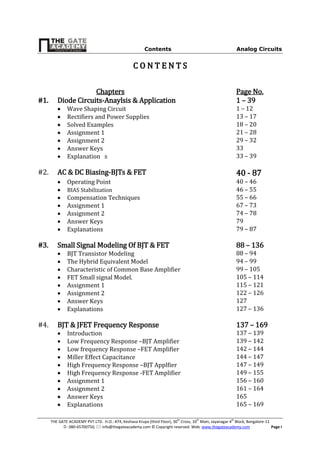
CC OO NN TT EE NN TT SS
Chapters Page No.
#1. Diode Circuits-Anaylsis & Application 1 – 39
 Wave Shaping Circuit 1 – 12
 Rectifiers and Power Supplies 13 – 17
 Solved Examples 18 – 20
 Assignment 1 21 – 28
 Assignment 2 29 – 32
 Answer Keys 33
 Explanation s 33 – 39
#2. AC & DC Biasing-BJTs & FET 40 - 87
 Operating Point 40 – 46
 BIAS Stabilization 46 – 55
 Compensation Techniques 55 – 66
 Assignment 1 67 – 73
 Assignment 2 74 – 78
 Answer Keys 79
 Explanations 79 – 87
#3. Small Signal Modeling Of BJT & FET 88 – 136
 BJT Transistor Modeling 88 – 94
 The Hybrid Equivalent Model 94 – 99
 Characteristic of Common Base Amplifier 99 – 105
 FET Small signal Model. 105 – 114
 Assignment 1 115 – 121
 Assignment 2 122 – 126
 Answer Keys 127
 Explanations 127 – 136
#4. BJT & JFET Frequency Response 137 – 169
 Introduction 137 – 139
 Low Frequency Response –BJT Amplifier 139 – 142
 Low frequency Response –FET Amplifier 142 – 144
 Miller Effect Capacitance 144 – 147
 High Frequency Response –BJT Applfier 147 – 149
 High Frequency Response -FET Amplifier 149 – 155
 Assignment 1 156 – 160
 Assignment 2 161 – 164
 Answer Keys 165
 Explanations 165 – 169
Contents Analog Circuits
THE GATE ACADEMY PVT.LTD. H.O.: #74, Keshava Krupa (third Floor), 30th
Cross, 10th
Main, Jayanagar 4th
Block, Bangalore-11
: 080-65700750,  info@thegateacademy.com © Copyright reserved. Web: www.thegateacademy.com Page II
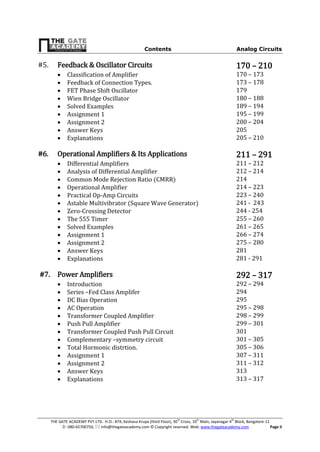
#5. Feedback & Oscillator Circuits 170 – 210
 Classification of Amplifier 170 – 173
 Feedback of Connection Types. 173 – 178
 FET Phase Shift Oscillator 179
 Wien Bridge Oscillator 180 – 188
 Solved Examples 189 – 194
 Assignment 1 195 – 199
 Assignment 2 200 – 204
 Answer Keys 205
 Explanations 205 – 210
#6. Operational Amplifiers & Its Applications 211 – 291
 Differential Amplifiers 211 – 212
 Analysis of Differential Amplifier 212 – 214
 Common Mode Rejection Ratio (CMRR) 214
 Operational Amplifier 214 – 223
 Practical Op-Amp Circuits 223 – 240
 Astable Multivibrator (Square Wave Generator) 241 - 243
 Zero-Crossing Detector 244 - 254
 The 555 Timer 255 – 260
 Solved Examples 261 – 265
 Assignment 1 266 – 274
 Assignment 2 275 – 280
 Answer Keys 281
 Explanations 281 - 291
#7. Power Amplifiers 292 – 317
 Introduction 292 – 294
 Series –Fed Class Amplifer 294
 DC Bias Operation 295
 AC Operation 295 – 298
 Transformer Coupled Amplifier 298 – 299
 Push Pull Amplifier 299 – 301
 Transformer Coupled Push Pull Circuit 301
 Complementary –symmetry circuit 301 – 305
 Total Hormonic distrtion. 305 – 306
 Assignment 1 307 – 311
 Assignment 2 311 – 312
 Answer Keys 313
 Explanations 313 – 317
Contents Analog Circuits
THE GATE ACADEMY PVT.LTD. H.O.: #74, Keshava Krupa (third Floor), 30th
Cross, 10th
Main, Jayanagar 4th
Block, Bangalore-11
: 080-65700750,  info@thegateacademy.com © Copyright reserved. Web: www.thegateacademy.com Page III
Module Test 318 – 345
 Test Questions 318 – 335
 Answer Keys 336
 Explanations 336 – 345
Reference Books 346
Chapter-1 Analog Circuits
THE GATE ACADEMY PVT.LTD. H.O.: #74, Keshava Krupa (third Floor), 30th
Cross, 10th
Main, Jayanagar 4th
Block, Bangalore-11
: 080-65700750,  info@thegateacademy.com © Copyright reserved. Web: www.thegateacademy.com Page 1
CHAPTER 1
Diode Circuits - Analysis and Application
Wave Shaping Circuits
Wave shaping circuits are of two types
(A) Linear wave shaping circuits
(B) Non linear wave shaping circuits
A. Linear Wave Shaping Circuits
The process by which the wave form of non sinusoidal signal is altered by passing it through the
linear network is called the linear wave shaping
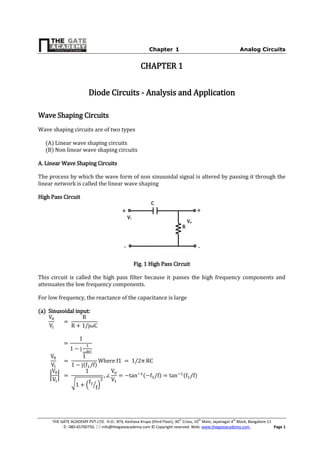
High Pass Circuit
Fig. 1 High Pass Circuit
This circuit is called the high pass filter because it passes the high frequency components and
attenuates the low frequency components.
For low frequency, the reactance of the capacitance is large
(a) Sinusoidal input:
( )
| |
√ ( ⁄ )
( ) ( )
Vo
R
Vi
C
+ +
- -
Chapter-1 Analog Circuits
THE GATE ACADEMY PVT.LTD. H.O.: #74, Keshava Krupa (third Floor), 30th
Cross, 10th
Main, Jayanagar 4th
Block, Bangalore-11
: 080-65700750,  info@thegateacademy.com © Copyright reserved. Web: www.thegateacademy.com Page 2
Fig. 2 Gain-frequency plot of high pass circuit
(b) Step Input:
Fig. 3 Output voltage of high pass circuit when input is a step voltage
(t) = ( ) ( ) ( ) ( )
( ) = 1/C ( )
iR,
So ( ) 1/RC (t) dt + ( ) ( )
It is a single time constant circuit and a first order equation is obtained. The general solution of
any single time constant circuit can be written as,
( ) ( ) , here Vf = 0, Vi = V, Vo(t) = Ve- τwhere τ
(c) Pulse Input: ( ) [ ( ) ( )]
1)
2) ( )
τ
τ
( )
0
V
| |
1
0.707
Chapter-1 Analog Circuits
THE GATE ACADEMY PVT.LTD. H.O.: #74, Keshava Krupa (third Floor), 30th
Cross, 10th
Main, Jayanagar 4th
Block, Bangalore-11
: 080-65700750,  info@thegateacademy.com © Copyright reserved. Web: www.thegateacademy.com Page 3
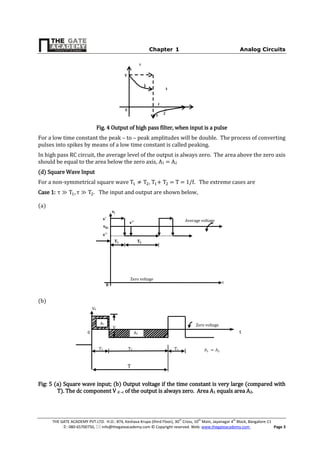
Fig. 4 Output of high pass filter, when input is a pulse
For a low time constant the peak – to – peak amplitudes will be double. The process of converting
pulses into spikes by means of a low time constant is called peaking.
In high pass RC circuit, the average level of the output is always zero. The area above the zero axis
should be equal to the area below the zero axis, A1 = A2
(d) Square Wave Input
For a non-symmetrical square wave , + = T = 1/f. The extreme cases are
Case 1: τ τ The input and output are shown below,
(a)
(b)
Fig: 5 (a) Square wave input; (b) Output voltage if the time constant is very large (compared with
T). The dc component V d –c of the output is always zero. Area A1 equals area A2.
V0
V
0
T1 T2
t
Zero voltage
T
T1
A2
A1
Zero voltage
Average voltage
( )
0
V
1
2
Chapter-1 Analog Circuits
THE GATE ACADEMY PVT.LTD. H.O.: #74, Keshava Krupa (third Floor), 30th
Cross, 10th
Main, Jayanagar 4th
Block, Bangalore-11
: 080-65700750,  info@thegateacademy.com © Copyright reserved. Web: www.thegateacademy.com Page 4
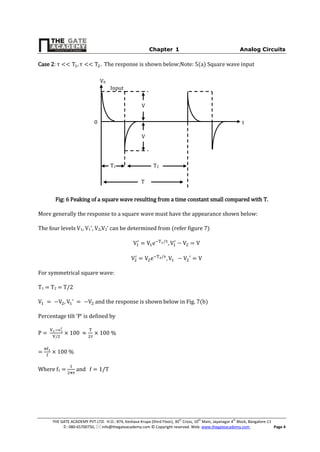
Case 2: τ τ The response is shown below;Note: 5(a) Square wave input
Fig: 6 Peaking of a square wave resulting from a time constant small compared with T.
More generally the response to a square wave must have the appearance shown below:
The four levels V1, V1’ 2,V2’ can be determined from (refer figure 7)
For symmetrical square wave:
T1 = T2 = T/2
’ and the response is shown below in Fig. 7(b)
P c ‘P’ by
P = 100 100 %
= 100 %
Where f1 = and
V0
T1 T2
T
V
V
0
Input
t
Chapter-1 Analog Circuits
THE GATE ACADEMY PVT.LTD. H.O.: #74, Keshava Krupa (third Floor), 30th
Cross, 10th
Main, Jayanagar 4th
Block, Bangalore-11
: 080-65700750,  info@thegateacademy.com © Copyright reserved. Web: www.thegateacademy.com Page 5
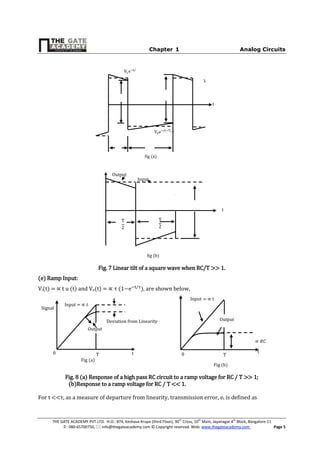
Fig. 7 Linear tilt of a square wave when RC/T >> 1.
(e) Ramp Input:
Vi(t) = t u (t) and Vo(t) = τ (1 ), are shown below,
Fig. 8 (a) Response of a high pass RC circuit to a ramp voltage for RC / T >> 1;
(b)Response to a ramp voltage for RC / T << 1.
For t <<τ as a measure of departure from linearity, transmission error, et is defined as
Deviation from Linearity
Output
Input =
Signal
0 T t
Fig (a)
t
Output
0 T
Fig (b)
t
( )
t
( )
Output
Input
(b)
 Electronics and Communication Engineering : Analog circuits, THE GATE ACADEMY

Electronics and Communication Engineering : Analog circuits, THE GATE ACADEMY

  • 2.
    ANALOG CIRCUITS For ECE /EE / IN By www.thegateacademy.com
  • 3.
    Syllabus Analog Circuits THEGATE ACADEMY PVT.LTD. H.O.: #74, Keshava Krupa (third Floor), 30th Cross, 10th Main, Jayanagar 4th Block, Bangalore-11 : 080-65700750,  info@thegateacademy.com © Copyright reserved. Web: www.thegateacademy.com Syllabus for Analog Circuits Small Signal Equivalent circuits of diodes, BJTs, MOSFETs and analog CMOS. Simple diode circuits, clipping, clamping, rectifier. Biasing and bias stability of transistor and FET amplifiers. Amplifiers: single-and multi-stage, differential and operational, feedback, and power. Frequency response of amplifiers. Simple op-amp circuits. Filters. Sinusoidal oscillators; criterion for oscillation; single-transistor and op-amp configurations. Function generators and wave-shaping circuits, 555 Timers. Power supplies. Analysis of GATE Papers (Analog Circuits) Year ECE EE IN 2013 15.00 8.00 18.00 2012 6.00 5.00 5.00 2011 10.00 5.00 15.00 2010 9.00 4.00 9.00 Over All Percentage 10.00% 5.50% 11.75%
  • 4.
    Contents Analog Circuits THEGATE ACADEMY PVT.LTD. H.O.: #74, Keshava Krupa (third Floor), 30th Cross, 10th Main, Jayanagar 4th Block, Bangalore-11 : 080-65700750,  info@thegateacademy.com © Copyright reserved. Web: www.thegateacademy.com Page I CC OO NN TT EE NN TT SS Chapters Page No. #1. Diode Circuits-Anaylsis & Application 1 – 39  Wave Shaping Circuit 1 – 12  Rectifiers and Power Supplies 13 – 17  Solved Examples 18 – 20  Assignment 1 21 – 28  Assignment 2 29 – 32  Answer Keys 33  Explanation s 33 – 39 #2. AC & DC Biasing-BJTs & FET 40 - 87  Operating Point 40 – 46  BIAS Stabilization 46 – 55  Compensation Techniques 55 – 66  Assignment 1 67 – 73  Assignment 2 74 – 78  Answer Keys 79  Explanations 79 – 87 #3. Small Signal Modeling Of BJT & FET 88 – 136  BJT Transistor Modeling 88 – 94  The Hybrid Equivalent Model 94 – 99  Characteristic of Common Base Amplifier 99 – 105  FET Small signal Model. 105 – 114  Assignment 1 115 – 121  Assignment 2 122 – 126  Answer Keys 127  Explanations 127 – 136 #4. BJT & JFET Frequency Response 137 – 169  Introduction 137 – 139  Low Frequency Response –BJT Amplifier 139 – 142  Low frequency Response –FET Amplifier 142 – 144  Miller Effect Capacitance 144 – 147  High Frequency Response –BJT Applfier 147 – 149  High Frequency Response -FET Amplifier 149 – 155  Assignment 1 156 – 160  Assignment 2 161 – 164  Answer Keys 165  Explanations 165 – 169
  • 5.
    Contents Analog Circuits THEGATE ACADEMY PVT.LTD. H.O.: #74, Keshava Krupa (third Floor), 30th Cross, 10th Main, Jayanagar 4th Block, Bangalore-11 : 080-65700750,  info@thegateacademy.com © Copyright reserved. Web: www.thegateacademy.com Page II #5. Feedback & Oscillator Circuits 170 – 210  Classification of Amplifier 170 – 173  Feedback of Connection Types. 173 – 178  FET Phase Shift Oscillator 179  Wien Bridge Oscillator 180 – 188  Solved Examples 189 – 194  Assignment 1 195 – 199  Assignment 2 200 – 204  Answer Keys 205  Explanations 205 – 210 #6. Operational Amplifiers & Its Applications 211 – 291  Differential Amplifiers 211 – 212  Analysis of Differential Amplifier 212 – 214  Common Mode Rejection Ratio (CMRR) 214  Operational Amplifier 214 – 223  Practical Op-Amp Circuits 223 – 240  Astable Multivibrator (Square Wave Generator) 241 - 243  Zero-Crossing Detector 244 - 254  The 555 Timer 255 – 260  Solved Examples 261 – 265  Assignment 1 266 – 274  Assignment 2 275 – 280  Answer Keys 281  Explanations 281 - 291 #7. Power Amplifiers 292 – 317  Introduction 292 – 294  Series –Fed Class Amplifer 294  DC Bias Operation 295  AC Operation 295 – 298  Transformer Coupled Amplifier 298 – 299  Push Pull Amplifier 299 – 301  Transformer Coupled Push Pull Circuit 301  Complementary –symmetry circuit 301 – 305  Total Hormonic distrtion. 305 – 306  Assignment 1 307 – 311  Assignment 2 311 – 312  Answer Keys 313  Explanations 313 – 317
  • 6.
    Contents Analog Circuits THEGATE ACADEMY PVT.LTD. H.O.: #74, Keshava Krupa (third Floor), 30th Cross, 10th Main, Jayanagar 4th Block, Bangalore-11 : 080-65700750,  info@thegateacademy.com © Copyright reserved. Web: www.thegateacademy.com Page III Module Test 318 – 345  Test Questions 318 – 335  Answer Keys 336  Explanations 336 – 345 Reference Books 346
  • 7.
    Chapter-1 Analog Circuits THEGATE ACADEMY PVT.LTD. H.O.: #74, Keshava Krupa (third Floor), 30th Cross, 10th Main, Jayanagar 4th Block, Bangalore-11 : 080-65700750,  info@thegateacademy.com © Copyright reserved. Web: www.thegateacademy.com Page 1 CHAPTER 1 Diode Circuits - Analysis and Application Wave Shaping Circuits Wave shaping circuits are of two types (A) Linear wave shaping circuits (B) Non linear wave shaping circuits A. Linear Wave Shaping Circuits The process by which the wave form of non sinusoidal signal is altered by passing it through the linear network is called the linear wave shaping High Pass Circuit Fig. 1 High Pass Circuit This circuit is called the high pass filter because it passes the high frequency components and attenuates the low frequency components. For low frequency, the reactance of the capacitance is large (a) Sinusoidal input: ( ) | | √ ( ⁄ ) ( ) ( ) Vo R Vi C + + - -
  • 8.
    Chapter-1 Analog Circuits THEGATE ACADEMY PVT.LTD. H.O.: #74, Keshava Krupa (third Floor), 30th Cross, 10th Main, Jayanagar 4th Block, Bangalore-11 : 080-65700750,  info@thegateacademy.com © Copyright reserved. Web: www.thegateacademy.com Page 2 Fig. 2 Gain-frequency plot of high pass circuit (b) Step Input: Fig. 3 Output voltage of high pass circuit when input is a step voltage (t) = ( ) ( ) ( ) ( ) ( ) = 1/C ( ) iR, So ( ) 1/RC (t) dt + ( ) ( ) It is a single time constant circuit and a first order equation is obtained. The general solution of any single time constant circuit can be written as, ( ) ( ) , here Vf = 0, Vi = V, Vo(t) = Ve- τwhere τ (c) Pulse Input: ( ) [ ( ) ( )] 1) 2) ( ) τ τ ( ) 0 V | | 1 0.707
  • 9.
    Chapter-1 Analog Circuits THEGATE ACADEMY PVT.LTD. H.O.: #74, Keshava Krupa (third Floor), 30th Cross, 10th Main, Jayanagar 4th Block, Bangalore-11 : 080-65700750,  info@thegateacademy.com © Copyright reserved. Web: www.thegateacademy.com Page 3 Fig. 4 Output of high pass filter, when input is a pulse For a low time constant the peak – to – peak amplitudes will be double. The process of converting pulses into spikes by means of a low time constant is called peaking. In high pass RC circuit, the average level of the output is always zero. The area above the zero axis should be equal to the area below the zero axis, A1 = A2 (d) Square Wave Input For a non-symmetrical square wave , + = T = 1/f. The extreme cases are Case 1: τ τ The input and output are shown below, (a) (b) Fig: 5 (a) Square wave input; (b) Output voltage if the time constant is very large (compared with T). The dc component V d –c of the output is always zero. Area A1 equals area A2. V0 V 0 T1 T2 t Zero voltage T T1 A2 A1 Zero voltage Average voltage ( ) 0 V 1 2
  • 10.
    Chapter-1 Analog Circuits THEGATE ACADEMY PVT.LTD. H.O.: #74, Keshava Krupa (third Floor), 30th Cross, 10th Main, Jayanagar 4th Block, Bangalore-11 : 080-65700750,  info@thegateacademy.com © Copyright reserved. Web: www.thegateacademy.com Page 4 Case 2: τ τ The response is shown below;Note: 5(a) Square wave input Fig: 6 Peaking of a square wave resulting from a time constant small compared with T. More generally the response to a square wave must have the appearance shown below: The four levels V1, V1’ 2,V2’ can be determined from (refer figure 7) For symmetrical square wave: T1 = T2 = T/2 ’ and the response is shown below in Fig. 7(b) P c ‘P’ by P = 100 100 % = 100 % Where f1 = and V0 T1 T2 T V V 0 Input t
  • 11.
    Chapter-1 Analog Circuits THEGATE ACADEMY PVT.LTD. H.O.: #74, Keshava Krupa (third Floor), 30th Cross, 10th Main, Jayanagar 4th Block, Bangalore-11 : 080-65700750,  info@thegateacademy.com © Copyright reserved. Web: www.thegateacademy.com Page 5 Fig. 7 Linear tilt of a square wave when RC/T >> 1. (e) Ramp Input: Vi(t) = t u (t) and Vo(t) = τ (1 ), are shown below, Fig. 8 (a) Response of a high pass RC circuit to a ramp voltage for RC / T >> 1; (b)Response to a ramp voltage for RC / T << 1. For t <<τ as a measure of departure from linearity, transmission error, et is defined as Deviation from Linearity Output Input = Signal 0 T t Fig (a) t Output 0 T Fig (b) t ( ) t ( ) Output Input (b)