LOW PASS FILTER
HIGH PASS FILTER
BAND PASS FILTER
BAND REJECT FILTER
• As name suggest it filters come contents of input signal
and give desired output signal.
• In general electrical and electronics engineering
sometimes it is desirable to have circuits capable of
selectively filtering of one frequency or range of
frequencies out of a mix of different frequencies in a
circuit.
• A circuit designed to perform this frequency selection is
called a filter circuit, or simply a filter best example is the
FM or frequency modulation that we use in our daily life
• The filter circuits can be made by
two components :-
• 1. PASSIVE
• 2. ACTIVE
TYPES OF FILTER☺
LOW PASS
FILTER
1
• An ideal low-pass filter is a circuit which passes
low-frequency signals and block high-frequency
signals.
• There are three basic kinds of circuits capable of
accomplishing this objective, and many variations of
each one:-
• First-order filter
• Second-order filter
• Higher-order filter
• Active electronic realization
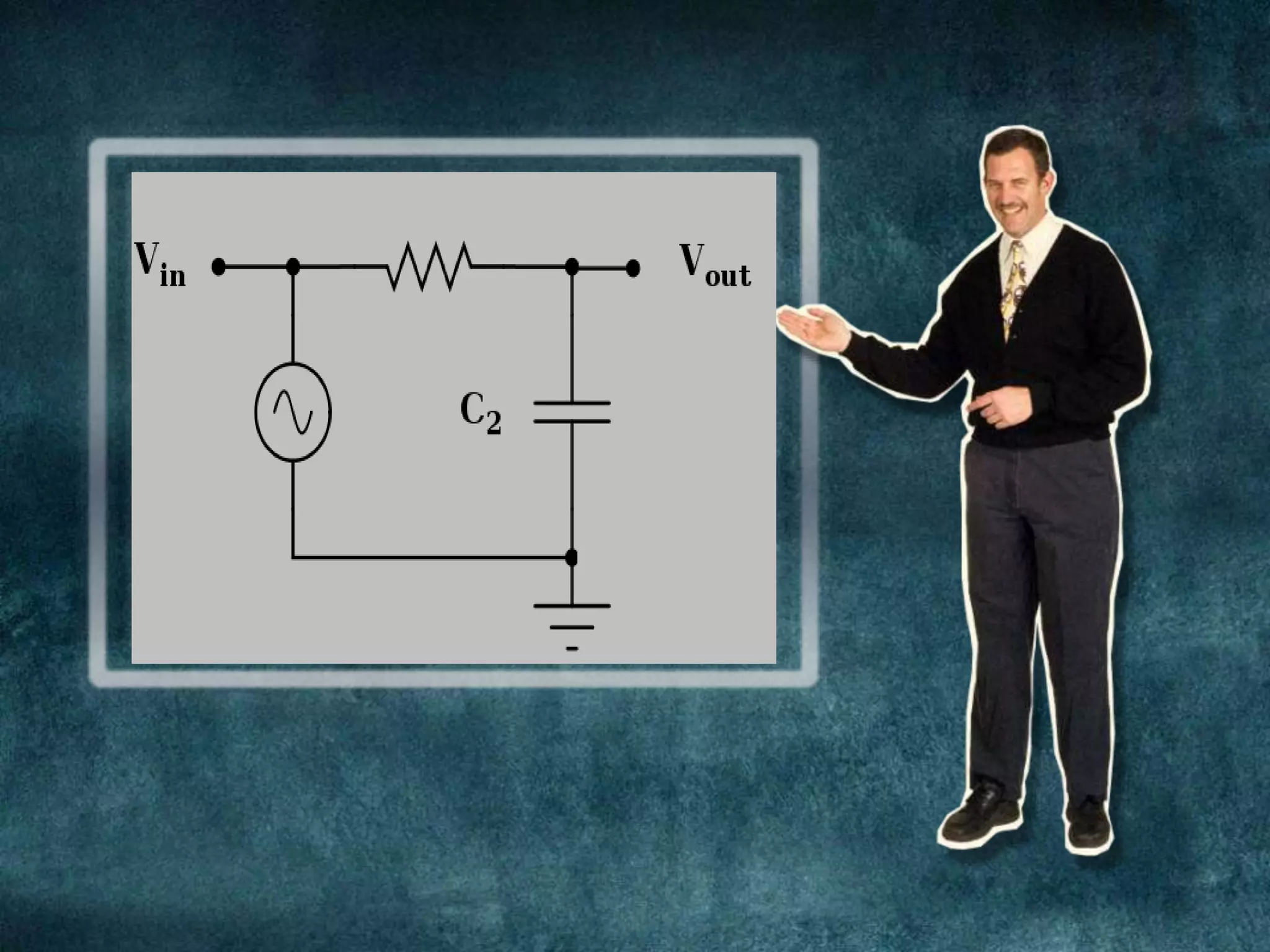
CIRCUIT
DIAGRAM
CIRCUIT
DIAGRAM
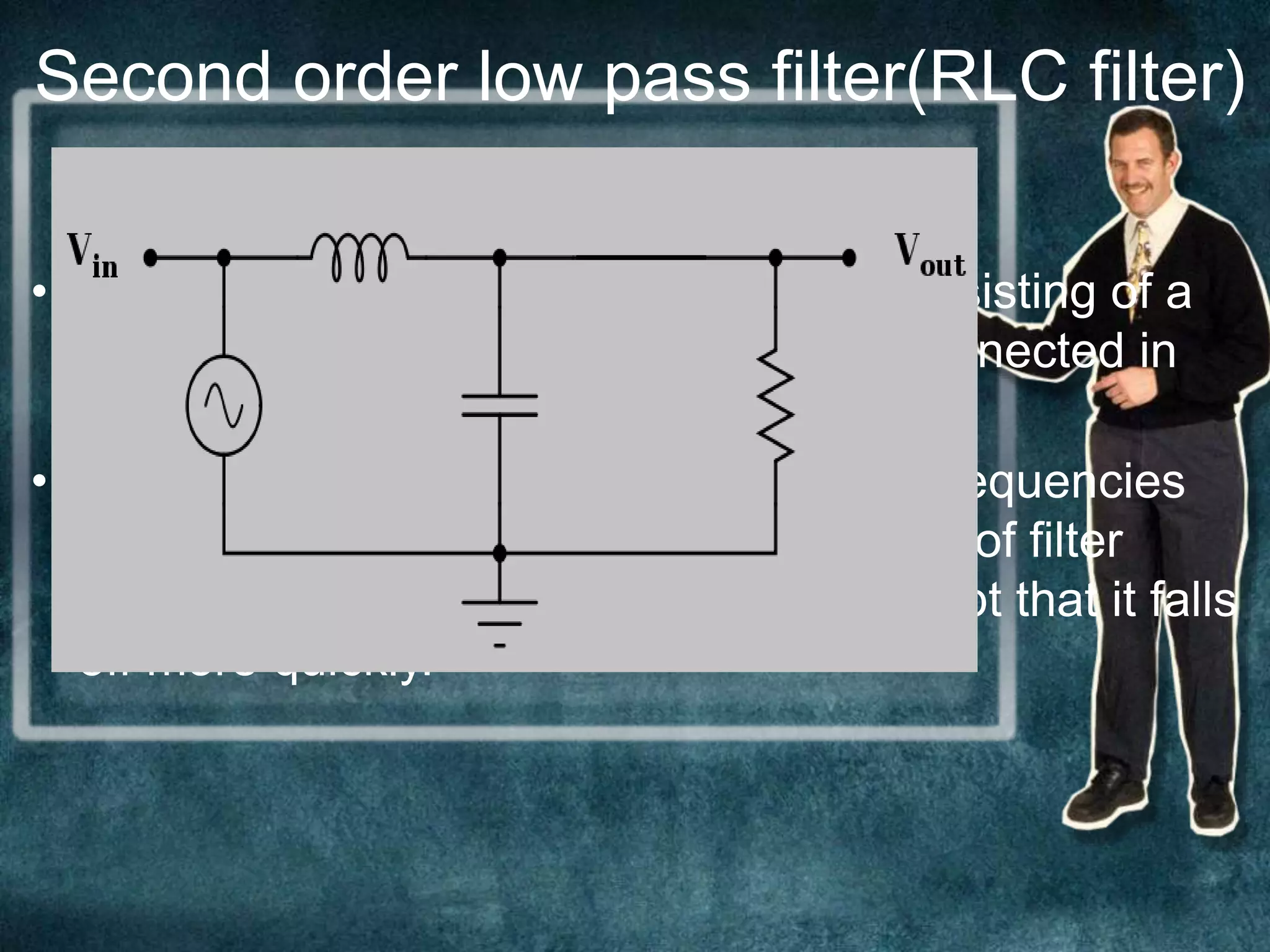
• An RLC circuit is an electrical circuit consisting of a
resistor, an inductor, and a capacitor, connected in
series or in parallel.
• A second-order filter attenuates higher frequencies
more steeply. The Bode plot for this type of filter
resembles that of a first-order filter, except that it falls
off more quickly.
Second order low pass filter(RLC filter)
CIRCUIT
DIAGRAM
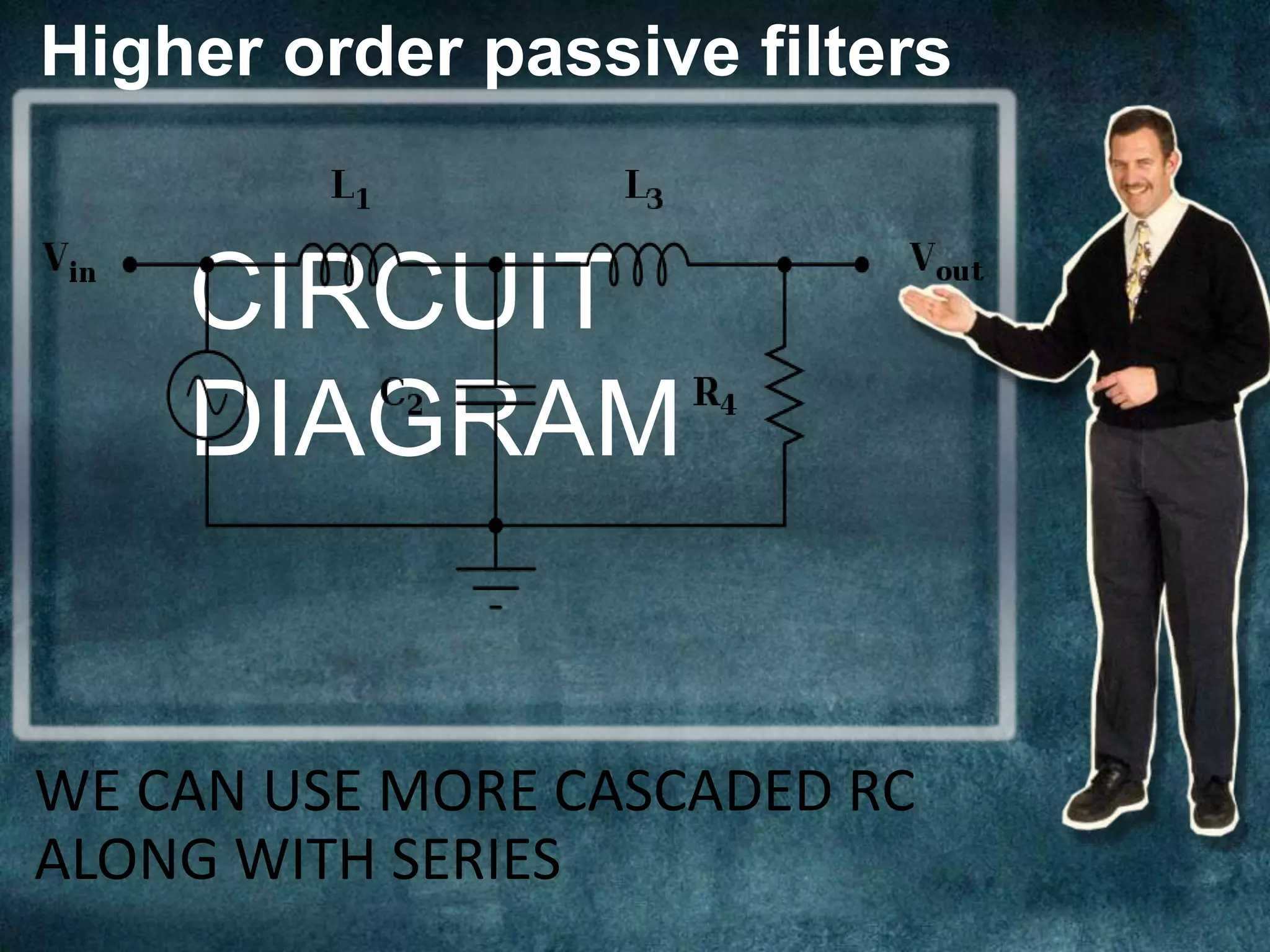
Higher order passive filters
WE CAN USE MORE CASCADED RC
ALONG WITH SERIES
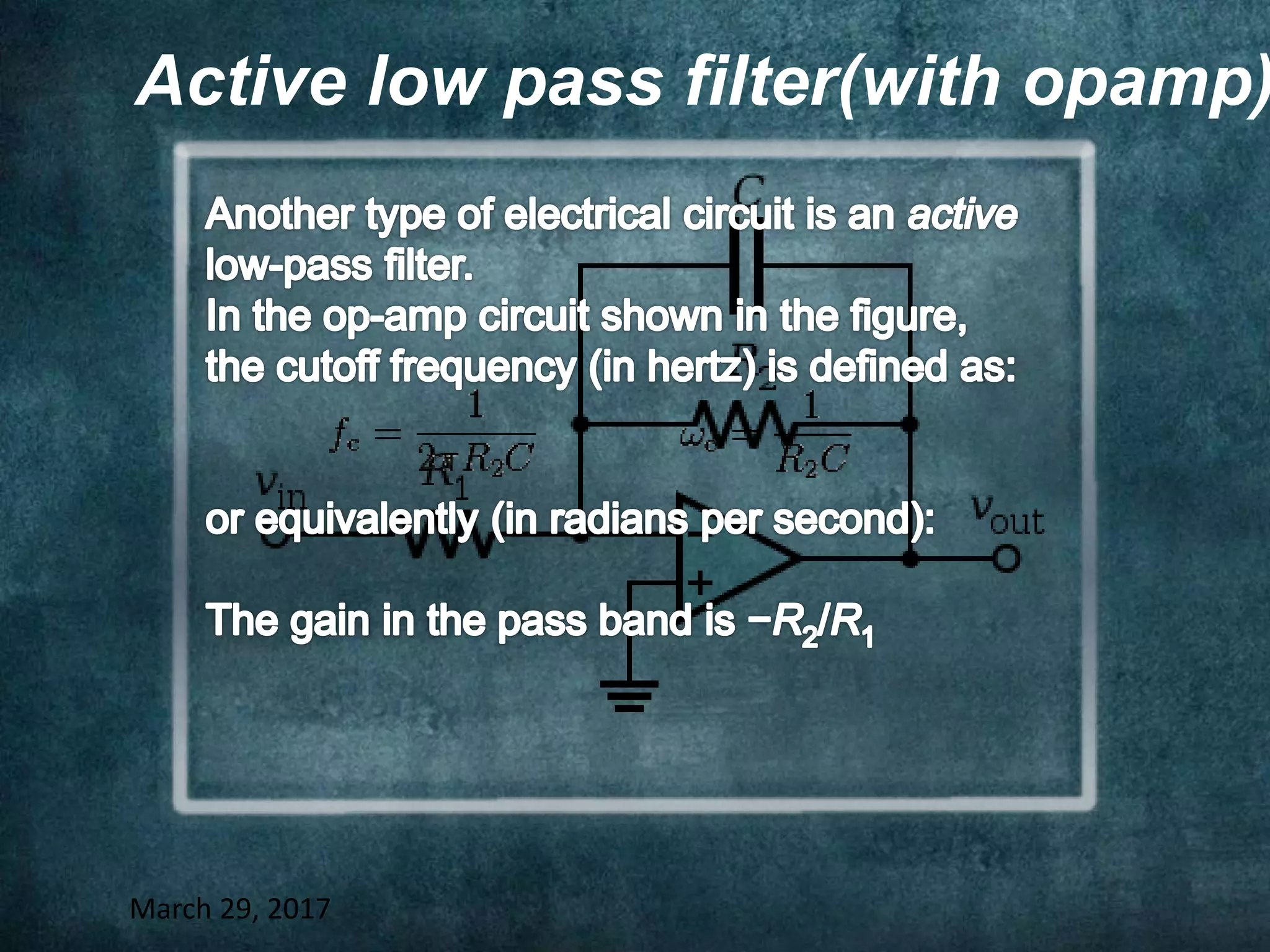
Active low pass filter(with opamp)
March 29, 2017
PASS2
CIRCUIT
DIAGRAM
High pass filters using LC components, i.e. inductors and
capacitors are arranged in ether a pi or T network. As suggested
by its name, the pi network has one series component, and
either side of it there is a component to ground. Similarly the T
network high pass filter has one component to ground and either
side there is a series in line component. In the case of a high
pass filter the series component or components are capacitors
whereas the components to ground are inductors. In this way
these filters pass the high frequency signals, and reject the low
frequency signals. These filters may be used in applications
where there are unwanted signals in a band of frequencies
below the cut-off frequency and it is necessary to pass the
wanted signals in a band above the cut-off frequency of the filter.
HIGH pass filter(RLC filter)
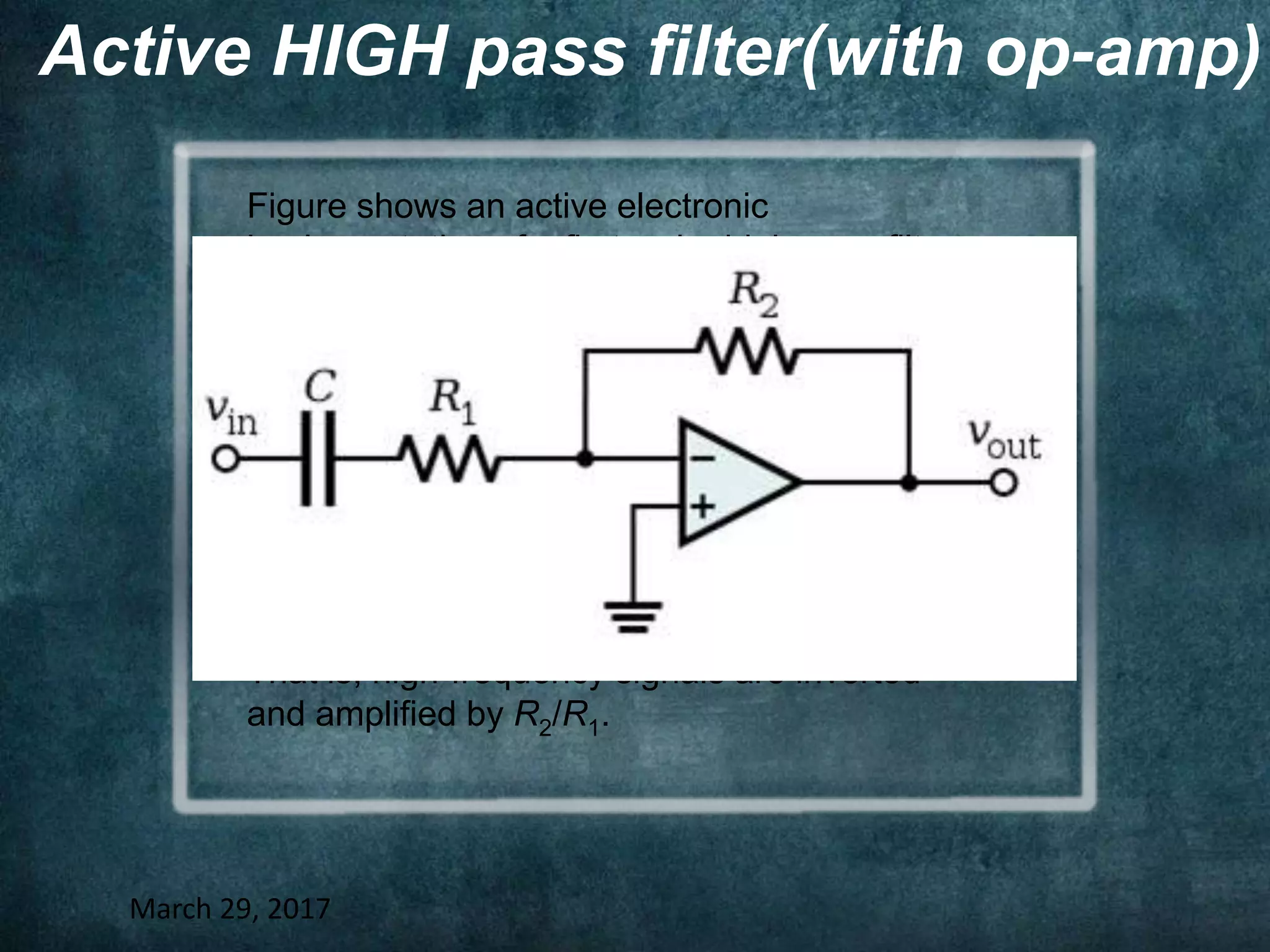
Active HIGH pass filter(with op-amp)
March 29, 2017
Figure shows an active electronic
implementation of a first-order high-pass filter
using an opamp.
In this case,the filter has a passband gain of -
R2/R1 and has a cutoff frequency of
Because this filter is active, it may have
nonunity passband gain.
That is, high-frequency signals are inverted
and amplified by R2/R1.
BANDPASS
3
Band pass filter
• A band-pass filter is a device that passes frequencies within
a certain range and rejects (attenuates) frequencies outside
that range.
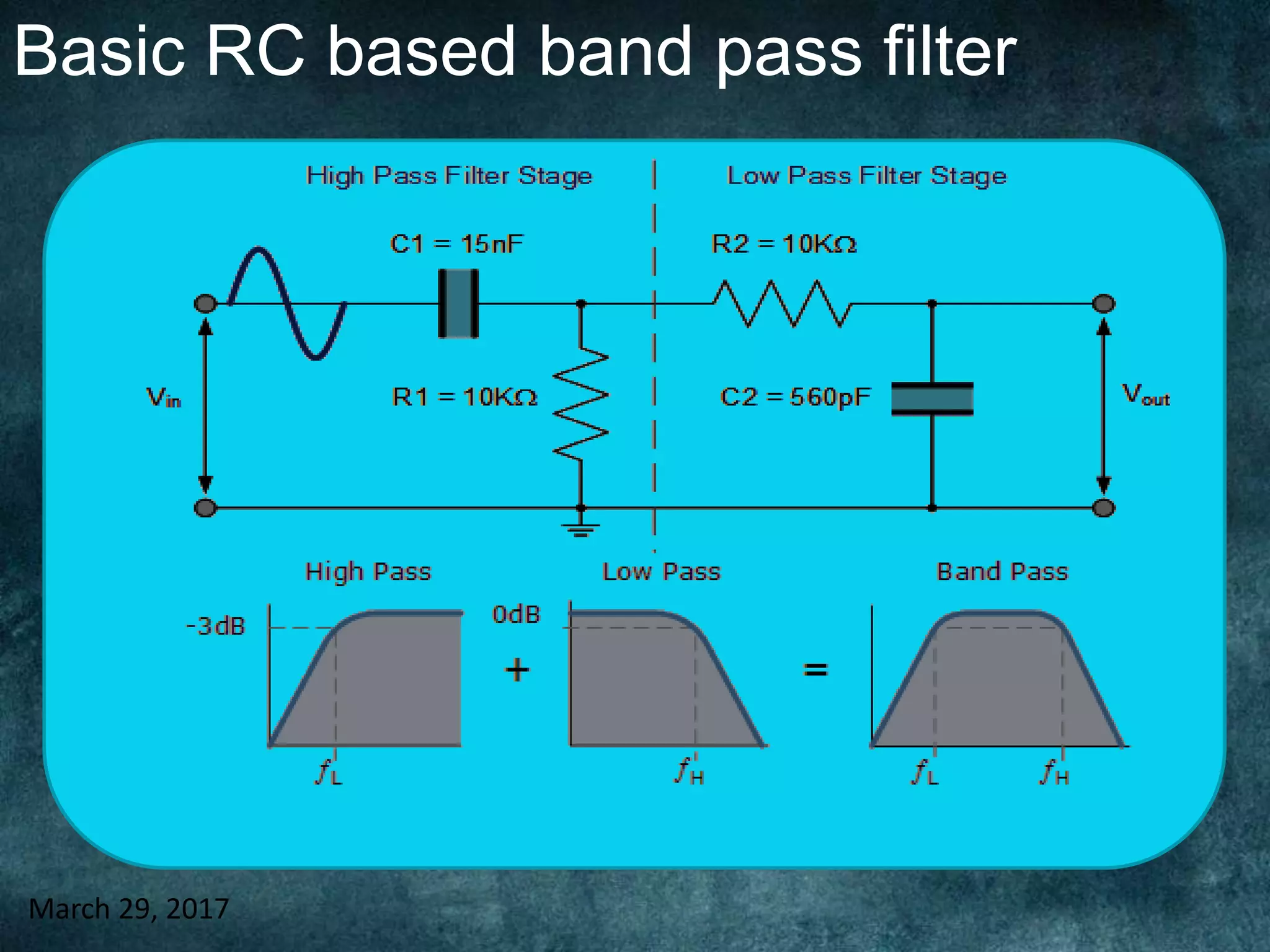
• These filters can also be created by combining a low-pass
filter with a high-pass filter.
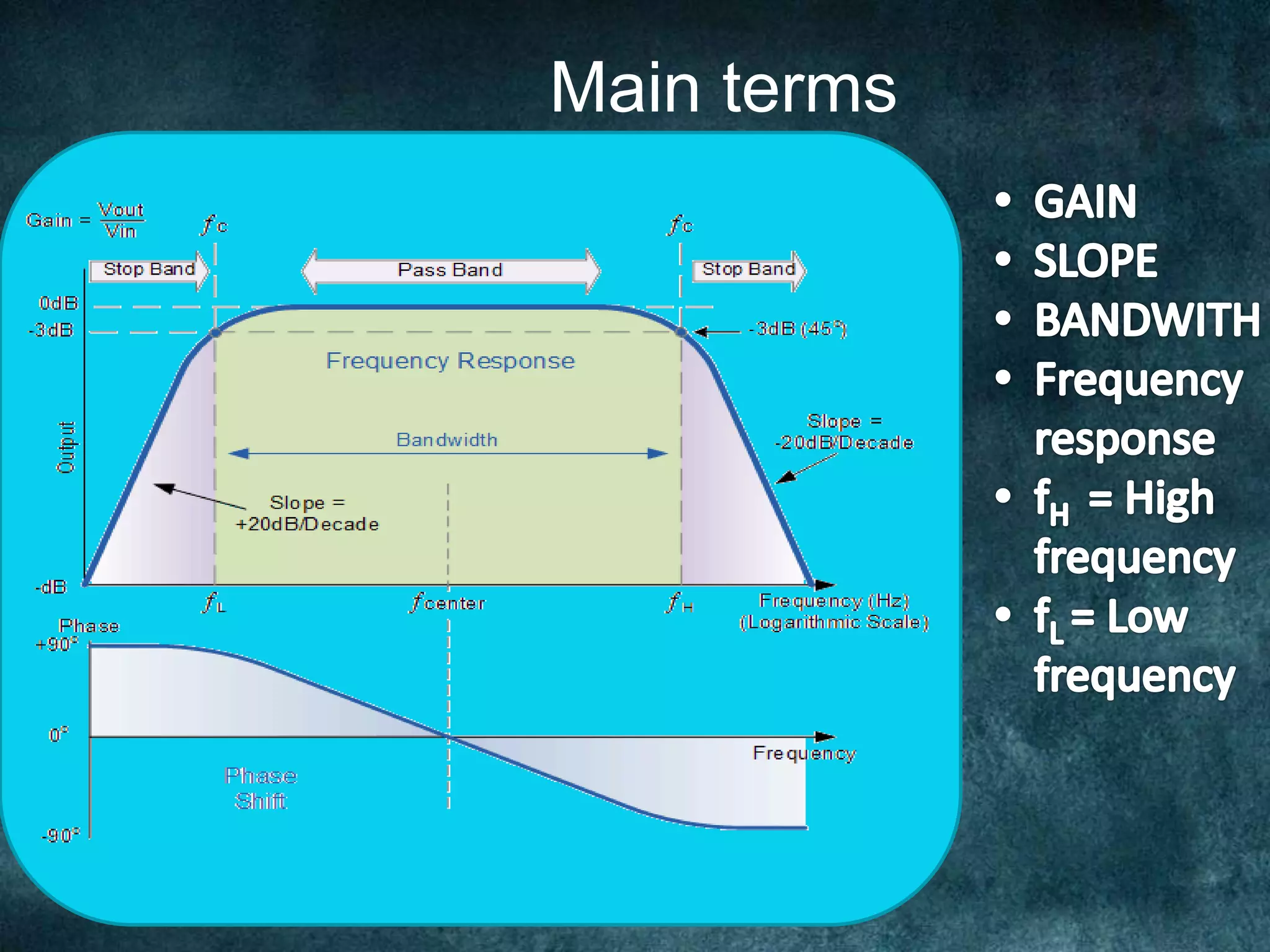
• The bandwidth of the filter is simply the difference between
the upper and lower cutoff frequencies.
• Q factor:-
• A band-pass filter can be characterised by its Q factor. The
Q-factor is the inverse of the fractional bandwidth. A high-Q
filter will have a narrow passband and a low-Q filter will
have a wide passband. These are respectively referred to
as narrow-band and wide-band filters.
March 29, 2017
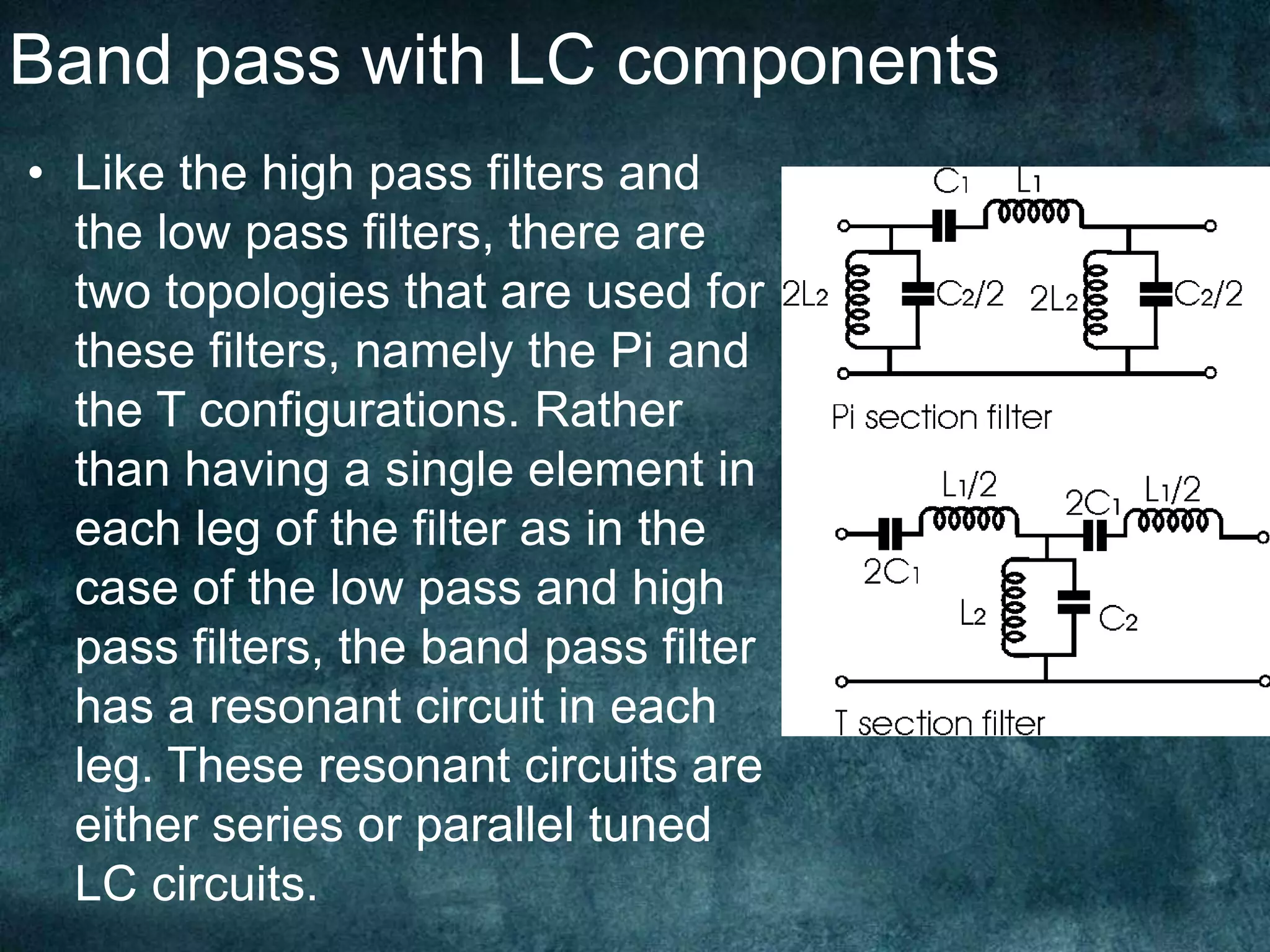
Band pass with LC components
• Like the high pass filters and
the low pass filters, there are
two topologies that are used for
these filters, namely the Pi and
the T configurations. Rather
than having a single element in
each leg of the filter as in the
case of the low pass and high
pass filters, the band pass filter
has a resonant circuit in each
leg. These resonant circuits are
either series or parallel tuned
LC circuits.
Main terms
March 29, 2017
Basic RC based band pass filter
March 29, 2017
Active Band pass filter
March 29, 2017
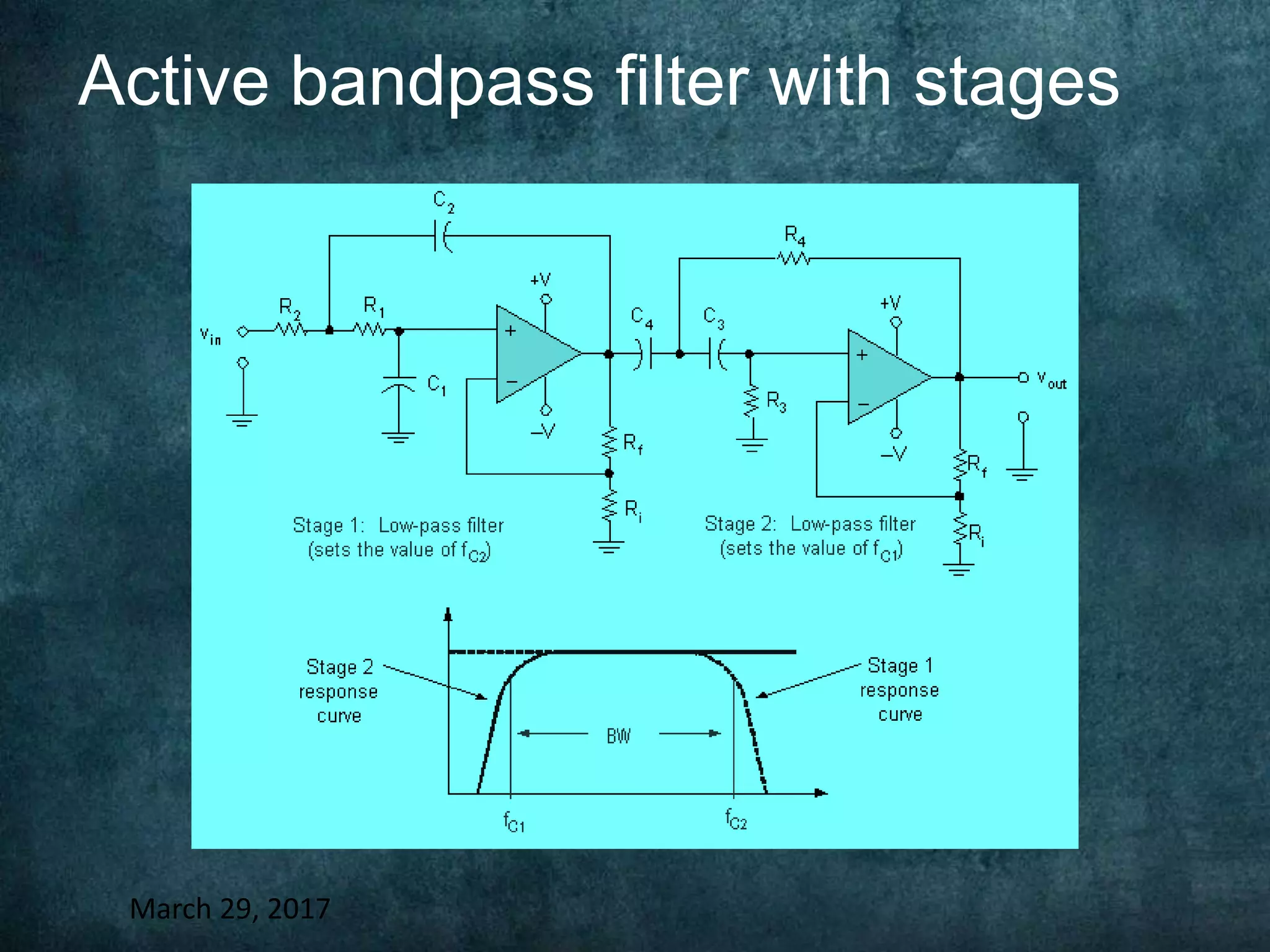
Active bandpass filter with stages
March 29, 2017
BAND STOP
OR
BAND REJECT4
Band stop or band rejection filter
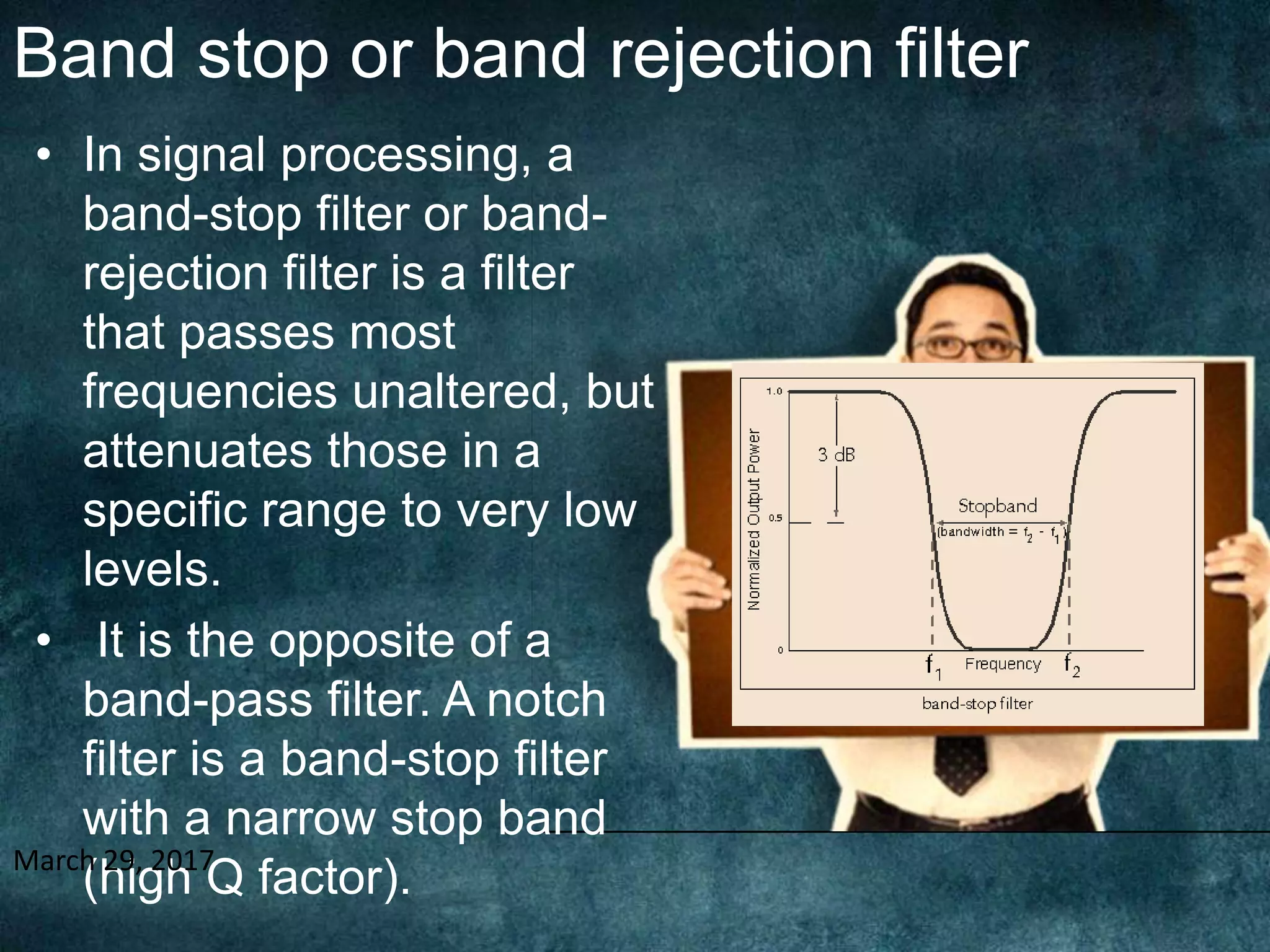
• In signal processing, a
band-stop filter or band-
rejection filter is a filter
that passes most
frequencies unaltered, but
attenuates those in a
specific range to very low
levels.
• It is the opposite of a
band-pass filter. A notch
filter is a band-stop filter
with a narrow stop band
(high Q factor).March 29, 2017
band stop filter( WITH RC )
March 29, 2017
Active band stop filter
March 29, 2017
These are classified as:
• Wide band reject filters
• Narrow band reject
filters (Notch filters).
Wide band reject filtersNarrow band reject filters (Notch filters).
filters
filters

filters

  • 1.
    LOW PASS FILTER HIGHPASS FILTER BAND PASS FILTER BAND REJECT FILTER
  • 2.
    • As namesuggest it filters come contents of input signal and give desired output signal. • In general electrical and electronics engineering sometimes it is desirable to have circuits capable of selectively filtering of one frequency or range of frequencies out of a mix of different frequencies in a circuit. • A circuit designed to perform this frequency selection is called a filter circuit, or simply a filter best example is the FM or frequency modulation that we use in our daily life
  • 3.
    • The filtercircuits can be made by two components :- • 1. PASSIVE • 2. ACTIVE
  • 4.
  • 5.
  • 6.
    • An ideallow-pass filter is a circuit which passes low-frequency signals and block high-frequency signals. • There are three basic kinds of circuits capable of accomplishing this objective, and many variations of each one:- • First-order filter • Second-order filter • Higher-order filter • Active electronic realization
  • 7.
  • 8.
    CIRCUIT DIAGRAM • An RLCcircuit is an electrical circuit consisting of a resistor, an inductor, and a capacitor, connected in series or in parallel. • A second-order filter attenuates higher frequencies more steeply. The Bode plot for this type of filter resembles that of a first-order filter, except that it falls off more quickly. Second order low pass filter(RLC filter)
  • 9.
    CIRCUIT DIAGRAM Higher order passivefilters WE CAN USE MORE CASCADED RC ALONG WITH SERIES
  • 10.
    Active low passfilter(with opamp) March 29, 2017
  • 11.
  • 12.
    CIRCUIT DIAGRAM High pass filtersusing LC components, i.e. inductors and capacitors are arranged in ether a pi or T network. As suggested by its name, the pi network has one series component, and either side of it there is a component to ground. Similarly the T network high pass filter has one component to ground and either side there is a series in line component. In the case of a high pass filter the series component or components are capacitors whereas the components to ground are inductors. In this way these filters pass the high frequency signals, and reject the low frequency signals. These filters may be used in applications where there are unwanted signals in a band of frequencies below the cut-off frequency and it is necessary to pass the wanted signals in a band above the cut-off frequency of the filter. HIGH pass filter(RLC filter)
  • 13.
    Active HIGH passfilter(with op-amp) March 29, 2017 Figure shows an active electronic implementation of a first-order high-pass filter using an opamp. In this case,the filter has a passband gain of - R2/R1 and has a cutoff frequency of Because this filter is active, it may have nonunity passband gain. That is, high-frequency signals are inverted and amplified by R2/R1.
  • 14.
  • 15.
    Band pass filter •A band-pass filter is a device that passes frequencies within a certain range and rejects (attenuates) frequencies outside that range. • These filters can also be created by combining a low-pass filter with a high-pass filter. • The bandwidth of the filter is simply the difference between the upper and lower cutoff frequencies. • Q factor:- • A band-pass filter can be characterised by its Q factor. The Q-factor is the inverse of the fractional bandwidth. A high-Q filter will have a narrow passband and a low-Q filter will have a wide passband. These are respectively referred to as narrow-band and wide-band filters. March 29, 2017
  • 16.
    Band pass withLC components • Like the high pass filters and the low pass filters, there are two topologies that are used for these filters, namely the Pi and the T configurations. Rather than having a single element in each leg of the filter as in the case of the low pass and high pass filters, the band pass filter has a resonant circuit in each leg. These resonant circuits are either series or parallel tuned LC circuits.
  • 17.
  • 18.
    Basic RC basedband pass filter March 29, 2017
  • 19.
    Active Band passfilter March 29, 2017
  • 20.
    Active bandpass filterwith stages March 29, 2017
  • 21.
  • 22.
    Band stop orband rejection filter • In signal processing, a band-stop filter or band- rejection filter is a filter that passes most frequencies unaltered, but attenuates those in a specific range to very low levels. • It is the opposite of a band-pass filter. A notch filter is a band-stop filter with a narrow stop band (high Q factor).March 29, 2017
  • 23.
    band stop filter(WITH RC ) March 29, 2017
  • 24.
    Active band stopfilter March 29, 2017 These are classified as: • Wide band reject filters • Narrow band reject filters (Notch filters). Wide band reject filtersNarrow band reject filters (Notch filters).

Editor's Notes

  • #2 To view this presentation, first, turn up your volume and second, launch the self-running slide show.
  • #3 To view this presentation, first, turn up your volume and second, launch the self-running slide show.
  • #4 Presentations are a powerful communication medium.
  • #5 …five simple rules for creating world-changing presentations.
  • #6 The first rule is: Treat your audience as king.
  • #7 …to launch products,
  • #8 Give them those things in a clear, easily understandable way…
  • #9 Give them those things in a clear, easily understandable way…
  • #10 Give them those things in a clear, easily understandable way…
  • #11 As tempting as it is to fill your slides with stuff, often de-decorating is the best policy.
  • #12 The second rule is: Spread ideas and move people.
  • #13 Give them those things in a clear, easily understandable way…
  • #14 As tempting as it is to fill your slides with stuff, often de-decorating is the best policy.
  • #15 The next rule is: Help them see what you are saying.
  • #16 …to launch products,
  • #17 …to launch products,
  • #18 …to launch products,
  • #19 For more than 20 years, Duarte has developed presentations…
  • #20 As tempting as it is to fill your slides with stuff, often de-decorating is the best policy.
  • #21 As tempting as it is to fill your slides with stuff, often de-decorating is the best policy.
  • #22 Rule number 4: Practice design, not decoration.
  • #23 Letting go is hard, we know.
  • #24 As tempting as it is to fill your slides with stuff, often de-decorating is the best policy.
  • #25 As tempting as it is to fill your slides with stuff, often de-decorating is the best policy.
  • #26 So there are the rules.
  • #27 Combining minimal text with meaningful visuals means that you’ll reach everyone.