INTERNATIONAL SCHOOL OF TECHNOLOGY &
SCIENCES (FOR WOMEN)
DEPARTMENT OF ELECTRONICS &
COMMUNICATION ENGINEERING
Prepared By:
Mr. K V VENKATARAMANA,
Assistant Professor.
K V VENKATARAMANA‖ ECA ‖ Dept of ECE ‖ ISTS
II BTECH II SEMESTER
ELECTRONIC CIRCUIT ANALYSIS
UNIT VI
Contents:
Introduction to Tuned Amplifier
Q-Factor
Small signal tuned amplifier
Capacitance single tuned amplifier
Double Tuned Amplifier
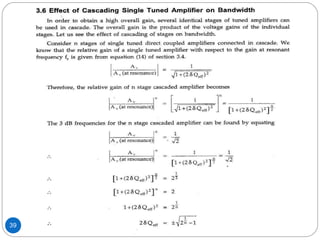
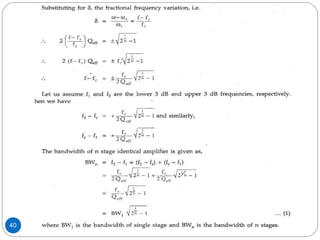
Effect of Cascading single Tuned Amplifier
Staggered tuned Amplifiers
Stability of Tuned Amplifiers
K V VENKATARAMANA‖ ECA ‖ Dept of ECE ‖ ISTS
DEFINITION:-
An amplifier circuit in which the load circuit is a
tank circuit such that it can be tuned to pass or amplify
selection of a desired frequency or a narrow band of
frequencies, is known as Tuned Circuit Amplifier.
K V VENKATARAMANA‖ ECA ‖ Dept of ECE ‖ ISTS
CHARACTERISTICSOFTUNEDAMPLIFIER
Tuned amplifier selects and amplifies a single frequency
from a mixture of frequencies in any frequency range.
A Tuned amplifier employs a tuned circuit.
It uses the phenomena of resonance, the tank circuit which
is capable of selecting a particular or relative narrow band
of frequencies.
The centre of this frequency band is the resonant frequency
of the tuned circuit .
Both types consist of an inductance L and capacitance C
with two element connected in series and parallel.
K V VENKATARAMANA‖ ECA ‖ Dept of ECE ‖ ISTS
RESONANCECIRCUITS:
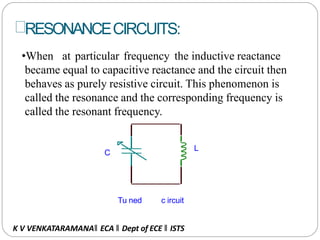
•When at particular frequency the inductive reactance
became equal to capacitive reactance and the circuit then
behaves as purely resistive circuit. This phenomenon is
called the resonance and the corresponding frequency is
called the resonant frequency.
C
L
Tu ned c ircuit
K V VENKATARAMANA‖ ECA ‖ Dept of ECE ‖ ISTS
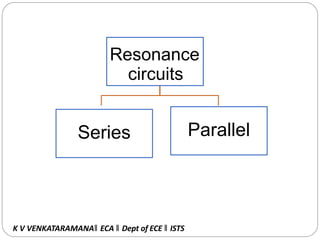
Resonance
circuits
ParallelSeries
K V VENKATARAMANA‖ ECA ‖ Dept of ECE ‖ ISTS
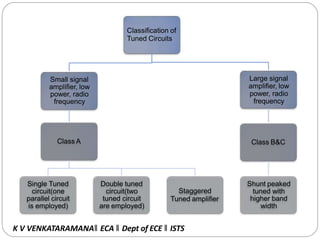
Classification of
Tuned Circuits
Small signal
amplifier, low
power, radio
frequency
Class A
Single Tuned
circuit(one
parallel circuit
is employed)
Double tuned
circuit(two
tuned circuit
are employed)
Staggered
Tuned amplifier
Large signal
amplifier, low
power, radio
frequency
Class B&C
Shunt peaked
tuned with
higher band
width
K V VENKATARAMANA‖ ECA ‖ Dept of ECE ‖ ISTS
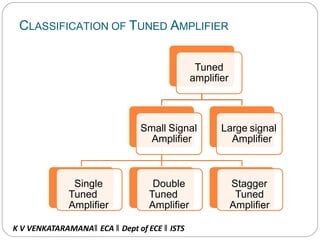
CLASSIFICATION OF TUNED AMPLIFIER
Tuned
amplifier
Small Signal
Amplifier
Single
Tuned
Amplifier
Double
Tuned
Amplifier
Stagger
Tuned
Amplifier
Large signal
Amplifier
K V VENKATARAMANA‖ ECA ‖ Dept of ECE ‖ ISTS
CLASSIFICATIONOFTUNED
AMPLIFIERS
Small Signal Tuned Amplifiers :- They are used to amplify
the RF signals of small magnitude.
They are further classified as:
(a)Single Tuned Amplifiers:- In this we use one
parallel tuned circuit in each stage.
(b)Double Tuned Amplifiers:- In this we use two
mutually coupled tuned circuits for every stage both of
tuned circuits are tuned at same freq.
(c)Stagger Tuned Amplifiers:- It is a multistage amplifier
which has one parallel tuned circuit for every stage but
tuned frequency for all stages
K V VENKATARAMANA‖ ECA ‖ Dept of ECE ‖ ISTS
(2) Large signal tuned amplifiers:-
They are meant for amplifying large signals in which
large RF power is involved & distortion level is also
higher. But tuned circuit itself eliminates most of the
harmonic distortion.
K V VENKATARAMANA‖ ECA ‖ Dept of ECE ‖ ISTS
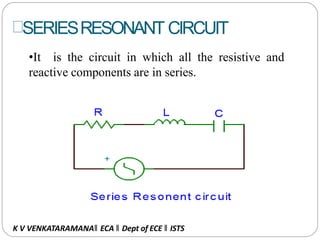
SERIESRESONANT CIRCUIT
•It is the circuit in which all the resistive and
reactive components are in series.
K V VENKATARAMANA‖ ECA ‖ Dept of ECE ‖ ISTS
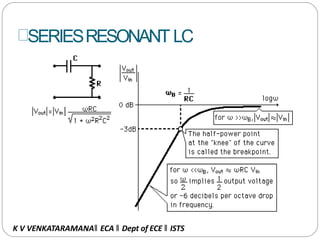
SERIESRESONANT LC
K V VENKATARAMANA‖ ECA ‖ Dept of ECE ‖ ISTS
SERIESRESONANTCIRCUIT:
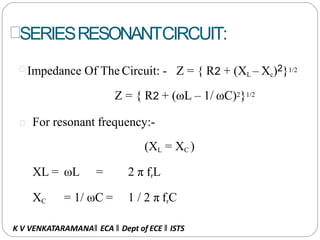
Impedance Of The Circuit: - Z = { R2 + (XL – Xc)2}1/2
Z = { R2 + (ωL – 1/ ωC)2}1/2
For resonant frequency:-
(XL = XC )
XL = ωL =
XC = 1/ ωC =
2 π frL
1 / 2 π frC
K V VENKATARAMANA‖ ECA ‖ Dept of ECE ‖ ISTS
SERIESRESONANTCIRCUIT
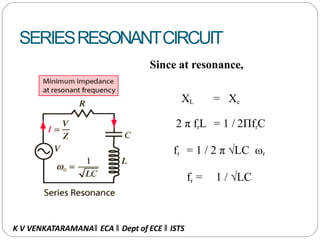
Since at resonance,
XL = Xc
2 π frL = 1 / 2ПfrC
fr = 1 / 2 π √LC ωr
fr = 1 / √LC
K V VENKATARAMANA‖ ECA ‖ Dept of ECE ‖ ISTS
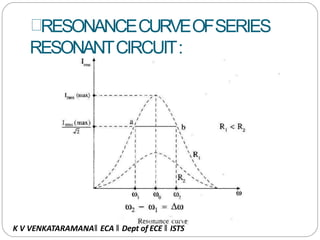
RESONANCECURVEOFSERIES
RESONANTCIRCUIT:
K V VENKATARAMANA‖ ECA ‖ Dept of ECE ‖ ISTS
QUALITYFACTOR:
• It is voltage magnification that circuit produces at
resonance is called the Q factor.
Imax XL
/ Imin R• Voltage Magnification =
= XL/ R
• At Resonance =
XL/R = XC/R
ωrL / R = 1 /
ωrRC
K V VENKATARAMANA‖ ECA ‖ Dept of ECE ‖ ISTS
THUS
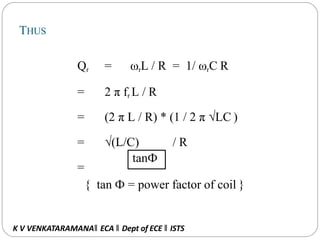
Qr = ωrL / R = 1/ ωrC R
= 2 π fr L / R
= (2 π L / R) * (1 / 2 π √LC )
= √(L/C) / R
=
{ tan Ф = power factor of coil }
tanФ
K V VENKATARAMANA‖ ECA ‖ Dept of ECE ‖ ISTS
IMPORTANTPOINTS
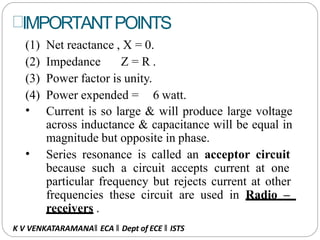
(1) Net reactance , X = 0.
(2) Impedance Z = R .
(3) Power factor is unity.
(4) Power expended = 6 watt.
•
•
Current is so large & will produce large voltage
across inductance & capacitance will be equal in
magnitude but opposite in phase.
Series resonance is called an acceptor circuit
because such a circuit accepts current at one
particular frequency but rejects current at other
frequencies these circuit are used in Radio –
receivers .
K V VENKATARAMANA‖ ECA ‖ Dept of ECE ‖ ISTS
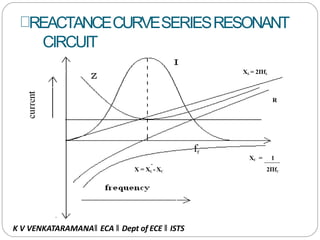
REACTANCECURVESERIESRESONANT
CIRCUIT
XL = 2ΠfL
X = XL - XC
XC = 1
2ΠfC
R
fr
K V VENKATARAMANA‖ ECA ‖ Dept of ECE ‖ ISTS
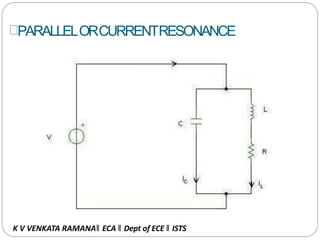
PARALLELORCURRENTRESONANCE
K V VENKATA RAMANA‖ ECA ‖ Dept of ECE ‖ ISTS
PARALLELORCURRENTRESONANCE
•When an inductive reactance and a capacitance are connected in
parallel condition may reach under which current resonance (also
known as parallel or anti- resonance ) will take palace.
•The frequency at which this happened is known as resonant
frequency. Current will be in resonance I reactive component of R -
L branch.
•IR-L sinФ R-L = Reactive component of capacitive branch,
neglecting leakage reactance of capacitor C.
K V VENKATA RAMANA‖ ECA ‖ Dept of ECE ‖ ISTS
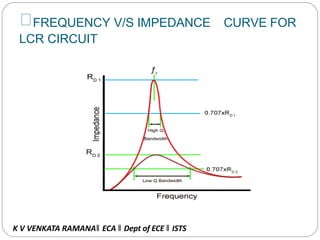
FREQUENCY V/S IMPEDANCE CURVE FOR
LCR CIRCUIT
K V VENKATA RAMANA‖ ECA ‖ Dept of ECE ‖ ISTS
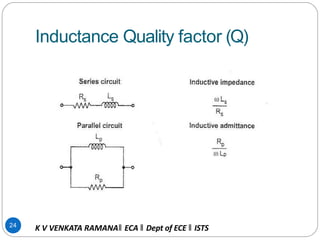
Inductance Quality factor (Q)
24
K V VENKATA RAMANA‖ ECA ‖ Dept of ECE ‖ ISTS
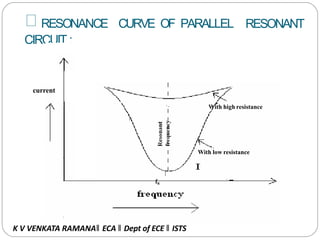
RESONANTRESONANCE CURVE OF PARALLEL
CIRCUIT :
With low resistance
With high resistance
current
fR
K V VENKATA RAMANA‖ ECA ‖ Dept of ECE ‖ ISTS
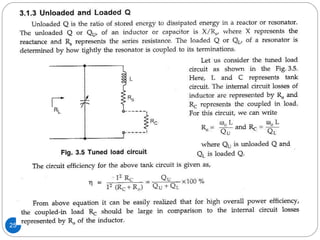
25
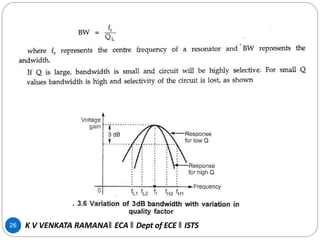
26 K V VENKATA RAMANA‖ ECA ‖ Dept of ECE ‖ ISTS
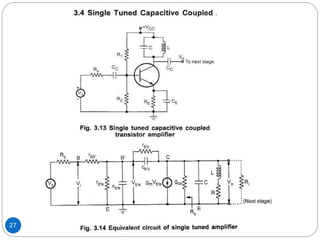
27
92
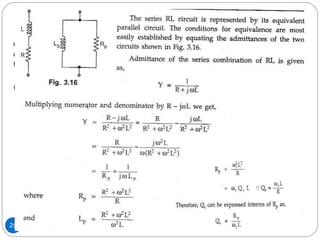
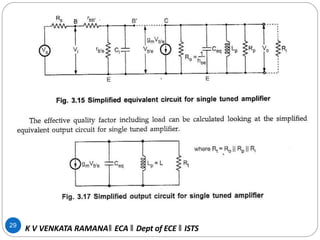
29
K V VENKATA RAMANA‖ ECA ‖ Dept of ECE ‖ ISTS
C o n d u c tan ce(R )
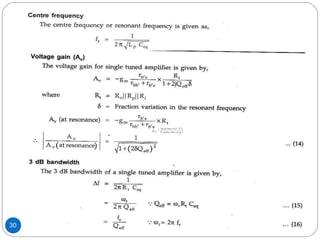
30
Q
t
eff
 Susp tan ce(L / C )
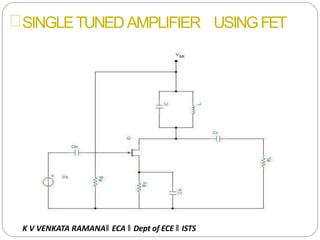
SINGLETUNEDAMPLIFIER USINGFET
K V VENKATA RAMANA‖ ECA ‖ Dept of ECE ‖ ISTS
LIMITATION:
• This tuned amplifier are required to be highly selective.
But high selectivity required a tuned circuit with a high Q-
factor .
• A high Q- factor circuit will give a high Av but at the
same time , it will give much reduced band with because
bandwidth is inversely proportional to the Q- factor .
• It means that tuned amplifier with reduce bandwidth may
not be able to amplify equally the complete band of
signals & result is poor reproduction . This is called
potential instability in tuned amplifier.
K V VENKATA RAMANA‖ ECA ‖ Dept of ECE ‖ ISTS
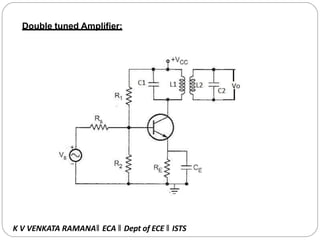
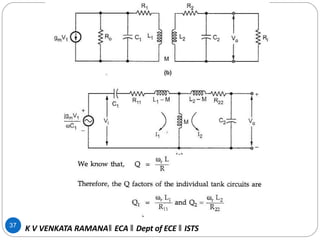
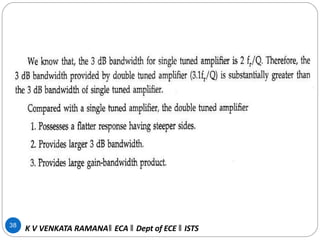
Double tuned Amplifier:
K V VENKATA RAMANA‖ ECA ‖ Dept of ECE ‖ ISTS
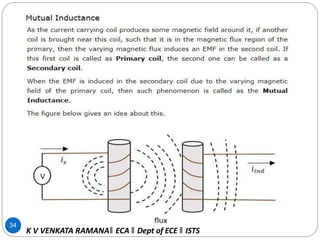
34
K V VENKATA RAMANA‖ ECA ‖ Dept of ECE ‖ ISTS
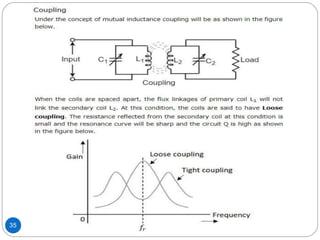
35
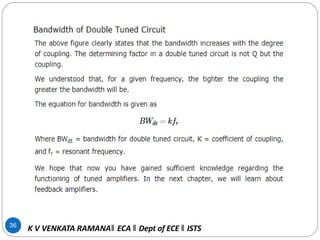
36
K V VENKATA RAMANA‖ ECA ‖ Dept of ECE ‖ ISTS
37
K V VENKATA RAMANA‖ ECA ‖ Dept of ECE ‖ ISTS
38
K V VENKATA RAMANA‖ ECA ‖ Dept of ECE ‖ ISTS
39
40
41
K V VENKATA RAMANA‖ ECA ‖ Dept of ECE ‖ ISTS
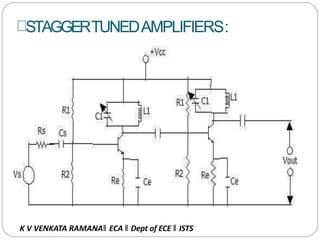
STAGGERTUNEDAMPLIFIERS:
K V VENKATA RAMANA‖ ECA ‖ Dept of ECE ‖ ISTS
43
44
K V VENKATA RAMANA‖ ECA ‖ Dept of ECE ‖ ISTS
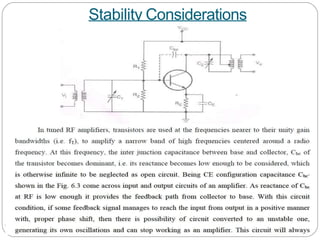
Stability Considerations
45
K V VENKATA RAMANA‖ ECA ‖ Dept of ECE ‖ ISTS
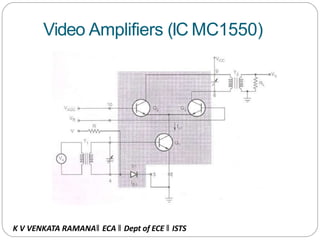
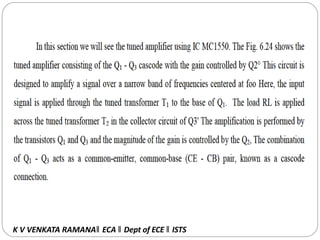
Video Amplifiers (IC MC1550)
K V VENKATA RAMANA‖ ECA ‖ Dept of ECE ‖ ISTS
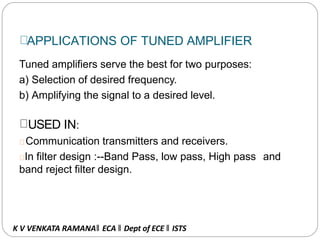
APPLICATIONS OF TUNED AMPLIFIER
Tuned amplifiers serve the best for two purposes:
a) Selection of desired frequency.
b) Amplifying the signal to a desired level.
USED IN:
Communication transmitters and receivers.
In filter design :--Band Pass, low pass, High pass and
band reject filter design.
K V VENKATA RAMANA‖ ECA ‖ Dept of ECE ‖ ISTS
ADVANTAGES
It provides high selectivity.
It has small collector voltage.
Power loss is also less.
Signal to noise ratio of O/P is good.
They are well suited for radio transmitters and
receivers .
K V VENKATA RAMANA‖ ECA ‖ Dept of ECE ‖ ISTS
DISADVANTAGES
They are not suitable to amplify audio
frequencies.
If the band of frequency is increase then design
becomes complex.
Since they use inductors and capacitors as tuning
elements, the circuit is bulky and costly.
K V VENKATA RAMANA‖ ECA ‖ Dept of ECE ‖ ISTS
Thank you
K V VENKATA RAMANA‖ ECA ‖ Dept of ECE ‖ ISTS

Tuned amplifiers

  • 1.
    INTERNATIONAL SCHOOL OFTECHNOLOGY & SCIENCES (FOR WOMEN) DEPARTMENT OF ELECTRONICS & COMMUNICATION ENGINEERING Prepared By: Mr. K V VENKATARAMANA, Assistant Professor. K V VENKATARAMANA‖ ECA ‖ Dept of ECE ‖ ISTS II BTECH II SEMESTER ELECTRONIC CIRCUIT ANALYSIS UNIT VI
  • 2.
    Contents: Introduction to TunedAmplifier Q-Factor Small signal tuned amplifier Capacitance single tuned amplifier Double Tuned Amplifier Effect of Cascading single Tuned Amplifier Staggered tuned Amplifiers Stability of Tuned Amplifiers K V VENKATARAMANA‖ ECA ‖ Dept of ECE ‖ ISTS
  • 3.
    DEFINITION:- An amplifier circuitin which the load circuit is a tank circuit such that it can be tuned to pass or amplify selection of a desired frequency or a narrow band of frequencies, is known as Tuned Circuit Amplifier. K V VENKATARAMANA‖ ECA ‖ Dept of ECE ‖ ISTS
  • 4.
    CHARACTERISTICSOFTUNEDAMPLIFIER Tuned amplifier selectsand amplifies a single frequency from a mixture of frequencies in any frequency range. A Tuned amplifier employs a tuned circuit. It uses the phenomena of resonance, the tank circuit which is capable of selecting a particular or relative narrow band of frequencies. The centre of this frequency band is the resonant frequency of the tuned circuit . Both types consist of an inductance L and capacitance C with two element connected in series and parallel. K V VENKATARAMANA‖ ECA ‖ Dept of ECE ‖ ISTS
  • 5.
    RESONANCECIRCUITS: •When at particularfrequency the inductive reactance became equal to capacitive reactance and the circuit then behaves as purely resistive circuit. This phenomenon is called the resonance and the corresponding frequency is called the resonant frequency. C L Tu ned c ircuit K V VENKATARAMANA‖ ECA ‖ Dept of ECE ‖ ISTS
  • 6.
  • 7.
    Classification of Tuned Circuits Smallsignal amplifier, low power, radio frequency Class A Single Tuned circuit(one parallel circuit is employed) Double tuned circuit(two tuned circuit are employed) Staggered Tuned amplifier Large signal amplifier, low power, radio frequency Class B&C Shunt peaked tuned with higher band width K V VENKATARAMANA‖ ECA ‖ Dept of ECE ‖ ISTS
  • 8.
    CLASSIFICATION OF TUNEDAMPLIFIER Tuned amplifier Small Signal Amplifier Single Tuned Amplifier Double Tuned Amplifier Stagger Tuned Amplifier Large signal Amplifier K V VENKATARAMANA‖ ECA ‖ Dept of ECE ‖ ISTS
  • 9.
    CLASSIFICATIONOFTUNED AMPLIFIERS Small Signal TunedAmplifiers :- They are used to amplify the RF signals of small magnitude. They are further classified as: (a)Single Tuned Amplifiers:- In this we use one parallel tuned circuit in each stage. (b)Double Tuned Amplifiers:- In this we use two mutually coupled tuned circuits for every stage both of tuned circuits are tuned at same freq. (c)Stagger Tuned Amplifiers:- It is a multistage amplifier which has one parallel tuned circuit for every stage but tuned frequency for all stages K V VENKATARAMANA‖ ECA ‖ Dept of ECE ‖ ISTS
  • 10.
    (2) Large signaltuned amplifiers:- They are meant for amplifying large signals in which large RF power is involved & distortion level is also higher. But tuned circuit itself eliminates most of the harmonic distortion. K V VENKATARAMANA‖ ECA ‖ Dept of ECE ‖ ISTS
  • 11.
    SERIESRESONANT CIRCUIT •It isthe circuit in which all the resistive and reactive components are in series. K V VENKATARAMANA‖ ECA ‖ Dept of ECE ‖ ISTS
  • 12.
    SERIESRESONANT LC K VVENKATARAMANA‖ ECA ‖ Dept of ECE ‖ ISTS
  • 13.
    SERIESRESONANTCIRCUIT: Impedance Of TheCircuit: - Z = { R2 + (XL – Xc)2}1/2 Z = { R2 + (ωL – 1/ ωC)2}1/2 For resonant frequency:- (XL = XC ) XL = ωL = XC = 1/ ωC = 2 π frL 1 / 2 π frC K V VENKATARAMANA‖ ECA ‖ Dept of ECE ‖ ISTS
  • 14.
    SERIESRESONANTCIRCUIT Since at resonance, XL= Xc 2 π frL = 1 / 2ПfrC fr = 1 / 2 π √LC ωr fr = 1 / √LC K V VENKATARAMANA‖ ECA ‖ Dept of ECE ‖ ISTS
  • 15.
  • 16.
    QUALITYFACTOR: • It isvoltage magnification that circuit produces at resonance is called the Q factor. Imax XL / Imin R• Voltage Magnification = = XL/ R • At Resonance = XL/R = XC/R ωrL / R = 1 / ωrRC K V VENKATARAMANA‖ ECA ‖ Dept of ECE ‖ ISTS
  • 17.
    THUS Qr = ωrL/ R = 1/ ωrC R = 2 π fr L / R = (2 π L / R) * (1 / 2 π √LC ) = √(L/C) / R = { tan Ф = power factor of coil } tanФ K V VENKATARAMANA‖ ECA ‖ Dept of ECE ‖ ISTS
  • 18.
    IMPORTANTPOINTS (1) Net reactance, X = 0. (2) Impedance Z = R . (3) Power factor is unity. (4) Power expended = 6 watt. • • Current is so large & will produce large voltage across inductance & capacitance will be equal in magnitude but opposite in phase. Series resonance is called an acceptor circuit because such a circuit accepts current at one particular frequency but rejects current at other frequencies these circuit are used in Radio – receivers . K V VENKATARAMANA‖ ECA ‖ Dept of ECE ‖ ISTS
  • 19.
    REACTANCECURVESERIESRESONANT CIRCUIT XL = 2ΠfL X= XL - XC XC = 1 2ΠfC R fr K V VENKATARAMANA‖ ECA ‖ Dept of ECE ‖ ISTS
  • 20.
    PARALLELORCURRENTRESONANCE K V VENKATARAMANA‖ ECA ‖ Dept of ECE ‖ ISTS
  • 21.
    PARALLELORCURRENTRESONANCE •When an inductivereactance and a capacitance are connected in parallel condition may reach under which current resonance (also known as parallel or anti- resonance ) will take palace. •The frequency at which this happened is known as resonant frequency. Current will be in resonance I reactive component of R - L branch. •IR-L sinФ R-L = Reactive component of capacitive branch, neglecting leakage reactance of capacitor C. K V VENKATA RAMANA‖ ECA ‖ Dept of ECE ‖ ISTS
  • 22.
    FREQUENCY V/S IMPEDANCECURVE FOR LCR CIRCUIT K V VENKATA RAMANA‖ ECA ‖ Dept of ECE ‖ ISTS
  • 23.
    Inductance Quality factor(Q) 24 K V VENKATA RAMANA‖ ECA ‖ Dept of ECE ‖ ISTS
  • 24.
    RESONANTRESONANCE CURVE OFPARALLEL CIRCUIT : With low resistance With high resistance current fR K V VENKATA RAMANA‖ ECA ‖ Dept of ECE ‖ ISTS
  • 25.
  • 26.
    26 K VVENKATA RAMANA‖ ECA ‖ Dept of ECE ‖ ISTS
  • 27.
  • 28.
  • 29.
    29 K V VENKATARAMANA‖ ECA ‖ Dept of ECE ‖ ISTS
  • 30.
    C o nd u c tan ce(R ) 30 Q t eff  Susp tan ce(L / C )
  • 31.
    SINGLETUNEDAMPLIFIER USINGFET K VVENKATA RAMANA‖ ECA ‖ Dept of ECE ‖ ISTS
  • 32.
    LIMITATION: • This tunedamplifier are required to be highly selective. But high selectivity required a tuned circuit with a high Q- factor . • A high Q- factor circuit will give a high Av but at the same time , it will give much reduced band with because bandwidth is inversely proportional to the Q- factor . • It means that tuned amplifier with reduce bandwidth may not be able to amplify equally the complete band of signals & result is poor reproduction . This is called potential instability in tuned amplifier. K V VENKATA RAMANA‖ ECA ‖ Dept of ECE ‖ ISTS
  • 33.
    Double tuned Amplifier: KV VENKATA RAMANA‖ ECA ‖ Dept of ECE ‖ ISTS
  • 34.
    34 K V VENKATARAMANA‖ ECA ‖ Dept of ECE ‖ ISTS
  • 35.
  • 36.
    36 K V VENKATARAMANA‖ ECA ‖ Dept of ECE ‖ ISTS
  • 37.
    37 K V VENKATARAMANA‖ ECA ‖ Dept of ECE ‖ ISTS
  • 38.
    38 K V VENKATARAMANA‖ ECA ‖ Dept of ECE ‖ ISTS
  • 39.
  • 40.
  • 41.
    41 K V VENKATARAMANA‖ ECA ‖ Dept of ECE ‖ ISTS
  • 42.
    STAGGERTUNEDAMPLIFIERS: K V VENKATARAMANA‖ ECA ‖ Dept of ECE ‖ ISTS
  • 43.
  • 44.
    44 K V VENKATARAMANA‖ ECA ‖ Dept of ECE ‖ ISTS
  • 45.
  • 49.
    K V VENKATARAMANA‖ ECA ‖ Dept of ECE ‖ ISTS
  • 50.
    K V VENKATARAMANA‖ ECA ‖ Dept of ECE ‖ ISTS
  • 51.
    K V VENKATARAMANA‖ ECA ‖ Dept of ECE ‖ ISTS
  • 52.
    K V VENKATARAMANA‖ ECA ‖ Dept of ECE ‖ ISTS
  • 53.
    K V VENKATARAMANA‖ ECA ‖ Dept of ECE ‖ ISTS
  • 54.
    Video Amplifiers (ICMC1550) K V VENKATA RAMANA‖ ECA ‖ Dept of ECE ‖ ISTS
  • 55.
    K V VENKATARAMANA‖ ECA ‖ Dept of ECE ‖ ISTS
  • 56.
    APPLICATIONS OF TUNEDAMPLIFIER Tuned amplifiers serve the best for two purposes: a) Selection of desired frequency. b) Amplifying the signal to a desired level. USED IN: Communication transmitters and receivers. In filter design :--Band Pass, low pass, High pass and band reject filter design. K V VENKATA RAMANA‖ ECA ‖ Dept of ECE ‖ ISTS
  • 57.
    ADVANTAGES It provides highselectivity. It has small collector voltage. Power loss is also less. Signal to noise ratio of O/P is good. They are well suited for radio transmitters and receivers . K V VENKATA RAMANA‖ ECA ‖ Dept of ECE ‖ ISTS
  • 58.
    DISADVANTAGES They are notsuitable to amplify audio frequencies. If the band of frequency is increase then design becomes complex. Since they use inductors and capacitors as tuning elements, the circuit is bulky and costly. K V VENKATA RAMANA‖ ECA ‖ Dept of ECE ‖ ISTS
  • 59.
    Thank you K VVENKATA RAMANA‖ ECA ‖ Dept of ECE ‖ ISTS