

By
Alaa Mohammed Khattab
10/23/2016 1
Content
 Introduction.
 Edge Detection.
 First-Order edge detection.
( Basic , Roberts , Prewitt , Sobel , Canny )
 Second-Order edge detection.
( Zero-crossing , Marr-Hildreth)
 Other edge detection operators.
( Spacek , Petrou )
 Comparison of edge detection operators.
 Describing image motion.
( Area-based , Differential approach )
 Implementation.
10/23/2016 2
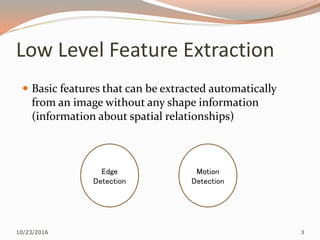
Low Level Feature Extraction
10/23/2016 3
Edge
Detection
Motion
Detection
 Basic features that can be extracted automatically
from an image without any shape information
(information about spatial relationships)
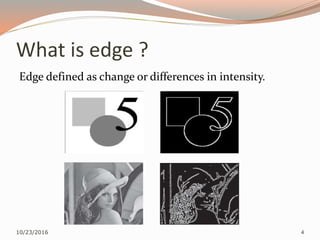
What is edge ?
Edge defined as change or differences in intensity.
10/23/2016 4
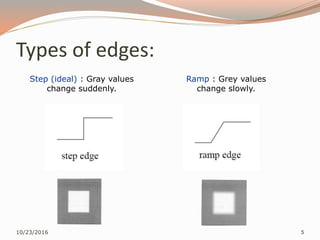
Types of edges:
10/23/2016 5
Step (ideal) : Gray values
change suddenly.
Ramp : Grey values
change slowly.
Content
 Introduction.
 Edge Detection.
 First-Order edge detection.
( Basic , Roberts , Prewitt , Sobel , Canny )
 Second-Order edge detection.
( Zero-crossing , Marr-Hildreth)
 Other edge detection operators.
( Spacek , Petrou )
 Comparison of edge detection operators.
 Describing image motion.
( Area-based , Differential approach )
 Implementation.
10/23/2016 6
Why ?
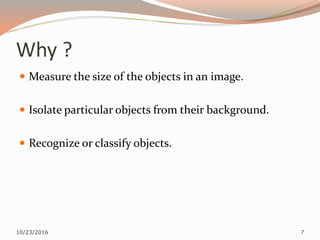
 Measure the size of the objects in an image.
 Isolate particular objects from their background.
 Recognize or classify objects.
10/23/2016 7
Edge detection
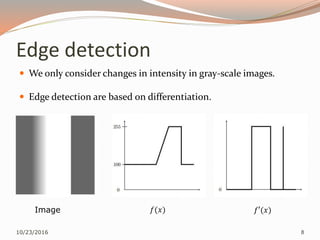
 We only consider changes in intensity in gray-scale images.
 Edge detection are based on differentiation.
10/23/2016 8
Image 𝑓(𝑥) 𝑓′(𝑥)
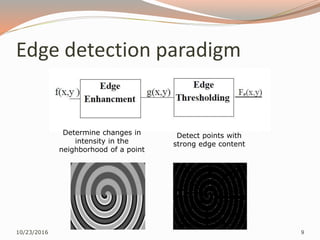
Edge detection paradigm
10/23/2016 9
Determine changes in
intensity in the
neighborhood of a point
Detect points with
strong edge content
Edge Magnitude & Direction
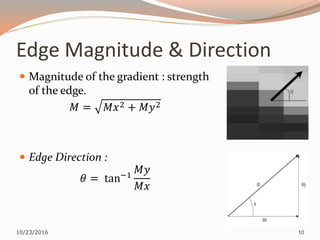
 Magnitude of the gradient : strength
of the edge.
𝑀 = 𝑀𝑥2 + 𝑀𝑦2
 Edge Direction :
𝜃 = tan−1
𝑀𝑦
𝑀𝑥
10/23/2016 10
Content
 Introduction.
 Edge Detection.
 First-Order edge detection.
( Basic , Roberts , Prewitt , Sobel , Canny )
 Second-Order edge detection.
( Zero-crossing , Marr-Hildreth)
 Other edge detection operators.
( Spacek , Petrou )
 Comparison of edge detection operators.
 Describing image motion.
( Area-based , Differential approach )
 Implementation.
10/23/2016 11
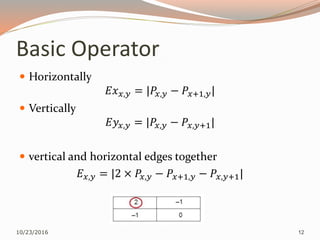
Basic Operator
 Horizontally
𝐸𝑥 𝑥,𝑦 = |𝑃𝑥,𝑦 − 𝑃𝑥+1,𝑦|
 Vertically
𝐸𝑦𝑥,𝑦 = |𝑃𝑥,𝑦 − 𝑃𝑥,𝑦+1|
 vertical and horizontal edges together
𝐸 𝑥,𝑦 = |2 × 𝑃𝑥,𝑦 − 𝑃𝑥+1,𝑦 − 𝑃𝑥,𝑦+1|
10/23/2016 12
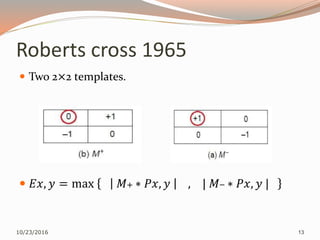
Roberts cross 1965
10/23/2016 13
 Two 2×2 templates.
 𝐸𝑥, 𝑦 = max 𝑀+ ∗ 𝑃𝑥, 𝑦 , | 𝑀– ∗ 𝑃𝑥, 𝑦 |
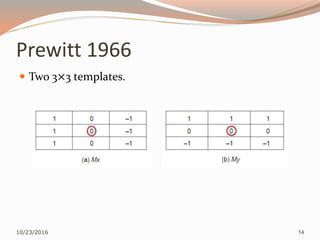
Prewitt 1966
10/23/2016 14
 Two 3×3 templates.
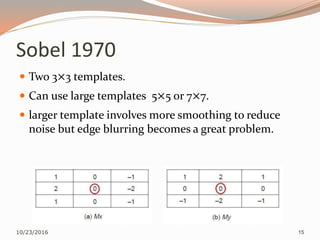
Sobel 1970
10/23/2016 15
 Two 3×3 templates.
 Can use large templates 5×5 or 7×7.
 larger template involves more smoothing to reduce
noise but edge blurring becomes a great problem.
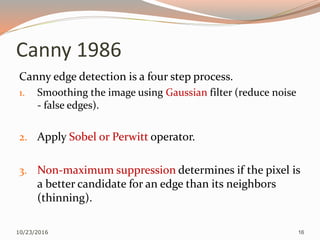
Canny 1986
Canny edge detection is a four step process.
1. Smoothing the image using Gaussian filter (reduce noise
- false edges).
2. Apply Sobel or Perwitt operator.
3. Non-maximum suppression determines if the pixel is
a better candidate for an edge than its neighbors
(thinning).
10/23/2016 16
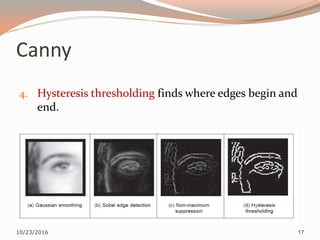
Canny
4. Hysteresis thresholding finds where edges begin and
end.
10/23/2016 17
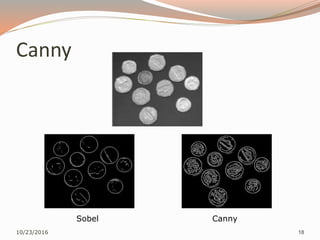
Canny
10/23/2016 18
Sobel Canny
Canny
 Good detection – the algorithm should mark as many real
edges in the image as possible.
 Works fine under noisy condition.
 Good localization – edges marked should be as close as
possible to the edge in the real image.
 Minimal response – a given edge in the image should only
be marked once, and where possible, image noise should
not create false edges.
10/23/2016 19
Content
 Introduction.
 Edge Detection.
 First-Order edge detection.
( Basic , Roberts , Prewitt , Sobel , Canny )
 Second-Order edge detection.
( Zero-crossing , Marr-Hildreth)
 Other edge detection operators.
( Spacek , Petrou )
 Comparison of edge detection operators.
 Describing image motion.
( Area-based , Differential approach )
 Implementation.
10/23/2016 20
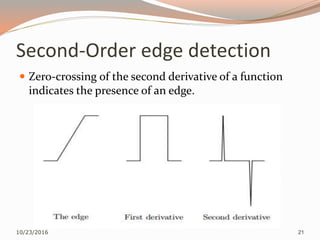
Second-Order edge detection
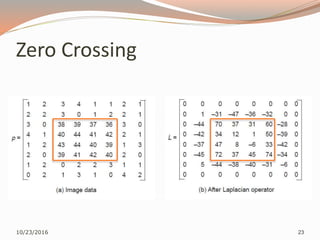
 Zero-crossing of the second derivative of a function
indicates the presence of an edge.
10/23/2016 21
Laplacian
10/23/2016 22
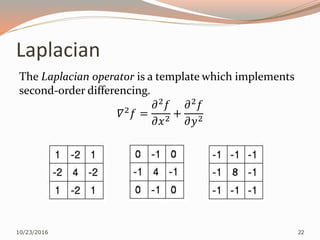
The Laplacian operator is a template which implements
second-order differencing.
𝛻2 𝑓 =
𝜕2
𝑓
𝜕𝑥2
+
𝜕2
𝑓
𝜕𝑦2
Zero Crossing
10/23/2016 23
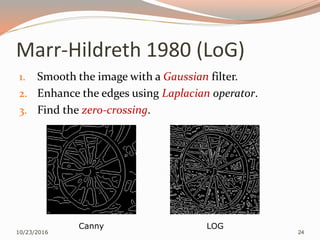
Marr-Hildreth 1980 (LoG)
1. Smooth the image with a Gaussian filter.
2. Enhance the edges using Laplacian operator.
3. Find the zero-crossing.
10/23/2016 24
Canny LOG
Content
 Introduction.
 Edge Detection.
 First-Order edge detection.
( Basic , Roberts , Prewitt , Sobel , Canny )
 Second-Order edge detection.
( Zero-crossing , Marr-Hildreth)
 Other edge detection operators.
( Spacek , Petrou )
 Comparison of edge detection operators.
 Describing image motion.
( Area-based , Differential approach )
 Implementation.
10/23/2016 25
Spacek 1986
1. Generate the coefficients of a template-smoothing
operator by:
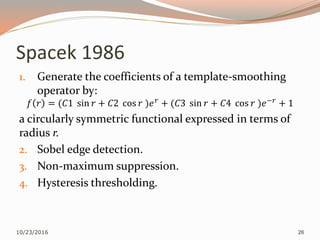
𝑓 𝑟 = (𝐶1 sin 𝑟 + 𝐶2 cos 𝑟 )𝑒 𝑟
+ (𝐶3 sin 𝑟 + 𝐶4 cos 𝑟 )𝑒−𝑟
+ 1
a circularly symmetric functional expressed in terms of
radius r.
2. Sobel edge detection.
3. Non-maximum suppression.
4. Hysteresis thresholding.
10/23/2016 26
Petrou 1991
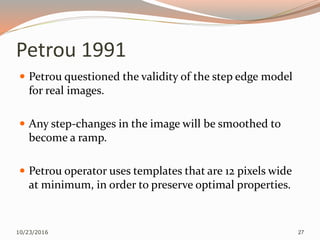
 Petrou questioned the validity of the step edge model
for real images.
 Any step-changes in the image will be smoothed to
become a ramp.
 Petrou operator uses templates that are 12 pixels wide
at minimum, in order to preserve optimal properties.
10/23/2016 27
Content
 Introduction.
 Edge Detection.
 First-Order edge detection.
( Basic , Roberts , Prewitt , Sobel , Canny )
 Second-Order edge detection.
( Zero-crossing , Marr-Hildreth)
 Other edge detection operators.
( Spacek , Petrou )
 Comparison of edge detection operators.
 Describing image motion.
( Area-based , Differential approach )
 Implementation.
10/23/2016 28
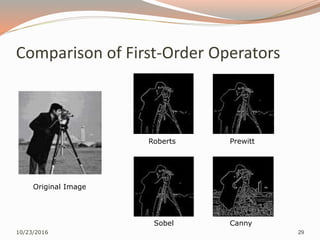
Comparison of First-Order Operators
10/23/2016 29
Original Image
Roberts Prewitt
Sobel Canny
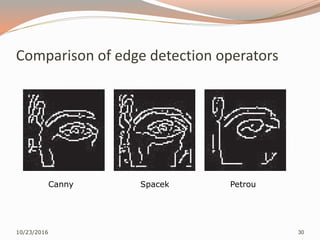
Comparison of edge detection operators
10/23/2016 30
Canny Spacek Petrou
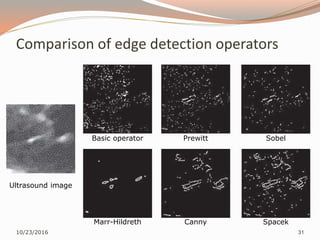
Comparison of edge detection operators
10/23/2016 31
Ultrasound image
Basic operator Prewitt Sobel
Marr-Hildreth Canny Spacek
Content
 Introduction.
 Edge Detection.
 First-Order edge detection.
( Basic , Roberts , Prewitt , Sobel , Canny )
 Second-Order edge detection.
( Zero-crossing , Marr-Hildreth)
 Other edge detection operators.
( Spacek , Petrou )
 Comparison of edge detection operators.
 Describing image motion.
( Area-based , Differential approach )
 Implementation.
10/23/2016 32
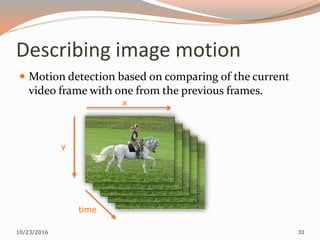
Describing image motion
 Motion detection based on comparing of the current
video frame with one from the previous frames.
10/23/2016 33
x
y
time
Describing image motion
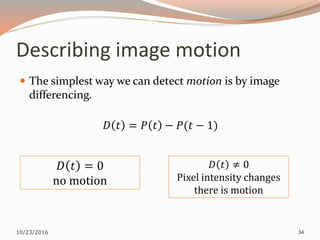
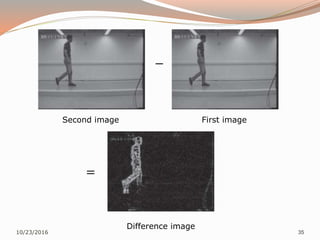
 The simplest way we can detect motion is by image
differencing.
𝐷 𝑡 = 𝑃 𝑡 − 𝑃(𝑡 − 1)
10/23/2016 34
𝐷 𝑡 = 0
no motion
𝐷 𝑡 ≠ 0
Pixel intensity changes
there is motion
10/23/2016 35
−
=
Second image First image
Difference image
Describing image motion
There are a lot of approaches to detect the motion in the
image such as:
 Area-based approach.
 Differential approach.
10/23/2016 36
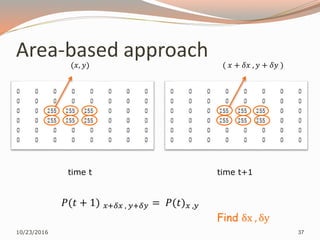
Area-based approach
10/23/2016 37
time t time t+1
(𝑥, 𝑦) ( 𝑥 + 𝛿𝑥 , 𝑦 + 𝛿𝑦 )
Find δx , δy
𝑃(𝑡 + 1) 𝑥+𝛿𝑥 , 𝑦+𝛿𝑦 = 𝑃(𝑡) 𝑥 ,𝑦
Area-based approach
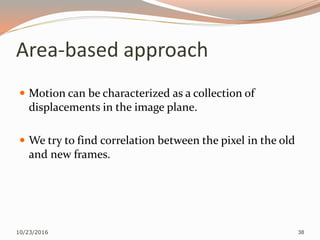
 Motion can be characterized as a collection of
displacements in the image plane.
 We try to find correlation between the pixel in the old
and new frames.
10/23/2016 38
Area-based approach
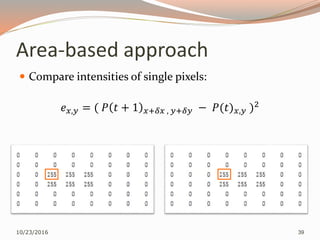
 Compare intensities of single pixels:
𝑒 𝑥,𝑦 = ( 𝑃 𝑡 + 1 𝑥+𝛿𝑥 , 𝑦+𝛿𝑦 − 𝑃(𝑡) 𝑥,𝑦 )2
10/23/2016 39
Area-based approach
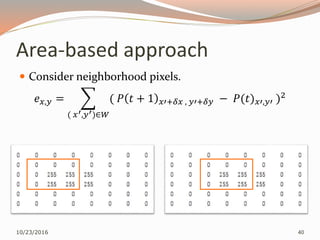
 Consider neighborhood pixels.
𝑒 𝑥,𝑦 =
( 𝑥′,𝑦′)∈𝑊
( 𝑃 𝑡 + 1 𝑥′+𝛿𝑥 , 𝑦′+𝛿𝑦 − 𝑃(𝑡) 𝑥′,𝑦′ )2
10/23/2016 40
Area-based approach
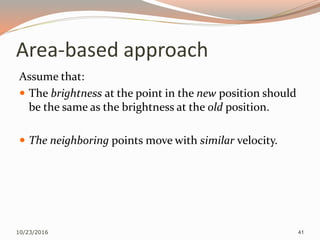
Assume that:
 The brightness at the point in the new position should
be the same as the brightness at the old position.
 The neighboring points move with similar velocity.
10/23/2016 41
Describing image motion
There are a lot of approaches to detect the motion in the
image such as:
 Area-based approach.
 Differential approach.
10/23/2016 42
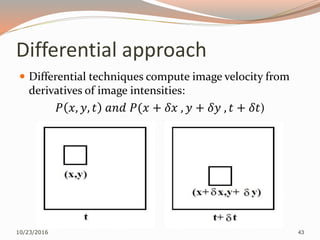
Differential approach
 Differential techniques compute image velocity from
derivatives of image intensities:
𝑃 𝑥, 𝑦, 𝑡 𝑎𝑛𝑑 𝑃(𝑥 + 𝛿𝑥 , 𝑦 + 𝛿𝑦 , 𝑡 + 𝛿𝑡)
10/23/2016 43
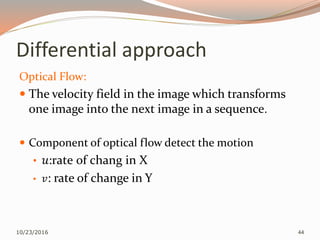
Differential approach
Optical Flow:
 The velocity field in the image which transforms
one image into the next image in a sequence.
 Component of optical flow detect the motion
• 𝑢:rate of chang in X
• 𝑣: rate of change in Y
10/23/2016 44
Differential approach
 Calculate the 𝑢, v for each pixel.
 Discontinuities in the optical flow can help in
segmenting images into regions that correspond to
different objects.
10/23/2016 45
Differential approach
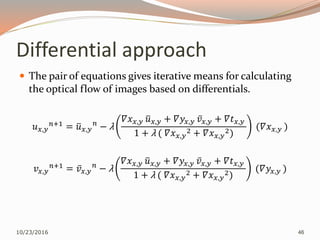
 The pair of equations gives iterative means for calculating
the optical flow of images based on differentials.
𝑢 𝑥,𝑦
𝑛+1 = 𝑢 𝑥,𝑦
𝑛
− λ
𝛻𝑥 𝑥,𝑦 𝑢 𝑥,𝑦 + 𝛻𝑦𝑥,𝑦 𝑣 𝑥,𝑦 + 𝛻𝑡 𝑥,𝑦
1 + λ ( 𝛻𝑥 𝑥,𝑦
2 + 𝛻𝑥 𝑥,𝑦
2)
(𝛻𝑥 𝑥,𝑦 )
𝑣 𝑥,𝑦
𝑛+1
= 𝑣 𝑥,𝑦
𝑛
− λ
𝛻𝑥 𝑥,𝑦 𝑢 𝑥,𝑦 + 𝛻𝑦𝑥,𝑦 𝑣 𝑥,𝑦 + 𝛻𝑡 𝑥,𝑦
1 + λ ( 𝛻𝑥 𝑥,𝑦
2 + 𝛻𝑥 𝑥,𝑦
2)
(𝛻𝑦𝑥,𝑦 )
10/23/2016 46
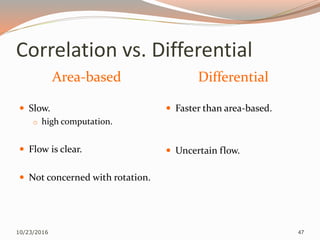
Correlation vs. Differential
Area-based Differential
 Slow.
o high computation.
 Flow is clear.
 Not concerned with rotation.
 Faster than area-based.
 Uncertain flow.
10/23/2016 47
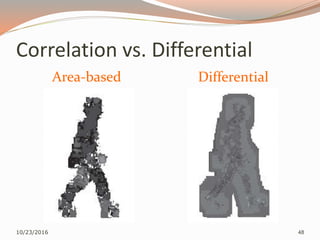
Correlation vs. Differential
Area-based Differential
10/23/2016 48
Content
 Introduction.
 Edge Detection.
 First-Order edge detection.
( Basic , Roberts , Prewitt , Sobel , Canny )
 Second-Order edge detection.
( Zero-crossing , Marr-Hildreth)
 Other edge detection operators.
( Spacek , Petrou )
 Comparison of edge detection operators.
 Describing image motion.
( Area-based , Differential approach )
 Implementation.
10/23/2016 49
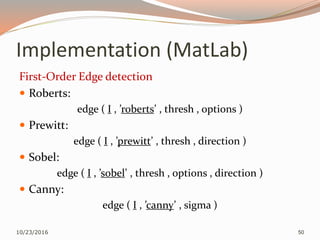
Implementation (MatLab)
First-Order Edge detection
 Roberts:
edge ( I , ’roberts’ , thresh , options )
 Prewitt:
edge ( I , ’prewitt’ , thresh , direction )
 Sobel:
edge ( I , ’sobel’ , thresh , options , direction )
 Canny:
edge ( I , ’canny’ , sigma )
10/23/2016 50
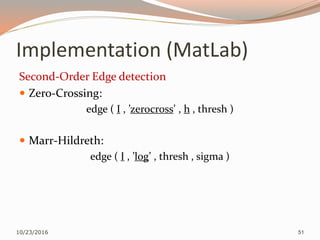
Implementation (MatLab)
Second-Order Edge detection
 Zero-Crossing:
edge ( I , ’zerocross’ , h , thresh )
 Marr-Hildreth:
edge ( I , ’log’ , thresh , sigma )
10/23/2016 51
10/23/2016 52

Low level feature extraction - chapter 4

  • 1.
  • 2.
    Content  Introduction.  EdgeDetection.  First-Order edge detection. ( Basic , Roberts , Prewitt , Sobel , Canny )  Second-Order edge detection. ( Zero-crossing , Marr-Hildreth)  Other edge detection operators. ( Spacek , Petrou )  Comparison of edge detection operators.  Describing image motion. ( Area-based , Differential approach )  Implementation. 10/23/2016 2
  • 3.
    Low Level FeatureExtraction 10/23/2016 3 Edge Detection Motion Detection  Basic features that can be extracted automatically from an image without any shape information (information about spatial relationships)
  • 4.
    What is edge? Edge defined as change or differences in intensity. 10/23/2016 4
  • 5.
    Types of edges: 10/23/20165 Step (ideal) : Gray values change suddenly. Ramp : Grey values change slowly.
  • 6.
    Content  Introduction.  EdgeDetection.  First-Order edge detection. ( Basic , Roberts , Prewitt , Sobel , Canny )  Second-Order edge detection. ( Zero-crossing , Marr-Hildreth)  Other edge detection operators. ( Spacek , Petrou )  Comparison of edge detection operators.  Describing image motion. ( Area-based , Differential approach )  Implementation. 10/23/2016 6
  • 7.
    Why ?  Measurethe size of the objects in an image.  Isolate particular objects from their background.  Recognize or classify objects. 10/23/2016 7
  • 8.
    Edge detection  Weonly consider changes in intensity in gray-scale images.  Edge detection are based on differentiation. 10/23/2016 8 Image 𝑓(𝑥) 𝑓′(𝑥)
  • 9.
    Edge detection paradigm 10/23/20169 Determine changes in intensity in the neighborhood of a point Detect points with strong edge content
  • 10.
    Edge Magnitude &Direction  Magnitude of the gradient : strength of the edge. 𝑀 = 𝑀𝑥2 + 𝑀𝑦2  Edge Direction : 𝜃 = tan−1 𝑀𝑦 𝑀𝑥 10/23/2016 10
  • 11.
    Content  Introduction.  EdgeDetection.  First-Order edge detection. ( Basic , Roberts , Prewitt , Sobel , Canny )  Second-Order edge detection. ( Zero-crossing , Marr-Hildreth)  Other edge detection operators. ( Spacek , Petrou )  Comparison of edge detection operators.  Describing image motion. ( Area-based , Differential approach )  Implementation. 10/23/2016 11
  • 12.
    Basic Operator  Horizontally 𝐸𝑥𝑥,𝑦 = |𝑃𝑥,𝑦 − 𝑃𝑥+1,𝑦|  Vertically 𝐸𝑦𝑥,𝑦 = |𝑃𝑥,𝑦 − 𝑃𝑥,𝑦+1|  vertical and horizontal edges together 𝐸 𝑥,𝑦 = |2 × 𝑃𝑥,𝑦 − 𝑃𝑥+1,𝑦 − 𝑃𝑥,𝑦+1| 10/23/2016 12
  • 13.
    Roberts cross 1965 10/23/201613  Two 2×2 templates.  𝐸𝑥, 𝑦 = max 𝑀+ ∗ 𝑃𝑥, 𝑦 , | 𝑀– ∗ 𝑃𝑥, 𝑦 |
  • 14.
    Prewitt 1966 10/23/2016 14 Two 3×3 templates.
  • 15.
    Sobel 1970 10/23/2016 15 Two 3×3 templates.  Can use large templates 5×5 or 7×7.  larger template involves more smoothing to reduce noise but edge blurring becomes a great problem.
  • 16.
    Canny 1986 Canny edgedetection is a four step process. 1. Smoothing the image using Gaussian filter (reduce noise - false edges). 2. Apply Sobel or Perwitt operator. 3. Non-maximum suppression determines if the pixel is a better candidate for an edge than its neighbors (thinning). 10/23/2016 16
  • 17.
    Canny 4. Hysteresis thresholdingfinds where edges begin and end. 10/23/2016 17
  • 18.
  • 19.
    Canny  Good detection– the algorithm should mark as many real edges in the image as possible.  Works fine under noisy condition.  Good localization – edges marked should be as close as possible to the edge in the real image.  Minimal response – a given edge in the image should only be marked once, and where possible, image noise should not create false edges. 10/23/2016 19
  • 20.
    Content  Introduction.  EdgeDetection.  First-Order edge detection. ( Basic , Roberts , Prewitt , Sobel , Canny )  Second-Order edge detection. ( Zero-crossing , Marr-Hildreth)  Other edge detection operators. ( Spacek , Petrou )  Comparison of edge detection operators.  Describing image motion. ( Area-based , Differential approach )  Implementation. 10/23/2016 20
  • 21.
    Second-Order edge detection Zero-crossing of the second derivative of a function indicates the presence of an edge. 10/23/2016 21
  • 22.
    Laplacian 10/23/2016 22 The Laplacianoperator is a template which implements second-order differencing. 𝛻2 𝑓 = 𝜕2 𝑓 𝜕𝑥2 + 𝜕2 𝑓 𝜕𝑦2
  • 23.
  • 24.
    Marr-Hildreth 1980 (LoG) 1.Smooth the image with a Gaussian filter. 2. Enhance the edges using Laplacian operator. 3. Find the zero-crossing. 10/23/2016 24 Canny LOG
  • 25.
    Content  Introduction.  EdgeDetection.  First-Order edge detection. ( Basic , Roberts , Prewitt , Sobel , Canny )  Second-Order edge detection. ( Zero-crossing , Marr-Hildreth)  Other edge detection operators. ( Spacek , Petrou )  Comparison of edge detection operators.  Describing image motion. ( Area-based , Differential approach )  Implementation. 10/23/2016 25
  • 26.
    Spacek 1986 1. Generatethe coefficients of a template-smoothing operator by: 𝑓 𝑟 = (𝐶1 sin 𝑟 + 𝐶2 cos 𝑟 )𝑒 𝑟 + (𝐶3 sin 𝑟 + 𝐶4 cos 𝑟 )𝑒−𝑟 + 1 a circularly symmetric functional expressed in terms of radius r. 2. Sobel edge detection. 3. Non-maximum suppression. 4. Hysteresis thresholding. 10/23/2016 26
  • 27.
    Petrou 1991  Petrouquestioned the validity of the step edge model for real images.  Any step-changes in the image will be smoothed to become a ramp.  Petrou operator uses templates that are 12 pixels wide at minimum, in order to preserve optimal properties. 10/23/2016 27
  • 28.
    Content  Introduction.  EdgeDetection.  First-Order edge detection. ( Basic , Roberts , Prewitt , Sobel , Canny )  Second-Order edge detection. ( Zero-crossing , Marr-Hildreth)  Other edge detection operators. ( Spacek , Petrou )  Comparison of edge detection operators.  Describing image motion. ( Area-based , Differential approach )  Implementation. 10/23/2016 28
  • 29.
    Comparison of First-OrderOperators 10/23/2016 29 Original Image Roberts Prewitt Sobel Canny
  • 30.
    Comparison of edgedetection operators 10/23/2016 30 Canny Spacek Petrou
  • 31.
    Comparison of edgedetection operators 10/23/2016 31 Ultrasound image Basic operator Prewitt Sobel Marr-Hildreth Canny Spacek
  • 32.
    Content  Introduction.  EdgeDetection.  First-Order edge detection. ( Basic , Roberts , Prewitt , Sobel , Canny )  Second-Order edge detection. ( Zero-crossing , Marr-Hildreth)  Other edge detection operators. ( Spacek , Petrou )  Comparison of edge detection operators.  Describing image motion. ( Area-based , Differential approach )  Implementation. 10/23/2016 32
  • 33.
    Describing image motion Motion detection based on comparing of the current video frame with one from the previous frames. 10/23/2016 33 x y time
  • 34.
    Describing image motion The simplest way we can detect motion is by image differencing. 𝐷 𝑡 = 𝑃 𝑡 − 𝑃(𝑡 − 1) 10/23/2016 34 𝐷 𝑡 = 0 no motion 𝐷 𝑡 ≠ 0 Pixel intensity changes there is motion
  • 35.
    10/23/2016 35 − = Second imageFirst image Difference image
  • 36.
    Describing image motion Thereare a lot of approaches to detect the motion in the image such as:  Area-based approach.  Differential approach. 10/23/2016 36
  • 37.
    Area-based approach 10/23/2016 37 timet time t+1 (𝑥, 𝑦) ( 𝑥 + 𝛿𝑥 , 𝑦 + 𝛿𝑦 ) Find δx , δy 𝑃(𝑡 + 1) 𝑥+𝛿𝑥 , 𝑦+𝛿𝑦 = 𝑃(𝑡) 𝑥 ,𝑦
  • 38.
    Area-based approach  Motioncan be characterized as a collection of displacements in the image plane.  We try to find correlation between the pixel in the old and new frames. 10/23/2016 38
  • 39.
    Area-based approach  Compareintensities of single pixels: 𝑒 𝑥,𝑦 = ( 𝑃 𝑡 + 1 𝑥+𝛿𝑥 , 𝑦+𝛿𝑦 − 𝑃(𝑡) 𝑥,𝑦 )2 10/23/2016 39
  • 40.
    Area-based approach  Considerneighborhood pixels. 𝑒 𝑥,𝑦 = ( 𝑥′,𝑦′)∈𝑊 ( 𝑃 𝑡 + 1 𝑥′+𝛿𝑥 , 𝑦′+𝛿𝑦 − 𝑃(𝑡) 𝑥′,𝑦′ )2 10/23/2016 40
  • 41.
    Area-based approach Assume that: The brightness at the point in the new position should be the same as the brightness at the old position.  The neighboring points move with similar velocity. 10/23/2016 41
  • 42.
    Describing image motion Thereare a lot of approaches to detect the motion in the image such as:  Area-based approach.  Differential approach. 10/23/2016 42
  • 43.
    Differential approach  Differentialtechniques compute image velocity from derivatives of image intensities: 𝑃 𝑥, 𝑦, 𝑡 𝑎𝑛𝑑 𝑃(𝑥 + 𝛿𝑥 , 𝑦 + 𝛿𝑦 , 𝑡 + 𝛿𝑡) 10/23/2016 43
  • 44.
    Differential approach Optical Flow: The velocity field in the image which transforms one image into the next image in a sequence.  Component of optical flow detect the motion • 𝑢:rate of chang in X • 𝑣: rate of change in Y 10/23/2016 44
  • 45.
    Differential approach  Calculatethe 𝑢, v for each pixel.  Discontinuities in the optical flow can help in segmenting images into regions that correspond to different objects. 10/23/2016 45
  • 46.
    Differential approach  Thepair of equations gives iterative means for calculating the optical flow of images based on differentials. 𝑢 𝑥,𝑦 𝑛+1 = 𝑢 𝑥,𝑦 𝑛 − λ 𝛻𝑥 𝑥,𝑦 𝑢 𝑥,𝑦 + 𝛻𝑦𝑥,𝑦 𝑣 𝑥,𝑦 + 𝛻𝑡 𝑥,𝑦 1 + λ ( 𝛻𝑥 𝑥,𝑦 2 + 𝛻𝑥 𝑥,𝑦 2) (𝛻𝑥 𝑥,𝑦 ) 𝑣 𝑥,𝑦 𝑛+1 = 𝑣 𝑥,𝑦 𝑛 − λ 𝛻𝑥 𝑥,𝑦 𝑢 𝑥,𝑦 + 𝛻𝑦𝑥,𝑦 𝑣 𝑥,𝑦 + 𝛻𝑡 𝑥,𝑦 1 + λ ( 𝛻𝑥 𝑥,𝑦 2 + 𝛻𝑥 𝑥,𝑦 2) (𝛻𝑦𝑥,𝑦 ) 10/23/2016 46
  • 47.
    Correlation vs. Differential Area-basedDifferential  Slow. o high computation.  Flow is clear.  Not concerned with rotation.  Faster than area-based.  Uncertain flow. 10/23/2016 47
  • 48.
    Correlation vs. Differential Area-basedDifferential 10/23/2016 48
  • 49.
    Content  Introduction.  EdgeDetection.  First-Order edge detection. ( Basic , Roberts , Prewitt , Sobel , Canny )  Second-Order edge detection. ( Zero-crossing , Marr-Hildreth)  Other edge detection operators. ( Spacek , Petrou )  Comparison of edge detection operators.  Describing image motion. ( Area-based , Differential approach )  Implementation. 10/23/2016 49
  • 50.
    Implementation (MatLab) First-Order Edgedetection  Roberts: edge ( I , ’roberts’ , thresh , options )  Prewitt: edge ( I , ’prewitt’ , thresh , direction )  Sobel: edge ( I , ’sobel’ , thresh , options , direction )  Canny: edge ( I , ’canny’ , sigma ) 10/23/2016 50
  • 51.
    Implementation (MatLab) Second-Order Edgedetection  Zero-Crossing: edge ( I , ’zerocross’ , h , thresh )  Marr-Hildreth: edge ( I , ’log’ , thresh , sigma ) 10/23/2016 51
  • 52.