Edge Detection
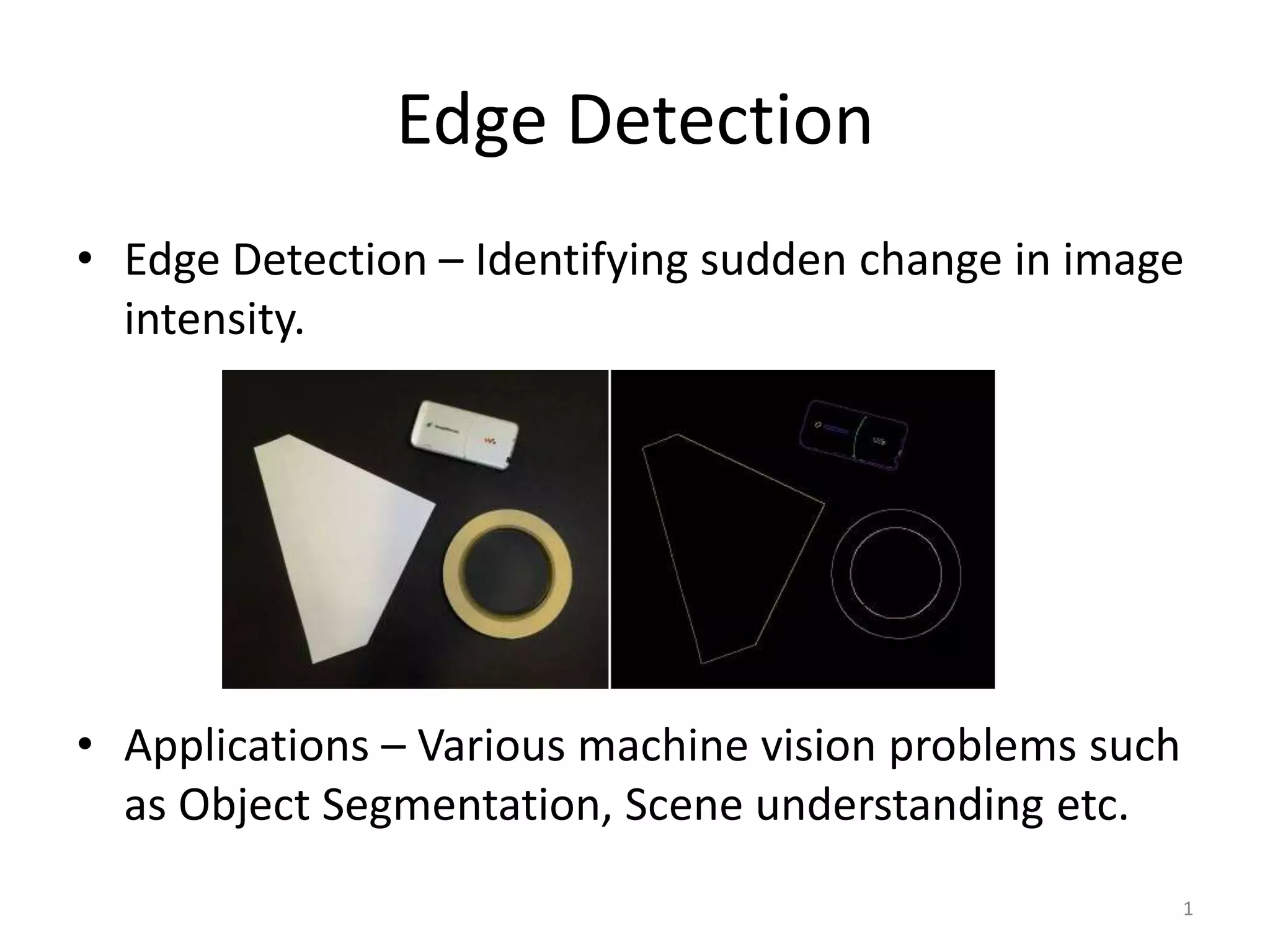
• Edge Detection – Identifying sudden change in image
intensity.
• Applications – Various machine vision problems such
as Object Segmentation, Scene understanding etc.
1
What is an edge?
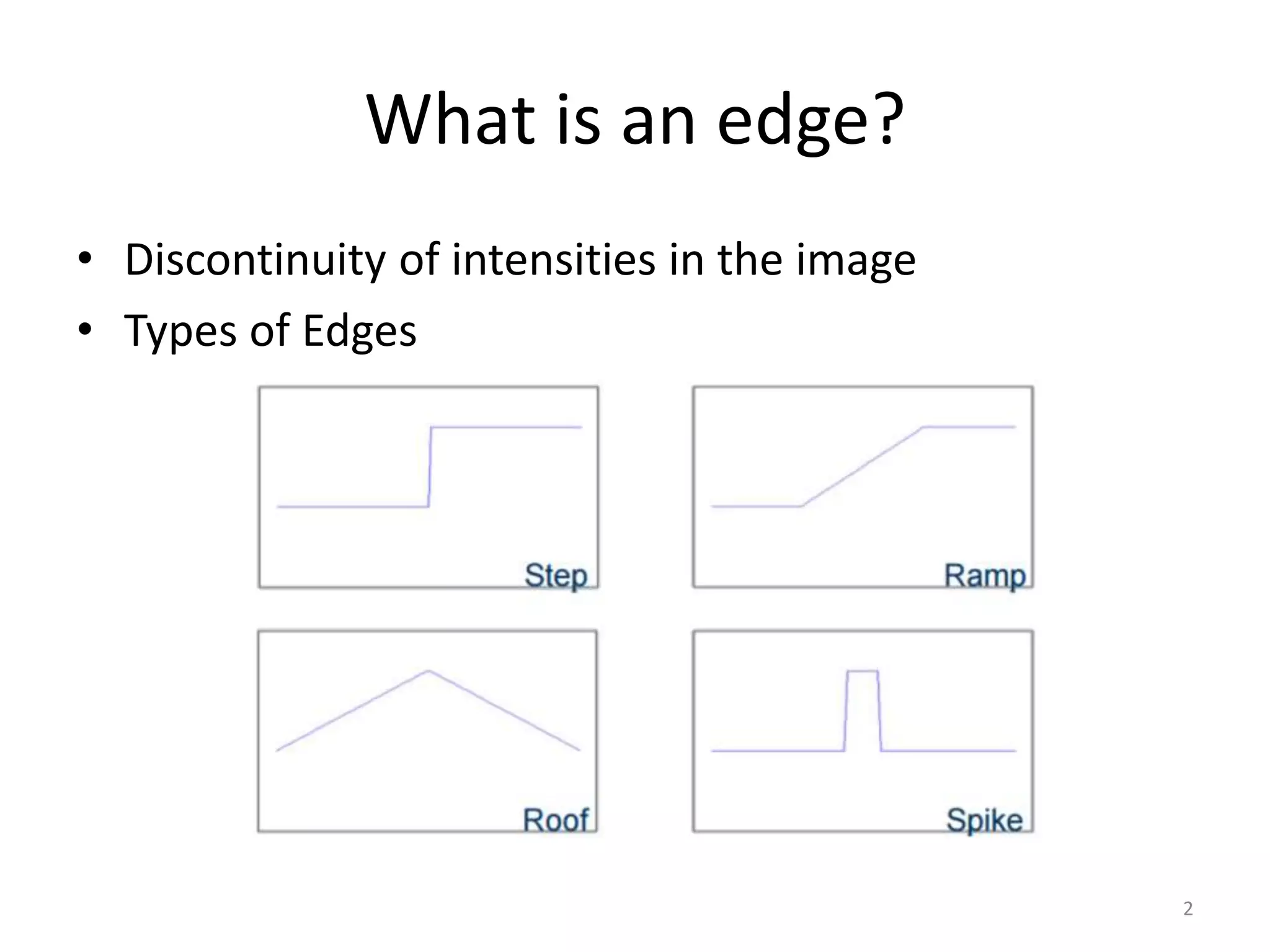
• Discontinuity of intensities in the image
• Types of Edges
2
Edge Detectors
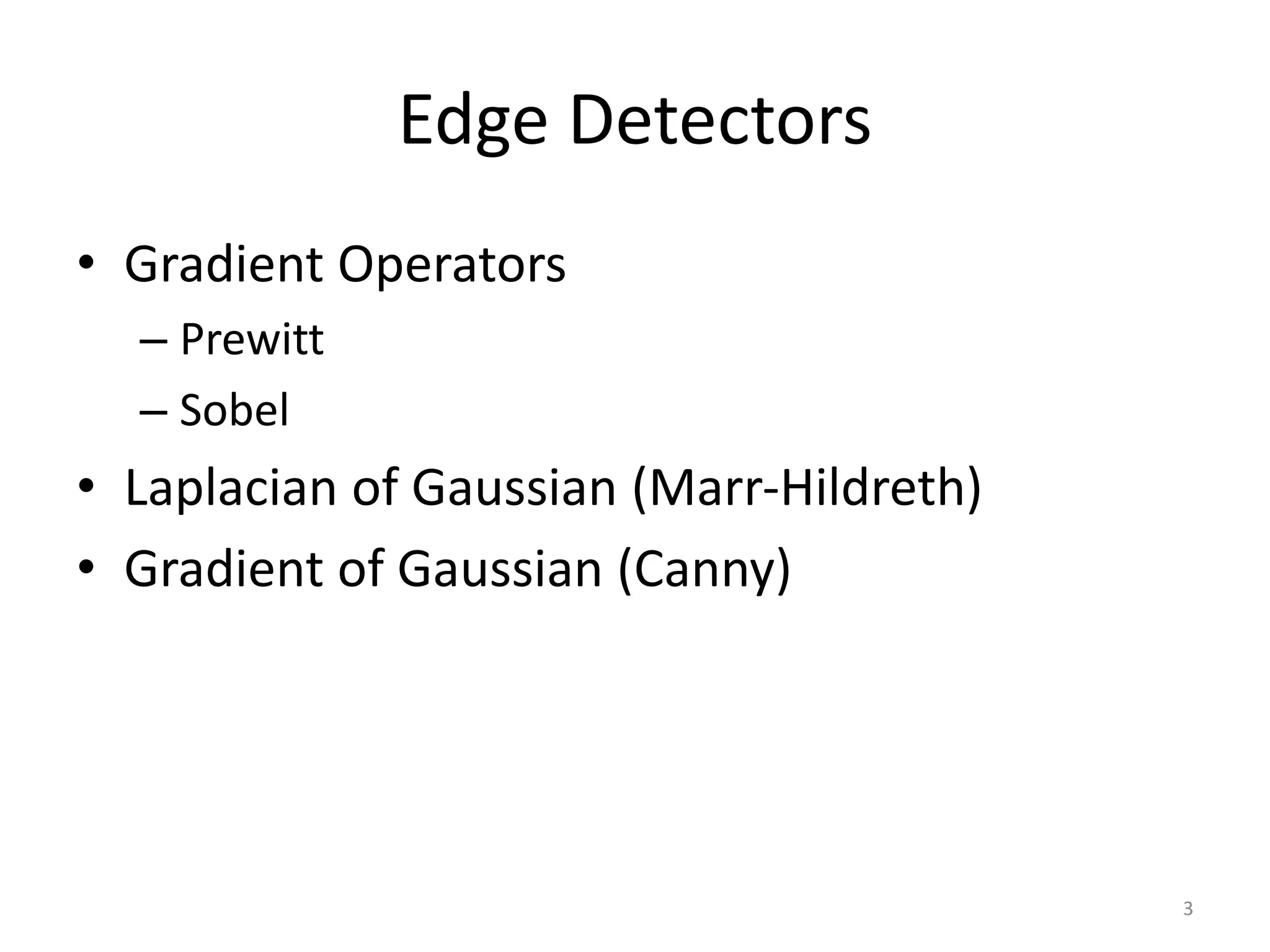
• Gradient Operators
– Prewitt
– Sobel
• Laplacian of Gaussian (Marr-Hildreth)
• Gradient of Gaussian (Canny)
3
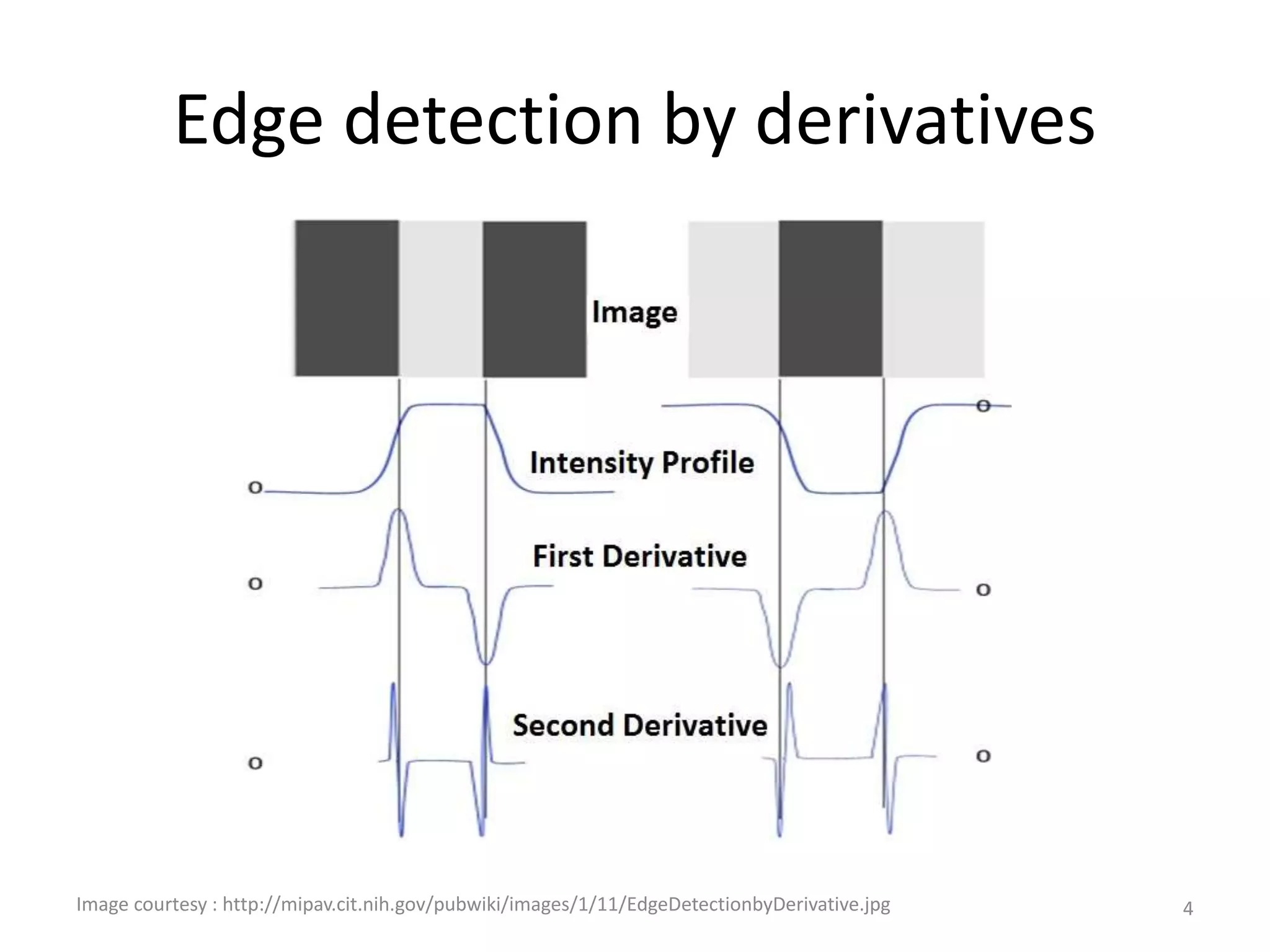
Edge detection by derivatives
4Image courtesy : http://mipav.cit.nih.gov/pubwiki/images/1/11/EdgeDetectionbyDerivative.jpg
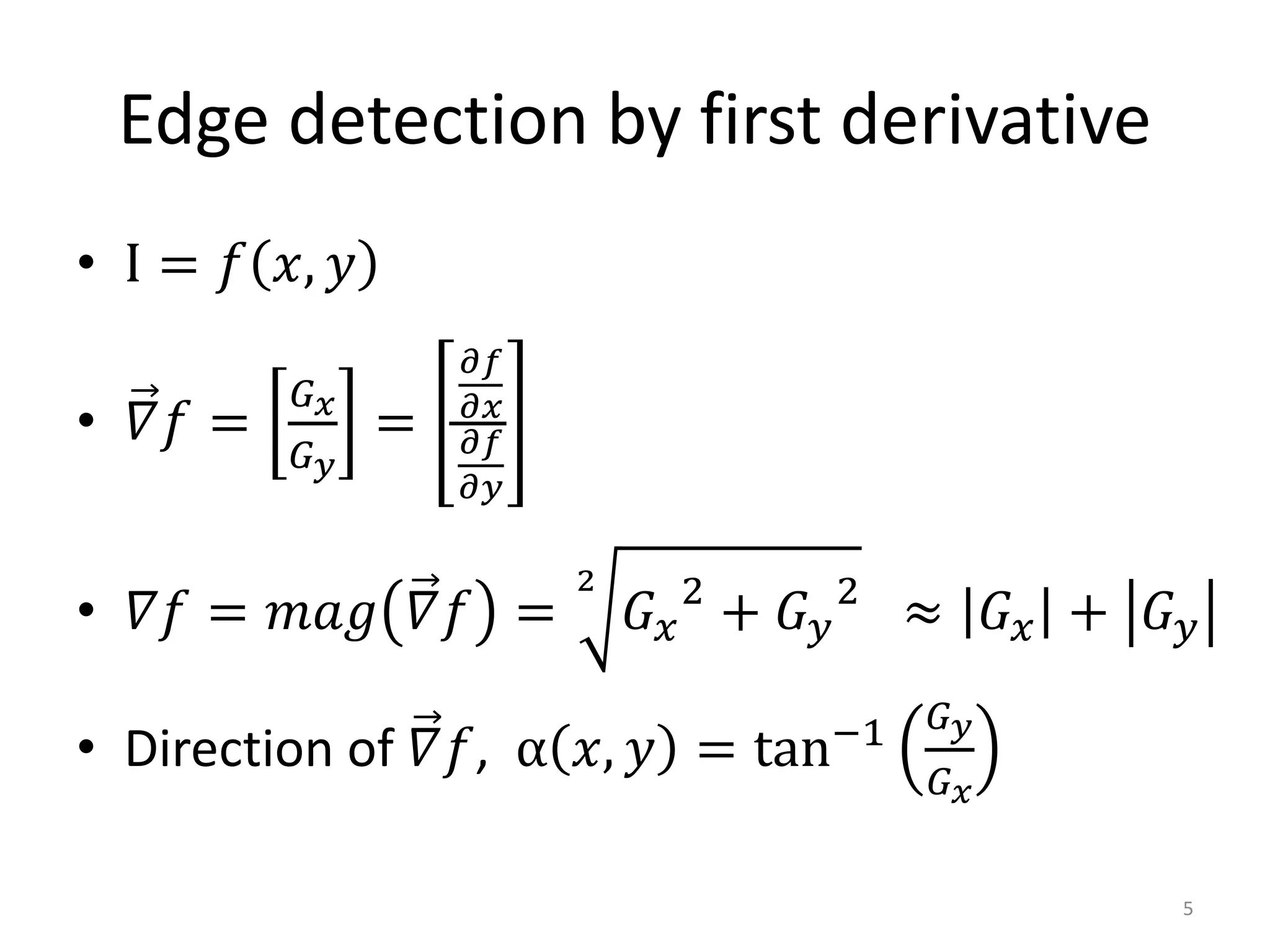
Edge detection by first derivative
• I = 𝑓 𝑥, 𝑦
• 𝛻𝑓 =
𝐺 𝑥
𝐺 𝑦
=
𝜕𝑓
𝜕𝑥
𝜕𝑓
𝜕𝑦
• 𝛻𝑓 = 𝑚𝑎𝑔 𝛻𝑓 =
2
𝐺 𝑥
2
+ 𝐺 𝑦
2
≈ 𝐺 𝑥 + 𝐺 𝑦
• Direction of 𝛻𝑓, α 𝑥, 𝑦 = tan−1 𝐺 𝑦
𝐺 𝑥
5
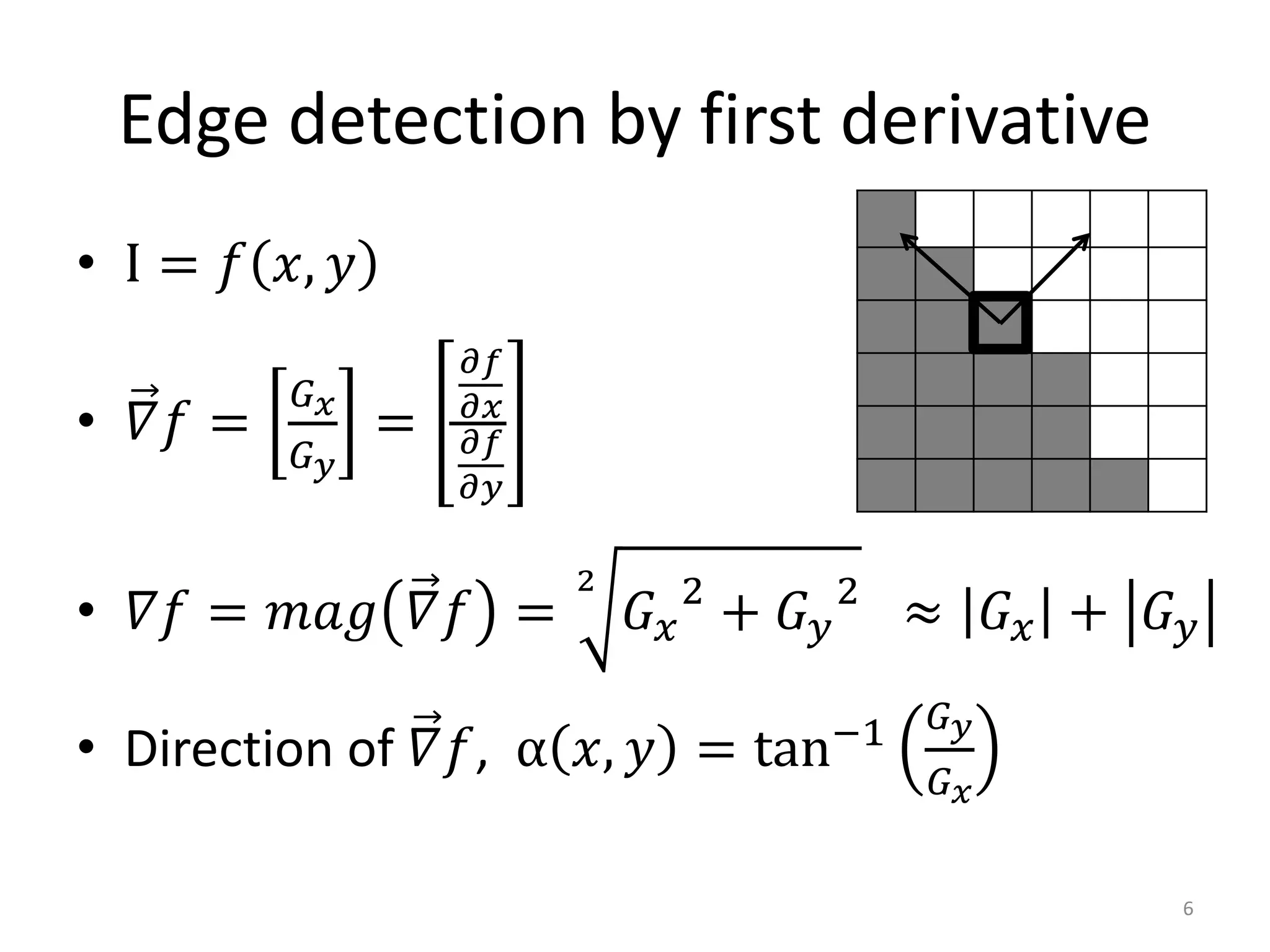
Edge detection by first derivative
• I = 𝑓 𝑥, 𝑦
• 𝛻𝑓 =
𝐺 𝑥
𝐺 𝑦
=
𝜕𝑓
𝜕𝑥
𝜕𝑓
𝜕𝑦
• 𝛻𝑓 = 𝑚𝑎𝑔 𝛻𝑓 =
2
𝐺 𝑥
2
+ 𝐺 𝑦
2
≈ 𝐺 𝑥 + 𝐺 𝑦
• Direction of 𝛻𝑓, α 𝑥, 𝑦 = tan−1 𝐺 𝑦
𝐺 𝑥
6
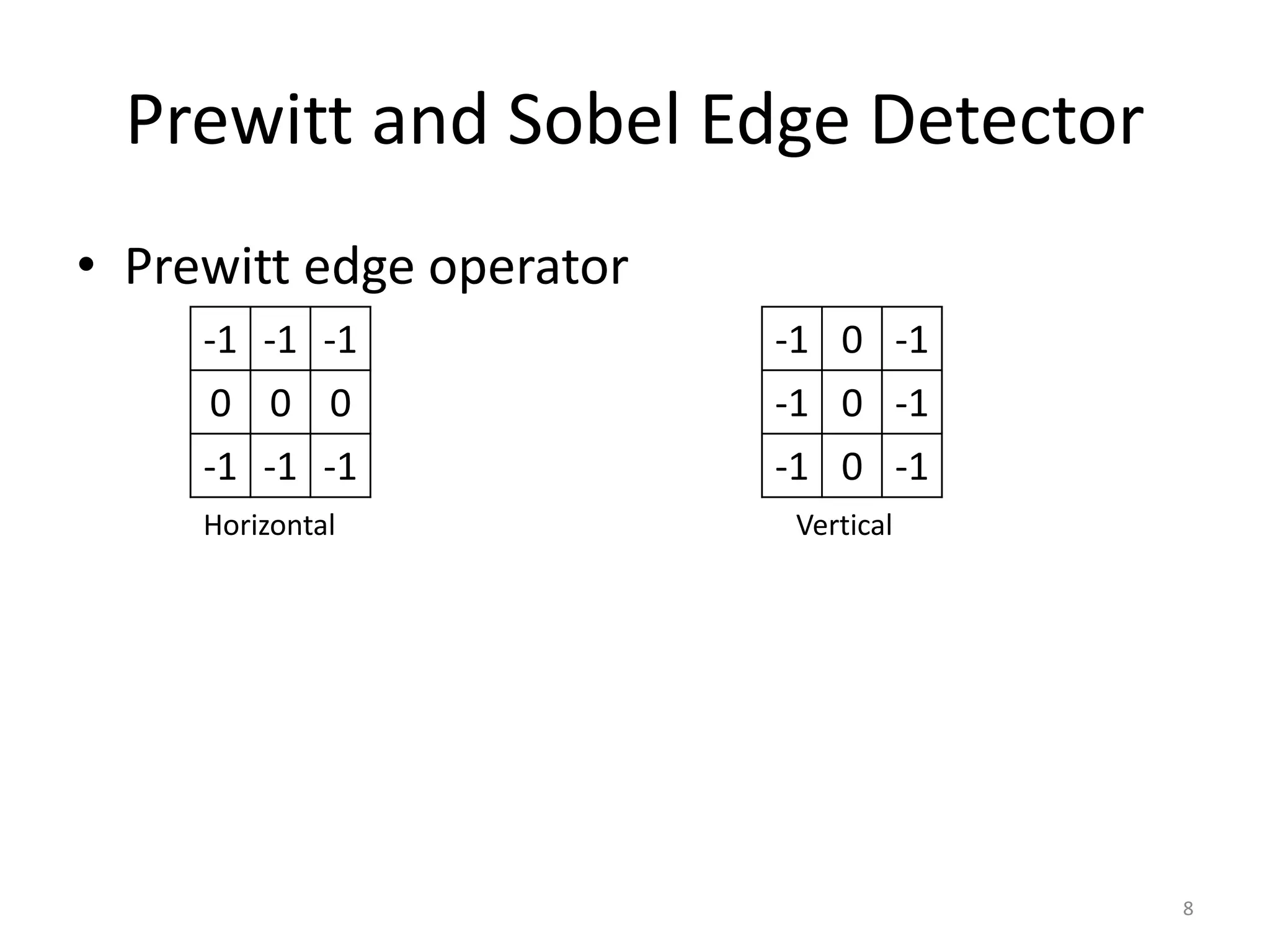
• Prewitt edge operator
Prewitt and Sobel Edge Detector
-1 -1 -1
0 0 0
-1 -1 -1
8
-1 0 -1
-1 0 -1
-1 0 -1
Horizontal Vertical
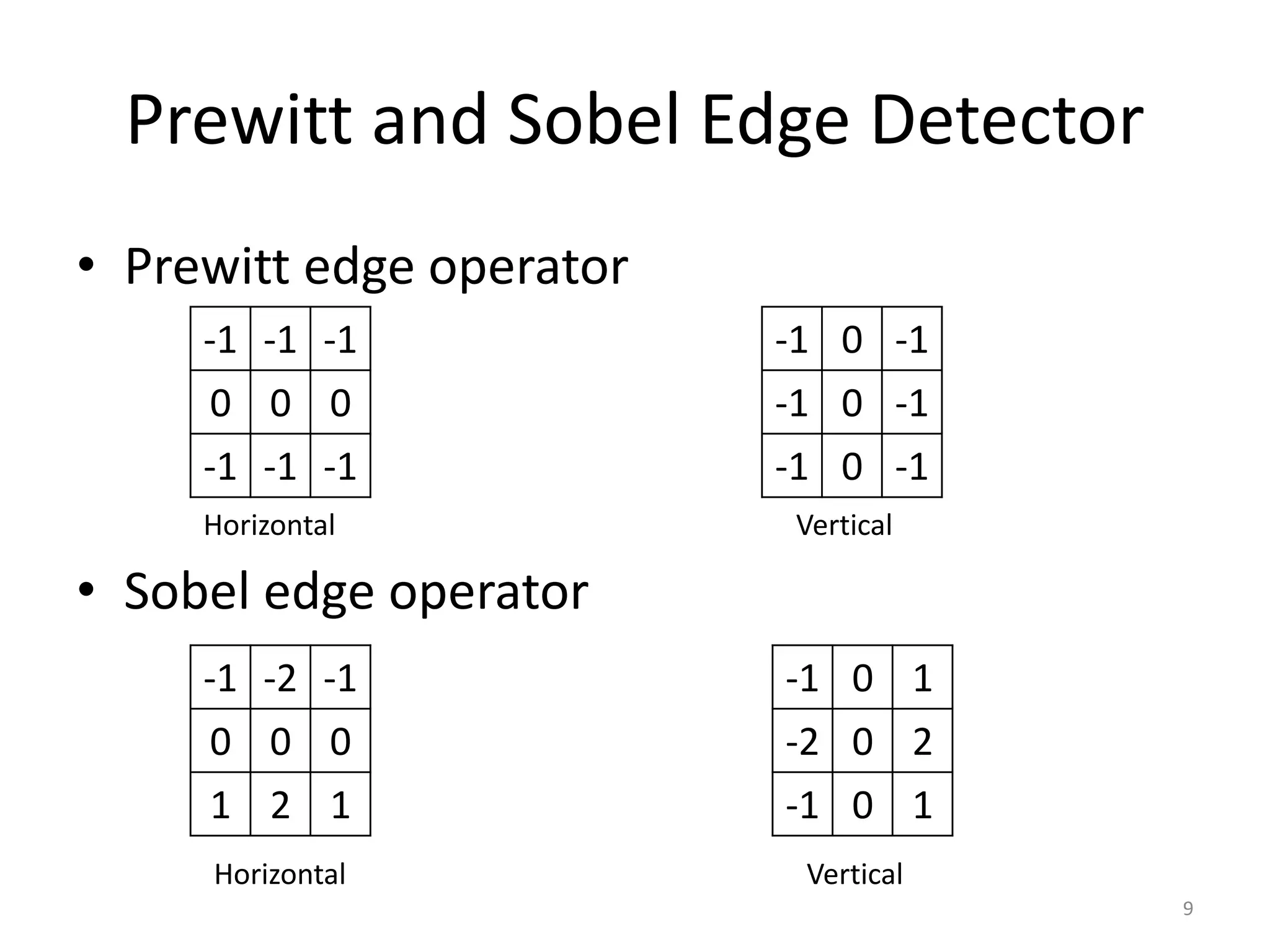
• Prewitt edge operator
• Sobel edge operator
Prewitt and Sobel Edge Detector
-1 -1 -1
0 0 0
-1 -1 -1
9
-1 0 -1
-1 0 -1
-1 0 -1
Horizontal Vertical
-1 -2 -1
0 0 0
1 2 1
-1 0 1
-2 0 2
-1 0 1
Horizontal Vertical
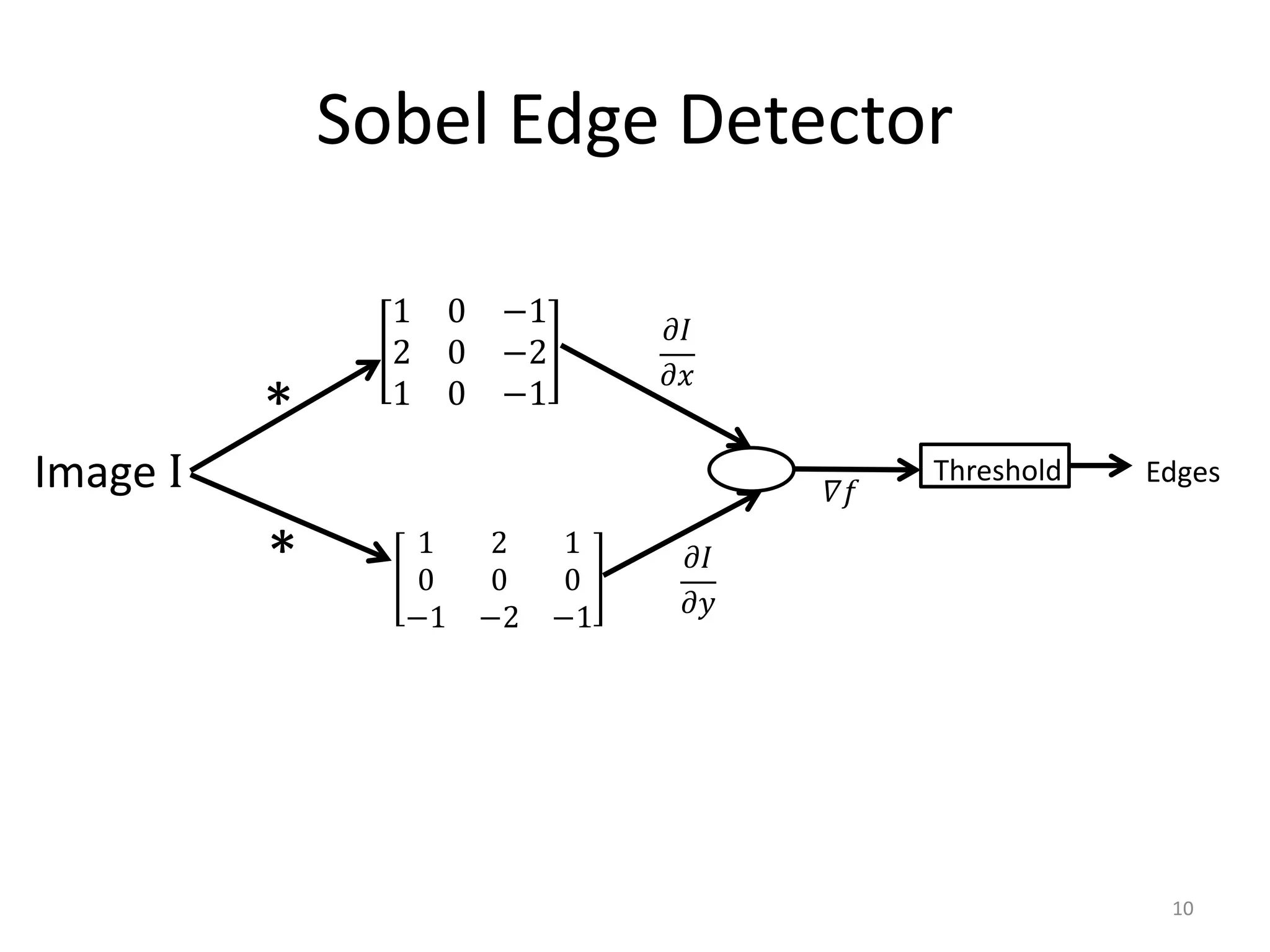
1 0 −1
2 0 −2
1 0 −1
1 2 1
0 0 0
−1 −2 −1
Sobel Edge Detector
10
Image I
*
*
𝜕𝐼
𝜕𝑥
𝜕𝐼
𝜕𝑦
𝛻𝑓
Threshold Edges
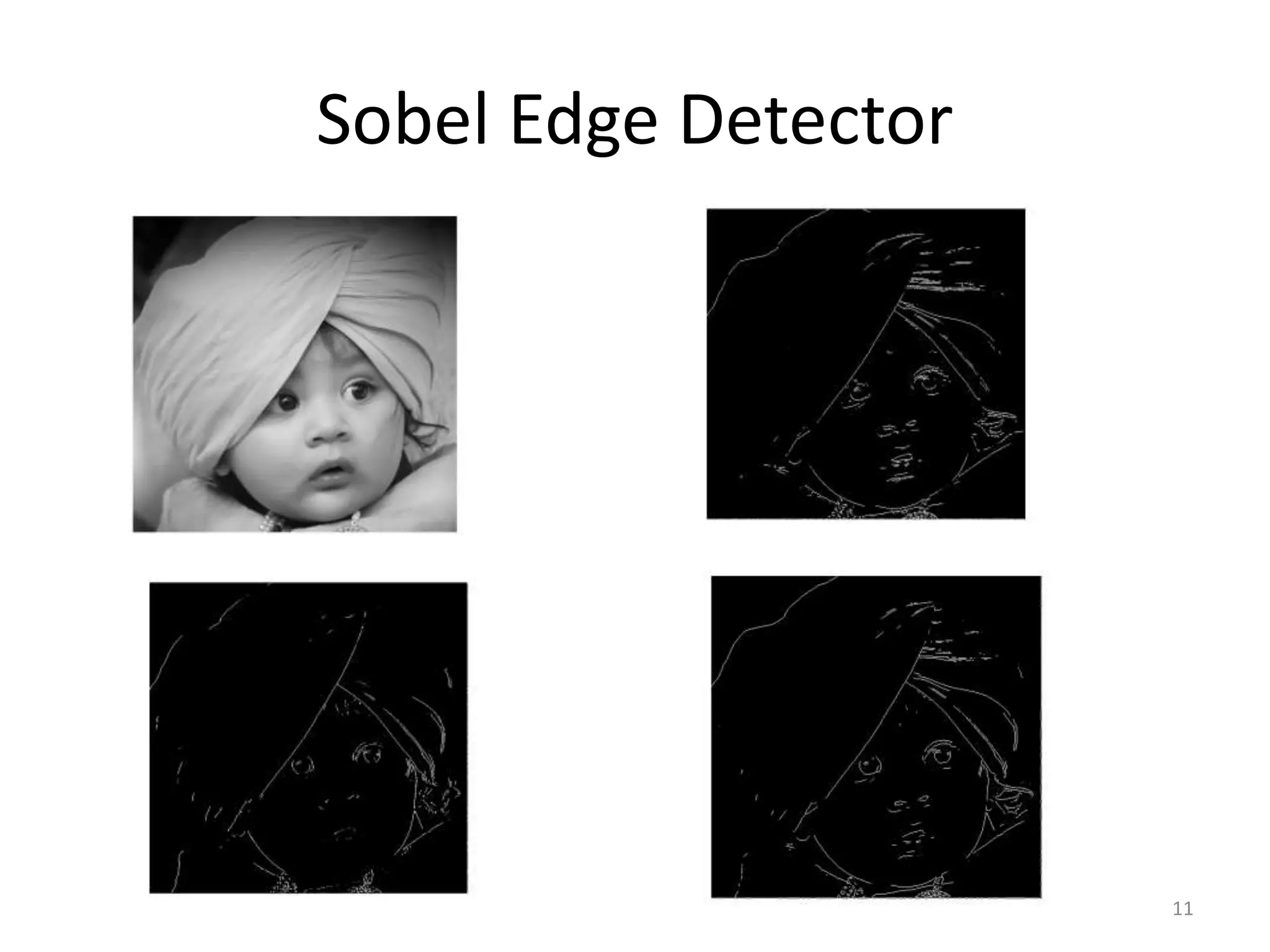
Sobel Edge Detector
11
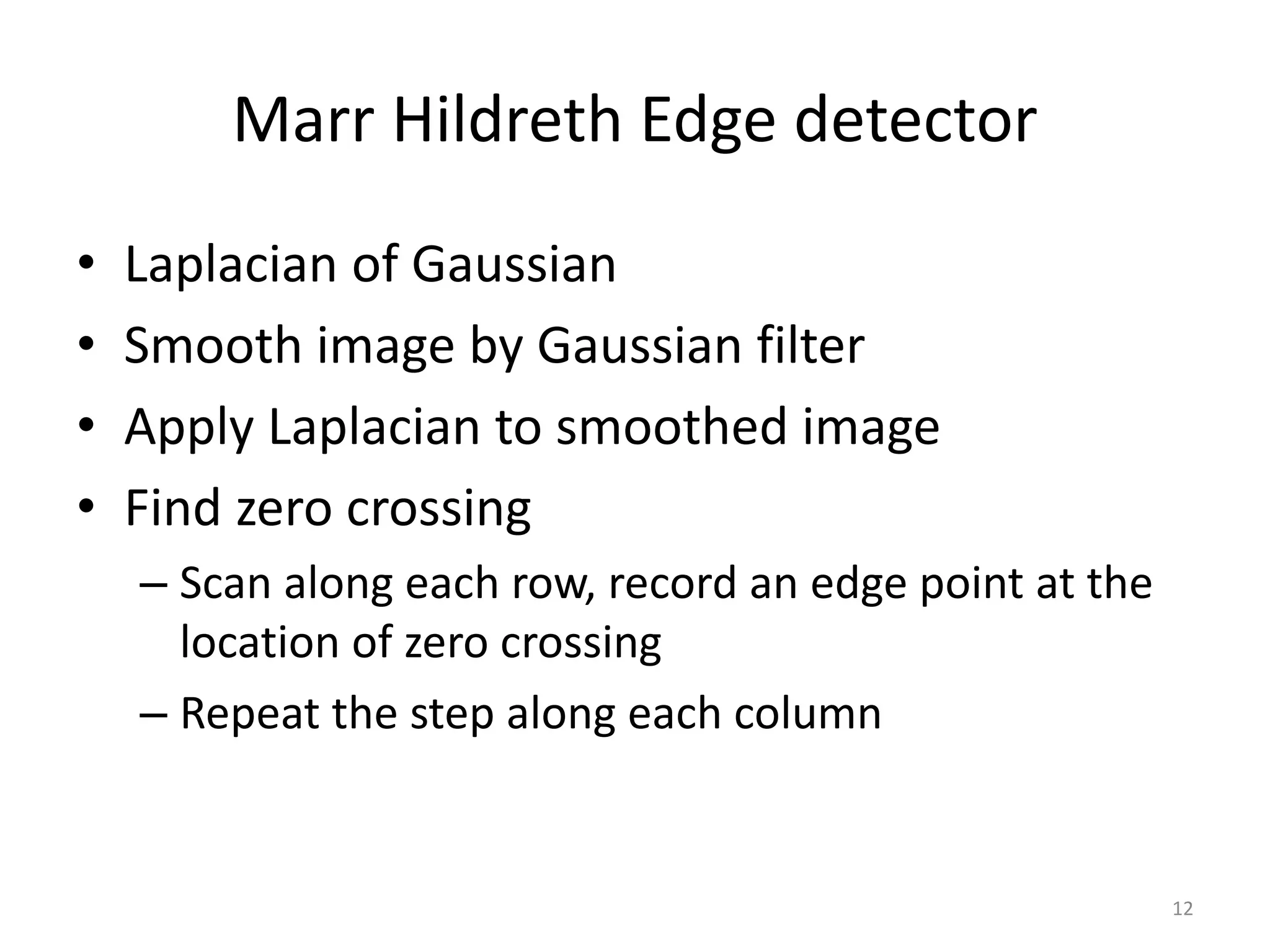
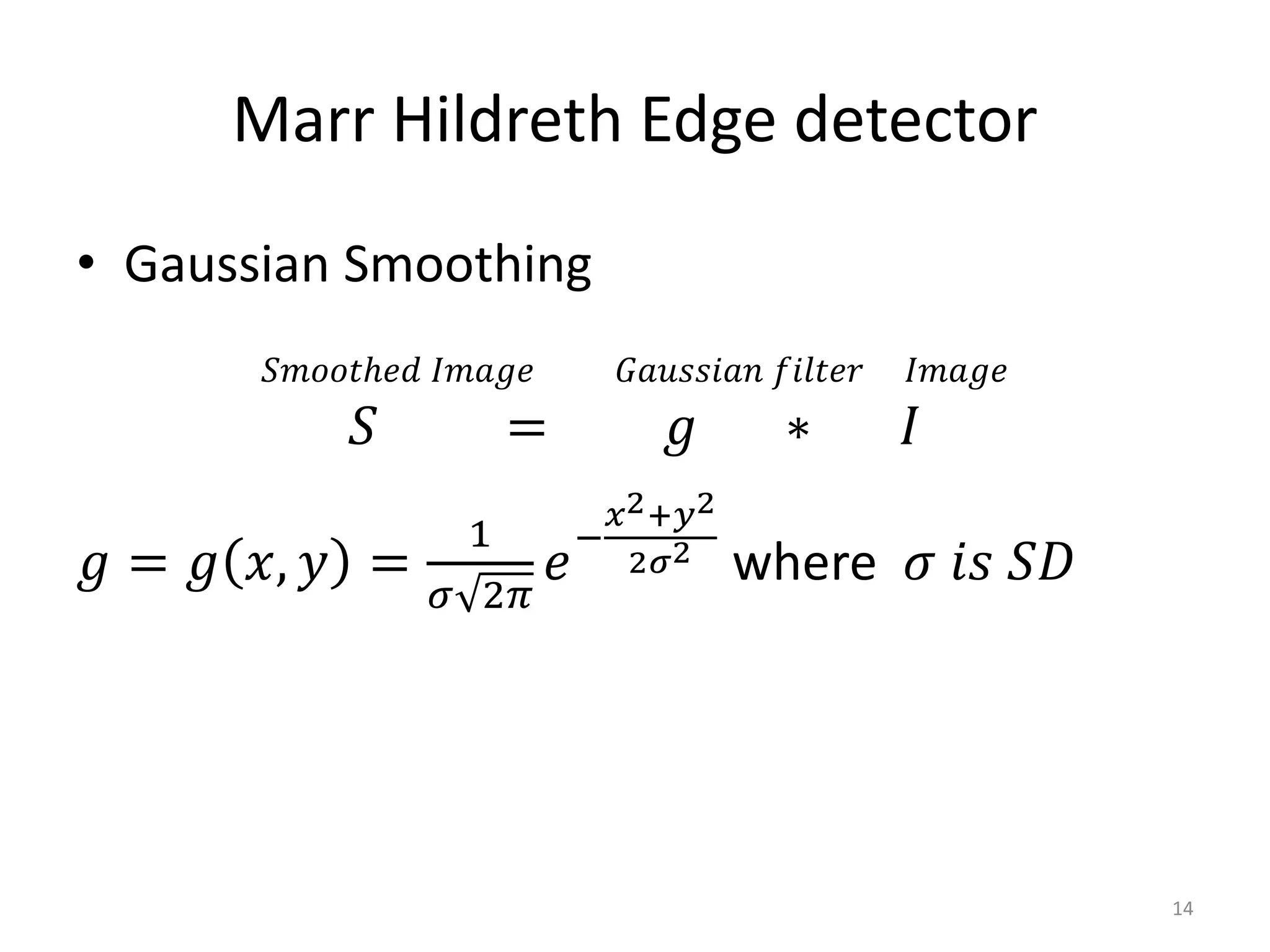
Marr Hildreth Edge detector
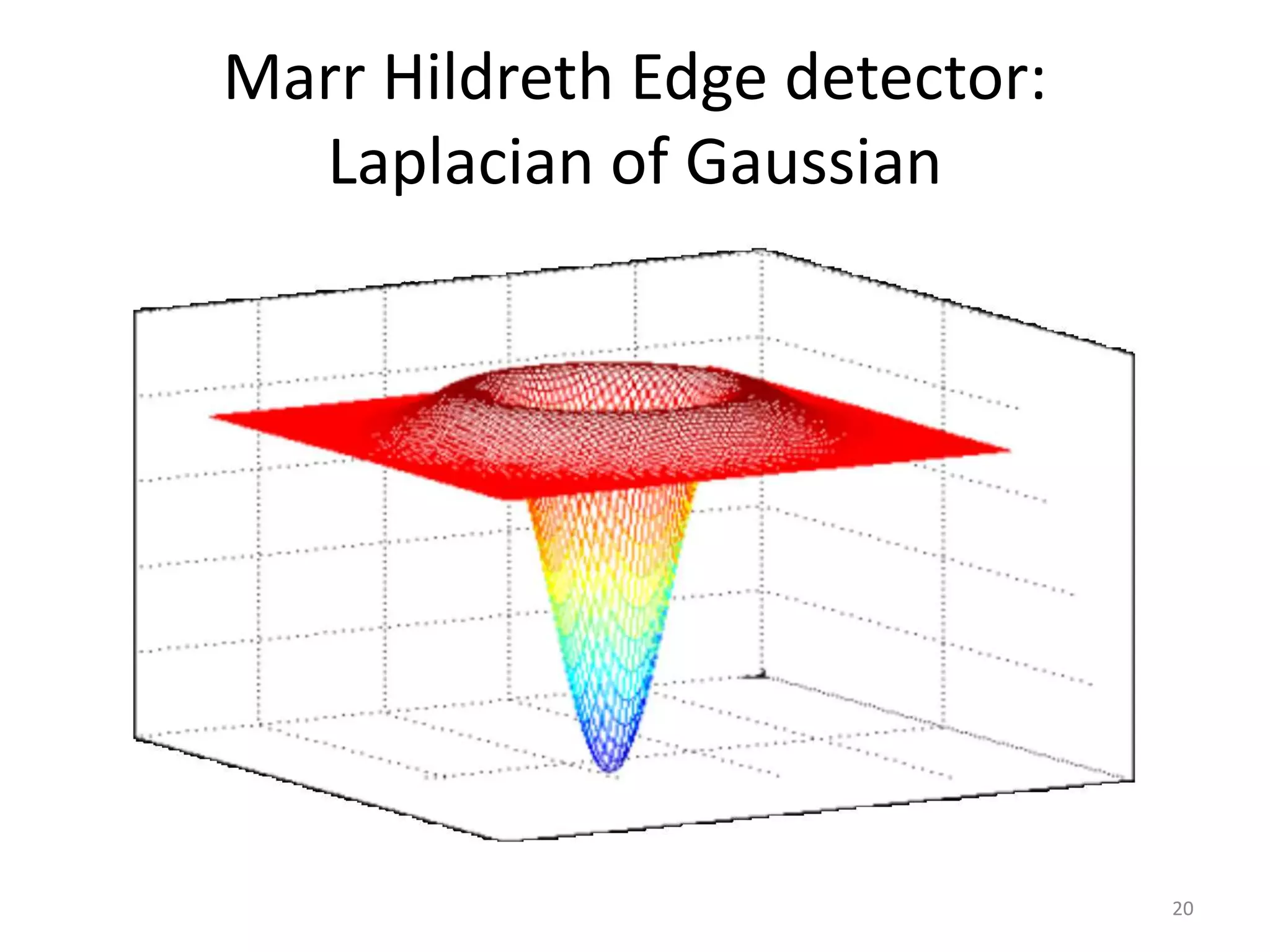
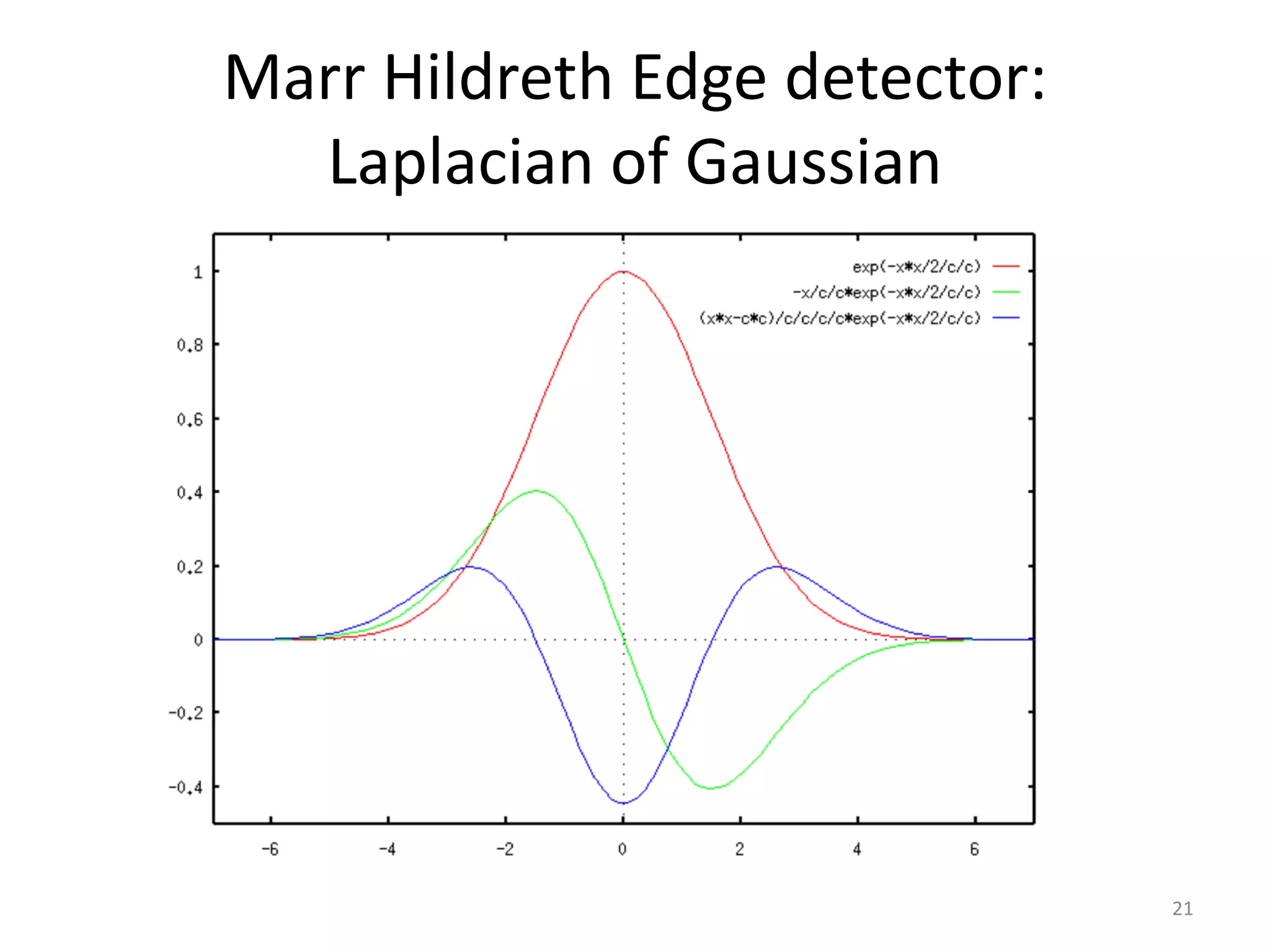
• Laplacian of Gaussian
• Smooth image by Gaussian filter
• Apply Laplacian to smoothed image
• Find zero crossing
– Scan along each row, record an edge point at the
location of zero crossing
– Repeat the step along each column
12
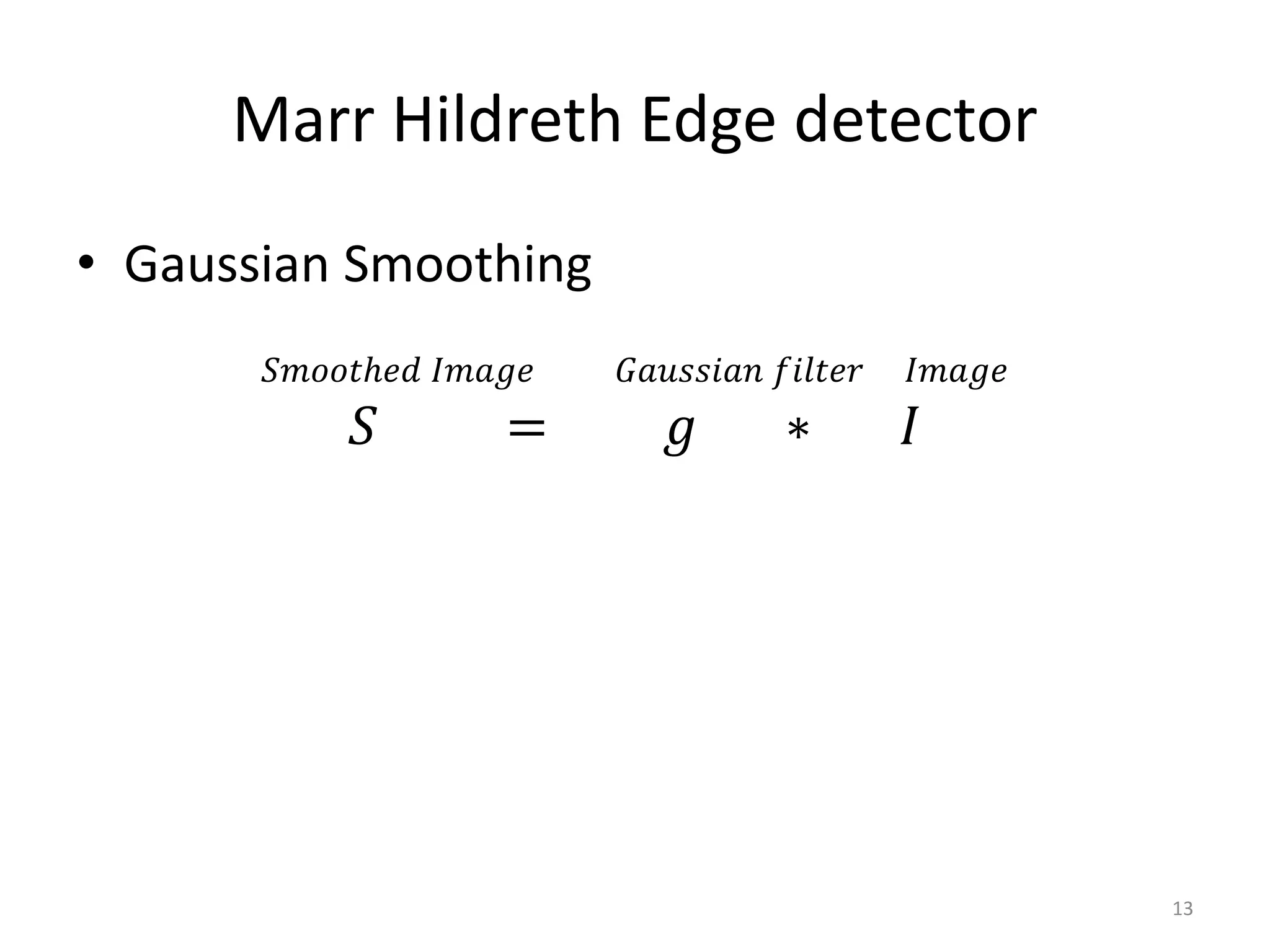
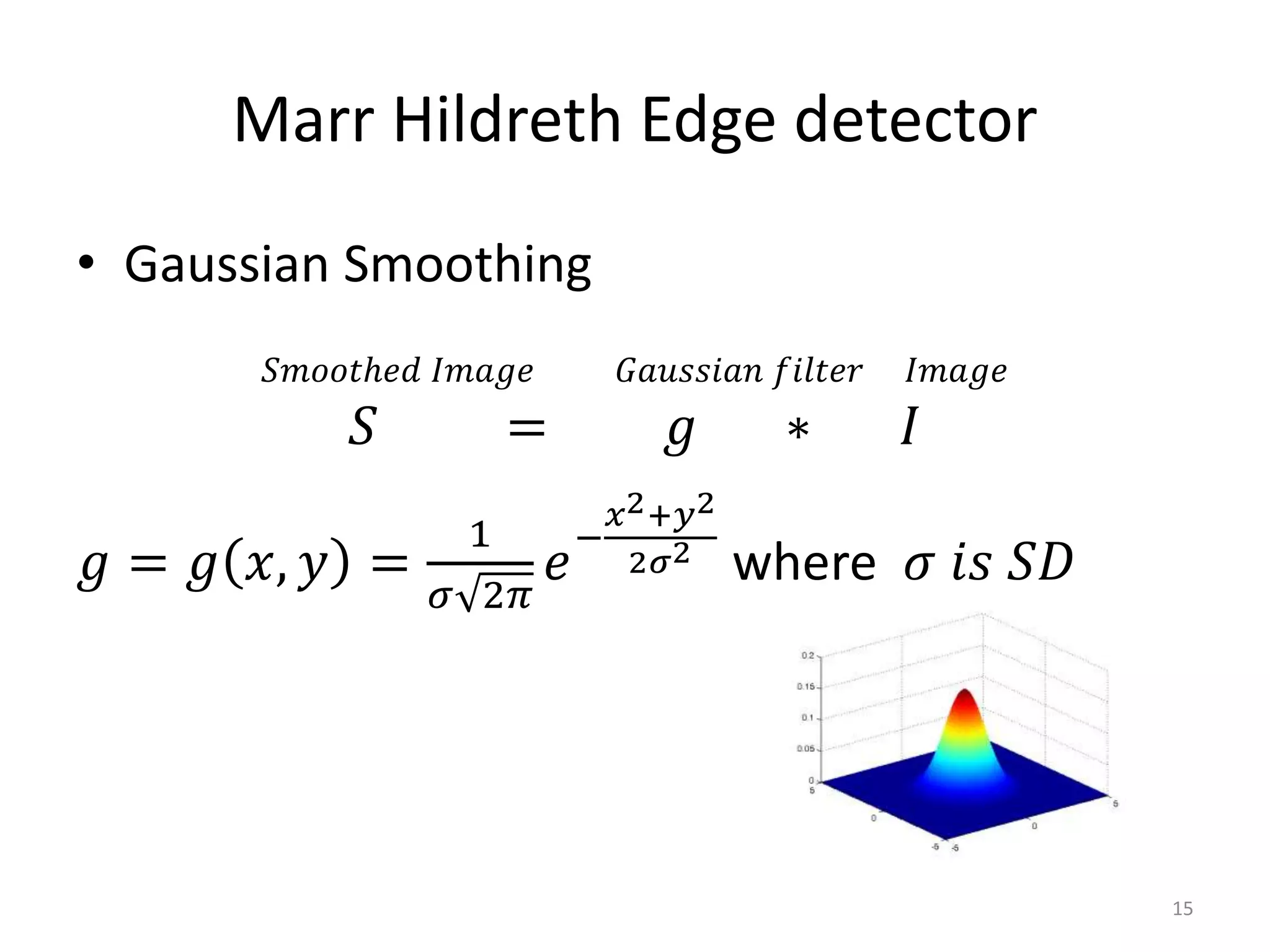
• Gaussian Smoothing
𝑆𝑚𝑜𝑜𝑡ℎ𝑒𝑑 𝐼𝑚𝑎𝑔𝑒 𝐺𝑎𝑢𝑠𝑠𝑖𝑎𝑛 𝑓𝑖𝑙𝑡𝑒𝑟 𝐼𝑚𝑎𝑔𝑒
𝑆 = 𝑔 ∗ 𝐼
Marr Hildreth Edge detector
13
• Gaussian Smoothing
𝑆𝑚𝑜𝑜𝑡ℎ𝑒𝑑 𝐼𝑚𝑎𝑔𝑒 𝐺𝑎𝑢𝑠𝑠𝑖𝑎𝑛 𝑓𝑖𝑙𝑡𝑒𝑟 𝐼𝑚𝑎𝑔𝑒
𝑆 = 𝑔 ∗ 𝐼
𝑔 = 𝑔 𝑥, 𝑦 =
1
𝜎 2𝜋
𝑒
−
𝑥2+𝑦2
2𝜎2
where 𝜎 𝑖𝑠 𝑆𝐷
Marr Hildreth Edge detector
14
• Gaussian Smoothing
𝑆𝑚𝑜𝑜𝑡ℎ𝑒𝑑 𝐼𝑚𝑎𝑔𝑒 𝐺𝑎𝑢𝑠𝑠𝑖𝑎𝑛 𝑓𝑖𝑙𝑡𝑒𝑟 𝐼𝑚𝑎𝑔𝑒
𝑆 = 𝑔 ∗ 𝐼
𝑔 = 𝑔 𝑥, 𝑦 =
1
𝜎 2𝜋
𝑒
−
𝑥2+𝑦2
2𝜎2
where 𝜎 𝑖𝑠 𝑆𝐷
Marr Hildreth Edge detector
15
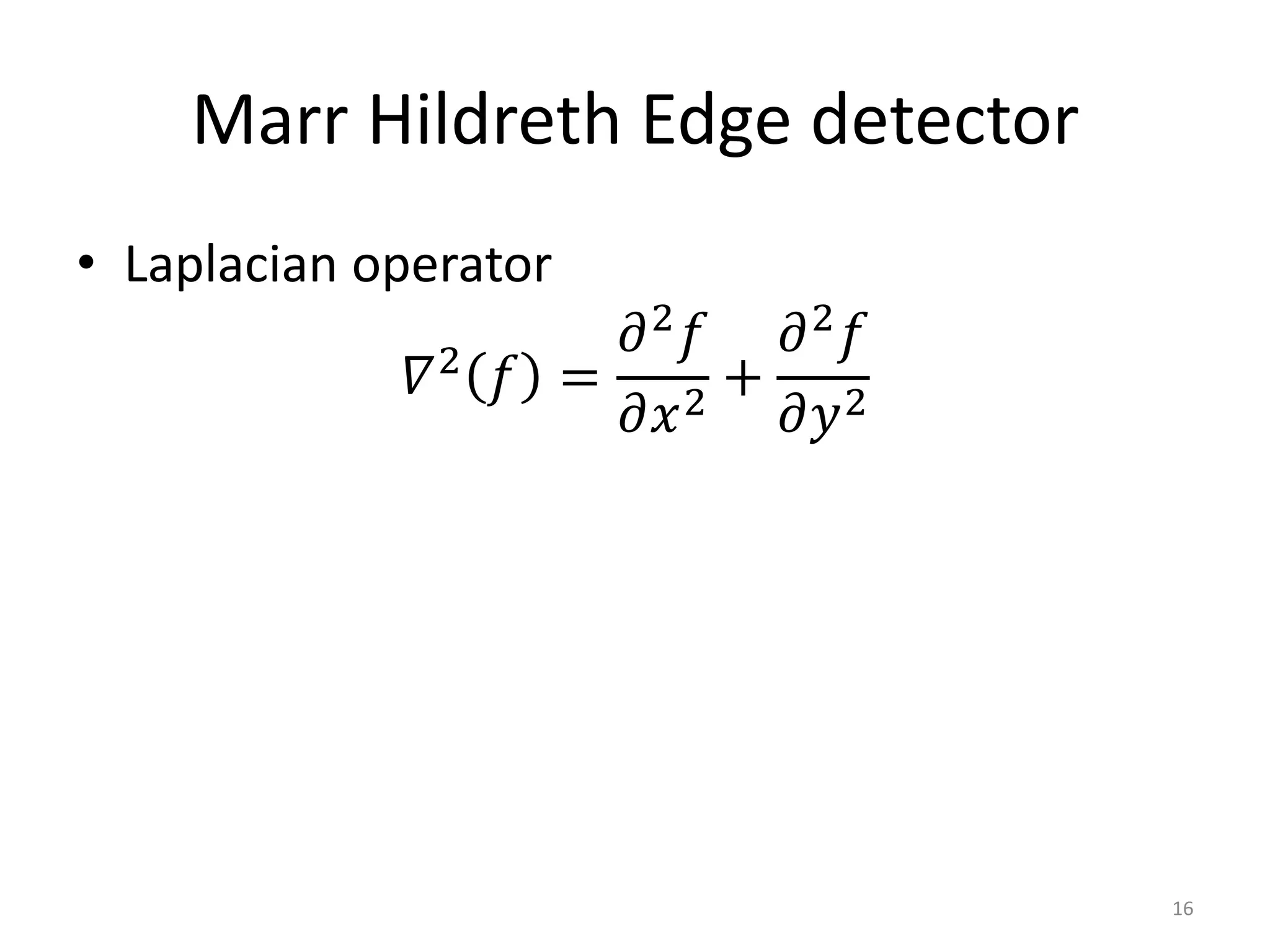
Marr Hildreth Edge detector
• Laplacian operator
𝛻2
𝑓 =
𝜕2
𝑓
𝜕𝑥2
+
𝜕2
𝑓
𝜕𝑦2
16
Marr Hildreth Edge detector
• Laplacian operator
𝛻2
𝑓 =
𝜕2
𝑓
𝜕𝑥2
+
𝜕2
𝑓
𝜕𝑦2
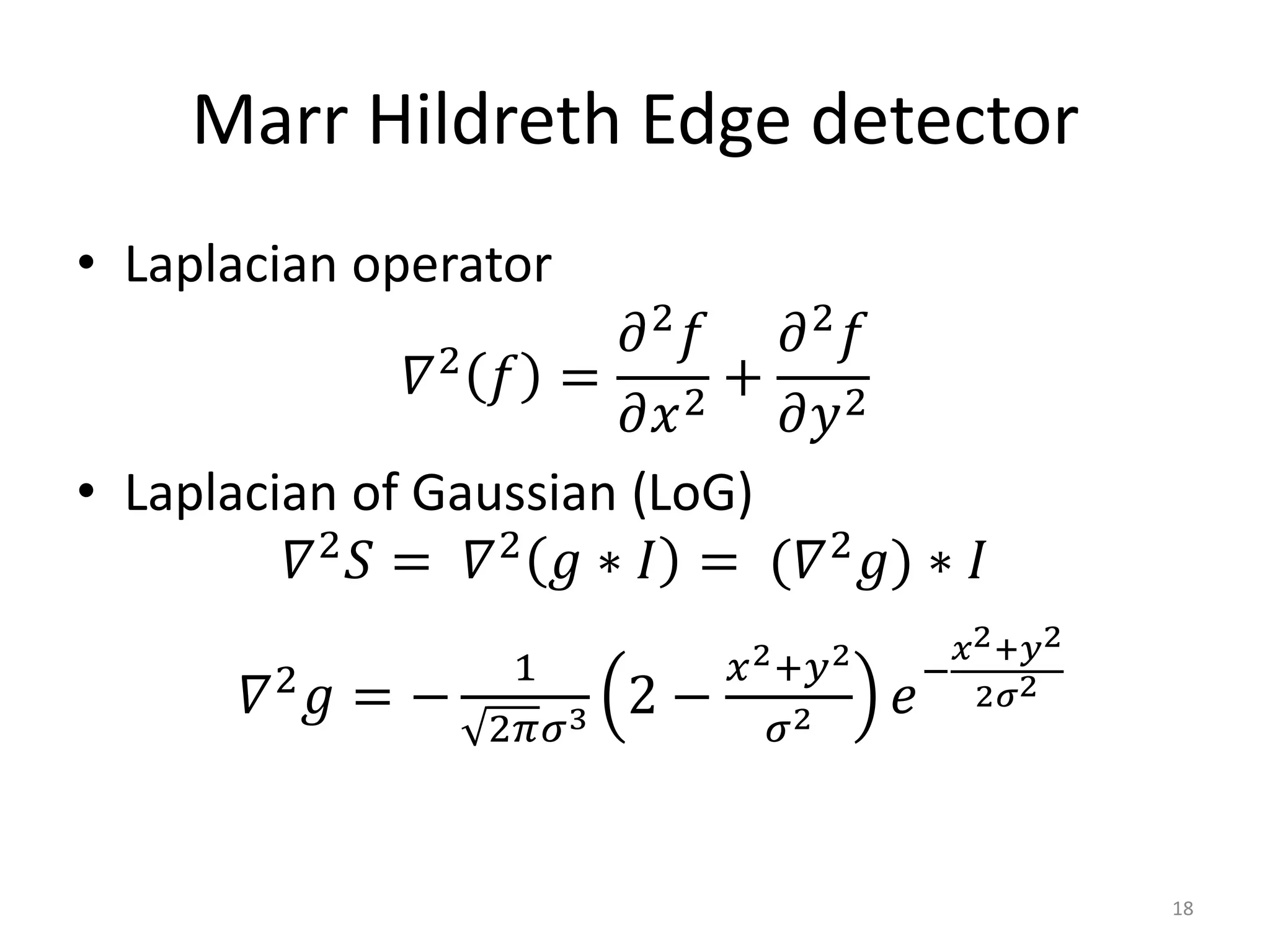
• Laplacian of Gaussian (LoG)
𝛻2
𝑆 = 𝛻2
𝑔 ∗ 𝐼 = (𝛻2
𝑔) ∗ 𝐼
17
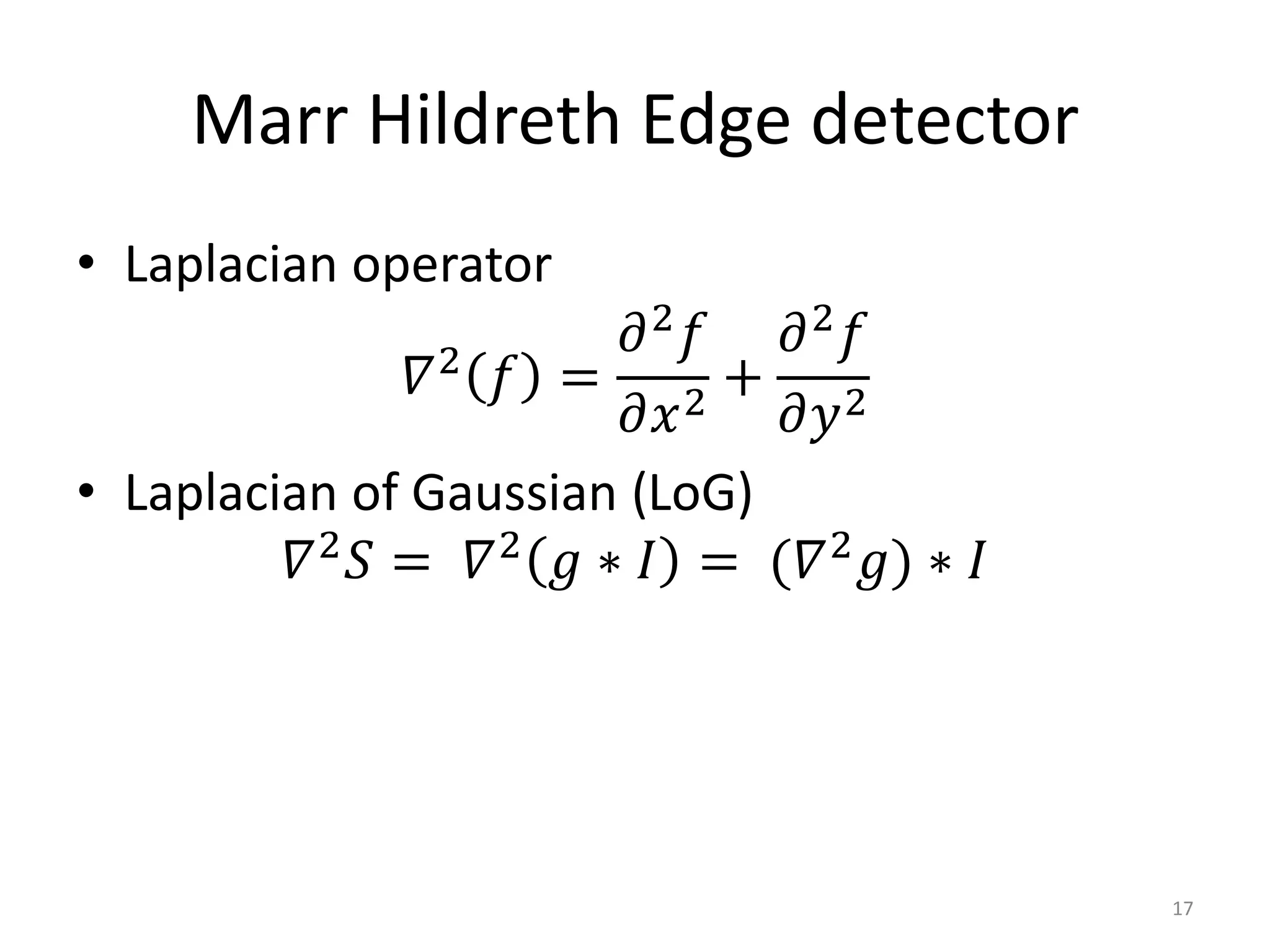
Marr Hildreth Edge detector
• Laplacian operator
𝛻2
𝑓 =
𝜕2
𝑓
𝜕𝑥2
+
𝜕2
𝑓
𝜕𝑦2
• Laplacian of Gaussian (LoG)
𝛻2
𝑆 = 𝛻2
𝑔 ∗ 𝐼 = (𝛻2
𝑔) ∗ 𝐼
𝛻2
𝑔 = −
1
2𝜋𝜎3 2 −
𝑥2+𝑦2
𝜎2 𝑒
−
𝑥2+𝑦2
2𝜎2
18
Marr Hildreth Edge detector:
Laplacian of Gaussian
20
Marr Hildreth Edge detector:
Laplacian of Gaussian
21
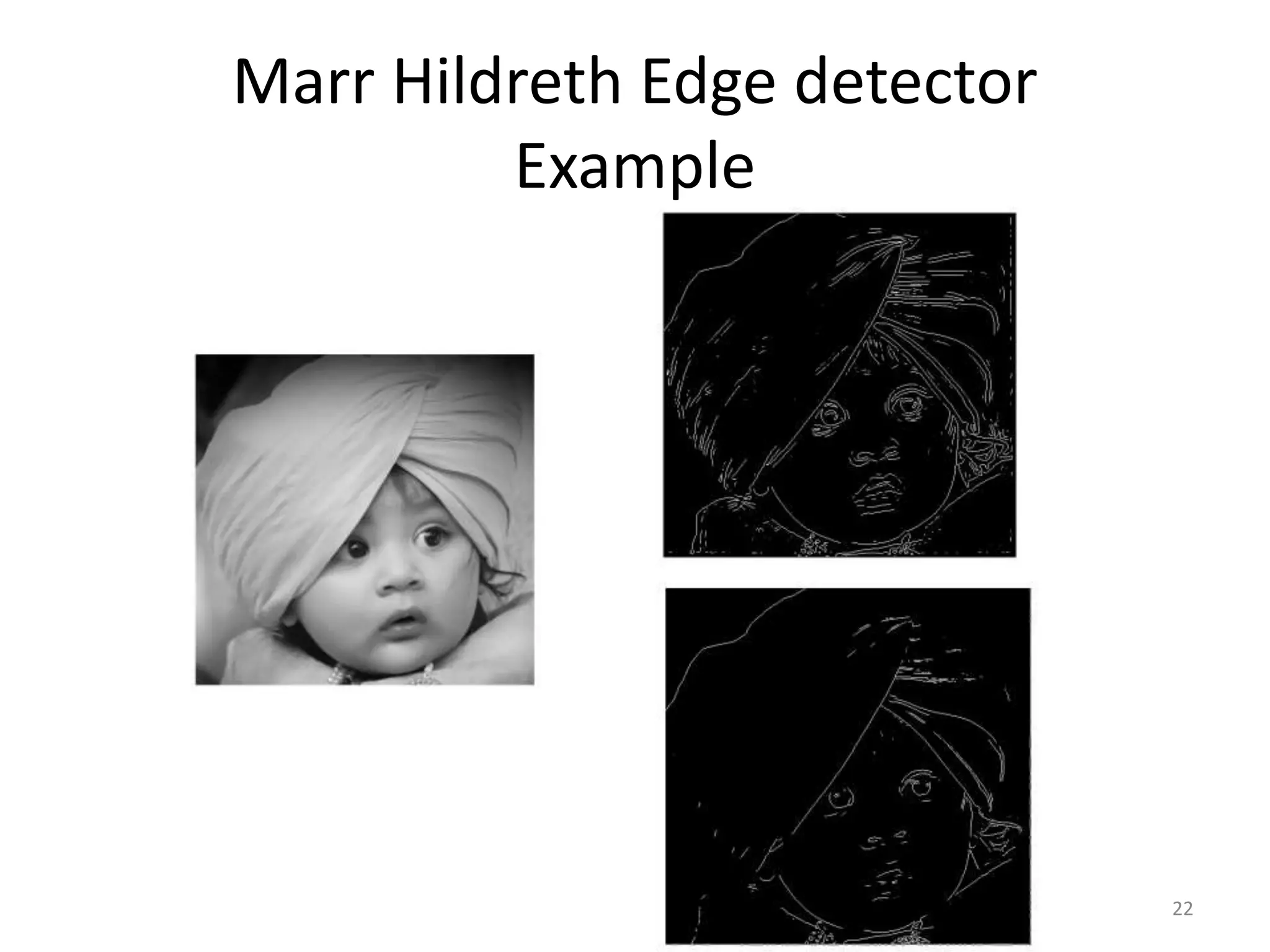
22
Marr Hildreth Edge detector
Example
Canny Edge Detector
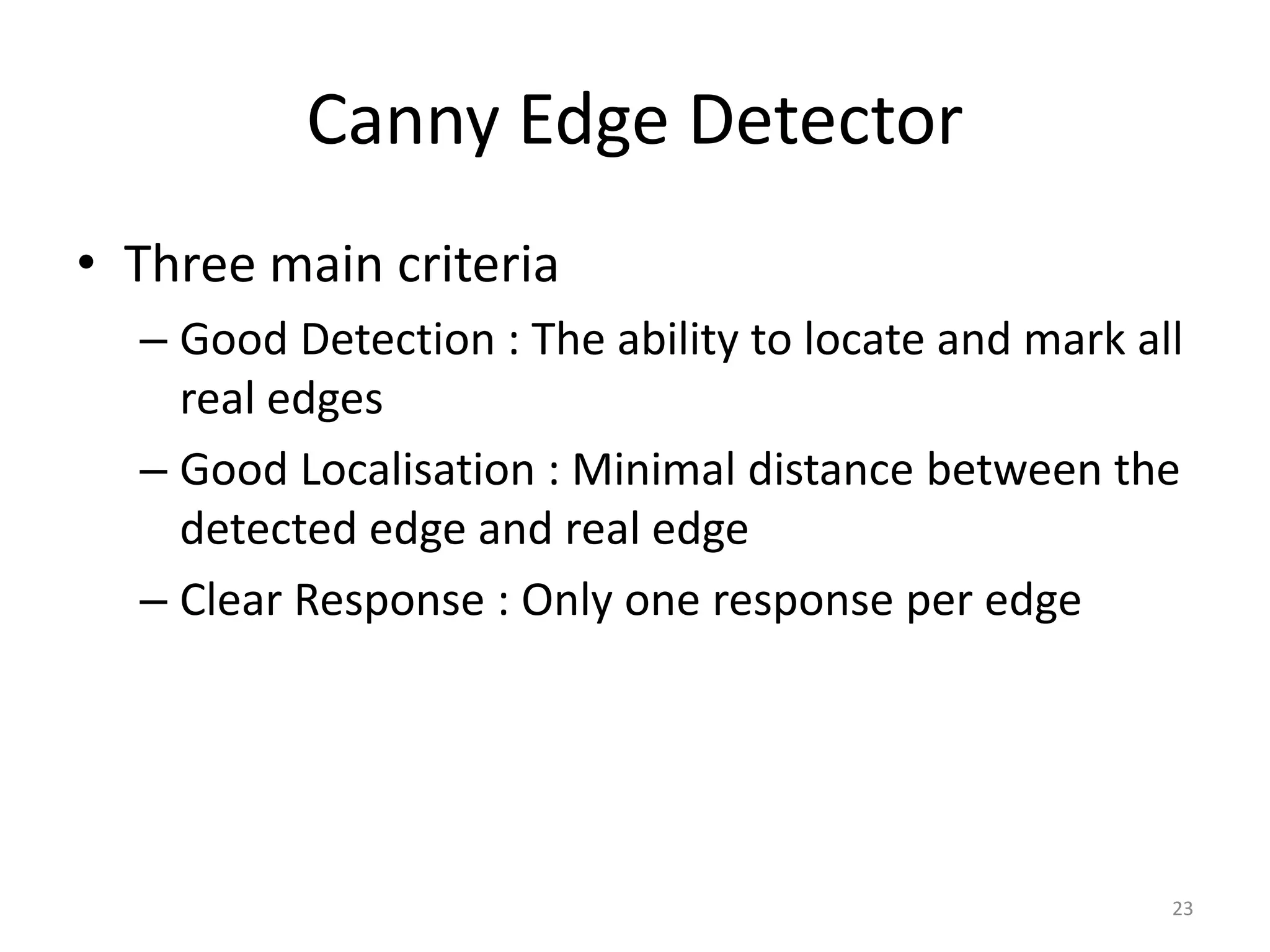
• Three main criteria
– Good Detection : The ability to locate and mark all
real edges
– Good Localisation : Minimal distance between the
detected edge and real edge
– Clear Response : Only one response per edge
23
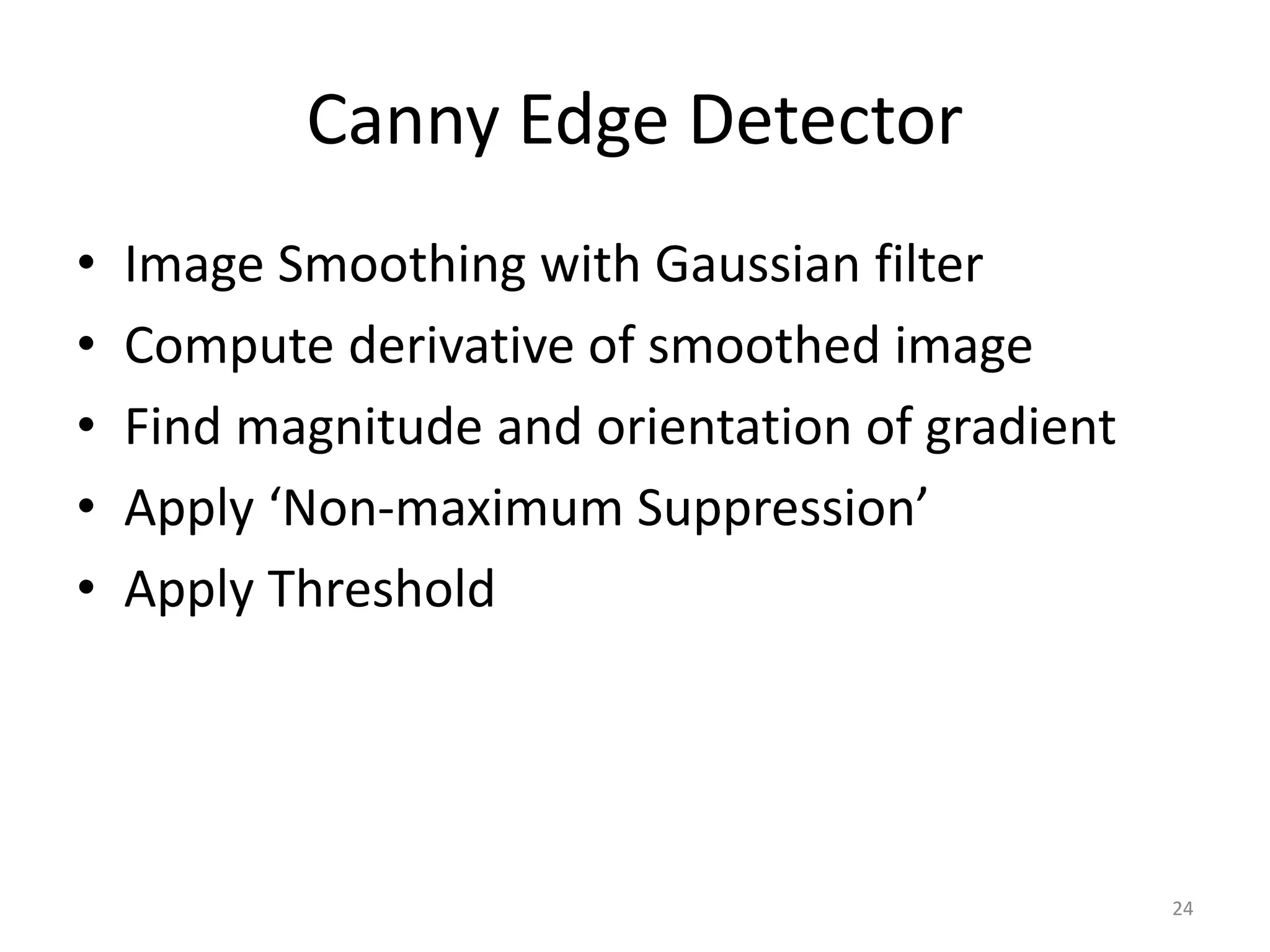
Canny Edge Detector
• Image Smoothing with Gaussian filter
• Compute derivative of smoothed image
• Find magnitude and orientation of gradient
• Apply ‘Non-maximum Suppression’
• Apply Threshold
24
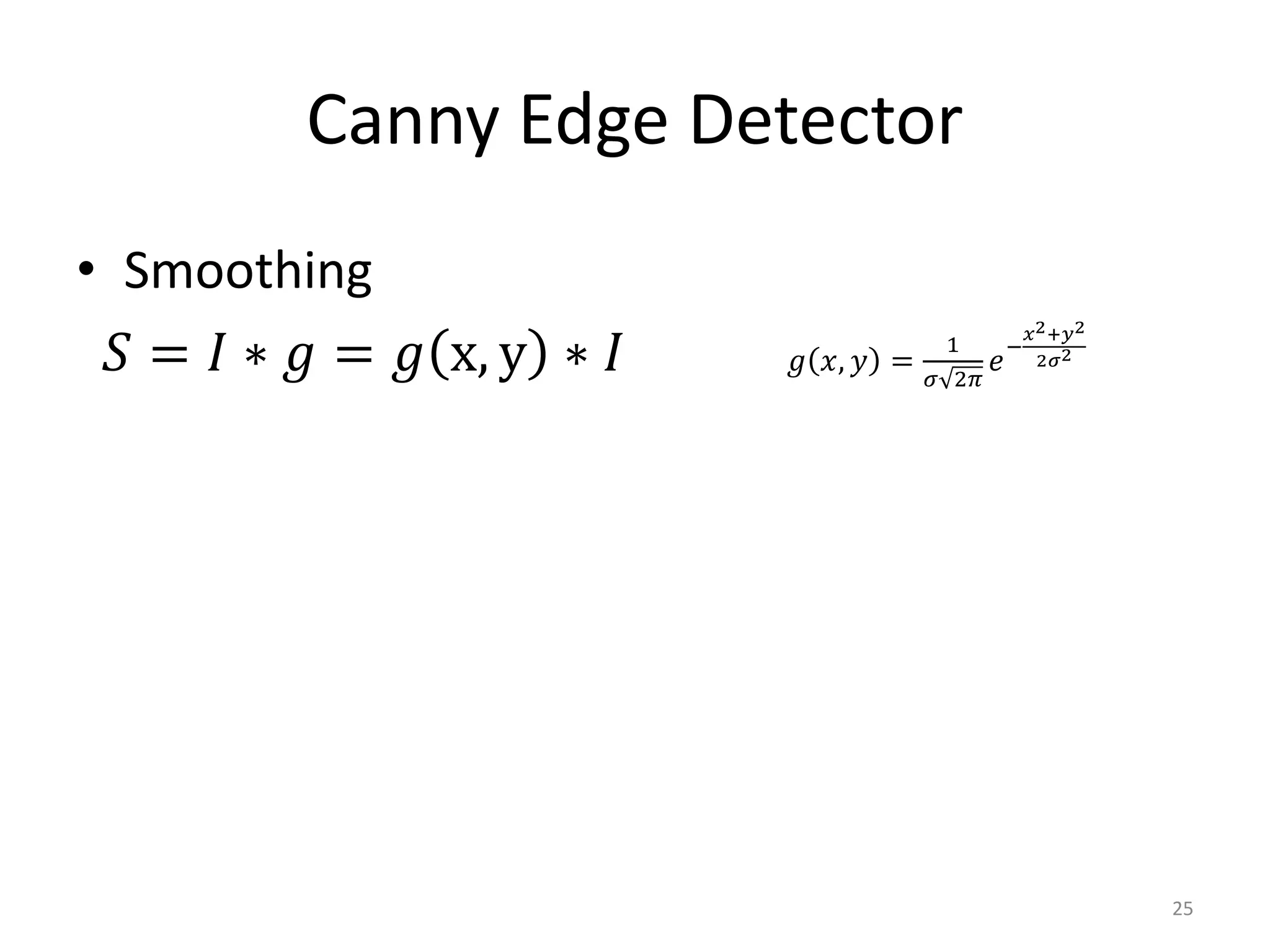
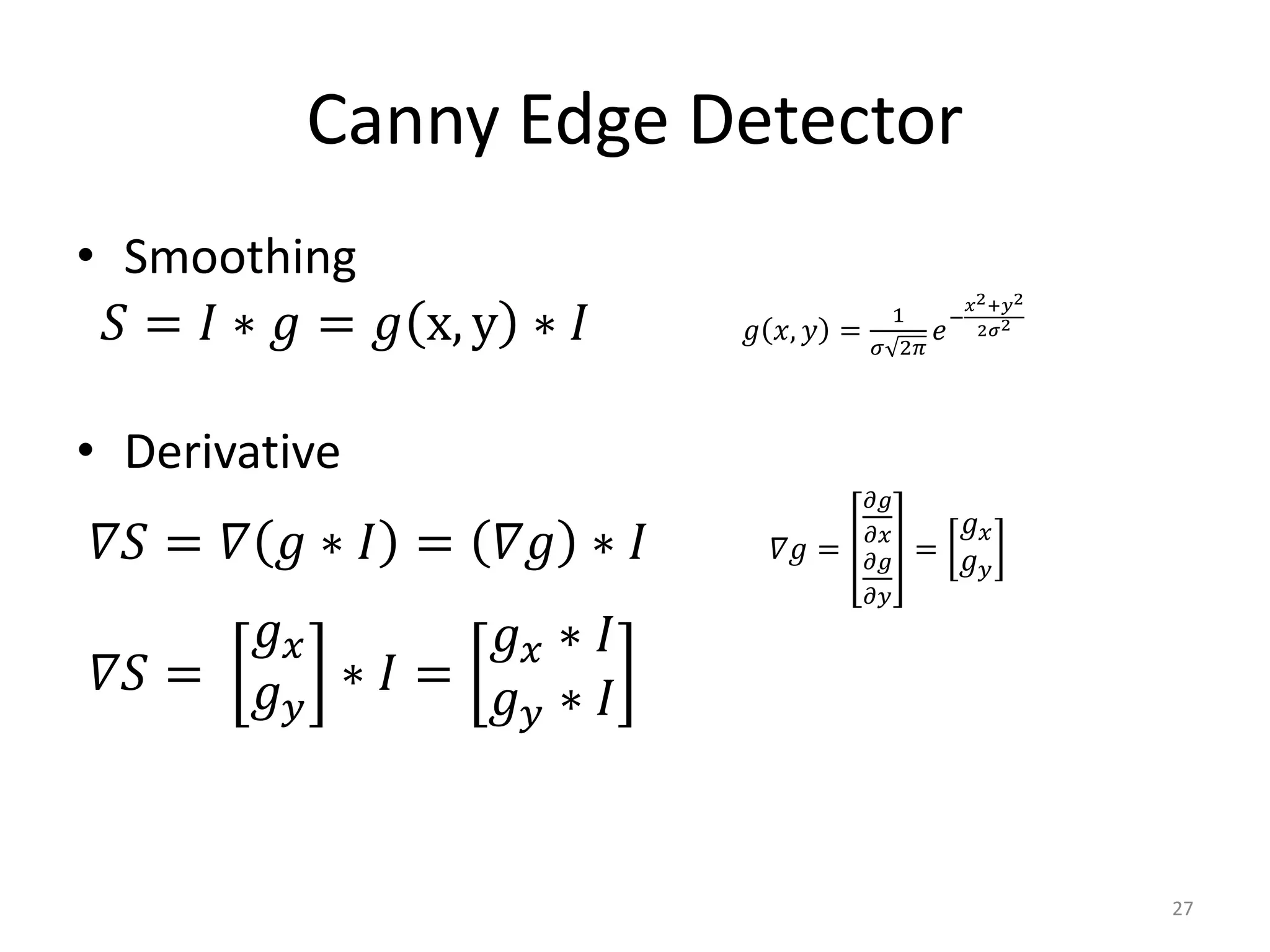
Canny Edge Detector
• Smoothing
𝑆 = 𝐼 ∗ 𝑔 = 𝑔 x, y ∗ 𝐼 𝑔 𝑥, 𝑦 =
1
𝜎 2𝜋
𝑒
−
𝑥2+𝑦2
2𝜎2
25
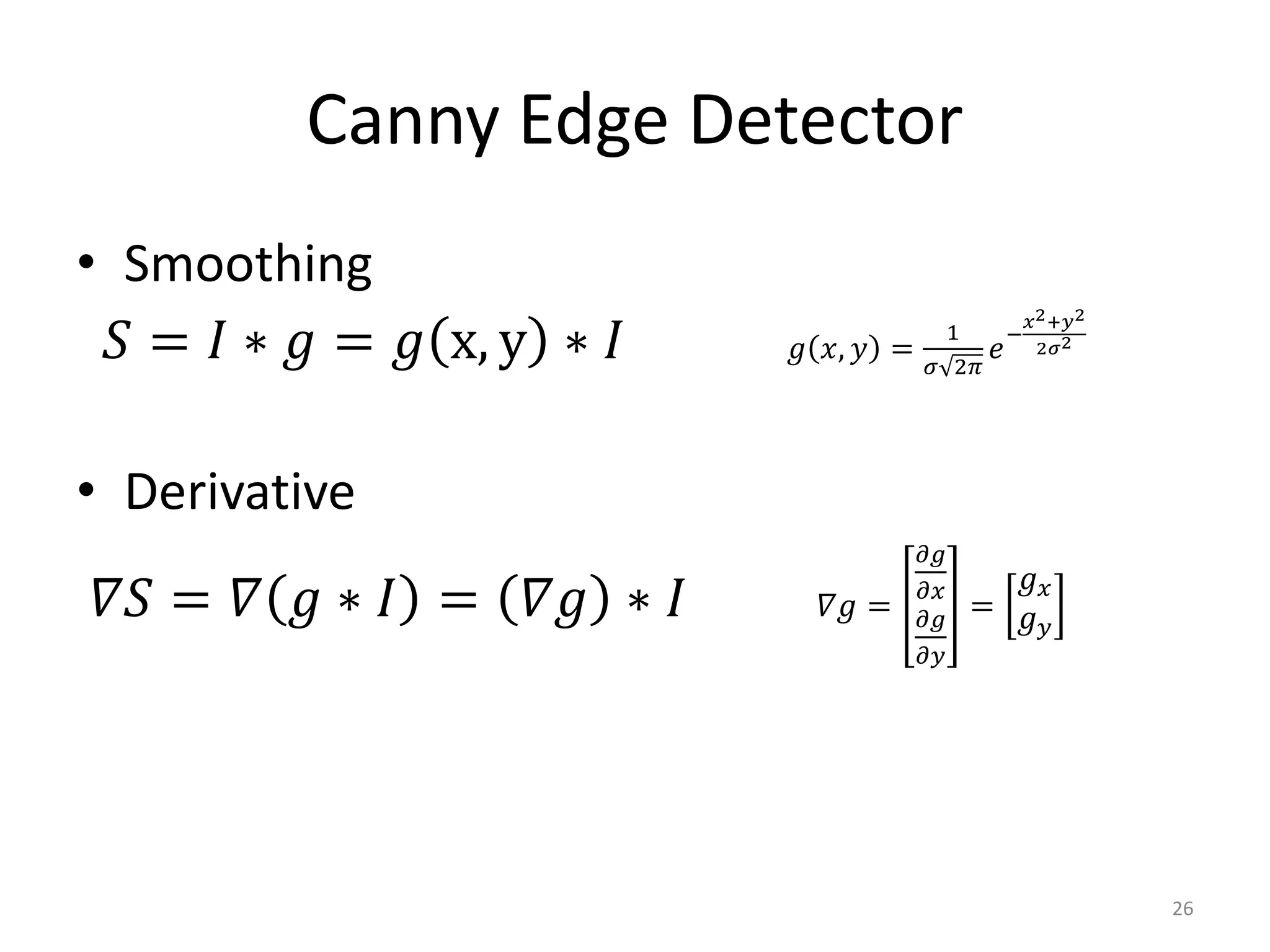
Canny Edge Detector
• Smoothing
𝑆 = 𝐼 ∗ 𝑔 = 𝑔 x, y ∗ 𝐼 𝑔 𝑥, 𝑦 =
1
𝜎 2𝜋
𝑒
−
𝑥2+𝑦2
2𝜎2
• Derivative
𝛻𝑆 = 𝛻 𝑔 ∗ 𝐼 = 𝛻𝑔 ∗ 𝐼 𝛻𝑔 =
𝜕𝑔
𝜕𝑥
𝜕𝑔
𝜕𝑦
=
𝑔 𝑥
𝑔 𝑦
26
Canny Edge Detector
• Smoothing
𝑆 = 𝐼 ∗ 𝑔 = 𝑔 x, y ∗ 𝐼 𝑔 𝑥, 𝑦 =
1
𝜎 2𝜋
𝑒
−
𝑥2+𝑦2
2𝜎2
• Derivative
𝛻𝑆 = 𝛻 𝑔 ∗ 𝐼 = 𝛻𝑔 ∗ 𝐼 𝛻𝑔 =
𝜕𝑔
𝜕𝑥
𝜕𝑔
𝜕𝑦
=
𝑔 𝑥
𝑔 𝑦
𝛻𝑆 =
𝑔 𝑥
𝑔 𝑦
∗ 𝐼 =
𝑔 𝑥 ∗ 𝐼
𝑔 𝑦 ∗ 𝐼
27
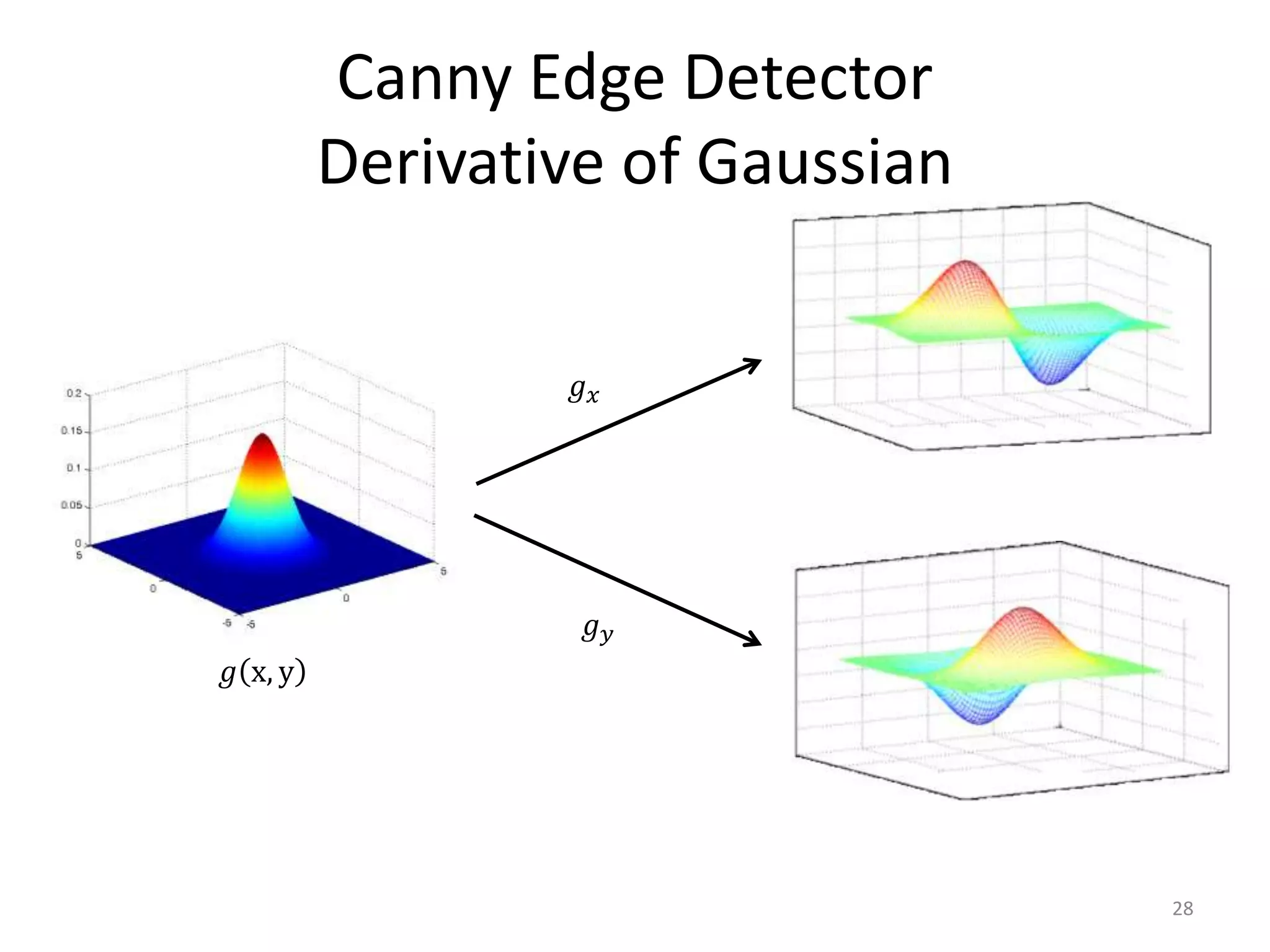
Canny Edge Detector
Derivative of Gaussian
28
𝑔 x, y
𝑔 𝑥
𝑔 𝑦
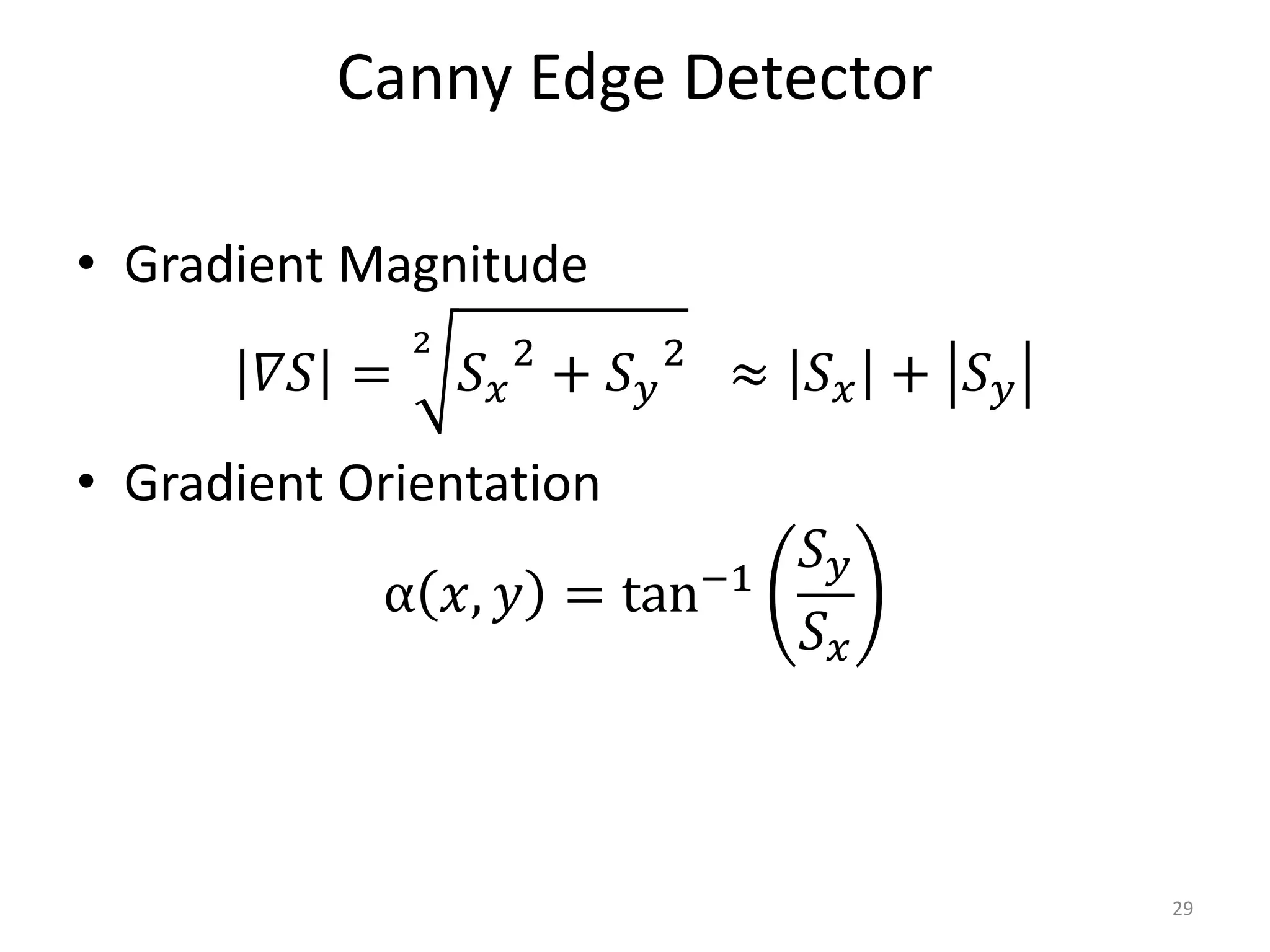
Canny Edge Detector
• Gradient Magnitude
𝛻𝑆 =
2
𝑆 𝑥
2
+ 𝑆 𝑦
2
≈ 𝑆 𝑥 + 𝑆 𝑦
• Gradient Orientation
α 𝑥, 𝑦 = tan−1
𝑆 𝑦
𝑆 𝑥
29
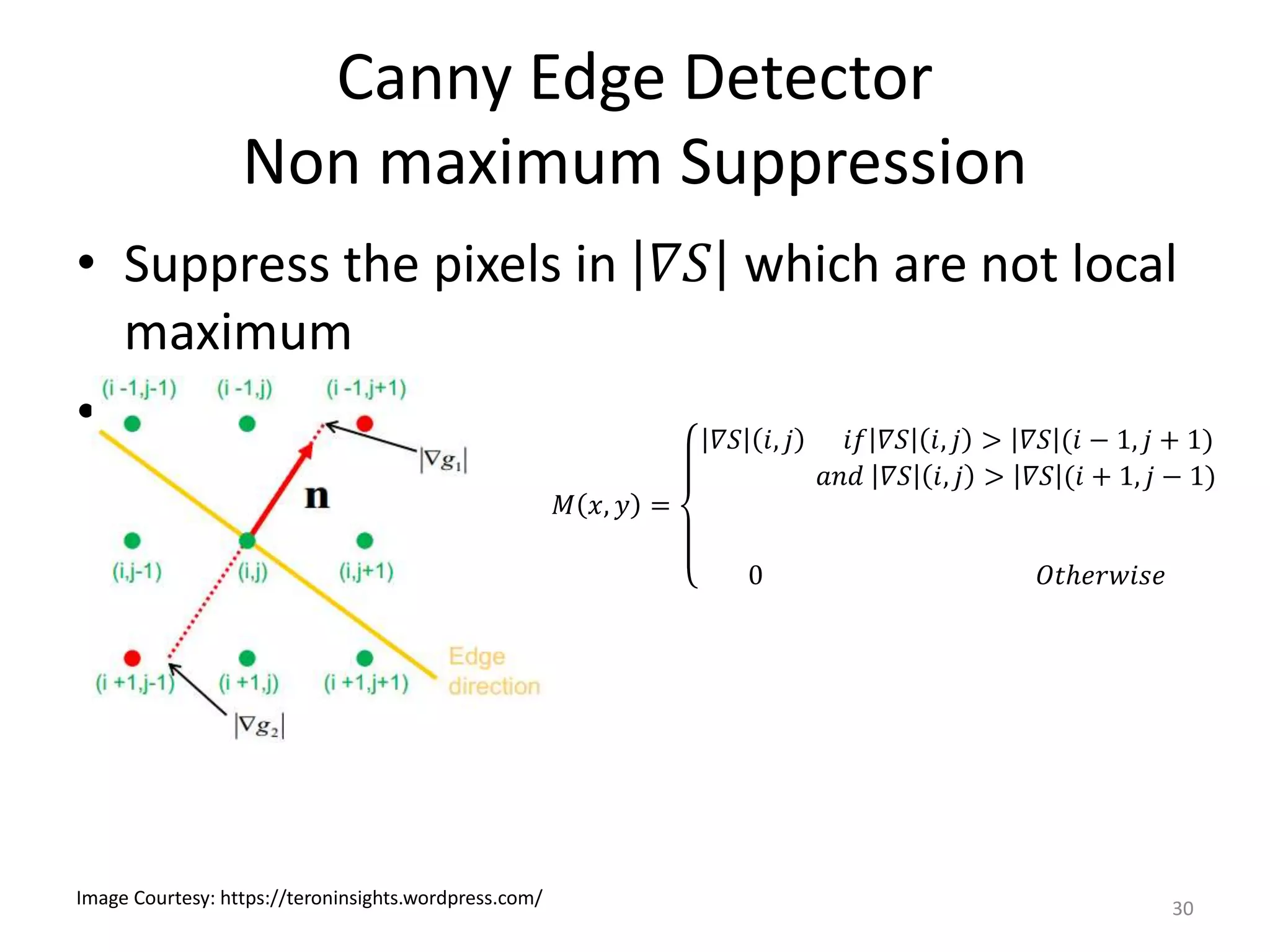
Canny Edge Detector
Non maximum Suppression
30
Image Courtesy: https://teroninsights.wordpress.com/
• Suppress the pixels in 𝛻𝑆 which are not local
maximum
•
𝑀 𝑥, 𝑦 =
𝛻𝑆 𝑖, 𝑗 𝑖𝑓 𝛻𝑆 𝑖, 𝑗 > 𝛻𝑆 (𝑖 − 1, 𝑗 + 1)
𝑎𝑛𝑑 𝛻𝑆 𝑖, 𝑗 > 𝛻𝑆 (𝑖 + 1, 𝑗 − 1)
0 𝑂𝑡ℎ𝑒𝑟𝑤𝑖𝑠𝑒
Canny Edge Detector
Hysteresis Thresholding
• If the gradient at the pixel is
– Above ‘High’, declare it as an ‘edge pixel’
– Below ‘Low’, declare it as a ‘non-edge pixel’
– Between ‘Low’ and ‘High’
• Consider its neighbours iteratively then declare it as an
edge pixel, if it is connected to an edge pixel directly or
via pixels between low and high
31
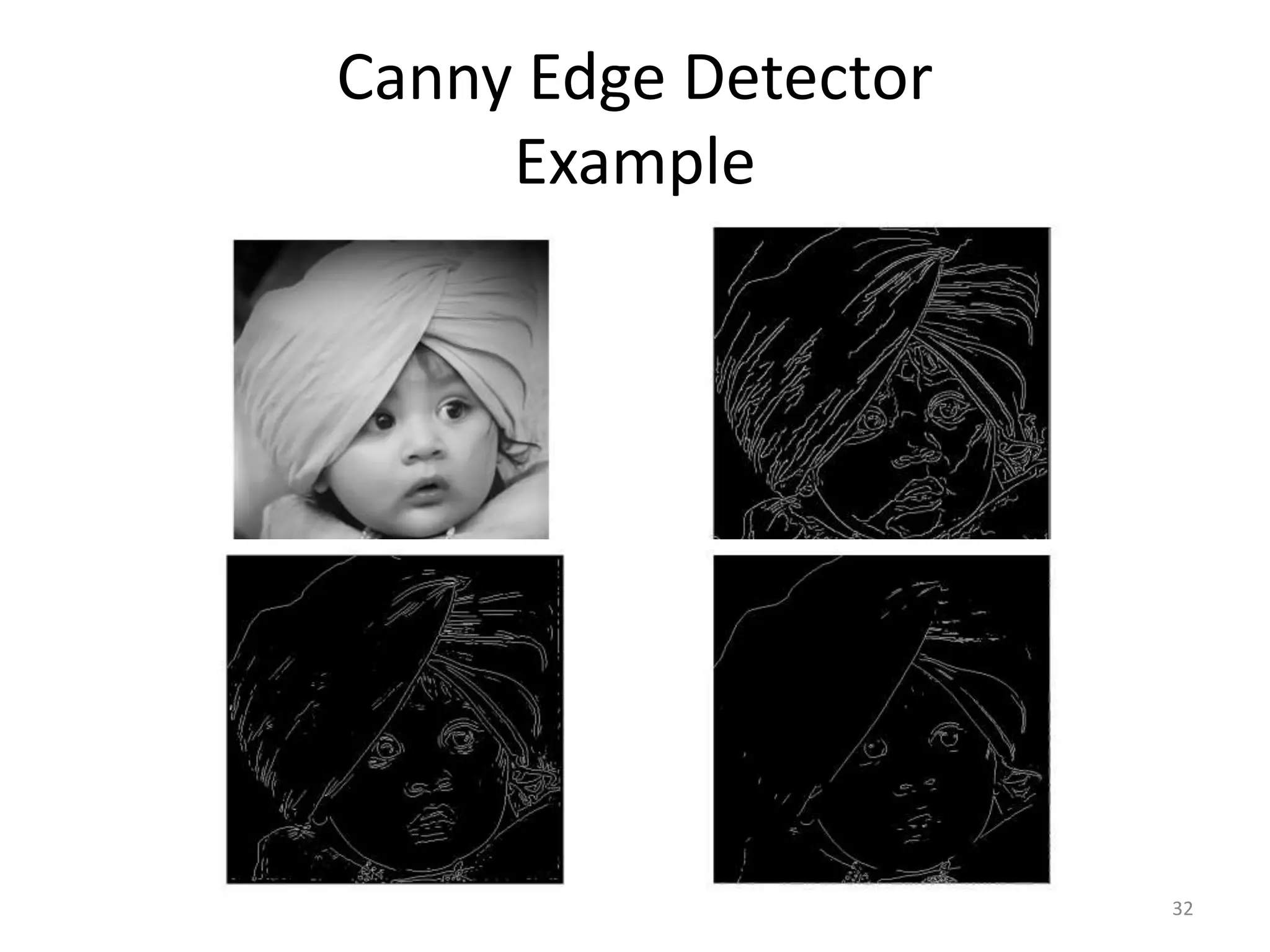
Canny Edge Detector
Example
32

Edge detection

  • 1.
    Edge Detection • EdgeDetection – Identifying sudden change in image intensity. • Applications – Various machine vision problems such as Object Segmentation, Scene understanding etc. 1
  • 2.
    What is anedge? • Discontinuity of intensities in the image • Types of Edges 2
  • 3.
    Edge Detectors • GradientOperators – Prewitt – Sobel • Laplacian of Gaussian (Marr-Hildreth) • Gradient of Gaussian (Canny) 3
  • 4.
    Edge detection byderivatives 4Image courtesy : http://mipav.cit.nih.gov/pubwiki/images/1/11/EdgeDetectionbyDerivative.jpg
  • 5.
    Edge detection byfirst derivative • I = 𝑓 𝑥, 𝑦 • 𝛻𝑓 = 𝐺 𝑥 𝐺 𝑦 = 𝜕𝑓 𝜕𝑥 𝜕𝑓 𝜕𝑦 • 𝛻𝑓 = 𝑚𝑎𝑔 𝛻𝑓 = 2 𝐺 𝑥 2 + 𝐺 𝑦 2 ≈ 𝐺 𝑥 + 𝐺 𝑦 • Direction of 𝛻𝑓, α 𝑥, 𝑦 = tan−1 𝐺 𝑦 𝐺 𝑥 5
  • 6.
    Edge detection byfirst derivative • I = 𝑓 𝑥, 𝑦 • 𝛻𝑓 = 𝐺 𝑥 𝐺 𝑦 = 𝜕𝑓 𝜕𝑥 𝜕𝑓 𝜕𝑦 • 𝛻𝑓 = 𝑚𝑎𝑔 𝛻𝑓 = 2 𝐺 𝑥 2 + 𝐺 𝑦 2 ≈ 𝐺 𝑥 + 𝐺 𝑦 • Direction of 𝛻𝑓, α 𝑥, 𝑦 = tan−1 𝐺 𝑦 𝐺 𝑥 6
  • 7.
    • Prewitt edgeoperator Prewitt and Sobel Edge Detector -1 -1 -1 0 0 0 -1 -1 -1 8 -1 0 -1 -1 0 -1 -1 0 -1 Horizontal Vertical
  • 8.
    • Prewitt edgeoperator • Sobel edge operator Prewitt and Sobel Edge Detector -1 -1 -1 0 0 0 -1 -1 -1 9 -1 0 -1 -1 0 -1 -1 0 -1 Horizontal Vertical -1 -2 -1 0 0 0 1 2 1 -1 0 1 -2 0 2 -1 0 1 Horizontal Vertical
  • 9.
    1 0 −1 20 −2 1 0 −1 1 2 1 0 0 0 −1 −2 −1 Sobel Edge Detector 10 Image I * * 𝜕𝐼 𝜕𝑥 𝜕𝐼 𝜕𝑦 𝛻𝑓 Threshold Edges
  • 10.
  • 11.
    Marr Hildreth Edgedetector • Laplacian of Gaussian • Smooth image by Gaussian filter • Apply Laplacian to smoothed image • Find zero crossing – Scan along each row, record an edge point at the location of zero crossing – Repeat the step along each column 12
  • 12.
    • Gaussian Smoothing 𝑆𝑚𝑜𝑜𝑡ℎ𝑒𝑑𝐼𝑚𝑎𝑔𝑒 𝐺𝑎𝑢𝑠𝑠𝑖𝑎𝑛 𝑓𝑖𝑙𝑡𝑒𝑟 𝐼𝑚𝑎𝑔𝑒 𝑆 = 𝑔 ∗ 𝐼 Marr Hildreth Edge detector 13
  • 13.
    • Gaussian Smoothing 𝑆𝑚𝑜𝑜𝑡ℎ𝑒𝑑𝐼𝑚𝑎𝑔𝑒 𝐺𝑎𝑢𝑠𝑠𝑖𝑎𝑛 𝑓𝑖𝑙𝑡𝑒𝑟 𝐼𝑚𝑎𝑔𝑒 𝑆 = 𝑔 ∗ 𝐼 𝑔 = 𝑔 𝑥, 𝑦 = 1 𝜎 2𝜋 𝑒 − 𝑥2+𝑦2 2𝜎2 where 𝜎 𝑖𝑠 𝑆𝐷 Marr Hildreth Edge detector 14
  • 14.
    • Gaussian Smoothing 𝑆𝑚𝑜𝑜𝑡ℎ𝑒𝑑𝐼𝑚𝑎𝑔𝑒 𝐺𝑎𝑢𝑠𝑠𝑖𝑎𝑛 𝑓𝑖𝑙𝑡𝑒𝑟 𝐼𝑚𝑎𝑔𝑒 𝑆 = 𝑔 ∗ 𝐼 𝑔 = 𝑔 𝑥, 𝑦 = 1 𝜎 2𝜋 𝑒 − 𝑥2+𝑦2 2𝜎2 where 𝜎 𝑖𝑠 𝑆𝐷 Marr Hildreth Edge detector 15
  • 15.
    Marr Hildreth Edgedetector • Laplacian operator 𝛻2 𝑓 = 𝜕2 𝑓 𝜕𝑥2 + 𝜕2 𝑓 𝜕𝑦2 16
  • 16.
    Marr Hildreth Edgedetector • Laplacian operator 𝛻2 𝑓 = 𝜕2 𝑓 𝜕𝑥2 + 𝜕2 𝑓 𝜕𝑦2 • Laplacian of Gaussian (LoG) 𝛻2 𝑆 = 𝛻2 𝑔 ∗ 𝐼 = (𝛻2 𝑔) ∗ 𝐼 17
  • 17.
    Marr Hildreth Edgedetector • Laplacian operator 𝛻2 𝑓 = 𝜕2 𝑓 𝜕𝑥2 + 𝜕2 𝑓 𝜕𝑦2 • Laplacian of Gaussian (LoG) 𝛻2 𝑆 = 𝛻2 𝑔 ∗ 𝐼 = (𝛻2 𝑔) ∗ 𝐼 𝛻2 𝑔 = − 1 2𝜋𝜎3 2 − 𝑥2+𝑦2 𝜎2 𝑒 − 𝑥2+𝑦2 2𝜎2 18
  • 18.
    Marr Hildreth Edgedetector: Laplacian of Gaussian 20
  • 19.
    Marr Hildreth Edgedetector: Laplacian of Gaussian 21
  • 20.
    22 Marr Hildreth Edgedetector Example
  • 21.
    Canny Edge Detector •Three main criteria – Good Detection : The ability to locate and mark all real edges – Good Localisation : Minimal distance between the detected edge and real edge – Clear Response : Only one response per edge 23
  • 22.
    Canny Edge Detector •Image Smoothing with Gaussian filter • Compute derivative of smoothed image • Find magnitude and orientation of gradient • Apply ‘Non-maximum Suppression’ • Apply Threshold 24
  • 23.
    Canny Edge Detector •Smoothing 𝑆 = 𝐼 ∗ 𝑔 = 𝑔 x, y ∗ 𝐼 𝑔 𝑥, 𝑦 = 1 𝜎 2𝜋 𝑒 − 𝑥2+𝑦2 2𝜎2 25
  • 24.
    Canny Edge Detector •Smoothing 𝑆 = 𝐼 ∗ 𝑔 = 𝑔 x, y ∗ 𝐼 𝑔 𝑥, 𝑦 = 1 𝜎 2𝜋 𝑒 − 𝑥2+𝑦2 2𝜎2 • Derivative 𝛻𝑆 = 𝛻 𝑔 ∗ 𝐼 = 𝛻𝑔 ∗ 𝐼 𝛻𝑔 = 𝜕𝑔 𝜕𝑥 𝜕𝑔 𝜕𝑦 = 𝑔 𝑥 𝑔 𝑦 26
  • 25.
    Canny Edge Detector •Smoothing 𝑆 = 𝐼 ∗ 𝑔 = 𝑔 x, y ∗ 𝐼 𝑔 𝑥, 𝑦 = 1 𝜎 2𝜋 𝑒 − 𝑥2+𝑦2 2𝜎2 • Derivative 𝛻𝑆 = 𝛻 𝑔 ∗ 𝐼 = 𝛻𝑔 ∗ 𝐼 𝛻𝑔 = 𝜕𝑔 𝜕𝑥 𝜕𝑔 𝜕𝑦 = 𝑔 𝑥 𝑔 𝑦 𝛻𝑆 = 𝑔 𝑥 𝑔 𝑦 ∗ 𝐼 = 𝑔 𝑥 ∗ 𝐼 𝑔 𝑦 ∗ 𝐼 27
  • 26.
    Canny Edge Detector Derivativeof Gaussian 28 𝑔 x, y 𝑔 𝑥 𝑔 𝑦
  • 27.
    Canny Edge Detector •Gradient Magnitude 𝛻𝑆 = 2 𝑆 𝑥 2 + 𝑆 𝑦 2 ≈ 𝑆 𝑥 + 𝑆 𝑦 • Gradient Orientation α 𝑥, 𝑦 = tan−1 𝑆 𝑦 𝑆 𝑥 29
  • 28.
    Canny Edge Detector Nonmaximum Suppression 30 Image Courtesy: https://teroninsights.wordpress.com/ • Suppress the pixels in 𝛻𝑆 which are not local maximum • 𝑀 𝑥, 𝑦 = 𝛻𝑆 𝑖, 𝑗 𝑖𝑓 𝛻𝑆 𝑖, 𝑗 > 𝛻𝑆 (𝑖 − 1, 𝑗 + 1) 𝑎𝑛𝑑 𝛻𝑆 𝑖, 𝑗 > 𝛻𝑆 (𝑖 + 1, 𝑗 − 1) 0 𝑂𝑡ℎ𝑒𝑟𝑤𝑖𝑠𝑒
  • 29.
    Canny Edge Detector HysteresisThresholding • If the gradient at the pixel is – Above ‘High’, declare it as an ‘edge pixel’ – Below ‘Low’, declare it as a ‘non-edge pixel’ – Between ‘Low’ and ‘High’ • Consider its neighbours iteratively then declare it as an edge pixel, if it is connected to an edge pixel directly or via pixels between low and high 31
  • 30.