SEMINAR ON : 
BY: 
Raghukumar 
D.S.
ABSTRCT 
 Introduction 
 Set Theory Concepts 
 Structuring Elements , Hits or fits 
 Dilation And Erosion 
 Opening And Closing 
 Hit-or-Miss Transformation 
 Basic Morphological Algorithms 
 Implementation 
 Conclusion
Introduction 
 Morphological – Shape , form , Structure 
►Extracting and Describing image component 
regions 
►Usually applied to binary images 
►Based on set Theory
Set Theory 
BASICS: 
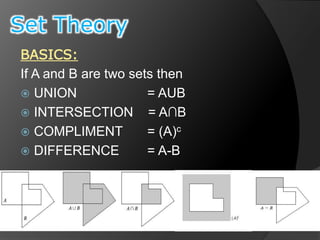
If A and B are two sets then 
 UNION = AUB 
 INTERSECTION = A∩B 
 COMPLIMENT = (A)c 
 DIFFERENCE = A-B
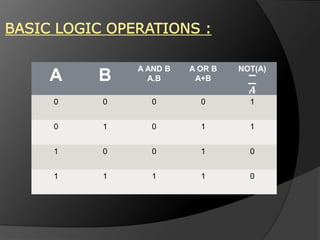
BASIC LOGIC OPERATIONS : 
A B A AND B 
A.B 
A OR B 
A+B 
NOT(A) 
− 
푨 
0 0 0 0 1 
0 1 0 1 1 
1 0 0 1 0 
1 1 1 1 0
LOGIC OPERATIONS REPRESENTATION:
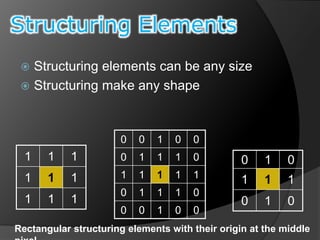
Structuring Elements 
 Structuring elements can be any size 
 Structuring make any shape 
1 1 1 
1 1 1 
1 1 1 
0 0 1 0 0 
0 1 1 1 0 
1 1 1 1 1 
0 1 1 1 0 
0 0 1 0 0 
0 1 0 
1 1 1 
0 1 0 
Rectangular structuring elements with their origin at the middle 
pixel
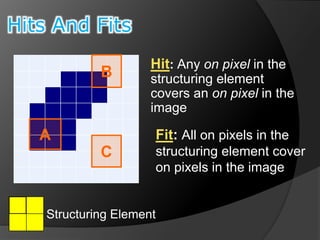
Hits And Fits 
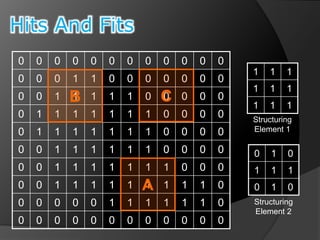
Hit: Any on pixel in the 
structuring element 
covers an on pixel in the 
image 
B 
A 
C 
Fit: All on pixels in the 
structuring element cover 
on pixels in the image 
Structuring Element
0 0 0 0 0 0 0 0 0 0 0 0 
0 0 0 1 1 0 0 0 0 0 0 0 
0 0 1 B 1 1 1 1 0 C 
0 0 0 0 
0 1 1 1 1 1 1 1 0 0 0 0 
0 1 1 1 1 1 1 1 0 0 0 0 
0 0 1 1 1 1 1 1 0 0 0 0 
0 0 1 1 1 1 1 1 1 0 0 0 
0 0 1 1 1 1 1 A 
1 1 1 1 0 
0 0 0 0 0 1 1 1 1 1 1 0 
0 0 0 0 0 0 0 0 0 0 0 0 
1 1 1 
1 1 1 
1 1 1 
Structuring 
Element 1 
0 1 0 
1 1 1 
0 1 0 
Structuring 
Element 2 
Hits And Fits
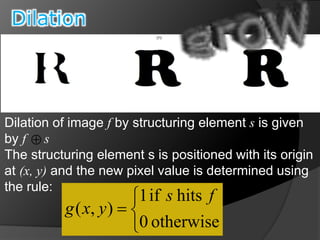
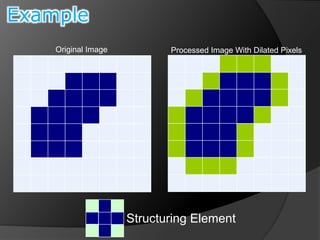
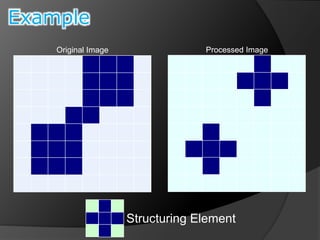
Dilation 
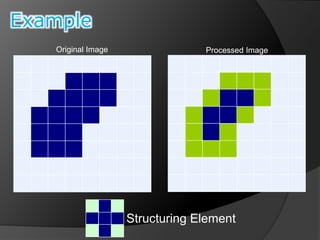
Dilation of image f by structuring element s is given 
by f s 
The structuring element s is positioned with its origin 
at (x, y) and the new pixel value is determined using 
the rule: 
1 if hits 
   
 
0 otherwise 
( , ) 
s f 
g x y 

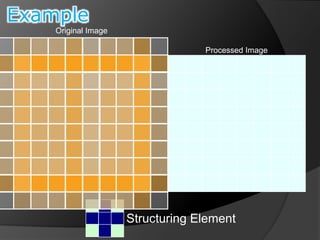
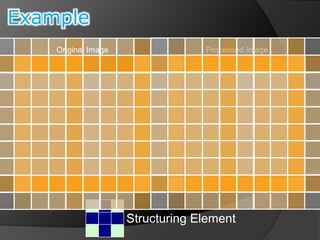
Example 
Structuring Element 
Original Image 
Processed Image
Original Image Processed Image With Dilated Pixels 
Structuring Element 
Example
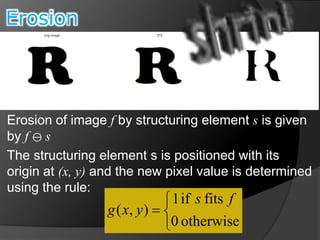
Erosion 
Erosion of image f by structuring element s is given 
by f  s 
The structuring element s is positioned with its 
origin at (x, y) and the new pixel value is determined 
using the rule: 
   
 
1 if fits 
0 otherwise 
( , ) 
s f 
g x y
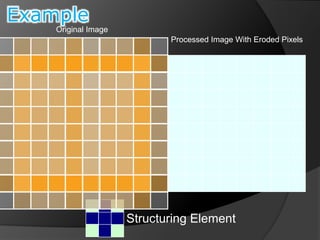
Structuring Element 
Original Image 
Processed Image With Eroded Pixels 
Example
Original Image Processed Image 
Structuring Element 
Example
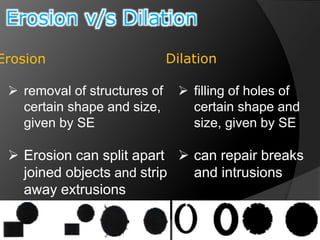
Erosion v/s Dilation 
Erosion 
 removal of structures of 
certain shape and size, 
given by SE 
 Erosion can split apart 
Dilation 
joined objects and strip 
away extrusions 
 filling of holes of 
certain shape and 
size, given by SE 
 can repair breaks 
and intrusions
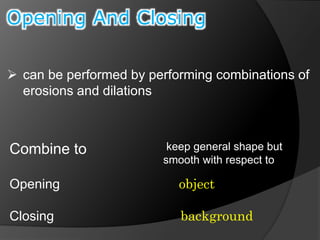
Opening And Closing 
 can be performed by performing combinations of 
erosions and dilations 
Combine to 
keep general shape but 
smooth with respect to 
Opening object 
Closing background
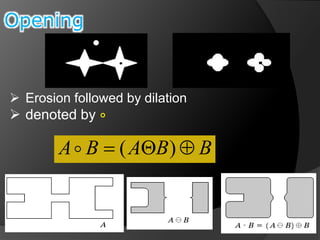
Opening 
 Erosion followed by dilation 
 denoted by ∘ 
A B  (AB) B
Original Image Processed Image 
Structuring Element 
Example
Original Image Processed Image 
Structuring Element 
Example
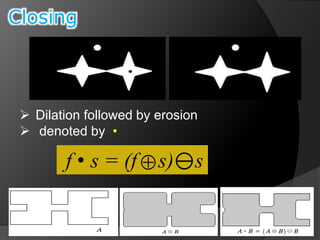
Closing 
 Dilation followed by erosion 
 denoted by • 
f • s = (f s)s 
Original Image Processed Image 
Structuring Element 
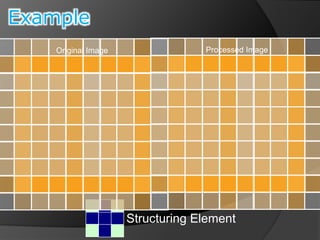
Example
Original Image Processed Image 
Structuring Element 
Example
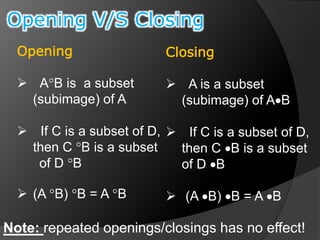
Opening V/S Closing 
Opening 
 AB is a subset 
(subimage) of A 
 If C is a subset of D, 
then C B is a subset 
of D B 
 (A B) B = A B 
Closing 
 A is a subset 
(subimage) of AB 
 If C is a subset of D, 
then C B is a subset 
of D B 
 (A B) B = A B 
Note: repeated openings/closings has no effect!
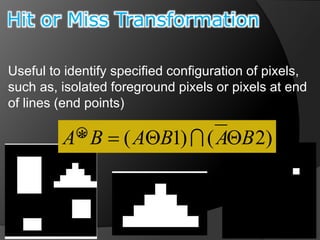
Hit or Miss Transformation 
Useful to identify specified configuration of pixels, 
such as, isolated foreground pixels or pixels at end 
of lines (end points) 
A*B  (AB1)(AB2)
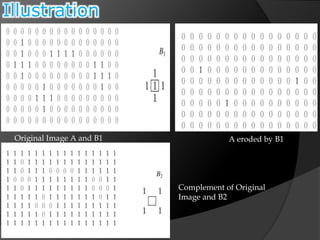
Illustration 
Original Image A and B1 A eroded by B1 
Complement of Original 
Image and B2
Erosion of A complement 
And B2 
Intersection of eroded images
Morphological Algorithms 
Using the simple technique we have 
looked at so far we can begin to consider 
some more interesting morphological 
algorithms 
We will look at: 
 Boundary extraction
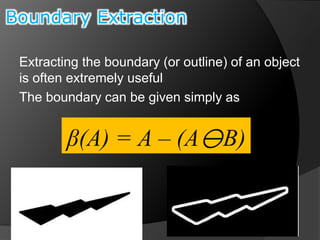
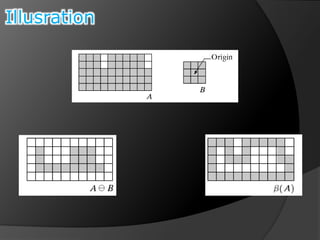
Boundary Extraction 
Extracting the boundary (or outline) of an object 
is often extremely useful 
The boundary can be given simply as 
β(A) = A – (AB)
Illusration
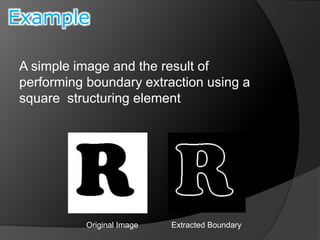
Example 
A simple image and the result of 
performing boundary extraction using a 
square structuring element 
Original Image Extracted Boundary
Conclusion 
Morphology is powerful set of tools for extracting 
features in an image 
We implement algorithms like Thinning thickening 
Skeletons etc. various purpose of image 
processing activities like semantation.
Thank you

Morphological image processing

  • 1.
    SEMINAR ON : BY: Raghukumar D.S.
  • 2.
    ABSTRCT  Introduction  Set Theory Concepts  Structuring Elements , Hits or fits  Dilation And Erosion  Opening And Closing  Hit-or-Miss Transformation  Basic Morphological Algorithms  Implementation  Conclusion
  • 3.
    Introduction  Morphological– Shape , form , Structure ►Extracting and Describing image component regions ►Usually applied to binary images ►Based on set Theory
  • 4.
    Set Theory BASICS: If A and B are two sets then  UNION = AUB  INTERSECTION = A∩B  COMPLIMENT = (A)c  DIFFERENCE = A-B
  • 5.
    BASIC LOGIC OPERATIONS: A B A AND B A.B A OR B A+B NOT(A) − 푨 0 0 0 0 1 0 1 0 1 1 1 0 0 1 0 1 1 1 1 0
  • 6.
  • 7.
    Structuring Elements Structuring elements can be any size  Structuring make any shape 1 1 1 1 1 1 1 1 1 0 0 1 0 0 0 1 1 1 0 1 1 1 1 1 0 1 1 1 0 0 0 1 0 0 0 1 0 1 1 1 0 1 0 Rectangular structuring elements with their origin at the middle pixel
  • 8.
    Hits And Fits Hit: Any on pixel in the structuring element covers an on pixel in the image B A C Fit: All on pixels in the structuring element cover on pixels in the image Structuring Element
  • 9.
    0 0 00 0 0 0 0 0 0 0 0 0 0 0 1 1 0 0 0 0 0 0 0 0 0 1 B 1 1 1 1 0 C 0 0 0 0 0 1 1 1 1 1 1 1 0 0 0 0 0 1 1 1 1 1 1 1 0 0 0 0 0 0 1 1 1 1 1 1 0 0 0 0 0 0 1 1 1 1 1 1 1 0 0 0 0 0 1 1 1 1 1 A 1 1 1 1 0 0 0 0 0 0 1 1 1 1 1 1 0 0 0 0 0 0 0 0 0 0 0 0 0 1 1 1 1 1 1 1 1 1 Structuring Element 1 0 1 0 1 1 1 0 1 0 Structuring Element 2 Hits And Fits
  • 10.
    Dilation Dilation ofimage f by structuring element s is given by f s The structuring element s is positioned with its origin at (x, y) and the new pixel value is determined using the rule: 1 if hits     0 otherwise ( , ) s f g x y 
  • 11.
    Example Structuring Element Original Image Processed Image
  • 12.
    Original Image ProcessedImage With Dilated Pixels Structuring Element Example
  • 13.
    Erosion Erosion ofimage f by structuring element s is given by f  s The structuring element s is positioned with its origin at (x, y) and the new pixel value is determined using the rule:     1 if fits 0 otherwise ( , ) s f g x y
  • 14.
    Structuring Element OriginalImage Processed Image With Eroded Pixels Example
  • 15.
    Original Image ProcessedImage Structuring Element Example
  • 16.
    Erosion v/s Dilation Erosion  removal of structures of certain shape and size, given by SE  Erosion can split apart Dilation joined objects and strip away extrusions  filling of holes of certain shape and size, given by SE  can repair breaks and intrusions
  • 17.
    Opening And Closing  can be performed by performing combinations of erosions and dilations Combine to keep general shape but smooth with respect to Opening object Closing background
  • 18.
    Opening  Erosionfollowed by dilation  denoted by ∘ A B  (AB) B
  • 19.
    Original Image ProcessedImage Structuring Element Example
  • 20.
    Original Image ProcessedImage Structuring Element Example
  • 21.
    Closing  Dilationfollowed by erosion  denoted by • f • s = (f s)s 
  • 22.
    Original Image ProcessedImage Structuring Element Example
  • 23.
    Original Image ProcessedImage Structuring Element Example
  • 24.
    Opening V/S Closing Opening  AB is a subset (subimage) of A  If C is a subset of D, then C B is a subset of D B  (A B) B = A B Closing  A is a subset (subimage) of AB  If C is a subset of D, then C B is a subset of D B  (A B) B = A B Note: repeated openings/closings has no effect!
  • 25.
    Hit or MissTransformation Useful to identify specified configuration of pixels, such as, isolated foreground pixels or pixels at end of lines (end points) A*B  (AB1)(AB2)
  • 26.
    Illustration Original ImageA and B1 A eroded by B1 Complement of Original Image and B2
  • 27.
    Erosion of Acomplement And B2 Intersection of eroded images
  • 28.
    Morphological Algorithms Usingthe simple technique we have looked at so far we can begin to consider some more interesting morphological algorithms We will look at:  Boundary extraction
  • 29.
    Boundary Extraction Extractingthe boundary (or outline) of an object is often extremely useful The boundary can be given simply as β(A) = A – (AB)
  • 30.
  • 31.
    Example A simpleimage and the result of performing boundary extraction using a square structuring element Original Image Extracted Boundary
  • 32.
    Conclusion Morphology ispowerful set of tools for extracting features in an image We implement algorithms like Thinning thickening Skeletons etc. various purpose of image processing activities like semantation.
  • 33.