DC Motor - 2
Muhamad Zahim
Ext : 2312
BEE2123BEE2123
ELECTRICAL MACHINESELECTRICAL MACHINES
Contents
– Overview of Direct Current Machines
– Construction
– Principle of Operation
– Types of DC Motor
– Power Flow Diagram
– Speed Control
DC motor principles
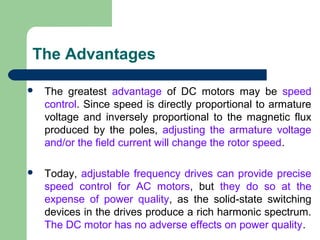
 DC motors consist of rotor-mounted
windings (armature) and stationary
windings (field poles). In all DC motors,
except permanent magnet motors,
current must be conducted to the
armature windings by passing current
through carbon brushes that slide over
a set of copper surfaces called a
commutator, which is mounted on the
rotor. Parts of an electric motor
 The commutator bars are soldered to armature coils. The brush/commutator
combination makes a sliding switch that energizes particular portions of the
armature, based on the position of the rotor. This process creates north and
south magnetic poles on the rotor that are attracted to or repelled by north
and south poles on the stator, which are formed by passing direct current
through the field windings. It's this magnetic attraction and repulsion that
causes the rotor to rotate.
The Advantages
 The greatest advantage of DC motors may be speed
control. Since speed is directly proportional to armature
voltage and inversely proportional to the magnetic flux
produced by the poles, adjusting the armature voltage
and/or the field current will change the rotor speed.
 Today, adjustable frequency drives can provide precise
speed control for AC motors, but they do so at the
expense of power quality, as the solid-state switching
devices in the drives produce a rich harmonic spectrum.
The DC motor has no adverse effects on power quality.
The drawbacks
 Power supply, initial cost, and maintenance
requirements are the negatives associated with DC
motors
 Rectification must be provided for any DC motors
supplied from the grid. It can also cause power quality
problems.
 The construction of a DC motor is considerably more
complicated and expensive than that of an AC motor,
primarily due to the commutator, brushes, and armature
windings. An induction motor requires no commutator or
brushes, and most use cast squirrel-cage rotor bars
instead of true windings — two huge simplifications.
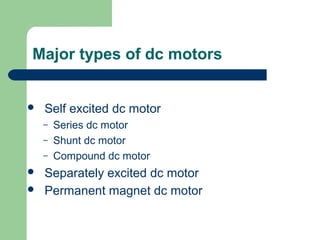
Major types of dc motors
 Self excited dc motor
– Series dc motor
– Shunt dc motor
– Compound dc motor
 Separately excited dc motor
 Permanent magnet dc motor
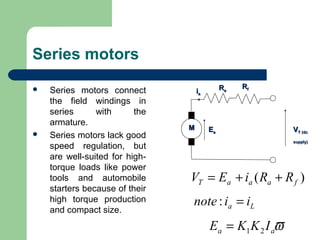
Series motors
 Series motors connect
the field windings in
series with the
armature.
 Series motors lack good
speed regulation, but
are well-suited for high-
torque loads like power
tools and automobile
starters because of their
high torque production
and compact size.
EEaa
RRff
MM VVT (dcT (dc
supply)supply)
RRaaiiaa
)( faaaT RRiEV ++=
La iinote =:
ϖaa IKKE 21=
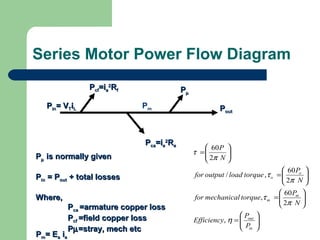
Series Motor Power Flow Diagram
PPµµ
PPoutout
PPinin= V= VTTiiLL
PPcaca=i=iaa
22
RRaa
PPcfcf=i=iaa
22
RRff
Pm
PPµµ is normally givenis normally given
PPinin = P= Poutout + total losses+ total losses
Where,Where,
PPcaca =armature copper loss=armature copper loss
PPcfcf =field copper loss=field copper loss
PPµµ=stray, mech etc=stray, mech etc






=






=






=






=
in
out
m
m
o
o
P
P
Efficiency
N
P
torquemechanicalfor
N
P
torqueloadoutputfor
N
P
η
π
τ
π
τ
π
τ
,
2
60
,
2
60
,/
2
60
PPmm= E= Eaa iiaa
Series Motor (cont)
 Example 1:
A dc machine in Figure 1 is
consumed a 6.5kW when the
12.5 A of armature current is
passing thru the armature and
field resistance of 3.3Ω and 2.0Ω
respectively. Assume stray
losses of 1.2kW. Calculate
a) terminal voltage, VT
b) back emf, Ea
c) net torque if the speed is at
3560rpm
d) efficiency of the machine
[520V, 453.75V, 12N-m, 68.8%]
EEaa
RRff
MM VVT (dcT (dc
supply)supply)
RRaaiiaa
Figure 1
Series Motor (cont)
 Example 2:
A 600V 150-hp dc machine in
Figure 2 operates at its full rated
load at 600rpm. The armature and
field resistance are 0.12Ω and
0.04Ω respectively. The machine
draws 200A at full load. Assume
stray losses 1700W. Determine
a) the armature back emf at full load,
Ea
b) developed/mechanical power and
developed/mechanical torque
c) assume that a change in load
results in the line current dropping
to 150A. Find the new speed in
rpm and new developed torque.
{Hint: Ea=K1K2iaω}
EEaa
RRff
MM VVT (dcT (dc
supply)supply)
RRaaiiaa
Figure 2
[568V, 113.6kW, 1808Nm, 811.27rpm, 1017Nm]
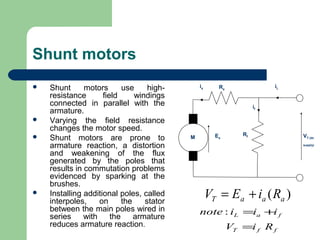
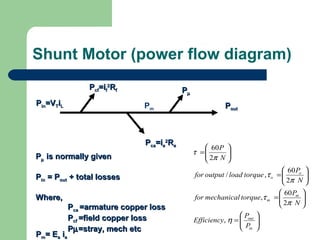
Shunt motors
 Shunt motors use high-
resistance field windings
connected in parallel with the
armature.
 Varying the field resistance
changes the motor speed.
 Shunt motors are prone to
armature reaction, a distortion
and weakening of the flux
generated by the poles that
results in commutation problems
evidenced by sparking at the
brushes.
 Installing additional poles, called
interpoles, on the stator
between the main poles wired in
series with the armature
reduces armature reaction.
Ea VT (dc
supply)
Ra
ia
if
Rf
M
iL
)( aaaT RiEV +=
ffT
faL
RiV
iiinote
=
+=:
Shunt Motor (power flow diagram)
PPµµ
PPoutout
PPinin=V=VTTiiLL
PPcaca=i=iaa
22
RRaa
PPcfcf=i=iff
22
RRff
Pm
PPµµ is normally givenis normally given
PPinin = P= Poutout + total losses+ total losses
Where,Where,
PPcaca =armature copper loss=armature copper loss
PPcfcf =field copper loss=field copper loss
PPµµ=stray, mech etc=stray, mech etc






=






=






=






=
in
out
m
m
o
o
P
P
Efficiency
N
P
torquemechanicalfor
N
P
torqueloadoutputfor
N
P
η
π
τ
π
τ
π
τ
,
2
60
,
2
60
,/
2
60
PPmm= E= Eaa iiaa
Shunt Motor
 Example :
– A voltage of 230V is applied to armature of a
machines results in a full load armature currents
of 205A. Assume that armature resistance is
0.2Ω. Find the back emf, net power and torque by
assuming the rotational losses are 1445W at full
load speed of 1750rpm.
[189V, 37.3kW, 203.5Nm]
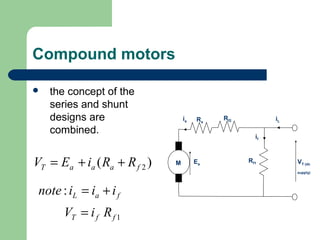
Compound motors
 the concept of the
series and shunt
designs are
combined.
Ea VT (dc
supply)
Ra
ia
if
Rf1M
iL
Rf2
)( 2faaaT RRiEV ++=
1
:
ffT
faL
RiV
iiinote
=
+=
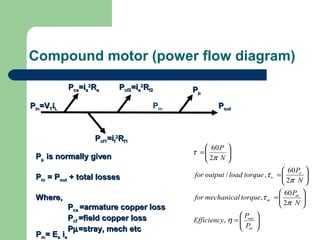
Compound motor (power flow diagram)
PPµµ is normally givenis normally given
PPinin = P= Poutout + total losses+ total losses
Where,Where,
PPcaca =armature copper loss=armature copper loss
PPcfcf =field copper loss=field copper loss
PPµµ=stray, mech etc=stray, mech etc






=






=






=






=
in
out
m
m
o
o
P
P
Efficiency
N
P
torquemechanicalfor
N
P
torqueloadoutputfor
N
P
η
π
τ
π
τ
π
τ
,
2
60
,
2
60
,/
2
60
PPmm= E= Eaa iiaa
PPµµ
PPoutoutPPinin=V=VTTiiLL
PPcaca=i=iaa
22
RRaa
PPcf1cf1=i=iff
22
RRf1f1
Pm
PPcf2cf2=i=iaa
22
RRf2f2
Separately Excited Motor
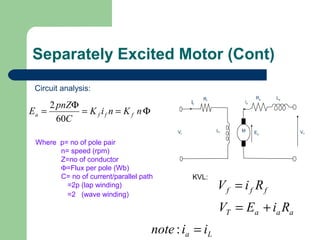
 There is no direct connection between the
armature and field winding resistance
 DC field current is supplied by an
independent source
– (such as battery or another generator or prime
mover called an exciter)
Separately Excited Motor (Cont)
Φ==
Φ
= nKniK
C
pnZ
E fffa
60
2
fff RiV =
aaaT RiEV +=
Where p= no of pole pair
n= speed (rpm)
Z=no of conductor
Φ=Flux per pole (Wb)
C= no of current/parallel path
=2p (lap winding)
=2 (wave winding)
KVL:
Circuit analysis:
La iinote =:
Ea
Ra La
ia
M
Rf
VTVf
Lf
If
Permanent Magnet motors
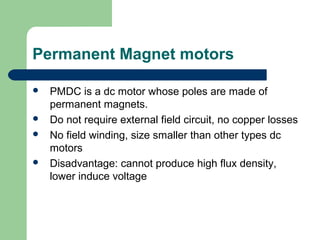
 PMDC is a dc motor whose poles are made of
permanent magnets.
 Do not require external field circuit, no copper losses
 No field winding, size smaller than other types dc
motors
 Disadvantage: cannot produce high flux density,
lower induce voltage
Speed Control for shunt motor and
separately excited dc motor
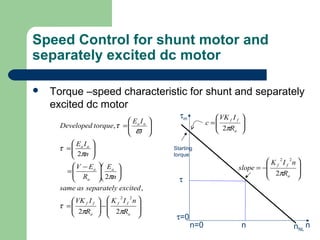
 Torque –speed characteristic for shunt and separately
excited dc motor








−





=











 −
=






=






=
a
ff
a
ff
a
a
a
aa
aa
R
nIK
R
IVK
excitedseparatelyassame
n
E
R
EV
n
IE
IE
torqueDeveloped
ππ
τ
π
π
τ
ϖ
τ
22
,
2
2
,
22






=
a
ff
R
IVK
c
π2
Starting
torque








−=
a
ff
R
nIK
slope
π2
22
nNL
nn
τm
τ
τ=0
n=0
Speed Control for shunt motor and
separately excited dc motor
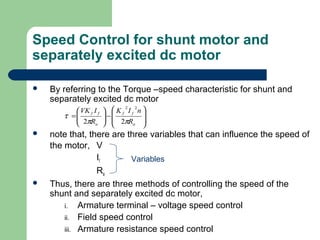
 By referring to the Torque –speed characteristic for shunt and
separately excited dc motor
 note that, there are three variables that can influence the speed of
the motor, V
If
Ra
 Thus, there are three methods of controlling the speed of the
shunt and separately excited dc motor,
i. Armature terminal – voltage speed control
ii. Field speed control
iii. Armature resistance speed control








−





=
a
ff
a
ff
R
nIK
R
IVK
ππ
τ
22
22
Variables
Speed Control for shunt motor and
separately excited dc motor
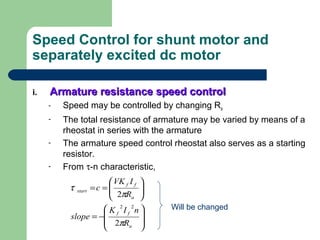
i.i. Armature resistance speed controlArmature resistance speed control
- Speed may be controlled by changing Ra
- The total resistance of armature may be varied by means of a
rheostat in series with the armature
- The armature speed control rheostat also serves as a starting
resistor.
- From τ-n characteristic,








−=






==
a
ff
a
ff
start
R
nIK
slope
R
IVK
c
π
π
τ
2
2
22 Will be changed
Speed Control for shunt motor and
separately excited dc motor
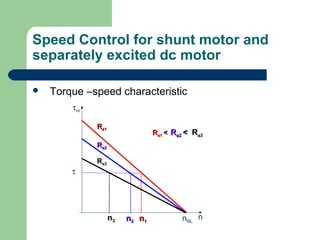
 Torque –speed characteristic
RRa1a1
nNL
nnn11
τm
τ
RRa2a2
RRa3a3
RRa1a1 << RRa2a2 << RRa3a3
nn22nn33
Speed Control for shunt motor and
separately excited dc motor
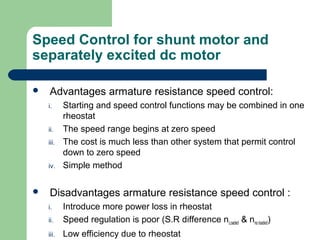
 Advantages armature resistance speed control:
i. Starting and speed control functions may be combined in one
rheostat
ii. The speed range begins at zero speed
iii. The cost is much less than other system that permit control
down to zero speed
iv. Simple method
 Disadvantages armature resistance speed control :
i. Introduce more power loss in rheostat
ii. Speed regulation is poor (S.R difference nLoaded & nno loaded)
iii. Low efficiency due to rheostat
Speed Control for shunt motor and
separately excited dc motor
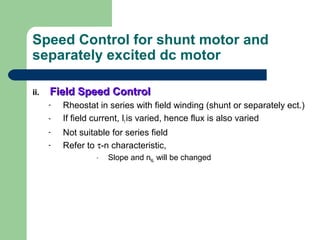
ii.ii. Field Speed ControlField Speed Control
- Rheostat in series with field winding (shunt or separately ect.)
- If field current, If is varied, hence flux is also varied
- Not suitable for series field
- Refer to τ-n characteristic,
- Slope and nNL will be changed
Speed Control for shunt motor and
separately excited dc motor
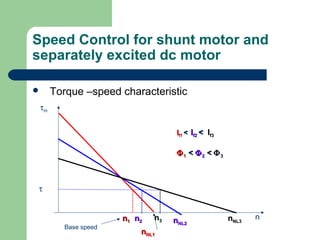
 Torque –speed characteristic
IIf1f1 << IIf2f2 << IIf3f3
ΦΦ11 << ΦΦ22 << ΦΦ33
nnNL3NL3
nnn11
τm
τ
nn22 nn33 nnNL2NL2
nnNL1NL1
Base speed
Speed Control for shunt motor and
separately excited dc motor
 Advantages field speed control:
i. Allows for controlling at or above the base speed
ii. The cost of the rheostat is cheaper because If is small value
 Disadvantages field speed control :
i. Speed regulation is poor (S.R difference nLoaded & nno loaded)
ii. At high speed, flux is small, thus causes the speed of the
machines becomes unstable
iii. At high speed also, the machines is unstable mechanically,
thus there is an upper speed limit
Speed Control for shunt motor and
separately excited dc motor
iii.iii. Armature terminal – voltage speed controlArmature terminal – voltage speed control
- Use power electronics controller
- AC supply rectifier
- DC supply chopper
- Supply voltage to the armature is controlled
- Constant speed regulation
- From τ-n characteristic,
- C and nNL will be change
- Slope constant
Speed Control for shunt motor and
separately excited dc motor
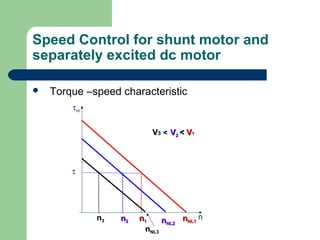
 Torque –speed characteristic
nnNL1NL1
nnn11
τm
τ
VV33 << VV22 << VV11
nn22nn33 nnNL2NL2
nnNL3NL3
Speed Control for shunt motor and
separately excited dc motor
 Advantages armature terminal voltage speed control:
i. Does not change the speed regulation
ii. Speed is easily controlled from zero to maximum safe speed
 Disadvantages armature terminal voltage speed control
:
i. Cost is higher because of using power electronic controller
FACTORS AFFECTING THE
PERFORMANCE OF DC MACHINE
 There are two factors affecting the
performance of dc machine
1. Armature reaction
2. Armature inductance
Armature Reaction
 Definition of armature reaction:
1. It is the term used to describe the effects of the armature
mmf on the operation of a dc machine as a "generator" no
matter whether it is a generator or motor.
2. It effects both the flux distribution and the flux magnitude in
the machine.
3. The distortion of the flux in a machine is called armature
reaction
 Two effects of armature reaction:
1. Neutral Plane Shift
2. Flux Weakening
Armature Reaction
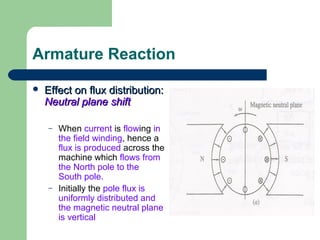
 Effect on flux distribution:Effect on flux distribution:
Neutral plane shiftNeutral plane shift
– When current is flowing in
the field winding, hence a
flux is produced across the
machine which flows from
the North pole to the
South pole.
– Initially the pole flux is
uniformly distributed and
the magnetic neutral plane
is vertical
Armature Reaction
 Effect on flux distribution:Effect on flux distribution:
Neutral plane shiftNeutral plane shift
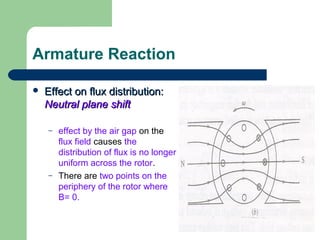
– effect by the air gap on the
flux field causes the
distribution of flux is no longer
uniform across the rotor.
– There are two points on the
periphery of the rotor where
B= 0.
Armature Reaction
 Effect on flux distribution:Effect on flux distribution: NeutralNeutral
plane shiftplane shift
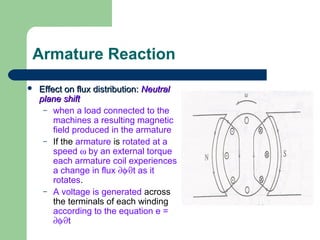
– when a load connected to the
machines a resulting magnetic
field produced in the armature
– If the armature is rotated at a
speed ω by an external torque
each armature coil experiences
a change in flux ∂φ⁄∂t as it
rotates.
– A voltage is generated across
the terminals of each winding
according to the equation e =
∂φ⁄∂t
Armature Reaction
 Effect on flux distribution:Effect on flux distribution:
Neutral plane shiftNeutral plane shift
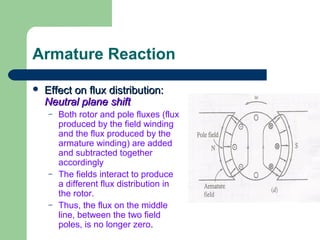
– Both rotor and pole fluxes (flux
produced by the field winding
and the flux produced by the
armature winding) are added
and subtracted together
accordingly
– The fields interact to produce
a different flux distribution in
the rotor.
– Thus, the flux on the middle
line, between the two field
poles, is no longer zero.
Armature Reaction
 Effect on flux distribution:Effect on flux distribution: Neutral planeNeutral plane
shiftshift
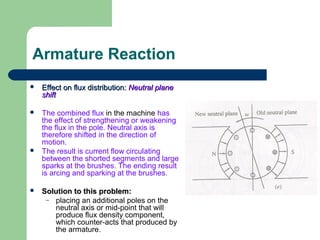
 The combined flux in the machine has
the effect of strengthening or weakening
the flux in the pole. Neutral axis is
therefore shifted in the direction of
motion.
 The result is current flow circulating
between the shorted segments and large
sparks at the brushes. The ending result
is arcing and sparking at the brushes.
 Solution to this problem:Solution to this problem:
– placing an additional poles on the
neutral axis or mid-point that will
produce flux density component,
which counter-acts that produced by
the armature.
Armature Reaction
 Effect on flux magnitude:Effect on flux magnitude: FluxFlux
WeakeningWeakening
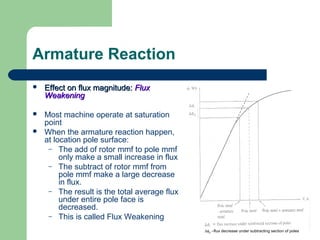
 Most machine operate at saturation
point
 When the armature reaction happen,
at location pole surface:
– The add of rotor mmf to pole mmf
only make a small increase in flux
– The subtract of rotor mmf from
pole mmf make a large decrease
in flux.
– The result is the total average flux
under entire pole face is
decreased.
– This is called Flux Weakening
∆φd –flux decrease under subtracting section of poles
Armature Inductance
 When rotor turns, thus we have inductance value, e1
= L(di/dt). Let say current ia1.
 That means, we have ability to store energy
 If the machine is turn ‘off’, thus, e1 will decreased.
This will affect the current as well. Say ia2.
 When the machine is turn ‘on’ again, it will produce
e2 while e1 is still inside. The current now is reversed
direction from previous (decreasing) current.
 Thus, it will cause sparking  resulting the same
aching problem caused by neutral plane shift.

Types-of_dc_motor

  • 1.
    DC Motor -2 Muhamad Zahim Ext : 2312 BEE2123BEE2123 ELECTRICAL MACHINESELECTRICAL MACHINES
  • 2.
    Contents – Overview ofDirect Current Machines – Construction – Principle of Operation – Types of DC Motor – Power Flow Diagram – Speed Control
  • 3.
    DC motor principles DC motors consist of rotor-mounted windings (armature) and stationary windings (field poles). In all DC motors, except permanent magnet motors, current must be conducted to the armature windings by passing current through carbon brushes that slide over a set of copper surfaces called a commutator, which is mounted on the rotor. Parts of an electric motor  The commutator bars are soldered to armature coils. The brush/commutator combination makes a sliding switch that energizes particular portions of the armature, based on the position of the rotor. This process creates north and south magnetic poles on the rotor that are attracted to or repelled by north and south poles on the stator, which are formed by passing direct current through the field windings. It's this magnetic attraction and repulsion that causes the rotor to rotate.
  • 4.
    The Advantages  Thegreatest advantage of DC motors may be speed control. Since speed is directly proportional to armature voltage and inversely proportional to the magnetic flux produced by the poles, adjusting the armature voltage and/or the field current will change the rotor speed.  Today, adjustable frequency drives can provide precise speed control for AC motors, but they do so at the expense of power quality, as the solid-state switching devices in the drives produce a rich harmonic spectrum. The DC motor has no adverse effects on power quality.
  • 5.
    The drawbacks  Powersupply, initial cost, and maintenance requirements are the negatives associated with DC motors  Rectification must be provided for any DC motors supplied from the grid. It can also cause power quality problems.  The construction of a DC motor is considerably more complicated and expensive than that of an AC motor, primarily due to the commutator, brushes, and armature windings. An induction motor requires no commutator or brushes, and most use cast squirrel-cage rotor bars instead of true windings — two huge simplifications.
  • 6.
    Major types ofdc motors  Self excited dc motor – Series dc motor – Shunt dc motor – Compound dc motor  Separately excited dc motor  Permanent magnet dc motor
  • 7.
    Series motors  Seriesmotors connect the field windings in series with the armature.  Series motors lack good speed regulation, but are well-suited for high- torque loads like power tools and automobile starters because of their high torque production and compact size. EEaa RRff MM VVT (dcT (dc supply)supply) RRaaiiaa )( faaaT RRiEV ++= La iinote =: ϖaa IKKE 21=
  • 8.
    Series Motor PowerFlow Diagram PPµµ PPoutout PPinin= V= VTTiiLL PPcaca=i=iaa 22 RRaa PPcfcf=i=iaa 22 RRff Pm PPµµ is normally givenis normally given PPinin = P= Poutout + total losses+ total losses Where,Where, PPcaca =armature copper loss=armature copper loss PPcfcf =field copper loss=field copper loss PPµµ=stray, mech etc=stray, mech etc       =       =       =       = in out m m o o P P Efficiency N P torquemechanicalfor N P torqueloadoutputfor N P η π τ π τ π τ , 2 60 , 2 60 ,/ 2 60 PPmm= E= Eaa iiaa
  • 9.
    Series Motor (cont) Example 1: A dc machine in Figure 1 is consumed a 6.5kW when the 12.5 A of armature current is passing thru the armature and field resistance of 3.3Ω and 2.0Ω respectively. Assume stray losses of 1.2kW. Calculate a) terminal voltage, VT b) back emf, Ea c) net torque if the speed is at 3560rpm d) efficiency of the machine [520V, 453.75V, 12N-m, 68.8%] EEaa RRff MM VVT (dcT (dc supply)supply) RRaaiiaa Figure 1
  • 10.
    Series Motor (cont) Example 2: A 600V 150-hp dc machine in Figure 2 operates at its full rated load at 600rpm. The armature and field resistance are 0.12Ω and 0.04Ω respectively. The machine draws 200A at full load. Assume stray losses 1700W. Determine a) the armature back emf at full load, Ea b) developed/mechanical power and developed/mechanical torque c) assume that a change in load results in the line current dropping to 150A. Find the new speed in rpm and new developed torque. {Hint: Ea=K1K2iaω} EEaa RRff MM VVT (dcT (dc supply)supply) RRaaiiaa Figure 2 [568V, 113.6kW, 1808Nm, 811.27rpm, 1017Nm]
  • 11.
    Shunt motors  Shuntmotors use high- resistance field windings connected in parallel with the armature.  Varying the field resistance changes the motor speed.  Shunt motors are prone to armature reaction, a distortion and weakening of the flux generated by the poles that results in commutation problems evidenced by sparking at the brushes.  Installing additional poles, called interpoles, on the stator between the main poles wired in series with the armature reduces armature reaction. Ea VT (dc supply) Ra ia if Rf M iL )( aaaT RiEV += ffT faL RiV iiinote = +=:
  • 12.
    Shunt Motor (powerflow diagram) PPµµ PPoutout PPinin=V=VTTiiLL PPcaca=i=iaa 22 RRaa PPcfcf=i=iff 22 RRff Pm PPµµ is normally givenis normally given PPinin = P= Poutout + total losses+ total losses Where,Where, PPcaca =armature copper loss=armature copper loss PPcfcf =field copper loss=field copper loss PPµµ=stray, mech etc=stray, mech etc       =       =       =       = in out m m o o P P Efficiency N P torquemechanicalfor N P torqueloadoutputfor N P η π τ π τ π τ , 2 60 , 2 60 ,/ 2 60 PPmm= E= Eaa iiaa
  • 13.
    Shunt Motor  Example: – A voltage of 230V is applied to armature of a machines results in a full load armature currents of 205A. Assume that armature resistance is 0.2Ω. Find the back emf, net power and torque by assuming the rotational losses are 1445W at full load speed of 1750rpm. [189V, 37.3kW, 203.5Nm]
  • 14.
    Compound motors  theconcept of the series and shunt designs are combined. Ea VT (dc supply) Ra ia if Rf1M iL Rf2 )( 2faaaT RRiEV ++= 1 : ffT faL RiV iiinote = +=
  • 15.
    Compound motor (powerflow diagram) PPµµ is normally givenis normally given PPinin = P= Poutout + total losses+ total losses Where,Where, PPcaca =armature copper loss=armature copper loss PPcfcf =field copper loss=field copper loss PPµµ=stray, mech etc=stray, mech etc       =       =       =       = in out m m o o P P Efficiency N P torquemechanicalfor N P torqueloadoutputfor N P η π τ π τ π τ , 2 60 , 2 60 ,/ 2 60 PPmm= E= Eaa iiaa PPµµ PPoutoutPPinin=V=VTTiiLL PPcaca=i=iaa 22 RRaa PPcf1cf1=i=iff 22 RRf1f1 Pm PPcf2cf2=i=iaa 22 RRf2f2
  • 16.
    Separately Excited Motor There is no direct connection between the armature and field winding resistance  DC field current is supplied by an independent source – (such as battery or another generator or prime mover called an exciter)
  • 17.
    Separately Excited Motor(Cont) Φ== Φ = nKniK C pnZ E fffa 60 2 fff RiV = aaaT RiEV += Where p= no of pole pair n= speed (rpm) Z=no of conductor Φ=Flux per pole (Wb) C= no of current/parallel path =2p (lap winding) =2 (wave winding) KVL: Circuit analysis: La iinote =: Ea Ra La ia M Rf VTVf Lf If
  • 18.
    Permanent Magnet motors PMDC is a dc motor whose poles are made of permanent magnets.  Do not require external field circuit, no copper losses  No field winding, size smaller than other types dc motors  Disadvantage: cannot produce high flux density, lower induce voltage
  • 19.
    Speed Control forshunt motor and separately excited dc motor  Torque –speed characteristic for shunt and separately excited dc motor         −      =             − =       =       = a ff a ff a a a aa aa R nIK R IVK excitedseparatelyassame n E R EV n IE IE torqueDeveloped ππ τ π π τ ϖ τ 22 , 2 2 , 22       = a ff R IVK c π2 Starting torque         −= a ff R nIK slope π2 22 nNL nn τm τ τ=0 n=0
  • 20.
    Speed Control forshunt motor and separately excited dc motor  By referring to the Torque –speed characteristic for shunt and separately excited dc motor  note that, there are three variables that can influence the speed of the motor, V If Ra  Thus, there are three methods of controlling the speed of the shunt and separately excited dc motor, i. Armature terminal – voltage speed control ii. Field speed control iii. Armature resistance speed control         −      = a ff a ff R nIK R IVK ππ τ 22 22 Variables
  • 21.
    Speed Control forshunt motor and separately excited dc motor i.i. Armature resistance speed controlArmature resistance speed control - Speed may be controlled by changing Ra - The total resistance of armature may be varied by means of a rheostat in series with the armature - The armature speed control rheostat also serves as a starting resistor. - From τ-n characteristic,         −=       == a ff a ff start R nIK slope R IVK c π π τ 2 2 22 Will be changed
  • 22.
    Speed Control forshunt motor and separately excited dc motor  Torque –speed characteristic RRa1a1 nNL nnn11 τm τ RRa2a2 RRa3a3 RRa1a1 << RRa2a2 << RRa3a3 nn22nn33
  • 23.
    Speed Control forshunt motor and separately excited dc motor  Advantages armature resistance speed control: i. Starting and speed control functions may be combined in one rheostat ii. The speed range begins at zero speed iii. The cost is much less than other system that permit control down to zero speed iv. Simple method  Disadvantages armature resistance speed control : i. Introduce more power loss in rheostat ii. Speed regulation is poor (S.R difference nLoaded & nno loaded) iii. Low efficiency due to rheostat
  • 24.
    Speed Control forshunt motor and separately excited dc motor ii.ii. Field Speed ControlField Speed Control - Rheostat in series with field winding (shunt or separately ect.) - If field current, If is varied, hence flux is also varied - Not suitable for series field - Refer to τ-n characteristic, - Slope and nNL will be changed
  • 25.
    Speed Control forshunt motor and separately excited dc motor  Torque –speed characteristic IIf1f1 << IIf2f2 << IIf3f3 ΦΦ11 << ΦΦ22 << ΦΦ33 nnNL3NL3 nnn11 τm τ nn22 nn33 nnNL2NL2 nnNL1NL1 Base speed
  • 26.
    Speed Control forshunt motor and separately excited dc motor  Advantages field speed control: i. Allows for controlling at or above the base speed ii. The cost of the rheostat is cheaper because If is small value  Disadvantages field speed control : i. Speed regulation is poor (S.R difference nLoaded & nno loaded) ii. At high speed, flux is small, thus causes the speed of the machines becomes unstable iii. At high speed also, the machines is unstable mechanically, thus there is an upper speed limit
  • 27.
    Speed Control forshunt motor and separately excited dc motor iii.iii. Armature terminal – voltage speed controlArmature terminal – voltage speed control - Use power electronics controller - AC supply rectifier - DC supply chopper - Supply voltage to the armature is controlled - Constant speed regulation - From τ-n characteristic, - C and nNL will be change - Slope constant
  • 28.
    Speed Control forshunt motor and separately excited dc motor  Torque –speed characteristic nnNL1NL1 nnn11 τm τ VV33 << VV22 << VV11 nn22nn33 nnNL2NL2 nnNL3NL3
  • 29.
    Speed Control forshunt motor and separately excited dc motor  Advantages armature terminal voltage speed control: i. Does not change the speed regulation ii. Speed is easily controlled from zero to maximum safe speed  Disadvantages armature terminal voltage speed control : i. Cost is higher because of using power electronic controller
  • 30.
    FACTORS AFFECTING THE PERFORMANCEOF DC MACHINE  There are two factors affecting the performance of dc machine 1. Armature reaction 2. Armature inductance
  • 31.
    Armature Reaction  Definitionof armature reaction: 1. It is the term used to describe the effects of the armature mmf on the operation of a dc machine as a "generator" no matter whether it is a generator or motor. 2. It effects both the flux distribution and the flux magnitude in the machine. 3. The distortion of the flux in a machine is called armature reaction  Two effects of armature reaction: 1. Neutral Plane Shift 2. Flux Weakening
  • 32.
    Armature Reaction  Effecton flux distribution:Effect on flux distribution: Neutral plane shiftNeutral plane shift – When current is flowing in the field winding, hence a flux is produced across the machine which flows from the North pole to the South pole. – Initially the pole flux is uniformly distributed and the magnetic neutral plane is vertical
  • 33.
    Armature Reaction  Effecton flux distribution:Effect on flux distribution: Neutral plane shiftNeutral plane shift – effect by the air gap on the flux field causes the distribution of flux is no longer uniform across the rotor. – There are two points on the periphery of the rotor where B= 0.
  • 34.
    Armature Reaction  Effecton flux distribution:Effect on flux distribution: NeutralNeutral plane shiftplane shift – when a load connected to the machines a resulting magnetic field produced in the armature – If the armature is rotated at a speed ω by an external torque each armature coil experiences a change in flux ∂φ⁄∂t as it rotates. – A voltage is generated across the terminals of each winding according to the equation e = ∂φ⁄∂t
  • 35.
    Armature Reaction  Effecton flux distribution:Effect on flux distribution: Neutral plane shiftNeutral plane shift – Both rotor and pole fluxes (flux produced by the field winding and the flux produced by the armature winding) are added and subtracted together accordingly – The fields interact to produce a different flux distribution in the rotor. – Thus, the flux on the middle line, between the two field poles, is no longer zero.
  • 36.
    Armature Reaction  Effecton flux distribution:Effect on flux distribution: Neutral planeNeutral plane shiftshift  The combined flux in the machine has the effect of strengthening or weakening the flux in the pole. Neutral axis is therefore shifted in the direction of motion.  The result is current flow circulating between the shorted segments and large sparks at the brushes. The ending result is arcing and sparking at the brushes.  Solution to this problem:Solution to this problem: – placing an additional poles on the neutral axis or mid-point that will produce flux density component, which counter-acts that produced by the armature.
  • 37.
    Armature Reaction  Effecton flux magnitude:Effect on flux magnitude: FluxFlux WeakeningWeakening  Most machine operate at saturation point  When the armature reaction happen, at location pole surface: – The add of rotor mmf to pole mmf only make a small increase in flux – The subtract of rotor mmf from pole mmf make a large decrease in flux. – The result is the total average flux under entire pole face is decreased. – This is called Flux Weakening ∆φd –flux decrease under subtracting section of poles
  • 38.
    Armature Inductance  Whenrotor turns, thus we have inductance value, e1 = L(di/dt). Let say current ia1.  That means, we have ability to store energy  If the machine is turn ‘off’, thus, e1 will decreased. This will affect the current as well. Say ia2.  When the machine is turn ‘on’ again, it will produce e2 while e1 is still inside. The current now is reversed direction from previous (decreasing) current.  Thus, it will cause sparking  resulting the same aching problem caused by neutral plane shift.