Subject :- DACM(2170909)
Topic :-TYPES OF SINGLE PHASE INDUCTION MOTOR
Guided by :- Prof Mahesh Patel
Electrical Department
Mishra Shweta 151040109009
Panda Shubhashree 151040109010
Thakkar Umang 151040109035
Parth Soni 151044109001
Submitted by :-
 Operating principle
The single-phase induction motor operation can be
described by two methods: –
Double revolving field theory;
Cross-field theory.
Why single phase IM is not self starting?
 The stator of a single phase induction motor is wound
with single phase winding.
 When the stator is fed with single phase supply, it
produced alternating flux (which alternates along one
space axis only).
 Alternating flux acting on a squirrel cage rotor can not
produce rotation , only revolving flux can.
 That’s why a single phase induction motor is not self
starting.
Starting torque
 The single-phase motor starting torque is zero of the
pulsating single-phase magnetic flux.
 The starting of the motor requires the generation of a
rotating magnetic flux similar to the rotating flux in a
three-phase motor.
 Two perpendicular coils that have currents 90° out of-
phase can generate the necessary rotating magnetic fields
which start the motor.
 Therefore, single-phase motors are built with two
perpendicular windings.
 The winding are starting winding (auxiliary winding) and
running winding (main winding)
 The phase shift is achieved by connecting
I. a resistance
II. an inductance
III. a capacitance in series with the starting winding.
 Most frequently used is a capacitor to generate the starting
torque.
 Single-phase induction motors are classified and named
according to the method employed to make them self-starting.
 (1) Split-phase induction motor : ( started by two phase
motor action through the use of an auxiliary and main
winding)
 (2) Capacitor motors : ( started by two phase motor action
through the use of an auxiliary and a capacitor)
(i) Capacitor-start induction motor
(ii) Capacitor run induction motor
(iii) Capacitor-start and Capacitor run induction motor
 (3) Shaded-pole induction motor :(started by the motion of
the magnetic field produced by means of shading coil around A
portion of the pole structure)
Split phase induction motor
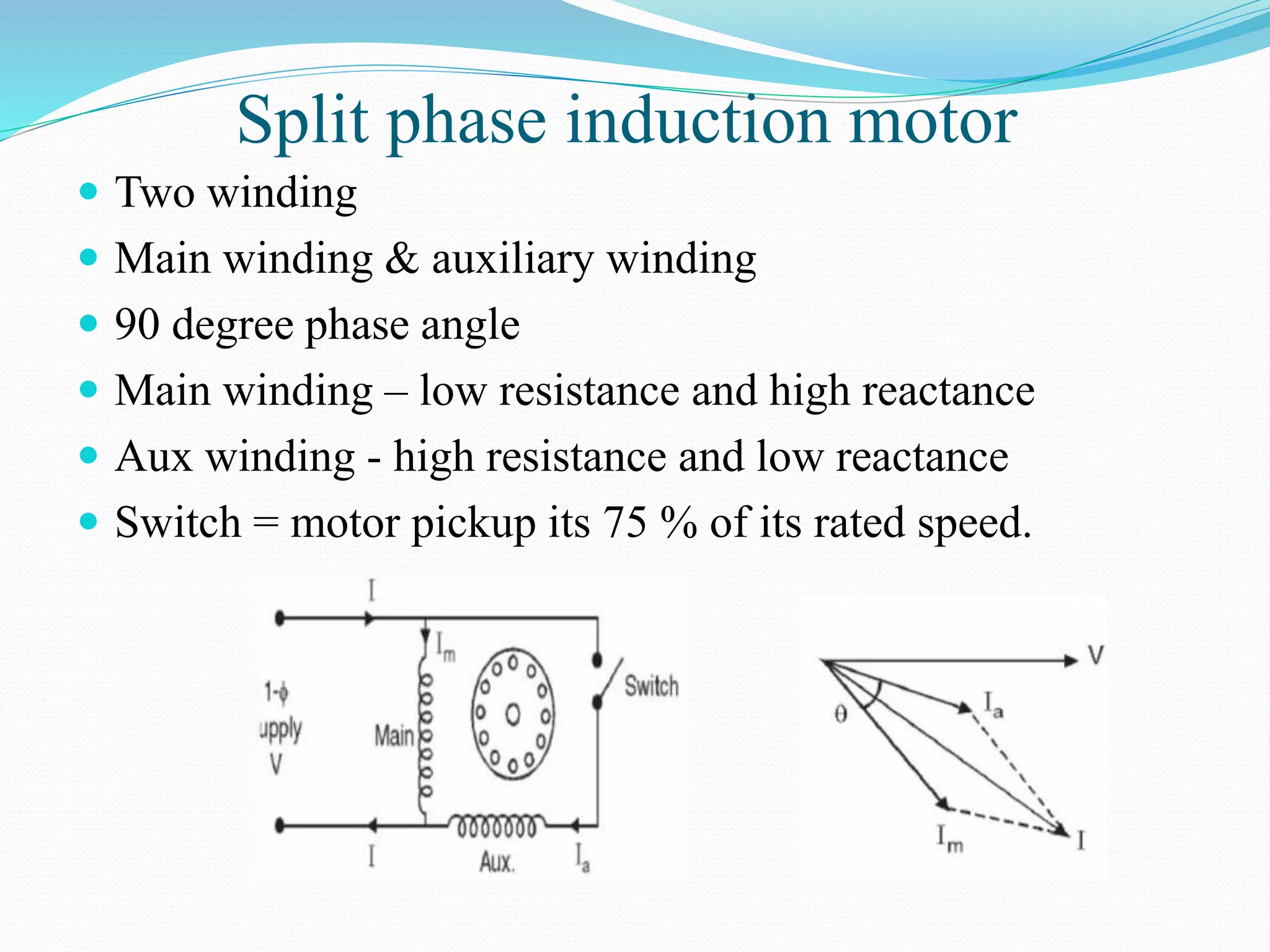
 Two winding
 Main winding & auxiliary winding
 90 degree phase angle
 Main winding – low resistance and high reactance
 Aux winding - high resistance and low reactance
 Switch = motor pickup its 75 % of its rated speed.
 Working
I. Is lags by V because low reactance and high resistance
II. Im lags V by very large angle due to high reactance
III. Starting torque proportional to sin θ (Ts α Sin θ)
IV. Disconnect switch after reach its 75 % of rated speed
 Operation Centrifugal switch
It is connected in series with the auxiliary winding and
mounted on the rotor shaft. When the motor started and
reaches 75% of synchronous speed, CFS is mechanically
opened and in running condition auxiliary winding
remains cutout from the circuit.
 Therefore, the motor runs only with main winding.
 Characteristics
I. Starting torque – 1.5 times to 2 times the full load
torque.
II. Starting current – 6 to 8 times the full load current.
III. Operating power factor – 0.55 to 0.65.
IV. Efficiency – 60-65%
V. Power rating-(1/6 to 1/3 H.P)
VI. Speed near to 1440rpm
 Applications
It has low starting current and moderate starting torque. It
is used for easily started loads and typical applications
include fans, saws, washing machines, grinders, blowers
etc.
 Capacitor induction motor
1. Capacitor start motor
2. Permanent capacitor motor
3. Capacitor start capacitor run motor
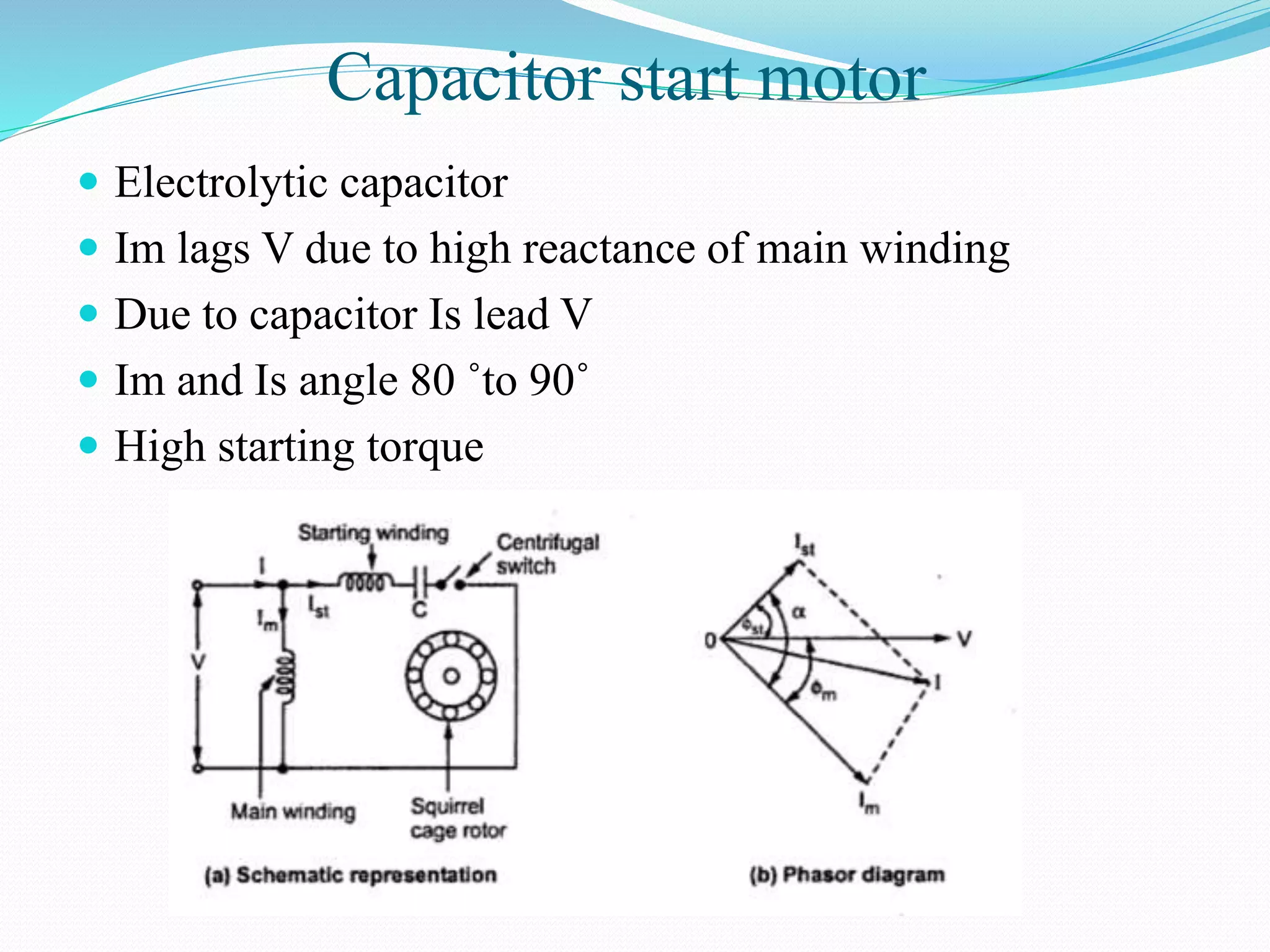
Capacitor start motor
 Electrolytic capacitor
 Im lags V due to high reactance of main winding
 Due to capacitor Is lead V
 Im and Is angle 80 ˚to 90˚
 High starting torque
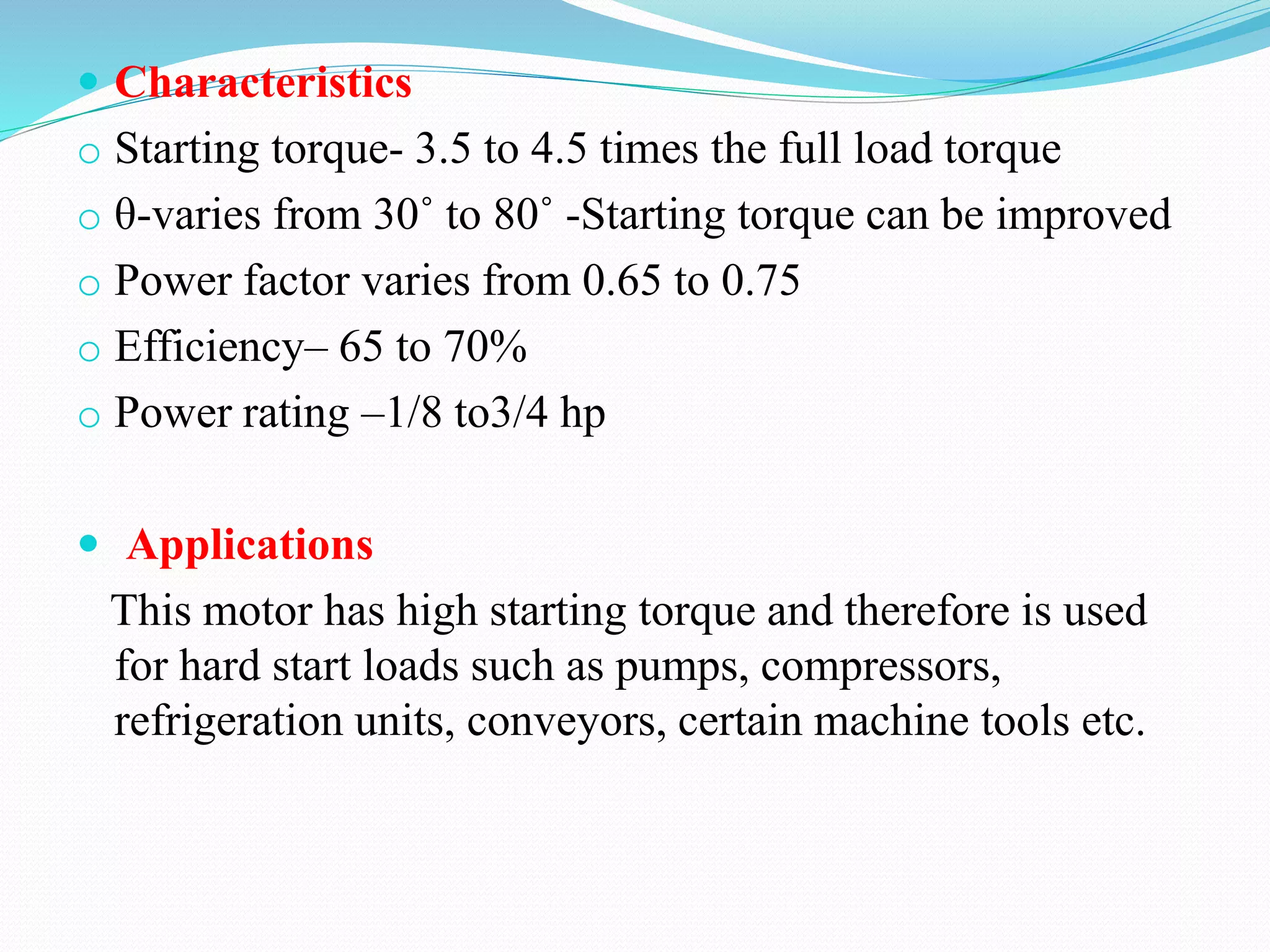
 Characteristics
o Starting torque- 3.5 to 4.5 times the full load torque
o θ-varies from 30˚ to 80˚ -Starting torque can be improved
o Power factor varies from 0.65 to 0.75
o Efficiency– 65 to 70%
o Power rating –1/8 to3/4 hp
 Applications
This motor has high starting torque and therefore is used
for hard start loads such as pumps, compressors,
refrigeration units, conveyors, certain machine tools etc.
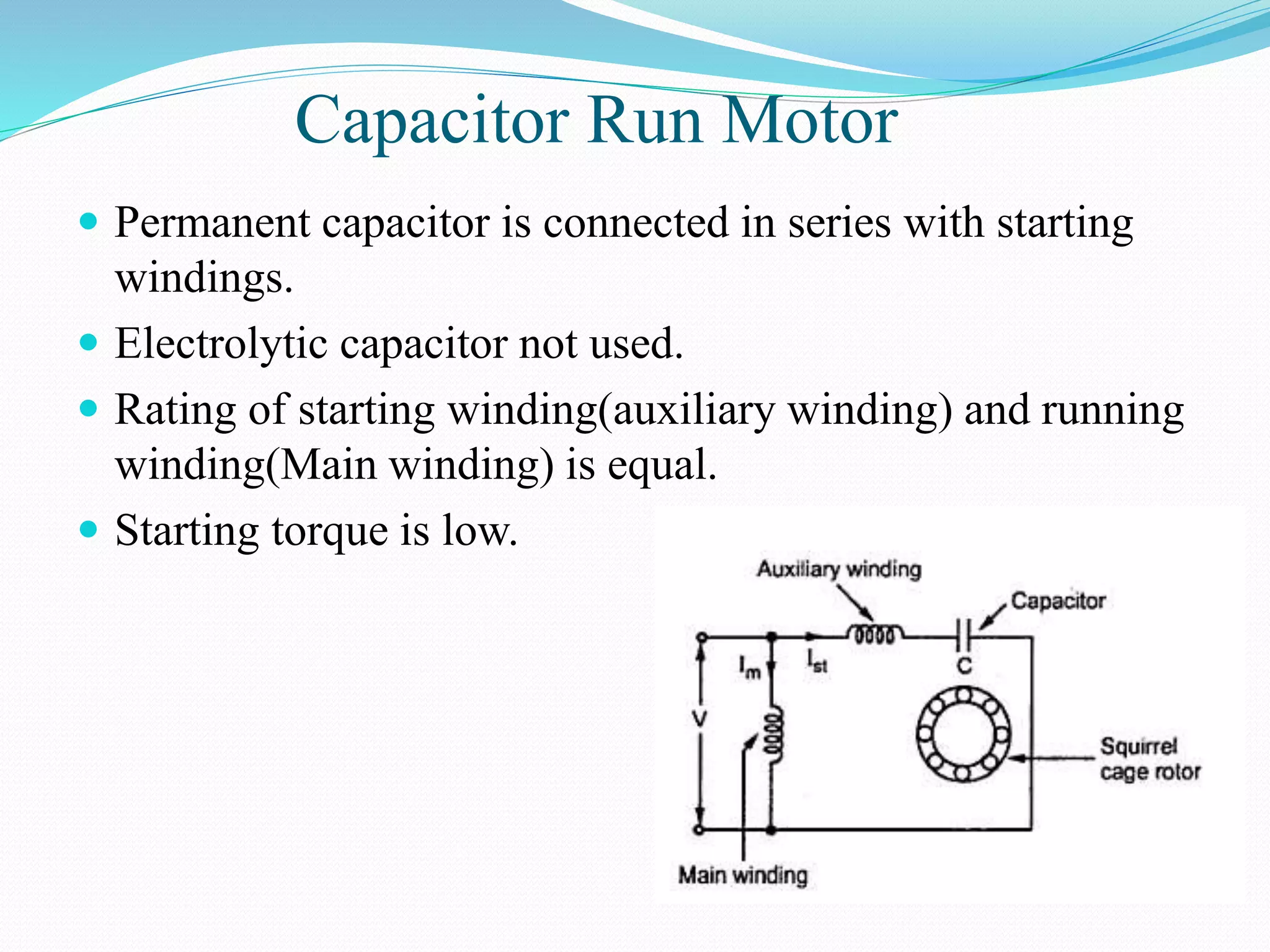
Capacitor Run Motor
 Permanent capacitor is connected in series with starting
windings.
 Electrolytic capacitor not used.
 Rating of starting winding(auxiliary winding) and running
winding(Main winding) is equal.
 Starting torque is low.
 Characteristics
o Starting torque is lower about 50 to 100% of the full load
torque
o Power factor (high) varies from 0.75 to 0.80
o Efficiency– 75 to 80%
 Applications
This motor has low starting torque and therefore is used in
Ceilling fans, Room coolers, Table fans and other
domestic appliances.
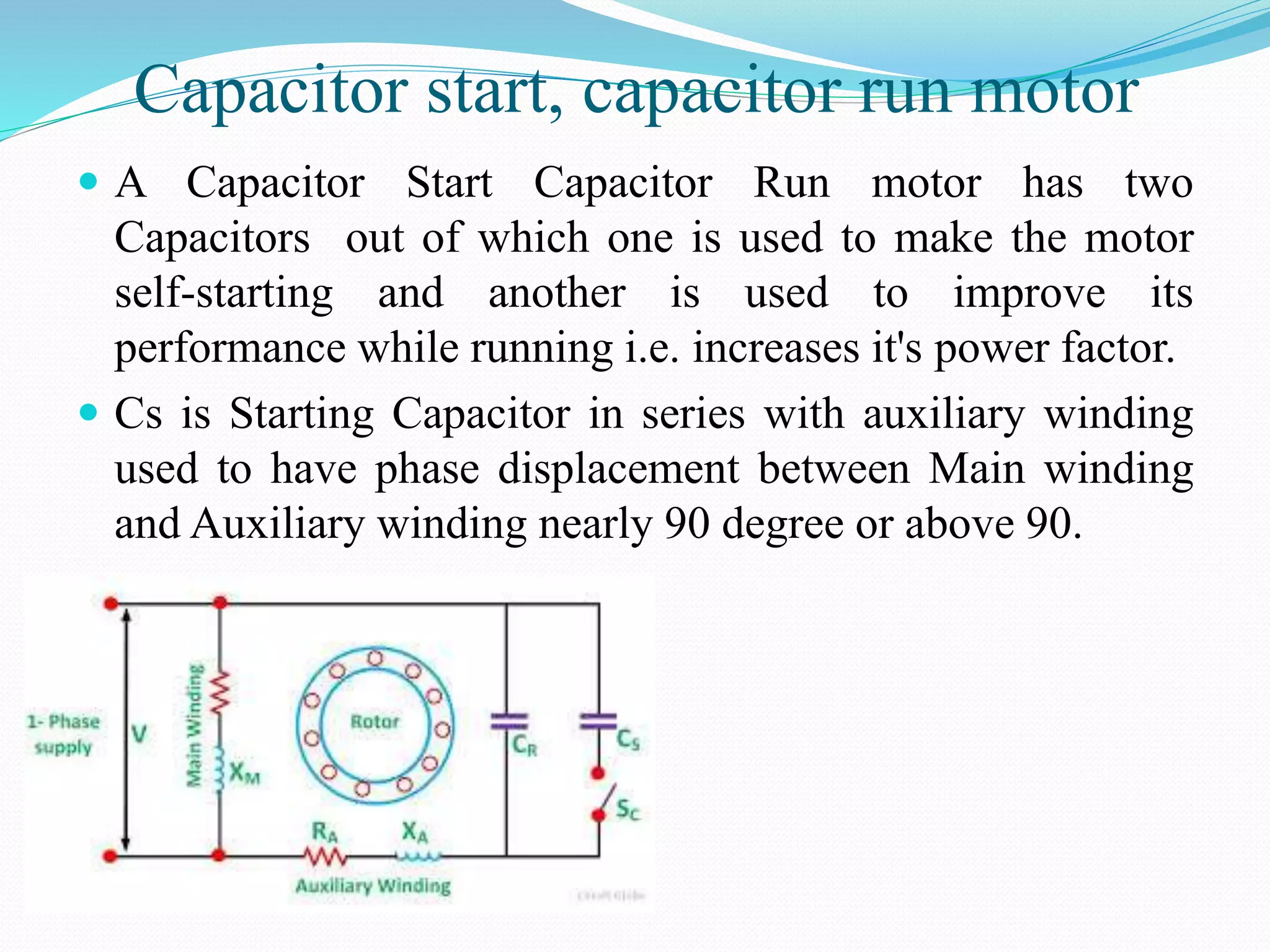
Capacitor start, capacitor run motor
 A Capacitor Start Capacitor Run motor has two
Capacitors out of which one is used to make the motor
self-starting and another is used to improve its
performance while running i.e. increases it's power factor.
 Cs is Starting Capacitor in series with auxiliary winding
used to have phase displacement between Main winding
and Auxiliary winding nearly 90 degree or above 90.
 Characteristics
o Starting torque – 3 to 3.5 times the full load torque.
o Efficiency is improved
o Power factor-0.9 approx.
o Pull out torque- up to 260% of rated torque
 Applications
It combines the advantages of capacitor start and
permanent-capacitors and is used for hard to start loads
such as compressors, refrigerators, pumps, conveyors
etc.These motors are often employed requiring a quite
operating motor such as in hospitals, studios.
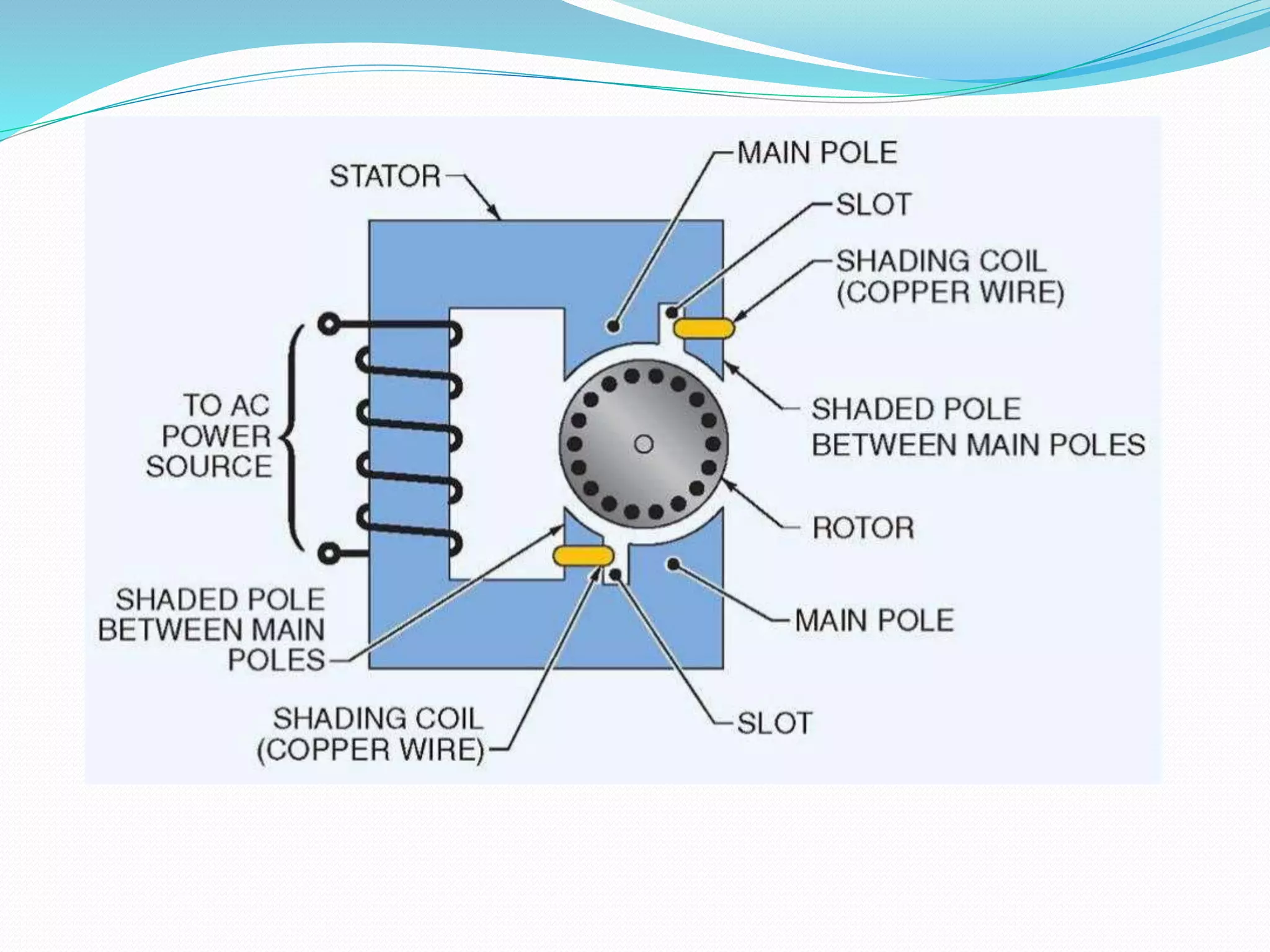
Shaded-pole induction motor
 Small motors requiring only small starting torque may be
made self-starting by using low resistance copper bands
called shading bands.
 The emf induced in the shading band causes a current to
flow in the band. This current opposes the change of flux
to which it is due and thus there is a time lag between the
fluxes in the shaded and unshaded portion of the pole.
 The flux in the shaded portion of the pole lags the flux in
the other portion. The results is like a rotating field
moving in the direction from the unshaded to the shaded
portion of the pole and a starting torque is produced
 Characteristics
o Low starting torque – 0.4 to 0.8 times the full load torque.
o Efficiency less -35% approx.
o Power factor poor - 0.45 approx.
o Pull out torque- 15% of full load torque.
o Power rating-1/300 to 1/20 HP (2.5W to 40W)
 Applications
Because of their poor starting torque, low power factor
and poor efficiency such motors are only suitable for low
power applications such as for toys, portable fans , electric
clocks, hair dryers, slide projectors, humidifiers, small
business machines such as photo copying machines,
vending machines, advertising displays etc.
TYPES OF SINGLE PHASE INDUCTION MOTOR

TYPES OF SINGLE PHASE INDUCTION MOTOR

  • 1.
    Subject :- DACM(2170909) Topic:-TYPES OF SINGLE PHASE INDUCTION MOTOR Guided by :- Prof Mahesh Patel Electrical Department Mishra Shweta 151040109009 Panda Shubhashree 151040109010 Thakkar Umang 151040109035 Parth Soni 151044109001 Submitted by :-
  • 2.
     Operating principle Thesingle-phase induction motor operation can be described by two methods: – Double revolving field theory; Cross-field theory.
  • 3.
    Why single phaseIM is not self starting?  The stator of a single phase induction motor is wound with single phase winding.  When the stator is fed with single phase supply, it produced alternating flux (which alternates along one space axis only).  Alternating flux acting on a squirrel cage rotor can not produce rotation , only revolving flux can.  That’s why a single phase induction motor is not self starting.
  • 4.
    Starting torque  Thesingle-phase motor starting torque is zero of the pulsating single-phase magnetic flux.  The starting of the motor requires the generation of a rotating magnetic flux similar to the rotating flux in a three-phase motor.  Two perpendicular coils that have currents 90° out of- phase can generate the necessary rotating magnetic fields which start the motor.  Therefore, single-phase motors are built with two perpendicular windings.  The winding are starting winding (auxiliary winding) and running winding (main winding)
  • 5.
     The phaseshift is achieved by connecting I. a resistance II. an inductance III. a capacitance in series with the starting winding.  Most frequently used is a capacitor to generate the starting torque.
  • 6.
     Single-phase inductionmotors are classified and named according to the method employed to make them self-starting.  (1) Split-phase induction motor : ( started by two phase motor action through the use of an auxiliary and main winding)  (2) Capacitor motors : ( started by two phase motor action through the use of an auxiliary and a capacitor) (i) Capacitor-start induction motor (ii) Capacitor run induction motor (iii) Capacitor-start and Capacitor run induction motor  (3) Shaded-pole induction motor :(started by the motion of the magnetic field produced by means of shading coil around A portion of the pole structure)
  • 7.
    Split phase inductionmotor  Two winding  Main winding & auxiliary winding  90 degree phase angle  Main winding – low resistance and high reactance  Aux winding - high resistance and low reactance  Switch = motor pickup its 75 % of its rated speed.
  • 8.
     Working I. Islags by V because low reactance and high resistance II. Im lags V by very large angle due to high reactance III. Starting torque proportional to sin θ (Ts α Sin θ) IV. Disconnect switch after reach its 75 % of rated speed  Operation Centrifugal switch It is connected in series with the auxiliary winding and mounted on the rotor shaft. When the motor started and reaches 75% of synchronous speed, CFS is mechanically opened and in running condition auxiliary winding remains cutout from the circuit.  Therefore, the motor runs only with main winding.
  • 9.
     Characteristics I. Startingtorque – 1.5 times to 2 times the full load torque. II. Starting current – 6 to 8 times the full load current. III. Operating power factor – 0.55 to 0.65. IV. Efficiency – 60-65% V. Power rating-(1/6 to 1/3 H.P) VI. Speed near to 1440rpm  Applications It has low starting current and moderate starting torque. It is used for easily started loads and typical applications include fans, saws, washing machines, grinders, blowers etc.
  • 10.
     Capacitor inductionmotor 1. Capacitor start motor 2. Permanent capacitor motor 3. Capacitor start capacitor run motor
  • 11.
    Capacitor start motor Electrolytic capacitor  Im lags V due to high reactance of main winding  Due to capacitor Is lead V  Im and Is angle 80 ˚to 90˚  High starting torque
  • 12.
     Characteristics o Startingtorque- 3.5 to 4.5 times the full load torque o θ-varies from 30˚ to 80˚ -Starting torque can be improved o Power factor varies from 0.65 to 0.75 o Efficiency– 65 to 70% o Power rating –1/8 to3/4 hp  Applications This motor has high starting torque and therefore is used for hard start loads such as pumps, compressors, refrigeration units, conveyors, certain machine tools etc.
  • 13.
    Capacitor Run Motor Permanent capacitor is connected in series with starting windings.  Electrolytic capacitor not used.  Rating of starting winding(auxiliary winding) and running winding(Main winding) is equal.  Starting torque is low.
  • 14.
     Characteristics o Startingtorque is lower about 50 to 100% of the full load torque o Power factor (high) varies from 0.75 to 0.80 o Efficiency– 75 to 80%  Applications This motor has low starting torque and therefore is used in Ceilling fans, Room coolers, Table fans and other domestic appliances.
  • 15.
    Capacitor start, capacitorrun motor  A Capacitor Start Capacitor Run motor has two Capacitors out of which one is used to make the motor self-starting and another is used to improve its performance while running i.e. increases it's power factor.  Cs is Starting Capacitor in series with auxiliary winding used to have phase displacement between Main winding and Auxiliary winding nearly 90 degree or above 90.
  • 16.
     Characteristics o Startingtorque – 3 to 3.5 times the full load torque. o Efficiency is improved o Power factor-0.9 approx. o Pull out torque- up to 260% of rated torque  Applications It combines the advantages of capacitor start and permanent-capacitors and is used for hard to start loads such as compressors, refrigerators, pumps, conveyors etc.These motors are often employed requiring a quite operating motor such as in hospitals, studios.
  • 17.
    Shaded-pole induction motor Small motors requiring only small starting torque may be made self-starting by using low resistance copper bands called shading bands.  The emf induced in the shading band causes a current to flow in the band. This current opposes the change of flux to which it is due and thus there is a time lag between the fluxes in the shaded and unshaded portion of the pole.  The flux in the shaded portion of the pole lags the flux in the other portion. The results is like a rotating field moving in the direction from the unshaded to the shaded portion of the pole and a starting torque is produced
  • 19.
     Characteristics o Lowstarting torque – 0.4 to 0.8 times the full load torque. o Efficiency less -35% approx. o Power factor poor - 0.45 approx. o Pull out torque- 15% of full load torque. o Power rating-1/300 to 1/20 HP (2.5W to 40W)  Applications Because of their poor starting torque, low power factor and poor efficiency such motors are only suitable for low power applications such as for toys, portable fans , electric clocks, hair dryers, slide projectors, humidifiers, small business machines such as photo copying machines, vending machines, advertising displays etc.